

Dental SEO marketing is all about making your practice easy to find online when local patients are looking for a dentist. It's a mix of smart local search tactics, helpful content, and behind-the-scenes website tune-ups, all working together to bring in patients who are actively searching for dental care. As search technology evolves with AI and Large Language Models (LLMs), ensuring your practice is found in these new environments is becoming a critical part of a modern strategy.
Why Your Practice Is Invisible Without Dental SEO
Imagine you’ve built a beautiful, modern dental office with the best equipment and a friendly team, but you’ve hidden it down a back alley with no sign out front. That’s what your practice looks like online without a solid dental SEO marketing plan.
These days, patients aren't thumbing through the Yellow Pages. They're grabbing their phones and searching on Google for things like 'emergency dentist near me' or 'dental implants in [Your City]'. These are what we call transactional search terms. When someone searches this way, they have money in hand and are ready to spend it.
These aren't just casual lookers; they're people with a genuine need, ready to book an appointment right now. This is where Transactional Marketing comes in. We focus entirely on capturing these high-value patients by making sure your practice is the first one they see for these specific, action-oriented transactional search terms in your local area.
Connecting Searchers to Your Chair
The journey from a patient’s Google search to a scheduled appointment is a straight line, and SEO is the roadmap. If you feel like your practice is currently hidden online, learning effective strategies to increase website traffic is your first move. Without that online visibility, your local competitors are the ones greeting all the new patients.
This simple chart shows exactly how modern patients find you—it all starts with being visible in search results.
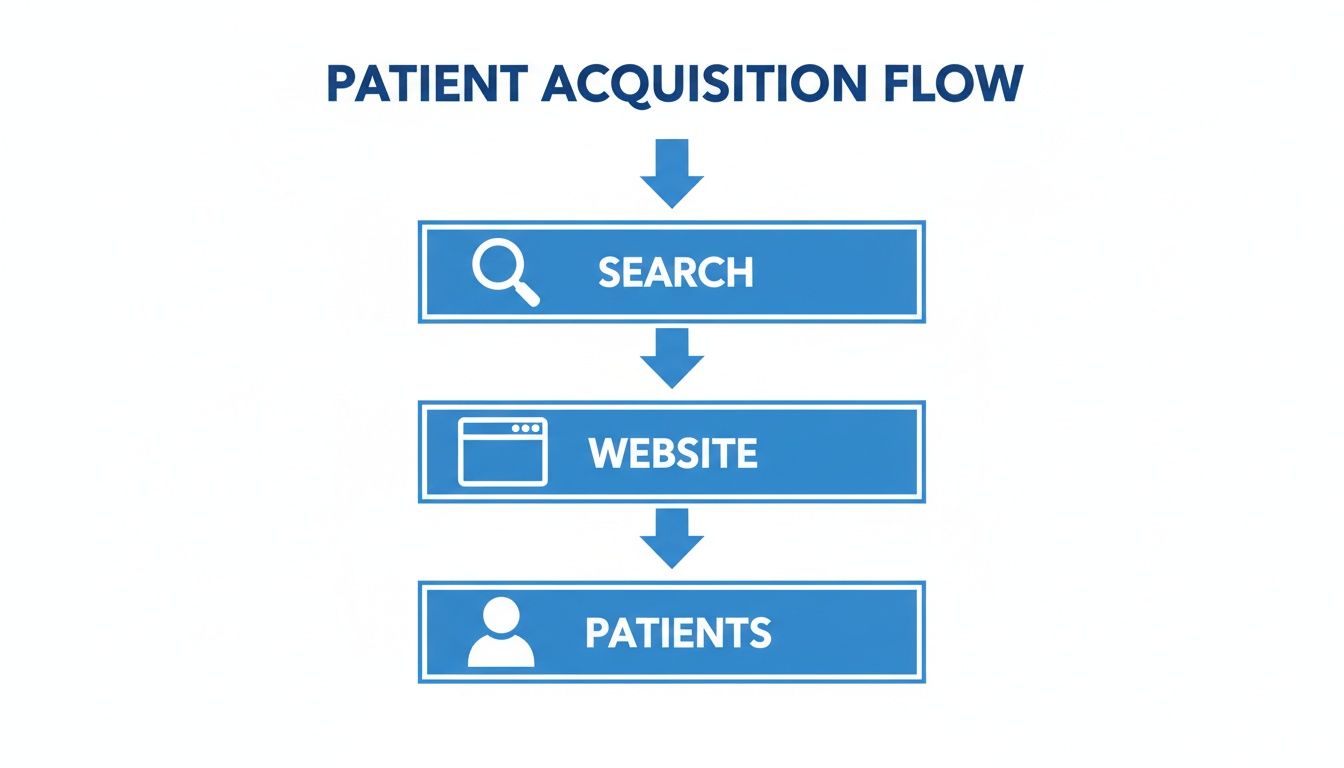
As you can see, if you don't show up in search, your website never even gets a chance to connect with potential patients.
From Transactional Searches to Patient Calls
The real goal here is to turn your website from a simple digital brochure into your most powerful patient-generating machine. Forget abstract theory; this guide is an actionable plan to make that happen. We're going to show you how to stop being invisible and start showing up exactly when and where your ideal patients are looking.
At Transactional Marketing, our proven system can get your website showing up on page one of Google, often within 30 to 60 days. The secret is our laser-focus on specific, transactional keywords that signal a patient is ready to act now.
This means we’ll be zeroing in on:
- Google Maps Optimization: Getting your practice into the top three spots on Google Maps for local searches is critical. This alone can drive hundreds of more phone calls every month and literally thousands more every year.
- Targeted Keyword Ranking: Ranking for the phrases that show urgency and intent, like "root canal near me" or "same-day dental crowns." These are the exact transactional search terms we get our customers to show up for.
- AI Optimization: The way businesses are found is changing. A lot of AI optimization has to do with LLMs (Large Language Models) and how your practice appears in AI-driven search results. We ensure you're visible in this new landscape.
When you get these pieces right, your practice becomes the clear, obvious choice for patients who need care now.
Dominating Local Search With Google Maps Optimization
For a dental practice, local search isn't just a part of the strategy—it's the entire ballgame. The grand prize here is a spot in the Google Maps "Map Pack," that block of three local businesses you see for high-intent searches. Nailing one of those spots is a true game-changer, and it directly leads to more patient calls. It’s that simple.
When a potential patient searches for a transactional term like "emergency dentist near me," they aren't just browsing. They're in pain, and they need help now. They are ready to book an appointment on the spot. Our name, Transactional Marketing, says it all: we get our clients to show up for these exact moments when patients are ready to act.
This isn’t about just filling out a profile and hoping for the best. It’s about sending strong, consistent signals to Google that your practice is the undisputed authority in your area. Our services include Google Maps optimization because it is very, very important for businesses to show up in the Google business maps. Mastering Google Maps is the fastest way to get in front of high-value patients who are actively looking for a dentist in your neighborhood.
Your GBP: The Foundation of Local Authority
The engine behind your Google Maps visibility is your Google Business Profile (GBP), which you might remember as Google My Business. Think of it as your digital storefront on Google's most valuable piece of real estate. A neglected profile is like having a broken sign out front—it turns people away and tells Google you’re not a serious player.
To really own local search, a fully built-out Google Business Profile is non-negotiable, a point driven home by this excellent Google My Business optimization guide. An optimized profile is more than just basic info; it's a dynamic tool for engaging with patients and a primary driver of your local rankings.
Our system for dental SEO marketing is designed to turn your GBP into a magnet for new patients. Transactional Marketing has the technology to turn these map locations and make sure they show up in the top three in their service areas. This step alone can bring in hundreds of additional phone calls every single month.
Your Google Business Profile is not a "set it and forget it" task. It's an ongoing effort to showcase your expertise, build patient trust, and signal to Google that your practice is the most relevant answer for local dental searches.
Key Components of a Winning GBP Strategy
Getting into that top-three Map Pack isn't about luck. It requires a meticulous, focused approach that combines accuracy, rich content, and social proof to convince Google that your practice deserves to be there. Here are the core elements we laser-focus on to get our clients ranked.
Critical GBP Optimization Factors:
- NAP Consistency: We ensure your practice’s Name, Address, and Phone number (NAP) are 100% identical across every single online directory. Even a small inconsistency, like "St." vs. "Street," creates confusion for Google and erodes trust.
- Service & Category Selection: We choose the most accurate primary and secondary categories (like "Cosmetic Dentist" or "Pediatric Dentist") to tell Google exactly what you do. Then, we build out a detailed list of your specific services, complete with keyword-rich descriptions.
- High-Quality Photos and Videos: A robust gallery of real office photos, team pictures, and patient-focused videos builds instant credibility. It gives prospective patients a peek inside your practice before they even pick up the phone.
- Consistent Patient Reviews: A steady stream of positive patient reviews is one of the most powerful ranking factors there is. We help you implement simple systems to encourage your happy patients to share their experiences online.
- Engaging with Q&As: We proactively populate the Questions & Answers section with common queries and provide clear, helpful answers. This positions your practice as an authority and saves your front desk time.
By dialing in these elements with precision, we build an undeniable case for your practice's local relevance. To dig into the specific techniques we use, you can learn more about how to rank higher on Google Maps in our detailed guide. This level of mastery is what turns local searches into a steady flow of new patient appointments.
How Transactional Content Attracts Premium Patients
Smart dental SEO marketing is about much more than just the technical stuff. While maps and site speed matter, the real engine is the content—content that speaks directly to patients who are past the "just browsing" stage and are ready to book. We're shifting from attracting casual readers to capturing high-value patients actively looking for the profitable procedures you offer. The whole point is to answer their most urgent questions with authoritative, compelling content that makes your practice the only logical choice.
This all comes down to targeting transactional keywords. These are the phrases people type into Google when they’re ready to pull out their wallets. For a dental practice, this means getting laser-focused on specific, high-intent searches like 'Invisalign cost near me,' 'same-day dental crowns in [Your City],' or 'best dentist for veneers.' Here at Transactional Marketing, this is our entire philosophy—we make sure your practice shows up for the searches that lead directly to appointments. That's why we're called Transactional Marketing.

Organizing Your Website for Search Dominance
To actually win these valuable searches, your website needs a clean, logical structure. Think of your site like a library. If all the books were just dumped in a giant pile on the floor, finding anything would be a nightmare. But a well-organized library groups books by subject, making it easy for people to walk right to the section they need.
Your website should work the exact same way. We use a powerful strategy called "content silos" to get everything organized. Essentially, each of your core services—dental implants, cosmetic dentistry, root canals—gets its own dedicated section, or "silo." This article is a perfect example of our approach: it focuses solely on SEO services and marketing for a dental business. We would never combine this with roofing or other industries; each gets its own dedicated strategy.
This silo isn’t just one page. It's a main service page supported by several deep-dive articles that answer every conceivable question a patient might have about that procedure. This structure sends a crystal-clear signal to Google that you are an authority on that specific service, which is absolutely vital for ranking at the top. To see this in action, you can learn more about posting a blog that gets results.
Creating Authoritative Service Pages
Forget about writing generic blog posts on "the importance of brushing." Our proven system is all about creating in-depth, locally-focused service pages. Each one is meticulously built to rank for the transactional keywords tied to a high-value procedure.
The content on these pages isn't filler; it’s a strategic tool designed to build trust and turn visitors into patients. It answers the big questions about the procedure, details the benefits, explains the process, and addresses cost concerns head-on, establishing your practice as the go-to expert.
Here’s why these pages work so well:
- They are hyper-focused: A page dedicated solely to "Dental Implants in [Your City]" will consistently outperform a generic "Our Services" page for that search term.
- They build authority: When you cover a topic from every angle, you signal to Google and AI models like LLMs that your practice is a true expert in that field.
- They convert visitors: By directly addressing a patient's specific needs and anxieties, these pages naturally guide them toward booking that initial consultation.
This laser-focused approach is how we get our clients showing up on page one of Google, often within 30 to 60 days. We don't just chase traffic; we target the exact search terms that bring premium patients through your door, like "dentist near me." These are the exact terms we get our customers to show up for.
You really can't overstate the impact of ranking at the top. Recent data shows that patients are 37.7% more likely to click on the very first organic search result. In a world where 71% of people check online reviews and search engines before choosing a dentist, securing that top spot isn't luck—it's the direct outcome of a smart content strategy.
Building Digital Trust Through Reviews And A Strong Reputation
In healthcare, trust is the currency that matters most. Before a new patient ever sits in your chair, they need to feel confident that your practice is credible and highly regarded. Online, that trust is built on two key pillars: genuine patient reviews and your website's overall authority. Getting both right is non-negotiable for a winning dental SEO marketing strategy.
Think of it this way: reviews are your modern-day word-of-mouth. When someone searches for a transactional term like "dentist near me," they aren't just looking for an address. They're looking for proof, for reassurance that they're making the right choice. A healthy stream of positive reviews on Google provides exactly that, telling potential patients that their neighbors have had a great experience with you.
Turning Happy Patients Into Powerful Social Proof
Reviews aren't just nice-to-have testimonials; they're a direct signal to Google that your practice is active and valued by the local community. It's a massive factor in how you rank. In fact, a recent survey found that a staggering 83% of patients choose a dentist based on their Google reviews. That number tells a clear story: if you're not actively managing your online reputation, you're handing new patients over to competitors who are.
This is a cornerstone of how we help our clients dominate their local markets. We put simple, effective systems in place that make it easy for satisfied patients to leave feedback. It's not about being pushy; it's about empowering your happiest patients to become your most vocal advocates. You can see exactly how we help practices automate this process with our reviews system.
What Are Backlinks? Think of Them as Digital Referrals
While patient reviews build trust with people, backlinks build trust with Google. The term might sound technical, but the concept is simple. Think of a backlink as a digital vote of confidence or a referral from another website. When a reputable site links to yours, it's essentially telling Google, "This dental practice is a legitimate, trustworthy resource."
Of course, not all backlinks are created equal. A random link from an unrelated website doesn't move the needle. But a link from a well-regarded local business directory, a community news site, or a relevant health blog sends a powerful signal to search engines that your practice is an authority.
Getting a high-quality, relevant backlink is like getting a referral from the most respected specialist in town. It immediately elevates your standing and signals to Google that you're a leader in your local area.
This is a huge part of the Transactional Marketing strategy. We work to build a robust backlink profile that cements your practice as a pillar of the community. This digital authority, when combined with glowing patient reviews, creates a powerful one-two punch for climbing the search rankings and attracting high-quality new patients.
It's this dual focus—on social proof (reviews) and digital authority (backlinks)—that separates the top-ranking practices from everyone else. This is how you stop just "being online" and start becoming the most trusted, visible, and obvious choice for dental care in your area.
4. The Technical Foundation for a Seamless Patient Journey
Let's be honest. You can have the most beautiful, persuasive website in the world, but if it’s slow, broken, or completely invisible to Google, it’s not doing you any good. This is where technical SEO comes in.
Think of it as the foundation of your practice's digital home. You wouldn't build a state-of-the-art office on a shaky foundation, right? The same principle applies here. Without a solid technical setup, all your other marketing efforts—from content to ads—are at risk. This includes both traditional SEO and the new field of AI Optimization to ensure your practice is found by LLMs.
This behind-the-scenes work covers the nuts and bolts: site speed, mobile-friendliness, security, and how your site is structured. These aren't just "nice-to-haves" anymore. Google demands a great user experience, and a technically sound website is a huge part of that, especially for patients searching on their phones.

Why Mobile-First Design Is Non-Negotiable
The modern patient journey almost always starts on a smartphone. A staggering 69% of patients now search online before they even think about booking an appointment.
If your website doesn’t show up for a simple transactional search term like "dentist near me" or "emergency root canal in [Your City]," you're effectively invisible to the vast majority of potential new patients. It's that simple.
This is exactly why Google now uses mobile-first indexing. In plain English, Google primarily judges your website based on its mobile version to decide how high to rank you—even for people searching on a desktop. A clunky, hard-to-read mobile site doesn't just frustrate users; it gets you actively penalized by the search engine that matters most.
The Need for Speed and Security
Have you ever clicked a link and waited… and waited? You probably hit the back button and went to the next result. Your potential patients are no different.
Site speed is a massive ranking factor because slow websites create a bad experience. A fast site keeps people engaged and signals to Google that your practice is professional and reliable. A slow one sends them straight to your competitor down the street.
Security is just as critical. Your website absolutely must use HTTPS encryption. That little padlock icon in the browser bar tells patients that any information they share is protected. For a healthcare provider, this isn't optional. It builds immediate trust and satisfies a core requirement from Google.
The Bottom Line: A seamless technical foundation ensures that when a potential patient in need searches for a local dentist, your website loads instantly, works perfectly on their phone, and provides a secure, trustworthy experience from the very first click.
Structuring Your Site for Patients and Search Engines
Finally, your technical foundation is rounded out by a logical site structure and a special bit of code called schema markup.
A well-organized site simply makes sense. It helps patients quickly find what they need, whether it's information on implants, your office hours, or new patient forms. This clear structure also helps search engines and AI language models (LLMs) understand what your practice is all about, reinforcing your authority on key dental topics.
Schema markup is like a cheat sheet for Google. It’s code you add to your site that explicitly tells search engines important details: "This is a dental practice," "Here are our office hours," "We have 250 five-star reviews," and "This is our address." This extra context helps you show up in more detailed and eye-catching search results, like map packs and review snippets.
Before you go all-in on content, a keyword audit for your dental practice is a smart move. It ensures your site's technical structure is perfectly aligned with the actual terms patients are using to find you.
Dental SEO Health Checklist
Is your website's foundation solid? Use this quick checklist to get a snapshot of your site's technical and user experience health. It's a great starting point for identifying potential issues that could be holding you back.
| Checklist Item | Importance | Quick Check Method |
|---|---|---|
| Mobile-Friendly Design | High | Open your site on your phone. Can you easily read the text and tap the buttons? Or use Google's Mobile-Friendly Test. |
| Fast Load Speed | High | Use Google PageSpeed Insights. Aim for a "Good" score (90+) for Core Web Vitals. |
| HTTPS Security | High | Look at your URL in the browser. Does it start with https:// and show a padlock icon? |
| Logical URL Structure | Medium | Are your URLs clean and descriptive (e.g., /services/dental-implants) or a jumble of numbers and letters? |
| No Broken Links | Medium | Use a free tool like Broken Link Checker to scan your site for "404 Not Found" errors. |
| XML Sitemap Present | Medium | Type your domain followed by /sitemap.xml (e.g., yourdentalpractice.com/sitemap.xml). You should see a list of URLs. |
| Schema Markup | Medium | Use Google's Rich Results Test on your homepage or a service page to see if structured data is detected. |
This checklist isn't exhaustive, but if you find red flags in any of the "High" importance areas, those should be your top priority for discussion with your web developer or SEO agency.
Choosing An SEO Partner And Measuring Your Growth
Let's cut to the chase. The only reason to invest in dental SEO marketing is to grow your practice. We're not talking about vanity metrics like website traffic; we're talking about new patient appointments in the calendar and more revenue in the bank. This is why you have to be crystal clear on the right key performance indicators (KPIs) when you’re building a strategy or hiring an agency.
At Transactional Marketing, our entire process is built around delivering tangible results you can see. We focus entirely on the metrics that directly impact your bottom line. We get our customers to show up for transactional search terms. Every single thing we do is designed to attract patients who are actively looking to book an appointment. That’s the real difference between a growth partner and just another marketing company.
Vetting Your SEO Partner
Picking the right agency is probably the single most important decision you'll make for your practice's online presence. A great partner can put your growth on the fast track. A bad one can waste thousands of dollars and set you back months, if not longer.
So, how do you tell them apart? You have to go in armed with the right questions. You're looking for an expert who not only knows SEO and AI optimization but truly understands the dental industry and is genuinely committed to your success. When you're talking to potential partners, demand transparency and proof of their work. A good agency will be excited to show you results from other dental practices and walk you through exactly how they plan to do the same for you.
Here are the essential questions you need to ask:
- Can you show me case studies from dental practices you've worked with?
- How do you specifically target transactional search terms like "emergency dentist near me"?
- What's your process for Google Maps optimization to land a spot in the top three?
- How will you report on the actual new patient calls and appointment requests that come from our SEO?
- What is your timeline for showing measurable results, like getting us on page one?
Focusing on Transactional Outcomes
A skilled SEO partner gets it: your success isn't about ranking for a bunch of random keywords. It’s about owning the search results for the high-intent, transactional terms that drive your most profitable services. These are the searches from patients who are ready to pull out their wallets and schedule an appointment right now.
Our name, Transactional Marketing, says it all. Our mission is to make sure our clients show up for the exact search terms that lead to business, right where their customers are. Our proven system gets our clients' websites ranking on page one of Google, typically within 30 to 60 days.
This laser focus on transactional outcomes is what creates a predictable stream of high-value patients. By tracking keyword rankings for terms like "dental implants in [Your City]," keeping a close eye on your Google Maps visibility, and tying new patient calls directly back to your SEO investment, you can measure your return with confidence. It's the only way to know your marketing dollars are working as hard as you do.
Your Top Dental SEO Questions Answered
If you're like most practice owners, you've probably got some questions about what it really takes to succeed online. Let's cut through the noise and get straight to the answers you need to make smart decisions for your practice's growth.
How Long Does It Take to See SEO Results?
I get this question all the time, and the honest answer is: it depends. But it doesn't have to take forever. While every city and market has its own quirks, a sharp, aggressive strategy can move the needle surprisingly fast.
Our focus at Transactional Marketing is on getting our clients ranking on page one of Google for the searches that actually lead to appointments—and we typically see that happen within 30 to 60 days. This isn't some smoke-and-mirrors trick. It's about front-loading the work that has the biggest impact, right from day one.
First, you'll see your website climb the rankings for specific, high-value keywords. That initial traction quickly translates into more website visitors, and the ultimate goal: a noticeable uptick in new patient calls and online bookings.
What Is the Difference Between Local SEO and National SEO?
Think of it this way: national SEO is like putting up a billboard in Times Square when your practice is in Topeka. It’s a huge audience, but almost none of them can actually become your patient. It's completely irrelevant for a local dental practice.
Local SEO, on the other hand, is your bread and butter. It's hyper-focused on making your practice the obvious choice for patients searching right in your backyard. This is all about:
- Dominating Google Maps: Getting your practice into that coveted 3-pack for searches like "emergency dentist near me." This is why Google Maps optimization is a core service for us.
- Creating Neighborhood-Specific Content: Building out pages that speak directly to your community (e.g., "Invisalign in South Austin").
- Building Local Trust Signals: Making sure your practice name, address, and phone number are consistent and visible across all the local online directories that matter.
At Transactional Marketing, we live and breathe local SEO. Our entire playbook is designed to connect you with patients in your community who are actively looking for a dentist using transactional search terms.
What Does a Realistic Dental SEO Budget Look Like?
This is less about a fixed cost and more about a strategic investment. The right budget depends on how competitive your local market is and how quickly you want to grow.
Here's a crucial mindset shift: SEO isn't an expense on a spreadsheet; it's the engine for your most powerful patient acquisition channel. A well-run campaign should deliver a massive return, attracting high-value implant, cosmetic, or emergency cases that pay for the investment many times over. A true partner won't just quote you a price; they'll analyze your goals and your market to build a strategy designed to get you there.
Why Can’t My Web Designer Just Handle My SEO?
This is a common misconception. While your web designer is fantastic at what they do—creating a beautiful, functional website—that's a completely different skill set from SEO and AI optimization.
Think of your web designer as the architect who builds a stunning new office. The SEO specialist is the marketing and logistics expert who puts up the signs, lists it in the right directories, and makes sure the roads lead right to your front door. A gorgeous website that's invisible to Google is like having that beautiful office with no address. You need a dedicated expert who understands the complex, ongoing work of keyword strategy, link building, and local search to actually drive new patients through the door.
Ready to stop being invisible online and start attracting the high-value patients you want? The team at Transactional Marketing uses a proven, laser-focused system to get dental practices on page one of Google, fast. We target the transactional search terms that matter, turning clicks into patients in your chair. Schedule your free consultation today to see how we can transform your patient acquisition strategy.