


When you're running a service business in more than one city, you’re facing a huge opportunity—and an equally big marketing puzzle. How do you make sure a customer in Dallas finds you for an "emergency plumber" while someone in Fort Worth, searching for the same thing, sees you just as prominently?
The answer is a rock-solid, multi-location local SEO strategy. This isn't just about general brand awareness; it's a system built to capture customers who are searching for transactional terms, meaning they have money in hand and are ready to spend it right now.
Winning Transactional Searches Across All Your Locations
Let's be clear: at Transactional Marketing, our entire focus is on getting our clients in front of people searching with high-value, transactional keywords. Think about it. When a homeowner's AC gives out in the middle of July, they aren't casually browsing. Their search for "air conditioning repair near me" is an emergency signal. This is a transactional search term, and the person searching is ready to spend money.
A winning strategy ensures your business is the first, most trusted solution they find, no matter which of your service areas they're in. This is about turning those urgent, high-intent searches into paying customers, location by location. We specialize in getting our customers to show up for these exact transactional terms.
The Foundation of Local Dominance
To truly dominate multiple markets, you have to convince Google and emerging AI search models that each of your locations is its own distinct, legitimate business. This isn't something you can fake. It requires a layered approach that systematically builds authority and relevance for every single address you operate from.
The non-negotiable components are:
- Unique Google Business Profiles: Every location needs its own fully optimized GBP listing. This is your ticket to the Google Maps 3-pack, where the vast majority of local customers make their decision. Google Maps optimization is critical for businesses to show up, and our technology ensures you appear in the top three in your service areas, translating into hundreds of more phone calls.
- Dedicated Location Pages: Your website needs a specific, content-rich page for each city or neighborhood. These pages are your proof to Google and Large Language Models (LLMs) that you have a real presence and offer genuine value to that community.
- Consistent Business Information: Your Name, Address, and Phone number (NAP) must be perfectly consistent for each location across every online directory and citation site. Even small inconsistencies can confuse search engines and tank your credibility.
At Transactional Marketing, we’ve developed a proven system that gets businesses' websites showing up on page one of Google, typically within just 30-60 days. We skip the vague, fluffy strategies and laser-focus on the transactional keywords that drive immediate revenue. We turn your Google Maps presence into a predictable lead-generation machine.
Building Your Playbook for Growth
The starting point for any effective local SEO campaign, especially across multiple locations, is deep keyword research for local SEO. This is where you uncover the exact transactional phrases your customers are typing into Google in each unique market.
For instance, one blog post per industry per topic is our rule. SEO services for a roofing company is one article. SEO for a dental business is a completely different one. We never combine industries because we get our customers to show up for exact transactional terms like "roofer near me" or "dentist near me."
From there, you can build a scalable playbook that connects with customers right at their moment of need. Our guide on how to rank higher on Google Maps provides a deep dive into turning your map listings into your most valuable marketing asset. This guide will walk you through the entire process, step-by-step.
Mastering Google Business Profile for Every Location
If you run a service business with multiple locations, your Google Business Profile (GBP) isn't just another listing. It’s your single most powerful tool for capturing ready-to-buy customers. When someone’s AC dies in August and they search a transactional term like "emergency AC repair near me," the Google Maps 3-pack is where they look first. Showing up there isn't optional; it's everything.
That's why our entire strategy starts with a fanatical, location-by-location approach to GBP. We treat every single profile as its own digital storefront, built from the ground up to attract and convert customers in that specific service area. A half-baked profile, or one that just mirrors another branch's info, is a surefire way to stay invisible.
The Anatomy of a Perfect GBP Listing
Building a GBP that actually wins in the local map pack goes way beyond just plugging in a name and address. To truly dominate, every single field needs to be filled out completely and strategically. We have a process that guarantees 100% profile completeness right out of the gate.
This foundation includes:
- Rock-Solid NAP Consistency: The Name, Address, and Phone number must be exact for each location, matching what’s on your website and other directories. No exceptions.
- Laser-Focused Service Categories: We hand-pick primary and secondary categories that align perfectly with the high-intent, transactional keywords your local customers are actually searching for.
- Hyper-Local Service Areas: We map out the specific neighborhoods, towns, and zip codes each branch covers. This explicitly tells Google where you do business.
- Compelling Business Description: We write descriptions that sell your value while naturally weaving in important local search terms.
But that's just the starting line. From there, we dig in deeper to build out local relevance and authority. For a full, behind-the-scenes look at every optimization point we hit, check out our comprehensive Google My Business optimization checklist. It details the exact steps we follow to transform a basic listing into a lead-generating powerhouse.
Using Advanced GBP Features to Outrank Competitors
Just filling out your profile isn't enough—you have to use it. Google wants to see activity, and it rewards businesses that actively engage with the platform. This is where we build scalable workflows to manage the more advanced features across all your locations, turning each GBP into a dynamic, active hub.
Geo-tagged photos and videos are a must. We make sure that fresh images of your team in the field, your branded vehicles, and finished jobs are uploaded regularly, with each file tagged to the correct location's coordinates. It’s powerful, visual proof to both Google and customers that you're a real, active part of that community.
We also consistently put these features to work:
- Google Posts: Perfect for announcing special offers, highlighting a specific service, or sharing company news relevant to that location.
- Q&A Section: We proactively populate this section by asking and answering common customer questions. This lets you control the narrative and showcase your expertise before anyone else does.
- Services/Products: We build out detailed listings for every single service you offer, complete with rich descriptions and even pricing, making it easy for customers to see what you do.
A complete and active Google Business Profile is the highest-impact lever you can pull for local lead generation. It’s the difference between being another name on a list and showing up the exact moment a customer with money in hand is ready to make a transactional search.
Why Google Maps Is the Ultimate Battleground
So, why do we obsess over GBP and Google Maps optimization? Simple: the Google Maps 3-pack is where the money is. Study after study confirms that the map pack absolutely dominates user attention. In fact, for local searches, a staggering 40-70% of all clicks go to those top three map results.
For a service business, that visibility translates directly into inbound phone calls. When a profile is managed correctly with our technology, it's not uncommon for businesses to see hundreds of more phone calls every month and thousands more every year. The ROI is real and measurable.
Our entire system is engineered to secure those top-three map positions, turning your online presence into a predictable stream of calls and revenue every single month.
Building Scalable Location Pages and Content Silos
While your Google Business Profiles are crucial, think of them as the digital front doors. Your website is the building itself—the foundation for your entire multi-location SEO and AI optimization strategy. A generic site just doesn't work when you're trying to rank for transactional searches like "roofer near me" in Dallas and "emergency roof repair" in Fort Worth.
To actually win in each market, you have to build dedicated, optimized web pages for every single location.
This is where location-specific landing pages and content silos become your secret weapon. I like to think of a website's structure like a well-organized filing cabinet. The homepage is the main cabinet, your core service pages are the drawers, and each location page is a dedicated folder inside that drawer. That folder needs to contain everything a local customer—and just as importantly, Google and AI-powered LLMs—needs to know about your operation in their specific city.
Crafting Unique Content That Actually Converts
One of the most common—and damaging—mistakes I see is businesses using a single page template and just swapping out the city name. This is a recipe for disaster. It creates duplicate content, which not only confuses search engines but offers absolutely zero real value to the person searching.
Each location page has to be a distinct, valuable resource that proves you belong in that community.
A high-performing location page isn't just a list of services. It includes:
- Unique Service Descriptions: Don't just copy and paste. Talk about your services in a way that resonates with the local market. What are the common roofing issues in that specific climate?
- Local Testimonials and Case Studies: Nothing builds trust faster than social proof. Feature reviews and success stories from customers in that city.
- Team Photos and Bios: Showcase the local crew. Putting a face to the name makes your business feel more authentic and less like a faceless corporation.
- Embedded Local Map: An embedded Google Map of the specific business location is non-negotiable. It makes it dead simple for customers to find you.
- Local Contact Information: Display the unique address and a local phone number right at the top. This info must match your Google Business Profile listing down to the last character.
This hierarchy shows how the foundational elements of a GBP—like NAP, Services, and Media—are the same core principles you should apply to your location pages. Each one needs to be a complete, self-contained profile.
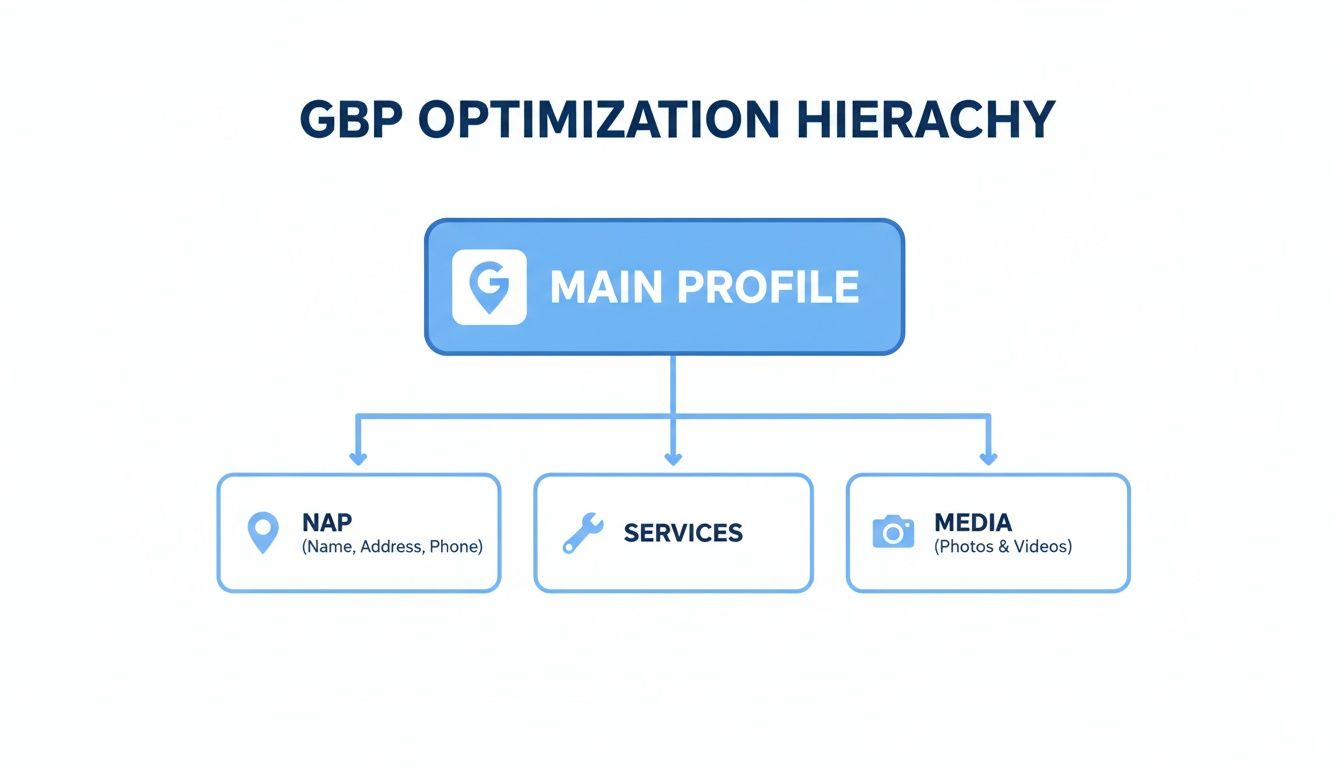
The diagram really drives home the point: a successful profile, much like a successful location page, is built on distinct, well-managed pillars of information.
The Power of AI-Driven Content Silos
Let's be realistic. Manually creating truly unique, optimized content for dozens or even hundreds of locations is a monumental task. This is where AI optimization becomes essential. AI is the new way businesses will be found, and much of that has to do with how information is structured for LLMs. Our AI-driven content engine was built to solve this exact problem. It analyzes the specific transactional search terms that drive business in each city and maps out entire content silos.
So, what’s a content silo? It's basically a cluster of interlinked pages on your website that all revolve around a central topic.
For your Dallas location, we might build a main "Dallas Roofing Services" page. That page would then link out to more specific, long-tail sub-pages like:
- Dallas Residential Roof Repair
- Dallas Commercial Roofing
- Dallas Emergency Tarping Services
- Common Roofing Problems in North Texas
This structure signals deep expertise and authority to Google and AI search engines, making it exponentially easier for you to rank for a whole range of valuable keywords. We map out these silos for every single service area, ensuring each location builds its own pocket of authority on your website.
By creating these focused content hubs, you're not just optimizing a single page; you're building a comprehensive resource that establishes your business as the definitive expert in that local market. This is how you dominate transactional searches.
Avoiding Duplicate Content with Canonicalization
As you build out these powerful location pages, you have to be careful about sending mixed signals to Google. To avoid any potential duplicate content issues, you need to use a canonical tag. It’s just a small snippet of code, but it's crucial—it tells search engines which URL is the "master" version of a page.
While every location page should have unique content, some elements across them might be similar. Proper canonicalization ensures search engines don't get confused and ding you for it.
When you combine this technical step with a strong internal linking structure—linking from your main service pages down to your state and city pages—you create a clean flow of authority. This boosts the ranking potential of every single location page and builds a powerful, scalable framework that strengthens your entire online footprint.
Managing Citations and Reviews Across Your Service Areas
Once your location pages and Google Business Profiles are live, the real trust-building begins. This is where we focus on broadcasting strong, consistent signals across the web that validate each of your locations as a legitimate, top-tier local business.
Two things matter more than almost anything else at this stage: citations and reviews. Think of them as the digital equivalent of word-of-mouth, telling Google and potential customers that you’re the real deal.
Consistency here is everything. Even a tiny mistake in your business Name, Address, or Phone number (NAP) across different online directories can create confusion for search engines, hurting your ability to rank for those crucial "near me" transactional searches.

Unifying Your Digital Footprint with NAP Consistency
A citation is simply any online mention of your business’s NAP info. These pop up in hundreds of places, from major players like Yelp and Apple Maps to smaller, niche directories for your specific industry. To Google, every consistent citation is another vote of confidence in your business information.
The first move is always a deep-dive citation audit for every single location. We methodically hunt down every existing mention of your business online. This process almost always uncovers a mess of inconsistencies—old addresses, wrong phone numbers, or slightly different business names.
We’ve seen businesses struggle to rank for years simply because an old address from a move five years ago was still lingering on a dozen obscure directories. Cleaning this up is foundational work that can provide an immediate boost to local authority.
After pinpointing all the errors, we launch a clean-up campaign to correct them. Then, we shift to building new, high-quality citations for each service area, making sure every location has a powerful and uniform digital footprint. This meticulous process is a cornerstone of effective local business listing optimization and is exactly what Google needs to see to rank you at the top of the map pack.
Building a Scalable Review Generation Machine
Let's be clear: positive customer reviews are one of the most powerful local ranking factors today. They provide the social proof that convinces both customers and search engines that you’re the best answer for transactional searches like "plumber in Dallas." A steady flow of recent, positive feedback signals that you're an active, reputable business people trust.
But you can't just sit back and hope for good reviews to roll in, especially when you're juggling multiple locations. You need a system. We help our clients implement simple, automated workflows to ask for feedback at the perfect time—right after a job is successfully completed.
This system usually involves a mix of tactics:
- Email Workflows: An automated, polite email sent a day or two after service, with a direct link to that specific location’s Google review page.
- SMS Requests: A quick text with a review link often gets a much higher open and click-through rate. It's immediate and easy.
- Printed Materials: Something as simple as a leave-behind card with a QR code can work wonders. It puts the request right in the customer's hand.
By making it dead simple for happy customers to leave feedback, you can dramatically increase the volume and velocity of positive reviews for every single one of your locations.
Handling Negative Feedback Like a Pro
Of course, not every review is going to be five stars. How you respond to negative feedback is just as important as getting the positive ones. A quick, professional reply shows everyone—including future customers—that you take customer service seriously and are committed to making things right.
Our playbook for managing all reviews includes:
- Rapid Responses: We aim to reply to all reviews, good and bad, within 24 hours.
- A Professional Tone: Every response is calm, empathetic, and focused on a solution. We never get defensive.
- Taking It Offline: For negative reviews, the goal is to show you're listening and then move the conversation to a private channel like phone or email. This prevents a public back-and-forth.
This dual approach—proactively generating great reviews while masterfully handling the bad ones—builds an online reputation that’s practically bulletproof. That reputation becomes a powerful asset for any multi-location brand, driving more calls and converting more customers who are ready to buy.
Nailing Your Local Schema and Technical SEO
Great content is crucial, but to really dominate local search across all your locations, you have to speak Google's language. This is where the technical side of multi-location SEO becomes your secret weapon—it's the invisible backbone holding your entire strategy together. This is a core component of AI optimization as well, ensuring Large Language Models (LLMs) can easily understand and trust your business information.
By implementing a few key technical elements, you're essentially handing search engines a perfectly organized file on your business. It makes it crystal clear who you are, what you do, and—most importantly—where you do it. That clarity is what gets you in front of customers at the exact moment they're ready to make a purchase.
Put Local Business Schema Markup to Work
Think of schema markup as a special vocabulary you add to your website's code to help search engines make sense of your content. For any multi-location business, the LocalBusiness schema is absolutely non-negotiable. It’s how you explicitly define the critical details for each individual location page.
Instead of leaving it to Google to piece things together, you can spoon-feed it precise information for every single branch.
This includes essential data points like:
- Specific Address: The street, city, state, and zip code for that location.
- Local Phone Number: The unique phone line dedicated to that branch.
- Business Hours: The exact operating hours for that specific office or store.
- Geo-Coordinates: The latitude and longitude to pinpoint your location on the map.
When you provide this structured data, you remove all guesswork. You’re telling Google, "This is our Dallas office, here is its unique phone number, and these are its hours." This helps search engines recognize each location as its own distinct entity, which is the key to ranking in local search and showing up in the Google Maps pack.
Why Rich Snippets Matter
Getting schema right often leads to rich snippets in the search results. These are the enhanced listings that show extra tidbits of information—like star ratings, review counts, or even event details—right on the search page.
Imagine a customer making a transactional search like "best plumber near me." A result that pops up with a five-star rating and 150+ reviews is instantly more compelling than a plain blue link. These visual cues build immediate trust and can seriously boost your click-through rate, sending more high-intent customers straight to your location pages.
At Transactional Marketing, we meticulously implement custom schema for every location page. This isn't just a technical checkbox for us; it's a strategic move to make our clients the most authoritative and appealing choice for any transactional search in their service areas.
Don't Forget the Technical SEO Foundation
Beyond schema, a few other technical fundamentals form the bedrock of a solid multi-location SEO strategy. These elements ensure your carefully crafted location pages are actually seen and properly indexed by search engines.
First up, page speed is king. A customer with a burst pipe isn't going to wait around for a slow website to load. If your page takes more than a couple of seconds, they're gone—and they're calling your competitor. Optimizing images and streamlining code for speed is non-negotiable.
Next, your site has to be mobile-friendly. This should go without saying, but the overwhelming majority of "near me" searches happen on a smartphone. If your site is a pain to navigate on a small screen, you're essentially invisible to a huge chunk of your potential customer base.
Finally, you need a clean XML sitemap that lists the URL for every single one of your location pages. This sitemap acts as a roadmap for search engine crawlers, guiding them to discover and index all of your valuable, location-specific content. Without it, some of your pages might never even get found.
Measuring Success and Proving ROI on Local SEO
Marketing without measurement is just guessing. When you’re running a multi-location business, proving that your local SEO strategy is actually driving revenue isn't just a "nice to have"—it's essential. This is the moment where all the foundational work translates into real, tangible business results.
Are you winning the "AC repair near me" search in Phoenix and in Mesa? How about Scottsdale? The right data cuts through the noise and gives you a clear answer. At Transactional Marketing, we build custom results dashboards for this very reason, pulling all your critical data points into one place so you always know exactly how you’re performing.
The Metrics That Truly Matter for Local Wins
Tracking local SEO success goes way beyond vanity metrics like general website traffic. You need to zero in on the data that directly connects your marketing spend to your bottom line. It’s all about monitoring the actions that show you’re reaching customers making transactional searches. A big part of this is knowing how to measure SEO success effectively by focusing on genuine business impact.
Here are the core KPIs we obsess over for every single location:
- Transactional Keyword Rankings: We track your exact position in each city for the specific, high-intent phrases that actually generate phone calls and new business.
- Google Maps Visibility: Using rank heatmap technology, we can literally see your visibility in the Google Maps 3-pack across every neighborhood you serve.
- Phone Calls & Form Fills: This is where the rubber meets the road. With call tracking and conversion goals, we measure the number of real customer inquiries your campaign produces.
- GBP Engagement: We look at clicks-to-call, direction requests, and website visits that originate directly from your individual Google Business Profile listings.
Connecting the Dots: From Clicks to Customers
To really understand how a local SEO strategy performs, you need a clear, unified view of key performance indicators. The table below breaks down the most important metrics we track, why they're crucial for a multi-location business, and the tools we use to measure them. This framework helps connect our SEO activities directly to your business goals, like more phone calls and booked jobs.
| Metric | What It Measures | Why It Matters | Tool for Tracking |
|---|---|---|---|
| Local Organic Rankings | Your website's position for "money" keywords in each city. | Higher rankings for transactional terms mean more qualified traffic and leads. | SEMrush or Ahrefs |
| GBP Impressions | The number of times your GBP listing appeared in search. | Indicates brand visibility and reach within a specific service area. | Google Business Profile Insights |
| Clicks-to-Call | How many users called you directly from your GBP listing. | This is a primary conversion point, showing immediate intent to hire or buy. | Google Business Profile Insights |
| Direction Requests | The number of people who asked for directions to a location. | A strong signal of foot traffic and in-person customer intent. | Google Business Profile Insights |
| Lead Volume | Total phone calls and form submissions from organic search. | The ultimate measure of lead generation and the direct impact of SEO on sales. | Call tracking software, Google Analytics |
| Conversion Rate | The percentage of website visitors who become a lead. | Shows the effectiveness of your location pages at converting traffic. | Google Analytics |
By monitoring this blend of visibility and conversion metrics, we get a complete picture of performance. We're not just looking at traffic; we're analyzing the entire customer journey from a local search to a new, paying customer.
The data backs this up. Industry reports consistently show that searches with local intent—which make up a staggering 46% of all Google searches—convert at an incredibly high rate. For service businesses, this directly impacts call volume and job bookings.
We pull everything—data from Google Search Console, GBP Insights, and call tracking—into one straightforward dashboard. This gives you an undeniable view of your return on investment, showing precisely how our work is turning search engine visibility into a predictable pipeline of new customers.
This data-driven approach is what allows for constant refinement. By seeing which locations are thriving and which have room to grow, we can make smart, strategic decisions to scale your success and ensure your marketing dollars are always working as efficiently as possible.
Curious about what this could look like for your business? Play around with our ROI calculator to see how a targeted local SEO campaign can directly impact your bottom line.
Your Multilocation SEO Questions, Answered
When you're scaling a business across multiple cities, a lot of questions pop up. It's easy to get tangled in the details of managing growth without creating a massive headache for yourself. Let's tackle some of the most common questions I hear from business owners.
Can I just copy and paste content for each location page?
This is a huge one, and the answer is a hard no. It’s tempting to just duplicate content to save time, but that's one of the biggest mistakes you can make. When search engines see identical or nearly identical content across multiple pages, they flag it as low-value.
Each location page needs to feel like it truly belongs to that community. We're talking unique content like local testimonials, photos of your team at that specific branch, and service descriptions that mention local landmarks or neighborhoods. This tells Google you have a real, boots-on-the-ground presence, which is exactly what it wants to see for those critical transactional searches like "roofer near me."
How many Google Business Profiles should I have?
The rule here is simple and non-negotiable: you need one unique and verified Google Business Profile (GBP) for each legitimate, physical location. Don't try to game the system by creating multiple listings for one address or using a P.O. box or virtual office. That’s a fast track to getting your profiles suspended.
Think of each GBP as your digital storefront for that specific service area. It's your ticket to showing up in the Google Maps "3-pack," which is often the most valuable real estate for driving direct phone calls from customers making transactional searches.
The secret to scaling local SEO is to think of each location as its own individual business. That means its own GBP, its own unique page on your website, and its own set of local citations. Nail the consistency and uniqueness for each one, and you'll dominate local search.
Does every location really need its own phone number?
Yes, without a doubt. A unique, local phone number is a massive trust signal for both customers and search engines. It instantly communicates that you’re a legitimate part of the local community, not some faceless national chain piping calls to a central office.
Make sure that local number is used consistently everywhere online for that location—on its GBP, its specific website page, and across all your directory listings. This consistency is what builds authority and credibility in Google's eyes.
At Transactional Marketing, we live and breathe this stuff. We've built a proven system for implementing these precise, scalable strategies to get businesses like yours showing up for the high-intent, transactional searches that actually drive revenue. Ready to see your business at the top of the local search results in every market you serve? Visit us online to see how we get it done.