


Local SEO for plumbers is all about making sure your business shows up when a local customer needs you right now. In today's world, that means optimizing for both traditional search engines like Google and the new wave of AI-powered search and Large Language Models (LLMs). It's the art and science of getting your plumbing company to the top of Google Maps and AI-generated search results for those critical searches like "emergency plumber near me" or "drain cleaning in [your city]".
Why Local SEO Is a Plumber’s Most Powerful Tool
Let’s get real for a second. Picture a homeowner in Phoenix staring at a burst pipe at 2 AM. What’s their first move? They grab their phone and frantically Google ‘emergency plumber near me.’ This isn't just window shopping; it's what we call a transactional search term. This person has a serious problem and money in their hand, ready to hire the first qualified plumber who can solve it.
This is exactly where we live and breathe at Transactional Marketing—getting our clients to show up for these high-stakes, transactional search terms. It’s why we’re called Transactional Marketing. We laser-focus on the exact phrases that lead to immediate business.
This guide will walk you through the proven system we use to get plumbing businesses on the first page of Google, often in as little as 30 to 60 days.
Capturing High-Intent Local Customers
Local SEO for a hands-on trade like plumbing is a completely different ballgame from other industries. Your customers aren’t casually browsing; they have an urgent, often messy, problem that needs fixing immediately. Your job is to be the first, most credible option they see when that pipe bursts or the water heater gives out.
This is why the Google Map Pack—that block of the top three local businesses you see on the map—is the most valuable piece of digital real estate you can own. Showing up here translates into hundreds of more phone calls every month.
Think about this: a staggering 42% of all local searches for terms like "emergency plumber" result in a click on one of those top three Google Map Pack listings. For a plumber, that’s not just an interesting stat; it’s your direct line to turning a homeowner's panic into your profit.
If you aren't in one of those top spots, you’re basically invisible to almost half of your most motivated potential customers.
The customer's journey from problem to solution is simple but powerful, as you can see below.
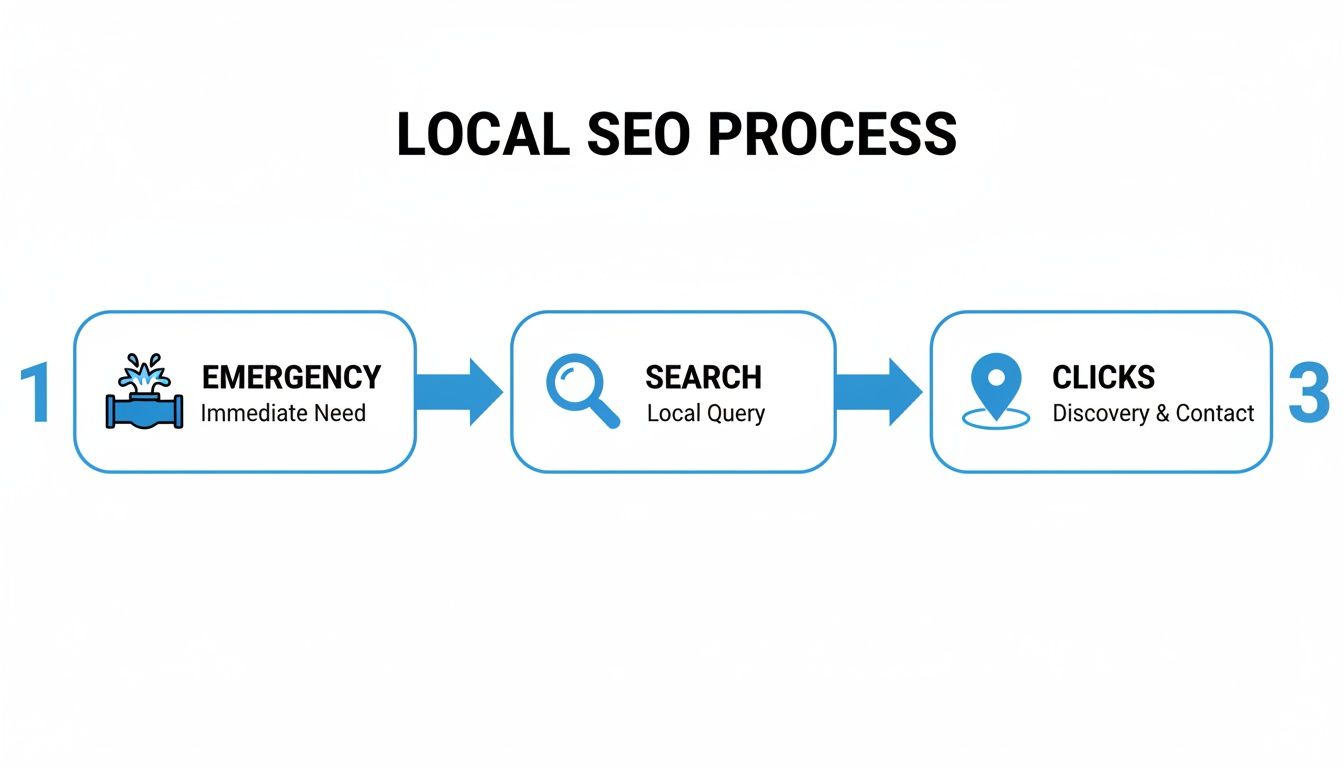
This flowchart makes it crystal clear: if you’re not visible when they search, you don’t get the click, and you certainly don’t get the job. It's that simple.
To put this all into perspective, we've broken down the key areas we'll be covering. Each piece of this puzzle is designed to put you in front of those high-intent customers who are ready to spend money.
Core Components of a Winning Local SEO Strategy for Plumbers
| SEO Component | Primary Goal | Impact on Your Plumbing Business |
|---|---|---|
| Google Business Profile | Dominate the Google Map Pack | Your primary source of high-quality, transactional leads. |
| Local Service Pages | Rank for service-specific terms | Captures transactional searches like "water heater repair Phoenix." |
| On-Page SEO & AI Optimization | Signal relevance to search engines & LLMs | Helps AI understand what you do and where you do it. |
| Citations & NAP | Build local authority and trust | Consistent business info across the web builds credibility. |
| Reviews & Reputation | Earn customer trust and clicks | More positive reviews lead to more calls, period. |
| Local Link Building | Boost your domain authority | Quality local links are a powerful ranking signal. |
| Tracking & Reporting | Measure what matters (ROI) | See exactly how SEO is driving calls and revenue. |
As you can see, a successful strategy is a complete system. Each component reinforces the others to create a powerful engine for generating local leads.
The Transactional Marketing Difference
Our entire philosophy is built around one thing: dominating those critical transactional search terms. We have the technology and the proven system to optimize your Google Maps presence, ensuring you appear in that coveted top-three Map Pack across every single one of your service areas. For our clients, this translates directly into hundreds of more phone calls every month—and literally thousands more every year.
Our approach is laser-focused on the exact search terms that drive immediate calls and booked jobs, like "air conditioning repair near me" for an HVAC company. We know that while general contractors and plumbers both work in homes, their SEO needs couldn't be more different, which is why we create a unique strategy for each industry. You can see how we tailor our strategies in our guide on local SEO for contractors.
And if you’re looking for a comprehensive roadmap to guide your own efforts, this ultimate local SEO checklist is a fantastic place to start.
Optimizing Your Google Business Profile for Maps
Let's be blunt: your Google Business Profile (GBP) is the single most important tool in your local marketing arsenal. It’s not just a listing; it’s your digital storefront on Google Maps. When a homeowner has a burst pipe and frantically searches "emergency plumber near me," a transactional search term, the businesses in that Google Map Pack are the ones getting the call. Period.
Here at Transactional Marketing, we obsess over GBP because we know it's a direct line to customers who are ready to hire someone right now. Our entire proven system is built to push your plumbing business to the top three of Google Maps in every neighborhood you serve. A properly optimized profile is a lead-generation engine that can bring in hundreds of extra calls each month.
Choosing Your Categories and Services
This is the first place I see plumbers go wrong—they're too generic. Getting hyper-specific with your categories and services is absolutely crucial for showing up when a customer has a specific, urgent problem. This is a core part of AI optimization; clear, structured data helps LLMs accurately recommend your business.
Your primary category must be "Plumber." Don't get creative here. This tells Google and AI the core of what you do and carries the most weight for broad searches.
After that, you need to list out every single service you offer. Think from the customer's perspective. They aren't just searching for a "plumber"; they're searching for "water heater installation," "clogged drain repair," or "sewer line inspection." You need to be there for all of it.
- Water Heater Repair & Installation
- Drain Cleaning & Unclogging
- Leak Detection & Repair
- Sewer Line Repair & Replacement
- Hydro-Jetting Services
- Faucet & Fixture Repair
- Toilet Repair & Installation
- Garbage Disposal Services
- Sump Pump Services
Each one of these services you add is a new transactional search term you can rank for. Leaving this section half-finished is like telling search engines and AI you don't offer those services.
Perfecting Your Profile Details
With your services locked in, it’s time to fill out every other field with painstaking accuracy. Consistency across the web is non-negotiable. Your business name, address, and phone number (NAP) on your GBP must perfectly match what's on your website and every other directory.
Your business description is your 750-character elevator pitch. Use it to highlight what makes you different—maybe it’s your 24/7 emergency response or your focus on specific neighborhoods. Write for a human, but make sure to naturally include your most important transactional keywords.
Getting every detail right is foundational to ranking on page one, a result our proven system typically delivers for clients in just 30 to 60 days. To make sure you don't miss a thing, we've put together an exhaustive guide. Follow our Google My Business optimization checklist to walk through the process step-by-step.
Building Authority with Photos Posts and Q&A
A static profile is a dead profile in the eyes of Google and AI. To truly dominate the Map Pack, you have to signal that your business is active, relevant, and engaged.
High-Quality Photos: Aim to upload new photos every single week. Get shots of your team on the job, your branded vans, before-and-after pictures of your work, and your equipment. The data is clear: businesses with over 100 photos get dramatically more customer engagement.
Google Posts: Think of these as free mini-ads. Use them to share service specials, post seasonal maintenance tips ("How to prevent frozen pipes"), or announce company news. Posts expire after seven days, so a weekly posting schedule keeps your profile looking fresh.
Questions & Answers (Q&A): This is a seriously underused feature. You can—and should—ask and answer your own questions. Pre-emptively answer things like, "Do you offer free estimates?" or "What are your emergency service hours?" This lets you control the conversation and work in valuable keywords.
Treating your Google Business Profile like a dynamic part of your business is how you build real local authority. For a more advanced look at this, check out this guide on Mastering Google Business Profile Management. At the end of the day, the more you give Google, the more it gives you back in the form of high-value, transactional customer calls.
Speaking Directly to Your Local Customers Through Geo-Targeted Content
Let's be blunt: a generic website doesn't get the phone to ring. When a homeowner has a pipe burst at 2 AM, they aren't looking for a plumber who serves "the greater metro area." They're searching for a transactional term like "emergency plumber in Scottsdale" right now. Your website has to show up for that exact search, and that means speaking their language in their specific location.
This is where we move from just having a website to building a high-performance lead generation tool that is optimized for both search engines and AI.
The strategy is simple but powerful: we build a digital footprint that perfectly mirrors your physical service area. Forget a single, catch-all "services" page. We're going to create dedicated, unique pages for every single city, suburb, and neighborhood you want to dominate. This is how you win those crucial, money-making transactional searches like "drain cleaning in Mesa."
Build Out Hyper-Local Service Pages
The whole point is to convince Google and AI models that you are the definitive plumbing expert for a very specific geographic location. When someone in that area searches, a dedicated page on your site should be the perfect match for what they typed in.
We dig into the data to find the exact transactional search terms people are using in each city. Then, we build out service pages that are steeped in local context.
A page targeting "Scottsdale" shouldn't just list the city name a few times. It needs to feel like it was written by someone who actually works there. We do this by including details that signal true local presence:
- Neighborhoods you cover: Give a shout-out to places like Old Town, McCormick Ranch, or DC Ranch. It shows you know the area.
- Local landmarks: Mentioning familiar spots builds trust and proves you're not an out-of-town operation.
- Common local problems: Talk about the specific issues Scottsdale homes face, like hard water buildup in pipes or fixtures.
This isn't just fluff; this level of detail sends powerful signals to search engines and LLMs. It proves you're an integral part of the community, not just some company casting a wide net. This is precisely how our proven system can get your business showing up on page one, often in as little as 30 to 60 days.
Use Content Silos to Structure Your Site for Authority
To really establish your expertise, we organize your website using a "content silo" model. Picture your website as a digital filing cabinet. Each of your main services—drain cleaning, water heater repair, leak detection—gets its own dedicated drawer.
Inside each "drawer" (or silo), we organize all the related content:
- Pillar Page: This is the main page for that service (e.g., "Water Heater Repair Services").
- Location Pages: These are your hyper-local pages (e.g., "Water Heater Repair in Mesa," "Water Heater Repair in Chandler").
- Supporting Blog Content: These are helpful articles that answer common questions (e.g., "5 Signs Your Water Heater is About to Fail").
This clean, logical structure makes it incredibly easy for Google and AI to understand what you're all about. It sees you don't just offer water heater repair; you are an absolute authority on it, especially in the specific towns you're targeting. This is a massive advantage that boosts your rankings for high-value, transactional searches.
A well-built content silo tells search engines and LLMs that for a specific service in a specific city, your plumbing company is the most complete and relevant answer. This is how you go from being a plumber in the area to the plumber people find first.
This organized approach is non-negotiable for any plumbing business serving multiple locations. By creating these distinct silos for each service area, you prevent your pages from competing against each other (a problem called keyword cannibalization) and allow each location to rank strongly in its own market.
For companies looking to expand, mastering this is key. You can dive deeper into the specifics in our guide to multilocation local SEO, which details how to manage and grow your online presence across several cities without watering down your results. It's this kind of focused strategy that ensures when a local customer has a problem, your business is the first one they see.
Earning Trust with Local Signals: Citations, Reviews, and Links
Google’s primary goal is to connect its users with the most trustworthy and relevant local businesses. If you want to show up for those high-value transactional search terms like "plumber near me," you have to prove your company is a respected, legitimate part of the community. This proof doesn't just come from your own website; it comes from three critical signals Google and AI look for across the web: citations, reviews, and local links.
Think of it like this: your website and your Google Business Profile are what you say about your business. But citations, reviews, and links? That’s what everyone else is saying about you. When that story is consistent and overwhelmingly positive, algorithms can't help but take notice.
The Bedrock of Local SEO: NAP Consistency
Before you do anything else, you have to get your core business information locked down and identical everywhere it appears online. We call this NAP consistency—your Name, Address, and Phone number need to be a perfect match across every directory, social profile, and online listing.
Even a tiny inconsistency can create doubt in an algorithm's "mind." If you're "Smith Plumbing Co." on Yelp but "Smith Plumbing Company" on Facebook, search engines get confused. They aren't 100% sure it's the same business, which ultimately waters down your authority and hurts your chances of landing in the Google Map Pack.
- Pro Tip: Settle on one official NAP format right now. Decide if you’re going to use "St." or "Street," "Co." or "Company," and stick to it religiously for every single citation you build from here on out.
The very first thing we do for any new plumbing client is a full-scale citation audit. We dig through the web to find and fix every last inconsistency. We know from experience that a clean, consistent digital footprint is the foundation for any successful SEO campaign. Without it, you're just building on quicksand.
Your Customers Can Be Your Biggest Ranking Asset
Let's be honest, positive reviews are one of the single most powerful factors for ranking in the Google Map Pack. Put yourself in a homeowner's shoes: they see three plumbers on Google Maps. Who gets the call? The one with 4.9 stars and 150 reviews, or the one with 4.2 stars and only 12 reviews? It's not even a contest.
You simply can't afford to be passive about getting reviews. You need a simple, repeatable process for asking happy customers to share their feedback. The absolute best time to ask is right after your technician has solved their problem, when they're relieved and most grateful.
A quick text or email with a direct link to your Google review page is all it takes to make it easy for them. This steady stream of fresh, positive feedback sends a clear signal to Google that you're an active, reputable company that consistently does great work. This is a direct lever you can pull to make the phone ring more often, translating into hundreds more calls every month.
Local Link Building: It’s Not as Complicated as It Sounds
Think of local link building as earning "votes of confidence" from other reputable websites in your area. When another local business links to your site, Google sees that as a powerful endorsement that you’re a legitimate and important part of the local business community. These aren't just random links; they are signals that prove your local relevance.
This doesn't have to be some complex, technical process. Here are a few real-world examples that work wonders for plumbers:
- Sponsor a local Little League team. Their website will almost always have a sponsors page with a link back to your site.
- Team up with a local hardware store. Offer to write a guest post for their blog about "5 DIY Plumbing Mistakes to Avoid" in exchange for a byline and a link.
- Join your local Chamber of Commerce. Your membership almost always comes with a listing in their online directory, which includes a valuable link.
Every one of these actions firmly grounds your business in the local community. They create authentic, powerful signals that build your authority and help push you higher in the search results for the money-making transactional keywords that drive your business forward.
Nailing the Technical SEO for Your Plumbing Website
You can have the best local SEO strategy on the planet, but it's all for nothing if your website is slow, broken, or a nightmare to use. Your site’s technical health is the foundation that holds up everything else. For a plumber, this isn't just a "nice-to-have"—it's mission-critical.
Think about your typical customer. They're often in a panic, searching on their phone for immediate help. A clunky, slow-loading website is more than just an annoyance; it's a lost job.

Getting the technical side of SEO right isn't about ticking boxes for Google. It’s about creating a frictionless path from a frantic "leak detection near me" search to a booked appointment. At Transactional Marketing, our proven system ensures a plumber’s website is technically sound, which is a key reason we can help get you on page one of Google within 30 to 60 days.
Mobile-First Design Isn't an Option—It's a Requirement
Let's be real: most of your emergency calls are coming from someone standing in their kitchen, staring at a growing puddle, with their smartphone in hand. In fact, over 50% of all internet traffic now comes from mobile devices. If your site is a pain to use on a phone, you're just handing business to your competitors.
A mobile-first approach means we design the experience for the small screen first and then adapt it for larger screens like desktops. This guarantees a smooth experience for customers on the go.
- Click-to-Call Buttons: Your phone number needs to be front and center. A single tap should be all it takes for a customer to call you.
- Simple Navigation: A stressed-out homeowner doesn't have time to decipher a confusing menu. They need to find your services or contact info instantly.
- Blazing-Fast Load Times: Mobile users have zero patience. A slow site sends them packing.
When a customer is dealing with a burst pipe, the last thing they want is to pinch and zoom just to find your phone number. A flawless mobile site is the first handshake you have with a potential client—it turns their emergency into a paying job for you.
Page Speed and a Clear Site Structure
Website speed is everything. A delay of just a couple of seconds can be the difference between landing a new customer and them hitting the back button. We obsess over every technical detail, from compressing image files to optimizing server response times, to make sure your site loads in the blink of an eye. This isn't just for user experience; it's a massive ranking factor for Google.
Just as important is a logical site structure. A potential customer should be able to land on your site and find what they need in two clicks, max. A chaotic website with dead ends and confusing navigation creates frustration and drives people away.
Use Local Schema to Speak Directly to Google and AI
Think of local schema markup as a secret language that lets you spoon-feed Google and AI models all the important details about your business. It's a specific type of code added to your site's backend that leaves no room for interpretation. This is a critical component of AI optimization.
This code clearly tells search engines and LLMs critical information, like your:
- Business Name
- Address
- Phone Number (NAP)
- Hours of Operation
- Specific Services (e.g., "water heater installation," "sewer line repair")
- Service Area
By implementing local schema, you make your plumbing company a prime candidate for "rich results" in search—those eye-catching listings with star ratings and service details right on the results page. This small technical detail is a huge part of our strategy at Transactional Marketing to make your business the clear and obvious choice for customers with money in hand, ready to hire a plumber right now.
Tracking Success and Measuring Real-World ROI
Forget about vanity metrics and confusing spreadsheets. When it comes to your marketing, the only numbers that matter are the ones you can take to the bank. Our entire approach at Transactional Marketing is built to drive real-world results, and we show you exactly how that investment translates into booked jobs.
Our goal is simple: get you on page one of Google for the transactional search terms that actually generate business, and do it within 30 to 60 days. From there, we prove the return.
From Rankings to Revenue
Ranking for a transactional search term like "plumber near me" is a great start, but it's completely meaningless if your phone isn't ringing. That's why every single piece of your local SEO campaign is tied directly back to real business outcomes. We go way beyond basic traffic numbers to show you what truly defines success for a plumbing company.
You get clear, straightforward data on:
- Keyword Ranking Improvements: We track your exact position for high-value, transactional keywords in every single city you serve.
- Google Maps Visibility: Our technology includes heat maps that paint a clear picture of your visibility in the Google Map Pack, showing precisely where you're dominating and where we need to focus next.
- Actionable Traffic Data: You'll see the specific transactional search terms real customers are using to find your website and call your business.
This isn't just about climbing the search rankings. It's about delivering tangible results—more phone calls and more appointments. We connect the dots between our work and your revenue, proving our proven system works.
Your Transparent Results Dashboard
We believe in total transparency, which is why you get a live dashboard showing you exactly what’s happening with your campaign in real time. This isn’t some static, outdated monthly report. It’s a dynamic look under the hood of the engine driving your business forward, ensuring you're never left in the dark.
We make it easy to see how better visibility on Google Maps directly translates into hundreds more customers calling you for service every month. For those interested in the technology behind this, you can explore some of the best local SEO reporting tools we use to pull and present this crucial data.
Ultimately, our success is measured by yours—more calls, more jobs, and measurable growth for your plumbing company.
Common Questions About Local SEO for Plumbers
Even with a solid plan, it’s natural to have questions about how local SEO actually works on the ground for a plumbing business. Let’s tackle some of the most frequent ones we hear from plumbers just like you.
How Long Does It Take to See Results from Local SEO?
This is always the first question, and the honest answer is: it depends on your starting point and how tough your local market is. That said, with the laser-focused and proven system we've perfected at Transactional Marketing, our clients usually see real, significant movement within 30 to 60 days.
We don't waste time. Our immediate priority is getting you to pop up for those money-making, transactional search terms like "emergency plumber near me." We achieve this by hitting the highest-impact areas hard and fast, especially Google Maps optimization, which is the quickest way to get more calls coming in.
Can I Do Local SEO Myself?
Sure, you can definitely handle some of the basics. But a truly comprehensive local SEO for plumber strategy is a full-time job, and that's no exaggeration. The real challenge isn't just knowing what to do, but consistently doing it all at once—managing citations, drumming up reviews, building out geo-targeted content, and digging into the data to see what's working.
Effective SEO also demands a whole suite of professional tools, years of expertise, and a major time commitment to keep up with Google's and AI's constant changes. Our clients partner with us so they can focus on running their plumbing business while we focus on making their phone ring off the hook.
Is Local SEO More Important Than My Website?
They're two sides of the same coin; you can't have one without the other. Your local SEO efforts, particularly your Google Business Profile, are what get you in front of potential customers in the first place. Think of it as the big, bright sign on your digital storefront that catches the eye of someone with a burst pipe.
Your website is where you seal the deal. A fast, easy-to-use site with clear "Call Now" buttons is what turns that initial visibility into a paying job. They have to work together perfectly to capture and convert those high-intent customers who used a transactional search term.
Local SEO gets you found by the customer with an urgent problem. Your website convinces them you're the right plumber to fix it.
What Is the Most Important Part of Local SEO for a Plumber?
If I had to pick one thing, it's dominating the Google Map Pack. Hands down. The technology we use at Transactional Marketing is built specifically to maximize your visibility and ensure you show up in the top three on Google Maps across every single neighborhood you service. Landing in those top three map results is the single fastest way to blow up your call volume.
It's the most valuable piece of digital real estate for any plumbing business. Why? Because that's where customers with an immediate, desperate need and money in hand look first. Securing a spot there can mean hundreds of extra calls every single month.
Ready to stop letting your competitors get all the high-value local jobs? Transactional Marketing has the proven system to get your plumbing business showing up for the transactional search terms that actually drive revenue. We deliver page-one results, more phone calls, and measurable growth—often within the first 30-60 days.