


A great web design for an electrician isn't just a digital business card. It's your hardest-working employee, a powerful sales tool that runs 24/7 to book jobs for you. Its whole purpose is to capture customers at the precise moment they’re searching online, money in hand, turning their urgent problems into your next appointment.
Your Website Is a 24/7 Lead Generation Engine
Think of your website as an always-on lead machine. It never sleeps, never takes a vacation, and is constantly ready to bring in new business. For any modern electrician, a website's primary job is to attract and convert people who are actively looking to hire someone right now. This is where smart, strategic web design stops being an expense and becomes one of your most valuable business assets.
At Transactional Marketing, our entire philosophy is built around this idea. We want our clients to show up for transactional search terms. A transactional search term simply means when somebody is searching "electrician near me," they have money in their hand and they are ready to spend it. We are going to get your business to show up for these exact transactional search terms.
Targeting High-Intent Customers
There’s a huge difference between someone searching for "why are my lights flickering" and someone searching for "emergency electrician near me." The first search is informational; the second one is transactional. That second person has a problem and needs a pro to fix it immediately. Your website has to be built from the ground up to appear for that second type of search. That’s how your online presence directly translates into phone calls and service requests.
Your website’s success isn't measured in clicks or visits; it's measured in the number of trucks you send out to paying customers. The goal is to build a direct pipeline from a local, transactional search query to a booked appointment.
Building Instant Trust and Credibility
When a homeowner is dealing with an electrical problem, they're not just looking for any technician. They're looking for a trustworthy professional they feel comfortable letting into their home. A clean, professional, and easy-to-use website builds that trust in seconds. It signals you’re a serious, reliable business. This is why Transactional Marketing prioritizes both high visibility for transactional terms and a professional presentation that converts visitors into callers.
The electrical services market is growing fast. By 2027, the U.S. market is projected to top $350 billion, which means competition for local jobs is fierce. Yet, while there are over a billion websites online, a surprising 29% of small businesses still don't have one. This creates a massive opportunity for electricians who invest in a solid online presence.
To help you get started, here's a breakdown of the essential website elements designed to attract those ready-to-buy customers.
Key Website Elements for Attracting Transactional Customers
| Website Element | Impact on Transactional Searches | Why It Matters for Electricians |
|---|---|---|
| Click-to-Call Buttons | Instantly connects mobile users to your phone. | A customer with an emergency wants to talk to a person, not fill out a form. |
| Prominent Contact Forms | Provides an easy way for non-urgent inquiries to reach you. | Captures leads who are planning projects or getting quotes after hours. |
| Clear Service Pages | Ranks for specific terms like "panel upgrade" or "EV charger install." | Matches your site content directly to what the customer is searching for. |
| Customer Reviews/Testimonials | Builds immediate trust and social proof. | Homeowners want to see that their neighbors have hired and trusted you. |
| Professional Photos & Videos | Shows your team, your trucks, and your work quality. | Puts a human face to your business, making you more approachable and credible. |
| Mobile-First Design | Ensures a seamless experience on phones and tablets. | Most urgent "near me" searches happen on mobile devices. |
Each of these components works together to convince a potential customer that you are the right choice, turning their search into a scheduled job. For a deeper dive into the SEO side, this comprehensive guide on SEO for electricians is a fantastic resource. You can also explore more general web design stats to understand the competitive landscape.
Designing a Website That Converts Clicks to Calls
Let’s be honest, a good-looking website is nice, but for an electrician, it’s not the main goal. Your website needs to be a lead-generating machine, built with one purpose: turning a curious visitor into a paying customer. Every single element—from the layout and colors to the words on the page—should guide a potential client from "I have a problem" to "I'm calling you."
When a homeowner is dealing with a flickering light or a dead outlet, they're stressed. The last thing they need is a slow, confusing website. Your site has to be the path of least resistance, making it dead simple for them to find what they need and contact you. This is where strategic web design for an electrician stops being an expense and becomes your most powerful sales tool.
Building the Essential Pages
Think of your website like a well-organized toolkit. You need the right tool for each job, and your site needs the right page for each customer need. These core pages work together to build trust and drive action.
- Impactful Homepage: This is your digital storefront. It needs to answer three questions in three seconds: Who are you? What do you do? Why should I trust you? It has to be packed with clear calls-to-action and trust signals right from the start.
- Targeted Service Pages: Don't just list "electrical services." Create specific pages for high-value jobs like "EV Charger Installation," "Panel Upgrades," or "Emergency Electrical Repair." This is how you start ranking for the exact transactional terms people are searching for when they're ready to hire.
- 'About Us' Page: This is your secret weapon for building trust. Tell your story. Show off your team. A little personality goes a long way in turning a faceless company into a group of people a homeowner feels comfortable inviting into their house.
- Contact Page: Make it incredibly easy to get in touch. Include a simple form (don't ask for their life story), your phone number plastered everywhere, and an embedded Google Map showing you're truly local.
This simple flow chart breaks down how a well-designed website turns a local search into a scheduled job. It’s all about creating a clear path from search to trust to a booked appointment.
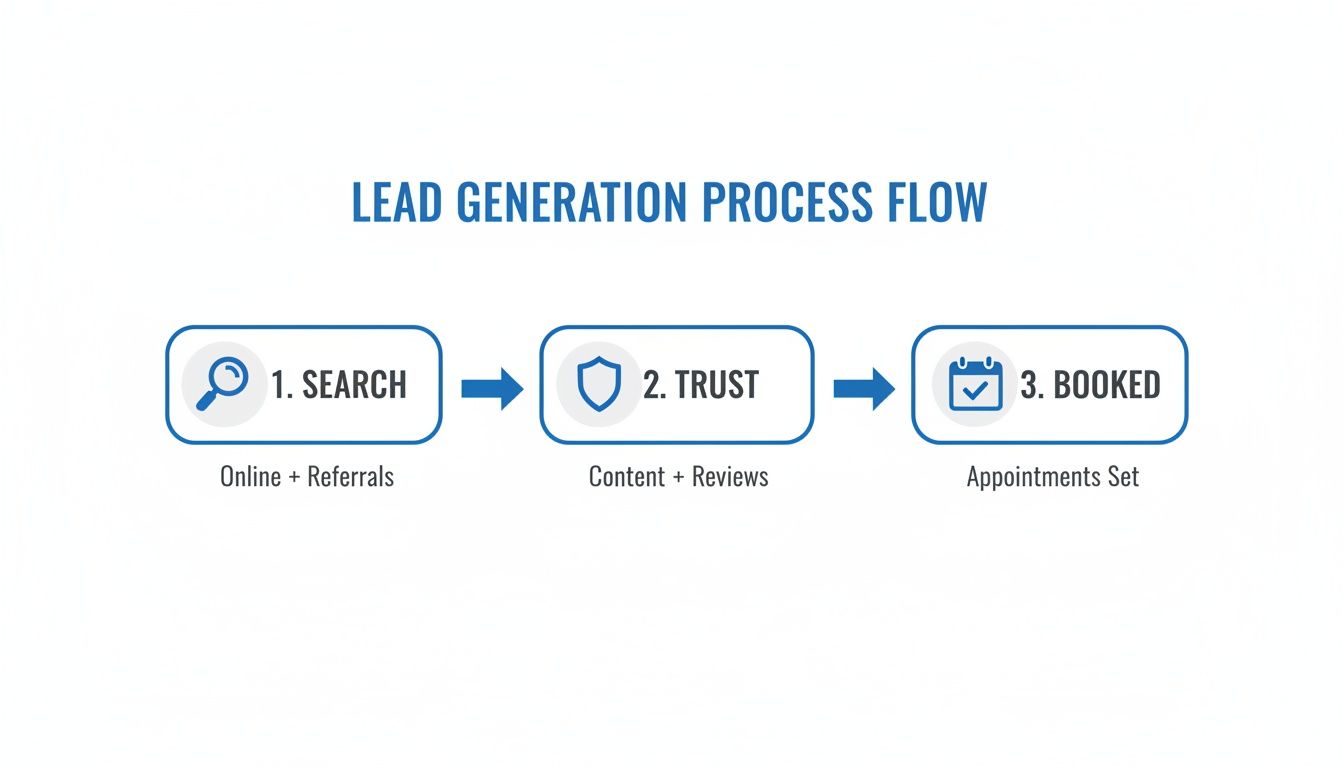
As you can see, that middle step—Trust—is where your website does the heavy lifting. A professional design and clear, helpful content are what convince a visitor that you're the right choice for the job.
The Psychology of a High-Converting Layout
A layout that converts isn't just about looking clean; it's about psychology. It guides the user's eye and puts the most important elements right where they expect them. We're talking about highly visible click-to-call buttons in the header of every page, simple contact forms above the fold, and badges showing off your licenses, insurance, and five-star reviews.
Pouring resources into a professional, conversion-focused design is a direct investment in your bottom line. A top-tier website built for an electrician typically costs between $7,000 and $20,000—the sweet spot for a growing company ready to dominate its local market.
It’s worth every penny. Think about it: 75% of people admit to judging a company's credibility based purely on its website design. More importantly, we've seen that sites built with a superior user experience achieve visit-to-lead conversion rates over 400% higher than their poorly designed competitors. You can discover more insights about electrician website costs and see for yourself why it's such a crucial business investment.
Win Local Searches with a Powerful Google Maps Strategy
For an electrician, showing up on the first page of Google is good. But showing up in the Google Maps 3-pack is where the real money is made. This is prime digital real estate, the first place customers look when they have an urgent problem and search for transactional terms like "emergency electrician near me."
Your website is the engine that drives your Google Business Profile (GBP) to the top of those map results. The two work together, creating a feedback loop that proves your authority to Google. At Transactional Marketing, Google Maps optimization is a core service because showing up in the top three map locations can translate into hundreds of more phone calls every month.
Think of it this way: when someone searches for a local electrician, Google's algorithm plays detective. It looks at your GBP and then cross-references that information with your website to confirm you're legit. A well-built website acts as the ultimate verification, telling Google, "Yes, this business is a real, trusted electrician serving this exact neighborhood." This is why we have the technology to get these map locations ranked in the top three for your service areas.
This vital connection is often what separates the businesses getting a flood of calls from the map pack from those that are buried on page two.
Connecting Your Website to Google Maps
A high-performing web design for an electrician does more than just list an address on the contact page. It requires a deliberate strategy to build local authority and send unmistakable signals to Google that you are the go-to expert in your service area.
Here’s how to forge that powerful link:
- Embed Your Google Map: Don't just link to your location—embed an interactive Google Map directly on your contact page and your main service area pages. This creates a tangible, digital-to-physical connection that search engines love.
- Build Hyper-Local Service Pages: Go beyond a simple list of towns you cover. Create dedicated pages for each key service area (e.g., "Electrician in Chandler," "EV Charger Installation in Mesa"). This shows Google you aren't just near these places; you are an active provider in them.
- Lock Down Your NAP Consistency: Your business Name, Address, and Phone number (NAP) must be 100% identical everywhere—website footer, contact page, and your Google Business Profile. Even a small difference like "St." vs. "Street" can confuse search engines and dilute your ranking power.
Showing up in the Google Maps 3-pack is non-negotiable. It's the digital equivalent of having the best storefront on the busiest street in town, putting you right in front of high-intent, transactional customers who need help now.
Using Website Content to Build Local Authority
The content on your website is the proof Google needs to trust you. When you detail your services and mention jobs you've completed in specific neighborhoods, you build a powerful portfolio of local relevance.
This isn't just a "nice to have"; it's a core strategy for earning top map rankings. For a deeper dive into the mechanics, you can learn more about how to rank higher on Google Maps and see exactly how a website powers this process.
Ultimately, a website that’s properly optimized with local signals ensures that when a potential customer searches for an electrician, your business is the most authoritative and relevant answer Google can find.
Fueling Your Site with AI-Driven SEO Content
A sharp-looking website is a great start, but it's the content that actually gets you found by customers on Google. And the rules for content are changing at lightning speed. With AI optimization and Large Language Models (LLMs) now at the heart of how search engines operate, your site needs more than just keywords. It needs to be the definitive, most helpful resource for the real-world electrical problems your customers are facing, optimized for how people will find businesses in the future.
This is the new reality of SEO and AI optimization for electricians. It’s no longer about just stuffing keywords onto a page. It's about creating laser-focused content that speaks directly to a homeowner with a flickering light and simultaneously satisfies the complex algorithms that decide who gets that top spot in search results.
Here at Transactional Marketing, this is what we do. We help electricians dominate their local search results by building out content that’s hyper-focused on transactional search terms. We create separate, dedicated content for each service and industry—one article for SEO for electricians, another for SEO for roofers. This laser-focused approach is how we get businesses to show up for the specific search terms in their local cities, right where their customers are.
Optimizing Every Page for Customers Ready to Buy
Put yourself in your customer's shoes. When a breaker keeps tripping, they aren't searching for "the history of electrical panels." They're frantically typing transactional terms like "emergency electrician near me" or "cost to replace electrical panel in [Your City]." Every single service page on your website must be expertly optimized to show up for these high-value, high-intent searches.
Our strategy for this involves getting a few key things just right:
- Title Tags: We write clear, direct titles that include the service and city, like "EV Charger Installation in Phoenix, AZ." No fluff.
- Meta Descriptions: These are your mini-ads in the search results. They need to be compelling, promise a quick solution, and make someone want to click.
- On-Page Content: The words on the page need to naturally include your keywords while explaining the service, answering common questions, and pushing the visitor to call you.
This approach transforms your website from a passive online brochure into an active lead-generation machine. The entire goal is to make your business the obvious, most helpful answer to a potential customer's urgent problem.
Transactional Marketing has a proven system that literally gets customers' websites showing up on page one of Google, typically within 30 to 60 days. We know how to laser-focus and target the exact search terms, like "air conditioning repair near me," that turn into paying jobs. To get ahead, you can explore some of the best AI SEO tools for 2025 that are helping contractors stay competitive.
The Role of AI in a Modern Content Strategy
The big shift to AI-powered search and LLMs means your content simply has to be smarter and more thorough. Modern search algorithms are built to understand what a user really wants. They reward websites that provide comprehensive, trustworthy information that directly solves the searcher's problem. By building our content around this principle, we position your business as the undisputed local authority.
This means developing service pages that don't just list what you do. They should answer related questions, showcase your past work, and provide crystal-clear next steps. By adopting an AI-first content strategy, you ensure your web design for an electrician not only looks professional but performs where it matters most—in front of paying customers. You can learn more about how we approach intelligent AI content building and see the results it gets for our clients in their local markets.
Winning Customers With A Flawless Mobile Experience
Think about your ideal customer for a moment. A homeowner has a sparking outlet, or a business owner just lost power to half their building. They're not sitting at a desk—they're on their phone, probably pacing, looking for an electrician right now. This is a transactional moment.
That's the moment of truth. Your website either loads instantly and gives them a clear way to call you, or they'll hit the back button and call your competitor. It happens that fast.
With over 68% of all web traffic now coming from mobile devices, this isn't just a small segment of your audience; it's the majority. For urgent, local searches like "emergency electrician near me," that percentage is even higher. A clunky, slow mobile site isn't just an inconvenience—it's a closed door to new business.
Speed And Simplicity Are Everything
When a potential customer is stressed out over an electrical issue, the last thing they want is a complicated website. They need speed, and they need clarity. The data doesn't lie: 40% of users will abandon a site if it takes more than three seconds to load. You get three seconds. That's it.
That's why every single design decision we make is obsessed with mobile performance. We're focused on a few core principles that make a massive difference:
- Responsive Layouts: The site needs to look and work perfectly on any screen. Text should be easy to read and buttons easy to tap, whether on a small iPhone or a large tablet—no pinching and zooming required.
- Image Optimization: Giant, uncompressed photos of your great work are the #1 killer of site speed. We make sure your images load quickly without looking pixelated or blurry.
- Intuitive Navigation: A stressed-out customer should never have to search for your phone number. We make sure a "click-to-call" button is always front and center, making it ridiculously easy to get in touch.
A great mobile website creates a frictionless path for a customer in need. They find you on Google, your professional site loads instantly, and they can call you with a single tap. This is how you convert a transactional search into a scheduled job.
Why Google Is Obsessed With Mobile-First
It's not just about user experience; it's about how Google sees your business. Google now uses what’s called mobile-first indexing. In plain English, this means they primarily look at the mobile version of your website to decide how to rank it.
If your site is slow, broken, or hard to use on a phone, Google notices. They see it as a poor-quality result and will rank you lower, even for people searching on a desktop. This directly impacts your visibility for those valuable, high-intent transactional searches that drive real business. We build every site to not only meet but exceed Google's mobile standards, turning your website into a powerful engine for generating calls.
To be clear, "mobile-friendly" and "mobile-first" are not the same thing. The former is a reactive adjustment, while the latter is a proactive strategy that wins in today's search environment.
Mobile-First vs Mobile-Friendly Design
| Feature | Mobile-Friendly (Responsive) | Mobile-First (Progressive Enhancement) |
|---|---|---|
| Design Philosophy | Starts with a full desktop site, then scales it down for mobile. | Starts with a core mobile experience, then adds features for larger screens. |
| Performance | Can be slower on mobile as it loads all desktop elements and hides some. | Optimized for speed; only loads essential mobile elements first. |
| User Experience | Often feels like a shrunken-down desktop site. Can be cluttered. | Clean, focused, and built around touch-based navigation. |
| Google's Preference | Acceptable, but not ideal. | Aligns perfectly with mobile-first indexing, leading to better rankings. |
Ultimately, a mobile-first approach ensures your most important audience—the customer with an urgent need—gets the best possible experience, which is exactly what Google wants to see.
Tracking Your Website's Performance to Maximize ROI
Once your new site is live, the real work begins. Think of the launch as the starting line, not the finish. A high-performance website needs constant attention to make sure it’s pulling its weight and bringing in leads for your electrical business. If you're not tracking its performance, you're essentially flying blind—you'll have no idea what’s working and what’s a waste of money.
This isn't about busywork; it's about being proactive so your site keeps driving real growth. By keeping a close eye on the data, you can make smart, informed decisions, react to changes in the market, and hold onto your rankings for the money-making transactional search terms that land you paying customers. This is how you turn a one-time investment into a consistent, growing source of jobs.
The Metrics and Tools That Actually Matter
To get a real handle on your website's success, you need the right tools and a clear focus on what to measure. This isn’t about drowning in data. It’s about zeroing in on the numbers that directly impact your bottom line: calls, form submissions, and booked jobs.
We rely on two core platforms to get this done:
- Google Analytics: This is your window into who is visiting your site. It tells you how they got there and which pages they care about most. It's essential for understanding your audience and how they interact with your content.
- Google Search Console: This tool gives you the inside scoop on how your site is doing in Google's search results. You can see which keywords are actually bringing people to your site and uncover any technical hiccups that might be tanking your rankings.
Don't ever fall into the "set it and forget it" trap with your website. The difference between a site that trickles in a few leads and one that generates a steady flood of high-quality inquiries every month comes down to consistent performance tracking.
Regular security scans, speed tests, and content refreshes are also non-negotiable for keeping your site healthy and your rankings high. For a deeper dive into measuring what matters, check out our guide on the best local SEO reporting tools for any service business. This is how you ensure your web design for an electrician keeps delivering a killer ROI.
Frequently Asked Questions
When it comes to digital marketing for your electrical business, it's easy to get bogged down in the details. Let's clear up a few of the most common questions we hear from electricians who are ready to get serious about growing their business online.
How Long Does It Take to See Results from a New Electrician Website?
A lot of agencies will give you a vague "six months to a year" answer, but that’s often because their strategy is too broad. When you zero in on what really matters—transactional search terms—you can see the needle move much faster.
Our entire approach at Transactional Marketing is a proven system built around targeting the exact phrases local customers are typing into Google when they need an electrician right now. This laser-focus allows us to get your business's website showing up on page one of Google, often in as little as 30 to 60 days, so you're not waiting forever for the phone to start ringing.
Why Is Google Maps So Important for an Electrician?
Think about your customers. They're local, and when a breaker trips or they need a new outlet installed, they grab their phone and search for "electrician near me." The first thing they see isn't a website; it's the Google Maps 3-pack. For an electrical business, being in that top-three listing is everything.
Securing a top-three spot in the Google Maps listings is very, very important. It directly translates into hundreds of more phone calls every month and literally thousands more every year. It puts your business front and center for customers with money in hand, ready to hire a professional immediately for transactional searches.
Can I Just Use a Cheap Website Builder for My Business?
I get it, the low price tag on DIY website builders is tempting. But for a service business trying to generate real leads, they can be a dead end. These platforms just aren't built with the technical SEO horsepower, AI optimization capabilities, or customization you need to compete for valuable, transactional keywords like "emergency electrical repair in [Your City]."
A professional web design for an electrician from Transactional Marketing is different. It’s an asset engineered from the ground up to do one thing: turn visitors into paying customers. It's built for speed, designed to work hand-in-glove with your Google Maps strategy, and structured to earn the trust of both search engines and the homeowners who find you.
Ready to turn your website into a 24/7 lead generation engine that dominates local, transactional search? The team at Transactional Marketing builds high-performance websites and marketing strategies designed to get you in front of customers who are ready to buy. Learn how we can get your phone ringing by visiting us at https://transactional.net.