

Is your appointment book looking a little sparse? The problem isn't just being online—it's about being found at the exact moment a patient in your neighborhood needs a dentist. This guide is built around one core idea: transactional SEO for dentists. I'm going to show you how to dominate the high-value searches that matter, like 'emergency dentist near me' or 'Invisalign specialist in [Your City]', to connect you with patients who are ready to book an appointment right now.
Winning the Battle for Local Dental Patients
For any modern dental or orthodontic practice, a full schedule starts with a single click. But let's be clear, not just any click will do. You need clicks from potential patients who are actively searching for your services with their credit card metaphorically in hand. This is the entire philosophy behind our name, Transactional Marketing. We don't waste time on vanity metrics; we target the specific transactional search terms that signal someone is ready to make a decision.
Think about it. When someone types "root canal near me" into Google, they aren't just doing research for a school project. They are in pain, have money in hand, and are ready to spend it. This is a transactional search term, and our entire system is engineered to get your practice on page one for these high-intent searches, often within 30 to 60 days.
The process is refreshingly simple. We help you turn online searches directly into booked appointments for your practice.
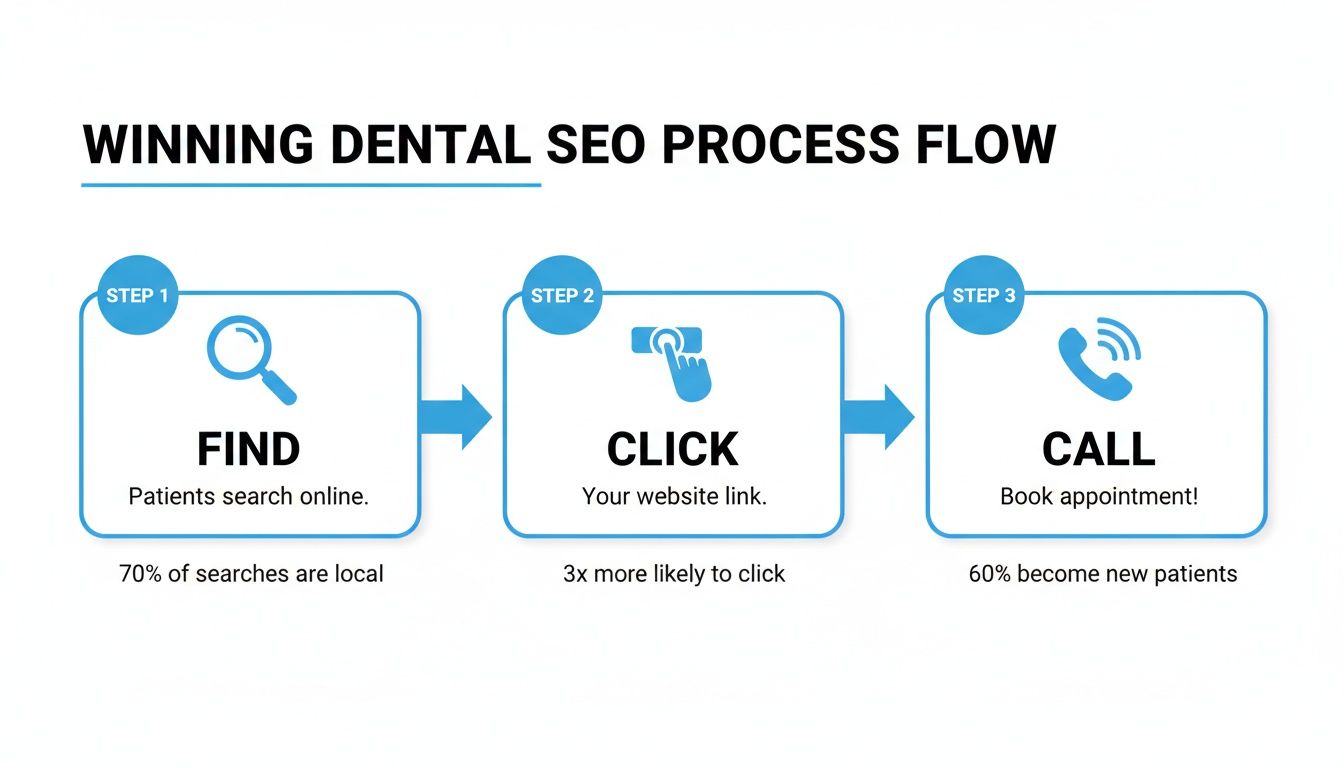
This direct path from discovery to action is what turns online visibility into real, measurable growth for your practice.
From Search Rankings to Patient Calls
Showing up at the top of Google is great, but it's only half the job. The real goal of any solid dental SEO strategy is to make your phone ring. That’s precisely why we put such a heavy emphasis on Google Maps optimization.
Securing a spot in the top three of the local map pack for those transactional searches is one of the most powerful lead-generation tools you have. If you're looking for a solid overview of the SEO landscape, this is a great a beginner's guide to winning the SEO game.
At Transactional Marketing, we have the technology to get your practice showing up in the top three map locations in your service areas. This isn't a minor tweak; it's a strategic move that translates into hundreds of more phone calls every month and literally thousands more every year.
We don’t do one-size-fits-all SEO here. We get laser-focused on the specific transactional search terms that matter to your dental practice in your city. This playbook will break down the strategies that take dental practices from being invisible online to becoming the go-to choice for patients ready to spend money. For a deeper look at specific tactics, you can also check out our guide on dental practice marketing strategies.
The New Frontier: AI Optimization
The way patients find local businesses is already changing, with AI and large language models (LLMs) becoming more integrated into search. This is the next frontier of being found online. We're talking about AI optimization—ensuring your practice shows up as the definitive answer when people use voice search or AI-driven platforms.
AI optimization is crucial because it’s the new way businesses will be discovered. When someone asks their phone "find the best dentist for a crown near me," you want your practice to be the answer. This guide will get into how to create content that not just ranks in traditional search but also positions your practice as the top result for AI assistants and LLMs.
This guide is your step-by-step playbook covering how to:
- Dominate Google Maps for high-value, transactional patient searches.
- Use AI optimization to create content that answers real patient questions in LLMs.
- Build a website that doesn't just look good, but actually converts clicks into calls and booked appointments.
This isn't about chasing traffic. It's about getting you to show up for transactional search terms that generate tangible, measurable results and grow your practice.
How to Dominate Google Maps and Drive Patient Calls
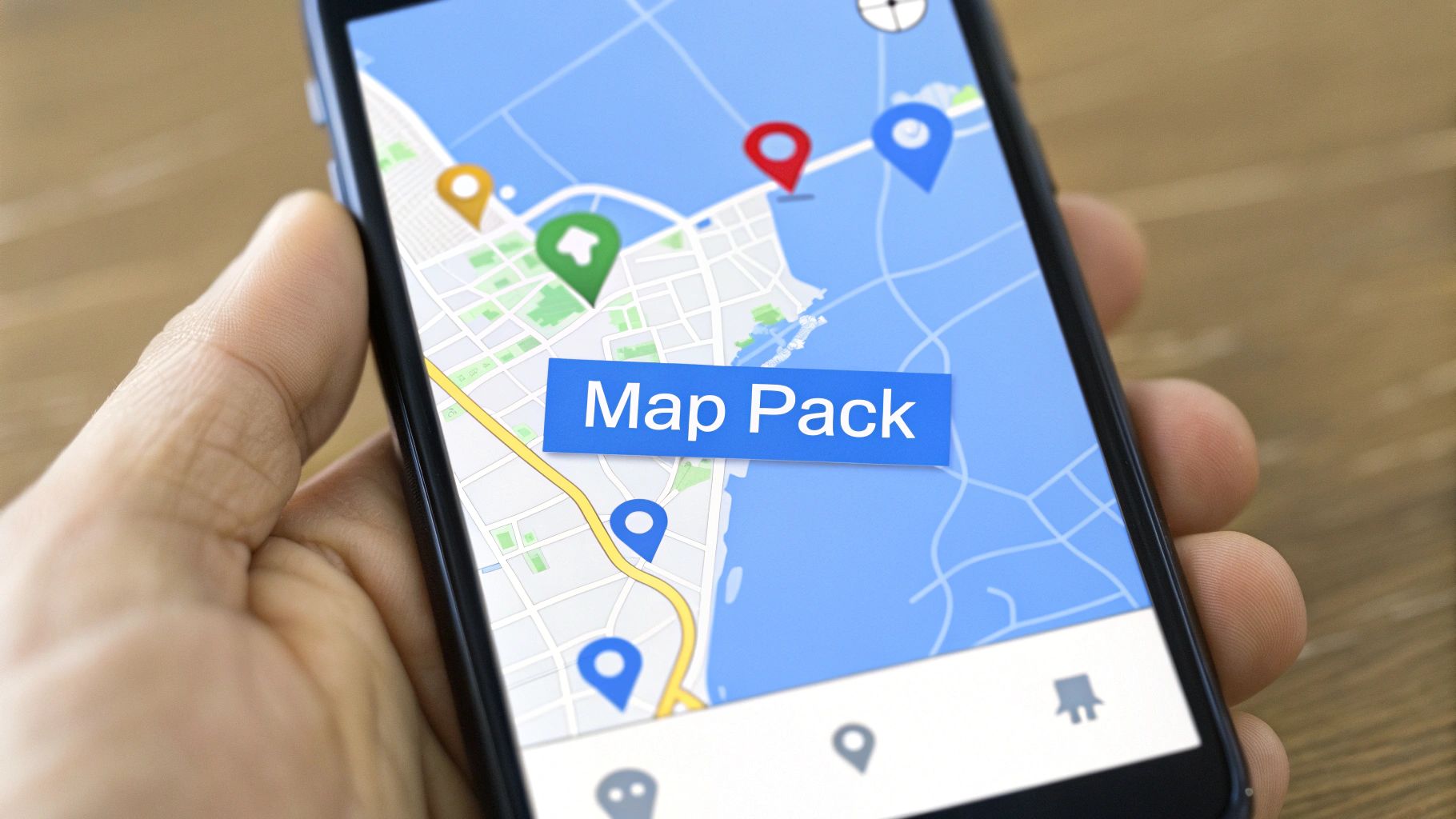
When someone frantically searches "emergency dentist near me," they aren't just browsing. They're in pain, stressed, and have money ready to spend now. Their first point of contact will almost certainly be the Google Map Pack—that block of three local businesses at the very top of the search results.
For a dental practice, this isn't just a map. It's the digital front door where your next high-value patient is waiting. Your Google Business Profile (GBP) is the key that unlocks it.
At Transactional Marketing, our entire focus is getting our clients into that top-three spot for the searches that actually convert. Why? Because visibility here translates directly into phone calls. It's the single most powerful tool for attracting local patients who are ready to book. A well-managed profile isn’t just a listing; it’s a patient-attraction machine that can deliver hundreds of new calls every single month.

Optimizing Every Detail for Patient Intent
Getting to the top of the Map Pack isn't about luck. It requires a meticulous, almost obsessive approach that goes way beyond a basic setup. Every single field in your Google Business Profile needs to be optimized to signal relevance and authority for transactional searches—both to Google's algorithm and to potential patients.
This starts with your business categories. Your primary category has to be precise. Choose "Dentist" or a specialty like "Orthodontist," never the vague "Dental Clinic." From there, your secondary categories should pinpoint your high-value services, like "Cosmetic Dentist," "Implant Dentistry," or "Pediatric Dentist."
Your business description is another piece of prime real estate. This is no place for generic marketing fluff. It should be a compelling, keyword-rich story that speaks directly to a patient's problems, weaving in transactional terms like "sedation dentistry in [Your City]" or "same-day dental crowns." Think of it as your elevator pitch to someone ready to spend money. We've actually built a proven system to rank higher on Google Maps which you can check out for more of our advanced techniques.
A fully optimized Google Business Profile is the non-negotiable cornerstone of any dental SEO strategy that actually works. We use specialized technology to ensure every element of your profile is perfectly tuned to capture high-intent, transactional patient searches, making your practice the obvious choice in the Map Pack.
Consistency is Your Local Authority Signal
One of the biggest local ranking factors is the consistency of your NAP (Name, Address, Phone Number) data across the web. It sounds simple, but it’s amazing how often this gets messed up.
Any small discrepancy—a slight variation in your practice name ("Dr. Smith Dental" vs. "Smith Dentistry"), an old address, or a wrong phone number on a random directory—confuses search engines and erodes the trust they have in your listing. This is a common and costly mistake.
Our system ensures your NAP information is perfectly consistent across every relevant online directory and citation source. This methodical data management builds a rock-solid foundation of local authority, signaling to Google that your practice is a legitimate, reliable business at its listed location. Getting this right is a prerequisite for reaching and holding onto those top-three Map Pack rankings.
Active Engagement Builds Trust and Drives Calls
A "set it and forget it" GBP is a dead GBP. To truly dominate the local search results, your profile has to be an active hub of engagement. This means doing a few key things consistently to build trust and give potential patients the confidence to pick up the phone.
- Google Posts: Regularly publish posts with practice updates, special offers, or new patient testimonials. This keeps your profile fresh and shows Google you’re an active, thriving business.
- Q&A Section: Don't wait for people to ask questions. Proactively populate the Questions & Answers section with common patient inquiries (and your expert answers) to address concerns upfront and position yourself as a helpful authority.
- Photo and Video Uploads: Nothing builds trust like seeing the real thing. High-quality images and videos of your office, your friendly staff, and your modern technology give new patients a virtual tour and help them feel comfortable before they even walk through the door.
Think this doesn't matter? A whopping 80% of potential dental patients turn to search engines like Google to find their next dentist. And according to recent dental marketing insights, 1 in 4 of those searches leads to a same-day appointment. That’s how immediate and high-intent these transactional searches are, making a dynamic, engaging Google Business Profile absolutely essential.
Building Your Digital Clinic: Content That Converts Patients
In a crowded market, a winning dental SEO strategy isn't just about ranking for a few keywords. It's about becoming the go-to authority for dental care in your community. Building that authority starts with great content, but let's be honest—consistently creating high-quality articles is tough.
This is where smart AI optimization comes in. By creating content structured for both traditional search and Large Language Models (LLMs), you can build out your digital presence faster and more effectively than ever before.
The idea is to create content that speaks directly to a potential patient's concerns while also sending all the right signals to Google and AI platforms. As search evolves with AI-powered answers, this approach ensures your practice shows up not just in the classic blue links, but in the new answer formats people are starting to rely on.
Structuring Your Content for Maximum Impact
A scattered approach to blogging simply won't get you the results you need. To really own the search results for your most profitable services, you need to think strategically. We do this by building content silos.
Imagine organizing a library. You wouldn't just throw books on random shelves, would you? You'd group them by topic. A content silo does the same for your website, making it incredibly easy for both patients and search engines to understand what you're an expert in.
A silo is built with two key components:
- Pillar Page: This is the cornerstone. It's a comprehensive, deep-dive page on a broad, high-value service you offer, like "Cosmetic Dentistry in [Your City]."
- Cluster Content: These are shorter, more focused articles or blog posts that explore specific subtopics related to your pillar. Crucially, they all link back to the pillar page, signaling its importance.
This structure is how you build true topical authority. Your website becomes the definitive resource for that service. When done right, this is a powerful way to drive down your marketing costs over time. We cover this concept more in our guide on how to reduce customer acquisition cost.
A Practical Dental Content Silo Example
Let's see what this looks like for a common, high-value service.
Pillar Page (The Core Service):
Your main service page for "Cosmetic Dentistry in Dallas"
Cluster Content (Supporting Blog Posts):
- "How Much Does Teeth Whitening Cost in Dallas?"
- "Are Porcelain Veneers the Right Choice for Me?"
- "Invisalign vs. Traditional Braces: A Patient’s Guide"
- "The Benefits of a Full Smile Makeover"
See how it works? Each blog post targets a very specific question a potential patient has. The post on teeth whitening costs, for instance, catches someone who is very close to making a decision. The Invisalign comparison, on the other hand, connects with a patient who is earlier in their research phase.
By creating content that covers every stage of the patient journey, you cast a much wider net. You're not just waiting for "dentist near me" searches. You're showing up for all the detailed questions that lead a person to that final, booking-focused transactional search.
This is the laser-focused approach we take. We dig deep to find the exact search terms your ideal patients use—from the moment they start wondering about a service to the day they're ready to book an appointment. We then build an unshakeable content foundation that gets your practice found. It's this proven system that allows us to get our clients showing up on page one, often in just 30 to 60 days.
Designing a Website That Converts Clicks into Patients
Getting your dental practice to the top of Google for a transactional search like "emergency dentist near me" is a huge win. But that victory is completely wasted if a potential patient clicks through to a website that’s slow, confusing, or just plain untrustworthy.
Think of it this way: a top ranking gets them to your digital front door. Your website's design and performance are what convince them to walk through it.
Your website is the final, critical step in the patient journey. It's the moment a high-intent searcher, ready to book, decides whether to call your practice or your competitor's. We build websites that are not just visually appealing but are meticulously engineered to turn those hard-earned clicks into booked appointments.
The Foundation of Conversion: User Experience
The patient experience doesn't start in your waiting room; it begins the second they land on your site. If your page takes more than three seconds to load, a huge chunk of those potential patients will simply leave. That's a lost opportunity and a negative signal to Google.
A modern dental website has to be built on a foundation of speed and accessibility. That means a fast, mobile-friendly design isn't a luxury—it's absolutely non-negotiable, especially since most local searches for dentists happen on a smartphone.
Navigation needs to be dead simple, allowing a visitor in distress to find your phone number or an online booking link without a second thought.
Your website is your 24/7 digital receptionist. It needs to be fast, helpful, and instill immediate confidence. Every single element, from page speed to the placement of your phone number, should be optimized for one goal: converting a searcher into a scheduled patient.
Structuring Service Pages for High-Intent Patients
Generic service pages just don't cut it anymore. If you want to capture high-value patients, each of your service pages needs to be laser-focused on a specific service and location.
Instead of a single, vague "Cosmetic Dentistry" page, a truly effective site structure features dedicated pages for each money-making service:
- Dental Implants in Boston
- Teeth Whitening in Boston
- Invisalign Specialist in Boston
Each of these pages acts as a specific landing zone for a patient with a clear, immediate need. They are optimized with targeted content, relevant keywords, and direct calls-to-action that speak to that exact service. This precise targeting is how we help our clients dominate transactional search results and attract the exact patients they want to see.
Building Instant Trust and Credibility
Trust is the currency of healthcare. When a potential patient lands on your website, they are subconsciously looking for signals that your practice is professional, experienced, and caring. Your website has mere seconds to build that trust.
Here's a reality check: a staggering 97% of dental patients research practices online before ever booking an appointment. That alone makes a high-quality, SEO-optimized website non-negotiable. When you combine this with the fact that online reviews can influence up to 70% of their decision, it becomes crystal clear why reputation and trust are everything. You can discover more insights about these dental SEO trends to see the full picture.
So, how do you build that trust? Here are the critical elements every dental website must have:
- Authentic Patient Testimonials: Feature real reviews and photos to provide powerful social proof.
- Compelling Before-and-After Galleries: Let the quality of your work speak for itself, especially for cosmetic procedures.
- Professional Staff Bios: Introduce your dentists and hygienists to build a genuine personal connection.
- Clear Calls-to-Action (CTAs): Make it incredibly easy for visitors to take the next step with prominent "Book Online" and "Call Us Now" buttons.
By combining a technically sound website with these essential trust factors, you create a powerful conversion engine. This ensures that the traffic we drive from transactional searches and top Google Maps rankings translates directly into a fuller appointment book for your practice.
Measuring SEO Success and Proving Your ROI
Any marketing effort is an investment, and SEO is no different. You need to know if it's actually working. The problem is, many agencies will try to distract you with "vanity metrics"—things like website traffic or impressions. These numbers look impressive on a report but don't necessarily put new patients in your chairs.
At Transactional Marketing, we cut right through that noise. We believe success is measured by the only metric that truly matters to your practice’s growth: new patient acquisition. Our entire focus is on tracking the key performance indicators (KPIs) that prove our strategies are delivering tangible value.
This isn't about guesswork; it's about data-driven proof. A successful seo dental campaign should produce a clear and measurable return on your investment every single month by getting you to show up for transactional search terms.

Key Performance Indicators That Matter
If you want to understand your ROI, you have to track the actions that directly lead to revenue. It's time to forget about those vague traffic charts. The KPIs we monitor are tied directly to real-world outcomes for your dental practice.
Here’s what we actually focus on:
- Inbound Phone Calls from Organic Search: This is the gold standard. We track how many potential patients pick up the phone and call your office after finding you on Google. This is the most direct line from a transactional search to a booked appointment.
- Appointment Form Submissions: Not everyone is ready to call. We also measure how many visitors fill out your "Book an Appointment" or contact forms after arriving from an organic search result.
- Google Maps Actions: We keep a close eye on how many people click for driving directions to your office or tap the "click-to-call" button on your Google Business Profile. These are high-intent actions from local patients who are ready to come in.
- New Patient Acquisition Rate: This is the ultimate KPI. We work with you to connect our marketing efforts directly to the number of new patients who walk through your door, which allows for a crystal-clear calculation of your return.
These are the metrics that move beyond abstract data and show the real, tangible impact on your practice's bottom line.
Transparent Reporting for True Accountability
You should never have to wonder if your marketing is paying off. That's why we provide a transparent, results-driven dashboard that gives you a clear and honest view of your campaign's performance at all times.
A partnership should be built on trust and provable results. Our reporting isn't designed to confuse; it's designed to give you complete confidence that your investment in targeting transactional terms is generating a significant return through a steady stream of new, high-value patients.
Our dashboards are far more than just spreadsheets; they are powerful visualization tools. We use a suite of professional local SEO reporting tools that bring your data to life, allowing you to see exactly where your practice is winning.
A look inside our dashboard would typically include:
- Keyword Rank Tracking: See your real-time rankings for the most critical patient-focused search terms, like "dental implants in [Your City]" or "emergency dentist near me."
- Service Area Heat Maps: Visualize your Google Maps visibility across your entire service area. This shows you exactly where your practice is dominating and where there are new opportunities to grow.
- Integrated Google Search Console Data: Get a clear overview of the exact search queries people are using to find your practice, providing invaluable insight into patient intent.
This level of transparency ensures you always know how our proven system is performing. We get your practice showing up for transactional searches, and our reporting proves its value, month after month.
Frequently Asked Questions About Dental SEO
Even with a solid plan, it's natural to have questions about how SEO actually works for a dental practice. Let's tackle some of the most common ones we hear from dentists, cutting straight to the practical answers you need.
How Long Does It Really Take to See Results From Dental SEO?
I know you want a straight answer, and a lot of agencies are hesitant to give one. Based on our proven system, you can realistically expect to see your website showing up on page one of Google for high-value, transactional keywords within 30 to 60 days.
How is that possible? Our process is not like every other boring marketing company. We laser-focus on the "money" keywords—the phrases patients type when they're in pain and ready to book. Think of searches like "emergency root canal in Dallas" or "chipped tooth repair near me." By optimizing your Google Business Profile and website for these urgent, transactional queries first, we generate momentum and get your phone ringing quickly.
Should My Practice Invest in SEO or Paid Ads?
This isn't an either/or question; it's about strategy. Both have their place, but a strong SEO foundation is the single best long-term investment you can make in your practice's growth. SEO builds organic visibility that brings in new patients consistently, month after month, without you paying for every single click. It's the difference between owning your digital real estate and just renting it.
Paid ads are fantastic for a quick boost, like promoting a new dental implant special or filling a last-minute opening. But our focus is on dominating the organic search and Google Maps results for those transactional terms. This approach creates a reliable, predictable stream of new patients that's far more cost-effective and builds more trust than ads ever could. Over time, a powerful SEO presence will dramatically lower your patient acquisition costs.
Can SEO Work for My Practice in a Competitive City?
Absolutely. In fact, if you're in a competitive metro area, a smart SEO strategy isn't just a good idea—it's essential for survival. Your competitors are already doing it, but that doesn't mean you can't win.
Our approach works so well in crowded markets because we don't just target the obvious keywords like "dentist in Chicago." We find the openings by focusing on hyper-local and service-specific transactional phrases that other agencies completely miss. By mastering Google Maps and building your authority around these niche searches, we carve out a dominant position right where your ideal patients are looking.
It's not about outspending the competition; it's about out-thinking them with a more precise strategy. If you're new to this whole world or just want a refresher on the fundamentals, this guide on What is Search Engine Optimization (SEO) is a great starting point.
What Makes SEO for Dentists Different From Other Industries?
Dental SEO is a completely different ballgame because it is entirely focused on a specific service in a specific local industry. It's intensely local and driven by immediate, often urgent, patient needs. Someone searching for "cracked molar repair" isn't just browsing—they have a problem and money in hand to fix it right now.
This means your entire strategy has to be built around local search signals, Google Maps visibility, and powerful trust factors like a steady stream of 5-star patient reviews. The only metric that matters is making the phone ring with a qualified patient ready to book an appointment. Every single element, from the transactional keywords we choose to the layout of your website, has to be laser-focused on that one conversion goal.
Ready to stop waiting for new patients and start attracting them directly from search? Transactional Marketing has the proven system to get your practice ranked for the high-intent, transactional terms that drive real growth.
Schedule your free, no-obligation strategy session with us today!