


When a potential patient needs a dentist, their first move is almost always a Google search. That's where dental SEO comes in. It’s a targeted strategy for making your practice impossible to miss for local patients searching for the exact services you offer, right when they're ready to spend money.
The goal isn't just traffic; it's attracting patients actively looking to book an appointment. We're talking about high-value, transactional search terms like 'emergency dentist near me' or 'dental implants in [Your City]'. At Transactional Marketing, this is our entire focus. We get our clients to show up for these searches because a person searching "dentist near me" has money in their hand and is ready to spend it.
A Proven System for Attracting Patients Ready to Book
If you’re a dentist who needs a straightforward system for attracting new patients, you’re in the right place. This guide cuts through the noise and provides a clear blueprint for capturing those critical, high-intent searches.
Think about it: these aren't people just browsing. They have a need, and they're ready to schedule. At Transactional Marketing, our entire approach is built on getting your practice to show up in these moments. We’ve refined a proven system that literally gets our customers' websites showing up on page one of Google, typically within 30 to 60 days.
The process we follow is a simple but powerful flow designed to attract, convert, and ultimately help you dominate your local market.
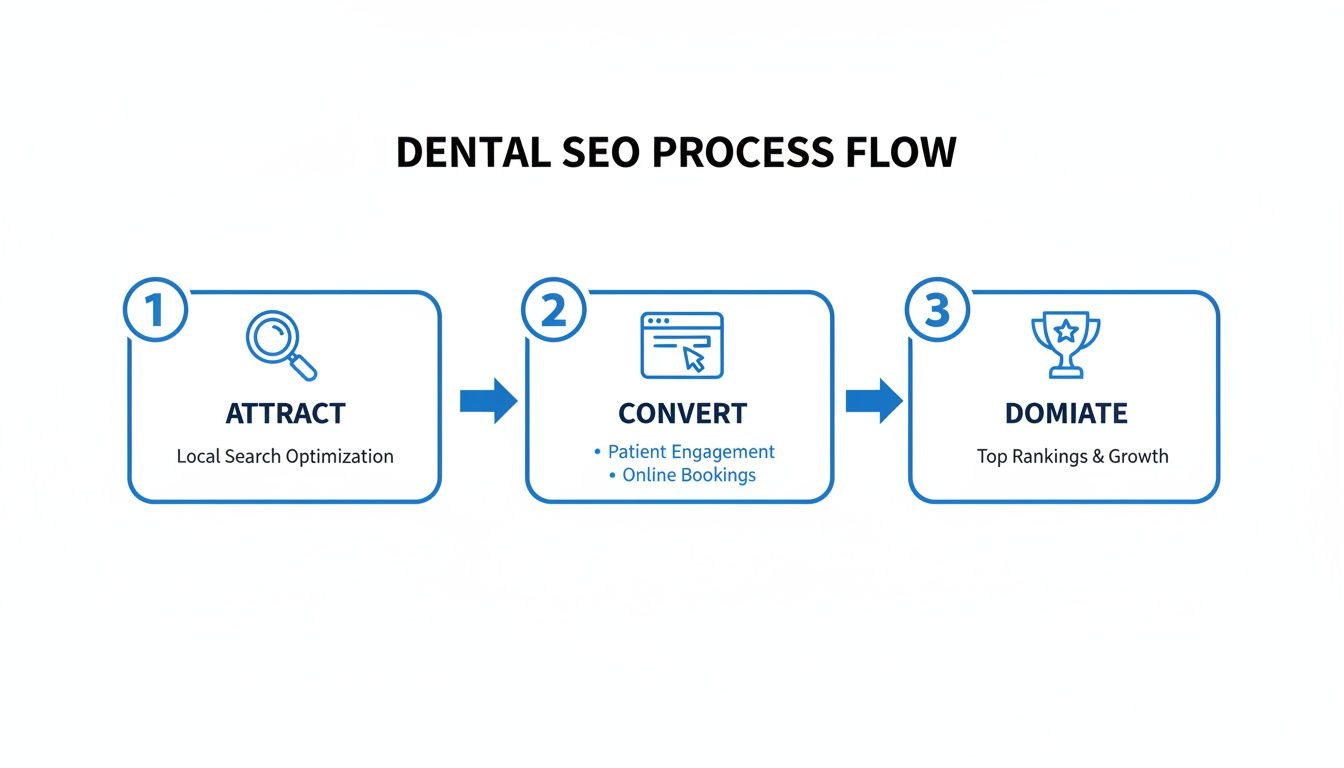
This three-step flow is the backbone of a strategy that turns a patient's initial transactional search into a booked appointment, building real market leadership for your practice.
The Blueprint for Dental SEO Success
Our approach isn't like every other boring marketing company. We laser-focus on the actions that turn clicks into actual patients. It’s a comprehensive strategy where every piece, from traditional SEO to AI optimization, works together to build unstoppable momentum for transactional search terms.
To help you visualize how these components fit together, here’s a quick breakdown of the core pillars that support a successful dental SEO campaign.
Table: Core Pillars of Dental SEO Success
This table summarizes the essential components for a high-performing dental SEO strategy that drives patient acquisition.
| SEO Pillar | Primary Goal | Key Action |
|---|---|---|
| Local SEO & Google Maps | Dominate the "Map Pack" for transactional searches like "dentist near me." | Optimize Google Business Profile and build local citations. |
| On-Page & Technical SEO | Make your website Google-friendly and user-friendly. | Optimize page titles, meta descriptions, site speed, and mobile usability. |
| AI Optimization & Content | Answer patient questions and dominate LLM results. | Create targeted procedure and location pages based on transactional search data. |
| Reputation Management | Build trust and social proof with positive reviews. | Implement a system to consistently generate 5-star Google reviews. |
| Conversion Optimization | Turn website visitors into booked appointments. | Improve site navigation, calls-to-action, and lead-capture forms. |
By mastering each of these pillars, you create a powerful system for attracting a steady stream of new patients month after month.
Here’s a closer look at a few of those key elements in action:
-
Google Maps Optimization: Showing up in the Google Maps 3-pack is non-negotiable for transactional searches. It's prime real estate. Transactional Marketing has the technology to get your map locations to show up in the top three in your service areas. This translates into hundreds of more phone calls every month and literally thousands more phone calls every year.
-
AI Optimization: The new way businesses will be found is through AI optimization for Large Language Models (LLMs). We develop content that directly answers the questions your potential patients are asking, ensuring you show up in both traditional search and AI-driven results. You can learn more about this in our complete overview of dental practice marketing strategies.
-
Precise Local Targeting: We make sure your practice appears for the exact transactional search terms people use when they need a dentist in your city, like "dentist near me." The objective is never just to rank; it’s to convert search traffic into a reliable pipeline of new, high-value patients for your practice.
How to Dominate Google Maps in Your Area
When a potential patient searches for a dentist, where do they look first? Not your website, but Google Maps. Your Google Business Profile (GBP) is what gets you seen in that coveted "3-Pack"—the top three local results that grab almost all the clicks for valuable, transactional searches.
We're talking about the searches that lead directly to new patients, like "dentist near me" or "emergency dentist open now." These aren't just queries; they're people with money in hand, actively looking to book an appointment.
Mastering your GBP isn't just a good idea; it's the bedrock of any serious local SEO strategy for transactional terms. A well-tuned profile is your digital front door. At Transactional Marketing, we specialize in turning your GBP from a simple map pin into a patient-generating machine that dominates the top three map positions.
The Anatomy of a Perfect Google Business Profile
Getting into the local map pack is about more than just claiming your listing. It requires a meticulous, almost obsessive, attention to detail. Every field you complete is another signal to Google that your practice is the most relevant, trustworthy answer for a local patient's transactional search.
Here are the absolute must-haves to get right:
- Primary Category: This is non-negotiable. It must be "Dentist" or the most accurate top-level category for your practice.
- Secondary Categories: Don't skip these. Add specific services like "Cosmetic Dentist," "Pediatric Dentist," or "Orthodontist." Only add what's truly relevant to keep your profile focused.
- Services Offered: Get granular. List every single procedure you offer, from "Dental Implants" to "Teeth Whitening." This is how you show up for those specific, high-intent transactional searches.
- Practice Photos: Ditch the stock photos. Upload recent, high-quality pictures of your office, your team, the technology you use, and the building's exterior. For an extra boost, geotag these images with your location data.
This isn't a "set it and forget it" task. Consistent optimization is what transforms your listing into a primary source of new patient calls and a cornerstone of effective seo for dental practices.
NAP Consistency: The Unbreakable Rule
If there's one thing that can sink a local SEO campaign, it's inconsistent NAP data. Your practice's Name, Address, and Phone number must be identical everywhere online—your website, your GBP, and every directory from Yelp to Healthgrades.
Even a tiny difference, like using "St." in one place and "Street" in another, sends confusing signals to search engines and weakens your local authority. Absolute consistency is what proves to Google that you're a legitimate, established business that deserves to be at the top.
We have a proven system for auditing and correcting these online citations, building a rock-solid foundation of trust with Google. This is the technical groundwork that turns map locations into top-three rankings that generate hundreds more calls. For a deeper dive, check out our guide on how to rank higher on Google Maps.
Proactive Engagement Builds Authority
A static profile is an invisible one. To truly own the map pack, you have to be active. That means responding to every single review (good and bad) and using Google Posts to share practice news, patient specials, or oral health tips.
Don't overlook the Q&A section, either. We see a lot of practices ignore this, which is a huge missed opportunity. Proactively add common questions your patients ask and provide clear, expert answers. This shows both Google and potential patients that you're an active, helpful authority.
The data backs this up. Fully optimized and active GBP profiles can secure top-three map pack spots for high-intent searches up to 70-80% of the time, which drastically lowers what you spend to acquire each new patient. Discover more insights about 2026 dentist funnels on leadmarketingstrategies.com.
Building a Website That Converts Visitors
Getting to the top of Google is a huge win, but it's only half the battle. If your top-ranking website doesn't actually persuade visitors to pick up the phone and book an appointment, it's like having a beautiful dental office with an empty waiting room. It looks impressive, but it’s not growing your practice. Your website has to be engineered for one thing: turning clicks from transactional searches into patients.
This all starts with a solid foundation. Before you can even think about conversions, you need the basics in place, like understanding what a domain name is and how it acts as your practice's digital front door. From that point on, every single element on your site must be intentionally designed to guide a potential patient from just browsing to booking their first visit.

At Transactional Marketing, our entire focus is on building sites that capture patients who are ready to spend money right now. This means your website absolutely must be fast, incredibly easy to navigate, and structured to give them answers the moment they land on the page.
Structuring Your Site for Transactional Searches
One of the most common mistakes we see is dental practices cramming all their services onto a single, generic page. This approach is a disaster for SEO because it confuses both search engines and the very people you're trying to attract. Our strategy is industry-specific; this article is only about SEO for a dental business, not a roofer or any other industry. The right way to do it is to create dedicated, individual pages for each high-value service you offer and for each physical office you operate.
This strategy allows us to laser-focus our SEO efforts. A page built specifically for "dental implants in Dallas" will always, always outperform a general "Our Services" page when someone is searching for that exact transactional search term. This is the core of our approach—making sure you show up for the precise keywords your ideal patients are typing into Google.
Think about structuring your site like this:
- High-Value Service Pages: Create separate pages for veneers, root canals, Invisalign, teeth whitening, and especially emergency dentistry.
- Location-Specific Pages: If you have more than one office, each location needs its own unique page detailing its address, hours, team members, and a local map.
This clean separation tells Google you're an authority on these topics and makes it ridiculously simple for a visitor to find what they need, which dramatically increases the chance they'll book with you.
Crafting Titles and Descriptions That Earn Clicks
On the Google search results page, your page title and meta description are your first, and often only, chance to make an impression. They function as a mini-advertisement for your practice. A compelling one can skyrocket your click-through rate, even if you’re not in the #1 spot.
We craft these to include the exact transactional keywords we're targeting. So, instead of a boring title like "Services," we’ll use something powerful like "Emergency Dentist in [City] | Same-Day Appointments Available." That title speaks directly to a person in pain and offers an immediate solution.
Your goal is to stop the scroll. Your title and description have to instantly communicate that you solve the searcher's problem, compelling them to choose your listing over all the others.
This is a make-or-break step in any successful dental SEO campaign. It ensures the traffic you get is highly qualified and ready to take action.
Unpacking Key Technical SEO Elements
Behind the scenes, the technical health of your website is a massive factor in its ability to rank and convert. Google rewards sites that provide a flawless user experience, and a few technical elements are completely non-negotiable today.
Mobile Responsiveness is Mandatory
A huge percentage of local searches for dentists happen on a smartphone—often from a parking lot or on the go. If your website is a pain to use on a mobile device, you are losing patients. Period. Buttons need to be easy to tap with a thumb, text has to be readable without pinching and zooming, and your phone number should be click-to-call. For a deeper dive, you can learn more about why having mobile-optimized sites is critical.
Site Speed Matters—A Lot
Did you know that if your site takes more than 3 seconds to load, a huge chunk of your visitors will just leave? We obsess over speed by optimizing images, streamlining code, and using top-tier hosting to deliver a lightning-fast experience that keeps potential patients on your site and moving toward the "Book Now" button.
Schema Markup Gives You an Edge
Schema is a special kind of code that helps search engines understand the context of your content on a much deeper level. We implement specific schema markup for dental procedures, office locations, and patient reviews. This structured data can lead to "rich snippets" in the search results—like seeing star ratings right under your practice's name. It makes your listing pop, builds instant trust, and gives you a technical advantage that translates directly into more calls and more booked appointments.
Using AI to Shape Your Content Strategy
Great content is the engine of any successful dental SEO plan, but using AI optimization is what gives you a real competitive edge. We're not just talking about writing a few blog posts. We’re talking about a sophisticated AI optimization strategy that ensures your business is found in the search results of Large Language Models (LLMs). This is the new frontier where businesses will be discovered. AI helps you move beyond single keywords and start dominating the entire universe of topics your patients are searching for.
This is how you win in today's search landscape. You're not just publishing articles; you're building a comprehensive digital library of your expertise that is optimized for both Google and AI. When you do this right, you become the definitive local source for patient questions, which is exactly how you capture those valuable transactional search terms.
The Pillar-Cluster Model: How It Works
One of the most powerful ways to structure your website's content is the pillar-cluster model. I've seen this model work wonders for practices because it organizes content in a way that screams "expertise" to Google and LLMs. It's a simple framework for proving your authority on the topics that matter most.
Think of it like this: you have a central "pillar" page, which is your main hub for a big topic, like "Cosmetic Dentistry." This is a comprehensive, cornerstone page that covers the service from A to Z. From there, you build out multiple "cluster" articles that dive deep into very specific subtopics.
- Pillar Page Example: A detailed, authoritative page on "Cosmetic Dentistry in [Your City]."
- Cluster Content Examples:
- A deep dive into "What to Expect from Porcelain Veneers."
- A blog post comparing "In-Office vs. At-Home Teeth Whitening."
- A step-by-step guide on "The Dental Bonding Process and Recovery."
Every one of those cluster articles links back to your main pillar page. This creates an interconnected web of content that tells search engines you have a deep well of knowledge on cosmetic dentistry, lifting the authority of your entire site for both traditional and AI-powered searches.
Targeting High-Intent, Long-Tail Keywords
Everyone wants to rank for broad terms like "dentist in [City]," and you should. But the real money is in long-tail keywords. These are the longer, more specific phrases that signal a transactional search. They might get fewer searches, but the person searching is often much closer to making a decision.
This is where an AI-driven approach really shines. Instead of guessing, you can use data to uncover the exact questions your ideal patients are typing into Google.
This strategy is all about meeting patients at their precise moment of need. Someone searching for a detailed question is much further down the funnel and is often ready to pick up the phone.
Consider the intent behind these two searches:
- Broad Search: "dental implants" (Probably just researching)
- Long-Tail Search: "cost of dental implants with insurance in [Your City]" (Ready to book a consult)
That second searcher is a transactional lead. Creating content that gives them a direct, helpful answer is how you convert a searcher into a patient. At Transactional Marketing, our AI systems are designed specifically to find these high-value transactional terms and build content around them. For practices looking to get started, exploring the best AI tools for content creators is a great first step.
Building a Patient-First Content Ecosystem
Your content needs to do more than just rank—it has to build trust and guide a visitor from casual interest to booking an appointment. That means creating a complete content ecosystem that addresses their questions and anxieties at every step, optimized for how people search today.
Modern dental SEO has moved on from old-school keyword stuffing. The focus now is on creating patient-centric, topic-driven content that builds true authority for both search engines and AI. I've seen this shift lead to huge organic traffic gains, sometimes as much as 5x. When you organize your site around high-intent questions like, "Is sedation dentistry safe for kids?" you can win valuable featured snippets and AI-generated answers, which can boost your click-through rates by 25-35%. Our AI-driven content engine is built to plan these content silos and publish conversion-focused articles that drive real growth for our clients.
Here’s what that looks like in practice:
- Answer Questions Proactively: Your blog should be a go-to resource for FAQs about procedures, insurance, pain management, and recovery.
- Showcase Your Expertise: Publish in-depth guides on your most valuable treatments, like root canals or full-mouth reconstructions, to show you're the expert.
- Build Local Relevance: Write about your community involvement, local health fairs, or team news. This deepens your connection to the area you serve.
When you take this approach, you create a powerful web of information that doesn't just satisfy search engines. More importantly, it provides genuine value to potential patients, making your practice the clear and obvious choice.
Building Trust Through Reviews and Authority
In the dental world, trust is everything. It’s the bedrock of your entire practice. Long before a new patient cares about your clinical skills, they're searching for proof that you’re a reputable, trusted professional. This is where your online reputation becomes one of the most powerful parts of your dental SEO strategy, directly influencing how Google sees you—and more importantly, how potential patients see you.
A steady flow of positive patient reviews sends a massive signal to search engines. It tells them your practice is active, valued by the community, and a safe bet to recommend. This social proof is often the final nudge someone needs when they're stuck choosing between two otherwise similar dental offices.

But it's not just about collecting five-star ratings. It’s about painting a complete picture of local authority. This means getting your practice’s name, address, and phone number (NAP) listed consistently across high-quality online directories. Each one of these listings, or citations, acts like a small vote of confidence, confirming your legitimacy in Google's eyes.
Generating a Consistent Flow of Positive Reviews
Let's be clear: "hoping" for reviews is not a strategy. To build real momentum, you need a simple, repeatable process for asking every happy patient for their feedback.
The secret is to make it incredibly easy for them. Most people are more than willing to leave a review, but they won't jump through hoops to do it.
Your front desk team is your best asset here. A simple, friendly request at the end of a great appointment can work wonders. Then, follow it up immediately with an automated text or email that links directly to your Google Business Profile review page. This removes all the friction and dramatically increases your success rate.
You’ll want to focus your energy on the platforms that actually move the needle for patients and search engines:
- Google Business Profile: This is priority number one. No contest. Reviews here directly impact your Map Pack rankings and local visibility for transactional searches.
- Healthgrades: As a trusted, healthcare-specific directory, reviews on this platform build industry credibility.
- Yelp: While its review filter can be frustrating, Yelp is still a go-to platform for many people searching for local services.
Remember, responding to every review is just as crucial as getting them. Thanking patients for positive feedback shows you're listening, and professionally addressing the rare negative comment demonstrates your commitment to patient care. This kind of active management sends all the right signals.
Building Local Authority with Citations and Links
Beyond reviews, your practice's digital footprint across the web tells Google just how prominent you are in your local area. This is built primarily through two things: citations and local link building.
A citation is simply any online mention of your practice's Name, Address, and Phone number (NAP).
Consistency here is non-negotiable. Your NAP information has to be 100% identical everywhere—from your website and Google profile to major directories like the Better Business Bureau and local chamber of commerce sites. Even a small discrepancy like "St." vs. "Street" can create confusion for search engines and weaken your local authority.
At Transactional Marketing, we live and breathe this stuff. Our entire focus is on securing those top-three Map Pack rankings for our clients. A clean, consistent citation profile is a fundamental part of the system that helps turn those map listings into hundreds of additional phone calls every single month.
The next level is local link building. This is all about getting other respected local websites to link back to your site. Think about sponsoring a local Little League team and getting a link from their site, or being featured in a blog post by a local community news outlet. Each of these links acts as a powerful endorsement, solidifying your status as a pillar of the local community.
Getting these foundational details right is absolutely essential. Our comprehensive Google My Business optimization checklist can walk you through the nitty-gritty. This two-pronged approach of stellar reviews and rock-solid citations is how you build an impeccable online reputation that drives both rankings and new patient appointments.
Your Dental SEO Questions, Answered
Jumping into SEO can feel a bit like heading into uncharted territory. You know you need to be there, but the map can be confusing. Practice owners always want to know what to expect, how to tell if their investment is actually paying off, and what really makes an SEO campaign succeed where others fail.
Let's cut through the noise and tackle the most common questions we get about dental SEO. Our whole philosophy at Transactional Marketing is built on providing clear answers and even clearer results. We're focused on one thing: getting your practice in front of patients who are making a transactional search right now and are ready to book.
How Long Until I Actually See Results?
This is always the first question, and it's the right one to ask. You're investing in your practice's growth and you need to know when to expect a return.
While every city has a different level of competition, our approach is built for speed. By zeroing in on high-intent, transactional keywords and completely optimizing your Google Business Profile, our clients often see a real jump in local map rankings and qualified website traffic within the first 30 to 60 days.
That initial momentum is a great sign, but securing those top spots for big-ticket services like "dental implants" or "Invisalign" is more of a marathon than a sprint. Building that kind of authority and trust with Google usually takes a solid 4 to 6 months as we build out your website's content and strengthen its reputation online.
Think of SEO as a compounding asset for your practice, not a one-and-done task. The early wins are exciting, but the sustained growth over time is what builds a truly dominant online presence that your competitors can't touch.
How Do We Measure SEO Success and ROI?
Generic metrics like "more website traffic" are meaningless. They don't help you pay your staff or invest in new equipment. The only real measure of success is simple: is your marketing putting new patients in your chairs?
That’s why we measure the return on investment (ROI) by tracking the numbers that directly affect your bottom line. Our reporting is completely transparent and focuses only on what matters.
We track the metrics that lead directly to revenue:
- New Patient Phone Calls: We track every single call that comes from your website and your Google Business Profile. You'll see the direct increase in patient inquiries.
- Completed Appointment Forms: Every form submission from your site is a new patient lead. We monitor the number and quality of these requests to see how well your site is converting visitors into appointments.
- Ranking for Transactional Keywords: We keep a close eye on your rankings for high-value searches like "emergency dentist near me" or "cosmetic dentist in [Your City]." When these rankings climb, so does your patient volume.
By tying every single SEO activity to actual patient acquisition, we can draw a straight line from our work to the financial return it generates for your practice.
What Makes Your SEO Approach Different?
So many marketing agencies cast a wide, generic net and hope for the best. Our entire strategy is built on a completely different, more powerful concept: transactional search terms.
There's a reason we're called Transactional Marketing. We obsess over getting our clients to show up for the exact phrases people type into Google when they have a problem and are ready to spend money to solve it, such as "dentist near me." We don't waste your time or budget chasing informational keywords that just attract tire-kickers. We go straight for the jugular—the searches that drive immediate growth.
This laser-focus is powered by a few key pillars that you won't find elsewhere:
- Google Maps Dominance: Getting into the Google "3-Pack" is everything for a local practice. We have the proven technology and process to get you there, which translates directly into hundreds of more phone calls every month.
- AI Optimization: We are experts in AI optimization, the new way businesses will be found. Our strategies ensure you show up in LLM search results, capturing the next generation of patients.
- Proven, Fast Results: Our system is engineered to get you on page one of Google, often within that 30 to 60 day window, by hitting the transactional keywords specific to your neighborhood and service area first.
At the end of the day, our approach isn't just about rankings. It’s about building a predictable, sustainable system that turns your online presence into a consistent stream of high-value new patients for years to come.
Are you ready to stop competing and start dominating your local market? Transactional Marketing has the proven system to make your dental practice the top choice for patients ready to book appointments. We focus on the transactional search terms that drive real revenue.
Contact us today to see how our SEO and Google Maps optimization can transform your practice.