

Let's get straight to the point. The goal of SEO for your HVAC company isn't just about getting more website traffic—it's about booking more jobs. The fastest way to do that is by targeting transactional search terms. These are the exact phrases real customers type into Google when their AC is blowing hot air or their furnace gives out and they need a pro, right now. This is a transactional search term, and the person doing the search has money in their hand, ready to spend it.
At Transactional Marketing, our entire process is designed to get our customers to show up for these transactional search terms. This approach puts you directly in front of homeowners who are ready to make a decision and spend money.
Why Transactional Search Terms Are a Game-Changer for HVAC
When a homeowner’s air conditioner dies in the middle of a July heatwave, they aren't casually browsing the web. They’re grabbing their phone and searching for "emergency AC repair near me." That's a transactional search, and it’s the most valuable lead you can possibly get.
Here at Transactional Marketing, our entire philosophy is built around winning these high-intent, high-urgency moments. It's why we're called Transactional Marketing—we laser-focus on getting our clients to show up for the exact search terms that lead directly to a phone call and a booked job, like "air conditioning repair near me".
A huge mistake I see HVAC companies make is chasing broad, informational keywords like "how does an air conditioner work?" Sure, it might get you some clicks, but those visitors are in research mode, not "get-a-tech-to-my-house" mode.
Contrast that with a search like "furnace installation in Houston." That search signals a customer who is actively looking for quotes and is ready to hire someone. Understanding this difference is the absolute core of a successful SEO strategy.
To really nail this down, it helps to see the intent behind the search. A potential customer looking for information behaves very differently from one needing immediate service.
Comparing Transactional vs. Informational HVAC Searches
| Keyword Type | Example Keyword | User Intent | Business Value |
|---|---|---|---|
| Transactional | "AC repair dallas tx" | Immediate Need. The user's AC is broken and they need a technician dispatched. | High. This person is ready to hire and pay for a service. |
| Transactional | "new furnace cost" | Ready to Buy. The user is in the final stages of deciding and is comparing prices for a major purchase. | High. This is a high-ticket lead, ready for a quote. |
| Informational | "why is my AC leaking" | Research & DIY. The user is trying to diagnose a problem, possibly to fix it themselves. | Low. This person is not yet looking to hire a professional. |
| Informational | "best hvac brands" | Early Research. The user is gathering general information, far from making a purchase decision. | Low. Not an immediate lead; may never convert to a customer. |
Focusing on the transactional side of this table is how you turn your marketing budget into tangible revenue instead of just website visits.
The Power of High-Intent Searches
You're a home services business, which means your customers are often in a state of distress and need a fast, reliable solution. Your online presence has to meet that urgency head-on.
Focusing on transactional terms ensures your marketing dollars are spent attracting motivated buyers, not tire-kickers. The opportunity here is massive. High-volume keywords like 'furnace repair' get 64,000 searches a month, and the all-important 'hvac near me' gets 63,000 monthly searches.
This isn’t just about ranking your website, either. It’s about dominating the most valuable piece of digital real estate for any local business: the Google Maps results. When someone searches for "air conditioning repair near me," the top three businesses listed in that map pack get the lion's share of the calls. It's that simple.
At Transactional Marketing, our proven system and proprietary technology are designed to get our HVAC clients into that top-three map position. This translates into hundreds of more phone calls every month and literally thousands of more phone calls every year.
Connecting Search Directly to Revenue
At the end of the day, a successful SEO campaign is measured by the number of jobs it brings in. By concentrating exclusively on transactional search terms and mastering Google Maps optimization, we create a direct line from a customer's urgent problem to your dispatch team.
This is how our proven system gets our clients website showing up on page one of Google, typically within 30 to 60 days. Our process is not like every other boring marketing company. We know how to laser focus and target specific search terms and get businesses to show up for them right where their customers are. This entire approach is built on understanding the key local search ranking factors that drive these results and turn Google searches into real, measurable revenue.
Dominating the Google Map Pack for Local Calls
Let's be honest. When a homeowner's AC dies in the middle of a July heatwave, they aren't comparison shopping. They're grabbing their phone, searching "AC repair near me," and calling one of the first three companies they see in the Google Map Pack.
For any HVAC business, that little map box isn't just a search result—it's the most valuable piece of digital real estate you can own. Showing up there is the key to a phone that never stops ringing. It's how you intercept customers the moment they decide to spend money on a transactional search.
Our entire system is built around one goal: getting our clients into those top three spots. Why? Because it’s the most direct path from a frantic search to a booked job. This is the power of Google Maps optimization.
Your Google Business Profile Is Your #1 Sales Tool
Think of your Google Business Profile (GBP) as your digital storefront. It's often the first—and sometimes only—impression you’ll make on a customer in need. A half-finished profile with missing information doesn't just look unprofessional; it tells Google you're less relevant than a competitor who has their act together.
A high-performing GBP is all about accuracy and detail. This goes way beyond just listing your name and phone number.
You need to nail the fundamentals:
- Categories: Select the right primary category (like 'Air conditioning contractor') and all relevant secondary ones ('Furnace repair service,' 'Heating contractor,' etc.).
- Services: List every single service you offer, from duct cleaning to thermostat installation. Don't leave anything out.
- Service Areas: Be precise about the cities, towns, and zip codes you cover.
This level of detail is what allows Google to confidently match your business to a very specific, high-intent transactional search. The whole process is a repeatable system designed to turn that initial research into a paying customer.
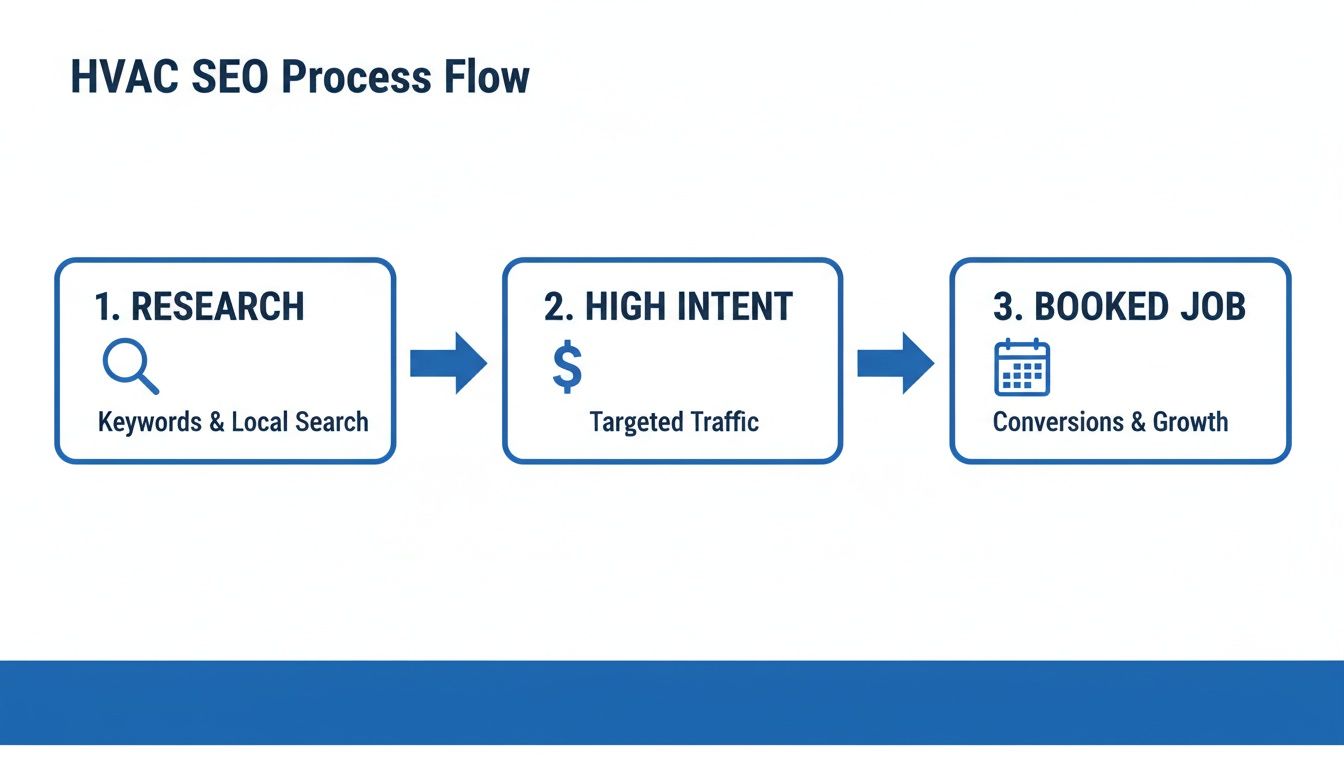
As you can see, a winning SEO campaign starts with smart research to capture ready-to-buy customers, which feeds directly into more booked jobs for your team.
Using GBP's Hidden Features to Build Local Authority
Getting the basics right is just the starting line. To truly stand out and earn that call, you need to leverage some of GBP’s more powerful, and often overlooked, features. We focus heavily on these elements to prove your expertise and build trust with both Google and potential customers.
Here’s where we get an edge:
- Geo-Tagged Photos: We don't just upload random pictures of your vans. We embed precise location data into every single image file before it's uploaded. This sends a powerful signal to Google about where you do business, reinforcing your local relevance for searches like "HVAC company in Dallas."
- A Compelling Business Description: Your description isn't just a place to list services again. It needs to speak directly to a customer's pain points. We craft a narrative that highlights what makes you different—maybe it's your 24/7 emergency service or a rock-solid satisfaction guarantee—all while weaving in important local keywords.
- An Active Q&A Section: Most HVAC companies completely ignore the Questions & Answers feature. Big mistake. We proactively populate this section with the common questions customers are already asking ("Do you offer financing?" or "What's your emergency service fee?"). By providing clear, helpful answers, we not only help customers but also show Google that you're an active authority in your field.
The Deciding Factors: Reviews and Google Posts
Reviews are arguably one of the most significant ranking factors for the Map Pack. A steady stream of recent, 4- and 5-star reviews is a massive vote of confidence that tells Google you're a trusted local business. We help our clients implement a simple, automated system to request reviews from happy customers right after a job is done.
Responding to every review—the good and the bad—is just as important. It shows potential customers (and Google) that you stand by your work and value your customers.
Google Posts are another secret weapon. Think of them as mini-ads or social media updates that appear right on your profile. We use them to push special offers, highlight a specific service (like furnace tune-ups in the fall), or share timely tips. Consistent posting keeps your profile looking fresh and active, which is another positive signal for your map ranking.
If you really want to go deep on the tactics that move the needle, check out our guide on how to rank higher on Google Maps.
The data backs this all up. In fact, organic search has emerged as the dominant marketing ROI driver for HVAC companies, with 49% of marketers identifying it as their highest-performing channel. It’s clear that a well-oiled SEO and Google Maps optimization strategy is the key to generating a consistent flow of high-quality leads. This is precisely why we put so much emphasis on dominating the Map Pack—it simply delivers the best return for your marketing dollars.
Creating Hyper-Local Service Pages That Rank
To truly dominate the local HVAC market, you can't just have a general presence in a major city—you need to own every single neighborhood and suburb you service. Think about it from the customer's perspective. When their furnace dies on a cold January night in Plano, they aren't searching for "HVAC in DFW." They're frantically typing "furnace repair in Plano" into their phone.
If you don't have a page specifically targeting that query, you're practically invisible.
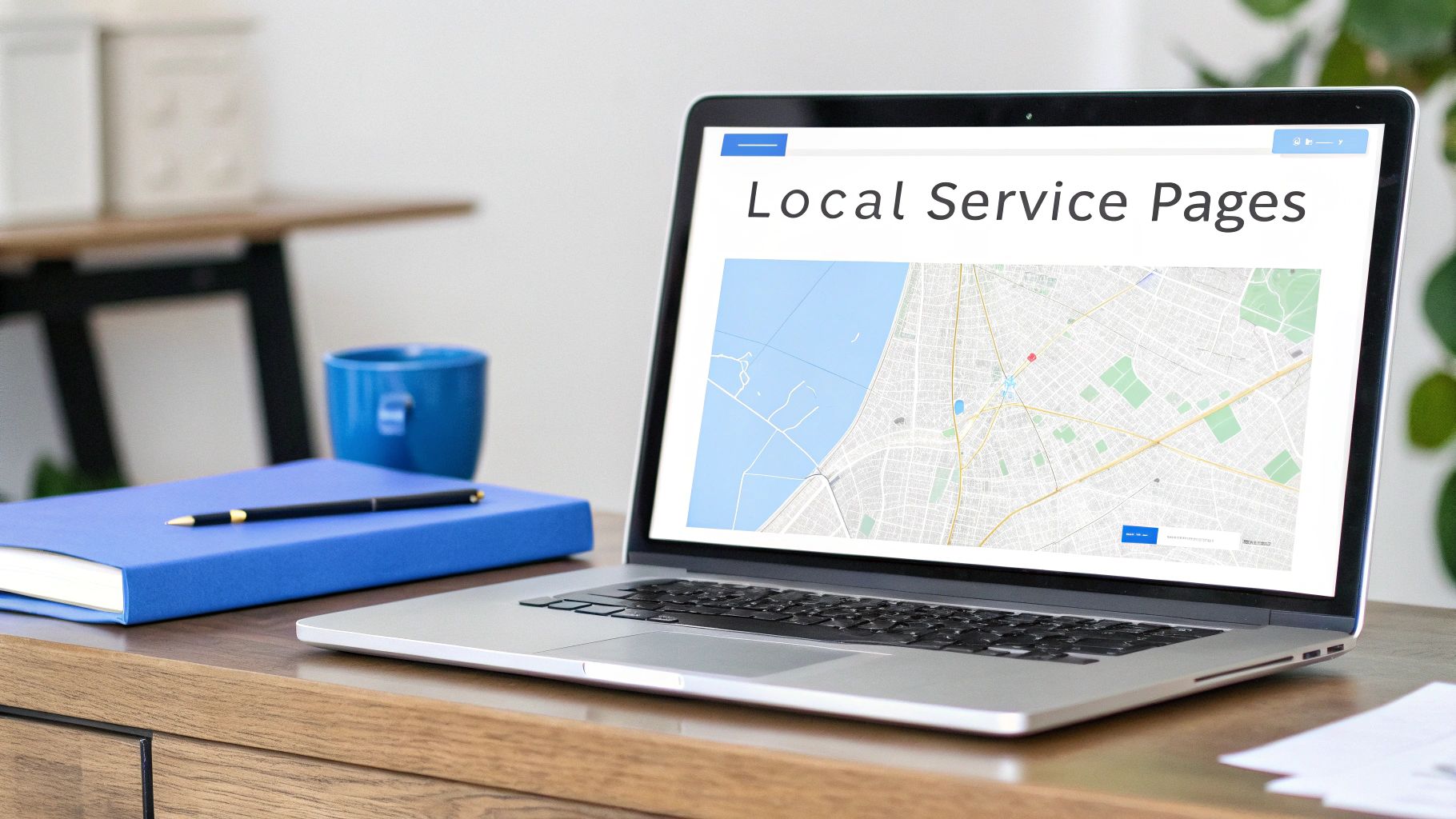
This is precisely why hyper-local service and city pages are your most powerful SEO weapons. At Transactional Marketing, this isn't a mere suggestion; it's a foundational, non-negotiable part of our strategy. A single "Service Areas" page with a long list of towns is lazy marketing, and frankly, it just doesn't work anymore. To win those high-intent, "I need help now" transactional searches, you have to prove to Google you’re the go-to expert in each community. Our strategy is to create one blog post per industry, per topic. SEO for an HVAC company is completely different from SEO for a dental business, and the content must reflect that singular focus.
The Blueprint for a High-Ranking City Page
Building a separate, dedicated page for every city you operate in is how you start showing up for those valuable "near me" searches, even when the searcher is miles away. But here’s the catch: each page must be a unique, valuable resource that establishes your local authority. A simple copy-paste job with the city name swapped out will get you flagged for duplicate content and can seriously tank your rankings.
Instead, every city landing page should be built from the ground up with a structure designed for local relevance and, most importantly, for converting visitors into customers.
Here’s the framework we’ve seen work time and time again:
- Unique Title and H1: Kick things off with a clear, optimized H1 tag like "Emergency AC Repair in Frisco" or "Trusted Furnace Installation in Frisco, TX." This immediately tells both visitors and Google what the page is all about.
- Locally-Focused Introduction: Your opening paragraph needs to confirm to the visitor they're in the right place. Mention the city by name and connect with a common local pain point. Something like, "Don't let the brutal Frisco summer heat leave you sweating with a broken AC unit."
- Embedded Google Map: This is a must. Include an embedded Google Map that clearly shows your service area for that specific city. It’s a powerful visual cue for users and a direct signal of geographic relevance to Google.
- Area-Specific Testimonials: This is where you build trust. Feature reviews from customers in that exact city. A glowing review from a neighbor is infinitely more persuasive than a generic one from someone across the county.
This isn't just about creating more pages; it's about creating powerful, localized assets that demonstrate your deep commitment to each community you serve.
A dedicated page for each service in each location tells Google you are the definitive authority for "[Service] in [Your City]". This precision is how we ensure our clients show up for the transactional terms that drive business, getting their phones to ring within 30-60 days.
AI Optimization for Local Search Intent
The game is changing. Search is evolving beyond simple keywords, with Large Language Models (LLMs) and AI optimization becoming the new way businesses are found. For an HVAC company, this means your content has to be structured so that AI can easily understand and recommend your business as the best local solution when a user asks a question.
We use AI-driven tools from platforms like SurferSEO to analyze the exact questions and phrasing people use in a particular city when looking for HVAC help. This lets us craft hyper-relevant content that perfectly matches the local search intent, optimizing for how LLMs process information.
For instance, our analysis might show that searches for "AC repair cost in City A" are frequent, while in neighboring City B, users are more likely to search for "best AC replacement company." We then tailor the content on each city page to directly answer those specific queries, ensuring that whether a customer uses Google or asks an AI assistant, your business is positioned as the top answer. This is the future of being found, and we integrate it deeply into our strategy.
Building Your Website's Local Structure
To make all of this work, your website needs a logical architecture. This is often called creating content silos. Essentially, you're building a clear hierarchy where your main service pages (e.g., /ac-repair/) become "parent" pages to individual location pages (e.g., /ac-repair/dallas/ and /ac-repair/plano/).
This structure is a win-win:
- It helps Google understand your expertise. By organizing your content this way, you're making it incredibly simple for search engine crawlers to map out that you offer specific services in specific places.
- It improves the user experience. A visitor from Plano can instantly find a page that speaks directly to them, without digging through information about other cities you serve.
When you combine this proven city page template with a smart site structure and AI-optimized content, you build an online presence that can truly own local search. This is the exact method we use to capture those all-important transactional searches for our clients, turning a simple search query into a scheduled job.
Get Your Technical House in Order to Rank Faster
While killer local pages and a top spot on Google Maps are what make the phone ring, none of it matters if Google can't find or understand your website. This is where technical SEO comes in. It’s all the behind-the-scenes work that makes your other marketing efforts actually pay off.
Think of it like tuning up your work van. A well-maintained engine gets you to the job site faster and more reliably. The same goes for your website.
At Transactional Marketing, we’ve honed a process that skips the fluff. We don’t waste months on tiny tweaks that don’t move the needle. Instead, we laser-focus on the high-impact technical fixes that get our clients ranking on page one for money-making keywords, often in just 30 to 60 days. This is the power of our proven system.
Nailing Your On-Page Signals
Your website's on-page elements are basically signposts for Google. They tell search engines exactly what a page is about and which searches it deserves to rank for. Getting these right is absolutely critical if you want to show up when a homeowner desperately searches for "emergency furnace repair in [Your City]."
We focus on three key areas right out of the gate for the biggest impact:
- Title Tags: This is the big blue headline people see in Google search results. A generic title like "AC Repair Services | Your HVAC Company" is a wasted opportunity. We change it to something like "Emergency AC Repair in Dallas | Same-Day Service," which grabs attention and targets a search from someone ready to buy.
- Meta Descriptions: This little blurb under your title tag doesn't directly affect your rankings, but it's your sales pitch in the search results. It’s your one shot to convince someone to click your link instead of the five others on the page. Make it action-oriented and reinforce the specific service and location.
- Header Tags (H1, H2): Headers give your page structure. The main headline on your page should always be an H1 tag, and it should closely match the keyword in your title tag. Use H2 subheadings to break up the content and target related questions, like "Common Air Conditioner Problems" or "Dallas AC Installation Costs."
Speed and Mobile Experience: The Non-Negotiables
In the HVAC business, every second counts. When a customer's AC dies in July, they’re probably on their phone, sweating, and losing patience fast. If your website takes more than a couple of seconds to load, they're gone. They'll just hit the back button and call your competitor.
A lightning-fast, mobile-friendly website isn't a "nice-to-have" anymore; it's the price of entry. Google openly favors sites that work flawlessly on a phone. Our team makes sure your site is quick to load and simple to use on any device. You can get a deeper look at our philosophy on building high-performing, mobile-optimized sites in our detailed guide.
Our process at Transactional Marketing is different. We don't just run through a generic checklist. We have a proven system that pinpoints the exact technical and on-page fixes needed to get you showing up for high-value transactional searches—fast.
Building a Smart Website Structure
A clean, logical website structure is good for two audiences: your customers and Google's crawlers. When you organize your service pages into clear categories (we call them "silos"), you make it incredibly easy for Google to see you as an authority on certain services in specific areas.
For instance, your main "AC Repair" page should link out to all your individual city pages for that service (e.g., Dallas, Plano, Frisco). This clear hierarchy sends a powerful signal about your expertise and service area depth, which helps you rank better across every city you serve.
When you combine this smart structure with sharp on-page signals, you create a powerful one-two punch that accelerates your climb to page one. It's an investment that pays for itself many times over. The ROI landscape for HVAC SEO shows a median return of 27.46x, which means every dollar you spend can generate nearly $27.50 in revenue. You can explore more about these impressive HVAC industry findings and see for yourself.
Building Trust with Citations and Reviews
Once your website is in good shape, Google starts looking for outside proof that your HVAC company is a real, authoritative local player. This is where your off-page SEO strategy comes in. It’s not enough to just say you’re the best; you need other trusted sources to vouch for you.
This is all about building trust. You're strengthening your digital footprint across the web so that when Google looks you up, it finds a consistent and positive story. These signals are what ultimately push you to the top for those money-making keywords like "emergency furnace repair near me."
The Power of Consistent Citations
A citation is just a mention of your business's Name, Address, and Phone number (NAP) on another website. We're talking about directories like Yelp, Angi, and the Better Business Bureau. For Google, every consistent citation is another vote of confidence in your business.
The single most important rule here is NAP consistency. If your Google Business Profile says "123 Main St." but Yelp has "123 Main Street, Suite A," you're creating confusion for search engines. These tiny discrepancies seem small, but they water down your local SEO signals and can absolutely hold you back from the top of the Map Pack.
We make sure our clients' business information is 100% identical across every important online directory. It's a tedious but crucial process that sends a clear, powerful signal to Google: this business is established and trustworthy. This is a foundational piece of our system for getting you ranked for those critical transactional searches. You can get a deeper look into the specifics by reading about our process for https://transactional.net/citation-building-for-local-seo/.
Driving More 5-Star Reviews
Reviews are today's word-of-mouth, and they're a massive ranking factor for the Google Map Pack. A steady stream of new, positive reviews tells both Google and potential customers that you do quality work.
Crossing your fingers and hoping for reviews isn't a strategy. You need a simple, repeatable system to ask every happy customer for their feedback. The perfect time to ask is right after a successful service call when the customer is feeling relieved and grateful.
Here are a few practical strategies that flat-out work:
- Automated Texts & Emails: After the job is done, send a follow-up message with a direct link to your Google review page. The easier you make it, the more likely they are to do it.
- Leave-Behind Cards: Give your technicians small cards to hand to customers. A simple QR code linking directly to your review profile can work wonders.
- Respond to Every Single Review: Thank people for the good ones and professionally address the bad ones. It shows you're engaged and that you care about your customers.
At Transactional Marketing, we help clients put these systems in place to generate a consistent flow of reviews. This builds the social proof you need to own your local search results and drive hundreds of more calls every month.
Earning Authority with Local Backlinks
While citations confirm your basic info, backlinks—links from other websites pointing to yours—signal your authority and reputation. A backlink from a well-respected local business or organization is a powerful endorsement in Google's eyes.
Think about sponsoring a local little league team or a community festival. In most cases, these organizations will link back to your website from their sponsors page. This kind of locally relevant link is digital gold for an HVAC company. It tells search engines you're a recognized and respected part of the community, which helps solidify your rankings for those high-value keywords.
Beyond digital listings, building trust also comes down to great customer service. You can discover how HVAC AI chatbots transforming customer support dynamics can improve customer satisfaction and lead to more positive reviews. When you combine dead-on citation consistency, a strong review profile, and authoritative backlinks, you're building an undeniable case for Google to put you at the top.
Answering Your Top HVAC SEO Questions
You’ve got questions about SEO, and we’ve got answers. Over the years, we've talked to hundreds of HVAC owners, and the same handful of concerns always seem to pop up. Let's cut through the noise and give you some straight answers based on what actually works to make the phone ring.
How Quickly Can I Expect Real Results from SEO?
This is always the first question, and for good reason—you're not investing in marketing for the fun of it. You need a return, and you need it fast. A lot of agencies will tell you to be patient, that it takes six months or even a year to see real movement. That's not our philosophy.
At Transactional Marketing, we've built our proven system for speed. Our goal is to get you on the first page for high-value, ready-to-buy transactional search terms within 30 to 60 days. How? We don't waste time on low-impact tactics. We go straight for the jugular with a strategy laser-focused on total Google Maps optimization and the handful of on-page tweaks that move the needle. This gets you in front of customers who have a problem right now.
Is Google Maps More Important Than My Website?
For an HVAC company that wants emergency repair jobs and profitable installations, the answer is a hard yes. Think about your customer. When their AC dies on a 95-degree day, they aren't leisurely browsing websites. They're grabbing their phone, searching "ac repair near me," and calling one of the first three companies they see in the Google Map Pack.
That little map section is the most valuable piece of digital real estate you can own. Our Google Maps optimization services are designed to get you into those top three spots, which is the fastest, most direct path to generating hundreds more calls every single month. Your website is still critical for building trust and providing details, but for driving immediate leads, winning in the maps is everything.
At Transactional Marketing, our entire process is built around one primary goal: getting our clients into the top three map positions across all their service areas with our proprietary technology. This isn't a "nice to have"—it's the core strategy that directly translates into more booked jobs.
What Is AI Optimization for Local Search?
This is the next big thing in being found online, and we’re already baking it into our strategy. AI optimization is all about structuring your business information so that new technologies—like the AI in Google's search results, ChatGPT, or other LLMs—can easily understand who you are, what you do, and why you're the best choice.
We meticulously organize your website's data and content. The goal is simple: when someone asks an AI tool, "Who's the best contractor for an emergency furnace repair in Dallas?" your business is served up as the most logical, authoritative answer. It’s about future-proofing your visibility, ensuring you show up not just in today's search results, but in the AI-powered recommendation engines of tomorrow. This is the new way businesses are going to be found.
Do I Really Need a Page for Every City I Service?
Yes. Absolutely. This is non-negotiable if you're serious about dominating your service area. We create one piece of content per industry, per topic, and for local SEO, that means one page per city.
That old-school "Service Areas" page with a bulleted list of 20 towns? It’s a relic. It does almost nothing to help you rank and leaves the door wide open for your competitors.
If you want to rank for "furnace maintenance in Plano," you need a dedicated page on your site all about providing furnace maintenance in Plano. This tells Google you're a legitimate authority in that specific community. It's the only way to consistently show up for these lucrative transactional searches and stop smaller competitors from picking off jobs in your own backyard.
Ready to stop competing and start dominating your local market? The team at Transactional Marketing uses a proven, laser-focused system to get your HVAC company ranked for the transactional search terms that lead to booked jobs, often within 30-60 days. Stop waiting for the phone to ring and make it happen. Learn more about our approach and get started today.