

When we talk about truly affordable local SEO, we're not just chasing the lowest price tag. We're hunting for the biggest return. That means getting your business in front of customers who have money in hand and are ready to spend it, right now. At Transactional Marketing, this is our entire focus. For a local service business, these are the transactional leads that fuel real, sustainable growth.
Laying the Groundwork for Transactional SEO
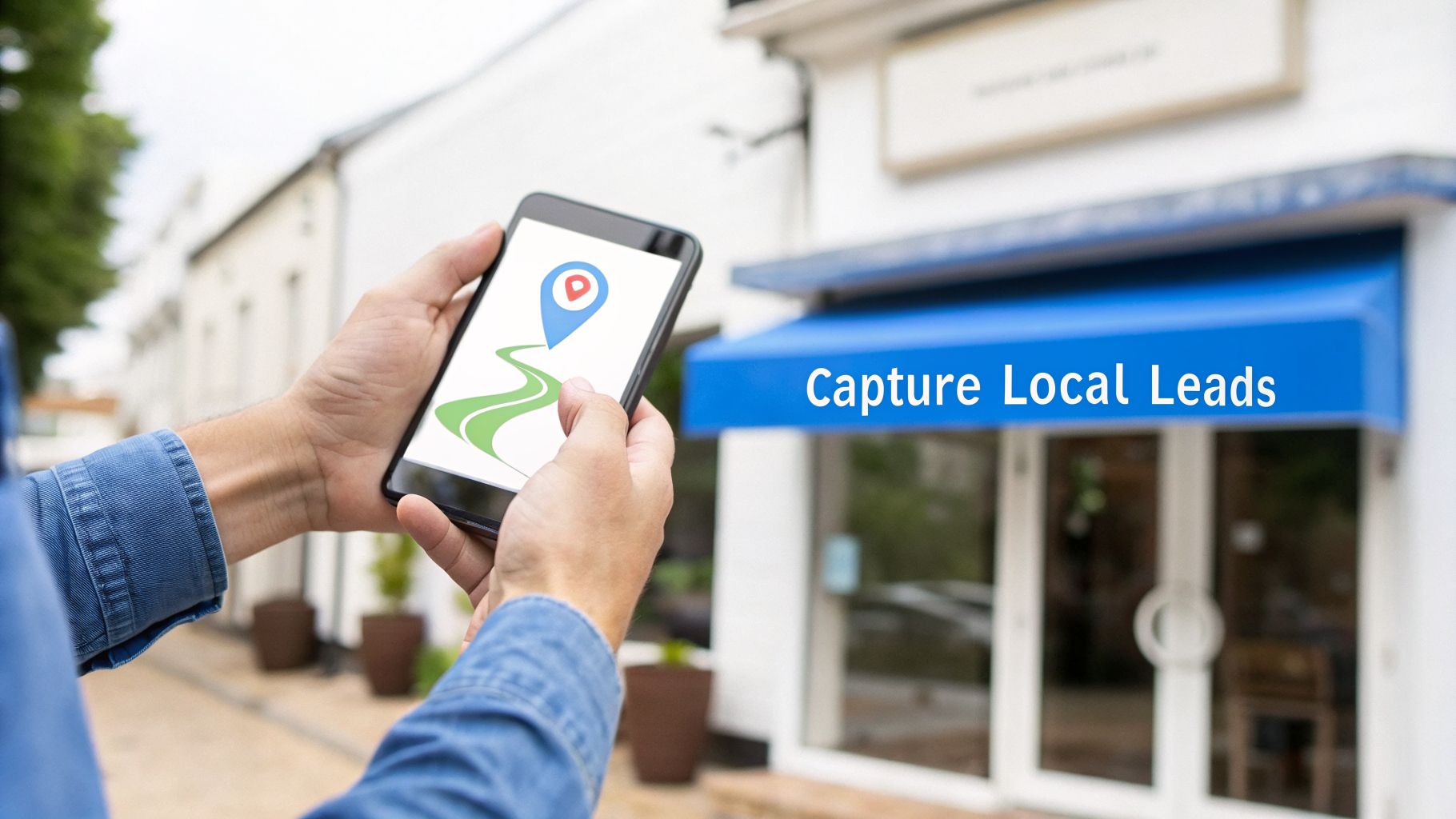
A rock-solid local marketing strategy is built on one thing: attracting customers who are actively searching for the services you offer. At Transactional Marketing, our entire focus is on getting our clients ranked for high-value transactional search terms. We're talking about the money phrases, like "roofer near me" or "air conditioning repair near me." These aren't just people browsing; they're buyers with a problem that needs solving. They have money in their hand, ready to spend.
Your budget-friendly SEO journey starts by dominating your digital storefronts—your Google Business Profile (GBP) and Google Maps listings. These free tools are where the real action happens for local services. When a homeowner has a burst pipe, their first move is almost always to check the Google Map Pack.
We’ve built our technology at Transactional Marketing specifically to push clients into the top three spots on Google Maps for their most important services. Getting that visibility is what turns into hundreds of additional phone calls every single month and thousands more every year.
Using AI for Smarter Targeting
The way search works is shifting, especially with AI and how Large Language Models (LLMs) are starting to answer user questions directly. AI Optimization is the new way businesses will be found. The good news is that AI gives us a much sharper tool for targeting. We can pinpoint the exact transactional search terms customers use when they're ready to open their wallets, moving away from a scattergun approach to one that's laser-focused on revenue.
Putting together a smart strategy means finding the right practical affordable SEO tools that can stretch your budget and amplify your results. It's all about working smarter.
Here’s what you should be focusing on:
- Transactional keywords: Zero in on specific service and city combinations, like "air conditioning repair near me." This is the exact kind of term we get our customers to show up for.
- "Near me" searches: Your Google Business Profile needs to be perfectly optimized to catch all the local traffic from mobile users who have money in hand.
- AI-powered insights: Modern tools can uncover what your customers are actually asking, not just what you think they're searching for, ensuring you show up in new AI-driven search results.
Our entire proven system is designed to land you on page one, often in just 30 to 60 days, for the transactional keywords that drive your business forward. If you want to dive deeper into the mechanics of it all, take a look at our complete breakdown of the most important local search ranking factors. Getting a handle on these is your first step to owning your local market.
Your Google Business Profile: The Cornerstone of Local SEO
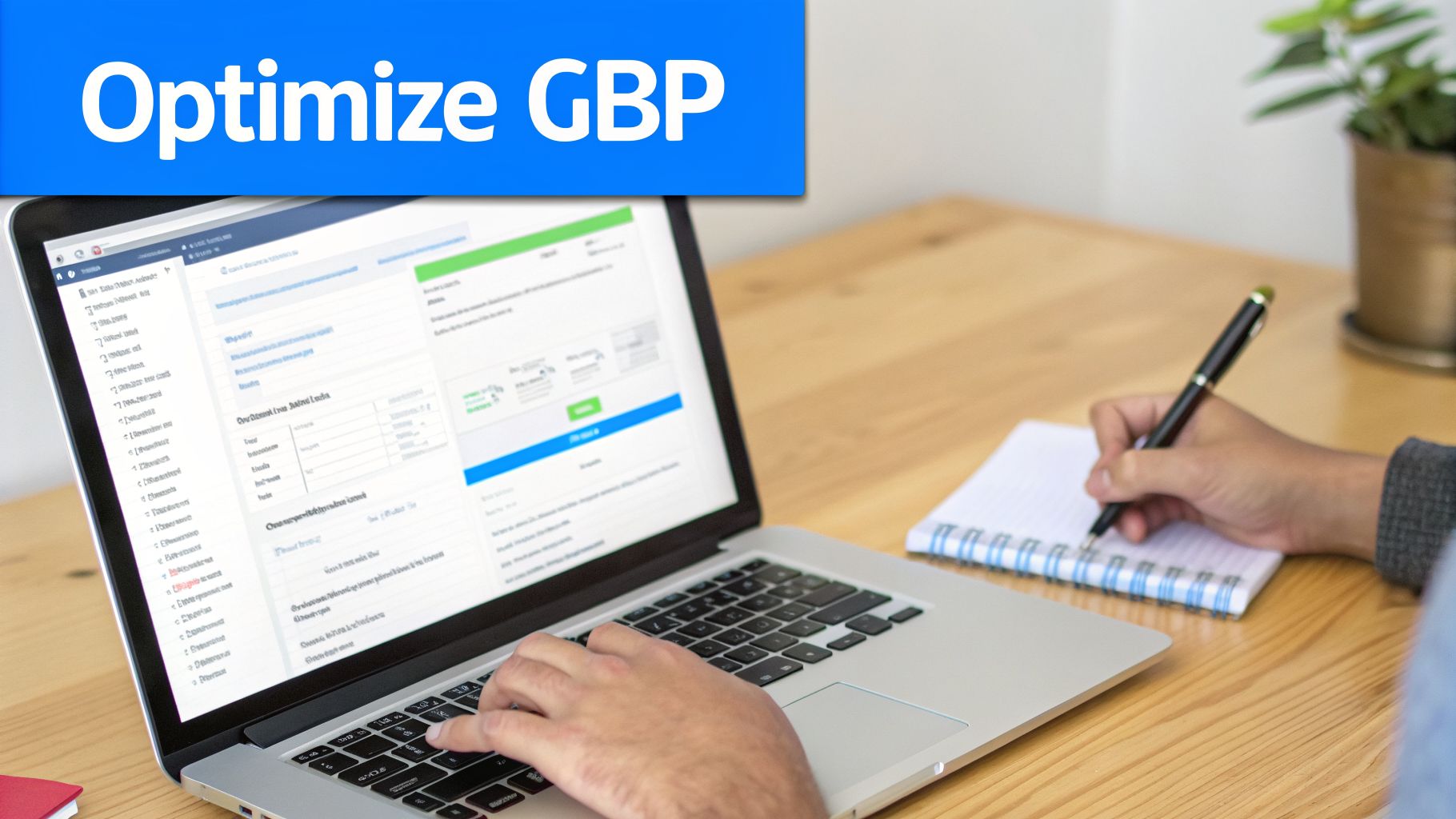
When you’re running a service business on a tight budget, there’s one free tool that outshines everything else: your Google Business Profile (GBP). For any affordable local SEO plan, this isn't just a nice-to-have; it's the absolute foundation of your strategy. A well-tuned GBP is the fastest way to get your phone ringing with calls from customers who are ready to buy. We specialize in Google Maps optimization because it is critically important.
We see GBP as the launchpad for taking over a local market. Simply claiming your profile and adding a name and address won’t cut it anymore. Your goal is to land in the top three results on Google Maps—that coveted "Map Pack" where the real action happens. Getting there requires engineering every part of your profile to attract the right kind of attention from customers with transactional intent.
This means you need to stop thinking in terms of generic services and start using the exact transactional search terms your best customers type into Google. If you’re a roofer in Phoenix, your profile can't just say "roofing services." It needs to be packed with phrases like "emergency roof leak repair Phoenix," "shingle replacement Mesa," and "tile roof inspection Scottsdale."
Weaving Transactional Keywords Into Your Profile
Think of every field in your Google Business Profile as a prime piece of real estate. Each one is an opportunity to signal to Google exactly what you do and where you do it. A profile that’s filled out completely doesn’t just look better to customers; it builds trust with Google’s algorithm, making it far more likely to show your business for those high-value, transactional searches.
Here’s where to focus your efforts first:
- Business Categories: Start with a primary category that nails your main service (like "Plumber"). But don't stop there. Add every relevant secondary category you can find, such as "Water Heater Installation & Repair" or "Drain Cleaning Service." Be thorough.
- Service Listings: This is a goldmine. Don't just list a service—build it out. For every service you add, write a solid description loaded with related transactional keywords. For an "AC Repair" service, you’d want to talk about your work on "central air conditioning repair," "compressor replacement," and "Freon leak detection."
- Business Description: You get 750 characters here to make your pitch. Use it wisely. Clearly state who you are, what you specialize in, and the specific problems you solve for customers, using the same language they use when they're searching for help with money in hand.
Your Google Business Profile is the single most powerful tool for attracting local customers ready to spend money. Our proven system focuses on turning this profile into a lead-generation machine, which is why our clients see hundreds of more phone calls every month.
Keep the Momentum Going with Ongoing Activity
A great GBP is never "set it and forget it." Google and AI search engines reward activity. To stay visible in the Map Pack, you need to show that you're an active, engaged business. This means using the built-in features regularly.
If you really want to get into the weeds, we've laid out the entire process in our guide on how to optimize your Google Business Profile.
Google Posts are essentially free ads. You should be using them at least once a week to showcase a specific service, run a special offer, or share photos from a recent job. This keeps your profile looking fresh. Also, make a habit of checking your Q&A section. Answering questions directly lets you address customer concerns while naturally working in valuable, keyword-rich answers for all to see.
Turning Your Website Into a Customer-Getting Machine
Let's be blunt: a website that doesn't make your phone ring is just a digital brochure. If you want to get paid, your content can't just be a collection of generic blog posts about industry news. It needs to be built from the ground up to attract customers who have a problem and are ready to spend money to solve it—what we call high transactional intent.
This is where we part ways with the typical, unfocused blog. We don't combine different industries into one post; each industry gets its own dedicated content. For a specific industry like roofing, we build content silos. The best way to think of this is like creating a dedicated mini-website for each of your core services. This hyper-focused approach shows both Google and your potential customers that you are the definitive expert on that specific service.
A content silo strategy is straightforward. You create a main "pillar" page for a broad service (like "Roof Repair") and then surround it with supporting pages that target the very specific, action-oriented searches people are typing into Google. This clear, organized structure is a powerful signal to search engines that you're an authority.
From Silos to Sales Calls
So, what does this actually look like for a local service business? Imagine you run a roofing company in Texas. A messy, all-in-one "Services" page just won't cut it. This is how we structure content for a single industry to maximize transactional leads.
Here’s how we’d structure it with a silo strategy:
- Pillar Page: "Roof Repair Houston"
- Supporting Pages:
- "Emergency Leak Repair Houston"
- "Shingle Replacement Sugar Land"
- "Metal Roof Installation Katy"
- "Hail Damage Roof Inspection Pearland"
See the difference? Each page is a magnet for a specific transactional search term in a specific location. This is the exact system we use to land our clients on the first page of Google, often within 30 to 60 days. It’s not a secret trick; it's about methodically aligning your content with what real customers are looking for.
When someone searches for "air conditioning repair near me," they expect to land on a page about exactly that—not a generic HVAC services page. Giving them that specific answer immediately builds trust. This precision is why we're called Transactional Marketing. We get customers to show up for the exact transactional terms that bring in business.
Finding the Right Keywords with a Little Help
Okay, so how do you uncover all these hyper-specific phrases your customers are using? This is where modern AI Optimization comes in. AI-powered platforms are fantastic for analyzing massive amounts of search data to pinpoint the long-tail keywords that signal a customer is ready to buy. They reveal the questions, pain points, and local jargon that will make your content connect and show up in LLM search results.
Of course, once you have visitors on your site, you need to guide them toward taking action by incorporating proven lead generation best practices. But it all starts with building that strong content foundation. Using a data-informed silo strategy ensures every page you publish has the potential to be a new front door for a paying customer.
Ultimately, your website should be your hardest-working salesperson. A transactional content strategy transforms it from a passive online flyer into a lead-generation engine that works for you 24/7. To see more examples of how this plays out, take a look at our deeper dive into content marketing for local businesses.
Building Trust and Authority on a Budget: Reviews and Local Signals
Positive customer reviews are the modern-day equivalent of word-of-mouth, and they're a huge piece of the puzzle for ranking in Google's Map Pack. For any business serious about affordable local SEO, creating a consistent flow of genuine reviews isn't just a "nice to have"—it's one of the highest-impact activities you can do to attract customers with transactional intent.
The trick is to make it a system. You can’t just cross your fingers and hope a happy customer leaves a review. You have to make it dead simple for them. The best time to ask is right after you’ve finished the job and your customer is smiling. A quick follow-up email or text with a direct link to your Google review page is incredibly effective. This one small action directly feeds Google the trust signals it needs to rank you for those valuable transactional search terms.
But great reviews are only half the story. Real local authority is also built on a consistent and accurate digital footprint across the web. This is where citations come into play.
Solidifying Your Local Footprint with Citations and Links
A citation is simply any online mention of your business's Name, Address, and Phone number (NAP). Google scours the web, looking at directories like Yelp, Angi, and local chamber of commerce sites to verify your business information. If it finds conflicting details—like an old address or a disconnected phone number—it creates confusion and can seriously hurt your rankings.
Your first move should be a citation audit to hunt down and correct any of these inconsistencies. Once your core NAP is squeaky clean across the board, you can start building new citations on other high-quality, relevant local websites. This entire process strengthens your online presence and proves to Google that you are a legitimate fixture in your service area.
Think of local authority as a web of trust. Every time a credible local source mentions your business, it’s another thread in that web. The stronger the web, the more confident Google is in showing your business in the top three Map Pack results, which is our specialty at Transactional Marketing.
At Transactional Marketing, we focus on targeting customers based on where they are in the buying journey. This flowchart breaks down how we think about content strategy for local businesses.
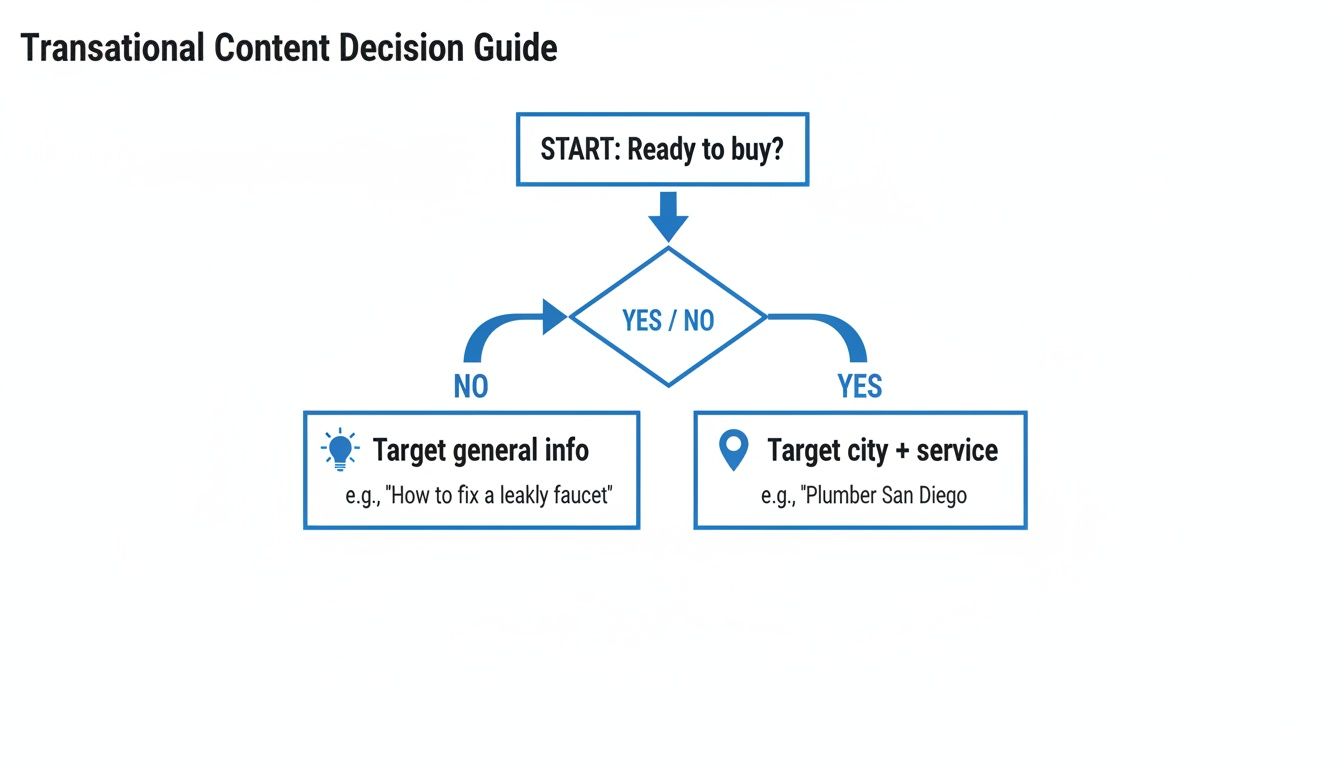
The graphic shows a simple but powerful idea: if a searcher is ready to make a purchase, your content should be laser-focused on a specific transactional search term. If they're still in the research phase, broader, more informational content is the way to go. We laser-focus on the buyers.
If you want to turn your happy customers into your most powerful marketing channel, you can learn more about our strategies for getting more reviews. The goal is to create a feedback loop where excellent service generates glowing reviews, which in turn attracts more customers who are ready to hire you.
Measuring SEO Success and Proving Your ROI
So you've put in the work to get your local SEO in order. Now for the million-dollar question: how do you know if any of it is actually working? An affordable local SEO plan is only a good investment if you can directly connect it to more money in your pocket.
It’s easy to get distracted by vanity metrics like website clicks or a spike in impressions. But from our experience, those numbers don't pay the bills. The real goal is to measure the actions that lead directly to new customers.
At Transactional Marketing, our entire philosophy is built on this kind of transparency. We focus on tracking the things that matter—qualified phone calls from your Google Business Profile, new service requests from your website, and better rankings for your most profitable transactional search terms. That's how you prove your return on investment.
Focusing on Business-Critical Metrics
Let's cut through the noise. A successful campaign isn’t measured in clicks; it’s measured by how many new, paying customers walk through your door (or have you walk through theirs). The key is to keep your measurement strategy simple and focused on your bottom line.
Here are the key performance indicators (KPIs) we live and die by:
- Google Maps Calls: How many phone calls are you getting right from your Google Business Profile? These are your hottest leads—people searching transactional terms like "dentist near me" who need your service now.
- Website Form Submissions: Are people filling out your "Request a Quote" or "Book an Appointment" forms? This is a clear signal of high intent, especially from your service-specific pages targeting transactional keywords.
- Keyword Rankings for Transactional Terms: Are you climbing the search results for money-making phrases like "emergency plumbing Houston" or "AC repair near me"? This shows you're becoming more visible to people ready to buy.
Any marketing effort that can’t demonstrate a clear path to revenue is just an expense. We provide our clients with transparent dashboards that show exactly how our work is turning into phone calls and booked jobs. That is the Transactional Marketing difference.
This focus is everything. A flood of general website traffic is nice, but a targeted increase in visitors looking for a specific service you offer is far more valuable. You need to know which channels are delivering actual customers, not just browsers.
Using the Right Tools for the Job
You don't have to spend a fortune on fancy software to track what really matters. In fact, Google gives you some incredibly powerful and completely free tools to get a clear picture of your performance.
If you're just starting out, get comfortable with these two:
- Google Business Profile Insights: Your GBP dashboard is a goldmine. It shows you exactly how customers find your listing, what actions they take (calls, website clicks, direction requests), and the search queries that brought you up.
- Google Search Console: This is where you see how your website is performing in search. It reveals the exact keywords people use to find you, which of your pages get the most traffic, and your average ranking for those terms.
Here at Transactional Marketing, we pull data from these sources and several others into a single, easy-to-read dashboard for our clients. This allows you to see everything at a glance—from real-time ranking heat maps that show your visibility across town to call volume trends over the last month.
This data-driven approach takes all the guesswork out of the equation. It proves that your investment in affordable local SEO is paying off right where it counts: your bank account.
Even with the best playbook, you're bound to have questions. And when it comes to local SEO, we've heard just about all of them. Let's tackle some of the most common ones we hear from business owners who are ready to get serious about their local search presence.
How Long Until I Actually See Results from Local SEO?
This is always the first question, and for good reason—you're investing time and money and need to see a return. While every market is different, our proven system can get you moving much faster than you might think. We consistently see clients get their website showing up on page one of Google for their most important transactional search terms in just 30 to 60 days.
The key is avoiding the trap of chasing broad, ego-driven keywords. Instead, we laser-focus on the exact service and city combinations your paying customers are typing into Google right now—think "emergency plumbing service in Dallas" or "AC repair near me." By targeting these high-intent, transactional searches, you can climb to page one and into the Google Maps top three much more quickly.
What's the Real Difference Between Local and Traditional SEO?
Think of it like this: traditional SEO is a megaphone, while local SEO is a high-powered scope.
- Traditional SEO is about broadcasting a message to a national or even global audience. It's for businesses trying to rank for broad terms that have no geographic boundaries.
- Local SEO is all about precision targeting. The goal is to make your business the obvious choice for customers right in your service area who are searching with transactional intent. Here, the battlefield isn't just the standard Google results; it's the Google Map Pack, which is prime real estate for any local service search.
For a local business, winning on the "map" is what keeps the phone ringing and the schedule full. Our technology is built to make you show up in the top three map locations.
We build our entire strategy around local SEO because that's where the money is. When someone searches for a local service with a transactional term like "roofer near me," they're ready to buy. Our job is to make sure your business is the first one they see. That's why we're called Transactional Marketing.
Can I Really Do This Myself on a Tight Budget?
Absolutely. In fact, getting your hands dirty with the basics is something we strongly encourage. The single most impactful thing you can do on your own is to claim and meticulously complete your Google Business Profile. Fill out every single section, add detailed service descriptions, and make a habit of uploading new photos. This alone will put you ahead of many competitors.
However, once you get past the fundamentals, the learning curve can get steep. The strategies that truly create a gap between you and the competition often require a deeper level of expertise. This is where things like:
- Advanced citation cleanup to fix inconsistent business information across the web.
- Building strategic content silos to establish authority for specific services.
- Earning high-quality local backlinks that signal trust to Google.
- Using AI Optimization to uncover hidden keyword opportunities and get found in LLM search results.
…come into play. Partnering with a specialist like Transactional Marketing can help you execute these more complex tactics correctly from the start, saving you from months of trial-and-error and costly mistakes.
Ready to see how a focused, revenue-driven strategy can work for your business? Transactional Marketing has a proven system designed to get service businesses like yours to the top of Google Maps, driving hundreds of additional calls every month. We get you to show up for the transactional search terms that matter.
See how our approach can transform your local visibility by visiting us at transactional.net.