


If you want to know whether your marketing is actually working, there’s one number you have to get right: Cost Per Acquisition (CPA).
Simply put, CPA is what you pay to get one new customer through the door. For any local service business—whether you're a roofer, a plumber, or a dentist—this is the metric that truly matters. At Transactional Marketing, we specialize in making sure you show up for transactional search terms. When a customer with money in hand is frantically searching for ‘roofer near me,’ your CPA determines if you won that business profitably.
The Core CPA Calculation
Cost Per Acquisition tells you exactly how much you're spending to land a single, paying customer. For businesses that depend on a constant stream of local clients, like HVAC contractors or electricians, this number is everything. It’s the line in the sand between profitable marketing and just throwing money away. We get our customers to show up for these transactional search terms, because that's where the real money is.
But here’s where many businesses get it wrong. A true CPA isn’t just your ad spend. You have to account for all the costs that went into acquiring that customer.
To get an accurate number, you need to tally up expenses like:
- Paid Ad Spend: The direct cost from your Google Ads or other paid campaigns.
- Agency or Freelancer Fees: Money paid for SEO, Google Maps optimization, and campaign management.
- Content & AI Optimization Costs: Any expenses related to blog posts, videos, or design work optimized for search engines and new AI-driven results.
- Software Subscriptions: Your monthly spend on CRMs, call tracking software, or analytics tools.
Once you add all of that up and divide by your new customers, you get a real-world picture of your marketing's efficiency.
To help clarify this, the table below breaks down the essential components for a precise CPA calculation.
CPA Calculation at a Glance
| Component | What It Means | Example for a Roofing Company |
|---|---|---|
| Total Costs | The sum of all marketing-related expenses over a specific period. | $5,000 in Google Ads spend + $2,000 agency fee + $500 for content = $7,500 |
| New Acquisitions | The number of new, paying customers generated from those marketing efforts. | 150 new roof repair jobs from searches like "roofer near me." |
| CPA | The final cost to acquire each new customer. | $7,500 ÷ 150 jobs = $50 CPA |
As you can see, looking beyond just ad spend gives you a much more honest assessment of your marketing investment.
The Basic Formula in Action
Getting a foundational understanding of how to calculate cost per acquisition is the first step toward building a predictable growth engine.
It all starts with this simple formula:
Total Marketing Costs ÷ Number of New Customers = Cost Per Acquisition (CPA)
Let's walk through a real-world example. Imagine a plumbing company in a competitive market spends $10,000 on a Google Ads campaign. By focusing their efforts on transactional terms like ‘leak repair near me’—the exact terms we get our customers to show up for—they tracked 250 new customers from their ads.
The math is straightforward: $10,000 ÷ 250 customers = a $40 CPA.
That’s a solid number, especially when you consider that industry averages can often be much higher. And as you’ll see when we dig deeper into how to measure marketing effectiveness, the real goal is to constantly find ways to drive that number even lower.
Why This Metric Is So Critical
For a local service business, every marketing dollar has a job to do. Knowing your CPA lets you make smart decisions about where to invest your budget for the best return.
A low CPA means you’re efficiently reaching customers who are ready to hire you for services like ‘air conditioning repair near me.’ This is the entire focus of our work at Transactional Marketing. Our proven system is built to get your website on the first page of Google, typically within 30 to 60 days, by laser-focusing on the exact transactional search terms your best customers are using right now.
This direct approach, combined with a top-three ranking in Google Maps, is how you achieve a lower CPA and bring in hundreds of more phone calls every month, which translates into literally thousands more calls every year.
Gathering Your Total Cost and Acquisition Data
To get a truly accurate cost per acquisition, you have to play detective. The formula itself is simple, but its accuracy depends entirely on the quality of the data you feed it. A real-world CPA calculation goes way beyond just your ad spend; it's about tracking down every single dollar you invested to win that new customer.
If you only look at the obvious costs, you'll make bad decisions based on incomplete information. The goal here is to build a complete financial picture of your customer acquisition machine, especially for transactional searches where customers have money in hand.
Identifying All Your Marketing Costs
First things first, you need a complete list of all your marketing expenses. This isn't just about what you pay Google every month. It’s the total cost of running your entire marketing operation, from traditional SEO to emerging AI optimization for LLMs.
Start with the most direct costs, then work your way out to include the softer, often-overlooked expenses:
- Direct Ad Spend: This is the easy one. It’s the total amount you’ve spent on platforms like Google Ads, Facebook, or any other paid media.
- Agency or Partner Fees: If you're working with a team like Transactional Marketing for SEO and Google Maps optimization, those fees are a core part of your acquisition cost.
- Content & Creative Production: Did you pay for blog posts, website photos, or video shoots? These costs belong here. A helpful tool for estimating these expenses is a video production cost calculator.
- Software & Tool Subscriptions: This adds up quickly. Include your CRM, call tracking software, email marketing platforms, and any specialized reporting or analytics tools you use.
Key Takeaway: A true CPA calculation includes every cent spent on your marketing efforts—from ad clicks to the software that tracks them. Missing even one piece of the puzzle can artificially deflate your CPA and hide major inefficiencies in your strategy.
Tracking Your Most Valuable Acquisitions
Now for the other side of the equation: tracking your acquisitions. For any local service business, an "acquisition" is simply a new, paying customer. The real challenge is correctly attributing that customer back to the specific marketing effort that brought them to you, especially when they came from a transactional term like "dentist near me."
A lead from a website form is simple enough to track. But what about the customer who found you on Google Maps and called for an emergency HVAC repair? Without the right systems in place, that lead can easily get lost in the shuffle, making your marketing look less effective.
This is exactly why call tracking software is non-negotiable for service businesses. It works by assigning unique, trackable phone numbers to your different marketing channels. You can see with 100% certainty whether a call came from your Google Business Profile (the maps), a specific Google Ad, or an organic search click. This data can then flow right into your CRM, connecting the marketing source to the final sale. If you're wondering how to pull all this together, we break it down in our guide on local SEO reporting tools.
At Transactional Marketing, we build this transparency directly into our client dashboards. We integrate data from Google Search Console, Google Business Profile insights, and call tracking logs into one unified view. This ensures every lead generated from our Google Maps optimization and SEO strategies is counted, giving our clients a CPA number they can actually trust. You'll see the direct impact of ranking for transactional keywords like "roofer near me" because we connect every single call and form submission back to its source.
Segmenting CPA by Marketing Channel
An average, or blended, Cost Per Acquisition gives you a bird's-eye view of your marketing performance, but it can hide some expensive truths. The real, actionable insights come when you start segmenting your CPA for each marketing channel. This is how you discover which of your efforts are genuine profit centers and which are quietly draining your budget.
When you calculate a channel-specific CPA, you stop guessing and start making decisions backed by data. It's the only way to accurately compare the efficiency of Google Ads, organic SEO, and crucially, Google Maps optimization. The formula doesn't change, but you apply it with a much tighter focus on each channel.
This diagram breaks it down to its two core components: the total costs for a channel and the total conversions it produced.
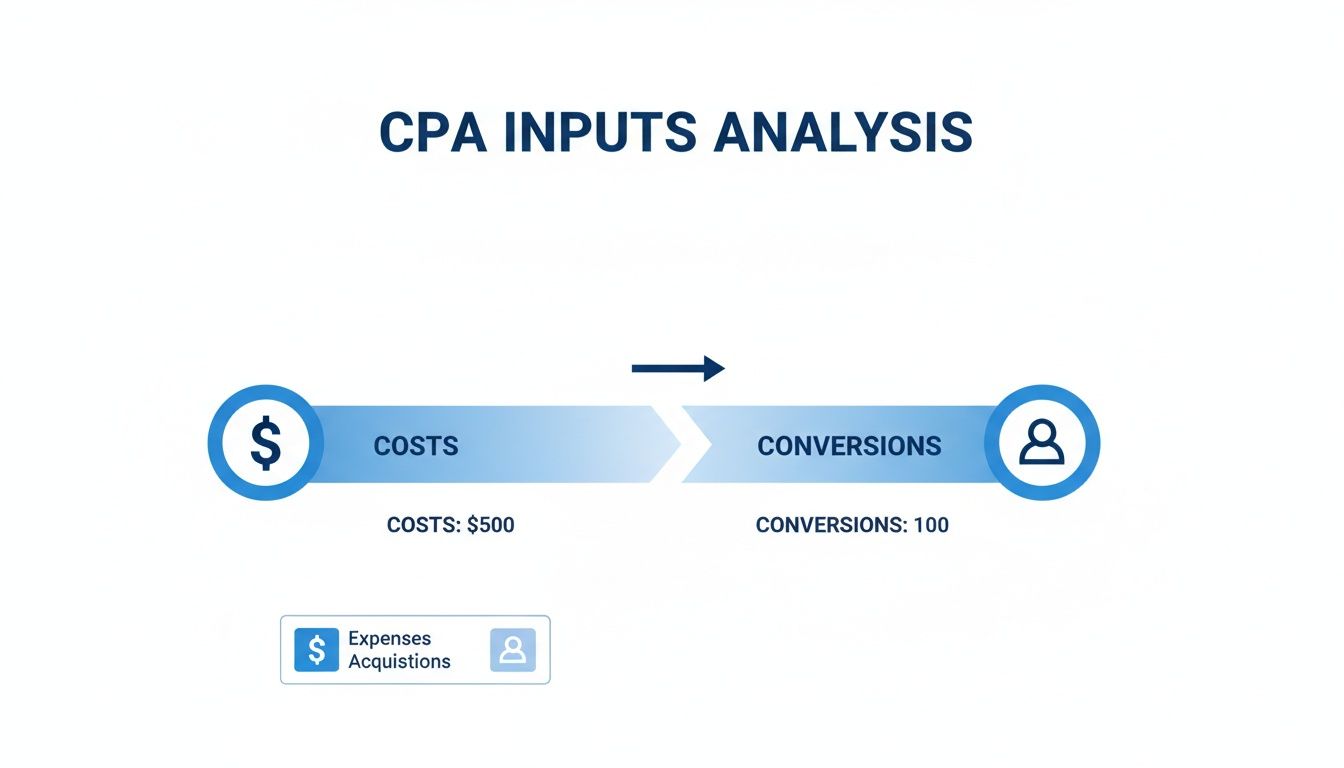
As you can see, the key is to cleanly isolate both the spending and the resulting new customers for each channel to understand its true performance.
Isolating Your Channel Performance
To do this right, you have to meticulously track your costs and correctly attribute new customers back to their source. This means knowing exactly how much you spent on a Google Ads campaign and how many new customers came directly from those ads. The same goes for your SEO investment—you need to connect that spending to the customers who found you through organic search or Google Maps.
This is where you really see the power of owning your digital assets versus renting them.
By comparing your organic SEO CPA against your paid search CPA, you see the incredible long-term ROI of earning your rankings for transactional terms. An owned asset like a top organic or map ranking generates customers month after month without continuous ad spend.
Real-World Channel Comparison
Let’s put this into practice with a common scenario. Imagine an HVAC company is spending its monthly marketing budget across three different channels. By calculating the CPA for each, they can spot their marketing goldmines using the simple formula: Channel CPA = Total Channel Spend ÷ New Customers from Channel.
Here's what their numbers might look like over a month:
Sample Channel CPA Comparison for an HVAC Business
| Marketing Channel | Monthly Spend | New Customers Acquired | Cost Per Acquisition (CPA) |
|---|---|---|---|
| Google Ads (PPC) | $6,000 | 40 | $150 |
| Facebook Ads | $2,500 | 10 | $250 |
| SEO & Google Maps | $1,500 | 50 | $30 |
This kind of analysis provides immediate clarity. While Google Ads brought in a good number of customers, the organic SEO and Google Maps work delivered the most customers at the lowest cost by a huge margin. This is because these channels capture users searching with high transactional intent.
This data gives you a clear roadmap. You can now confidently reallocate budget and double down on what’s proven to work best—in this case, amplifying the low-CPA strategies of organic search and Google Maps optimization. For any service business looking to lower its Google paid search cost, this method is a game-changer.
This is exactly how we operate. We prove our value by delivering an exceptionally low CPA for our clients. Our system is laser-focused on getting local businesses to show up for high-intent, transactional searches like "air conditioning repair near me" in their specific cities. By securing top-three positions in Google Maps and dominating organic search—often within 30 to 60 days—we help our clients generate hundreds more phone calls every month at a fraction of what they’d pay for ads. That's how you build a profitable customer acquisition engine.
How to Set a Profitable Target CPA
So you've calculated your CPA. Great. That number is your report card for your marketing spend. But knowing your grade is one thing; knowing what grade you actually need to pass is another entirely.
This is where you set a profitable target CPA. It's the critical move that separates businesses that scale from those that just spin their wheels. We’re defining the absolute maximum you can afford to pay for a new customer from a transactional search and still guarantee you make money on the deal.
Without a target, you're flying blind. You might be celebrating a $100 CPA, not realizing that each new customer at that cost is quietly pushing you into the red. A well-defined target CPA turns that simple metric into a strategic guardrail for your entire marketing budget.
Incorporating Profit Margins and LTV
To get this right, you need to look inward at two fundamental business metrics: your average profit per job and your Customer Lifetime Value (LTV). The first tells you what you can afford to spend right now on a transactional customer, while the second gives you the long-term view of what that customer is really worth.
Let's look at how this plays out in the real world for a specific industry, like HVAC:
One-Time Services: Imagine you run an HVAC company. Many of your jobs are one-off repairs. If an average repair job nets you $400 in profit, your CPA has to come in well below that. A $100 CPA on a customer searching "AC repair near me" is a clear win, leaving you with a healthy $300 profit.
Recurring Services: Now, think about the same HVAC business. A new customer might only generate $200 in profit on the first maintenance visit, but if they sign a year-long service contract worth $1,000 in profit, you can play the long game. This high LTV means you can justify a much higher CPA upfront because you know you'll more than make it back.
Grasping this distinction is everything. It empowers you to make smarter, more aggressive marketing decisions based on the true, long-term value of a customer.
A profitable target CPA isn't just a number—it's your business's growth formula. It's defined by your profit margins and LTV, ensuring every dollar you spend targeting transactional search terms directly contributes to your bottom line.
Defining Your Maximum Allowable CPA
Once you're clear on your profit per job and LTV, you can calculate your maximum allowable CPA. This is your absolute break-even point. If you spend one penny more, you officially lose money on that acquisition.
Your target CPA should always be set comfortably below this ceiling. For our HVAC company with $400 profit per job, the maximum CPA is $400. But aiming for the break-even point is risky and leaves zero margin for error.
A much smarter approach is to set a target CPA at a fraction of that figure. For example, aiming for a CPA that is 25% of the profit would give you a target of $100. This strategy locks in a $300 gross profit on every single customer your marketing brings in.
This is the core of our Transactional Marketing philosophy. While other boring marketing companies get fixated on clicks, we focus entirely on this final number. Our entire system—from AI optimization for LLM search to aggressive Google Maps optimization—is built to deliver customers who are ready to buy, and to do it at a CPA that makes you money from day one.
We prove our worth by hitting your target CPA, fast. By getting you ranked for critical transactional terms like "dentist near me" or "roofer near me" in just 30 to 60 days, we make sure your marketing investment pays for itself with immediate, measurable returns.
So, you've calculated your CPA and set a target. Now for the fun part: actively driving that number down.
Knowing your cost per acquisition is one thing, but the real win comes from systematically shrinking it. This is where you transform your marketing spend from an expense into a powerful, customer-generating investment.
Here at Transactional Marketing, we've built our entire proven system around a three-part strategy designed to bring in high-intent customers for local service businesses at the lowest possible cost. This isn’t just theory—it’s the field-tested approach we use every day to help businesses show up for transactional search terms.
Pillar 1: Dominate "Money-in-Hand" Transactional Keywords
Your CPA is a direct reflection of your traffic quality. That's why our first pillar is to optimize your online presence—from your website to your content—for the new world of AI-driven search and transactional keywords.
Think of these as the "buy now" searches. We're talking about queries like "air conditioning repair near me" or "emergency dentist open now." We use a data-driven, AI-optimized approach to ensure you are the answer when LLMs and search engines look for the best local provider. This focus dramatically improves conversion rates and pushes your CPA down.
Pillar 2: Win the Google Maps "Top Three"
For any local service business, a top-three ranking on Google Maps is a game-changer. It's prime real estate for transactional searches. Our second pillar is an aggressive, tech-powered push to dominate the map pack.
Our proven technology is engineered to get your Google Business Profile to show up in the top three in your service areas. This one strategy often brings in hundreds of extra phone calls a month—calls with an incredibly low CPA because they're driven by organic visibility, not expensive ad clicks. This translates into literally thousands of more phone calls every year.
Pillar 3: Build Organic Authority to Slash Ad Spend
Paid ads get you customers fast, but relying on them exclusively is a recipe for ever-increasing costs. Our third pillar is all about building your website's organic authority, creating a sustainable asset that frees you from total dependence on pricey ad campaigns.
As your site starts climbing to page one of Google for your most valuable keywords—a process we can often accelerate into just 30 to 60 days—you'll capture more and more customers without paying per click. Every customer you win organically helps drive down your overall blended CPA. You can see a detailed breakdown of this effect in our guide on how to reduce customer acquisition cost.
Quick Wins You Can Implement Today
While those three pillars form the long-term foundation, you can start making immediate improvements. Here are a few practical tips to enhance the efficiency of your current marketing efforts.
Sharpen Your Ad Copy and Targeting
- Speak to the Transaction: Is the search for an "emergency plumber"? Your ad copy needs words like "fast," "24/7," and "immediate help" to connect instantly with a buyer who has money in hand.
- Use Negative Keywords: Don't waste money on bad clicks. If you're a high-end roofer, add terms like "cheap," "DIY," and "free quote" to your negative keyword list to filter out non-transactional searchers.
Boost Your Landing Page Conversion Rate
- Create a Scent Trail: The headline on your landing page must match the promise in your ad for a transactional keyword. A disconnect here will kill your conversion rate.
- Build Instant Trust: Make sure your customer reviews, testimonials, and industry certifications are front and center.
- Make It Easy to Act: Your phone number and contact form should be impossible to miss. This is crucial for capturing transactional leads.
Frequently Asked Questions About CPA
Once you start calculating your Cost Per Acquisition, you'll find that a lot of other questions pop up. It's completely normal. Getting into the weeds of your marketing numbers for transactional searches is where the real insights are found.
Here are the straightforward answers to the questions we hear most often from service business owners just like you.
What Is a Good Cost Per Acquisition?
This is always the first question, and the only honest answer is: it depends entirely on your business.
There's no universal "good" number. A $50 CPA might be incredible for a roofing contractor who just landed a $10,000 job from it. But for a pest control business selling a $75 initial service, that same $50 CPA would be a complete disaster.
The real benchmark for a "good" CPA is your Customer Lifetime Value (LTV).
A healthy business often aims for an LTV to CPA ratio of at least 3:1. So, if your average customer is worth $1,500 over their lifetime, you can confidently spend up to $500 to acquire them from a transactional search and still maintain a strong profit margin.
How Is CPA Different from CAC?
People often use CPA and Customer Acquisition Cost (CAC) interchangeably, but they measure very different things. Getting this right is key to making smart decisions.
Think of it this way:
Cost Per Acquisition (CPA) is a tactical metric. You have a CPA for your Google Ads campaign, a different one for your SEO efforts, and another for your Google Maps optimization. It’s channel-specific, telling you what it costs to get a customer from one marketing channel.
Customer Acquisition Cost (CAC) is a big-picture, business-level metric. It takes your total sales and marketing spend—ad budgets, salaries, software, everything—and divides it by all the new customers you brought in. It’s your average cost to acquire one customer, period.
As a business owner, you'll use CPA to fine-tune individual campaigns (like ads targeting the transactional term "emergency plumber near me") and use CAC for high-level financial planning.
What Should Be Included in My CPA Calculation?
To get a CPA that’s actually useful, you have to look beyond just your ad spend. Only counting the money you pay directly to Google or Facebook gives you a dangerously optimistic number that doesn't reflect your real costs.
Your true campaign costs should include:
- Direct Ad Spend: The obvious one—what you pay the ad platform.
- Agency & Partner Fees: Any fees you pay to a marketing partner like Transactional Marketing for managing the campaign and optimizing for search and AI.
- Creative & Content Costs: The budget for designing ad creative, writing copy, or producing videos for a specific industry like roofing or dentistry.
- Software & Tools: A portion of what you pay for your CRM, call tracking, and other analytics tools that support the campaign.
When you add all of this up, you get the "Total Cost" for your CPA formula. It’s the only way to know your true return on investment from transactional keywords.
Why Is My Organic SEO CPA So Hard to Calculate?
Calculating the CPA for paid ads is pretty simple because the costs and results are immediate. SEO and AI optimization are different. It's a long-term investment where you put in the work upfront, and the results—a steady stream of customers from organic search and LLMs—build over months and years.
While it’s not as exact as paid search, you can absolutely estimate your organic CPA. Here’s how:
- First, add up your total SEO and AI optimization investment over a specific period, like a quarter or a full year. Be sure to include agency fees and content creation costs.
- Next, track the number of new customers you can attribute directly to organic search during that same timeframe.
- Finally, divide your total investment by the number of new customers.
This calculation is incredibly powerful. As your rankings climb for valuable transactional keywords, you'll see your organic CPA drop month after month. You keep acquiring customers, but your costs stay flat. This is exactly how we prove our value; Transactional Marketing's proven system gets clients ranked on page one, typically within 30-60 days, to build a lead-generating asset that pays for itself for years to come.
Ready to stop guessing and start acquiring customers at a CPA that guarantees profitability? At Transactional Marketing, our entire system is engineered to help your service business dominate local search and win the customers who are ready to spend money. We laser-focus on getting businesses to show up for the specific transactional search terms in their local cities, right where their customers are.