

So, is Yelp advertising actually worth the money? For a local service business, that's the million-dollar question, and the answer isn't a simple yes or no. While you can expect to spend anywhere from $350 to over $2,200 per month on Yelp ads, the real issue is whether that money brings in customers who are ready to book a job right now.
Is Yelp Advertising a Smart Move for Your Business?
If you’re a roofer, plumber, or HVAC contractor, your entire business revolves around capturing a customer at their exact moment of need. This is where we need to talk about transactional search terms. When a homeowner’s pipe bursts and they search for an "emergency plumber near me," they have a credit card in hand and a serious problem that needs solving immediately. At Transactional Marketing, that's precisely why we exist: to get our customers to show up for these high-intent, money-in-hand transactional searches.
Yelp markets itself as the go-to platform for these high-intent customers. And it's true, people often hit Yelp specifically to find and vet local service pros. It’s a valuable place to be seen. But thinking of Yelp ads as a magic bullet is a huge mistake. It's just one tool in a much bigger toolbox for local marketing, especially as we move into an age of AI-driven search.
The most successful companies we work with don't just pay for clicks; they build a powerful presence across multiple channels that keeps working even when the ad budget is turned off. This strategy is about true market dominance, not just renting visibility.
It boils down to a few key areas:
- Google Maps Optimization: Here at Transactional Marketing, our first priority is getting clients into the top three of the Google Map Pack. This isn't just for show—this visibility drives hundreds of real phone calls every month by putting your business right in front of customers using the world's biggest search engine for transactional queries like "air conditioning repair near me".
- AI Optimization & SEO: We use a proven system to get your website ranking on the first page of Google, often within 30-60 days. Our AI optimization targets the exact transactional terms your customers are typing into search engines and asking large language models (LLMs). This creates a sustainable flow of leads that you own.
- An Integrated Approach: Yelp ads can definitely provide a quick boost in lead flow. But they're most powerful when they support a solid foundation built on organic SEO and an authoritative Google Maps presence.
At Transactional Marketing, our entire philosophy is built around helping our clients show up for those money-in-hand transactional searches. We do this by creating an unbeatable presence across Google and optimizing for AI search, not by relying on a single source of paid leads.
Ultimately, whether you should invest in Yelp advertising comes down to your larger strategy. It can be a decent source of immediate work, but you have to weigh its cost and returns against more permanent assets, like a top-ranking Google Business Profile that is optimized for both traditional and AI search.
If you're curious about how paid ad costs compare on other platforms, check out our detailed guide to Google's paid search costs.
How Yelp Calculates Your Advertising Cost
One of the first things business owners ask is, "What's this actually going to cost me?" Unlike a simple price tag, Yelp's advertising costs are fluid. For the most part, you'll be working with a Cost-Per-Click (CPC) model.
Think of it like this: you only pay when a potential customer is interested enough to click on your ad. It's a far cry from old-school advertising where you paid just for your ad to be seen, whether anyone cared or not. With CPC, you're paying for a tangible action—a click.
But that "cost per click" isn't a fixed number. It’s determined by a real-time auction happening behind the scenes. Every time a user searches for "plumber in Austin" or "best salon near me," Yelp instantly runs an auction among all the businesses vying for that customer's attention. The winner gets their ad shown in a prime spot. The price they pay for that click is directly influenced by how much their competitors are willing to spend.
This is how Yelp aims to connect you with people who are actively searching and ready to make a purchase—those customers with transactional intent.
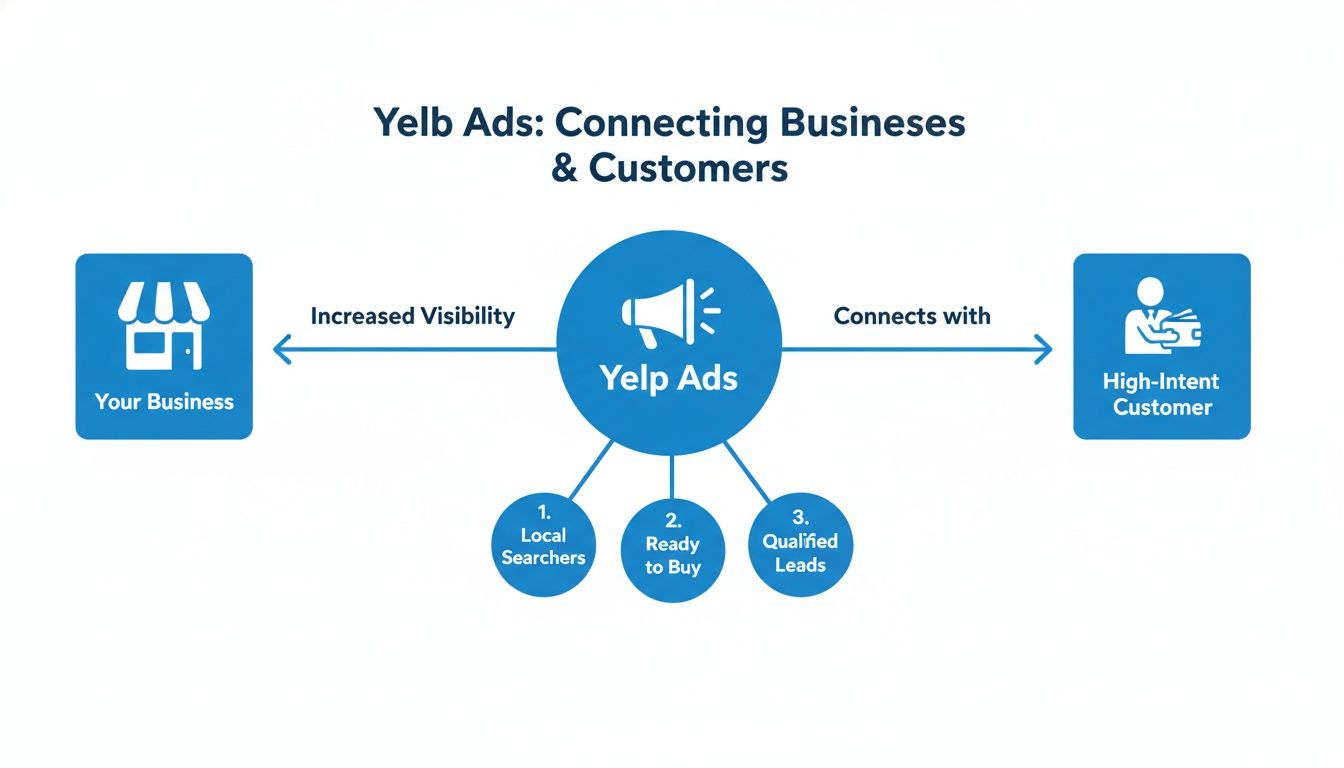
The platform is built to funnel these high-intent customers right to your business profile, which is a powerful concept when it works.
To better understand where your money goes, it helps to see the two main pricing structures side-by-side.
Yelp Advertising Models Explained
| Model | What You Pay For | Best For | Analogy |
|---|---|---|---|
| Cost-Per-Click (CPC) | Each time a user clicks on your ad. | Most businesses, especially those wanting to pay for direct engagement and leads. | A pay-per-entry event. You only pay when someone decides to walk through the door. |
| Cost-Per-Mille (CPM) | Every 1,000 times your ad is shown (impressions). | Larger brands focused on brand awareness rather than immediate clicks or calls. | A billboard on a busy highway. You pay for eyeballs, not for people pulling over. |
While CPM is an option, the vast majority of local service businesses on Yelp operate on the CPC model, as it’s tied more directly to potential leads and aligns with the goal of capturing transactional searchers.
Understanding Budgets and Bids
When you sign up, you'll set a monthly budget. A common starting point for many small businesses falls in the $350 to $550 per month range, though this can scale up significantly. This budget is your ad-spend fuel tank for the month.
Every click sips from that tank. For example, if your average CPC is $10 and your monthly budget is $500, you can get up to 50 clicks before your budget is exhausted. Simple enough, right?
Here’s the catch:
Yelp uses an "auto-bidding" system. You don't get to manually set a maximum CPC. Instead, their algorithm does it for you, adjusting your bid in real-time to try and win auctions. While this sounds convenient, it means you're handing over direct control of your per-click spending to Yelp.
This lack of direct control is precisely why you have to be vigilant about your results. You need to know exactly what a click—and ultimately, a new customer—is worth to your bottom line. To figure that out, you have to understand how to calculate cost per acquisition, which reveals the true cost of winning each new job.
This automated system is also why your costs fluctuate. If a new, aggressive competitor enters your market and doubles their budget, the auction gets hotter, and your CPC will likely climb. This is the inherent risk of a purely paid ad strategy: your lead flow is always subject to your competitors' spending habits and the whims of Yelp's algorithm. It’s why we always emphasize building assets you actually own—like a top-ranked Google Business Profile—that can generate leads without that constant per-click cost.
The Key Factors That Determine Your Ad Spend
Ever wonder why a roofer in Dallas might pay a small fortune per click while one in a smaller town pays just a fraction of that? Your Yelp advertising cost isn't some fixed, arbitrary number. It's a dynamic price shaped by a few powerful market forces. Getting a handle on these factors is the first real step toward building a smart ad strategy that prioritizes profit over just spending money.
It helps to think of Yelp’s ad platform not as a menu, but as a live auction. You are constantly bidding against other local businesses for the attention of a customer who is ready to buy. The more bidders there are, the more a single click is going to cost you.
Industry and Competition
Without a doubt, the single biggest driver of your ad cost is how competitive your industry is. High-value services, especially those dealing with urgent problems, face the most intense bidding wars on the platform.
- Emergency Services: Think about searches like "emergency plumber near me" or "24/7 electrician." These come from people with a critical, immediate need and a high willingness to pay to solve it. Because the potential revenue from that one job is so high, dozens of plumbers will bid aggressively for that click, driving the CPC through the roof. This is a classic example of a transactional search term in action.
- High-Ticket Renovations: It's the same story for keywords like "kitchen remodeling" or "roof replacement." A single lead can easily turn into a five-figure project, which makes each click incredibly valuable—and therefore, expensive.
On the other hand, a business in a less crowded niche, like a mobile dog groomer, will likely find their CPC is much lower simply because fewer companies are fighting for the same keywords.
Your Yelp ad spend is a direct reflection of the demand in your market. It’s not just about how many people are searching, but how many other businesses are also fighting for that same customer’s attention.
Geographic Targeting and Seasonality
Where you do business matters just as much as what you do. Targeting a massive metro area like Los Angeles or New York City will always be more expensive than advertising in a quiet suburb. There are simply more businesses and more cutthroat competition packed into a dense urban market.
Seasonality also plays a huge role in your costs. The price for a click on "AC repair near me" can surge during a July heatwave as every HVAC company pours money into ads to capture those frantic customers. In the same way, a roofer’s CPC for "storm damage repair" will spike right after a major hailstorm rolls through town.
Understanding these cycles is key to budgeting effectively. For a deeper look into controlling these expenses, it's worth learning how to reduce customer acquisition cost with a more holistic strategy.
This is a core reason why our team at Transactional Marketing focuses on building a dominant presence on Google Maps. While Yelp costs can fluctuate wildly with competition, earning a top-three spot in the Map Pack for your most valuable transactional keywords provides a steady, predictable stream of inbound calls. It’s a way to turn your marketing into an asset, not just a recurring expense that's at the mercy of an auction.
How to Maximize Your Return on Investment
It’s easy to get caught up in paying for clicks, but let’s be honest—clicks don’t pay the bills. Booked jobs do. If your ad spend is high but your phone isn't ringing, you've got a problem. This is where we need to stop talking about the cost of Yelp ads and start focusing on your return on investment (ROI). Here at Transactional Marketing, we measure success by what actually matters: phone calls, form fills, and appointments on the calendar from customers with transactional intent.
Think of it this way: running ads to a weak Yelp profile is like paying to send customers to a store with a broken front door and empty shelves. Before you even think about spending a dollar on ads, your Yelp page needs to be a polished, conversion-ready asset packed with recent, positive reviews and all the details a customer needs. Getting this foundation right isn't just a good idea; it's essential for a positive ROI.
From Clicks to Conversions
You’ve got to know your numbers. Without tracking, you're just guessing whether your investment is actually working. The data shows that people on Yelp aren't just browsing—they're ready to hire. Consider this: a massive 68% of Yelp's $1.277 billion in advertising revenue in 2023 came straight from service-based businesses. The potential to grab high-intent leads is huge, but only if your campaign is dialed in. You can dig into the latest Yelp advertising revenue trends on wallstreetzen.com to see the breakdown for yourself.
To see a real return, you have to track the actions that lead to business:
- Phone Calls: How many people clicked the call button on your profile?
- Website Clicks: How many went to your site to book online or learn more?
- Quote Requests: How many prospects used Yelp’s messaging to ask for a price?
When you focus on these concrete outcomes, your Yelp ad budget stops being a monthly expense and starts becoming a predictable source of new business. It's the only way to know for sure if the cost is worth it.
The Power of an Integrated Strategy
While a well-managed Yelp Ads campaign can certainly bring in leads, it shouldn't be the only tool in your toolbox. A strong Yelp presence becomes exponentially more powerful when it supports a commanding presence on Google, optimized for both traditional search and new AI platforms.
This is exactly what our system at Transactional Marketing is built to do. We focus on getting your business to pop up for high-value transactional search terms like "roofer near me" or "dentist near me" right on Google, where the vast majority of ready-to-buy customers are looking.
By locking in a top-three spot in the Google Map Pack and ranking on page one for your most important services, you build a sustainable lead-generation machine that doesn't just vanish the moment you turn off your ad spend. You can learn more about how to measure marketing effectiveness to see how all the pieces fit together. This integrated approach puts you in front of customers everywhere they’re looking, building a much more resilient and profitable business.
Powerful Alternatives to Paid Yelp Ads
If you're relying on Yelp ads, it can feel like you're stuck on a treadmill. The moment you stop paying, the leads stop coming. But what if you could build something that generates high-quality leads consistently, without that constant cost-per-click drain?
The most successful service businesses we've seen don't just "rent" attention on platforms like Yelp; they build and own their own digital presence. This approach creates a lead-generation machine that works for you around the clock, long after a paid campaign has ended. The goal isn't just to find a few customers—it's to become the go-to expert in your service area.
Dominating Google with Transactional SEO
Let's be honest: when someone has an urgent problem, they aren't scrolling through directories for fun. They're grabbing their phone and heading straight to Google. This is where the real action is, and it's the most powerful alternative to Yelp ads. The key is to show up for what we call transactional search terms—the exact phrases people type when they have their wallets out, ready to hire someone.
Think about a homeowner in a heatwave searching for "air conditioning repair near me." Our entire focus at Transactional Marketing is on making sure your business is the first one they see. We've developed a proven system that consistently gets our clients' websites onto the first page of Google, often in just 30 to 60 days, by laser-focusing on the exact terms your customers are searching for.
This isn't the slow-and-steady SEO you might have heard about. It’s a targeted strategy aimed directly at the customers in your city who are ready to make a decision right now. That's why we're called Transactional Marketing—we get you to show up for the transaction.
The Unmatched Power of Google Maps Optimization
While Yelp is just one of many directories, Google Maps is the default navigation and local search tool for millions. Landing one of the top three spots in the Google Map Pack for your core services is arguably the most valuable piece of digital real estate a local business can own today.
Think of the Google Map Pack as the new digital main street. Being in the top three puts your business front and center for hundreds of potential customers every month who are actively searching for your services.
Getting into that top-three is a core part of what we do at Transactional Marketing. We have the technology to optimize your Google Business Profile and make sure you show up in the top three in your service areas. The result? Our clients often see hundreds of more phone calls every month—which translates into literally thousands of more calls and booked jobs every single year.
AI Optimization for a Sustainable Lead Flow
The way people find information is changing. The rise of AI and large language models (LLMs) like ChatGPT is the next frontier of search, and we make sure our clients are prepared. AI optimization is the new way businesses will be found. It is all about creating high-quality, targeted content that both ranks in traditional search and provides clear, authoritative answers for these new AI-driven searches.
This strategy creates a truly sustainable marketing asset. Unlike a Yelp ad that vanishes the second you stop your budget, an AI-optimized article or service page can continue attracting and converting customers for years. By building a library of industry-specific content—one blog post per industry, per topic, like "SEO for roofing companies"—we establish your authority and build a powerful, long-term lead generation machine that fuels real business growth.
Building an Integrated Local Lead Generation Plan
Getting a handle on your Yelp advertising cost isn't the real end game. The ultimate goal is to build a reliable system that brings profitable leads through the door, month after month. Too many businesses get stuck thinking it's an either/or choice between Yelp ads and Google SEO. The smartest approach, however, is an integrated plan where each channel plays to its unique strengths, with a heavy focus on AI optimization.
Think of it this way: Yelp ads are great for an immediate injection of leads. But it's a rented audience—the moment you turn off the spend, the leads dry up.
A truly resilient marketing engine pairs that short-term boost with a powerful, long-term asset you actually own. This is where you have to look at Google, the platform where the overwhelming majority of transactional searches—think "roofer near me" or "dentist near me"—actually happen. While Yelp ads can fill your pipeline today, a solid foundation in SEO, Google Maps optimization, and AI optimization is what secures your business for tomorrow.
A Blueprint for Sustainable Growth
Our strategy at Transactional Marketing is built to deliver both immediate and lasting results. We believe in earning your business every single month by delivering real, measurable outcomes.
Here’s how this integrated model works in practice:
- Immediate Impact: We start with a carefully controlled Yelp ads budget. The goal is to generate quick leads and keep your cash flow healthy from day one.
- Long-Term Dominance: At the same time, our team gets to work on what truly moves the needle for long-term growth: securing top rankings on Google. We focus on getting your website to show up on page one for high-value transactional keywords, often within 30-60 days.
- Google Maps Mastery: We also deploy our technology to get your business into the coveted top three of the Google Map Pack. This turns your Google Business Profile into a lead-generation machine that can drive hundreds of extra phone calls a month on its own.
This isn't just another marketing plan; it's a blueprint for owning your local market. You capture customers actively searching on Yelp right now while simultaneously building an unconquerable presence on Google that is optimized for AI and pays dividends for years to come.
While Yelp ads are a valuable piece of this puzzle, it's always wise to have a broad strategy. For example, medical practices can find success by exploring other proven strategies for growth to maintain a steady stream of new patients. With the right integrated system, you become the obvious choice for local customers, right at the moment they’re ready to spend money.
Answering Your Top Questions About Yelp Ads
When it comes to Yelp advertising, it's easy to get bogged down in the details. I've worked with countless service businesses, and these are the questions that come up time and time again before they decide to take the plunge.
What Should I Realistically Expect to Budget Each Month?
For most local service businesses, a starting budget of $500 to $1,500 per month is a realistic entry point. Of course, this isn't a one-size-fits-all number.
Think about it this way: an emergency plumber in a dense city like Chicago is facing far more competition than a landscaper in a quiet suburb. The plumber will naturally need a more aggressive budget to get seen. The best approach is to start with a budget you're comfortable with, obsess over the return you're getting, and only scale up once the numbers prove it's a profitable move.
Am I Forced Into a Long-Term Contract?
This is a big one. While Yelp’s sales team often steers businesses toward 6 or 12-month contracts with the promise of better rates, you aren't completely locked in. They do offer more flexible, month-to-month options.
Just be aware that this flexibility comes at a price—usually a higher cost-per-click. If you go this route, make sure you get the cancellation policy in writing and understand it completely before signing anything. It’s a major departure from how we operate at Transactional Marketing, where we believe our results—not a contract—should be what keeps you with us month after month.
Which Is a Smarter Investment: Yelp Ads or Google Maps?
It's a classic debate. For truly sustainable, long-term growth, investing in Google Maps optimization almost always delivers a superior return. When you secure a top-three spot in the Google Map Pack for your most valuable transactional search terms, you've built a durable asset—one that keeps generating high-quality leads without you having to pay for every single click.
Yelp ads can give you a quick shot of adrenaline, but the leads dry up the second you turn off the spend. A much smarter strategy uses Google Maps and organic SEO (including AI optimization) as the foundation of your lead generation. You can then sprinkle in Yelp ads to grab some extra market share. While Yelp can be part of the mix, it's also wise to diversify with other modern strategies, like exploring AI-powered lead generation to create multiple streams of inbound customers.
At Transactional Marketing, we don't rent you leads; we build you a lead-generating asset. Our proven, AI-driven system is designed to get your business to the top of Google for the transactional search terms that drive revenue—all without locking you into a long-term contract. See how we make the phone ring by visiting us at https://transactional.net.