

You’re probably here because Scorpion just landed on your radar the same way it lands on a lot of service business owners’ radar. You got the polished pitch. You saw the slick platform. You heard about AI, lead recovery, call tracking, websites, ads, reporting, and one company handling everything.
That pitch is attractive because running a roofing company, plumbing shop, dental practice, or pest control business doesn’t leave much time to babysit marketing vendors. You want the phone to ring. You want booked jobs. You want patients. You want to show up when someone searches “roofer near me”, “emergency plumber near me”, or “dentist near me.” Those are the searches that matter. Those are transactional searches. That’s where money changes hands.
The problem with a lot of scorpion marketing reviews is that they blur together brand, software, paid ads, websites, and SEO into one big promise. That makes it hard to answer the only question that matters for a local service business owner: Will this investment help you win high-intent local searches and Google Maps visibility, or will it mostly buy you an expensive system and a lot of activity?
Considering Scorpion Marketing Start Here
A common scenario goes like this. A business owner has hit a plateau. Referrals are inconsistent, Google Ads are getting expensive, and the local competition keeps showing up above them in the map pack. Then Scorpion enters the picture with a clean sales process and a convincing story about centralizing everything.
That story isn’t wrong. It’s just incomplete.
If you own a local service business, you don’t need more dashboards for the sake of dashboards. You need more calls from buyers who are ready now. If a company can’t help you rank for the terms that carry buying intent, or can’t move your Google Business Profile into stronger map visibility, then the rest is secondary.
I’ve seen owners get pulled toward “all-in-one” because it feels safer. One vendor. One login. One account manager. That can work. But convenience and performance aren’t the same thing. A lot of agencies can build a nice reporting layer around weak local SEO execution.
Practical rule: Judge any agency by what happens on your most valuable local searches, not by how polished the demo looks.
When you read scorpion marketing reviews, filter everything through that lens. Don’t ask whether the software is advanced. Ask whether your business will rank better for the searches that produce jobs and patients. Don’t ask whether they offer SEO, PPC, and websites. Ask which of those channels they’ll lean on when pressure hits, and whether that mix fits your margin goals.
If you’re still comparing options, this guide on how to choose a digital marketing agency is worth reading before you sign anything. It’ll help you separate presentation from actual fit.
What Is Scorpion and Who Do They Serve
Scorpion isn’t a boutique local SEO shop. It’s a large, process-driven marketing company built to serve major verticals. That matters because the way a company grows shapes the kind of client experience it delivers.
According to this Scorpion growth analysis, Scorpion grew from $20 million to over $120 million in annual revenue, and by 2024 had passed $200 million. The same analysis says Scorpion acquired Ranking.ai in 2022 and rebranded it as Scorpion Ranking, a system that analyzes 40,000 data points to produce marketing suggestions developed for specific needs.

A big agency with a big-agency model
That revenue story tells you two things right away.
First, Scorpion knows how to sell and scale. That’s not a criticism. It’s reality. Companies don’t reach that size by accident.
Second, their model is designed for repeatability. Large agencies need systems, standardization, internal process, and packaged delivery. That’s useful for some clients and frustrating for others.
Here’s where they’ve historically focused:
- Legal businesses that need lead intake, strong web presence, and measurable attribution
- Healthcare practices that want one platform handling multiple moving parts
- Home services companies that need calls, booked jobs, and operational visibility
- Multi-location brands that want reporting rolled up under one system
That last group is where Scorpion often makes the most sense. If you manage multiple offices or multiple service areas, centralized reporting and integrated lead handling can save a lot of internal friction.
Their pitch is software plus service
Scorpion doesn’t sell only agency labor. They sell an operating environment. Website management, advertising, analytics, review tools, and communication features get bundled into one platform-first experience.
That sounds efficient because it is efficient. But it also changes the buying decision. You’re not just asking whether they’re good at local SEO. You’re asking whether you want your marketing stack, reporting, website, and lead management tied into their ecosystem.
The more integrated the platform, the more important it becomes to ask how easy it is to pivot if the strategy underperforms.
Why home service owners should care about the distinction
A roofing company, plumbing company, HVAC contractor, pest control brand, or local dental office doesn’t win because its vendor has the most features. It wins because it captures transactional demand in a specific market.
That means:
- ranking for high-intent local terms
- showing strongly in Google Maps
- converting calls fast
- keeping lead handling tight
- building enough local authority that you don’t have to buy every lead forever
Scorpion is credible. It’s established. It has scale. But scale cuts both ways. It usually brings stronger tools and deeper infrastructure. It can also bring a less personal process, more standardized execution, and strategy shaped around what fits the platform.
An In-Depth Look at Scorpion's Service Offerings
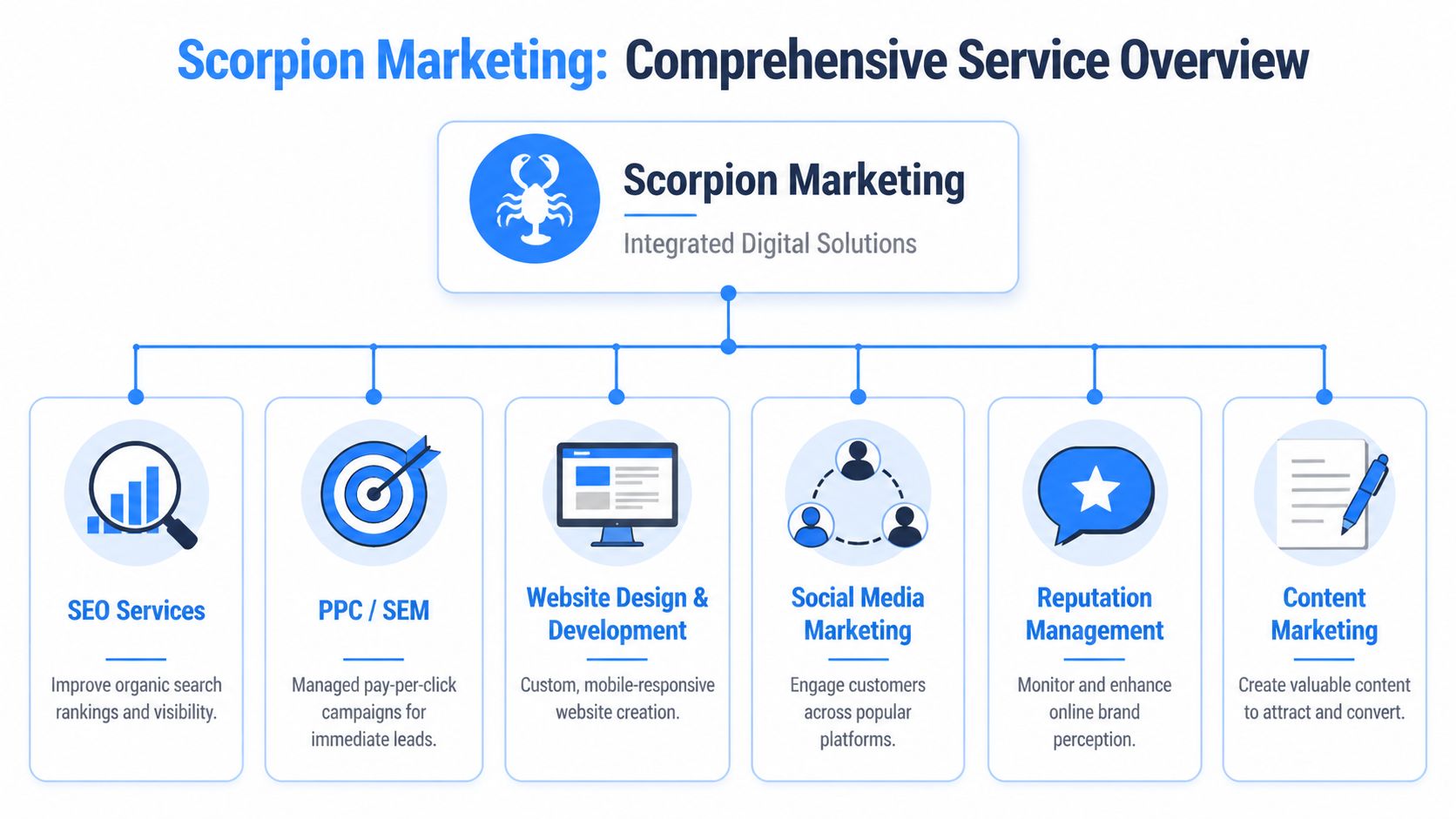
Scorpion offers a broad stack. On paper, that’s a strength. In practice, each piece needs to be judged by one standard: does it help a local business win more transactional searches and convert that demand into calls and booked work?
The service mix looks extensive. The harder question is whether that extensive package is the right one for your market.
SEO and local visibility
Scorpion sells SEO, and for service businesses that’s good in theory. But “SEO” is too broad to be useful. The central issue is whether the work is aimed at local buyer intent.
For a roofer, that’s not generic blog traffic. It’s terms like roof repair, roof replacement, storm damage roofing, and near-me service queries in the exact cities that generate revenue. For a dentist, it’s the same logic with emergency dental, dental implants, and dentist near me. For an HVAC company, it’s AC repair and furnace service by location and urgency.
When I evaluate an agency’s SEO offering, I look for these signs:
- Local page architecture built around service-city combinations
- Google Business Profile support and map pack strategy
- Content tied to buying intent, not vanity traffic
- Technical execution that doesn’t bloat the website
- Conversion-first page design so rankings produce calls
If an agency talks endlessly about authority, content, and visibility but can’t explain how it will move your ranking for the exact search phrases your customers use when they’re ready to buy, that’s a red flag.
For businesses focused on hyperlocal rankings, this primer on local SEO services is useful because it frames the work around service-area demand rather than generic organic traffic.
AI intake and lead recovery
Scorpion’s strongest differentiator may be its AI intake and lead management layer.
According to this Scorpion platform comparison, Scorpion Convert launched in October 2025 as an AI-powered intake tool that automates responses to missed calls and messages through voice and text assistants. The same source says G2 reviewers praised its call tracking for analyzing high buyer intent and predicting incoming calls, while RevenueMAX uses AI algorithms to prioritize high-intent leads from different channels.
That’s a meaningful capability.
If your office misses calls after hours, loses web leads, or struggles with front-desk response speed, lead recovery tech can plug a real leak. A lot of service businesses don’t have a lead generation problem. They have a lead handling problem.
Still, there’s a catch. Lead recovery doesn’t create demand by itself. It improves the conversion of demand you already generated. If your rankings are weak or your map visibility is weak, AI intake can help salvage missed opportunities, but it won’t replace the need to own the search results.
Key distinction: Intake software helps you close more of the traffic you already have. Local SEO helps you own more of the traffic your competitors are getting.
Here’s the embedded video for a closer look at the platform context:
PPC and paid lead generation
Scorpion is also known for paid media management. That includes Google Ads and campaign optimization inside their platform environment. For some businesses, paid media is necessary. If you need immediate lead flow in a competitive market, ads can fill the pipeline while SEO matures.
But paid search should support your long-term local visibility strategy, not replace it.
For local service companies, overreliance on PPC creates a few problems:
- Lead costs stay rented. You stop paying, volume drops.
- Maps and organic don’t strengthen by default. Ads don’t build the same local asset.
- Bad intake wastes expensive clicks. If the office misses calls, ad spend leaks fast.
- You can confuse motion with progress. More campaign activity doesn’t always mean better unit economics.
That doesn’t make PPC bad. It makes it dangerous when it becomes the main answer.
Websites and reputation management
Scorpion’s website and reputation tools are part of the broader all-in-one promise. That’s attractive to owners who don’t want a patchwork of vendors.
The review management side is one area where Scorpion clearly understands local search behavior. Their own review-focused material, summarized in this analysis of Scorpion’s reputation tools, says the platform aggregates reviews from over 70 sites and supports fast responses, notifications, and review solicitation workflows. That matters because reviews influence trust, click-through behavior, and map pack performance.
The downside is potential lock-in. Proprietary websites and tightly bundled services can make life simpler when things are going well. They can also make switching harder if you decide the strategy isn’t delivering.
Scorpion Pricing Contracts and Real ROI
A lot of owners get serious about Scorpion right up until they see the proposal.
The problem is not merely price. The problem is paying enterprise-style fees when your business wins or loses on a handful of high-intent searches, your Google Business Profile, and whether the phone gets answered. If most of your revenue comes from terms like "roof repair near me" or "emergency plumber [city]," you should judge Scorpion by one standard. Does it improve transactional visibility enough to produce profitable jobs?
Scorpion vs Transactional Marketing At a Glance
| Attribute | Scorpion Marketing | Transactional Marketing |
|---|---|---|
| Core model | Large all-in-one agency platform | Specialized local SEO and AI optimization approach |
| Best fit | Multi-location, established brands that want centralized systems | Service businesses focused on transactional rankings and Maps visibility |
| Contract style | Reviews often reference higher-commitment engagements | Contract-free approach |
| Cost posture | Premium pricing and larger commitments | More flexible for businesses that want to prove performance month to month |
| SEO focus | Broad integrated marketing package | Focus on transactional search terms and local service-area visibility |
| Google Maps emphasis | Part of broader local marketing stack | Core priority |
| PPC role | Important part of the overall model | Support channel, not the whole strategy |
| Ideal buyer mindset | Wants one vendor and one platform | Wants direct focus on rankings, calls, and booked jobs |
What the pricing decision really comes down to
Scorpion sells breadth. That can work if you need one vendor to handle site management, ads, reporting, CRM-style workflows, and support across multiple locations.
A local service business with one brand, one main service area, and a hard need to rank in Maps has a different problem. You do not need more platform. You need tighter execution on the searches that bring in estimates, inspections, and booked jobs.
That is why the actual risk is not "high pricing" by itself. The risk is mismatch.
If your company has strong close rates, a trained office staff, multiple service lines, and enough margin to absorb a slower ramp, a premium agency model can make sense. If you need clean local rankings, fast map pack gains, and clear accountability each month, a specialist model is usually the better buy.
How to judge ROI without getting distracted
Ignore vanity reporting. Focus on business math.
Track these instead:
- rankings for high-intent local terms
- Google Maps visibility in your actual service area
- qualified call volume
- booked jobs
- cost per acquired customer
- revenue from organic and Maps leads
That last metric decides whether a proposal is sane. Before signing anything, run your numbers through a simple cost per acquisition calculation and compare that target against the monthly retainer, ad spend, and close rate you would need to make the relationship profitable.
You should also understand how bundled retainers hide tradeoffs between strategy, labor, software, and account management. This breakdown of how agencies set their prices is useful because it explains why expensive agency packages can look organized on paper while still producing weak unit economics.
My take
Scorpion is easier to justify for bigger operators than for owner-led local service companies.
If you run several locations and want one system for a lot of moving parts, the premium may be worth it. If you are trying to win "near me" searches, improve map pack placement, and turn local intent into calls without getting locked into a broad agency relationship, Scorpion starts to look expensive fast.
That is the key contrast with a specialist like Transactional Marketing. Scorpion sells scale and centralization. Transactional Marketing sells focus, month-to-month accountability, and direct attention on the searches that drive jobs. For a service business that lives on transactional search, I would pick focus.
Analyzing Real Customer Review Patterns
A roofer signs with a big agency expecting more calls from "roofer near me." Six months later, the dashboard looks polished, but the owner still is not showing where it counts. In Maps, in the local pack, and on buyer-intent searches.
That is the pattern I look for in scorpion marketing reviews.

Positive reviews usually come from businesses that want one vendor to handle a lot of moving parts. They like the centralized reporting, the bundled website and ad management, and the convenience of keeping everything under one roof. For multi-location operators, that setup can reduce internal chaos.
That value is real. It just does not answer the main question for a local service business owner. Will this agency help you win more high-intent local searches that turn into booked jobs?
Review systems matter here because reputation affects both click-through rate and conversion rate. If you want to get better at that side of local search, this guide on how to convert reviews into customers is worth reading.
The complaints follow a different pattern. On G2's Scorpion review page, you can see the usual split that happens with large agencies. Some clients praise the support and breadth of services. Others describe frustration with execution, fit, and results. That gap usually shows up when a business needs focused local SEO work, but gets a broader agency process instead.
For home service companies, that mismatch gets expensive fast.
An HVAC company, roofer, or pest control business does not need marketing that only looks organized in a report. It needs stronger visibility on service-plus-city terms, better Google Business Profile performance, more review velocity, and pages built to rank for urgent local intent. If those pieces are weak, the campaign can stay busy without producing enough calls.
This is the part many articles miss.
Scorpion serves several verticals, and that matters because legal, healthcare, and home services do not win search the same way. A law firm can tolerate a broader content strategy and a longer path to conversion. A local service company usually cannot. The money is in transactional searches and map pack clicks from people who need help now.
That is why I pay close attention to whether reviews hint at these problems:
- weak movement in Google Maps
- heavy reliance on paid traffic to create activity
- generic strategy across very different local markets
- account management that feels polished but not close enough to the business
- slow progress on searches with immediate buying intent
If you are a service business owner, review generation should also be an operating habit, not a side task. A simple process for getting more reviews can improve rankings, click-through rate, and close rate at the same time.
My read is straightforward. Scorpion tends to make more sense for companies that want scale, systems, and broad support. It makes less sense for the owner-led service business that must win "near me" searches in one market and cannot afford a diluted local strategy.
That is the key review pattern. Bigger clients often like the platform. Smaller local operators often need sharper execution than a big-agency model can consistently deliver.
Is Scorpion the Right Choice for Your Service Business
Here’s the blunt answer. Scorpion can be the right choice for some service businesses, but it’s the wrong default choice for most locally focused operators who need to dominate transactional search and Google Maps.
That distinction matters.
When Scorpion makes sense
Scorpion is a reasonable option if your business looks like this:
- You operate in multiple locations and want one system across all of them.
- You have a substantial marketing budget and can absorb a slower optimization curve.
- You want broad support across websites, paid ads, intake, reporting, and reputation.
- You prefer a more hands-off relationship where a large agency runs the machine.
For that type of company, platform depth can outweigh the downsides. The operational convenience alone may justify the investment.
When I’d be cautious
I’d be cautious if you’re:
- a single-location home service company
- a local dental or med spa business trying to improve patient acquisition in one region
- a pest control or roofing company where map pack rankings are the difference between growth and stagnation
- a business owner who needs fast, visible progress on buyer-intent local terms
- anyone who hates long commitments before proof is clear
If that’s you, a big-agency model can easily become too broad, too expensive, and too dependent on paid media.
The wrong question owners ask
A lot of owners ask, “Is Scorpion a good company?”
That’s too vague.
Ask these instead:
- Will they improve my rankings for the exact terms people use when they need my service now?
- Will they help me break into the top map results in my service areas?
- Will the plan build a long-term local asset, or mainly drive temporary traffic through ads?
- Can I clearly see what’s happening by city, service, and lead source?
- What happens if results lag and I need to pivot?
Those questions get you closer to the truth.
My recommendation by business type
For franchises and large regional operators: Scorpion is worth considering. Their all-in-one model can reduce internal complexity.
For growth-stage local service businesses: I’d lean away unless the proposal is extremely clear on Maps, local SEO execution, and accountability.
For roofers, plumbers, HVAC contractors, electricians, pest control companies, dentists, chiropractors, and med spas trying to win “near me” searches: A specialized approach is usually better. You need focus, not breadth. You need map pack pressure, city-level content strategy, review systems, and conversion-first execution.
If your next customer is searching with money in hand, the fastest path usually isn’t the biggest platform. It’s the sharpest local strategy.
The Alternative Path to Dominating Transactional Search
If your business lives on local intent, the better approach is simpler.
Start with Google Maps. If you’re not visible in the map pack, you’re missing the part of the results that often gets the highest local buying attention. That means your Google Business Profile, review flow, service-area signals, and local relevance need active management, not occasional cleanup.
Then build your website and content around transactional search terms, not fluff. A local service business doesn’t need a bloated content library full of informational posts that never turn into calls. It needs pages and supporting content that match what buyers search when they’re ready to hire. Terms like roofer near me, AC repair near me, emergency plumber near me, and dentist near me are where the money is.
AI optimization matters here too. Businesses are no longer discovered only through standard search listings. They’re increasingly surfaced through AI-driven answer layers, summaries, and recommendation workflows. That changes content strategy. Your website has to be structured so search engines and AI systems can understand your services, locations, trust signals, and buyer relevance fast.
There’s also the intake side. If you generate more calls but still miss them, growth stalls. For companies evaluating lead handling options alongside SEO, this overview of the Recepta.ai answering platform is a useful reference point because it highlights how answering speed affects conversion from high-intent calls.
The right system for a service business usually looks like this:
Map pack first
Get visible where local buyers click first.Service plus city targeting
Build content and pages around exact local demand.Fast conversion paths
Calls, forms, and booking flows can’t create friction.AI-friendly structure
Make your business easy for search engines and AI systems to interpret.No unnecessary lock-in
Flexibility forces accountability.
If your goal is to own your market for transactional searches instead of renting visibility month after month, that’s the path I’d take.
If you want a contract-free partner focused on ranking your business for transactional searches, improving Google Maps visibility, and building an AI-optimized local presence that turns searches into calls, talk to Transactional LLC. They specialize in helping service businesses win the exact local searches that produce jobs and patients.