


Most local service businesses already know the feeling. You're paying for a website, posting on Google Business Profile when you remember, maybe running ads, and still wondering why the calls aren't as steady as they should be.
The problem usually isn't effort. It's targeting. If your marketing speaks to everyone, it doesn't connect with the person searching “dentist near me,” “AC repair near me,” or “pest control near me” right when they're ready to hire. That's where user personas become useful. Not as a branding exercise, but as a tool for winning more transactional searches and turning searchers into booked jobs.
What Are User Personas Really
A user persona is a working profile of the kind of customer who is most likely to hire you, and why they hire. For a local service business, that matters less as a branding exercise and more as a revenue tool. It helps you match your pages, Google Business Profile, reviews, and offers to the searches that lead to booked jobs.
A genuine, research-based persona is built from patterns you already see in the business. Call notes. Estimate requests. Sales conversations. Review language. Questions your office answers every week. As Airfocus explains in its overview of user personas, personas are useful because they reflect behavior, goals, and friction points, not just surface traits.
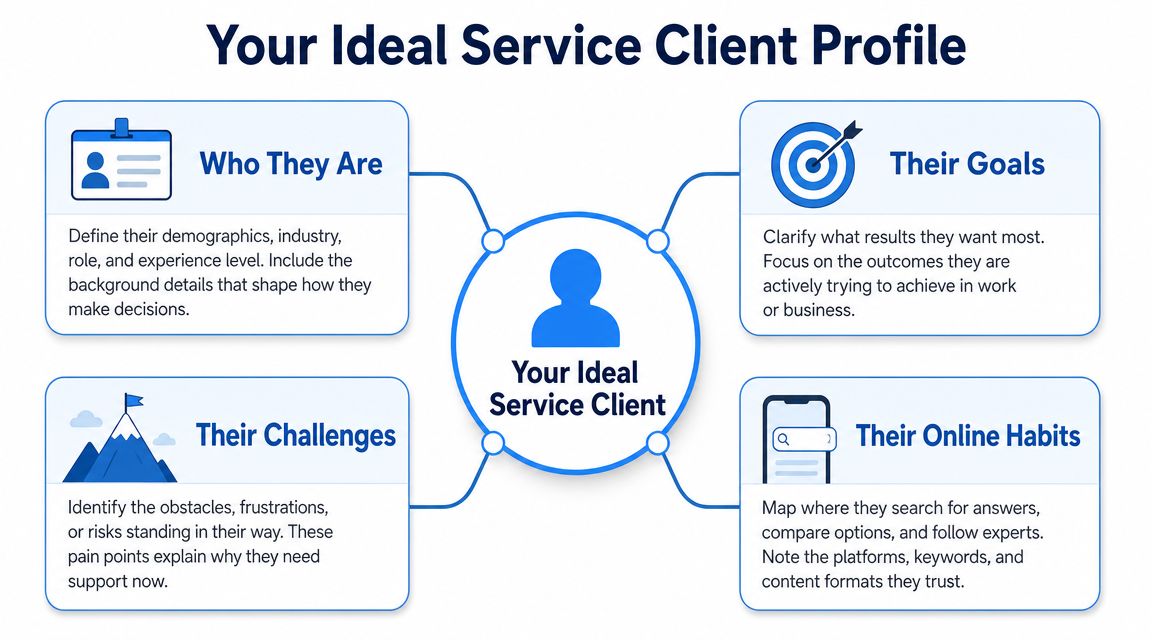
Personas are not demographic worksheets
Age range, income, and homeowner status can add context. They do not tell you why someone searches, what convinces them, or what makes them leave and call a competitor.
A useful persona answers questions like these:
- What triggered the search? Emergency problem, routine maintenance, second opinion, or quote comparison?
- What matters most right now? Fast response, price clarity, insurance help, financing, proof of expertise, or neighborhood proximity?
- What creates hesitation? Fear of getting oversold, unclear pricing, scheduling hassle, concern about quality, or weak reviews?
- How do they search? “Emergency electrician near me,” “roof leak repair cost,” “best family dentist,” or a longer question asked into Google or an AI assistant?
That last point matters more every month. People still type short local queries, but they also ask detailed questions through Google, Maps, Siri, and AI tools. A solid persona helps you write pages and FAQs that answer both. That gives you a stronger shot at showing up for transactional searches and for AI-generated recommendations.
Think like an operator
If you run the phones, check estimates, or review missed leads, you already know your main personas. You know which callers need same-day service, which ones fixate on price, which ones ask if you serve their ZIP code, and which ones want proof before they trust you in their home.
The advantage comes from documenting those patterns and using them consistently. That changes what goes on a service page, which reviews you feature, how you write title tags, what photos you upload to Google Business Profile, and how you structure a content marketing strategy for local growth.
I've found local businesses either waste traffic or convert it, depending on their messaging. If your site talks in broad claims like “quality service” and “customer satisfaction,” it blends in. If it speaks to a specific hiring situation, such as urgent repair, insurance-related cleanup, kid-friendly dental care, or after-hours availability, it starts pulling in people who are ready to act.
The same principle shows up in other high-trust service categories. Firms that develop effective law firm marketing use buyer personas to match messaging to the concerns behind the inquiry, not just the practice area.
That is what a persona really is. A tool for turning customer patterns into clearer messaging, better local targeting, stronger AI visibility, and more calls from people ready to hire.
How Personas Drive More Transactional Leads
A persona matters because it changes the quality of your decisions. Instead of guessing which services to push, which headlines to write, or which offers to feature, you build your marketing around the exact concerns of the people most likely to buy now.
That's how more transactional leads happen. Not from louder messaging. From tighter alignment.
Better personas create better conversion paths
Docsie notes that user personas work best when they're research-based composites of multiple real users, built from inputs like interviews, surveys, and support tickets so teams can make decisions from shared evidence instead of assumptions in its user persona glossary.
That matters in local marketing because assumptions usually sound like this:
- “People just want the cheapest option.”
- “Our customers are homeowners over a certain age.”
- “Everyone wants the same message.”
In the field, that usually isn't true. Some callers want the fastest appointment. Some want a specialist. Some need proof you serve their exact neighborhood. Some want to know whether you work with insurance. A persona gives those patterns names and structure so your website and Maps presence stop trying to appeal to everyone at once.
What changes when you know the buyer
Here's the practical shift.
| Without personas | With personas |
|---|---|
| Generic homepage copy | Service pages built around actual buying triggers |
| Broad keywords | Transactional search terms tied to real intent |
| Random GBP posts | Posts that match urgency, objections, and seasonality |
| Weak calls to action | Calls to action matched to the customer's decision style |
Practical rule: If your page doesn't answer the reason the person searched, it won't convert well even if it ranks.
For a local business, this affects everything from title tags to review strategy. A customer who searches “emergency electrician near me” needs speed and certainty. A customer who searches “best cosmetic dentist near me” needs trust and outcome confidence. Different persona, different page structure, different supporting proof.
If you want more examples of how lead generation becomes more predictable once messaging matches buyer intent, this guide on how to get more leads for Fort Myers businesses is a useful companion read.
Strong personas also make keyword research for local intent far more accurate because you stop chasing search volume in general and start targeting the searches that produce paying customers.
Using Personas to Dominate Local SEO and Google Maps
Local SEO gets stronger when your business reflects how real customers search, compare, and choose. Personas help you build that relevance across your website, your Google Business Profile, your review requests, and the location signals that support Google Maps visibility.
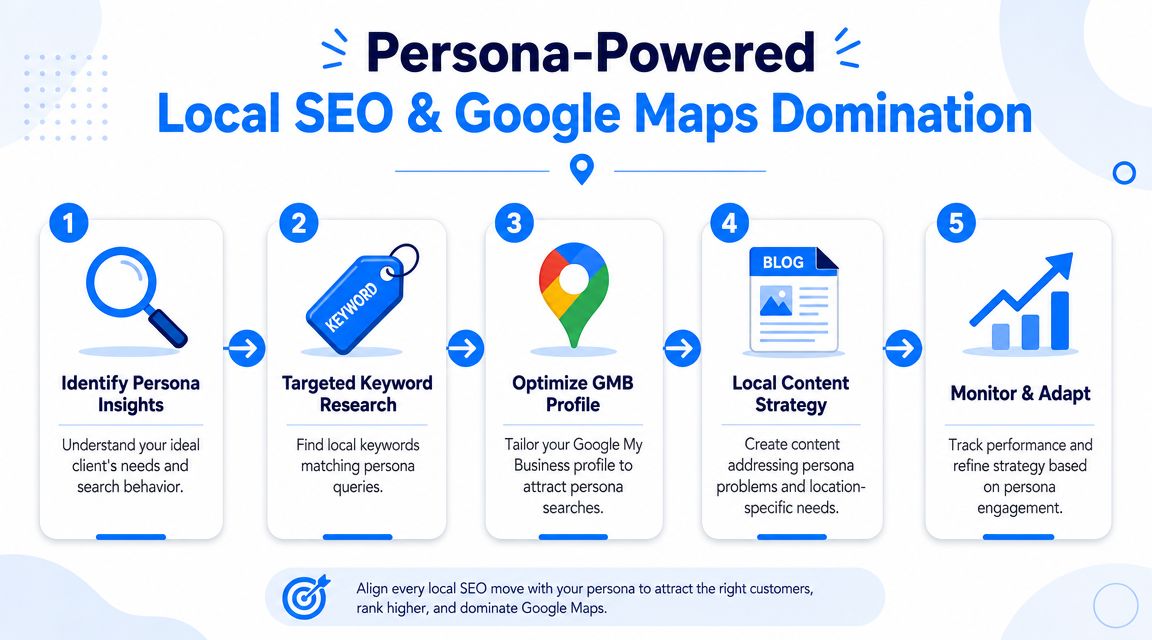
Behavior gives you the right keywords
SurveyMonkey's guidance is useful here. A strong persona should include behavioral variables such as goals, context of use, pain points, decision criteria, device or channel use, and technical expertise because behavior explains how users interact with a service better than demographics alone in its explanation of user personas.
For local SEO, that means keyword selection stops being random.
A plumbing company might think the target keyword is “plumber.” A persona-driven approach often uncovers more profitable intent:
- Urgent searcher: “burst pipe repair near me”
- Price-sensitive homeowner: “water heater replacement cost”
- Trust-focused buyer: “licensed plumber with reviews”
- Mobile searcher on the go: “24 hour plumber open now”
Those are not just keyword variations. They represent different customer states. Each state needs different copy, proof, and calls to action.
Google Maps rewards clarity
Your Google Business Profile should reflect what your strongest personas care about. If speed matters, your photos, business description, services, and posts should reinforce responsiveness. If trust matters, review language and service explanations need to reduce risk. If family safety matters, your content should speak to that directly.
A weak local profile says, “We offer quality service.”
A persona-driven local profile says, “Same-day service available,” “financing options,” “family-safe treatments,” or “gentle care for anxious patients,” depending on the specific buyer.
That level of specificity helps in traditional search and also supports AI-driven discovery. Large language models don't just scan for raw keywords. They infer relevance from patterns, context, and consistency. When your pages, reviews, FAQs, and business profile all align around the same user needs, your business becomes easier for both search engines and AI systems to understand.
A quick video can help if you want the Maps side explained visually.
Before and after in the real world
Here's the difference in practice.
| Generic approach | Persona-driven approach |
|---|---|
| Optimize for “roofing company” | Optimize for “roof leak repair near me” and “storm damage roofer” |
| One service page for everyone | Separate pages by urgency, service type, and buyer concern |
| Generic review asks | Ask for reviews that mention speed, cleanliness, financing, or pain relief |
| Broad blog topics | Write content around real pre-call questions and local decision triggers |
If your ideal customer is in panic mode, your local SEO has to look useful at a glance. They won't dig for answers.
That same logic applies to map rankings. Relevance improves when your profile, categories, services, website pages, and customer language all point toward the exact transactional terms your market uses. If you're trying to strengthen that side of your local presence, this guide on how to rank higher on Google Maps is the right next step.
Local Service Persona Examples in Action
Theory is easy to nod along with. Examples make it usable.
HVAC example
Call this persona Comfort-First Craig. He isn't browsing for fun. His system is struggling, the house is uncomfortable, and he wants a company that can fix the issue without dragging him through a complicated sales process.
His likely transactional searches include:
- Fast help: “AC repair near me”
- Replacement intent: “new air conditioner installation”
- Money concern: “HVAC financing near me”
The content that closes Craig isn't a broad article about home comfort. It's a service page that explains response speed, common repair problems, financing availability, and what happens after he calls. He also responds well to review language that mentions punctual techs, honest recommendations, and clear pricing.
Dental example
A dental practice might serve Anxious Annie. She needs treatment, but hesitation is the obstacle. She isn't just choosing a dentist. She's trying to avoid pain, embarrassment, and a bad experience.
Her searches often look like this:
- Trust search: “best dentist near me”
- Fear-reduction search: “gentle dentist reviews”
- Urgent need: “emergency dentist near me”
The wrong page talks only about technology and credentials. The better page answers what Annie is thinking. Will this hurt? Will anyone explain things clearly? Can I be seen quickly? For this persona, testimonials, reassurance-focused FAQs, and staff photos usually matter more than polished branding language.
A high-intent searcher doesn't always need more information. Sometimes they need less uncertainty.
Pest control example
Then there's Home-Protector Helen. She's worried about her home, her kids, and whether the problem will get worse if she waits. She wants a company that acts fast and doesn't make her feel like she's overreacting.
Her search behavior often includes:
- Immediate local intent: “pest control near me”
- Specific problem intent: “termite treatment near me”
- Safety concern: “safe pest control for families”
What convinces Helen to call is different from what convinces Craig or Annie. She wants clear treatment steps, family-safe messaging if that reflects the service, proof you handle her exact pest issue, and obvious service-area coverage. A well-built page for Helen should sound calm, specific, and local.
That's the pattern across industries. Different service. Different emotional trigger. Different transactional search terms. Different conversion message.
A Simple Persona Template You Can Use Today
A usable persona for a local service business should fit on one page and help you make better marketing decisions fast. If it does not change the pages you publish, the terms you target, and the proof you show, it is just branding paperwork.
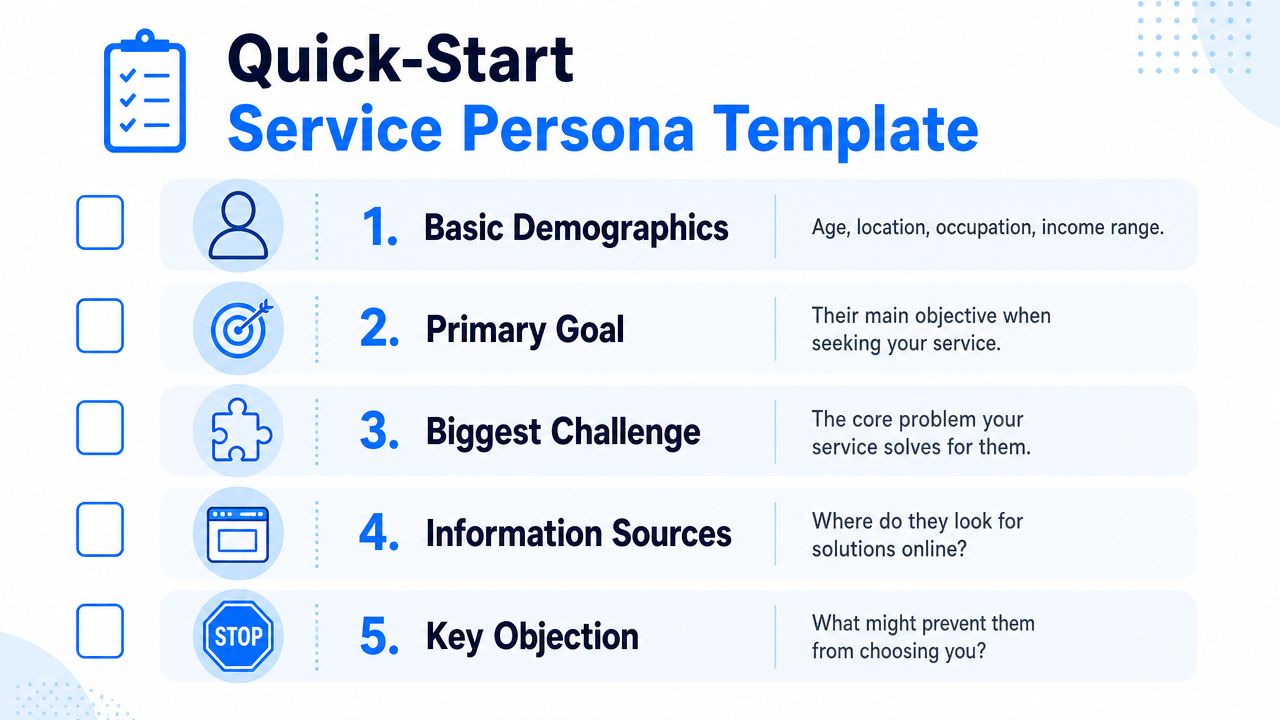
The lean version
Capture the details that affect rankings, clicks, calls, and booked jobs:
- Persona name: A simple label your team will remember.
- Trigger event: What happened that made this person start searching right now?
- Desired outcome: What result do they want by today, this week, or this month?
- Search language: The exact words they type into Google or say into their phone.
- Decision factors: What pushes them to choose. Speed, reviews, price, insurance, financing, experience, or proximity.
- Main objection: What could stop the call or form submission?
- Proof needed: Reviews, photos, guarantees, certifications, FAQs, response-time claims, or service-area proof.
- Best page type: Service page, city page, emergency page, comparison page, review page, or FAQ.
That is enough to build around.
How to build it without guessing
Use customer evidence, not team assumptions. Pull language from sales calls, intake notes, search console queries, reviews, chat logs, and the questions people ask before they book. As noted earlier, established persona guidance also stresses direct customer research and regular updates. The practical takeaway is simple. Build from repeated patterns, then revise when those patterns change.
A simple process works well:
- Review recent leads: Start with the services that bring the best jobs and strongest close rates.
- Highlight repeated phrases: Look for the exact wording customers use to describe the problem, urgency, and what they fear.
- Split by buying behavior: Separate urgent buyers, price checkers, trust-first buyers, and specialty-service buyers.
- Assign a page and offer: Give each group a page type, CTA, and proof set that matches how they decide.
- Update on a schedule: Revisit the persona after service changes, seasonal shifts, or clear changes in lead quality.
One rule matters here. If two customer groups search differently and choose differently, they usually need different pages.
That matters for local SEO, Google Business Profile content, and AI visibility. Clear persona structure gives your website stronger relevance for transactional searches, and it gives AI systems cleaner signals about who you serve, where you serve them, and why a searcher should trust you. The same method improves lead magnets when they answer a real pre-sale question tied to buyer intent. This lead magnet example for local businesses shows how to turn persona research into a conversion asset instead of another generic PDF.
Turn Personas Into Profit with Transactional Marketing
If you're still asking what are user personas, the shortest answer is this. They are the missing link between traffic and revenue.
A local business doesn't win by attracting a vast general audience. It wins by attracting the right people at the exact moment they're ready to act. That's why personas matter so much in local SEO, Google Maps, and AI-driven discovery. They help you align your site, your business profile, and your content with the transactional search terms that bring in actual customers.
The businesses that pull ahead usually stop publishing generic marketing and start building around buyer intent. They know which customers need speed, which need reassurance, which need proof, and which need pricing clarity. Once you know that, your pages get sharper, your Maps presence gets stronger, and your marketing starts behaving like a system instead of a guessing game.
For service businesses, that system should always point back to transactional searches. Not broad awareness terms. Not vanity traffic. The terms that signal money-in-hand intent like “roofer near me,” “dentist near me,” “pest control near me,” and “air conditioning repair near me.” That's where booked jobs come from.
If you want help turning persona research into rankings, Maps visibility, and more calls from high-intent local searches, Transactional LLC specializes in building local SEO systems around transactional search terms. Their approach combines Google Maps optimization, service-area targeting, content built for buyer intent, and AI-focused visibility so local businesses can get found by the customers who are ready to hire now.