

If you're shopping for a PPC agency right now, you've probably already seen the problem. One firm talks about impressions. Another shows screenshots of click-through rates. A third promises “more visibility” but can't tell you how that turns into booked jobs, phone calls, or new patients.
For a local service business, that gap is where ad budgets get burned.
A plumber, roofer, HVAC company, dentist, med spa, or chiropractor doesn't need random traffic. You need to show up when someone searches transactional search terms like “roofer near me,” “dentist near me,” or “air conditioning repair near me.” Those searches carry buying intent. The person isn't browsing. They're looking for someone to hire.
That's why the conversation around pay per click experts has changed. The right expert isn't just a Google Ads operator. They need to understand local SEO, Google Maps, landing pages, attribution, and increasingly, AI optimization. Businesses are being discovered not only in traditional search results, but through LLM-driven discovery paths that shape what users click, compare, and trust.
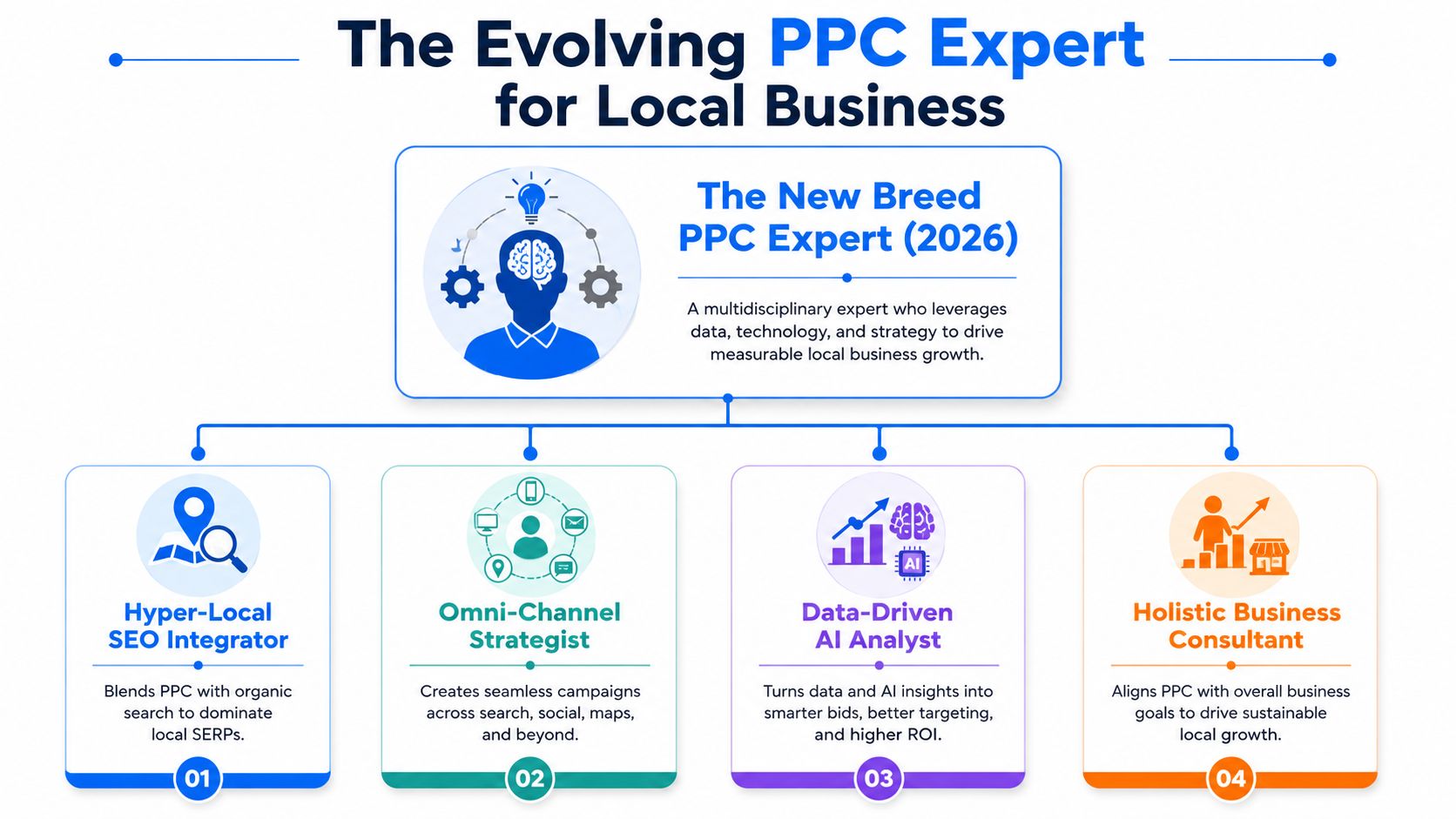
The New Breed of PPC Expert for Local Business
The old model of PPC management was narrow. Build campaigns. Pick keywords. Adjust bids. Report clicks. That approach misses how local buying behavior works.
A local customer often sees your paid ad, your Google Business Profile, your map listing, your reviews, and your landing page in the same decision window. If those assets aren't aligned, the campaign leaks money. You might buy the click and still lose the lead.
Existing industry content often treats PPC experts as ad technicians only. But for service businesses, the stronger model is the Hybrid Local SEO + PPC Expert. That matters because 76% of people seeking local services on mobile click on a result within the first 3 organic listings, and 90% of PPC agencies fail to provide actionable, integrated strategies for home service verticals like HVAC and plumbing, according to this analysis of why local businesses need a PPC expert.
What hybrid expertise looks like in practice
A real local PPC expert does more than launch ads for “plumber” or “dentist.” They connect paid search to local market signals:
- Google Business Profile alignment means the ad groups, landing pages, and service categories support the same local intent.
- City and service segmentation means “AC repair near me” doesn't get handled the same way as “AC installation.”
- Map pack reinforcement means paid traffic doesn't get sent to weak pages that ignore local trust elements.
- AI-assisted campaign production means keyword clustering, ad copy drafting, and search term review happen faster, but still under human control.
According to the projected State of PPC 2026 benchmark cited by Coupler.io's PPC statistics roundup, 59% of PPC experts now use LLMs for ad copy and 39% use them for keyword research, while those tools save experts 5.2 hours per week on average. That time savings only matters if the expert reinvests it into tighter strategy, cleaner account structure, and better local targeting.
Practical rule: If an agency talks only about ads and never asks about your Google Maps visibility, service-area cities, or GBP categories, they aren't operating at the modern local-business standard.
Why pure PPC specialists often waste money
A pure media buyer can drive clicks to a local site and still leave revenue on the table. That's because local conversion doesn't happen in one touch. People compare map listings, scan reviews, and verify whether you serve their area.
That's why businesses hiring PPC ad management services should look for an operator who thinks in transactional search terms first. The phrase “near me” isn't just a keyword modifier. It's a commercial signal. “Emergency plumber near me” is not the same search as “how to fix a leaking pipe.” One deserves budget. The other often deserves exclusion.
The best pay per click experts understand that local paid search, local SEO, Maps visibility, and AI optimization now sit in the same system. If one part is weak, the whole campaign underperforms.
How to Identify Experts Who Target Transactional Terms
Most agencies say they focus on results. Very few show evidence that they know how to win local commercial intent.
You can spot the difference fast by looking at what they emphasize. If the sales conversation stays centered on reach, impressions, or “getting your brand out there,” you're hearing a top-of-funnel pitch. Local service businesses usually need a bottom-of-funnel operator.
Look for money-keyword thinking
A strong PPC expert talks in terms like:
- “Service + city” searches such as AC repair in a target city
- “Near me” searches that indicate immediate buying intent
- Urgency modifiers like emergency, same-day, or open now
- Procedure or high-value service terms for dental, med spa, or roofing campaigns
They should also separate industries instead of forcing one generic blueprint onto every account. Roofing isn't dental. Pest control isn't chiropractic. The search language, lead urgency, landing-page proof, and conversion flow differ by vertical. Good operators build around those differences.
A smart conversation about keyword planning should also connect to keyword research best practices for local service demand, especially when you're trying to rank and advertise for the exact terms people use when they're ready to buy.
Review what their examples actually prove
A case study can be polished and still be weak. Read it like a buyer.
Use this checklist:
- Specific search intent. Do they show campaigns built around purchase-ready phrases, or are they hiding behind vague awareness language?
- Local proof. Do they mention service areas, city pages, map visibility, or Google Business Profile support?
- Lead quality focus. Do they talk about calls, form quality, booked appointments, and sales conversations instead of just traffic?
- Landing-page fit. Do the pages reflect the ad promise, or do they dump visitors onto a generic homepage?
The right expert doesn't brag about sending more people to your site. They show that they know which searchers are worth paying for.
Ask how they handle Google Maps with paid search
Many agencies often collapse. They know campaign settings, but they don't know how local buyers decide.
A serious local operator should be able to explain how paid campaigns support map performance, how service categories and ad themes line up, and how local landing pages reinforce both channels. If they can't explain that clearly, they're still treating local PPC as a standalone media buy.
For business owners who want a plain-English framework for optimizing for user intent, that concept is useful here. Transactional intent isn't abstract. It's the difference between paying for someone researching symptoms and paying for someone searching “dentist near me” because they want an appointment.
What a strong fit sounds like
You want someone who says things like:
- We build around the searches that produce jobs, not just traffic.
- We segment by service and city because local intent changes.
- We connect ads, landing pages, and Google Business Profile signals.
- We review search terms aggressively so informational junk doesn't eat budget.
That's the profile of a PPC expert who understands local buying behavior. Everything else is noise.
Crucial Vetting Questions to Ask Any PPC Agency
A local service business can burn through a month of ad spend before the owner realizes the agency is optimizing for the wrong thing. The phone rings, but the calls are junk. Form fills come in, but half are outside the service area. The account looks active. Revenue does not.
That gap usually shows up in the sales process first. Good PPC operators answer hard questions with specifics. They explain how they qualify traffic, how they connect ads to local landing pages, and how paid search supports Google Maps visibility instead of working in a silo.
Start with questions that force clear answers.
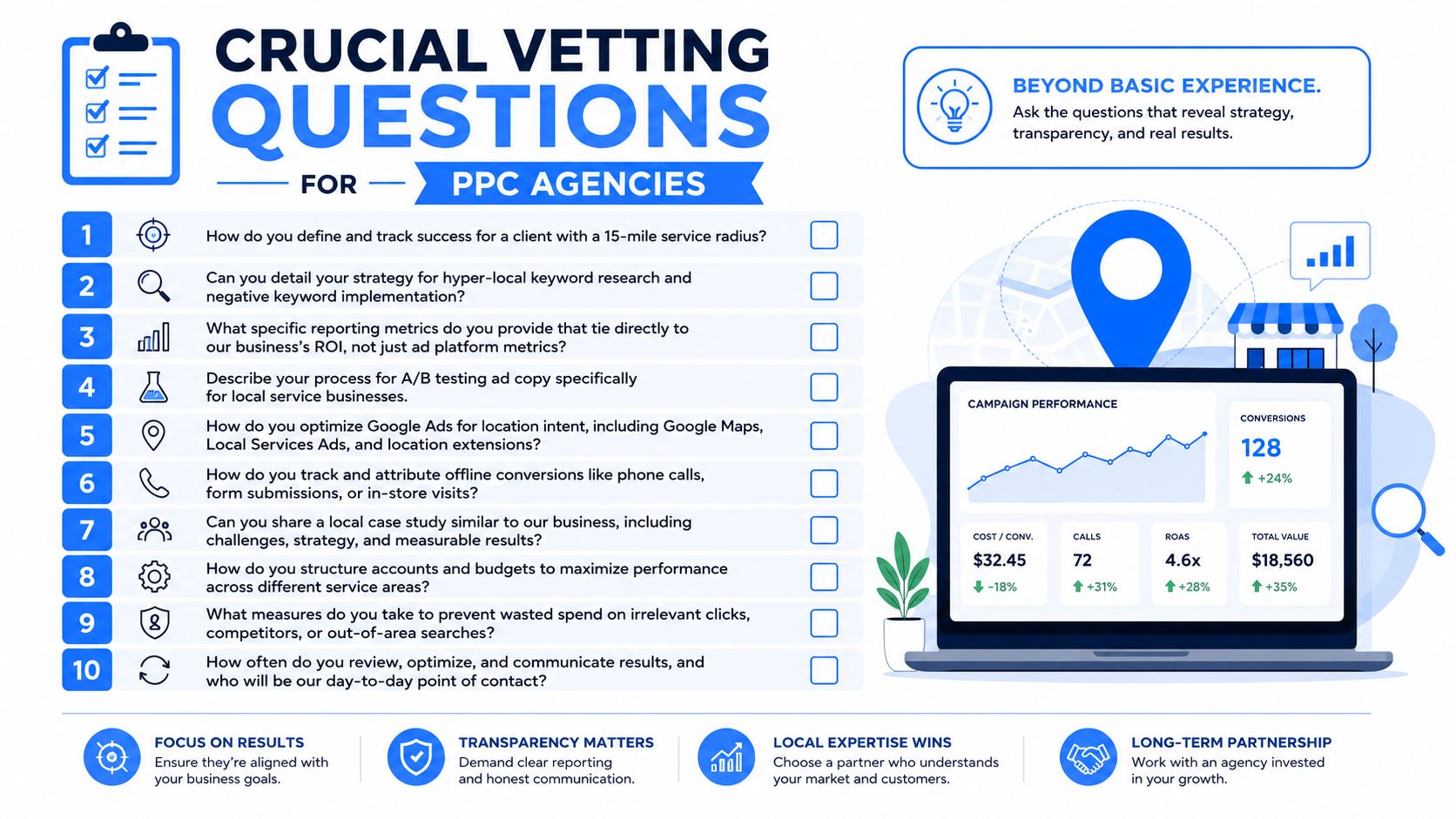
Questions that expose weak strategy fast
How do you define success for a local service business?
Strong answers start with qualified calls, booked jobs, close rates, cost per real lead, and service-area fit. If the first answer is clicks, impressions, or traffic growth, keep digging.How do you set campaign goals before launch?
A serious operator should be able to explain lead targets, priority services, target locations, and what a healthy cost per lead looks like before the first ad goes live. They should also explain what gets tested first and what would make them cut or rework a campaign.How do you control broad match waste?
Broad match can help in the right account, but only with active search term review and aggressive negative keyword work. Ask which searches they would exclude for your business, how often they review search terms, and when they switch a keyword from exploration to tighter control.
Ask for real examples of negative keywords they would add for your market. A team that manages local intent well can answer that quickly.
Questions about landing pages and local conversion
A decent ad account still underperforms if the click lands on a weak page. Local PPC gets better when the agency can explain the full path from keyword to ad to landing page to call or form submission.
Ask:
- Do you send traffic to service-specific landing pages or a general page?
- How do you match the ad message to the page headline, offer, and call to action?
- How do you build city relevance for service-area businesses without creating thin pages?
- How do paid landing pages support local SEO and Google Business Profile visibility?
- Who handles page testing and conversion improvements?
That last point matters more than agencies like to admit. A PPC specialist who ignores local landing pages and Google Maps is only managing media spend. For a local service business, the better hire is usually a hybrid operator who understands paid search, local SEO, and how those channels reinforce each other. If you want a broader framework for comparing vendors, this guide on how to choose a digital marketing agency is a useful reference.
A useful benchmark for what serious practitioners discuss is in this short video.
What a good answer sounds like
Good answers are concrete and local.
| Question | Weak answer | Strong answer |
|---|---|---|
| Negative keywords | “We optimize continuously.” | “We review search terms every week, cut low-intent queries, and separate research searches from hire-now searches.” |
| Landing pages | “We can send traffic anywhere.” | “Each core service gets its own page with matching copy, local proof, and a call tracking setup tied to that campaign.” |
| Goal setting | “We'll improve visibility.” | “We set lead targets by service line, define target zip codes, and judge performance by qualified lead cost and booked work.” |
One more question separates polished sales teams from real operators. Ask what they do when paid search reveals a local SEO problem. The right answer is not, “That's outside scope.” The right answer is a plan for fixing weak location pages, inconsistent service signals, or a weak Google Business Profile so paid traffic converts better.
If an agency cannot explain that relationship clearly, they may know the ad platform. They do not yet understand local demand capture.
Decoding PPC Pricing and Setting a Winning Budget
A roofing company in a mid-size metro can burn through a monthly ad budget in days if the account is built around broad keywords, weak location targeting, and landing pages that have nothing to do with how people hire. The fee on the proposal matters. The bigger question is whether the expert knows how to turn paid search into booked jobs, and whether they connect that work to Google Maps visibility and local SEO so each click has a better chance of becoming revenue.
That changes how pricing should be judged.
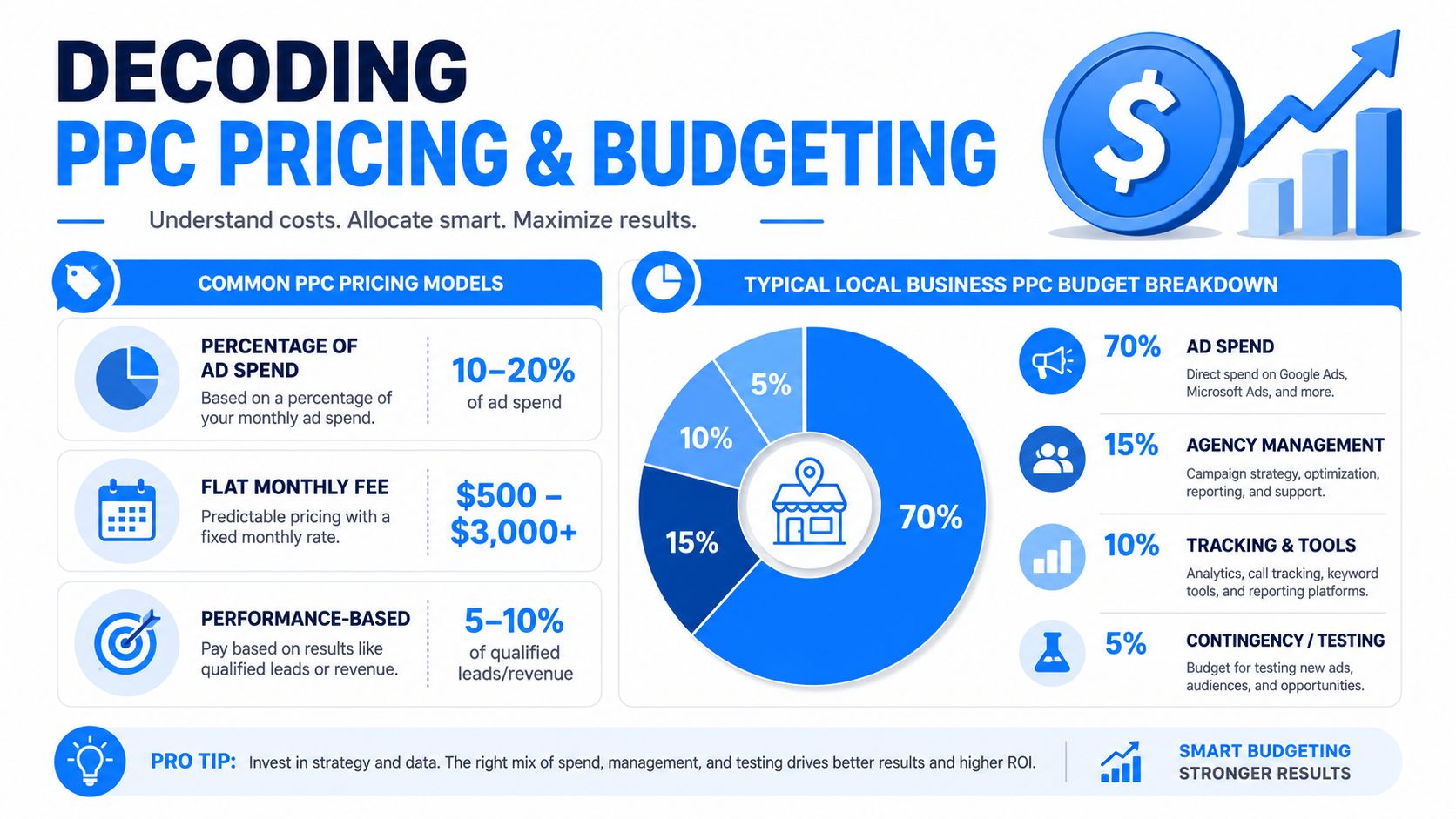
What pricing models actually mean
You'll usually see three common setups.
| Pricing model | What it means | Where it works |
|---|---|---|
| Flat retainer | Same monthly management fee regardless of spend | Useful when you want predictable scope and regular account work |
| Percentage of ad spend | Fee rises as media budget rises | Can fit accounts with more locations, more services, and more campaign complexity |
| Performance-tied structure | Compensation links to lead or revenue outcomes | Works best when call tracking, CRM data, and lead qualification are accurate |
No model is automatically good or bad. The issue is incentives.
A percentage-of-spend fee can push an agency to recommend more budget before fixing wasted spend. A flat retainer can also create problems if the account needs weekly search term review, landing page testing, and map pack coordination, but the provider has priced the work too low to do any of that properly. Performance-based deals sound attractive, but they fall apart fast when nobody agrees on what counts as a qualified lead, a booked estimate, or closed revenue.
Where modern PPC management should earn its fee
AI can speed up ad drafting, reporting cleanup, and testing workflows. It does not fix bad keyword strategy. It does not know which service-area pages are thin, which cities produce higher-value jobs, or why your Google Business Profile gets impressions but few calls.
That is why local service businesses should look for a hybrid operator, not just a platform technician. If the specialist runs Google Ads in isolation, they miss the compounding effect of stronger local landing pages, better service-area relevance, and improved Google Maps trust signals. Paid traffic converts better when the local SEO foundation is doing its job.
Pay for judgment, account structure, and business alignment. Do not pay premium rates for tasks software now handles in minutes.
Set budget from revenue targets, service mix, and local intent
Good budget planning starts with the jobs you want more of. Emergency plumbing, high-ticket cosmetic dentistry, and legal consultations do not deserve the same budget logic as low-margin maintenance work.
A smart plan looks at:
- Highest-margin services first, because cheap leads are not the same as profitable jobs
- Priority cities and ZIP codes based on close rates, travel efficiency, and competition
- Lead handling capacity so missed calls do not waste ad spend
- Transactional search terms that show hire-now intent
- Local SEO and Google Maps support so the click lands on a page that can convert
For a practical benchmark, review these Google paid search cost considerations for local campaigns. Use that range as a starting point, then pressure-test it against your real numbers. If one booked job is worth $3,000 and your close rate is healthy, paying more for tightly filtered, high-intent clicks can make sense. If your office misses half the inbound calls, increasing spend usually makes the problem more expensive.
Budget decisions also get better when reporting is tied to operations. A Performance insights dashboard helps because it keeps attention on calls, lead quality, service lines, and local visibility trends instead of surface metrics like impressions and click volume.
The best PPC budgets are built backwards from revenue. They fund the searches with buying intent, the geographies that produce good jobs, and the pages that support both ads and local rankings. That is the standard to hold any PPC expert to.
Onboarding and Measuring What Truly Matters
Hiring the agency isn't the finish line. It's the point where accountability starts.
A clean onboarding process should feel operational, not theatrical. You shouldn't get buried in jargon or dashboards that hide the full picture. The first priority is to confirm what you're buying traffic for, where it's going, how it's tracked, and how lead quality will be judged.

What strong onboarding includes
The early phase should lock down a few essentials:
- Service and city priorities so the account reflects actual revenue opportunities
- Keyword confirmation focused on transactional terms, not broad curiosity searches
- Landing-page mapping so every major ad theme has a clear destination
- Call and form tracking connected to real business follow-up, not vanity events
- Dashboard access so you can see what matters without waiting for a polished month-end summary
A visual reporting environment helps here. A tool like a Performance insights dashboard is useful because it pushes the conversation toward calls, leads, trends, and local visibility instead of surface-level ad metrics.
The KPI shift that separates amateurs from professionals
A weak agency reports:
- clicks
- impressions
- average CPC
- click-through rate
Those numbers have diagnostic value, but they don't tell you if the campaign is producing revenue.
A serious local PPC expert reports things like:
| Better KPI | Why it matters |
|---|---|
| Qualified phone calls | Calls show direct purchase intent |
| Sales-ready form submissions | Form volume is only useful if the leads are legitimate |
| Booked jobs or appointments | This connects marketing to operations |
| Lead source by service and city | This shows where budget is actually working |
If the report doesn't help you decide where to scale, pause, or tighten targeting, it isn't a management report. It's decoration.
Why attribution discipline matters
A common occurrence is that many agencies overstate performance. Platform-reported conversions often count activity that never turns into real sales opportunity.
In the verified data set above, expert-level PPC specialists use a CRM-Matched Opportunity process that cross-references weekly conversion exports against CRM opportunity creation timestamps. That method typically reduces CPA by 18 to 24% within 90 days, and it matters because standard platform tracking can over-credit last-click interactions by 30 to 40%.
That changes how you judge success. A form fill isn't automatically a win. A phone call isn't automatically a lead. A booked estimate that never becomes a real opportunity shouldn't influence budget the same way a qualified sales conversation does.
What ongoing management should feel like
The relationship should become more precise over time. Search terms get cleaner. Bad geographies get cut. Good service categories get more support. Landing pages improve. Reporting gets less noisy.
That's how pay per click experts prove their value. Not by showing more dashboard activity, but by producing a more reliable pipeline of transactional leads that your business can close.
Transactional LLC helps local service businesses win the searches that lead to calls, appointments, and booked jobs. If you want a partner focused on transactional search terms, Google Maps visibility, local SEO, AI optimization, and paid campaigns that support real revenue, visit Transactional LLC.