

You already know the feeling. Your website gets traffic, your phone rings a little, and the leads that do come in are full of people asking broad questions, comparison shopping, or “just looking around.” Meanwhile, the jobs you want come from people who need help now and are ready to hire.
That gap usually comes down to keyword intent.
A local service business doesn't need more random visitors. It needs to show up when someone searches roofer near me, dentist near me, air conditioning repair near me, or another phrase that signals real buying intent. Those are transactional searches. The person isn't writing a school paper or browsing for fun. They have money in hand, and they want a provider.
That focus matters even more now because search isn't limited to Google's blue links anymore. AI search, LLMs, and tools like ChatGPT are changing how businesses get discovered. The companies that win over the next few years won't be the ones with the most blog posts. They'll be the ones with the clearest signals around service, location, trust, and transactional relevance.
Why Transactional Keywords Are Your Most Valuable Asset
A lot of business owners waste months chasing traffic that never turns into booked work. They rank for educational terms, publish generic content, and then wonder why the calendar still has gaps. Traffic by itself doesn't pay for trucks, payroll, or rent.
The better approach is to build your SEO around transactional keywords. These are the phrases people use when they're close to taking action. In local service work, that usually means they need service, pricing, an appointment, or immediate help in a specific area.

What transactional really means
When someone searches how does a furnace work, that person might become a customer later.
When someone searches emergency furnace repair near me, the buying signal is completely different. They're not collecting trivia. They're trying to solve a problem right now.
That difference shows up in performance. Landing pages targeting transactional high-intent keywords demonstrate significantly superior conversion performance, with conversion rates ranging from 2% to 5% or higher, whereas informational queries often convert at less than 0.5%, according to GA Connector's analysis of high-intent keywords.
Practical rule: If a keyword sounds like something a customer would say right before calling, it's worth your attention. If it sounds like a homework question, it probably isn't.
Why local businesses should care
For plumbers, roofers, HVAC companies, dentists, chiropractors, pest control companies, med spas, and electricians, search intent isn't an abstract SEO concept. It's the line between empty clicks and real jobs.
The highest-value searches usually include modifiers like:
- Action words such as buy, hire, get, book, or call
- Urgency words like emergency, same-day, open now, or 24-hour
- Location signals such as near me, city names, neighborhoods, or service areas
- Decision words like cost, quote, pricing, appointment, or best
Those phrases push you closer to a phone call. Broad keywords usually don't.
What doesn't work
A lot of agencies still treat SEO like a publishing contest. They go broad, chase vanity rankings, and celebrate pageviews. That method can fill a dashboard, but it usually doesn't fill your schedule.
What works is narrower. Build pages around the exact searches customers make when they're ready to spend money. If you want calls for AC work, target air conditioning repair near me. If you want implant cases, target phrases around implant consultations and appointments in the cities you serve. If you want roofing leads, focus on roofing repair and replacement terms tied to clear local intent.
That's the core of high intent SEO. You stop trying to be interesting to everyone and start becoming visible to buyers.
How to Identify Keywords That Drive Phone Calls
Most local business owners can spot a good lead in seconds. You need that same instinct when you look at keywords. The test is simple. Does the search suggest curiosity, or does it suggest action?
High intent keywords usually contain a verb or modifier that points toward a transaction. Up to 70% of all search traffic is driven by high-intent keywords involving verbs such as "buy," "visit," "get," and "purchase," according to Yext's overview of high-intent keywords.
The easiest way to read intent
A useful shortcut is to ask what the searcher wants next.
- If they want an explanation, the keyword is usually informational.
- If they want a provider, price, appointment, or fast answer, the keyword is usually transactional.
- If they want to compare options before making a decision, the keyword may still be valuable, but it needs a different page type.
Here's the difference in plain view.
| Industry | Informational Keyword (Low Intent) | Transactional Keyword (High Intent) |
|---|---|---|
| HVAC | how does an air conditioner work | emergency AC repair service Dallas |
| Plumbing | why is my water heater leaking | water heater repair near me |
| Pest Control | what do termites look like | termite treatment quote |
| Dental | what is a root canal | root canal appointment near me |
| Roofing | how long does a roof last | roof replacement estimate |
| Electrical | why do breakers trip | licensed electrician near me |
The modifiers that usually matter most
Some words show up again and again on keywords that lead to calls.
Service and urgency modifiers
These terms usually mean the customer needs help soon:
- Emergency
- 24-hour
- Same-day
- Open now
- Fast repair
- Immediate service
An HVAC company should pay attention to terms like emergency AC repair, 24-hour HVAC service, or same-day furnace repair.
Buying and action modifiers
These terms often indicate the customer is ready to move:
- Near me
- Hire
- Book
- Get
- Schedule
- Appointment
A dental office should care far more about dentist near me or schedule dental appointment than a broad phrase like teeth cleaning tips.
A keyword doesn't have to be glamorous to be profitable. The boring-looking phrases often bring the best customers.
Pricing and comparison modifiers
These often sit right near the conversion point:
- Cost
- Price
- Quote
- Estimate
- Best
- Reviews
- Vs
These searches can be strong if the business gives a direct answer and doesn't hide behind vague marketing language.
Industry examples that actually make sense
The patterns stay consistent, but each vertical has its own flavor.
For HVAC, strong phrases often revolve around repair, installation, urgency, and seasonality. Think in terms of what a homeowner says when the unit quits.
For plumbing, the money terms usually tie to leaks, clogs, water heaters, sewer issues, and emergency service.
For dental, the strongest searches often combine procedure plus urgency or appointment language, especially for pain-driven services.
For pest control, the best terms usually tie to infestation type plus treatment or inspection intent.
The point isn't to collect a giant list. The point is to recognize the phrases that sound like a real customer on a real day with a real problem.
Finding Your High Intent Keywords
Most keyword research starts in a tool. That's backwards.
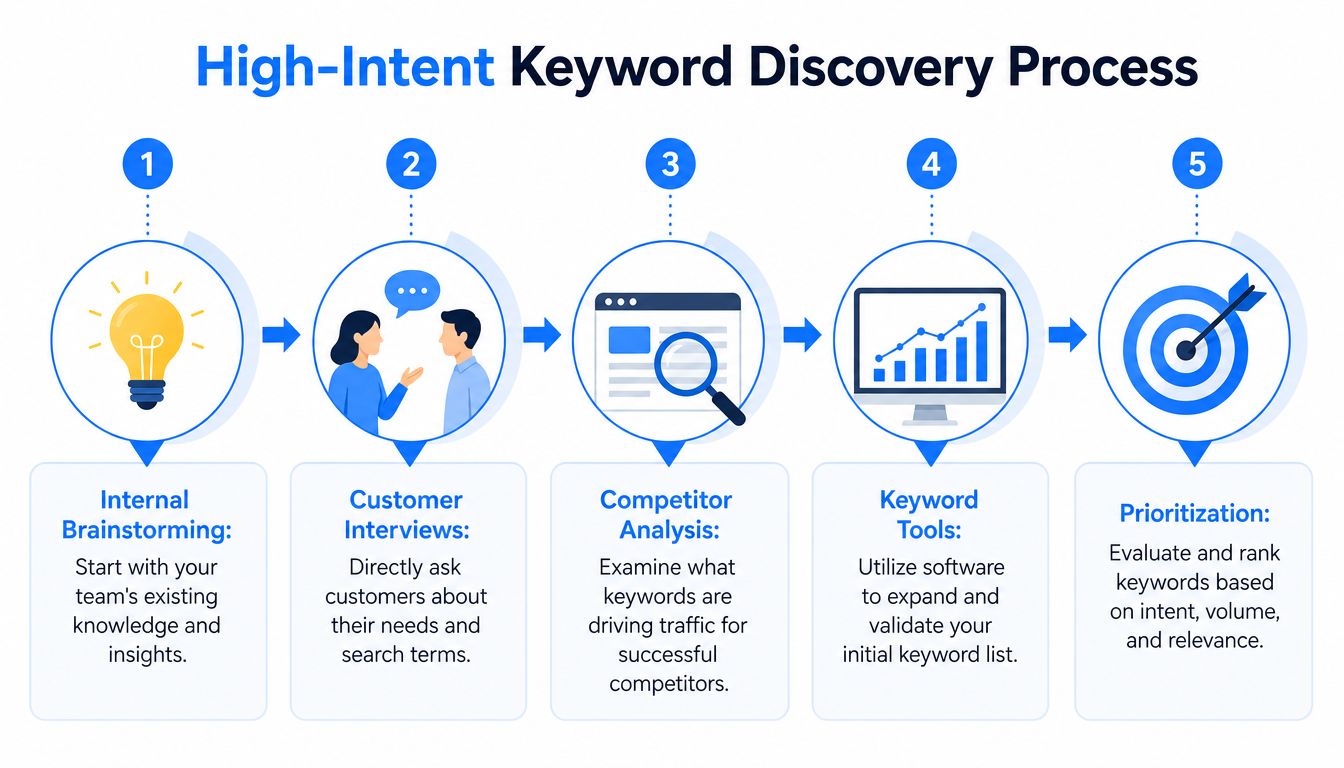
The best high intent keywords usually come from the way your customers talk when they need service. If you skip that step and rely only on software, you miss the terms that bring in business.
Start inside your business
Your front desk, office manager, sales staff, and technicians hear buying language every day. That's where the strongest keyword list begins.
Look at sources like:
- Call recordings to hear the exact words customers use when they describe the problem
- Contact form submissions to spot recurring service requests and city mentions
- Emails and text messages that include pricing, availability, and urgency language
- Technician feedback from the field, especially the phrases customers repeat on estimates and service visits
Pay attention to the wording. Customers rarely speak like keyword tools. They say things like “my AC stopped working,” “I need a dentist open Saturday,” or “I need someone for a roof leak today.”
Those are SEO clues.
Don't trust volume tools too much
This is one of the biggest mistakes I see. Business owners open Semrush or Ahrefs, sort by volume, and assume the visible terms are the only ones that matter.
They aren't.
Up to 40% of high-converting phrases are missed by tools like Semrush or Ahrefs because they lack volume estimates, yet they drive significant lead value, according to Luth Research on high-intent B2B keywords that don't show up in volume tools.
The customer language your staff hears on calls is often more valuable than the biggest number in a keyword database.
That matters a lot for local services. Search tools may understate highly specific phrases tied to neighborhoods, urgency, or niche service combinations. A phrase with no visible volume can still bring in excellent leads.
Use Google to expand what you already know
Once you've built an internal list, use Google itself to widen it.
A practical process looks like this:
Type your service into Google Autocomplete
Start with phrases like plumber near, emergency dentist, or AC repair. Watch what Google suggests.Review People Also Ask results
These can reveal how prospects phrase concerns before and during the buying decision.Check the related searches at the bottom of the results page
Those often surface strong local modifiers and service variants.Search your top service terms plus a city name
That helps uncover the exact combinations people use in each market.
Add an AI search layer
Smart local SEO is evolving this way: Don't just ask what someone types into Google. Ask how they'd phrase the same need to an AI assistant.
The language often gets longer and more specific.
A person might type dentist near me into Google. The same person might ask an LLM, “Find me the best-rated dentist for implants in Austin that can schedule an appointment soon.”
That tells you something useful. Your pages need clear service descriptions, city relevance, trust signals, and direct answers. AI systems pull recommendations from pages they can understand quickly.
If your site is vague, generic, or stuffed with broad content, it won't be easy for an LLM to cite or summarize.
Turning Your Keyword List into a Growth Map
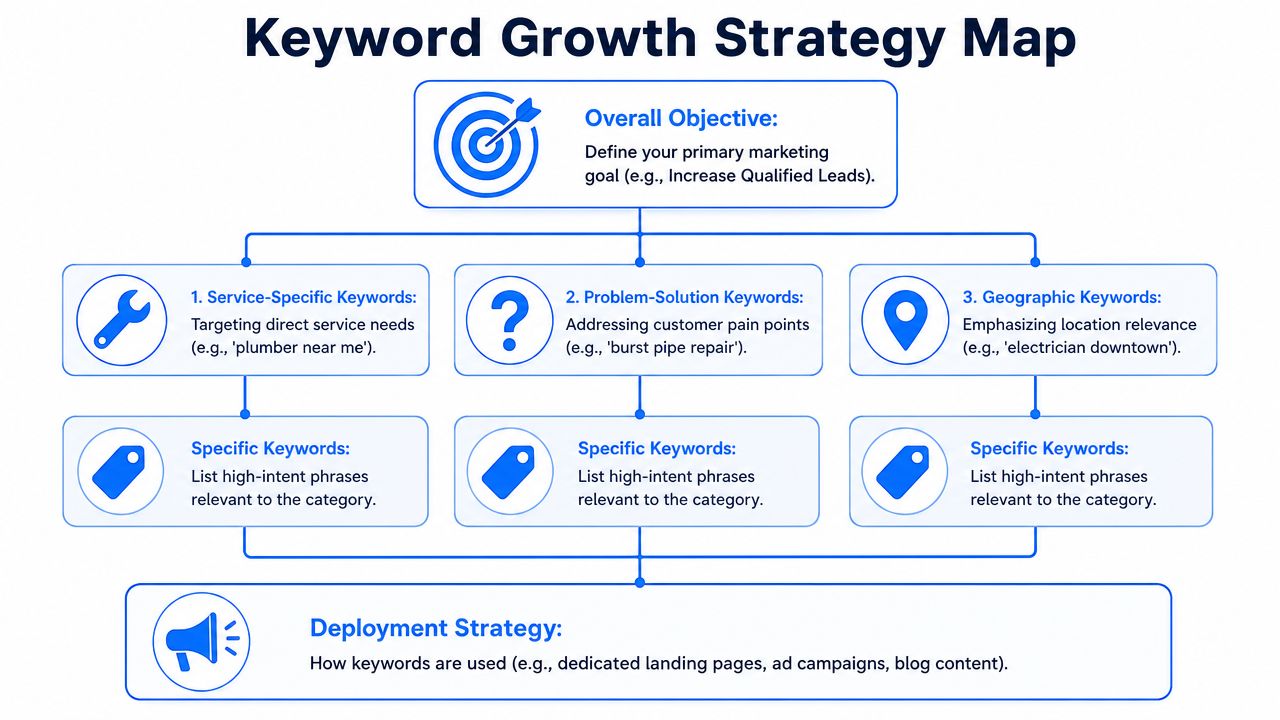
A keyword list by itself doesn't do much. Most companies have a spreadsheet full of terms and no real deployment plan. The useful move is to turn that list into a map of what page gets built, what profile gets optimized, and what query each asset is supposed to capture.
Filter hard before you build
Not every keyword deserves a page. That's especially true in local service SEO, where broad informational traffic can eat time and budget without producing many calls.
Only 26.4% of total search volume reflects buying intent, while 60.5% remains purely informational, according to RankDots on transactional keywords. That's why filtering matters. If you don't separate buying terms from browsing terms, your content calendar fills up with low-value work.
A clean prioritization process usually asks:
- Is this service directly profitable
- Does the keyword show clear intent to hire or book
- Can we tie it to a specific city or service area
- Does it belong on a service page, location page, or Google Business Profile
- Would a person searching this likely call if the page answers the need
Match the keyword to the right asset
Local businesses either get sharp or stay messy.
Website service pages
Use these for service-specific transactional phrases. Examples include:
- Tankless water heater installation
- Emergency AC repair
- Dental implants consultation
- Roof leak repair
- Termite treatment
These keywords need dedicated pages with strong local relevance and clear conversion elements.
Location pages
Use these when the service and city need to work together. For example:
- AC repair in Plano
- Emergency dentist in Austin
- Roofing contractor in Sarasota
A strong location page isn't a duplicate page with the city swapped. It should reflect real service-area relevance, clear service details, and distinct local context.
Google Business Profile and Maps signals
These searches represent a significant source of local revenue. Hyperlocal searches with near me, neighborhood names, and urgent service intent often trigger map results before anything else.
Google Maps optimization matters because many customers don't want to read three blog posts. They want to tap, call, and solve the problem.
If a searcher wants a nearby provider today, your Google Business Profile often matters as much as your website.
Use high intent keywords naturally in your service descriptions, posts, Q&A entries, and supporting website pages connected to the profile. Keep the language tight and service-focused.
Build around service, city, and problem
A simple structure works best:
| Keyword type | Best destination | Example |
|---|---|---|
| Service keyword | Dedicated service page | water heater repair |
| Service plus city | Location page | water heater repair Tampa |
| Near me search | Google Business Profile plus supporting page | plumber near me |
| Problem-based term | Focused landing page | burst pipe repair |
| Appointment or estimate term | Conversion page with direct CTA | dentist appointment near me |
This is how a spreadsheet becomes a growth system. Every keyword has a home, and every page has a job.
Crafting Pages That Close Deals
Ranking is only half the work. If the page doesn't convert, the keyword isn't the problem. The page is.
A strong local service page should make the next step obvious within seconds. When someone lands on the page, they should know what you do, where you do it, why they should trust you, and how to contact you.

What a service page needs above the fold
Start with message match. If the keyword is emergency plumber near me, the page headline should reflect that exact service intent. Don't send that click to a vague homepage headline about “trusted home solutions.”
The first screen should usually include:
- A direct headline that mirrors the service searched
- A phone number placed prominently
- A short service-area mention so visitors know they're in the right place
- A simple call to action like book service, request estimate, or call now
- Trust signals such as reviews, licenses, certifications, or years in business
This isn't complicated. People with high intent want speed and clarity.
Structure the page for humans and AI systems
AI optimization changes how you should think about page structure. LLMs and AI search tools don't respond well to fluffy copy. They prefer pages that are easy to parse, specific about services, and direct about answers.
That matters because high-intent keywords in the emerging AI search era convert at 4.4 times higher than traditional organic search traffic, according to Connor Gillivan's note on AI-era high-intent SEO keywords.
A page built for both traditional SEO and AI discovery should include:
- Clear headings that separate service, location, pricing cues, and process
- Direct answers to common questions instead of vague promotional copy
- Scannable sections with short paragraphs and useful subheads
- FAQ content that reflects real customer questions
- Consistent NAP details on the site and business profile where relevant
Add proof where the visitor expects it
A lot of service pages fail because they ask for trust before they provide it.
Use proof elements that reduce hesitation:
- Reviews tied to the service
- Before-and-after examples when relevant
- Credential badges and professional memberships
- Financing or payment information if it helps the buying decision
- Photos of real work, team members, trucks, or office locations
Here's a useful example to study in action:
Extend the same thinking to Google Business Profile
Your Google Business Profile shouldn't read like an afterthought. It should reinforce the same transactional themes as your service pages.
Keep these areas aligned:
- Primary and secondary services should reflect your real money services
- Business description should stay focused on what you do and where you do it
- Posts can highlight seasonal services, urgent services, and common booking needs
- Q&A should answer practical questions a buyer would ask before calling
- Photos should support trust and local legitimacy
When a page and profile tell the same story, Google understands the business better, customers trust it faster, and AI systems have cleaner information to summarize.
From Search Terms to Signed Contracts
High intent SEO isn't about gaming search engines. It's about matching your business to the exact moment a customer is ready to act.
That means choosing transactional search terms over vanity traffic. It means listening to customer language instead of blindly trusting keyword tools. It means mapping each keyword to the right page, the right city, and the right Google Business Profile signals. It also means building pages that answer the question fast and make contact easy.
For local service businesses, this approach is what drives calls. Not broad awareness content. Not random blog traffic. Not ranking for terms that sound impressive but bring in people who were never going to hire you.
The shift to AI search makes this even more important. LLMs reward clarity, relevance, and structured information. Businesses that organize their websites around specific services, local intent, and direct answers are in a better position to be surfaced in both search engines and AI-generated recommendations.
This is also why industry-specific execution matters. SEO services and marketing for a roofing company should be handled differently from SEO services and marketing for a dental business. The language is different, the urgency is different, the buying triggers are different, and the page structure should reflect that. Lumping every industry into one generic strategy weakens the result.
A focused transactional strategy is how businesses reach page one for the terms that matter. It's also how they show up in Google Maps where local customers make fast decisions. In practice, that means targeting exact searches like air conditioning repair near me, dentist near me, or roofer near me in the cities that produce revenue.
If your current SEO campaign brings traffic but not jobs, the fix usually isn't more content. It's better intent.
If you want help turning this playbook into rankings, map visibility, and booked jobs, talk to Transactional LLC. They focus on the search terms that bring in buyers, not browsers, and they build local SEO, Google Maps optimization, and AI-driven content systems around the exact services and cities that generate revenue.