

You're probably dealing with this right now. A smaller contractor with a weaker reputation, fewer trucks, and less experience is showing up above you on Google. They're in the map pack. They're on page one. Their phone rings first.
That usually doesn't happen because they're better at the work. It happens because they're better at being found when a buyer is ready to hire.
Most construction companies waste money on soft marketing. They pay for “brand awareness,” broad social posting, and generic websites that say nothing useful. A serious construction marketing agency should do something much simpler. It should get your business in front of people searching transactional terms like “roofer near me,” “concrete contractor near me,” or “commercial builder near me.” Those are buyer searches. Those people aren't browsing. They're trying to spend money.
That same logic now applies to AI search and LLM-driven discovery. Search isn't limited to ten blue links anymore. Buyers use AI tools to compare local providers, summarize options, and narrow decisions faster. If your site, service pages, maps listing, and local authority signals aren't structured well, you don't just lose rankings. You lose inclusion in the shortlist.
Why Your Competitors Are Winning Online
Your competitors are winning because they've aligned their marketing with buyer intent, and you probably haven't. Harsh, but true.
A lot of contractors still treat marketing like a brochure. They want a nice homepage, a few gallery photos, and maybe some boosted social posts. That's not a revenue strategy. That's decoration. If someone searches “air conditioning repair near me” or “foundation repair contractor near me,” Google isn't rewarding the prettiest brand. It's rewarding the company that looks most relevant, closest, and most trustworthy for that exact need.
Brand awareness doesn't book jobs
There's nothing wrong with brand building. It just shouldn't be your first priority if you need leads now.
A buyer who types a transactional search term has already moved past awareness. They're in decision mode. They have a problem, a budget, and a short list in mind. That's why the smartest agencies focus on terms tied directly to action, not vanity phrases with vague intent.
Buyers don't call the company they vaguely remember. They call the company they can find the moment they need help.
Construction firms are finally catching up to that reality. The construction marketing services market is valued at $1,174 million in 2025 and projected to reach about $1,398 million by 2033 at a 3% CAGR, driven by stronger competition and broader digital adoption. More contractors are investing online because they have to. Local visibility is no longer optional.
AI search is changing local discovery
AI optimization matters now because buyers don't always search the old way. They ask fuller questions. They compare providers through AI summaries. They look for the fastest answer to “Who handles this near me?” and “Which company serves my area?”
That means your local pages can't be thin. Your service content can't be generic. And your site architecture can't be a mess. If your marketing agency doesn't understand how LLMs pull business information from structured, service-specific, location-relevant content, they're already behind.
Here's the no-nonsense version:
- Generic content loses because it doesn't match specific buying intent.
- Weak local signals lose because nearby relevance matters.
- Slow, bloated websites lose because friction kills calls.
- Map invisibility loses because many buyers never scroll past the local pack.
What a serious strategy looks like
A real strategy starts with revenue terms first. Not broad industry terms. Not fluff content. Not random topics shoved into a blog.
For construction, that means building around exact service and location combinations. One page for one service intent. One article for one industry angle. If you market roofing, dental, HVAC, and plumbing with the same generic playbook, you're doing lazy SEO. Strong agencies separate them because search behavior is different by service line, urgency level, and market.
That's the difference between marketing that looks busy and marketing that produces calls.
The Core Services of a Transactional Agency
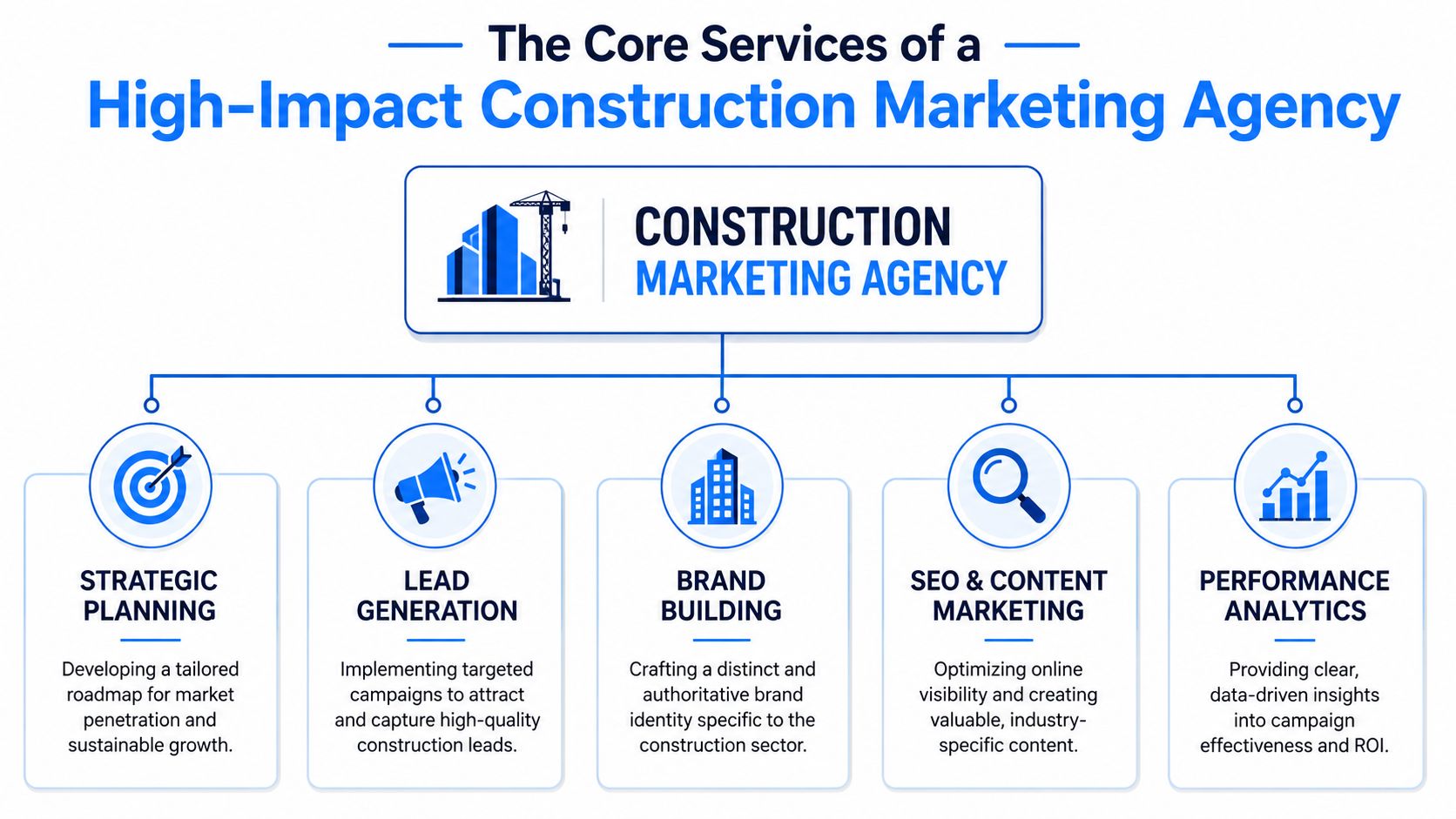
A good agency offers a menu. A high-performance agency builds a system around transactional search terms.
That distinction matters. You don't need disconnected services. You need local SEO, Google Maps optimization, AI-friendly content, paid search support, and conversion-focused web infrastructure all working toward the same goal: showing up when someone is ready to hire.
Local SEO built for buyer intent
The foundation is local SEO, but not the watered-down version most agencies sell.
Transactional searches like “roofer near me” or “dentist near me” signal a high-intent user with money ready to spend, and Google's local algorithm gives heavy weight to proximity when deciding who appears in the top three map results, as explained in this breakdown of how Google Maps rankings work for near-me searches. Construction companies need service pages and city pages built around that reality.
The work usually includes:
- Service-specific landing pages that target exact terms, not vague category pages.
- Location targeting for each real service area, not a giant list of cities stuffed into the footer.
- Internal linking that helps Google understand which services matter most.
- Schema, title tags, and on-page structure that make the page useful for both search engines and AI-driven summarization.
If you want a practical starting point for search targeting, this guide to construction business keywords is useful because it pushes you toward service-led keyword planning instead of generic industry phrases.
Google Maps optimization isn't optional
For local contractors, Google Maps is often the first battleground. A lot of prospects never make it to organic listings because they choose from the map pack.
That means your agency needs a real maps process. Not just claiming the profile. Not just adding photos once. A real process includes category alignment, service-area structuring, review management, posting cadence, Q&A coverage, and ranking heat map tracking.
If an agency says they “do local SEO” but can't explain map ranking mechanics, keep looking. Strong local execution should look more like a system such as local SEO services for service-area businesses, not a checklist done once and forgotten.
Practical rule: If your business depends on local calls, your Google Business Profile is not a side asset. It's a lead channel.
AI content that targets exact searches
Most agency content is filler. It's written to satisfy a calendar, not a customer.
AI optimization changes the standard. Articles and landing pages need to answer exact questions tied to commercial intent. That means one topic per industry, one service angle per page, and clear language that LLMs can interpret without guessing. A roofing article should be about roofing. A dental article should be about dental. Mixing everything together weakens relevance.
The best content programs focus on things like:
| Content type | What it should do |
|---|---|
| Service pages | Rank for direct buying terms in target cities |
| Location pages | Reinforce local relevance and service coverage |
| FAQ content | Capture question-based searches and AI summaries |
| Comparison pages | Help decision-stage buyers choose a provider |
Web and paid media should support search, not distract from it
Your website shouldn't act like a digital brochure. It should route people to call, book, or request service with minimal friction. Click-to-call buttons, trust elements, clean page structure, and service-area clarity matter more than flashy design.
Paid ads also have a role. But they should support high-intent terms where you need faster coverage, not substitute for a weak organic strategy. If your agency can't explain how paid search, maps, and organic rankings work together, they're still selling channels instead of outcomes.
Measuring Real-World Outcomes and ROI
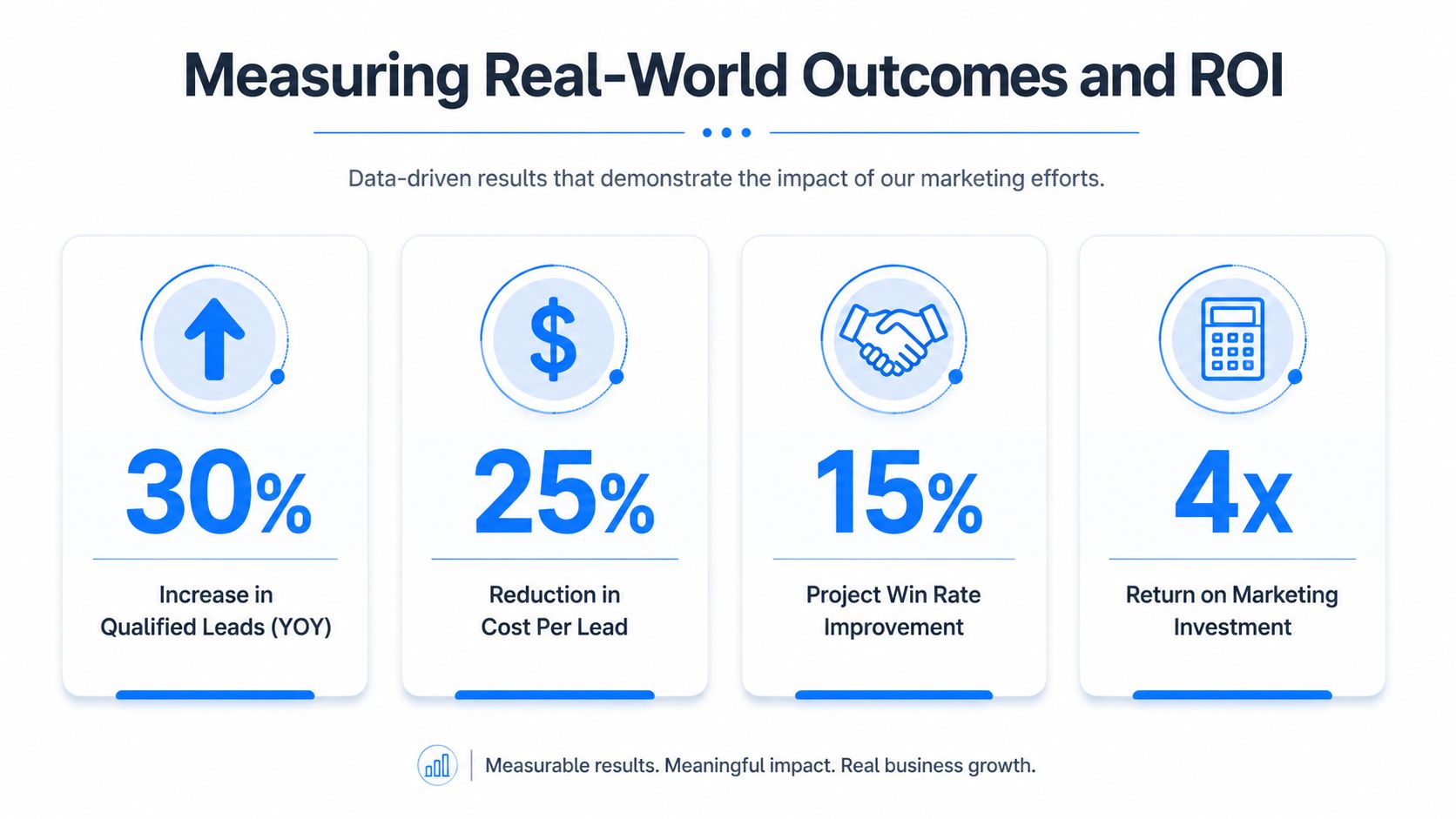
Most agencies hide behind reports full of impressions, reach, and traffic graphs. Contractors don't need prettier reports. They need proof that marketing turned into calls, estimates, and signed work.
That's the only scoreboard that counts.
Phone calls are worth more than form fills
Construction is a call-driven business. Emergency work, bid conversations, schedule coordination, and project scoping all move faster by phone. That isn't opinion. In construction marketing, phone leads convert at a 40% rate and generate 10 to 15 times more revenue than web form submissions, which is why click-to-call and channel-specific call tracking matter so much.
If your agency isn't measuring calls by source, you're flying blind. You won't know whether SEO, Maps, paid search, or referral traffic produced the lead. And if you can't tie lead source to revenue, your budget decisions become guesswork.
A stronger reporting stack includes:
- Call tracking by channel so you know which campaign produced the conversation
- Recorded call review so you can separate junk leads from real opportunities
- CRM attribution so closed jobs are tied back to the original source
- Response-time monitoring because missed calls ruin otherwise good marketing
For a deeper framework on this, a practical resource is how to measure marketing effectiveness.
ROI should decide your channel mix
The reason serious agencies push SEO so hard in construction is simple. It pays better when done right.
According to this construction contractor marketing guide for 2026, construction marketing delivers an average ROI of 280% to 350%, while SEO campaigns specifically average 400% to 450% in 2026. The same source states SEO delivers 681% ROI, nearly 7 times the return of paid social, and organic acquisition makes up 58% of the typical builder budget. It also notes that average construction search ad CPC is $2.56, which is another reason weak paid campaigns burn cash fast.
That should reshape how you evaluate agencies. If their strategy is heavy on low-intent channels and light on search visibility, they're pushing effort into the wrong place.
Don't let an agency celebrate activity when you hired them for revenue.
What good reporting actually looks like
A useful monthly review answers plain questions:
| Question | What the agency should show |
|---|---|
| Which channels produced calls? | Source-level call and lead attribution |
| Which pages drove action? | Landing pages tied to calls or booked appointments |
| Which search terms mattered? | Exact high-intent queries, not broad vanity terms |
| What should change next? | Budget shifts, page improvements, and follow-up actions |
If your report can't answer those, it's not a performance report. It's theater.
How to Choose the Right Agency
Picking a construction marketing agency shouldn't feel like buying a used truck from someone talking too fast. Yet that's how a lot of agency sales calls go.
They promise rankings. They throw around jargon. They show screenshots without context. Then they lock you into a contract and hope you won't ask hard questions for six months.
Ask questions that expose strategy
Start with the obvious one. Ask how they plan to rank your business for transactional search terms in the exact cities you serve. If the answer drifts into generic branding talk, they're dodging.
Then ask how they handle the difference between residential and commercial lead generation. According to this construction marketing budgeting perspective, commercial bids require more spend on stakeholder mapping and outreach, while residential depends more heavily on geo-targeted ads and local SEO, with 5% to 10% revenue allocation for residential. If an agency applies the same budget logic to both, they don't understand construction buying cycles.
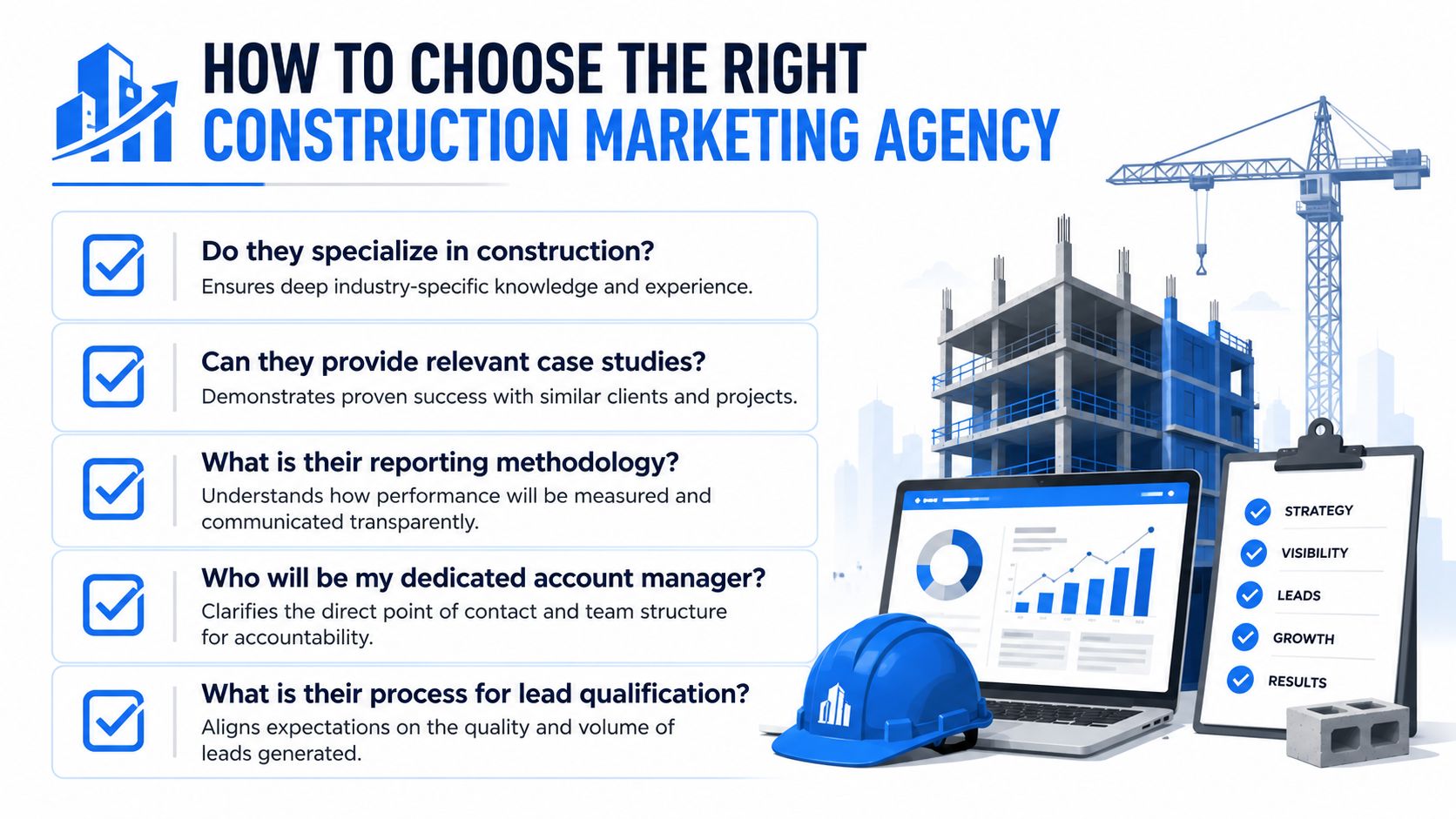
Use a checklist like this during sales calls:
- Show me your local strategy: Ask how they approach service pages, city targeting, map visibility, and review acquisition.
- Explain your reporting: If they can't walk you from click to call to closed job, their reporting is incomplete.
- Tell me what happens in the first month: Vague answers usually mean no process.
- Separate commercial from residential: Their targeting and budgeting should reflect different sales motions.
Watch for guarantee games and shallow promises
A lot of agencies sell confidence instead of competence. One common trap is the “guaranteed SEO” pitch with no explanation of what's guaranteed. Sometimes it means traffic. Sometimes it means a blog quota. Sometimes it means nothing at all.
If you want a grounded view of that issue, this guide on SEO guarantees for agencies is worth reading before you sign anything.
Red flags usually show up fast:
- Long contracts before proof of execution
- No clarity on who does the work
- No examples in your vertical
- No discussion of Maps or high-intent search terms
- No explanation of how AI search affects content structure
Pick the agency that talks like an operator
The right agency sounds like someone who understands lead flow, not just rankings. They talk about service areas, booked jobs, call handling, map pack visibility, and content built for specific buyer actions.
A useful benchmark is whether their thinking lines up with a practical decision process like how to choose a digital marketing agency. The details matter. Who owns the strategy? How are campaigns adjusted? What happens when one city underperforms?
If an agency can't explain how they'll make the phone ring, they're not ready to manage your budget.
In-House Marketing vs Hiring a Specialist Agency
This decision is simpler than people make it.
If you need immediate local visibility, tighter execution, and a team that already knows how to rank service businesses for buyer-intent terms, a specialist agency usually wins. If you have time to recruit, train, manage tools, and build a process from scratch, in-house can work. Most SMB contractors don't have that kind of runway.
Side-by-side reality
Here's the practical comparison:
| Factor | In-house team | Specialist agency |
|---|---|---|
| Startup speed | Slower because hiring and training take time | Faster because systems already exist |
| Local SEO depth | Depends on one hire or a small team | Usually broader technical and strategic coverage |
| Tool access | You buy and manage the stack yourself | Often bundled into service delivery |
| Execution capacity | Limited by staff bandwidth | Shared team handles content, SEO, reporting, and web updates |
| Risk | Higher if one person underperforms | Spread across specialists and existing processes |
The strongest argument for a specialist agency is speed to effective execution. A mature agency already has playbooks for page structure, map optimization, call tracking, conversion routing, and content production. An in-house team often spends months figuring out basics the agency solved years ago.
Follow the payback, not the ego
Some owners want in-house because it feels more controlled. That's understandable. But control without expertise gets expensive.
High-performing construction marketing agencies achieve SEO returns of about 681% ROI with a 9-month break-even period, while optimized PPC can reach 36% ROI with a 4-month payback, outperforming the industry average payback of 18+ months. That doesn't mean every agency will produce those outcomes. It does mean specialist execution can beat slow, fragmented internal marketing when the operator knows what they're doing.
When in-house makes sense
In-house is more viable when:
- You already have strong lead flow and need brand support more than demand generation
- You can hire specialists, not one generalist expected to do SEO, content, ads, web, and analytics alone
- You have leadership time to manage output and hold people accountable
For most construction SMBs, the smarter move is to use an agency until local visibility, content systems, and lead tracking are built properly. Then decide whether to keep outsourcing or bring selected functions inside.
Your First 90 Days A Practical Onboarding Timeline
The first three months with a serious agency shouldn't feel mysterious. You should know what's happening, why it matters, and what progress looks like.
That's especially important with local SEO and AI optimization because the early work is foundational. A strong start usually determines whether your campaign becomes focused or drifts into generic noise.
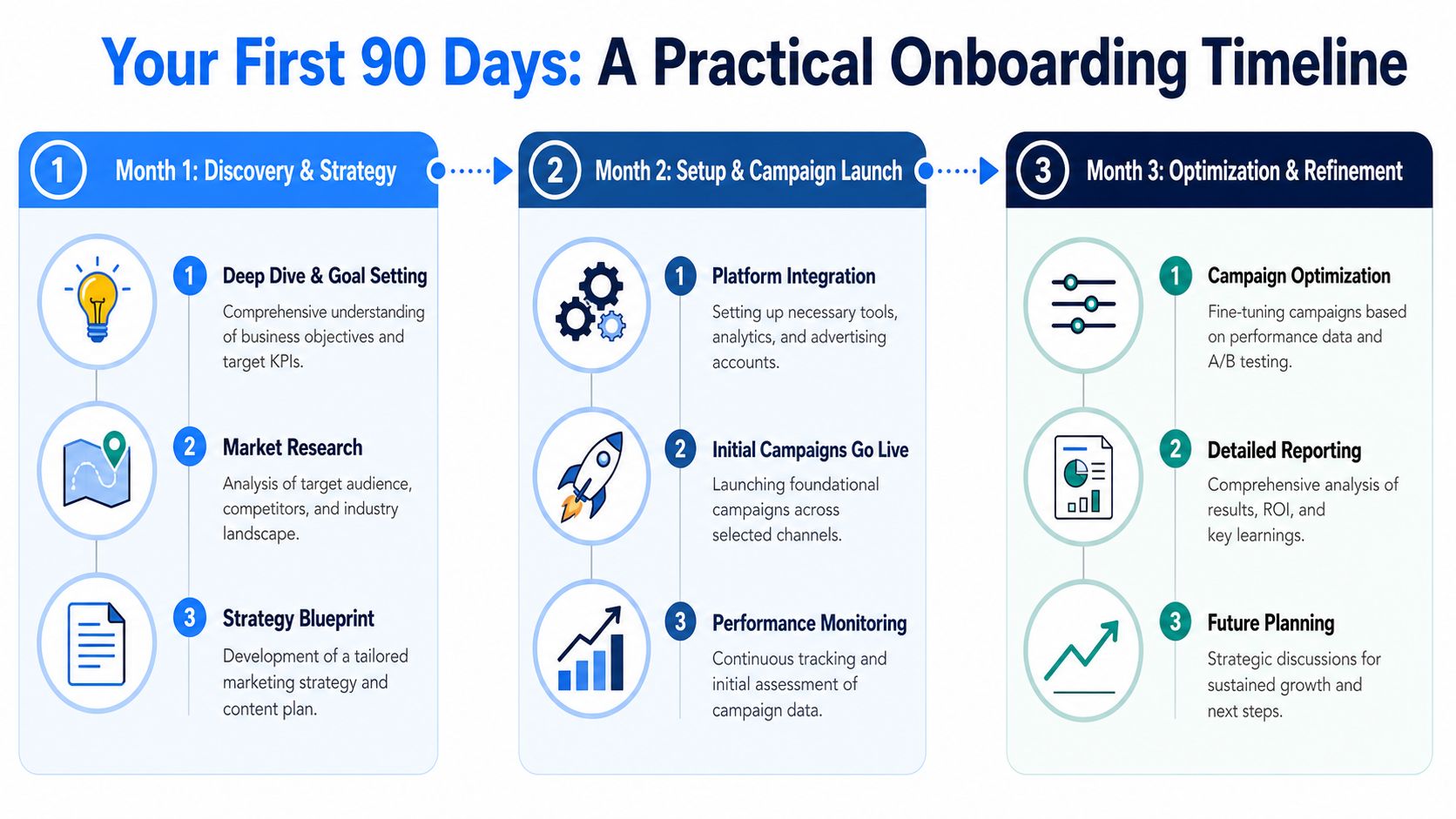
Month one needs clarity, not activity for its own sake
The first month should lock down the basics.
That means auditing your current site, checking your Google Business Profile, identifying transactional search terms by service and city, reviewing competitors, and making sure call handling and tracking are set up correctly. This is also where the agency should define content by exact vertical and service intent. Roofing content should stay about roofing. HVAC should stay about HVAC. Construction firms need the same discipline across commercial and residential services.
A smart kickoff usually includes:
- Keyword mapping by service area so each term has a clear target page
- Site and GBP audit to catch technical and visibility issues
- Tracking setup for calls, forms, and source attribution
A practical support document during this phase is a Google Business Profile optimization checklist, especially if your map presence has been neglected.
Month two is where campaigns go live
This is when the agency should start publishing or updating the pages that matter most. Core service pages come first. Priority city pages follow. Supporting content and paid search coverage can launch alongside them if needed.
This is also where your website should be tightened for conversion. Buttons, forms, service-area messaging, and mobile usability matter because transactional traffic doesn't tolerate friction. If someone searches “contractor near me,” they want the answer fast.
Good onboarding doesn't produce busywork. It produces a visible path from search term to phone call.
Month three should show signal, direction, and decisions
By month three, you should have enough data to identify patterns. Which service pages are gaining traction? Which map areas are lagging? Which calls are turning into real opportunities?
The agency should review actual search queries, local ranking movement, call quality, and page-level performance. Then they should decide what gets expanded, rewritten, or deprioritized. AI optimization also becomes more useful here because content can be refined around the language real buyers are using, not the language marketers guessed they'd use.
What you want by the end of this period isn't fake certainty. You want evidence of movement, a better content map, stronger local signals, and a tighter plan for the next quarter.
If you want a partner that focuses on transactional search terms, Google Maps visibility, AI-driven local content, and the kind of SEO that turns searches into booked jobs, take a hard look at Transactional LLC. Their approach is built for service businesses that need calls, rankings, and local dominance without getting trapped in bloated marketing retainers.