

You're probably looking at a phone that keeps ringing, a crew that's finishing good work, and a Google Business Profile that still isn't pulling its weight for searches like “hvac repair near me,” “dentist near me,” or “roofer near me.” That's the gap. The job is getting done, but the review trail isn't strong enough to help you win the transactional search terms that turn into calls, booked visits, and same-day revenue.
For local service businesses, how to get more reviews isn't a reputation side project. It's a visibility system tied to the map pack, the business profile, and the trust signal that makes a customer choose you over the other two results. Google's own Business Profile guidance says to remind customers to leave reviews with a Google link or QR code, and to reply to reviews so people see that feedback matters. It also notes that a mix of positive and negative reviews can feel more trustworthy, which is why a steady, authentic pattern usually beats a polished but unnatural profile. Google Business Profile review guidance and Transactional's Google Maps ranking factors line up on the same point, the profile has to look alive, recent, and credible before it can convert.
A useful reality check comes from freshness. One widely cited consumer survey finding says 73% of people only trust reviews from the last 30 days (YouTube reference). That means old praise decays fast, especially for home services where buyers want current proof that the team still shows up on time, answers the phone, and finishes the work. If you're trying to rank for transactional intent, review velocity matters as much as total count.
If you want a practical resource for the review side of local trust, ViralRef's guide on Square reviews is worth reading alongside your own workflow. It reinforces a simple point that holds up in the field, the easier you make the ask, the more often customers finish it.
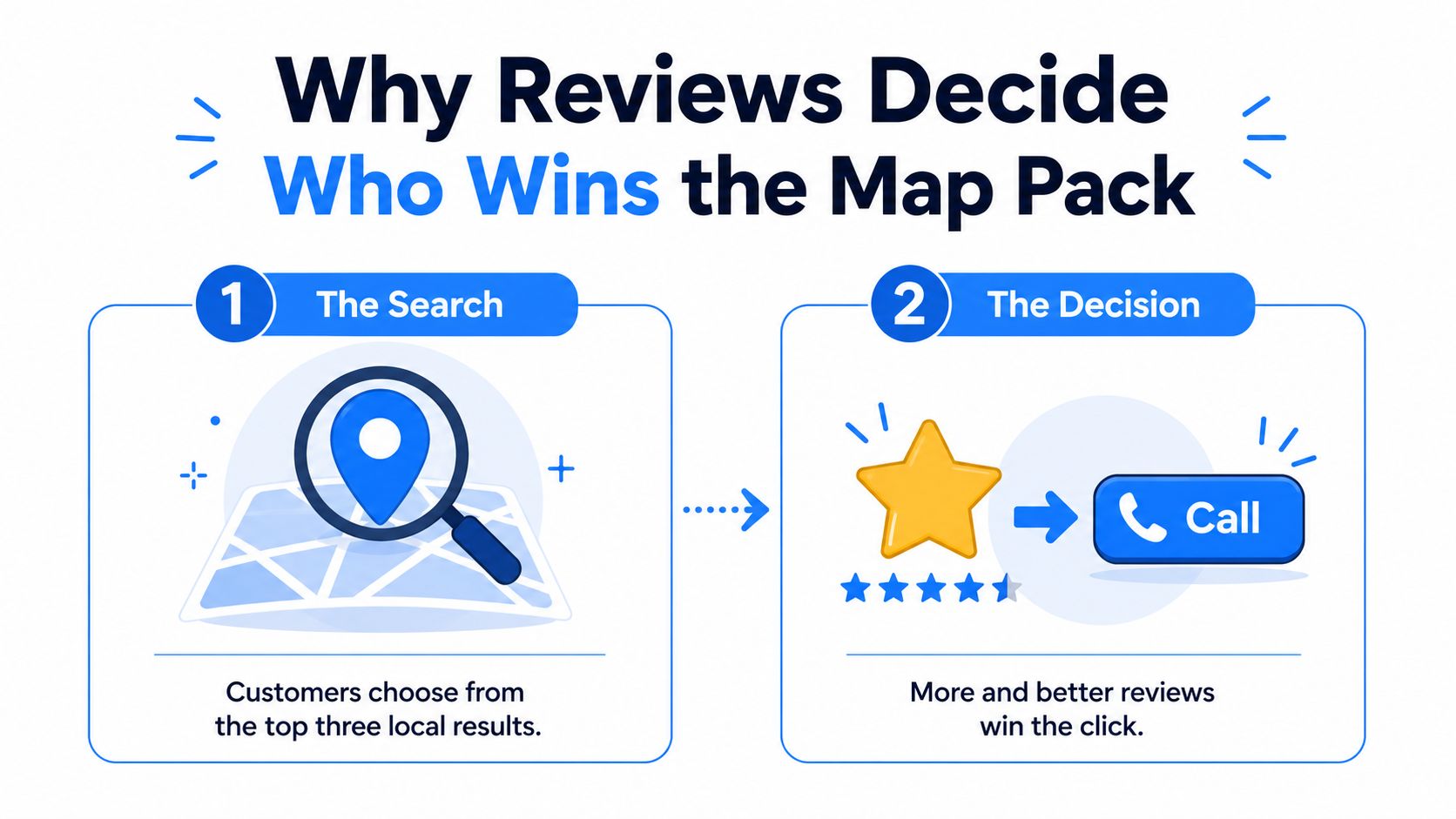
Why Reviews Decide Who Wins the Map Pack
A homeowner searches “air conditioning repair near me” because the house is hot, the family is annoyed, and they want the first company that looks safe to call. Google has to sort fast, and the map pack usually becomes the shortlist. That means your reviews are not decoration, they're the proof that turns a profile into a click, a click into a call, and a call into a job.
The businesses that win transactional searches usually do three things well. They show recent review activity, they reply like they care, and they look like they're active in the exact city or service area the search came from. That matters because AI-driven local discovery also leans on fresh, concrete trust signals, not just a static list of stars.
Practical rule: the map pack rewards businesses that look active right now, not businesses that looked good last year.
When a local service company stalls on reviews, the profile starts to feel stale even if the work is excellent. Recency is what keeps the business believable to both people and search systems. The older the reviews get, the less persuasive they become in a high-intent moment where the buyer is ready to spend.
One often-missed detail is that review generation should support the exact search terms you want to own. If you want more calls for roofer near me, dentist near me, or plumber near me, your review flow should be built around real jobs in those categories, not generic brand praise. The wording won't be scripted, but the timing and the service context should make it easy for customers to mention the work they received.
For businesses that want to improve local discovery, the review ask belongs inside the visibility strategy, not after it. Transactional Marketing's model is built around these transactional search terms, which is exactly where review velocity helps the most. If you're curious how review activity fits into broader map performance, the profile factors outlined in Transactional's Google Maps ranking factors are the right companion piece to this workflow.
Building a Profile That Customers Actually Review
Before you ask for anything, the profile has to look like a business people trust with their money. A half-finished Google Business Profile creates friction before the review request even goes out. If the category is wrong, the service area is vague, or the photos look generic, the customer has less reason to spend the extra minute leaving feedback.
Get the foundation right first
The practical setup starts with the basics, primary category, relevant secondary categories, accurate hours, service-area coverage, and a short description that names the city and service lines you want to rank for. Real photos matter here, because customers review what they recognize. A truck shot, a finished install, a front-desk photo, and a clean team image do more for trust than stock artwork ever will.
NAP consistency matters too, because the business should look the same everywhere the customer can verify it. That includes directories, map listings, and any page that routes someone back to the review request. The review link itself should come straight from the GBP dashboard, and the QR code should point to that direct review URL, not a homepage that asks the customer to hunt for the right button.
The difference is simple. A weak profile makes the customer think, “I'll do it later.” A complete profile makes the review feel like a natural next step.
The same standard shows up in Transactional's guide to optimizing Google Business Profile, because the business profile is where local intent turns into action. If you want review requests to convert, start with a listing that already looks worth reviewing. Otherwise, every outreach channel has to overcome avoidable doubt.
Timing the Ask for Maximum Conversion
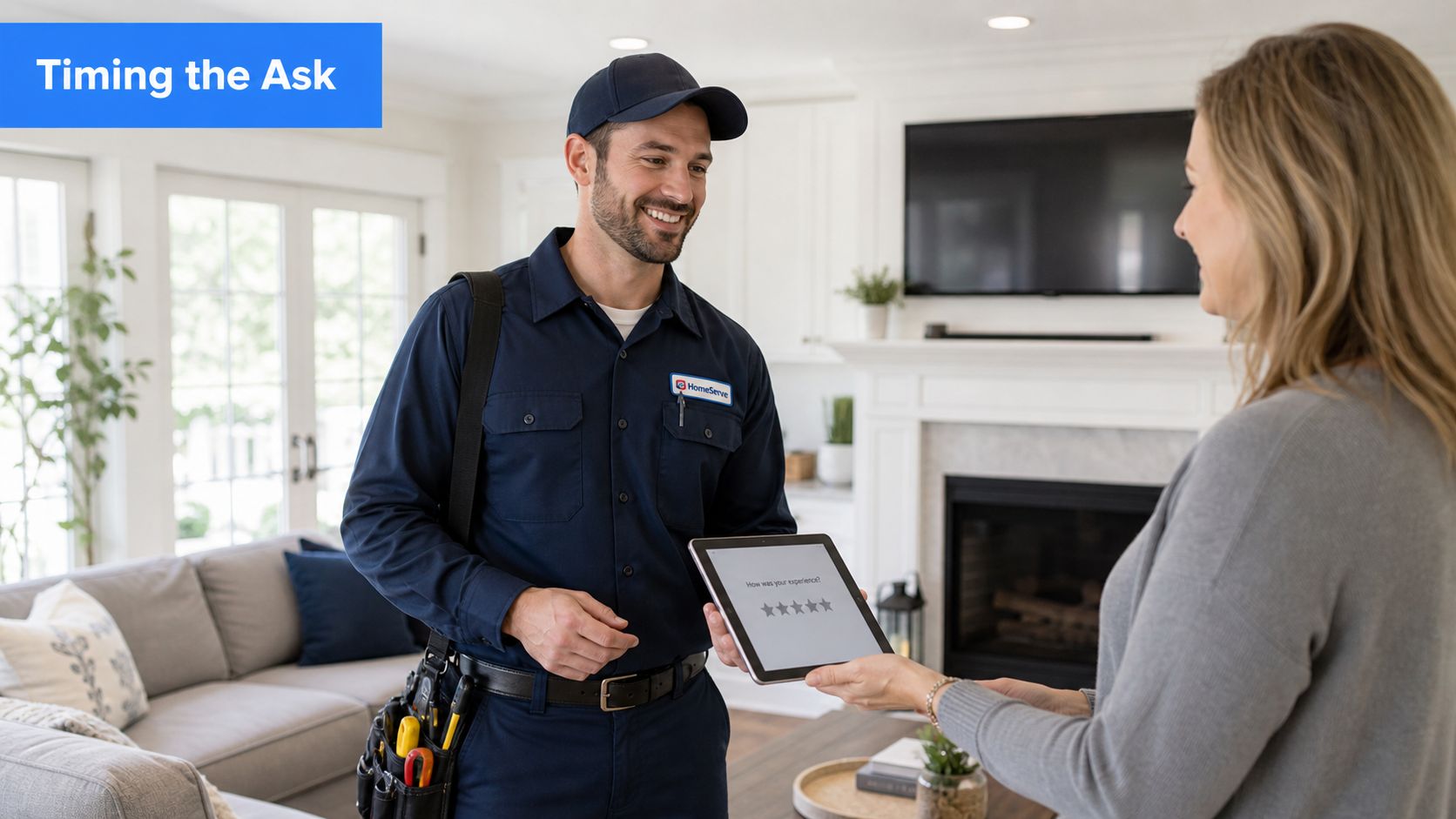
Most businesses lose reviews because they ask at the wrong time, or they ask after the customer's attention has already moved on. The best moment is usually tied to relief. The system is working again, the invoice is paid, the front desk has confirmed the appointment, or the technician has just solved the problem that was stressing everyone out.
Ask when the win is still fresh
For HVAC, plumbing, dental, and similar local services, the highest-converting ask usually lands right after the milestone, not days later. If the technician just restored cooling, if the dentist just completed the procedure, or if the plumber just stopped the leak, the customer is still emotionally anchored to the outcome. That's when a review feels like a quick thank-you, not a chore.
A weak ask sounds like this, “Please leave us a review.” It's generic, and it forces the customer to do the thinking. A stronger ask references the actual job, names the person who helped, and hands over the direct link so there's no friction.
“Thanks for trusting us with your AC repair today. If you've got 30 seconds, would you mind leaving a review for Jordan and the team? I'll text you the direct link right now.”
That script works because it feels specific, timely, and personal. It also gives the customer an easy out, which makes the request feel respectful instead of pushy.
After the in-person ask, a follow-up confirmation text keeps the momentum alive. That's the moment when many customers complete the review if they were interrupted on-site. The key is to keep the tone human, not automated, and to make sure the link goes straight to the review form.
The best operators don't wait for a perfect social moment that never comes. They train the technician, the dispatcher, or the front-desk lead to ask at the service peak, then they finish the job with a link that takes less than a second to open. ViralRef's guide on Square reviews is useful here because it reinforces the same operational truth, timing and simplicity beat vague follow-up.
Email, SMS, and QR Workflows That Actually Convert
The strongest review systems use more than one channel, but they don't pile on friction. Email, SMS, and QR codes each solve a different part of the problem, and the best results usually come from stacking them in a clean sequence. The customer should never have to search for your business or retype a long URL.
Use each channel for what it does best
Email works well when you can personalize the note and give the customer one clear button. It gives you room to say thank you, reference the service, and keep the ask polite. SMS is better for immediacy, especially because most reviews are written on phones, and a short text with the direct link reduces abandonment.
QR codes are the field version of the same idea. They belong on invoices, truck dashboards, counter cards, and leave-behinds, anywhere the customer can scan without thinking. The QR should go to the same direct review link the email and SMS use, because every extra step costs responses.
Here's the channel stack I'd use for a local service business:
| Channel | Best Moment | Friction Level | Best For |
|---|---|---|---|
| QR code | At the job site or front desk | Low | In-person handoff and quick scans |
| SMS | Shortly after service completion | Very low | Mobile-first customers |
| Within a day of service | Low | Longer thank-you note and repeat visibility |
A practical sequence is simple. Ask in person or hand over the QR at service, send SMS shortly after completion, send email within 24 hours, and follow up once if there's no response. That keeps the request visible without feeling needy.
For teams that want a workflow reference on the messaging side, ScanStay's Airbnb messaging templates and tools is a smart example of how structured follow-up can keep communication consistent without sounding robotic. The same thinking applies here, the message should be short, specific, and easy to act on.
Transactional's review request templates fit into this stack well because the templates can be adapted for front desk, technician, or office use without changing the underlying logic. The channel matters, but the conversion lift comes from removing choice overload and making the ask feel like a natural next step.
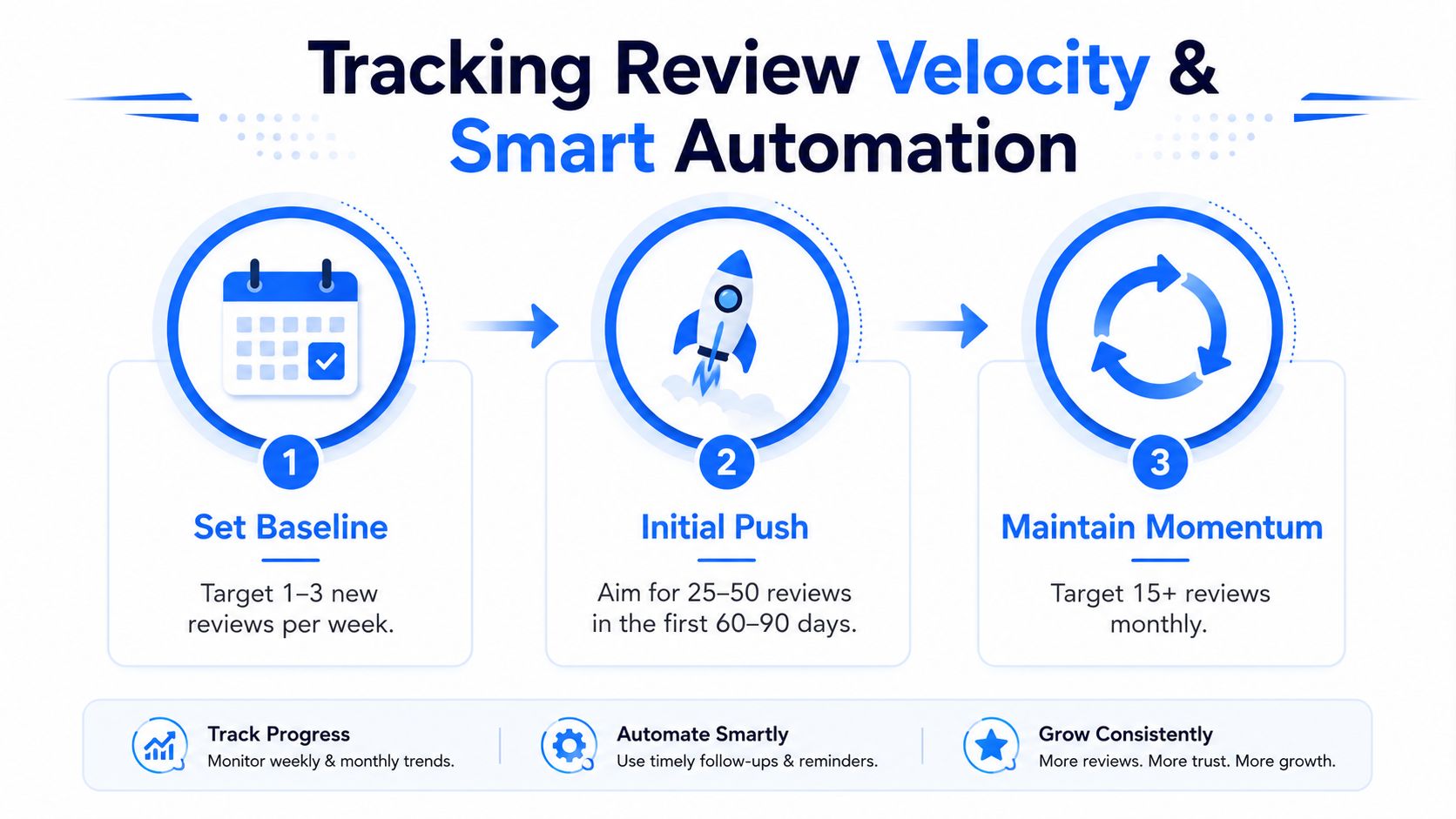
Tracking Velocity and Setting Up Smart Automation
If reviews arrive in bursts and then stop, the profile never builds enough momentum to feel current. A business starting from a thin base should work toward 25–50 reviews in 60–90 days and then keep 15+ new reviews in a rolling 90-day window for competitive categories, while aiming for 1–3 new reviews per week per location as an always-on baseline (Shapo review statistics). Those numbers give the business a real operating cadence instead of a vague “let's get more reviews” goal.
Watch the right dashboard signals
The weekly or biweekly metrics that matter most are review count, average rating, response rate, velocity trend, and the kinds of keywords customers use inside review text. If the profile is gaining reviews but not getting replies, the system still looks passive. If the review count is flat, the ask is probably too manual or too delayed.
Automation helps when it fires off a job-completed event from the CRM or field-service software, then sends the request through SMS or email without waiting for someone to remember. But the best systems still use human spot-checks. Fully autopilot review outreach can get sloppy fast, especially if the job was incomplete, the customer is unhappy, or the timing lands outside business hours.
Operational rule: automate the trigger, not the judgment.
The AI angle matters here too. Google's high-quality reviews guidance says strong reviews should include first-hand supporting material and concrete comparison language when needed, which is why review text with real service details is more useful than blank praise (Google's review quality guidance). That kind of specificity helps local discovery systems understand what the business does.
For teams building the automation layer, Andy's guide to automate lead capture with AI is a useful reference point because it treats automation as a workflow design problem, not just a software toggle. If you're managing multiple crews or multiple locations, the right system keeps the review request tied to a completed job, then hands the task to the right channel at the right time.
Staying Compliant With Incentives, Gating, and Responses
A lot of bad review advice looks efficient right up until it gets the business in trouble. Paying for reviews is off-limits under Google and FTC expectations, and review gating is a bad habit because it filters who gets the public ask. The clean approach is to send the same review link to everyone, then route unhappy customers to a private support channel before they post.
Keep the system defensible
Small incentives can get murky fast. A raffle entry for any reviewer, positive or negative, sits in a gray zone that needs careful disclosure, and it should never be presented as a way to buy a favorable rating. If the goal is credibility, the ask has to stay open, honest, and equal for all customers.
The response side matters just as much as the request side. Reply to both positive and negative reviews within 24–48 hours so customers can see that the profile is actively managed. A short thank-you on a five-star review helps future readers see there's a real team behind the business, and a calm, specific response to a one-star review can turn a complaint into visible recovery.
If a review is unfair or has been removed, Transactional's guide to Google review removal is a useful reference for understanding the cleanup side without crossing policy lines. The point isn't to erase criticism. The point is to respond cleanly, document the issue, and show future customers how the business handles friction.
Vertical Playbooks for HVAC, Plumbing, Dental, and Pest Control
The same review system works differently depending on how the job is sold and how often the customer interacts with you. HVAC and plumbing are usually emergency-driven, so the ask belongs at the moment relief sets in. Dental and orthodontic practices need a calmer front-desk handoff, because the patient often leaves with the experience still fresh. Pest control works better on recurring service, where the first completed quarterly visit gives you a stronger emotional peak than the signup call.
Four workable patterns
For HVAC, the trigger is the system coming back online. The SMS can say, “Thanks for trusting us with your AC repair today. If you've got a minute, here's the direct review link for Mike and our service team.” That wording reinforces transactional searches like air conditioning repair near me and HVAC repair near me without sounding forced.
For plumbing, the best trigger is the finished repair and the invoice payment. The message should reference the exact fix, because customers remember the leak, the clog, or the water heater issue more clearly than the company name. That's also where review text often mirrors the service term itself, which helps local discovery.
For dental, the front desk can hand off the ask after checkout and follow with an email that uses the patient's name and procedure reference. The most relevant search terms are usually dentist near me, emergency dentist, or the specific treatment the office wants to own. Pest control should wait until the first completed quarterly visit, because that's when the customer has proof the service is working.
The review ask is the same system in each case. The trigger changes, the wording changes, and the search terms change. The business that matches the ask to the service cadence usually gets the cleanest results.
Transactional LLC builds local SEO and Google Maps systems for service businesses that want more calls from transactional search terms. If you want a review funnel tied to map rankings, AI-driven visibility, and a cleaner path to more booked jobs, visit Transactional LLC and see how the team structures profiles, content, and review workflows around real local demand.