


Most advice about digital marketing for local businesses starts with “get more traffic.” That's the wrong starting point for a roofer, HVAC contractor, dentist, plumber, or pest-control company. A pageview from someone researching a general topic won't pay the invoice. The opportunity appears when a customer searches for “roofer near me,” “air conditioning repair near me,” “dentist near me,” or an urgent service plus a city.
That's a transactional search term. The searcher isn't casually browsing. They're looking for a provider and are closer to calling, booking, or requesting an estimate. Transactional Marketing is built around that distinction, combining service-and-city SEO, Google Maps optimization, conversion-focused pages, and emerging AI optimization so local businesses can be found when demand is strongest.
Local discovery is already a recurring customer-acquisition behavior. BrightLocal's 2020 Local Consumer Review Survey found that 93% of U.S. consumers had used the internet to find a local business during the previous year, while 34% searched every day and 73% searched weekly. That makes an accurate website and Business Profile foundational, but foundations don't generate revenue unless they connect to the exact services and locations customers search.
Why Transactional Intent Beats General Traffic
General traffic is one of the easiest marketing numbers to celebrate and one of the least reliable numbers for a local service operator. An article about “how HVAC systems work” might attract visitors from outside your service area, students doing research, or homeowners who won't need a technician for months. A page targeting “emergency plumber [city]” speaks to a much narrower audience, but that audience is far more valuable when the phone needs to ring now.
The practical question isn't, “How many people visited the website?” It's, “Which service did they need, where were they located, and did they contact a business that could solve the problem?” That changes the keyword plan. A roofing company should separate roof repair, roof replacement, storm damage, and inspection pages by relevant service areas. A dental practice should distinguish emergency dentistry, implants, cosmetic dentistry, and new-patient searches instead of placing every service on one generic page.
Google's local-search research shows why this focus matters. Among smartphone users conducting local searches, 50% visited a store within one day, compared with 34% for local searches on a computer or tablet, according to Think with Google's local-search research. The same research found that 18% of smartphone local searches led to a purchase within a day, compared with 7% of non-local searches, meaning local searches produced purchases at more than twice the rate of non-local searches.
Revenue rule: A smaller set of searches with clear service, location, and urgency signals is usually more useful than a large audience with no buying context.
Finding the searches that matter
Start with the language customers use immediately before contacting a provider. For most local operators, that includes:
- Service plus proximity: “roofer near me,” “dentist near me,” or “pest control near me.”
- Urgency plus service: “emergency plumber,” “same-day HVAC repair,” or “toothache dentist.”
- Service plus city: “air conditioning repair in Phoenix” or “roof replacement in Denver.”
- Commercial modifiers: “quote,” “estimate,” “appointment,” “company,” “contractor,” and “service.”
These terms should shape your service pages, Google Business Profile services, paid-search groups, calls-to-action, and tracking. Don't combine unrelated industries into one broad SEO page. Roofing content should address roofing decisions. Dental content should address dental decisions. Separate industry-and-service entities give customers and search systems a clearer answer to the question, “Is this the right provider for this exact need?”
Transactional Marketing's name reflects this operating principle. The work targets the phrases people use when they're ready to spend, not just phrases that create awareness. Rankings matter because they create access to demand, but the target is a qualified call, form submission, appointment, or booked job.
Mastering Google Maps and Local Search Rankings
For service-area businesses, Google Maps isn't a side listing. It can be the first place a customer sees the company name, phone number, reviews, service categories, and directions. Google describes local ranking through relevance, distance, and prominence, as documented in its official local-ranking guidance.
Relevance asks whether the Business Profile matches the query. A plumbing company that clearly identifies drain cleaning, water-heater repair, leak detection, and emergency plumbing gives Google more context than a profile with only a vague business description. The website should reinforce those same service entities with dedicated pages, clear headings, internal links, and service-area information.
Distance considers how close the business is to the searcher, or to the location named in the query. A dental practice or HVAC company can't consistently overcome a geographic disadvantage by publishing more blog posts. Location targeting must reflect the actual markets the team can serve, and rankings should be checked from defined geographic points rather than through one personalized Maps search.
Prominence reflects how well-known and trusted the business appears across the web. Google identifies links, articles, directories, review volume, and review sentiment as relevant signals. That makes accurate listings, legitimate local and industry links, and a consistent review process more useful than shortcuts that manipulate names, locations, or ratings.
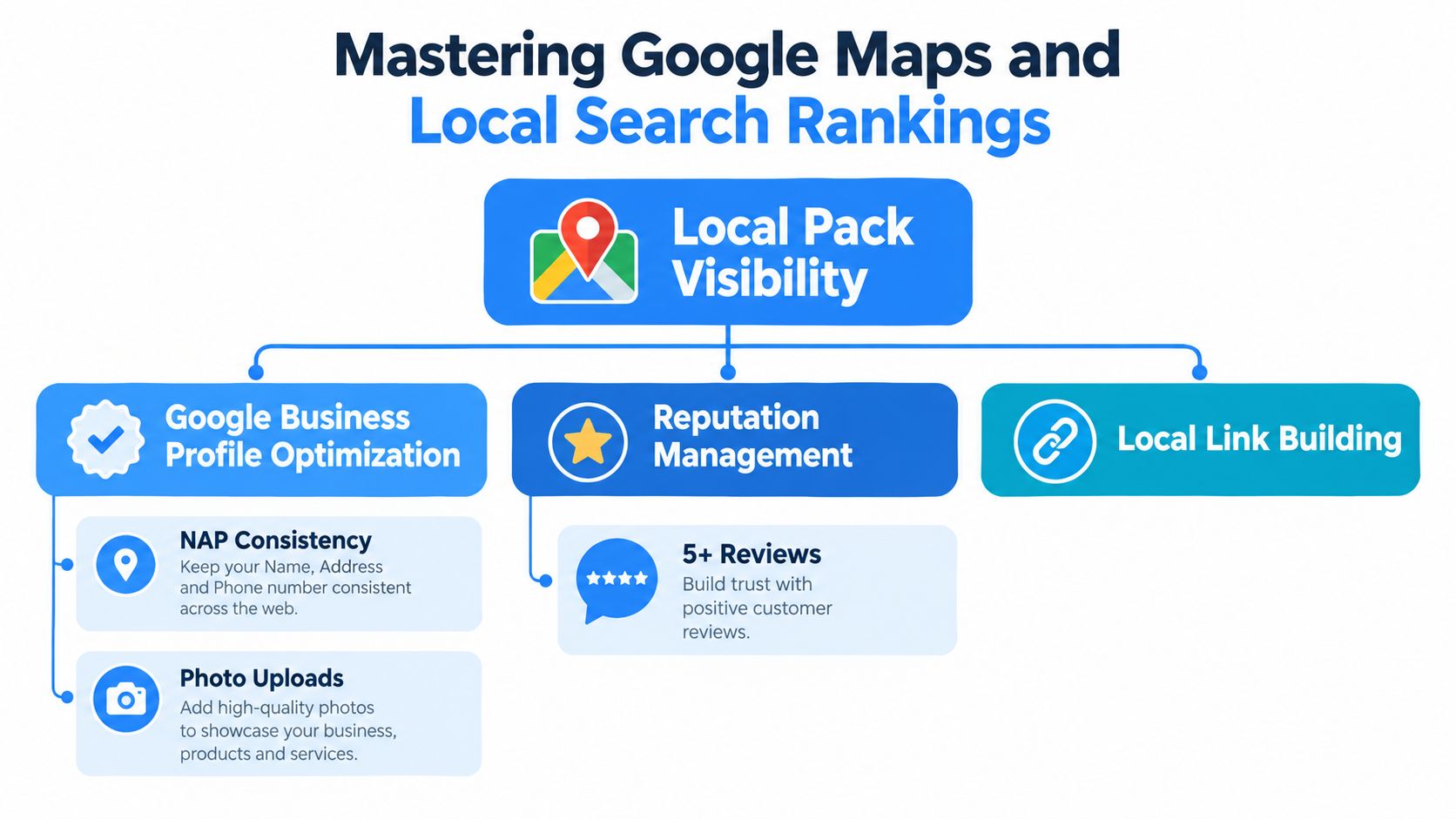
A controlled local-pack workflow
Treat map optimization as a constrained operating process:
- Complete the Business Profile: Verify the name, phone number, hours, categories, website, service areas, and service descriptions. Add useful photos that reflect the actual business.
- Build service alignment: Match the profile's services to dedicated website pages. A query for "air conditioning repair near me" should lead to a page that clearly explains repair capabilities, locations served, contact options, and next steps.
- Protect information consistency: Keep business details aligned across the website, directories, social profiles, and industry listings. Conflicting information makes verification harder for customers and search systems.
- Earn legitimate prominence: Seek relevant local partnerships, trade associations, community coverage, and industry references. Don't buy irrelevant links or create artificial locations.
- Request and answer reviews: Ask real customers for feedback after completed work, without requiring positive ratings or scripting their words. Respond professionally and address the service experience directly.
For an additional practical perspective, these tips from AI Tools for Local SEO can help teams think through map visibility and local optimization workflows. Businesses that want a deeper operational reference can also review how to rank higher on Google Maps.
The map pack shouldn't be managed separately from the website. A strong listing can generate a call, but the caller still needs accurate service information, a responsive team, and a clear booking path. Google Maps optimization creates the opportunity. Operations convert it.
The following video provides a visual overview of local-search ranking considerations:
Building an AI-Optimized Content Silo Strategy
AI assistants are changing how people discover local providers, but that doesn't make Google Maps irrelevant. The practical shift is that a business must now publish facts clearly enough for both a customer and an LLM to understand, retrieve, compare, and verify them.
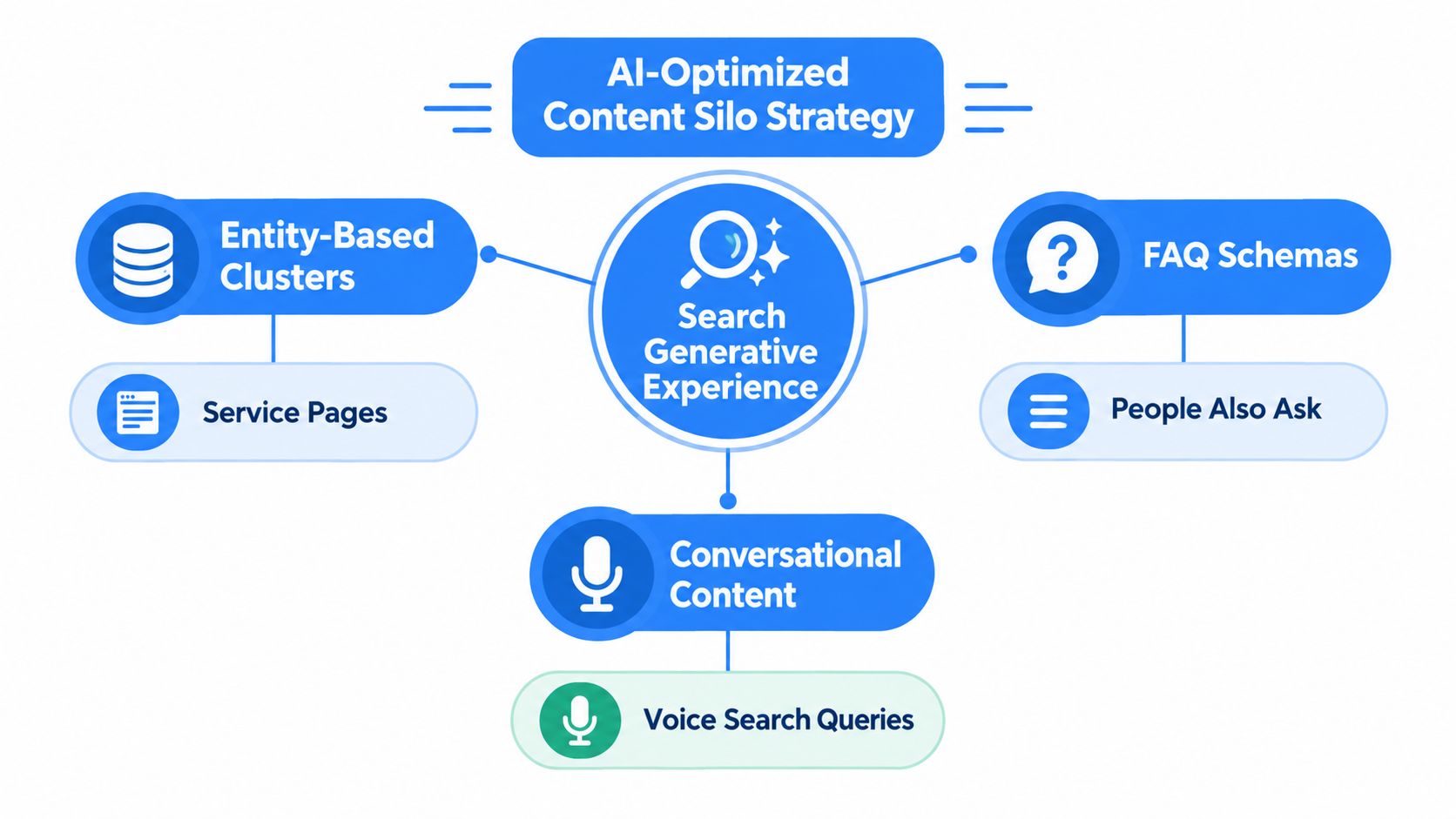
The website architecture should mirror the way customers buy. Don't place every service and location on one generic page. Create a defined structure in which each industry, service, and market has a logical home.
A useful model looks like this:
- Industry hub: Identify the business category and the problems it solves. A roofing site should establish roofing expertise, while a dental site should establish clinical services and patient care.
- Service pages: Give roof repair, roof replacement, emergency dentistry, implants, HVAC repair, or pest control their own pages. Each page should explain who the service is for, what the provider does, service limitations, credentials, and how to request help.
- Location pages: Connect each important service to a real city or service area. Avoid thin pages that just swap a city name while repeating identical text.
- Evidence pages: Include licensing or credentials where applicable, team information, process details, FAQs, photos, reviews, and clear business facts.
- Conversion paths: Link every relevant page to a call, estimate request, appointment form, or booking system. AI visibility without a usable next step is not a marketing result.
Writing for verification rather than volume
An LLM needs more than a repeated keyword. It needs unambiguous relationships between the business, its services, its locations, and its proof. State the service area in plain language. Explain whether the company handles residential, commercial, emergency, scheduled, or specialized work. Identify relevant credentials accurately, and keep hours, phone numbers, addresses, and booking details consistent.
Use structured data where it accurately describes the page, but don't treat schema as a substitute for visible content. A machine-readable field can't rescue a page that fails to explain what the provider does. The same principle applies to AI-generated drafts. Tools can help organize subjects and identify content gaps, but a subject-matter reviewer must correct unsupported claims, local details, and service promises.
A 2025 analysis of local AI search examined 14,472 citations across 1,487 local-search queries in 50 U.S. metropolitan areas. Search Engine Land reported that nearly 60% of citations in Google Gemini's local-search answers pointed directly to businesses' own websites, as described in its analysis of business websites in Gemini citations. That finding supports a straightforward priority: make the company's own site a clean, authoritative source of transactional facts.
AI recommendations can vary between identical searches, so no responsible operator should promise one permanent answer position. Build durable evidence instead. A detailed service page for “air conditioning repair near me” should help a homeowner decide whether the company offers the right repair, serves the right area, and can be contacted immediately.
For more guidance on producing focused local content without creating low-quality pages, see how to scale local service business content using AI without facing search engine penalties.
Reputation Management for Humans and AI Models
Reviews perform two jobs. They reduce uncertainty for a person deciding whether to call, and they contribute to the web-wide reputation signals that search systems use to understand prominence. In local SEO, reputation management isn't a campaign you turn on during a slow month. It's an operating habit tied to completed work.
A review request should arrive when the customer can accurately describe the experience. For a plumber, that might follow a completed repair and a clear explanation of the work. For a dentist, it might follow a comfortable appointment and successful follow-up. Send a direct review link, make the request easy, and ask every eligible customer consistently. Don't offer incentives for positive reviews, pressure customers to change feedback, or filter requests only to people expected to be happy.
Responses should reinforce trust
Responding to reviews isn't an excuse to stuff “best dentist near me” into every reply. That creates unnatural language and can make the business sound less trustworthy. Write as a manager who wants future customers to understand how the company handles service.
A useful response does three things:
- Acknowledges the experience: Thank the customer or recognize the concern without exposing private information.
- Clarifies the service context: Refer naturally to the type of work, such as an emergency repair, routine cleaning, or roof inspection, when appropriate.
- Offers a next step: Invite an unhappy customer to continue the conversation privately, while keeping the public response calm and professional.
The AI-discovery angle matters because consumers still want evidence they can inspect. A 2025 survey found that 39% of consumers don't trust AI-generated local recommendations unless they can read individual customer reviews, according to this survey of traditional search and local-business discovery. A generated recommendation may introduce the provider, but individual reviews help the customer verify quality.
Review problems also require a documented process. If a legitimate review disappears or appears incorrectly, record the review details, check platform policies, and use the appropriate support channel. Businesses can consult this resource on what to do when a Google review is removed, but they shouldn't attempt to replace platform review systems with copied testimonials on their own website.
Reputation principle: Ask for honest feedback, respond like a real operator, and make the underlying customer experience strong enough to support the review strategy.
Review text should never be treated as a substitute for service quality. A company that generates requests but misses calls, arrives late, or fails to resolve complaints will eventually create a reputation problem that no content silo can hide.
Measuring Revenue Instead of Vanity Metrics
A ranking report can look impressive while the schedule stays empty. Total sessions can rise because an informational article attracts visitors from outside the service area. Even a top position for a broad term can be commercially weak if the query doesn't identify a service, location, or need.
The measurement model should follow the customer from discovery to revenue. Track calls, form submissions, booked appointments, qualified leads, close rate, average job value, and cost per acquired customer. Segment those outcomes by service area and source, including Google Search, Maps, organic pages, and paid campaigns.
The metrics that change decisions
| Metric Type | Vanity Metric (Ignore) | Revenue Metric (Track) |
|---|---|---|
| Visibility | Total impressions | Impressions for target service-and-city terms |
| Traffic | Total website sessions | Visits to transactional service pages |
| Engagement | Average time on site | Calls, forms, and booking actions |
| Leads | Raw contact submissions | Qualified leads by service and location |
| Sales | Ranking position alone | Booked jobs, appointments, close rate, and job value |
| Advertising | Click volume | Cost per qualified lead and cost per booked job |
The distinction is operational. If Maps produces calls but the office misses them, the SEO campaign isn't the only problem. If one city generates qualified roof-replacement leads while another produces low-value inquiries, the budget and content plan should reflect that difference. If a lower-ranked page produces more profitable jobs than a higher-ranked page, the business should investigate conversion quality before chasing another ranking point.
Small-business owners report this measurement gap clearly. Although 89% of surveyed small businesses invest in local SEO, only 29% say it has a high impact, while 15% identify ROI tracking and connecting visibility to booked revenue as a major challenge, according to Local Impact's small-business marketing research. Rankings are useful diagnostic signals, but they aren't the final KPI.
Build a closed loop
Use call tracking that preserves the original source and landing page where possible. Connect form submissions to the customer relationship system, record whether the lead was qualified, and require the team to mark the outcome. For dental practices, distinguish new-patient appointments from information requests. For HVAC companies, distinguish emergency repairs from maintenance inquiries.
Review the data by service and city rather than relying on a single domain-wide score. The practical guide to measuring marketing effectiveness can help teams structure this process around outcomes instead of activity.
Measurement rule: If a report can't show which service, city, source, and interaction led to a booked job, it isn't a revenue report yet.
The Local Marketing Technology and Process Stack
A local marketing system needs fewer disconnected tools and more reliable handoffs. The stack should make it easy to update business information, publish service-specific content, monitor map visibility, capture calls, and connect leads to booked work.
Start with the source-of-truth layer. Maintain the Google Business Profile, website service pages, location information, hours, phone numbers, and booking paths in a controlled process. Add citation and directory monitoring where it supports consistency, but don't mistake a large directory count for prominence. Relevant accuracy matters more than collecting listings indiscriminately.
A practical operating stack
Profile management covers Business Profile categories, services, photos, hours, service areas, and review responses. Teams should assign ownership so updates don't depend on one busy owner remembering to make them.
Content planning maps each industry to its services, cities, customer problems, and transactional terms. An AI writing tool can help cluster topics and draft outlines, but a human should verify every credential, service promise, location, and process detail before publication.
Rank and map monitoring should use geographic grids or defined locations rather than one manual search. Track target queries such as “air conditioning repair near me,” “roofer near me,” or “dentist near me” by service area, then compare map visibility with calls and booked outcomes.
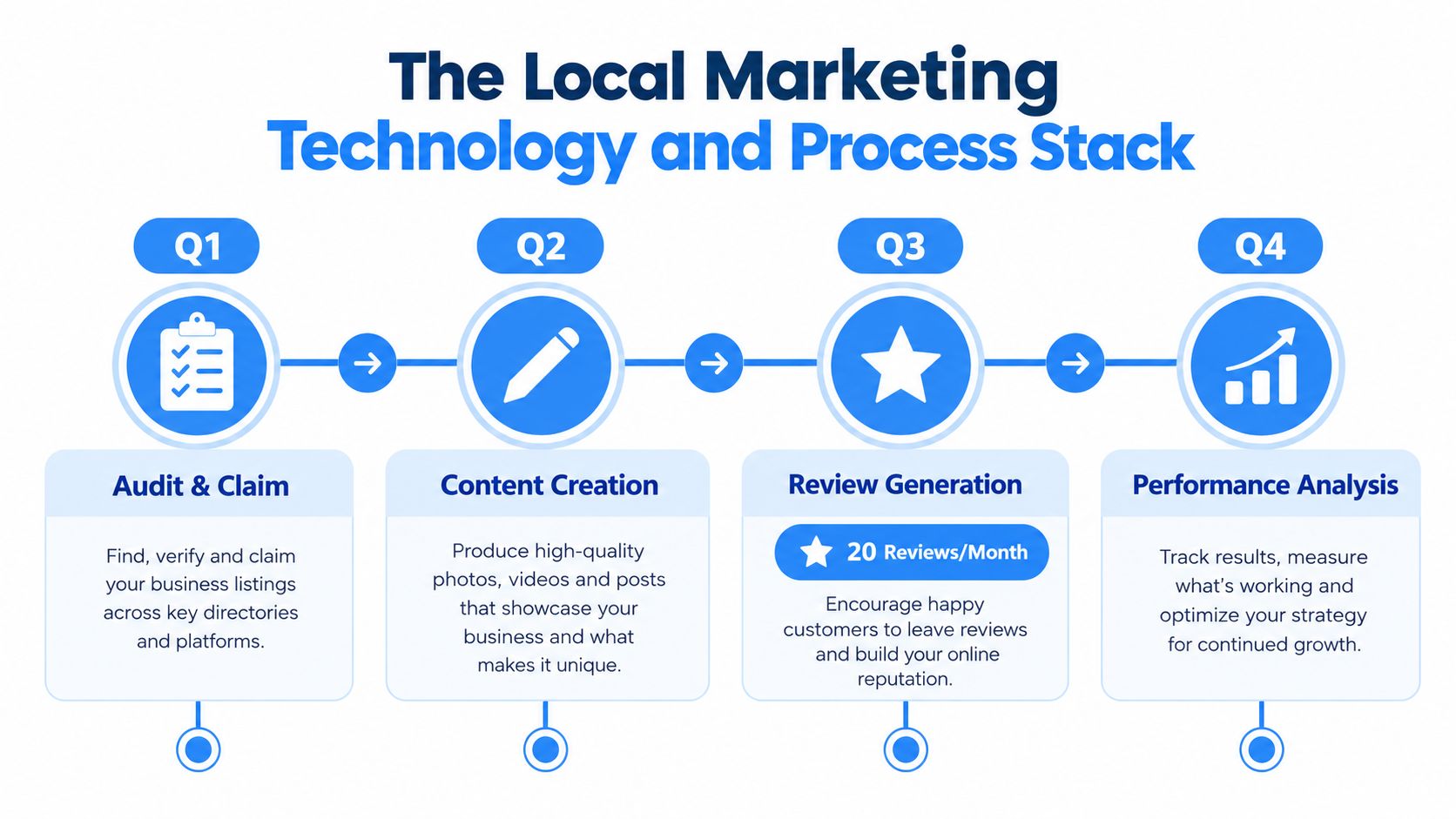
Reporting should bring Search Console queries, landing-page performance, map visibility, call records, form data, and booking outcomes into one readable view. If a reporting platform feels too complex for the team, this overview of a Raven Tools alternative offers a useful comparison point for simpler SEO reporting workflows.
A focused implementation cycle
During the first phase, audit the Business Profile, website, service areas, tracking, and conversion paths. Next, build or improve the highest-value service pages and connect them to the profile. Then establish the review request and response process, correct inconsistent business information, and begin monitoring target service-and-city searches.
The early objective isn't to publish everything. It's to identify the searches most likely to produce booked work and make the business credible for those searches. A disciplined plan may begin with “air conditioning repair near me” for an HVAC company, then expand after tracking shows which cities, services, and lead types deserve more investment.
A contract-free arrangement can reduce the risk of staying locked into tactics that aren't producing qualified opportunities, but flexibility doesn't replace accountability. Require clear access to profiles and analytics, defined deliverables, source-level reporting, and regular decisions based on booked revenue. Transactional LLC is one example of a partner that combines local SEO, Google Maps work, industry-specific content planning, website services, paid campaigns, and reporting around service-area performance.
Turning Local Searches into Booked Jobs
The strongest local strategy is not “be visible everywhere.” It's be findable for the exact service, in the exact market, when the customer is ready to act. That means targeting transactional searches, building distinct industry-and-service pages, strengthening Google Maps signals, maintaining reviews, preparing factual content for AI systems, and measuring the result in booked jobs.
The same principle applies across industries, even though the pages must remain separate. An HVAC company needs repair and installation intent. A roofing company needs inspection, replacement, and storm-damage intent. A dental practice needs appointment and treatment intent. A pest-control company needs service and problem-specific intent. The content should reflect those real buying paths rather than forcing every business into one generic local-marketing template.
Conversion details finish the work. Make the phone number prominent, explain the next step, use forms that ask only for useful information, and give staff a process for answering and following up. Businesses reviewing the path from a map listing to a phone conversation may also find this resource on how to convert clicks into calls useful.
Audit your presence by asking four practical questions: Can customers find the exact service? Can Google and AI systems verify the business facts? Can a prospect trust the reviews and page content? Can the team prove which source produced the booked job? If any answer is unclear, the next marketing dollar should go toward fixing that gap before buying more traffic.
Transactional search terms are the center of the strategy because they connect visibility to intent. “Roofer near me,” “dentist near me,” and “air conditioning repair near me” aren't abstract keyword targets. They represent customers looking for a provider now. Digital marketing for local businesses works best when every page, profile, review, campaign, and report supports that moment.
Transactional LLC helps local service businesses target transactional search terms, improve Google Maps and organic visibility, build AI-ready content silos, and connect marketing activity to calls and booked jobs. Visit Transactional LLC to review a focused, contract-free approach for growing your service-area presence.