


A polished proposal can make a weak dental SEO deal look like a safe bet. A practice owner signs a year-long contract, pays for months of “optimization,” and watches keyword positions move while the phone stays quiet. The problem isn't that rankings never matter. It's that rankings alone don't tell you whether the campaign is attracting patients, and a contract can leave you paying for work you don't control.
Before you hire, get clear answers to four questions: Who controls your Google Business Profile? How will the company measure success? Does its strategy target transactional searches such as “dentist near me”? And what happens to your website, data, and content when the contract ends? Those answers matter more than a slick deck or a long list of deliverables. If you're also comparing practice-management resources, browse dental practice solutions to see what other operational needs you may want to address.
Choosing an SEO partner should be a decision about ownership, evidence, and patient acquisition, not a contest in presentation skills. Use the framework below to test whether a company can connect search visibility to real appointments without taking control of assets your practice should own.
Why Most Dental SEO Decisions Go Wrong
A solo dentist signs a 12-month agreement after a persuasive sales call. The vendor promises better rankings, regular content, and “more visibility.” Months later, some search positions have improved, but the practice can't tell whether calls came from SEO, whether those callers booked, or what the agency changed. The owner wants to leave, then discovers the vendor controls the Google Business Profile and website access.
That's not a strategy problem alone. It's a buying problem. The practice signed before agreeing on what success means, who owns the accounts, or how it can leave without losing essential assets.
Start with operational questions
Ask each company to answer these questions in writing:
- Who owns and administers the Google Business Profile? Your practice should retain access and control, even when a vendor does the work.
- How will success be measured? Require a path from search activity to calls, appointment requests, qualified bookings, and, where your systems allow, completed visits.
- Which searches are the strategy targeting? A campaign should distinguish appointment-ready searches such as “dentist near me” and “emergency dentist” from broad informational traffic.
- What happens when the agreement ends? The answer should cover the website, analytics, content, call-tracking setup, and all account credentials.
Transactional Marketing's name reflects a focus on searches with buying intent. For a dental practice, “dentist near me” is different from a general oral-health question: the searcher may be choosing a provider now. But intent is only useful if the campaign can turn visibility into a measurable patient opportunity.
Practical rule: Don't sign until you know who controls the assets and how the vendor will prove that its work is producing qualified opportunities.
Treat vendor selection as a decision framework, not a checklist of services. In the next steps, you'll establish a baseline, test the proposed measurement model, and put ownership and exit terms in writing.
Defining What a Dental SEO Company Should Actually Deliver
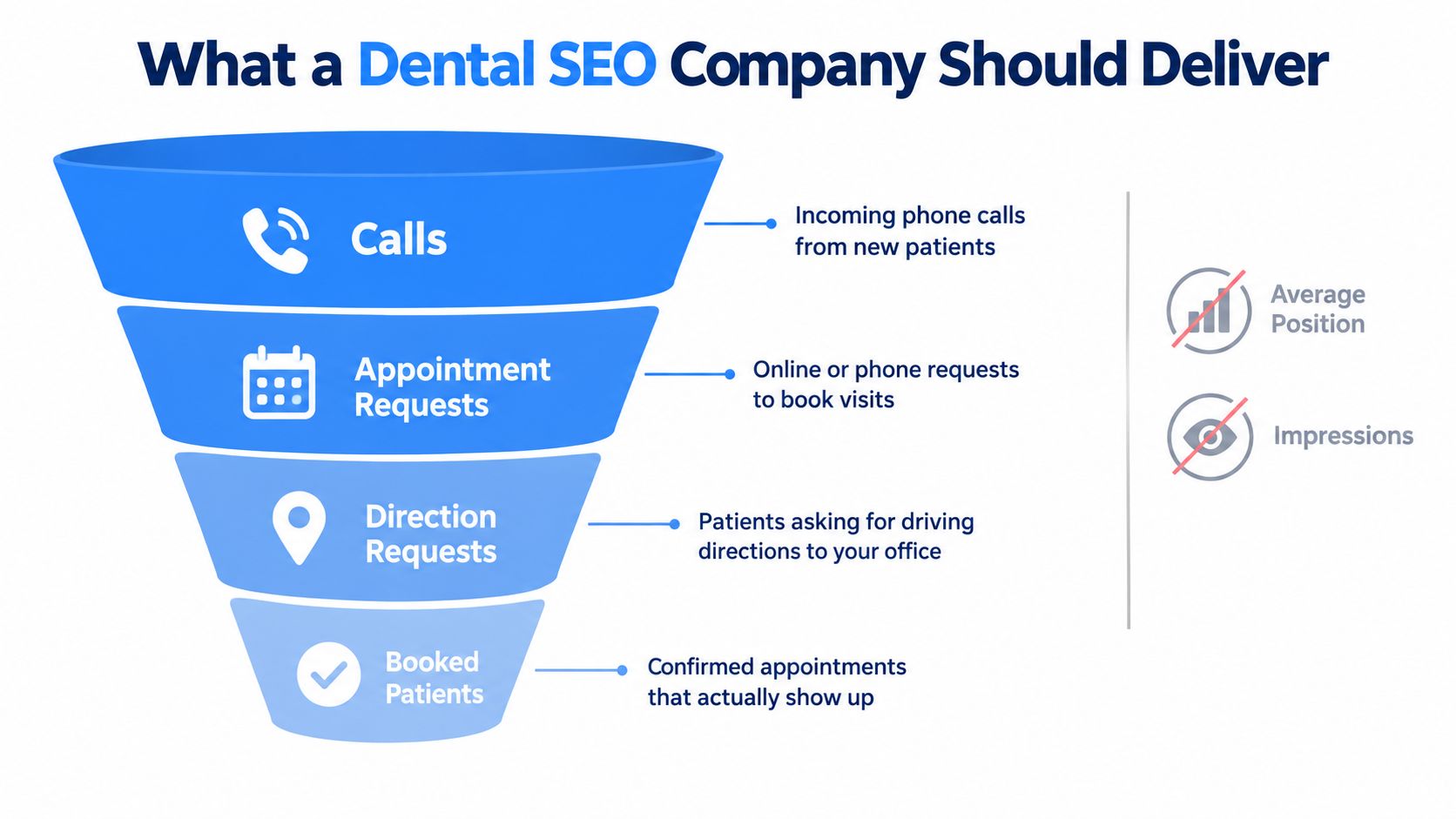
A dental SEO company shouldn't ask you to accept impressions as proof that the campaign is working. Its job is to improve visibility that can lead to calls, appointment requests, direction requests, and booked patients. Google research found that 50% of consumers who made a local search on a smartphone visited a physical business within one day, compared with 34% of local searchers on a computer or tablet. The same research found that 18% of smartphone local searches led to a purchase within one day, versus 7% of non-local searches. The study is historical and not dental-specific, but it illustrates why high-intent local searches deserve attention. (Google's research on local search behavior)
Set the outcomes before the activity
The vendor should explain how it will connect specific work to a patient action. Google Business Profile accuracy and local relevance support map visibility. Useful service and location pages help match searches to the right treatment and practice location. Mobile usability and clear call or booking options help a prospective patient act once they arrive. Conversion tracking then helps distinguish a visit from an inquiry, and an inquiry from a qualified appointment.
Ask for the attribution model before the campaign starts. It should distinguish branded searches, where someone already knows your practice, from non-branded searches that may introduce a new patient. It should also explain how calls and forms are tracked, how duplicate or junk inquiries are excluded, and how the practice confirms appointments.
Ranking without conversion is decoration. Conversion without ranking is luck. Require both.
A vendor should volunteer its reporting method rather than waiting for you to demand it. If you're comparing what agencies include in their broader marketing mix, this overview of performance marketing channels and pricing can help you frame questions about channel roles and costs. For a dental-specific view of the service itself, review dental SEO services and compare its scope with the proposal in front of you.
Running the Pre-Audit Before Talking to Vendors
Don't let a salesperson define your starting point for you. Before taking calls, make a short baseline document that every prospective company can review. You don't need to conduct a complete technical audit yourself. You do need enough information to spot a vendor who gives the same generic pitch to every practice.
Build a one-page baseline
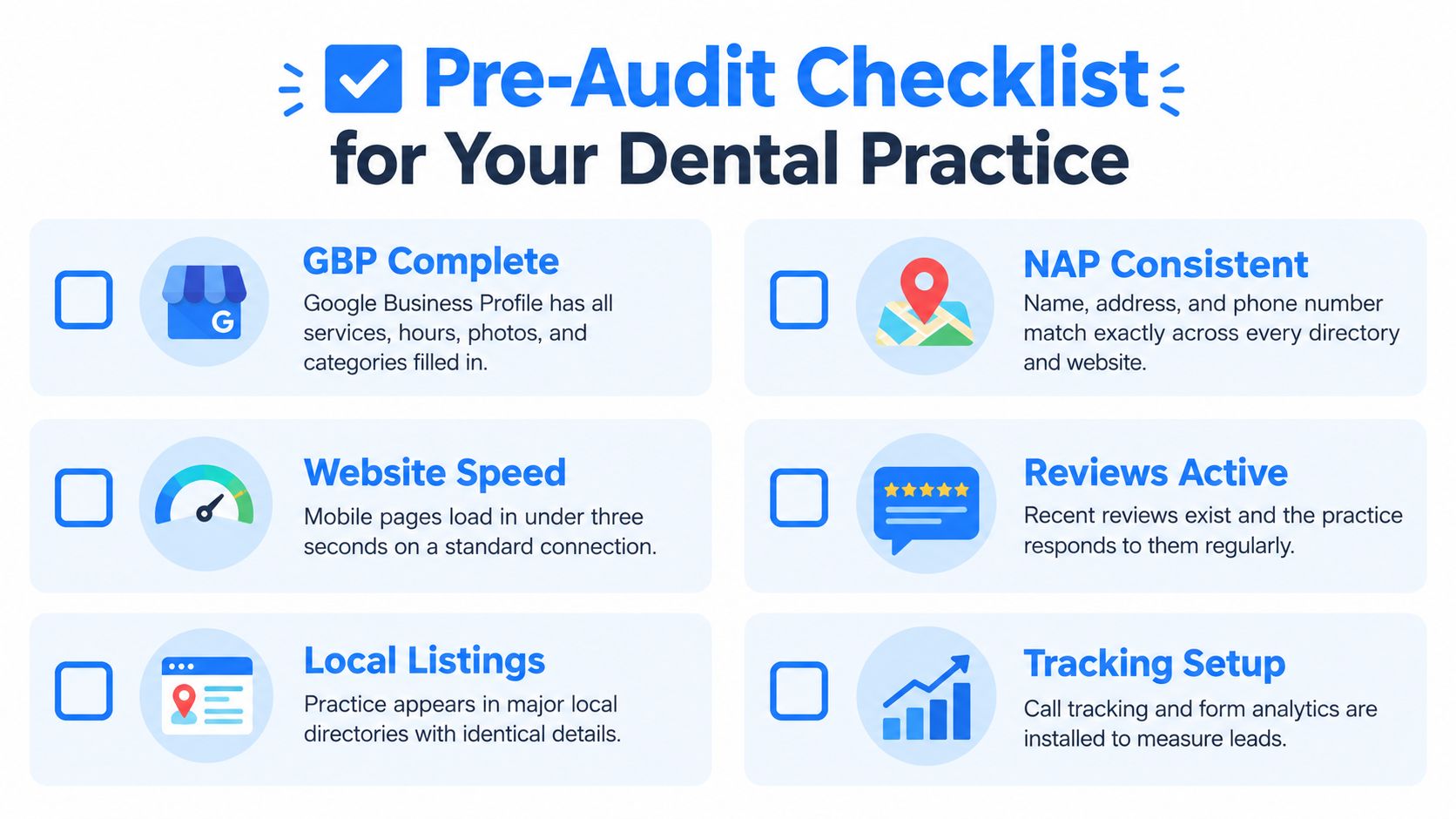
Use this checklist to record what you know and mark anything that needs professional review:
- Google Business Profile: Check whether the listing is complete, accurate, and controlled by the practice. Review the hours, categories, services, photos, and contact details.
- Name, address, and phone consistency: Compare the practice details on its website and major directories. Note discrepancies instead of assuming a vendor will find them.
- Website health: Check whether important treatment pages are indexed, whether the site works well on mobile, and whether technical issues or poor Core Web Vitals need investigation.
- Reviews: Record the current review profile and whether the practice responds. Ask the vendor to explain how it will support legitimate review acquisition without incentives or fabricated activity.
- Local competitors: Search the target cities and note which practices appear prominently in Maps for relevant treatments. A useful prospect should be able to discuss why those competitors may be visible, rather than promising to outrank them.
- Current measurement: Find out whether Search Console, analytics, call tracking, and appointment records are available, and who has account access.
This baseline makes proposals comparable. One company may find that the website has strong treatment pages but weak tracking. Another may identify incomplete profile information or inconsistent listings. Those are different starting conditions and should lead to different scopes of work.
A credible provider will explain what it can verify, what it still needs access to, and which issues deserve priority. If the pitch ignores your actual profile, site, and market, you're hearing a template, not an audit. For a related example of how visibility audits are discussed in another professional-services field, see how law firms are cited by AI. Use it as a prompt to ask dental vendors how they assess evidence and entity accuracy, not as a substitute for dental-specific analysis.
Questions That Expose a Weak Dental SEO Company
A vendor interview should sound less like a sales presentation and more like a review of who will do what, using which accounts, and how you'll judge the result. Ask the same questions of every company, then compare the answers in writing.

Use this vendor interview script
- What specific work will you complete in the first three months, and why is that the right order? Look for a sequence tied to the audit, not a calendar of generic deliverables.
- Who will do the work, and who will be my named point of contact? Ask whether clinical content is reviewed by a qualified professional.
- Who owns the website, Google Business Profile, analytics, content, and call-tracking data? The answer should leave your practice with access and control.
- How do you define a qualified appointment? Ask how the report separates a real prospective patient from a duplicate call, spam lead, or unrelated inquiry.
- How will you attribute calls and forms to search activity? Ask to see the proposed setup and how it avoids unnecessary exposure of patient information.
- What will your regular report show? Request a sample report from a current dental client, with sensitive details removed.
- How do you track local visibility across different parts of the service area? A single location-based ranking check can conceal how results vary by searcher location.
- How do you assess visibility in AI Overviews, conversational tools, and Apple Maps? Ask for a sample query-level report and how the vendor checks factual accuracy.
- What is your process for reviewing treatment claims, before-and-after content, and patient testimonials? The practice should retain clinical approval.
- Do you guarantee rankings, patient volume, or a particular position in the map results? Treat a guaranteed outcome as a warning, not reassurance.
- What happens to all accounts and materials if we end the agreement? Ask for the transfer process and timeline.
- Can you show how you handle patient-review campaigns and testimonials? The FTC says endorsements and testimonials used in advertising must be truthful and not misleading, and material connections may need disclosure. Its guidance also warns that unrepresentative testimonials can mislead without information about what consumers generally can expect. (FTC advertising and marketing guidance)
For clinical pages, ask who verifies claims about treatment risks, outcomes, candidacy, and costs. Google identifies health-related content as a high-stakes area and says it should be accurate and consistent with established expert consensus. (Google's guidance on helpful, people-first content)
The company should accept your practice's final clinical sign-off. It shouldn't publish unsupported promises or unreviewed AI-generated treatment copy.
Watch the vendor's answers as carefully as the proposal. If it dodges ownership questions, can't explain attribution, or responds to an AI-visibility question by selling a magic markup package, keep interviewing.
A recorded walkthrough can make a proposal easier to assess. Use the video below as another point of reference while judging whether the vendor's explanation is specific enough to verify.
Contract Terms That Protect the Practice
The contract decides whether a bad engagement is recoverable. Don't let the monthly fee distract you from clauses that determine who controls the work, how performance is defined, and what you can take with you if you leave.
Put ownership and exit terms in plain language
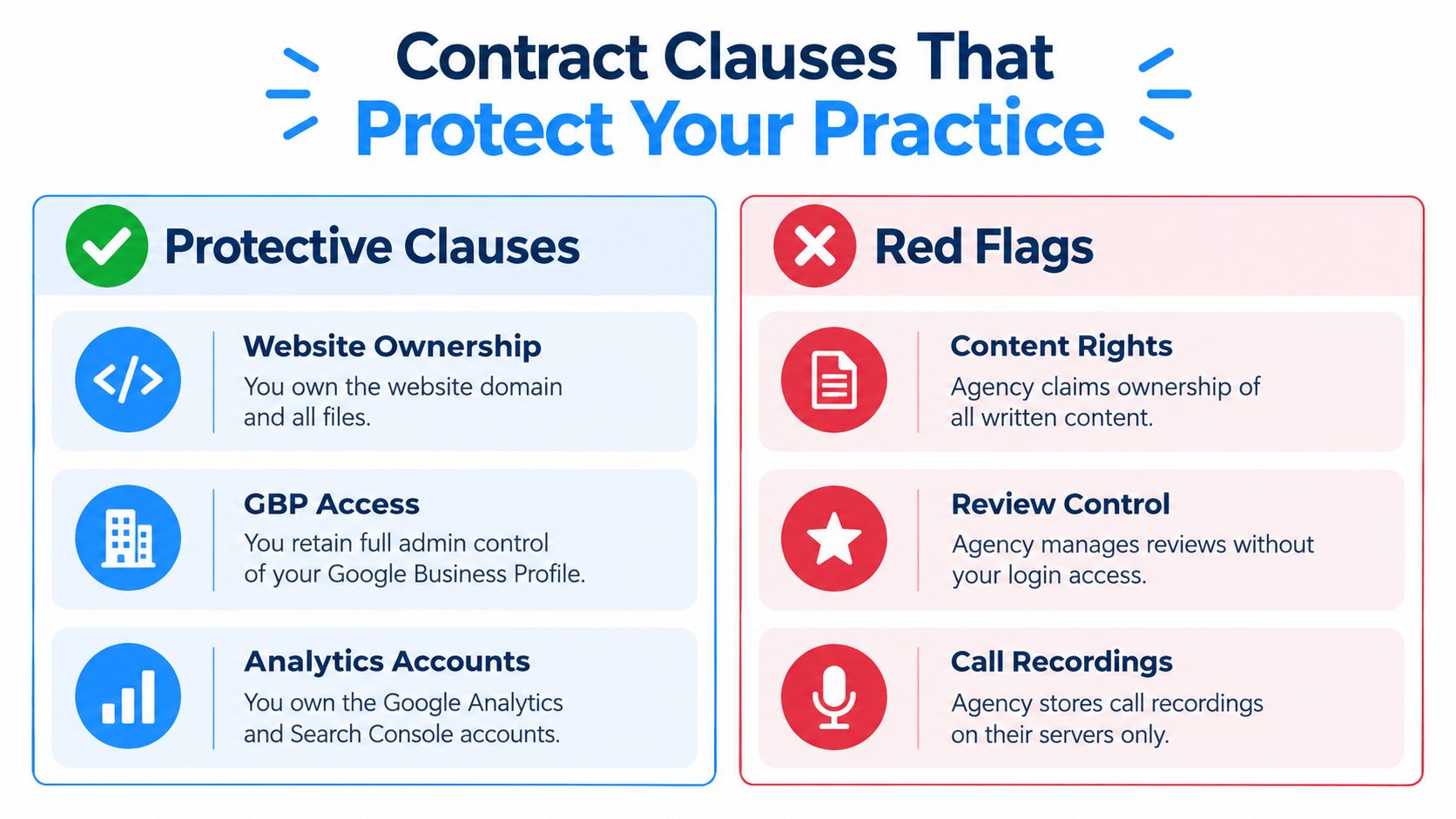
The agreement should state that your practice owns its domain, website files, content it has paid for, analytics accounts, Search Console access, Google Business Profile, and relevant call-tracking data. The vendor can receive the permissions needed to do the work, but it shouldn't be the only party with access. Spell out how patient reviews and call recordings are handled, too.
Write termination rights, notice periods, and handover obligations into the contract. Specify what the vendor must transfer and when, including credentials, content files, tracking configurations, and change logs. A defined transfer deadline, such as within thirty days of cancellation, gives both sides a clear obligation instead of leaving the practice to negotiate access after a dispute.
Reporting terms need the same precision. Define a conversion, a qualified lead, and a booked patient. State whether reports arrive biweekly or monthly, and require annotations for major site changes, seasonality, budget changes, and algorithm updates. Google says local results are based on relevance, distance, and prominence, so a report should separate meaningful inputs and outcomes rather than promise a fixed universal position. (Google's explanation of local ranking)
Review payment terms, automatic renewal, cancellation notice, and invoice detail. Your practice should be able to tell which services were completed and challenge charges that don't match the agreement. A vendor unwilling to explain its billing or transfer process is asking you to take avoidable risk.
If you're weighing shorter commitments against traditional retainers, compare the trade-offs in this discussion of contract-free digital marketing models and long-term SEO retainers. The point isn't that every short agreement is good or every longer one is bad. The point is that you should understand how to exit before you sign.
AI Search, Google Maps, and the Visibility That Actually Converts
A dental SEO proposal that measures only Google rankings and website visits is missing part of the search journey. AI-generated answers can surface local businesses, and patients may look for treatment details, cost context, urgency, and nearby providers across more than one platform. That doesn't make conventional SEO obsolete. It makes accurate business information and treatment-specific evidence more important.
A 2025 survey found that 40% of U.S. consumers actively use generative AI during search, while 39% estimated that at least 41% of their searches are for local businesses. Separate 2025 local-search research reported AI Overviews in 68% of local searches overall and 97% of hybrid-intent queries, such as a search for the average cost of dental implants in Phoenix. (BrightLocal's consumer search behavior research)
Ask for a visibility audit, not an “AI package”
A capable vendor should show how it checks whether your practice is accurately represented for treatment, cost, urgency, and location searches. Ask it to explain how it maintains consistent business information, builds useful service pages and practitioner bios, and monitors reviews and citations. It should separate visibility across Google organic results, Maps, AI Overviews, Apple Maps, and conversational tools instead of bundling them into a vague “AI visibility” score.
Google's documentation says businesses can appear in AI-generated responses and points to Business Profiles as one route to visibility. It also cautions that there's no special schema markup required for generative AI search. Structured data can support a broader SEO approach, but it isn't a ticket into AI answers. (Google's AI search optimization guide)
Test the vendor in the pitch: ask it to show a real example of query-level monitoring and explain what it would change if an AI answer misstates your location or treatment offering. More blog posts aren't automatically the answer. For practical ideas on map visibility, review how to rank higher on Google Maps, then ask the vendor to connect those actions to your practice's actual service area.
Red Flags, Green Flags, and the 90-Day Checkpoint
Walk away from guaranteed rankings, vague reports, locked contracts, hidden dashboards, unverifiable testimonials, or a vendor that won't explain who reviews clinical claims. An agency that controls your accounts and refuses to put exit terms in writing is making itself hard to replace.
Look for the opposite: a named contact, transparent attribution, documented privacy-aware data handling, clear asset ownership, and a willingness to start with a defined diagnostic. HHS guidance makes clear that HIPAA restrictions depend on the information and relationships involved, so ask the vendor to map each analytics and call-tracking tool, limit access, and explain how data is retained or deleted. (HHS guidance on HIPAA and marketing)
At the agreed 90-day diagnostic checkpoint, review whether the practice has a clearer baseline and whether calls, direction requests, qualified appointments, and AI-search visibility are trending in the right direction. Don't demand a guaranteed ranking by a deadline. Do demand transparent evidence, an explanation of what changed, and a contract that lets you act if the work or reporting falls short. Tools and dashboards are useful only when they show meaningful outcomes; compare local SEO reporting tools with that standard in mind.
The right dental SEO company behaves like a partner accountable for patients in the chair, not invoices paid.
Transactional LLC provides dental-focused SEO, Google Maps optimization, web development, and transparent reporting tied to local search activity. If you want a partner that targets high-intent dental searches and gives your practice clear visibility into the work, visit Transactional LLC.