


Full lead service line replacement in the United States runs between $5,328 and $9,015 per line under the EPA's 2023 benchmark, and that range covers both the utility-owned and customer-owned portions of the line. The low end marks the point below which 25% of observed costs fell, and the high end marks the point above which 25% fell.
The price is only part of the story. The EPA's final Lead and Copper Rule Improvements require systems to replace lead and galvanized requiring replacement lines at a cumulative average annual rate of 10% over the compliance period, with a deferred deadline available when replacing 10% of known lines would require more than 39 replacements per 1,000 service connections annually, as the EPA rule text sets out. That schedule turns a per-line benchmark into a multiyear budget, and it explains why the share a homeowner pays matters as much as the national average.
Lead Service Line Replacement Cost at a Glance
The EPA's September 2023 update puts full lead service line replacement between $5,328 and $9,015 per line, and the Congressional Research Service's summary of EPA cost estimates explains what those quartiles mean. The $5,328 figure is the point below which 25% of observed costs fell; $9,015 is the point above which 25% fell. These numbers replace the 2020 estimate of $2,352 to $7,056 per line, which averaged $4,704, and the older figures rested on limited survey observations and no standardized costing method. The 2023 low end now sits above the 2020 average, so a budget built on the older baseline is already behind.
| Benchmark | Range per line | Average per line | What it includes |
|---|---|---|---|
| EPA 2020, full replacement | $2,352 to $7,056 | $4,704 | Utility-owned and customer-owned portions, based on limited survey data |
| EPA 2020, coordinated with other construction | $1,882 to $5,645 | $3,763 | Shared excavation, pavement removal and restoration |
| EPA 2023 updated benchmark | $5,328 to $9,015 | About $7,172, the midpoint of the two quartiles | Lower and upper quartile of observed costs from the Seventh Drinking Water Infrastructure Needs Survey and Assessment |
How to read the 2023 benchmark
The table is a set of per-line benchmarks, not a quote. A short line under a grass verge and a long line under a driveway can share the same national range while producing very different bills, because the benchmark averages over surface type, excavation depth, restoration, traffic control, line length, and whether both sides of the property boundary are included.
What the benchmark is not: It isn't a bid, a quote, or a promise. It's a screening range you use to judge whether a number is plausible before you ask what it leaves out.
The 2020 coordinated-project range is the clearest evidence that timing changes price. When crews share excavation, pavement removal, and restoration with other construction, the EPA's reduced estimate was $1,882 to $5,645 per line, averaging $3,763. That's not a discount trick. It's the same work purchased in a different sequence.
Why local ranges beat a national average
Local labor rates, soil conditions, paving types, and the question of who funds the private side all move the number. So does the utility's own program design. Compare a quote with ranges published by your state or utility before you compare it with the national figure, because the national figure is a planning benchmark, not a local price.
What the Replacement Bill Actually Covers
A replacement bill combines physical construction with the work needed to manage, inspect, and restore the site. The shares vary by property: one job may be driven by excavation and pipe, while another costs more for restoration and coordination.
| Component | What it covers | What raises it |
|---|---|---|
| Excavation and access | Digging to the line on both sides of the property boundary | Deep lines, hard surfaces, tight yards |
| Pipe and fittings | New service line material, connections and valves | Long runs, difficult routing, required material upgrades |
| Surface restoration | Pavement, sidewalk, driveway, lawn or landscape repair | Concrete or asphalt surfaces, landscaped front yards |
| Traffic control and permits | Right-of-way permits, lane closures and signage | Busy streets, city-managed roads |
| Engineering and inspection | Design, project management, utility inspection and testing | Coordinated multi-property projects |
| Temporary water service | Water supply while the line is open | Long work windows, unstable service |
| Customer-side coordination | Access agreements and interior plumbing reconnection | Interior work, multi-unit buildings |
The infographic below maps these seven components, including items that may appear on a bill without a clear price.
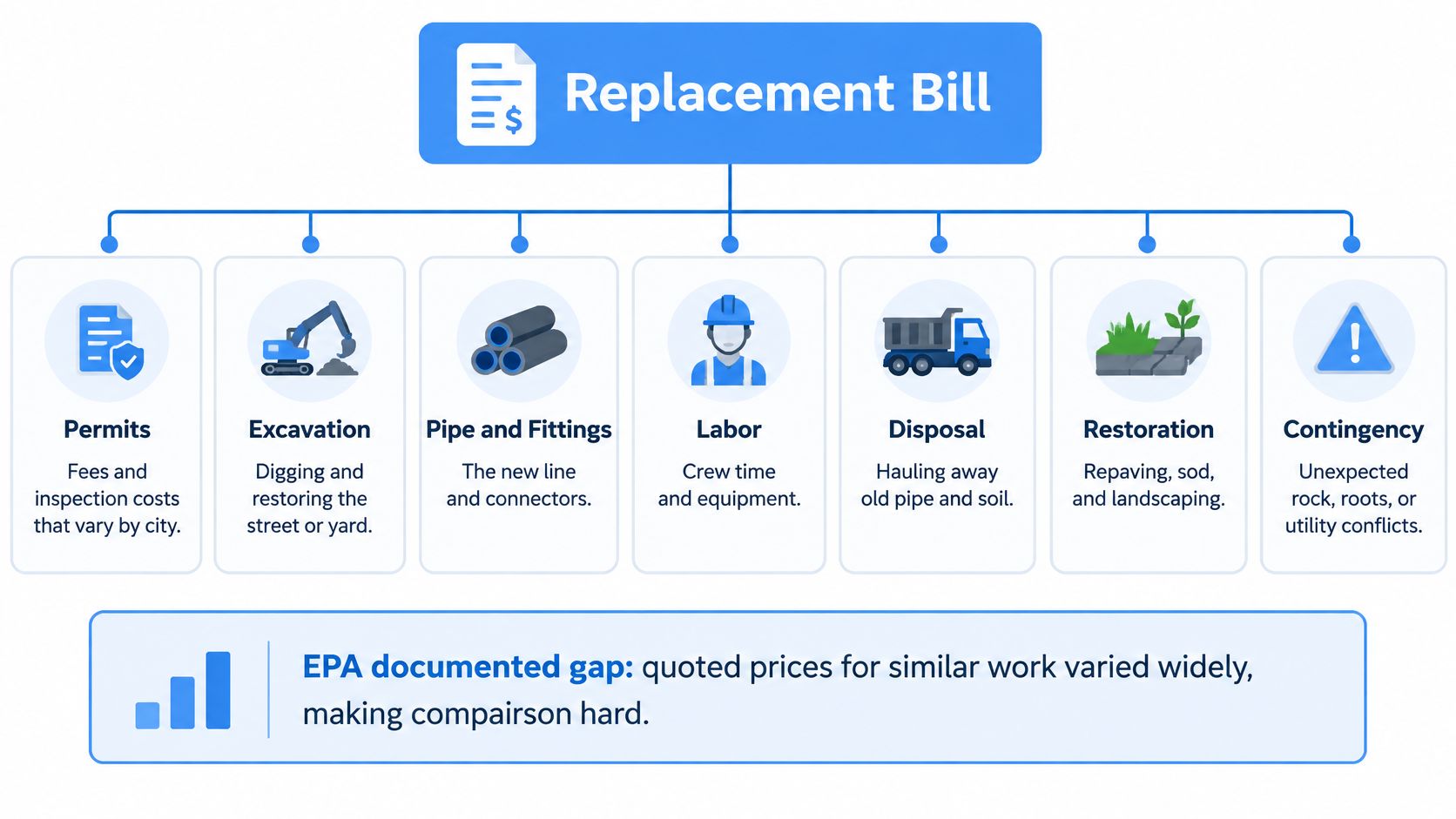
The EPA docketed cost analysis estimated the core utility-and-private-side replacement scope at about $6,154 per line, compared with an average full-replacement cost of about $12,500 when auxiliary costs were included. Those costs may cover engineering and design, project management, inspection, outreach, customer-side access, temporary water, traffic control, testing, restoration, and administration.
Why auxiliary costs dominate some bills
Full-replacement costs vary widely between projects. Scope definition and local construction conditions can drive the spread as much as pipe cost. A line beneath a sidewalk, driveway, road, or planted area may require more restoration and coordination than one in an unpaved verge.
Comparison rule: A quote that does not separate base construction from restoration and auxiliary allowances cannot be compared reliably with one that does.
The line-by-line comparison rule
Ask each contractor to itemize excavation, pipe and fittings, surface restoration, permits, traffic control, temporary water, and interior reconnection. Then identify which amounts are fixed prices and which are allowances. Permit fees, traffic control, and temporary water service may appear without a clear price, so ask whether each is included and how its cost is calculated.
Factors That Move Your Price
Full replacement means the whole line, not the public segment. The EPA's planning guidance for lead service line replacement defines a full replacement as removing or replacing the entire service line, including both the customer-owned portion and the water-system portion, and it states that replacing only the publicly owned segment does not count as a completed replacement. The rule also sets a 10-year replacement window for affected systems unless a state approves a shorter or deferred deadline. That definition changes the budget before a contractor prices anything.
Seven drivers, in order of impact
- Surface above the line. An unpaved verge needs little restoration. A sidewalk, driveway, road, or planted bed adds demolition and repair.
- Depth and access. Deep lines, tight side yards, and obstructions need more excavation and shoring.
- Line length and routing. Longer runs, bends, and crossings add pipe, fittings, and labor.
- Scope boundary. A project that replaces only the public segment leaves the private side untouched and the job incomplete under the federal definition.
- Bundling with other construction. When crews share excavation and pavement work, those expenses spread across a larger project and the per-line cost falls.
- Labor and material escalation. The jump from the 2020 benchmark to the 2023 benchmark shows how quickly a multiyear budget can move.
- Unknown material and local permitting. Once digging starts, a different pipe material or a permit condition can change the scope.
Two identical lines, two very different bills
Say two neighboring properties have lines of the same length. One sits under grass; the other runs under a new concrete driveway. The first needs a trench, backfill, and sod. The second needs saw-cutting, concrete removal, disposal, a new pour, curing time, and probably traffic control. The pipe and fittings might cost the same. The second bill carries restoration and access costs the first never touches.
Field rule: List these seven factors for your property before you request quotes, then note which ones each contractor has already priced.
Who Pays for Each Part of the Line
The homeowner's actual cost is the amount left after utility or program assistance. That figure depends on which part of the line is replaced and on local policy. A Massachusetts estimate reported by WBUR puts the resident-side replacement cost at $3,000 to $8,000.
| Jurisdiction example | Portion covered | Reported owner cost |
|---|---|---|
| Massachusetts water-industry estimate | Resident-side replacement | $3,000 to $8,000 |
| DC Water program | Coverage depends on program rules | Varies by eligibility and scope |
| New York reporting | Coverage depends on local policy | Varies by jurisdiction |
| Municipality covering eligible work | Eligible private-side work | $0 for eligible work |
| Municipality without full coverage | Private-side work | Thousands of dollars, set by local policy |
The three scopes in every quote
Separate the work into three parts before comparing totals. Public-side work sits in the right-of-way and is usually the utility's responsibility. Private-side work runs across the customer's property, where cost-share rules differ. Interior plumbing connects the new line to fixtures and may include replacing lead-bearing components inside the home.
A quote that combines these scopes obscures which costs may qualify for assistance. Municipalities may cover eligible private-side work, while other programs leave some or most of that cost to the property owner. The same replacement can therefore produce different out-of-pocket bills under different local rules.
A higher quote may include private-side excavation, roadway restoration, or permits that the utility does not cover. Ask the utility for a written breakdown of responsibility for each segment, then compare that scope with the contractor's quote before approving the work.
Funding Programs and Whether You Can Access Them
The 2021 Infrastructure Investment and Jobs Act dedicated $15 billion through the Drinking Water State Revolving Fund specifically for lead service line identification and replacement, and 49% of that dedicated funding was structured to reach communities as grants or principal-forgiveness loans, according to the EPA's lead service line funding page. The program was designed to reduce what local governments and qualifying property owners would need to repay.
The application desk is where the funding story gets practical.
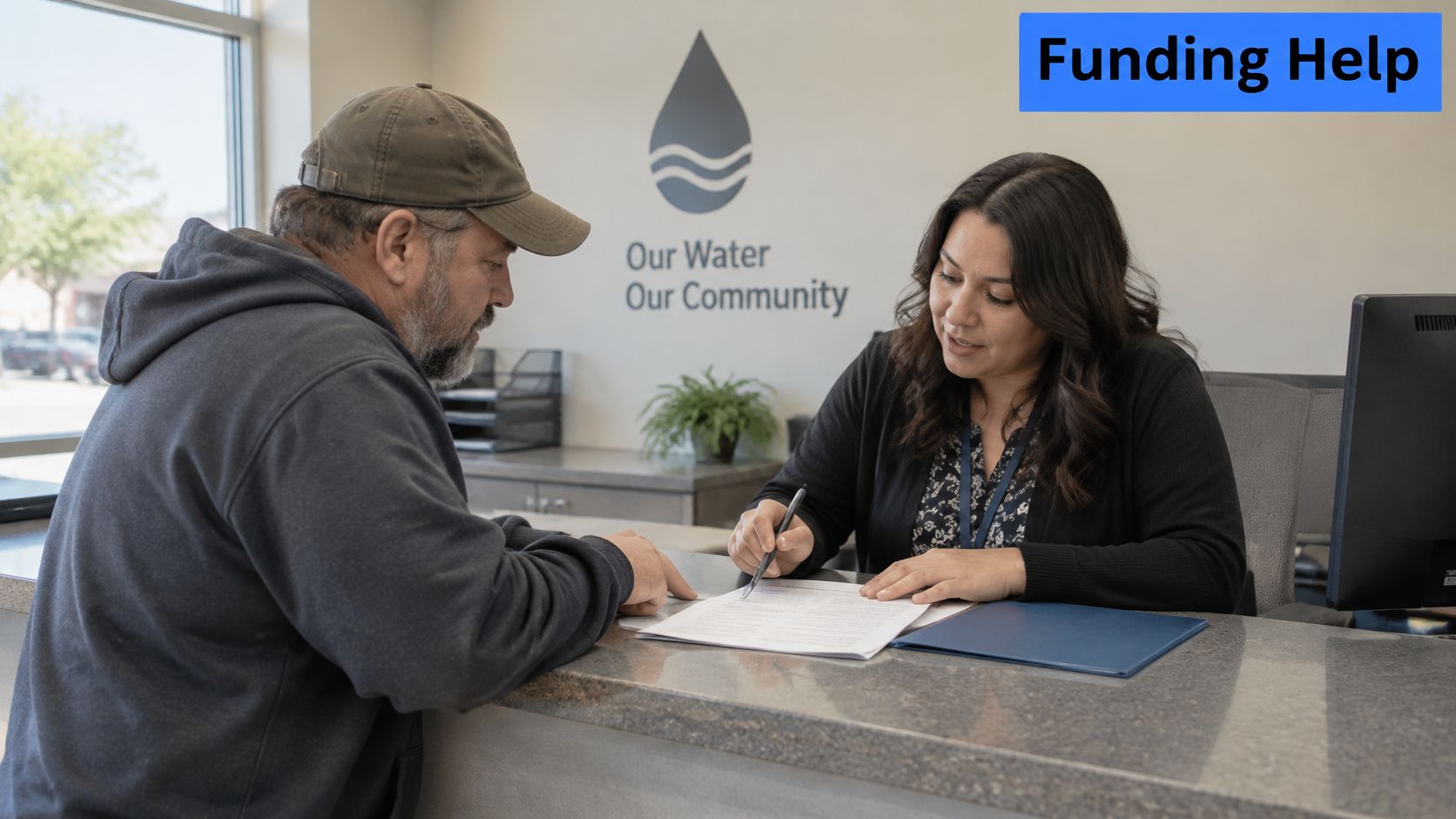
The EPA's FY2025 allocation included $3 billion for lead service line replacement and estimated about 4 million lead or galvanized lines still require replacement nationwide, while Illinois separates inventory grants from replacement funding and EPA's Tribal Pacific Southwest program allows eligible projects from $30,000 to more than $2 million with no matching funds required, according to the EPA FY2025 allotment memorandum. The gap between available funding and accessible funding is where most homeowners get stuck.
A six-step funding screen
- Ask whether the line is in the utility's inventory. If it isn't, the replacement may not be scheduled or eligible yet.
- Confirm which portions the program covers. Public-side only, private-side only, or both.
- Check income or disadvantaged-community criteria. Some programs target eligible households or neighborhoods.
- Ask whether restoration and service reconnection are included. A grant that pays for pipe but not pavement leaves a real bill.
- Ask about application timing and waitlists. Funding cycles matter more than the headline total.
- Do not start unauthorized excavation. In many programs the utility or approved recipient must control the project.
The video below walks through how replacement programs are planned and staged.
The practical question is whether you can hire a contractor now and get reimbursed later. In many programs the answer is no, because the utility or approved recipient controls procurement and the work may be bundled block by block rather than scheduled as an individual emergency job.
How to Get an Accurate Quote Step by Step
Comparable quotes start before a contractor arrives. The sequence below keeps two bids from looking alike when they cover different work.
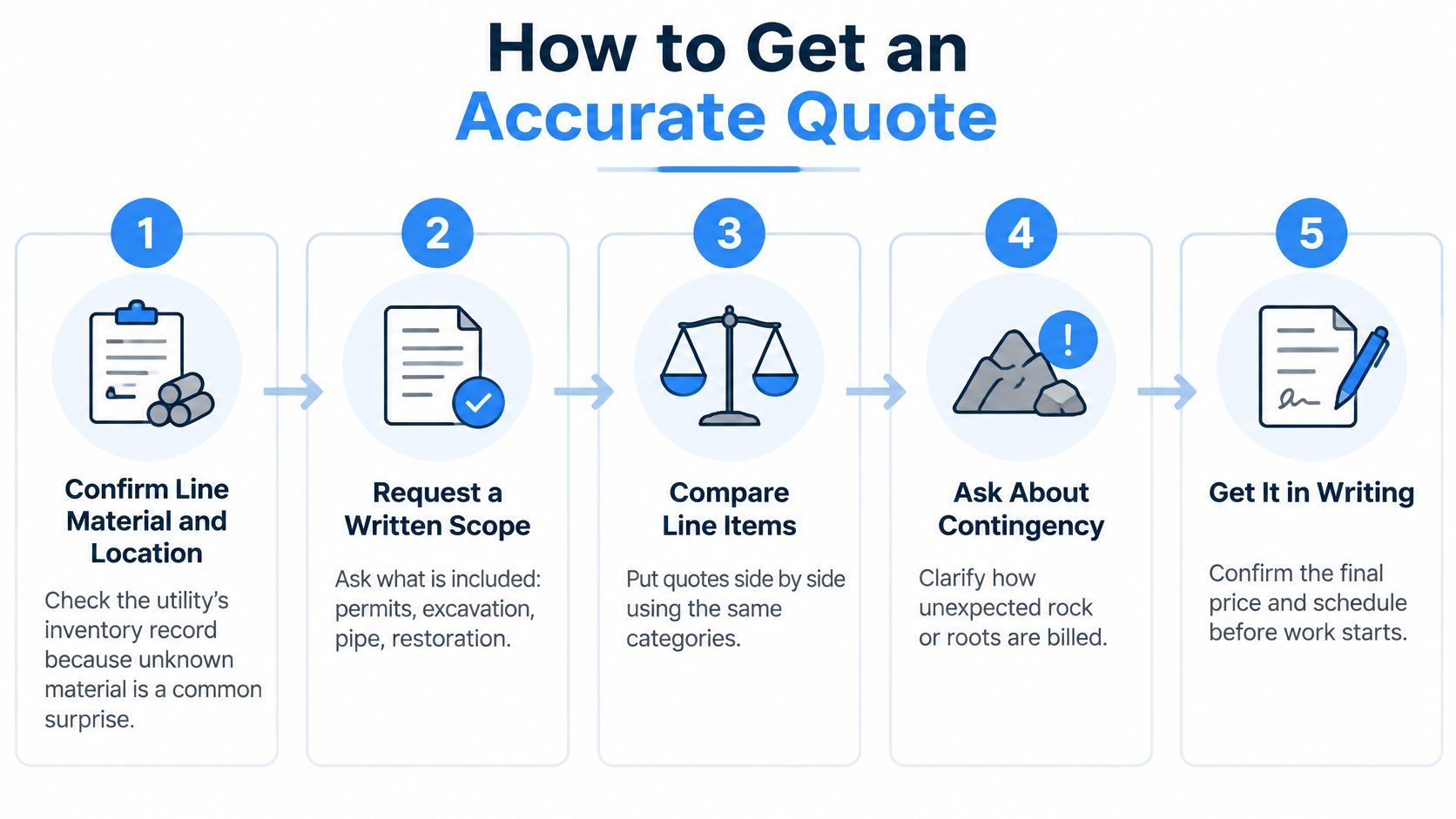
Steps 1 to 4
- Confirm the line material and location. Use the utility's inventory record, because unknown material is a common source of change orders. If the record is missing, test the water before you authorize excavation, and use these lead testing tips from Water Filter Advisor to collect a sample that isn't contaminated by the faucet aerator.
- Ask whether the public side is scheduled and what it covers. The utility may replace its segment on a different timeline, and a private quote that assumes otherwise can leave the job half finished.
- Request separate line items for excavation, pipe and fittings, surface restoration, permits, traffic control, temporary water, and interior reconnection. The common mistake is accepting one total with no scope, which makes comparison impossible.
- Ask whether the price covers both the public and private portions. Replacing only the public segment doesn't complete the work, so a low bid may be pricing an incomplete job.
Steps 5 to 8
- Get the surface type and restoration scope in writing. Name concrete, asphalt, lawn, and landscaping separately, because restoration is where allowances most often turn into change orders.
- Ask for a stated contingency and a change-order rule. Unknown material, difficult access, and utility conflicts are predictable risks, so the quote should say how they'll be priced.
- Compare quotes scope by scope, not by total. A lower bid may exclude restoration or temporary water, which makes it cheaper on paper and more expensive at completion.
- Confirm licensing, insurance, and authorization before anyone digs. Ask for a current state plumbing or contractor license, general liability coverage, workers compensation, and evidence of utility-approved lead-line work. The most common mistake is hiring before the utility approves the project.
Frequently Asked Questions About Hiring a Lead Line Contractor
Can I hire a contractor now and get reimbursed later? Usually no. In most programs the utility or approved recipient must control the project, so confirm authorization before you sign anything.
Does the EPA full-replacement figure cover both sides of the line? Yes. The federal definition treats the customer-owned portion as part of the line, so replacing only the public segment doesn't count as a completed replacement.
Why is my quote higher than the national benchmark? Private-side excavation, roadway restoration, traffic control, and the absence of public funding often explain the gap. A higher number can be the more complete number.
What licensing and insurance should a contractor show? Ask for a current state plumbing or contractor license, general liability insurance, workers compensation coverage, and examples of utility-approved lead-line projects.
Should I accept a verbal estimate? No. Require a written scope with separate line items, a stated contingency, and a rule for pricing change orders.
What if the crew finds unknown or copper pipe mid-job? Ask how the change will be priced and whether the contingency covers it before work begins. The answer belongs in the written scope, not in a conversation after the trench is open.
Confirm Your Share Before You Approve the Work
The amount you owe after utility or program assistance is the figure to confirm before approving replacement. Get a written breakdown of public-side, private-side, and interior costs, along with the assistance applied and your remaining share. That makes it possible to compare bids on the same basis.
The approval sequence
- Request a written cost-share statement for your address. It should identify the line segments covered and the assistance available.
- Collect at least two quotes using the eight-step procedure above. Matching cost categories makes differences between totals easier to explain.
- Compare each quote with the stated homeowner share. Ask for an explanation if any portion of your expected payment is unclear.
- Wait for the utility to confirm authorization before approving work. The project's approval status can affect funding eligibility.
For plumbing contractors, local visibility can help connect the business with homeowners searching for lead service line replacement. Transactional LLC offers local SEO and Google Maps optimization for home service businesses, including plumbing companies. Home service businesses can call +1 866-922-0756 to request a free audit of their service area.
Approve the work once the costs, assistance, and remaining amount are clear.