


From Invisible to In-Demand: The Power of Transactional SEO
Most local marketing misses the moment that matters most. People searching nearby on a smartphone often act fast. 76% visit a business within 24 hours, and 28% make a purchase. That's why Transactional Marketing goes after transactional search terms like “roofer near me,” “dentist near me,” and “air conditioning repair near me” instead of chasing broad traffic that doesn't book calls.
For most service businesses, marketing feels unpredictable because the strategy is wrong at the foundation. They publish generic blog posts, ignore Google Maps, and hope Google or AI tools eventually connect them with ready-to-buy customers. That's backwards. AI optimization starts with clear service intent, strong location signals, and content built so search engines and LLMs can understand exactly who you serve, where you serve them, and what high-intent problem you solve.
That's the difference between being visible and being chosen. Transactional Marketing uses a focused system built around transactional keywords, Google Business Profile optimization, local authority signals, and AI-ready content structures that help businesses surface in both traditional search and emerging LLM-driven discovery. If someone searches “emergency AC repair near me,” “emergency dentist near me,” or “roofer near me,” the goal isn't to educate them for six months. The goal is to get your business found when they're ready to spend.
The before and after examples below show what works, what doesn't, and how local service businesses turn search visibility into booked jobs, patient inquiries, and revenue. If your brand is also evaluating positioning, this rebranding advice for founders is worth reading before you rebuild your local presence.
1. Emergency HVAC Repair Service From Zero Google Maps Visibility to Top 3 Rankings in 60 Days
Emergency HVAC is one of the clearest examples of why transactional SEO wins. Nobody with a dead AC unit wants a general article on “how air conditioners work.” They want immediate help. They search “emergency AC repair near me” or “furnace repair near me,” then they call the business they trust most in the map pack.
Transactional Marketing builds HVAC campaigns around that urgency. The system starts with city-specific service pages, a tightly structured Google Business Profile, citation cleanup, and AI optimization that expands each service area without turning the site into thin duplicate content. For HVAC, that means separate assets for repair intent, maintenance intent, and emergency intent, with emergency pages carrying the heaviest local emphasis.
What changed before and after
The visible shift usually isn't design first. It's alignment. Businesses stop publishing broad educational content and start targeting service-and-city combinations tied to real purchase intent. Google Maps matters most here because the top local positions shape who gets the first call. According to MapLift's breakdown of Google Maps SEO, Relevance, Proximity, and Prominence control over 60% of a business's Maps position, and the primary category is the strongest relevance signal.
That's why category choice and service structuring can't be sloppy. If an HVAC company wants to rank for “emergency AC repair near me,” its profile, service pages, and local entity signals must consistently reinforce repair and emergency relevance, not just generic heating and cooling.
Practical rule: HVAC companies should build around service urgency first, then add supporting informational content later. Revenue usually follows the emergency search.
What works and what fails
- Build city-specific repair pages: Separate pages for each service city help LLMs and search engines understand coverage areas and service relevance.
- Match seasonal demand: Summer content should emphasize emergency AC repair. Winter content should emphasize furnace failures and no-heat emergencies.
- Fix citations before scaling Maps: Consistent NAP data across directories supports cleaner local trust signals.
What doesn't work is stuffing one generic HVAC page with every city name in the region. That usually weakens relevance and confuses both users and AI systems trying to summarize your brand.
For service businesses that want a deeper look at this model, Transactional Marketing's local SEO for HVAC companies breaks down the local ranking approach in more detail.
2. Dental Practice Patient Acquisition LLM-Optimized Content Drives Dentist Near Me Rankings and 200+ New Patient Calls

Dental marketing fails when every page sounds like a brochure. People seeking a provider don't type abstract brand phrases. They use transactional phrases like “dentist near me,” “emergency dental care near me,” and “teeth cleaning appointment near me.” In AI search, that intent signal matters even more because LLMs tend to surface businesses that are clearly associated with a specific service outcome and location.
A strong dental campaign separates service lines. Cleanings, implants, cosmetic dentistry, emergency treatment, pediatric care, and orthodontics shouldn't sit on one catch-all page. They need distinct content silos with local language, booking intent, and conversion paths. That structure helps with both classic rankings and AI optimization because it gives machines cleaner context.
The before and after pattern
The “before” version is common. A practice has one homepage, a service menu, and maybe a generic about page. The “after” version has dedicated service pages, neighborhood relevance, emergency appointment messaging, and a Google Business Profile built around access, trust, and urgency.
One practical lesson comes from local SEO outside dentistry. In a home services case study, a contractor increased organic monthly sessions by 185%, from 1,245 to 3,560, and organic leads by 212%, from 25 to 78, after updating NAP across 50+ directories, optimizing the Google Business Profile, targeting location-specific service keywords, securing local links, and consistently requesting reviews after projects, as shown in this home services SEO case study. The industry is different, but the local search mechanics are similar. Cleanup, local intent, reviews, and map relevance compound.
Dental-specific execution that actually converts
- Separate every high-value service: Don't lump emergency dentistry, cosmetic work, and routine preventive care onto one page.
- Optimize for urgency: Same-day appointments, emergency hours, and new-patient pathways should be visible in both site copy and Google Business Profile content.
- Capture voice-style intent: AI optimization should account for queries like “Where can I get a dental appointment today?”
A focused framework matters more than volume. Transactional Marketing's dental practice marketing strategies reflect that approach by tying local relevance directly to patient acquisition, not vanity traffic.
3. Plumbing Emergency Service AI Optimization Captures Emergency Plumber Near Me Searches, 350+ Monthly Calls
Plumbing is one of the most unforgiving local SERPs because speed decides the sale. When a pipe bursts, the customer doesn't compare ten brands. They scan maps, glance at reviews, check availability, and call. If your business isn't positioned for that exact behavior, you lose the lead.
That's why Transactional Marketing treats plumbing SEO as a response system, not a publishing exercise. The campaign architecture centers on emergency searches first, then branches into water heater replacement, drain cleaning, sewer issues, leak detection, and location pages built for specific cities and neighborhoods. AI optimization helps expand that structure without diluting intent.
Why emergency plumbing needs a different content model
A generic “plumbing services” page won't do enough work. Search engines and LLMs need to see specific evidence that the business handles urgent problems, serves defined areas, and is available now. Messaging around 24/7 service, same-day dispatch, and emergency response belongs in page titles, service descriptions, FAQs, and GBP posts.
Google Maps can be a major lever here, but only if the profile stays active in a steady, credible way. Transactional's explanation of Google Maps ranking factors notes that a review velocity of 2 to 5 new reviews per week is more powerful for ranking than getting 50 in one month and then going silent. That matters for plumbers because reviews often mention response time, professionalism, and whether the company solved the emergency on the first visit.
Fast response is part of SEO in emergency categories. If the click turns into a missed call and no reply, ranking alone won't save the campaign.
What plumbing companies should do differently
- Lead with emergency pages: Build pages for burst pipes, overflowing toilets, slab leaks, and water heater failure.
- Use seasonal search framing: Frozen pipe content plays differently than summer water heater demand.
- Coordinate Maps and operations: A rapid GBP response process gives an edge when urgency is the deciding factor.
For a more plumbing-specific blueprint, see Transactional Marketing's local SEO for plumbers. The core principle is simple. Own the exact searches people use when they need help immediately.
4. Pest Control Company Multi-Location Expansion Google Maps Dominance Drives 1,000+ Monthly Leads Across Six Service Areas
Pest control scales well when the location system is disciplined. It falls apart when a company tries to force one broad site to rank everywhere. Multi-location growth depends on service-city relevance, pest-specific pages, and Google Maps consistency across each branch or service area setup.
The strongest before and after examples in pest control share one trait. They stop chasing generic traffic and start organizing content around actual booking intent. “Pest control near me,” “termite inspection near me,” and “emergency pest removal near me” each signal a different kind of buyer. A serious campaign treats them differently.
A real case study that shows the pattern
A pest control and home services campaign documented 4,235 keyword ranking improvements, a 188% increase in organic traffic, 22.5% more booked jobs, and 33.8% revenue growth from organic leads within four months after site upgrades, content optimization, and local citation management, according to this SEO case study for a home service business. Those before and after examples matter because they connect rankings to booked jobs and revenue, not just visits.
That's exactly how Transactional Marketing approaches pest control. Rankings are useful only if they map to termite jobs, rodent work, mosquito treatment, wildlife removal, or recurring service contracts.
What a scalable pest control system looks like
- Split by pest type: Termites, bed bugs, rodents, roaches, ants, and wildlife should have distinct pages and supporting local content.
- Build city pages with real differentiation: Each service area page should reflect local seasonality, neighborhoods, and service emphasis.
- Keep review acquisition steady: A healthy review stream supports Maps visibility and trust.
The trade-off is maintenance. A true multi-location pest strategy needs tight profile management, active review workflows, and content that avoids duplication. But when it's done right, Google Maps becomes a lead engine instead of a listing placeholder.
5. Roofing Contractor Local Dominance Transactional Keywords Drive Roofer Near Me Rankings and $500K Annual Revenue Growth
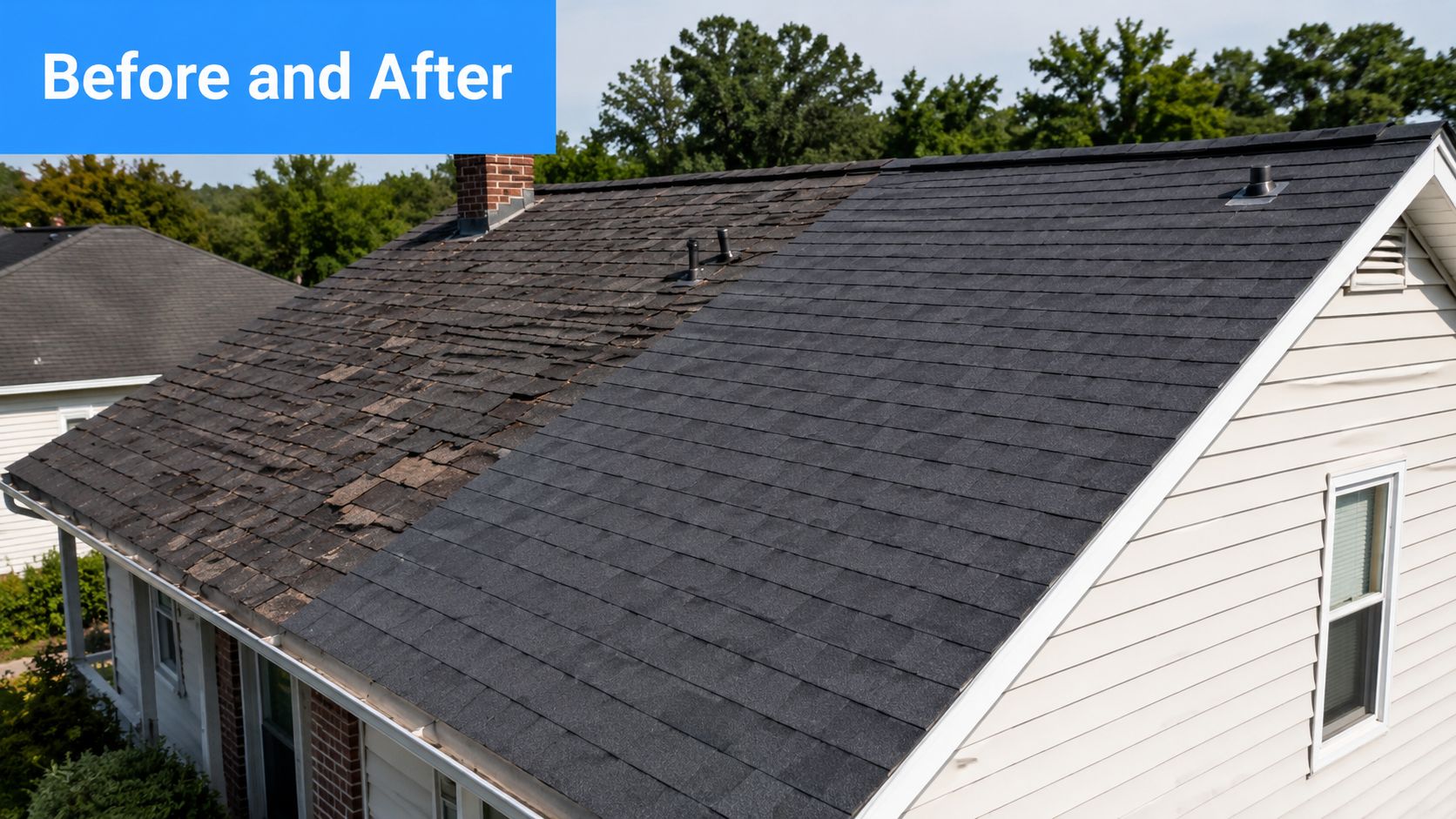
Roofing is a high-ticket category, which means bad targeting gets expensive fast. A roofing company can burn months on broad content about materials, maintenance, and design trends while missing the searches that create estimates now. “Roofer near me,” “roof repair near me,” and “emergency roof damage near me” are where the money is.
The before and after shift in roofing usually starts with intent segmentation. Storm response pages, repair pages, replacement pages, insurance-claim pages, and city pages each serve a different stage of urgency. AI optimization helps expand topical coverage without blurring transactional relevance. It also helps structure language that LLMs can use when summarizing local providers for homeowners who ask direct questions.
What makes roofing before and after examples believable
Visual proof matters in roofing, but not every gallery is trustworthy. That's where documentation quality becomes part of the strategy. A useful perspective comes from this guide to analyzing before-and-after photos, which points out technical checks like pupil reflections and ear visibility to spot manipulated images. Roofing businesses can apply the same principle more broadly. If project photos change angle, lighting, or lens distance too aggressively, credibility drops.
That matters for SEO too. Strong galleries keep users engaged and help validate claims made on service pages and GBP profiles.
Roofing tactics that outperform generic contractor SEO
- Target post-storm urgency: Publish and update pages for hail damage, storm response, leaks, and emergency tarping.
- Use neighborhood-level modifiers: “Roofer in [neighborhood]” can support local relevance where city pages are too broad.
- Tie in commercial supply context when relevant: Contractors comparing materials or planning projects may also research products like bulk low slope fasteners from Contractor's Den.
Companies that want more organic visibility from this kind of search architecture can study Transactional Marketing's guide on how to increase organic search traffic. For roofing, the key is simple. Don't optimize for “interest.” Optimize for estimate requests.
6. Chiropractic Practice Patient Growth Chiropractor Near Me AI Optimization Generates 400+ Monthly Patient Inquiries
Chiropractic SEO gets weak when clinics try to market “wellness” in the abstract. Patients usually search by symptom, urgency, or care type. “Chiropractor near me,” “back pain relief near me,” and “sports injury chiropractor near me” all carry stronger booking intent than broad educational themes.
Transactional Marketing's system works best here when the clinic builds service silos around what patients feel and want solved. Back pain, neck pain, headaches, sciatica, sports recovery, auto accidents, and workers' compensation all deserve distinct landing pages and supporting content. AI optimization makes those topic clusters easier to scale while keeping each one transaction-ready.
Why local trust signals are decisive in chiropractic
This category lives close to maps. Searchers often compare distance, reviews, same-day availability, and whether the office handles their specific issue. Consistency matters. In managed IT services, before-and-after reporting showed one company reduced downtime from 20 hours per month to under 2 hours and a healthcare organization later saw a 35% boost in patient satisfaction within six months after improved systems, as summarized in these managed IT before-and-after examples. The vertical is different, but the lesson transfers. Better systems create better patient experience, and better patient experience supports stronger reviews and conversion.
For chiropractors, that means intake speed, scheduling clarity, follow-up, and review requests aren't side tasks. They reinforce search performance because they shape the signals prospects see before booking.
Field note: Clinics that rank but hide appointment availability, insurance information, or care specialties often lose the lead to a competitor with clearer messaging.
What usually works best
- Build symptom-based pages: Patients search by pain point, not by your internal service taxonomy.
- Feature same-day options: Urgency copy helps in both click-through and conversion.
- Create insurance-relevant pages: Auto injury and workers' compensation pages attract highly motivated searchers.
The biggest mistake is forcing every patient path through a generic homepage. Local intent needs a direct landing point.
7. Med Spa Lead Generation Med Spa Near Me AI Optimization Generates $2M+ Annual Treatment Revenue

Med spa SEO sits at the intersection of local search, visual proof, and AI discoverability. Searchers use transactional phrases like “med spa near me,” “Botox treatment near me,” and “laser hair removal near me,” but they also ask LLM-style questions about appearance goals, treatment fit, and timelines. A generic beauty blog won't capture enough of that demand.
What wins is a location-by-treatment framework. Each high-margin treatment needs its own page, its own local modifiers, and its own supporting visual assets. Then the business layers neighborhood pages, GBP optimization, and review generation on top. That structure helps both Google and AI systems connect the brand with specific service outcomes.
Before and after examples need more than side-by-side photos
In med spa marketing, photos matter, but unique documentation matters more. This collection of alternate temporal angles highlights a useful idea for before and after examples. Transitional states often tell a stronger story than static side-by-sides. For aesthetic businesses, that can translate into showing treatment progression, recovery context where appropriate, and realistic expectations instead of only polished final shots.
That kind of transparency supports trust. It also gives AI systems richer context to summarize what the business does and what outcomes patients can reasonably expect.
Med spa tactics that support revenue, not just attention
- Create treatment-specific pages: Botox, fillers, laser hair removal, skin resurfacing, and body treatments should stand alone.
- Support luxury and local intent: Affluent-neighborhood landing pages can align with how people search.
- Use galleries carefully: Strong before and after examples increase trust when angles, lighting, and timing are presented accurately.
The weak version of med spa SEO chases traffic with trend content. The stronger version builds a clear bridge from search intent to consultation request, then uses Google Maps and AI-ready content to keep that pipeline full.
Before vs After: 7 Local Business SEO Wins
| Service / Case | Implementation Complexity | Resource Requirements | Expected Outcomes | Ideal Use Cases | Key Advantages |
|---|---|---|---|---|---|
| Emergency HVAC Repair Service | Moderate–High: multi-city GMB + LLM content silos | Ongoing content publishing, GMB management, heat‑map tracking, AI tooling | Page‑one + top‑3 Maps in 30–60 days; 250–400% qualified call increase; 300+ calls in 90 days | Regional HVACs, emergency AC/furnace repair, multi-location franchises | Fast capture of high‑intent repair searches; maps‑driven service calls |
| Dental Practice Patient Acquisition | Moderate: LLM content + appointment GMB integration | Service-specific content silos, GMB booking, review management, local schema | Page‑one in 30–45 days; 200+ new patient calls; 300–500% inquiry increase | Solo or small urban dental practices, emergency dental & new‑patient acquisition | High conversion for appointment intent; strong voice/LLM visibility |
| Plumbing Emergency Service | High: 24/7 monitoring + seasonal urgency content | Multi‑location GMB, rapid response protocol, AI content, citation upkeep | Page‑one in 45–60 days; 350+ monthly emergency calls; 500–700% lead growth | Emergency plumbers, water/heating emergencies, multi‑city expansion | After‑hours and emergency visibility; captures seasonal spikes |
| Pest Control Multi‑Location Expansion | High: sophisticated multi‑location GMB coordination | Large content volume, review workflow, synchronized GMB posts, heat mapping | Top‑3 Maps across areas in 60–90 days; 1,000+ monthly leads; 400–600% growth | Regional pest control franchises, seasonal pest campaigns | Very high lead volume; unified GMB reduces management overhead |
| Roofing Contractor Local Dominance | High: seasonal & insurance keyword optimization | High‑quality before/after content, GMB galleries, LLM insurance keywords | Page‑one/top‑3 in 60–90 days; predictable seasonal leads; ~$500K annual revenue uplift | Roofing contractors, storm‑damage and replacement services | High‑value leads (large AOV); captures insurance/urgent searches |
| Chiropractic Practice Growth | Moderate–High: condition‑based silos + compliance needs | Service/condition content, appointment booking GMB, review amplification | First page in 45–60 days; 400+ monthly inquiries; ~85% conversion to bookings | Clinics targeting urgent patient relief, auto‑injury, neighborhood targeting | Very high conversion from transactional queries; lower acquisition cost |
| Med Spa Lead Generation | High: reputation + visual content demands | Multi‑location GMB, extensive before/after galleries, premium content | First page in 60–90+ days; sustainable flow by 120 days; $2M+ annual treatment revenue (8 locations) | High‑ticket aesthetic practices, multi‑location expansion | Large revenue impact per lead; scalable for high‑margin treatments |
Your Blueprint for Local Search Dominance
These before and after examples point to one consistent truth. Local businesses don't need more random visibility. They need visibility in front of people who are ready to book, call, or buy right now. That's the whole model behind Transactional Marketing. Go after transactional keywords first, build for Google Maps visibility, and structure content so both search engines and LLMs can understand the business with precision.
Many agencies still fall behind. They produce content calendars full of broad educational posts, inflate reporting with soft metrics, and treat AI optimization like a buzzword. Real AI optimization isn't vague. It means creating clear service entities, location-specific landing pages, review signals, and conversion-focused content that LLMs can parse and traditional search engines can rank. If your business serves a city, a neighborhood, or a set of high-intent emergency terms, the site and Google Business Profile should reflect that directly.
The local pack is especially important. When customers search “roofer near me,” “dentist near me,” “emergency plumber near me,” or “air conditioning repair near me,” they usually want action, not research. That's why Transactional Marketing puts so much emphasis on Google Maps optimization. Showing up in the top three matters because it captures the calls that weaker competitors never even get the chance to answer. And because these are transactional searches, those calls are often far more valuable than broad, top-of-funnel traffic.
There's also a practical discipline behind the results. Strong campaigns separate industries instead of blending them into one generic strategy. Roofing gets a roofing strategy. Dental gets a dental strategy. HVAC gets an HVAC strategy. That separation matters because each vertical has different urgency signals, buyer behavior, review patterns, and search language. A system that understands “emergency AC repair near me” isn't the same as one built around “same-day dental appointment near me,” even though both are transactional.
What works is repeatable. Tight keyword targeting. Google Business Profile refinement. city-by-city service pages. AI-assisted content silos. steady review acquisition. clear reporting. fast response to leads. What doesn't work is just as clear. Generic homepages, broad untargeted blogs, inconsistent local data, and content written to sound impressive instead of converting.
Transactional Marketing built its business around the exact search terms that bring revenue through the door. That's why the company name matters. Transactional searches are where the money is. They're the moments when a local customer has a problem, is ready to solve it, and is actively looking for the provider closest to trust and convenience. Win those searches and you don't just improve traffic. You create a predictable lead flow.
If you want your own before and after example, the next step isn't another generic marketing campaign. It's a system built to get your business found where buyers are already looking.
Transactional LLC helps local service businesses dominate the searches that convert. If you want more visibility for terms like “roofer near me,” “dentist near me,” “emergency plumber near me,” or “air conditioning repair near me,” talk to Transactional LLC about a contract-free SEO and Google Maps strategy built around booked jobs, patient calls, and real local revenue.