

When you type "best SEO company near me" into Google, you're not just looking for a vendor. You're looking for a partner who gets that rankings are meaningless unless they make your phone ring. The right agency understands the mission is to turn your website into a lead-generating asset, not just a pretty online brochure.
They do this by focusing on one thing: high-intent, transactional search terms. At Transactional Marketing, that's our entire philosophy and the reason for our name. We get your business to show up for the exact searches your customers are making when they have money in hand, ready to spend.
Why Your Search Is About More Than Just Rankings
Think about how your own customers search. They aren't looking up "history of plumbing" when their basement is flooding. They’re frantically searching for an "emergency plumber near me" or "air conditioning repair near me."
These are what we call transactional search terms. They signal that a customer has a problem right now and is ready to pay to solve it. This is precisely what Transactional Marketing goes after for our clients.
We don't chase vanity metrics. We focus on getting your business in front of people who are ready to make a buying decision, targeting the specific, high-value keywords that drive immediate business.
The Power of Local Intent
The "near me" part of a search is a massive indicator of commercial intent. It's not just a trend; it's a fundamental shift in how people find local services.
Projections show that by 2026, over 1.5 billion searches each month will include the phrase "near me." That's a huge audience of local customers actively looking for what you offer. This movement has been fueled by a staggering 900% growth in "near me" and "close by" type queries in just a couple of years.
For local service businesses, this is everything.
- A massive 46% of all Google searches are for local information.
- An incredible 76% of people who look for something nearby on their smartphone end up visiting a business within a day.
- Local searches are famously effective, with some reports showing an 80% conversion rate.
Your goal shouldn't be just to "be found online." It's to be found by the right people at the exact moment they need you. The best SEO company isn't the one promising the moon—it's the one that delivers paying customers by targeting transactional search terms.
Transactional vs. Informational Search Breakdown
Here's a quick comparison to understand the high-value keywords a local SEO strategy must target. This is the core of what we do at Transactional Marketing.
| Search Type | Example Query | Customer Intent | Business Value |
|---|---|---|---|
| Transactional | "emergency roofer dallas" | I have a leak and need it fixed now. | High. Leads to immediate calls and jobs. |
| Informational | "how much does a new roof cost" | I'm in the research phase, budgeting. | Medium. Potential future customer, but not urgent. |
| Transactional | "air conditioning repair near me" | My AC is broken and I need an expert. | High. Ready to hire a qualified technician. |
| Informational | "diy ac maintenance tips" | I want to try and fix it myself first. | Low. Unlikely to convert into a paid job. |
Targeting transactional queries is what separates a cost from an investment.
Dominating the Google Maps Pack
A huge part of winning with transactional searches is owning the Google Maps pack. That's the box with the top three local listings you see for searches like "dentist near me." For local success, showing up there is non-negotiable.
This prime digital real estate can translate into hundreds of more phone calls every month and literally thousands more every year.
Transactional Marketing has the technology and proven system to get our clients into the top three of the Google Maps pack. We laser-focus on aligning your website and Google Business Profile to appear on page one, often within the first 30 to 60 days. Our process is built to turn those high-intent local searches into real, profitable jobs for your business.
If you're curious about the nuts and bolts of the work involved, our guide on what SEO companies actually do breaks down the specific tasks.
Diving Into an Agency's Core Strategy
Once you start talking with a potential SEO partner, your job is to get past the slick sales presentation and see the engine under the hood. A solid local SEO plan is never a cookie-cutter template. It's a custom-built machine designed for your industry and your specific service area. The real goal isn't just ranking—it's ranking for the searches that make your phone ring and fill your appointment book.
The right SEO company for you will lay out a clear, logical plan that’s all about high-value, transactional keywords. These are the "money terms"—the exact phrases customers type in when they're ready to open their wallets. Think "air conditioning repair near me" or "emergency roofer in [Your City]." This is the entire philosophy behind our name, Transactional Marketing; we focus on getting you found for the transactional search terms that lead to sales.
Are They Targeting Real Customers or Just Traffic?
This is where the rubber meets the road. A critical part of your evaluation is seeing if they truly understand what is search intent in SEO. This concept drives every single thing that works in modern SEO. I've seen countless agencies build beautiful websites that are nothing more than digital brochures—they look great but do a terrible job of capturing people who are actively trying to spend money.
A winning strategy needs to show you exactly how they plan to connect with these high-intent users. You should be looking for a plan that prioritizes:
- Google Maps Optimization: Your Google Business Profile isn't just a listing; it's the heart of local visibility. A meticulously optimized profile is non-negotiable for getting you into the coveted top 3 of the Google Maps pack. This is a core service at Transactional Marketing.
- Smart Local Citation Building: This is about more than just getting your name out there. It’s about making sure your business name, address, and phone number (NAP) are perfectly consistent across the online directories that matter, which builds tremendous trust with Google.
- Laser-Focused On-Page SEO: Every single page on your website needs a job. Each one should be built to capture specific transactional searches for the services you offer.
Here’s a piece of advice from my years in this business: if an agency ever promises you "guaranteed #1 rankings," walk away. No one can ethically guarantee a specific spot on Google. A trustworthy partner guarantees a proven process and a strategy obsessed with one thing: getting your business found for transactional searches that lead to measurable growth.
Getting Granular with Content for Your Services and Location
A generic, one-size-fits-all content strategy is a waste of money. The game plan for a dental practice in Dallas is completely different from the one for a roofing company in Denver. A truly effective agency will create dedicated blog posts and pages for each individual service you offer. For example, SEO for a roofing company is one article, and SEO for a dental business is a completely separate one.
If you're a plumber who works in three different towns, a smart agency won't just build a single "services" page. They’ll propose creating separate, highly optimized pages like:
- "Emergency Plumbing in Town A"
- "Water Heater Repair in Town B"
- "Drain Cleaning Services in Town C"
This hyper-local, service-specific approach signals to Google that you are the authority for those exact services in those exact locations. It’s this meticulous level of detail that separates the agencies that deliver real results. At Transactional Marketing, this granular focus is how our proven system gets clients showing up on page one of Google, typically within just 30 to 60 days.
If you want to work with a partner that lives and breathes these kinds of precise, revenue-focused strategies, you can see more about our approach as an SEO optimization company that puts your bottom line first.
Testing Their Google Maps Expertise
For a local service business, Google Maps isn't just a feature—it's your digital storefront. It’s the first place a potential customer, cash in hand, is going to look when they make a transactional search like "roofer near me."
Landing a spot in the coveted Google Maps "Map Pack" isn't a bonus; it's essential for getting a steady stream of high-quality leads. This is why you must vet an agency’s Google Maps optimization skills. At Transactional Marketing, we have the technology to get businesses into those top three spots, which translates into hundreds of more phone calls every month. A top-tier agency will have a battle-tested system for getting clients there and keeping them there.
Verifying Real-World Map Pack Performance
Don't just listen to their sales pitch—make them prove it. Ask for a list of current clients, preferably in service industries similar to yours.
Now, it’s time to do some digging. Open an incognito browser window (this prevents your personal search history from influencing the results) and start searching for the transactional search terms their clients should be ranking for.
For instance, if they represent a dentist in Dallas, your search list might look like this:
- "dentist near me" (after setting your browser location to Dallas)
- "emergency dentist Dallas"
- "cosmetic dentistry Dallas TX"
What you're looking for is consistency. Seeing a client pop up for one obscure keyword doesn't mean much. You want to see their clients consistently showing up in the top three map results for multiple high-value, transactional search terms. That's the real proof of a strategy that gets results.
This simple validation process reflects the core components of any successful SEO campaign.
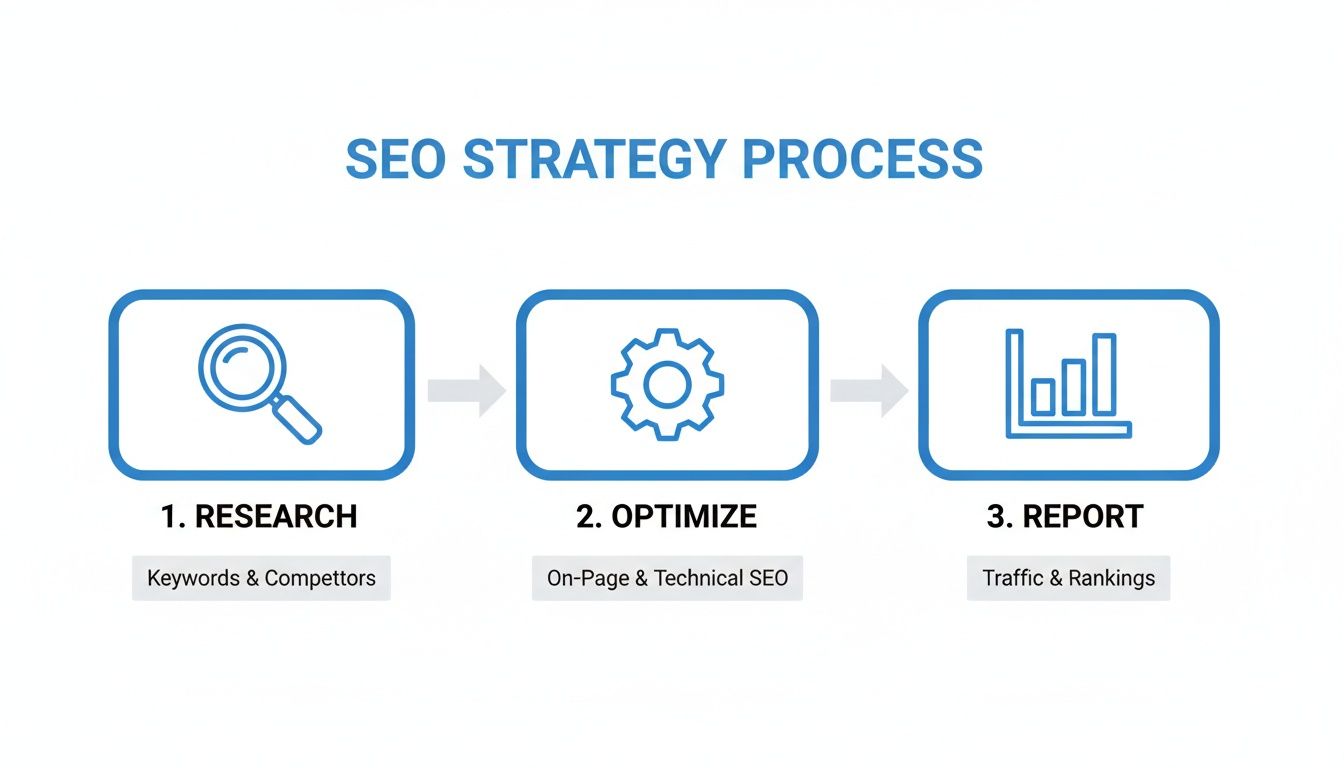
As you can see, strong rankings don't happen by accident. They're the end product of diligent research and meticulous optimization.
Go a step further and click through to their clients' Google Business Profile (GBP) listings. Are they actually optimized? Look for recent, high-quality photos, a consistent flow of new and positive reviews, and fully filled-out business information. An active, well-managed GBP sends powerful signals to Google and is a clear indicator the agency is on top of its game. For a deeper dive, check out our guide on how to rank higher on Google Maps.
You really can't overstate how important this visibility is. Studies show that 86% of people rely on Google Maps to find local businesses. And with AI-powered search results on the rise, the fight for those top spots is getting more intense. An analysis from Places Scout found that AI local packs are now showing up in 14% of reports but feature only 32% as many businesses as the traditional 3-packs. This shrinking real estate makes expert optimization more critical than ever.
When an agency can show you client after client dominating the map pack for valuable transactional terms, you're not just looking at good SEO. You're looking at a system built to generate predictable revenue. That is the ultimate test of a great local SEO partner.
Asking the Right Questions to Find Your Partner
Once you have a shortlist of agencies, it's time for the interview. This is where you cut through the sales pitch and get a real look at how they operate. The questions you ask here are critical—they'll separate the agencies with a proven system from the ones with a slick presentation.
Your main goal is to find a partner who is transparent and can back up their claims with a repeatable process. You need to be absolutely sure they're focused on what truly matters: getting your business found for the specific, transactional searches that actually bring in paying customers.
Uncovering Their Strategic Approach
First, you need to understand how they think. A good agency will be able to draw a clear line from their proposed strategy directly to your business goals. If you get vague, cookie-cutter answers, consider it a major red flag.
You can learn a lot by digging into their strategy with questions like these:
How do you find the most valuable transactional keywords for a business like mine, in my specific service area? A solid answer will cover competitive analysis, digging into local search data, and a clear focus on transactional phrases. They should mention terms like "air conditioning repair near me," not just "HVAC services."
Walk me through your process for getting a new client to rank on page one. What's a realistic timeline? You're listening for a detailed, step-by-step approach. Here at Transactional Marketing, our proven system is built to achieve page-one visibility for core terms, often within 30 to 60 days, because we laser-focus on specific keywords in the cities where you actually do business.
Can you explain how you would structure our website content to target our industry specifically? The right answer involves creating separate, dedicated blog posts and pages for each service and industry. A generic, one-size-fits-all strategy simply doesn't work for local businesses and shows a lack of real-world experience.
A confident, data-backed answer shows a deep understanding of local search. An evasive or generic response suggests they don't have a defined, effective system. This is where you separate the true experts from the amateurs.
Evaluating Their Technical and Local Expertise
Next, it's time to test their technical knowledge, especially around the most important part of local SEO: Google Maps optimization. Dominating the map pack is what turns online searches into a flood of new phone calls every month.
Probe their technical skills with a few pointed questions:
What specific tools do you use to track Google Maps rankings across different neighborhoods in our service area? A top-tier agency uses sophisticated tools to monitor map performance grid-by-grid, not just by plugging your address into Google. This is how we ensure our clients grab and hold those coveted top-three spots.
How do you measure the success of a Google Business Profile optimization campaign? A great answer goes way beyond just rankings. They should be talking about tracking phone calls, requests for driving directions, website clicks, and messages—all coming directly from your GBP listing. Those are the metrics that prove their work is generating real customer activity.
To help you get the most out of these conversations, I've put together a checklist of questions. Think of this as your interview cheat sheet. It covers the key areas you need to investigate to make a confident decision.
Essential SEO Agency Interview Questions
Use this table to guide your interviews. A good potential partner will have clear, confident answers, while a poor fit will likely stumble or give vague responses to these very specific questions.
| Question Category | Sample Question | What to Listen For (Green Flag) | Warning Sign (Red Flag) |
|---|---|---|---|
| Strategy & Keywords | "How will you determine which keywords will drive actual phone calls for my business?" | They talk about analyzing search intent and focusing on high-value "transactional" search terms (e.g., "roofer near me," "dentist near me"). | They focus on broad, high-volume keywords that sound impressive but don't lead to sales (e.g., "roofing tips"). |
| Local SEO & GMB | "What's your strategy for getting us into the Google Maps 3-pack for our most important services?" | A detailed plan involving Google Maps optimization, local citations, getting reviews, and building location-specific content on your website. | A vague answer like "We'll optimize your GMB" without specifics, or they guarantee a #1 spot (which no one can). |
| Technical SEO | "How do you handle the technical side of SEO, like site speed and mobile-friendliness?" | They mention specific tools (Google PageSpeed Insights, GTmetrix) and have a clear process for technical audits and implementation. | They dismiss technical SEO as unimportant or can't explain their process for fixing issues. |
| Reporting & KPIs | "What metrics will you report on, and how often will we see them?" | A focus on business outcomes: phone calls from transactional searches, form submissions, GMB actions, and keyword ranking improvements. They offer a clear reporting schedule (e.g., monthly). | They focus on "vanity metrics" like traffic or impressions without tying them to leads. Reports are inconsistent or confusing. |
| Client Communication | "Who will be my main point of contact, and what's your typical response time?" | You'll have a dedicated account manager or point of contact. They have a clear policy on communication (e.g., "within 24 business hours"). | You can't get a straight answer, or it seems like you'll be passed around a generic support desk. |
| Past Performance | "Can you share a case study or example of a local service business you've helped and the results you achieved?" | They provide specific, verifiable examples of clients in similar industries and can clearly explain the results they generated (e.g., "increased leads by 75%"). | They are cagey about past clients, citing NDAs for everyone, or provide vague, unverifiable success stories. |
Asking these targeted questions is the single best way to vet any agency. It empowers you to find a partner who truly understands how to turn transactional searches into a steady stream of paying customers for your business.
Is Your Potential Agency Ready for AI Search?
The way your customers find you is changing, and it's changing fast. With AI-powered search and Large Language Models (LLMs), the old rules of local visibility are being rewritten. This isn't some far-off future—it's happening right now. AI optimization is the new way businesses will be found.
When someone asks an AI assistant for "the best roofer near me," the answer isn't just a simple list. It’s a synthesized response pulled from a mountain of data: your website's content, your Google Business Profile signals, online reviews, and mentions from all over the web. How businesses are found in these LLM results is a key part of modern marketing.
If an agency isn't talking about how to optimize for this, they're already behind. They’re preparing you for a search world that's on its way out.
The New Essentials for AI Visibility
To get your business featured in these new AI-driven results, a few core elements have become absolutely critical. Any SEO partner you consider must have a concrete plan to strengthen these signals. This is the foundation that gets your business recommended by both traditional search engines and AI assistants.
A truly forward-thinking strategy will prioritize:
- Highly Structured Data: Think of this as a detailed "cheat sheet" about your business for search engines. It clearly labels your services, service areas, hours, and contact info so AI can understand and trust it instantly.
- Authoritative and Specific Content: Vague service pages just don't cut it anymore. Your website needs to become the go-to source for your services in your local market by directly answering the specific questions your customers are asking.
- Dominant Google Business Profile Signals: A powerful GBP, packed with recent reviews, photos, and an active Q&A section, is a massive trust signal for AI. It proves you're a real, active, and respected local business.
If an agency's proposal looks identical to one from three years ago, they aren't ready for this shift. The best SEO company near you will build a strategy for both today's search results and tomorrow's AI-powered conversations.
Verifying a Future-Proof Approach
Finding the 'best SEO company near me' is tough, but the data reveals what separates the real experts from the rest. Recent analyses of top-performing local SEO firms show that the best excel in Google Business Profile management, building content authority, and proving expertise.
This is the level of focus you should demand.
At Transactional Marketing, our entire system is built around winning high-value transactional search terms—whether someone types them into a search bar or speaks them to an AI. We build your online presence to be the undeniable answer when a customer is ready to spend money. A forward-thinking SEO and AI optimization strategy is the single most effective way to lower your customer acquisition costs over the long run. To dive deeper, check out our guide on how to reduce customer acquisition cost.
Answering Your Top Questions About Choosing an SEO Company
Deciding to bring on an SEO partner is a big move for your business. It's smart to have questions about how it all works, what it costs, and what you can realistically expect. I get these questions all the time, so let's tackle the most common ones head-on.
How Much Should a Small Business Pay for Local SEO?
Honestly, the cost can be all over the map. It really depends on how competitive your local market is and what you're trying to achieve. But here's the thing: a good agency will give you straightforward pricing tied to things you can actually see and understand.
Instead of getting hung up on the monthly price tag, think about the potential return. A solid local SEO strategy that brings in just a few transactional leads a month—think someone searching "emergency plumber near me"—can pay for itself many times over. It stops being an expense and starts becoming a machine that generates profit.
How Long Until I Actually See Results?
Look, anyone promising you'll be on page one overnight is selling you snake oil. While we can get the basic groundwork done pretty fast, seeing real, meaningful results—like showing up in the Google Maps pack for your most profitable services—usually takes about three to six months of steady work.
A trustworthy partner, like we are at Transactional Marketing, will be upfront about this. Our proven system is not like every other boring marketing company; we know how to laser focus and get clients showing up on page one of Google, typically within 30 to 60 days for the exact transactional search terms their customers use.
What’s the Big Deal About Local SEO vs. Regular SEO?
This is a critical distinction, especially for a local service business. General SEO is all about ranking nationally or even globally. That's great if you're running an e-commerce store or a blog, but it does very little for a roofer in Dallas.
Local SEO is hyper-focused on one thing: getting your business found by people in your area who are ready to buy. These are the "near me" searches. It's a completely different ballgame that relies heavily on:
- Google Maps Optimization: This is your ticket to getting featured in the Google Maps pack, where the real action is.
- Local Citation Management: We make sure your business name, address, and phone number are consistent and accurate everywhere online.
- Location-Specific Reviews: Getting real reviews from local customers builds massive trust with both Google and the people looking to hire you.
The entire point of local SEO is to own the map pack and the top organic spots for the high-intent, transactional searches happening right in your local cities, right where your customers are. That's how you connect with customers who are literally ready to hand you their money.
Is My Business Ready for AI Search?
With AI and tools like ChatGPT changing how people find information, just ranking for a list of keywords isn't going to cut it for much longer. Any agency worth its salt must focus on SEO and AI optimization.
They should understand how to use new SEO AI tools and, more importantly, how to build your online presence so that AI assistants and LLMs will see you as a trusted, authoritative choice to recommend. If an agency isn't talking about optimizing for AI, they're preparing you for a version of search that's already on its way out. Your SEO partner needs a plan for where search is going, not just where it is today.
Ready to stop being invisible online and start dominating the local searches that actually drive business? At Transactional Marketing, we specialize in getting our clients found for the high-value, transactional search terms that make the phone ring. Our proven system can get your website showing up on page one, often within 30-60 days.