


Most service businesses hit the same wall. Paid ads get more expensive, referrals come in waves, and SEO feels like it takes forever. Meanwhile, the calls you want most come from people searching terms like roofer near me, emergency dentist near me, or same day dental crown. Those are transactional searches. The buyer already wants help and is ready to act.
That's why business referral networks still matter. Not as some old-school side tactic, but as a force multiplier for local SEO, Google Maps visibility, and now AI-driven discovery. A strong referral partner doesn't just send you a lead. They can strengthen your brand mentions, drive review velocity, create partnership content, and help your business look more trusted in the exact local market where you want to rank.
If you run a roofing company or dental practice, this matters more than ever. The businesses that win local search usually aren't doing one thing well. They're stacking trust signals from multiple directions, offline and online, so Google Maps, organic search, and AI search systems all reach the same conclusion. This company is the local answer.
Why Referral Networks Are Your Secret SEO Weapon
A homeowner gets a roofer's name from an insurance adjuster after a storm. Ten minutes later, they search that company on Google, scan the reviews, tap the Google Business Profile, and compare it against two other roofers in the map pack. A dental patient does the same thing after a pediatrician or orthodontist makes a recommendation. The referral opens the door. Local search decides who gets the call.
That is why referral networking belongs inside your SEO strategy, not beside it. Offline trust changes online behavior in ways that matter for transactional search terms. People search your brand name, click your listing, read reviews, visit service pages, and look for proof that you are the obvious local choice. Those signals support the same goal every roofer and dentist cares about. More booked jobs from searches like "roof repair near me" and "emergency dentist near me."
The best referral relationships do more than pass a name across the table. They create search demand and trust signals you can use.
- More branded searches after someone hears your business name from a trusted source
- Better review potential because warm leads are easier to convert into documented experiences
- Stronger local relevance when partners mention you on their sites, in emails, or in community content
- Better conversion rates on Google Maps because the prospect already has context before they compare listings
Google does not rank a business because it shook enough hands at a chamber event. Google ranks the business that turns real-world trust into visible evidence online. For a roofer, that might mean a property manager referral that leads to a branded search, a quote request, and then a review mentioning roof replacement in the target city. For a dentist, it might mean a wedding planner sending cosmetic cases that later produce before-and-after content, location-relevant testimonials, and stronger engagement on high-intent service pages.
I have seen this play out repeatedly in local campaigns. The businesses that gain ground in Google Maps are rarely relying on one channel. They use referral partners to feed the exact digital signals that help them rank for bottom-funnel terms. They also use those relationships to build co-marketing assets, neighborhood-specific authority, and cleaner entity signals for AI-driven search systems that are trying to decide which local brand is most trusted.
If a referral partnership never produces a digital footprint, it helps revenue but leaves SEO value on the table.
That is why smart operators build referral systems with both outcomes in mind. They want introductions, and they want the branded search lift, review momentum, local mentions, and co-created content that come with those introductions. A structured approach to industry partnerships that support local SEO growth gives you more than a lead swap. It gives you a repeatable way to strengthen your position in organic search, Maps, and AI results. If you work with contractors and adjacent home service partners, this example of how to Connect remodelers to digital marketing experts shows how referral ecosystems can expand beyond word-of-mouth and support measurable online visibility.
Identifying Your Ideal Referral Partners
A roofer does not need a giant contact list. A roofer needs five local businesses that hear, "I think I need a new roof," before that homeowner searches "roof replacement near me." A dentist needs the same kind of positioning with partners who hear treatment intent before the patient searches "emergency dentist" or "cosmetic dentist near me."
That is the standard. The right referral partner sits close to the buying moment and can create both lead flow and digital proof that supports rankings in organic search and Google Maps.
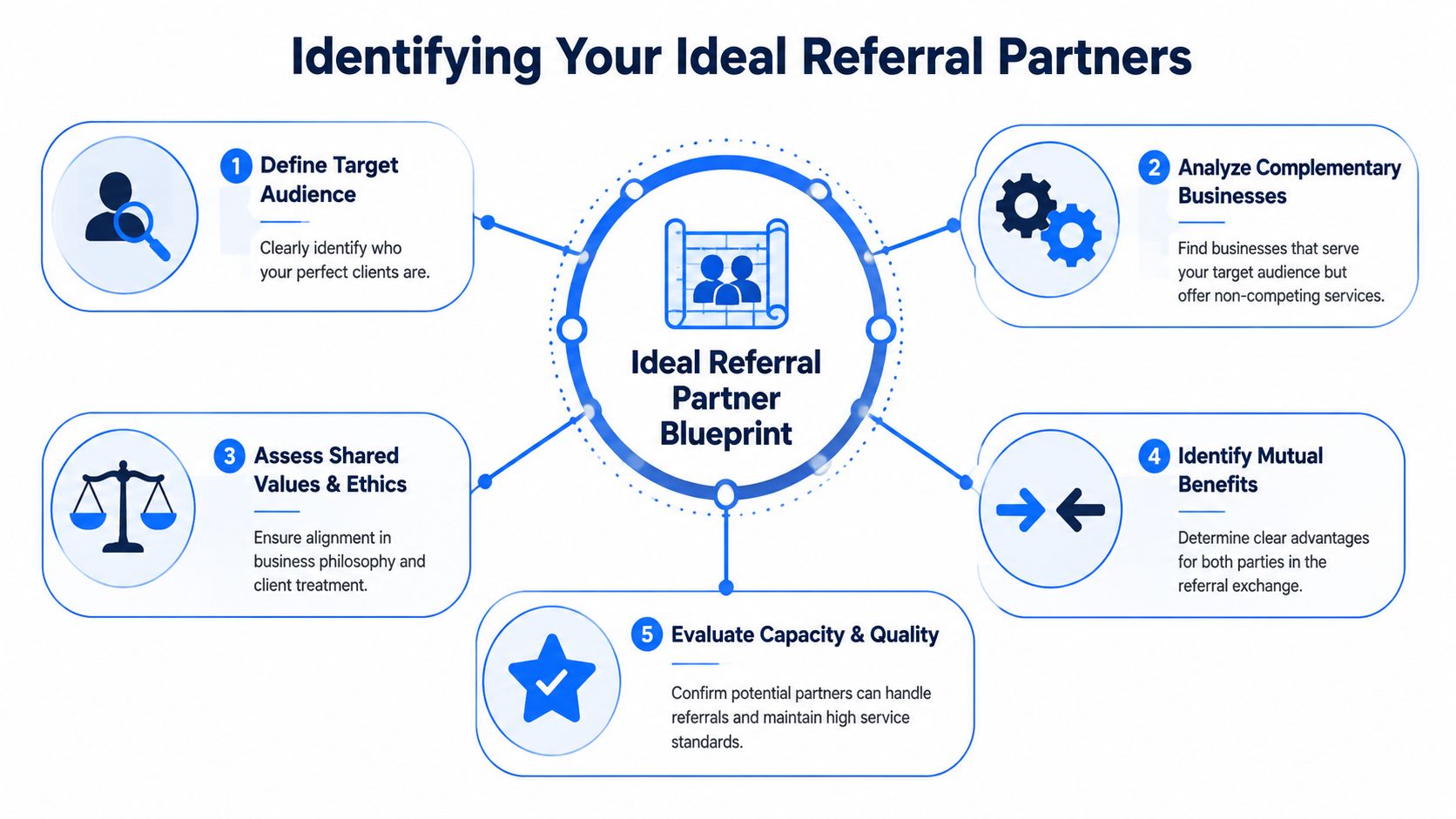
What a strong partner looks like
Use a simple filter before you book a meeting.
- They serve the same customer at a nearby decision point. The overlap should be obvious. Homeowners with storm damage. Parents looking for family care. Patients planning cosmetic work.
- They solve a different problem. Good partners complement your service instead of creating confusion about who owns the job.
- They have local trust already. Solid reviews, clear communication, and a real presence in the community matter because their reputation transfers to you.
- They can follow through operationally. If they are disorganized, slow to reply, or overloaded, the partnership will stay theoretical.
- They offer reciprocal value. The best relationships work both ways, whether that means leads, co-branded content, testimonial opportunities, or local mentions.
This is the same logic behind industry partnerships that support local growth. The connection has to lead to booked work, stronger local authority, or both.
Roofing examples that actually produce jobs
For roofers, partner quality comes down to timing. The closer someone is to property damage, inspection friction, or replacement planning, the more useful that relationship becomes.
Strong fits include:
- Property managers who need fast leak response, inspection support, and dependable crews for ongoing maintenance
- Insurance adjusters who speak with homeowners during claim activity and often influence which contractors get considered
- Solar installers who spot roof condition issues before panel work starts
- Gutter companies because drainage problems and roofing problems often show up together
- Real estate agents working through inspection objections, repair requests, and pre-listing updates
A roofer can take this one step further. If a real estate agent refers two inspection-driven projects, ask for a short testimonial about response time and documentation, then build a page around that service angle. That helps with referrals and gives the site more relevance for transactional searches tied to inspections, repairs, and replacement.
Dental examples that actually produce patients
Dentists need partners tied to treatment transitions, family care decisions, and appearance-driven demand.
Strong fits include:
- Orthodontists when patients need general care, restorative work, or coordinated treatment planning
- Pediatricians who hear from parents trying to choose a reliable family dentist
- Oral surgeons when patients need continuity before or after procedures
- Wedding planners who hear cosmetic urgency early for whitening, bonding, or smile touch-ups
- Med spas and day spas that already serve appearance-focused clients willing to pay for elective care
There are trade-offs here. A wedding planner may send fewer total referrals than a pediatrician, but the patient value can be higher if the practice wants more cosmetic cases. An oral surgeon may produce stronger continuity and trust, but the volume may be lower. The right mix depends on whether the practice is trying to win more searches for "family dentist near me," "emergency dentist," or "cosmetic dentist" in a specific city.
A quick decision table
| Business | Strong partner | Why it works | Weak partner |
|---|---|---|---|
| Roofer | Insurance adjuster | Sees roof need early and influences contractor consideration | General retail shop |
| Roofer | Property manager | Controls repeat maintenance and urgent repair decisions | Random B2B vendor with no homeowner overlap |
| Dentist | Orthodontist | Shares patients and supports coordinated care | Unrelated office with no patient crossover |
| Dentist | Pediatrician | Parent trust carries into family dental selection | Broad social group with no care relevance |
Choose partners based on proximity to intent, customer fit, and local credibility. If they cannot influence a buying decision or contribute signals that strengthen your brand in Maps and search, they are a casual contact, not a referral asset.
Crafting Your Outreach and Structuring the First Meeting
A roofer meets an insurance adjuster for coffee. A dentist sits down with a pediatrician between patient blocks. In both cases, the outreach works or fails before anyone talks about referrals. The key question is whether the other business sees a practical fit between your service, their customers, and the search terms you both want to own locally.
Referral outreach should sound like market alignment, not a favor request. The strongest first message shows three things fast. You understand when their customer needs you, you can make that customer's experience better, and you have something useful to share right away.

Outreach that earns the meeting
Keep the first email or LinkedIn message short and specific. Skip the brochure. Skip the company history. Ask for a 15-minute conversation tied to a real customer situation they already handle.
A simple framework works well:
Hi [Name], I work with [type of customer] in [city], and we usually enter the picture right after they deal with [their service]. I noticed your team serves the same people. I'd like to learn how you handle those situations and share a resource we use to help clients make faster decisions when [specific issue] comes up.
That format works because it stays close to buyer intent.
For a roofer, that might mean storm damage, inspection findings, denied claims, or a property manager trying to act before a leak turns into an emergency search for “roof repair near me.” For a dentist, it might mean a pediatric office seeing anxious parents, an orthodontist flagging restorative issues, or a wedding planner hearing about whitening requests before someone searches “cosmetic dentist [city].”
If you want something concrete to send after the first touch, build a simple asset first. A practical lead magnet example for local businesses can help you create a homeowner storm checklist, a new-patient prep guide, or a referral handout a partner will keep. If your outreach starts on LinkedIn, these LinkedIn tips for sales teams are useful for tightening the message without sounding scripted.
How to run the first meeting
The first meeting is a working session. Its job is to find overlap between customer needs, referral timing, and local search demand.
Ask questions that expose buying signals:
- Which customers do you want more of this quarter?
- What usually happens right before they need my service?
- What mistakes do they make before choosing a provider?
- What would make you comfortable introducing us?
- What information would help your clients choose faster and with less friction?
Then listen for language you can reuse.
This matters for SEO, not just relationship-building. If a property manager keeps saying tenants wait until “ceiling stains” or “active leaks,” that language can shape a roofer's service pages, FAQ content, and Google Business Profile updates around high-intent searches. If a pediatrician talks about “first dental visit anxiety” or “tooth pain after hours,” a dentist can turn that into pages and posts that support “kids dentist near me” or “emergency dentist [city].” Offline conversations often reveal the exact phrases real buyers use before they convert.
Take notes on specifics: referral triggers, common objections, service area limits, response-time expectations, and what a qualified introduction looks like. Those details separate a casual contact from a partner who can help you win both referrals and Maps visibility.
What earns trust fast
Useful follow-up beats a polished pitch deck.
A roofer can leave the meeting with a one-page roof damage photo checklist that an insurance adjuster or property manager can hand to clients. A dentist can send a pediatric office a short guide for parents on preparing a nervous child for a first appointment. Good tools do two jobs at once. They help the partner look helpful, and they create branded assets that can later support reviews, branded searches, and local authority signals around your target service terms.
Common mistakes in first meetings
Several patterns kill momentum early:
- Talking too long about your company. Partners care more about fit, speed, and client experience than your origin story.
- Asking for referrals in meeting one. That usually creates pressure and weakens trust.
- Offering vague value. “Let me know how I can help” is forgettable. A checklist, script, or handout is usable.
- Ignoring operational reality. A roofer who cannot inspect within 48 hours should not promise fast storm response. A dentist who does not handle same-day emergencies should not position the practice that way.
- Failing to connect the relationship to search visibility. If the partnership never produces review prompts, branded mentions, useful content ideas, or local links, it may still send leads, but it will not do much for your rankings.
The best first meetings end with one small next step. Share one resource. Make one introduction. Agree on one follow-up. That is enough to test fit without forcing the relationship.
Nurturing Your Network for a Consistent Flow of Leads
A roofing company gets lunch with three insurance adjusters after a hailstorm. A dental practice meets two pediatric offices and a local orthodontist. Everyone says they should stay in touch. Then nothing happens, and six months later the referrals are going to the competitor who followed up, kept the process easy, and stayed visible when people were ready to recommend someone.
That middle stretch decides whether a network produces real leads.
Referral relationships need a working rhythm. Without one, partners forget your service lines, stop noticing who fits, and send business to the company that made their job simpler. The upside is bigger than referral volume alone. Repeated partner touchpoints can also create the mentions, branded searches, review prompts, and local content ideas that help you win transactional search terms and hold stronger positions in Google Maps.
Build a cadence your partners will actually remember
You do not need a formal networking chapter to create consistency. You do need a schedule that is easy to maintain when work gets busy.
A practical cadence looks like this:
- Monthly check-in with top referral partners
- Same-day acknowledgment when a lead comes in
- Quarterly review conversation about lead quality, close rates, and client fit
- Small give-first actions between meetings, such as an introduction, a resource, or a market update
For a roofer, that monthly touchpoint might be a quick message to a property manager with current repair timelines, storm response capacity, and the neighborhoods where crews are already working. For a dentist, it could be a short update to nearby pediatricians or orthodontists about emergency appointment availability, sedation options, or insurance changes that affect patient handoffs.
One rule matters more than the rest. Close the loop fast.
If a partner sends you a lead and hears nothing back, trust drops immediately. They do not need private details. They do need to know you responded, the handoff was handled professionally, and the referral did not disappear into a black hole.
Make follow-up useful enough to forward
Weak follow-up creates noise. Useful follow-up gets shared inside offices, texted to clients, and remembered later.
Send specifics:
- “We are seeing more attic leak calls this week. Here is a one-page homeowner prep sheet your tenants can use before our crew arrives.”
- “We opened two same-day emergency slots on Thursday. If a patient calls your office in pain, send them here.”
- “One of our customers needs your service. Want an introduction?”
- “We keep hearing homeowners ask the same insurance question after storm damage. I wrote a short answer sheet your staff can send.”
Many businesses miss the SEO value. If your handouts, booking pages, service explainers, and local guides are strong, partners start using assets that support branded search demand and reinforce service relevance in your market. A storm checklist tied to roof repair in Frisco or an emergency dental page built for “dentist near me” searches gives the relationship a second job. It helps convert referred leads and supports the pages you want ranking.
If you need a clearer process for asking and earning referrals without sounding forced, this guide on how to get referrals from local partners and customers is a strong framework.
Choose a referral model that fits the industry
Different industries need different rules.
| Approach | Best use case | Main trade-off |
|---|---|---|
| Simple reciprocity | Home service businesses with natural overlap | Easy to start, but expectations can stay fuzzy |
| Educational value exchange | Healthcare, legal, financial, and reputation-sensitive services | Builds trust, but takes more effort to sustain |
| Formal incentive arrangement | Trades and channel relationships where allowed | Can produce activity fast, but may weaken trust or create compliance issues |
For dentists, patient fit and communication quality usually matter more than any incentive. A pediatric office wants to know the referred family will be treated well, scheduled promptly, and updated clearly if the case is complex. For roofers, speed and documentation often decide who keeps getting recommended. Insurance adjusters, realtors, and property managers remember who answers the phone, shows up on time, and writes estimates that do not create extra work.
That trade-off matters online too. The partner who trusts your process is more likely to mention your brand by name, invite you to a local event page, share your resource, or send a client who later searches your company plus the service they need. Those are strong signals for local SEO, especially when you are trying to rank for bottom-of-funnel searches and stay visible in the map pack.
Keep the relationship warm between meetings
A lot of network maintenance now happens in small digital touches. Comment on a partner's project post. Congratulate a new office opening. Share a useful local update. Send a short note when their review volume spikes or when you notice a common customer question showing up in search.
LinkedIn can help here if your outreach stays personal and relevant. These LinkedIn tips for sales teams are a useful reference for keeping partner communication active without turning every message into a pitch.
The businesses that get steady referrals usually do three things well. They stay in contact, they make it easy to refer them, and they turn each relationship into assets that strengthen both lead flow and local search visibility.
Fusing Referrals with Your SEO and Google Maps Strategy
Many local businesses leave money on the table. They treat referrals as a sales channel and SEO as a separate marketing channel. In reality, the strongest local brands use referrals to create search signals that help them rank for transactional terms and show up in Google Maps.
If someone refers your roofing company, and that homeowner later searches roofer near me, your goal is simple. You want your brand to appear everywhere the customer looks. Organic results, map pack, reviews, local content, and increasingly AI-generated search answers.
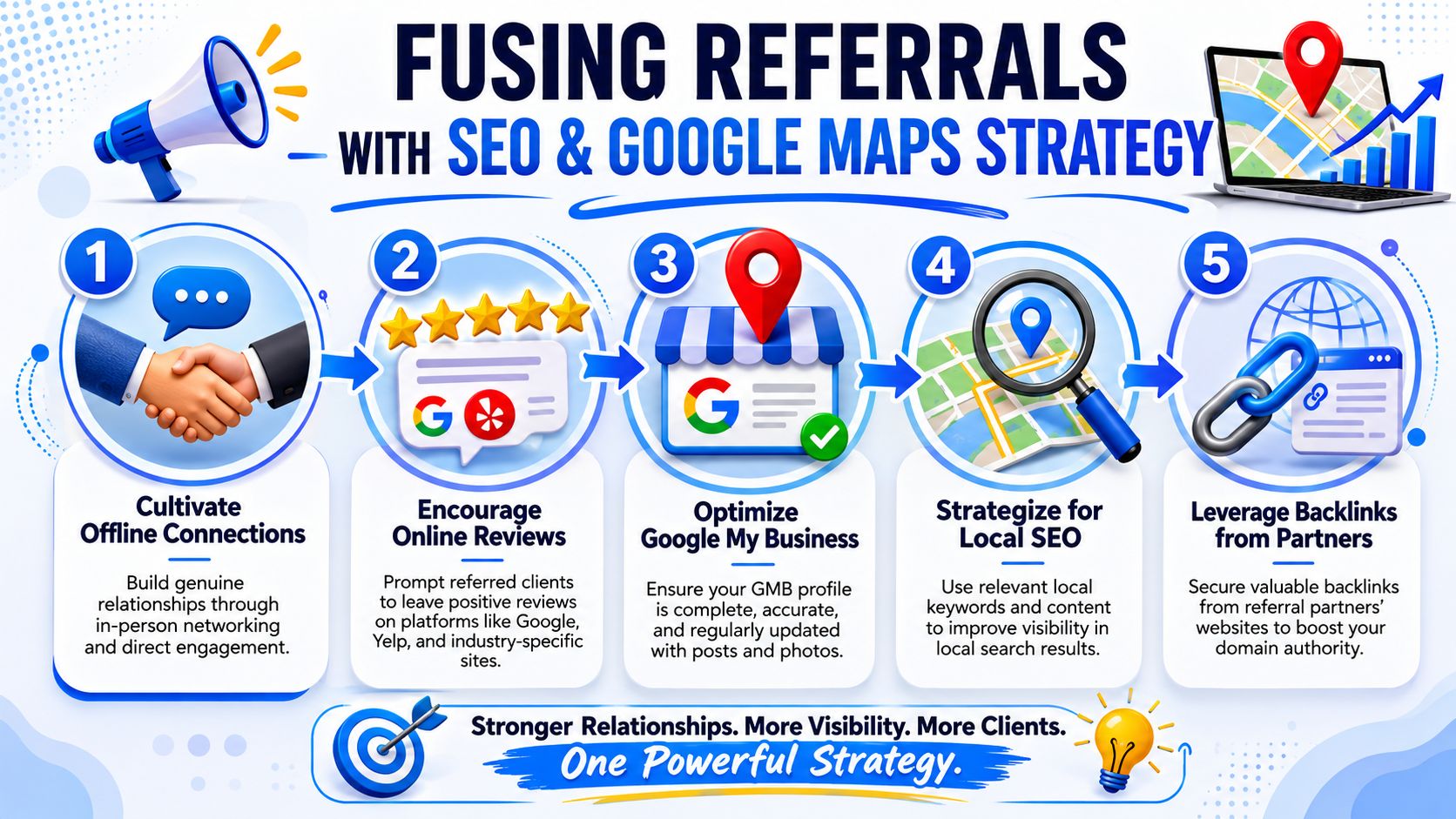
Turn partner relationships into local relevance
A referral partner can strengthen local SEO in several ways that go beyond direct lead flow.
Partner mentions and backlinks
If you co-host a homeowner workshop with a gutter company, insurance office, or local realtor, that event can live on both websites. One event becomes:
- a partner blog post
- a locally relevant backlink
- photos you can publish on your Google Business Profile
- branded search demand from attendees
- trust signals for AI systems that look for local entity relationships
For contractors in smaller regional markets, this kind of collaboration often matters more than generic directory spam. If you want to see how local specialization gets framed online, this page on digital marketing for Uinta Basin companies is a useful example of why geographic relevance matters.
Referred customers become review assets
The highest-value referral often isn't the lead. It's the review after the job is done.
A referred roofing customer can leave a review that mentions the city, the service, and the urgency of the job. A referred dental patient can mention emergency care, same-day availability, family-friendly service, or the procedure they needed. Those details support relevance for the exact terms local buyers use.
Don't script reviews. Do make the ask specific and easy.
Build a workflow that supports Maps rankings
Google Maps visibility improves when your business keeps generating fresh, trustworthy local signals. Referral partnerships can feed that system if you build a process.
Use a workflow like this:
Receive the referral
Capture the referring partner inside your CRM, intake form, or call notes.Confirm service details
Log the exact location, service type, and urgency. This helps you spot recurring transactional themes.Deliver a strong customer experience
Fast response and clear communication matter because referred leads often become your best review opportunities.Request the review at the right moment
Ask after the problem is solved. Point the customer to your Google review link.Publish supporting local content
If the lead came through a realtor in a specific city, that may justify a city-service article, FAQ, or case-style page without naming the customer.
If you're building a repeatable system around this, a page on how to get referrals that support local growth can help frame the process.
Roofing and dental examples tied to transactional search
A roofer can use referrals to support rankings for phrases like:
- roofer near me
- roof repair near me
- emergency roof repair
- storm damage roofing [city]
How? By publishing neighborhood-level content, collecting review language around actual repair scenarios, and earning partner mentions from nearby businesses that already serve homeowners.
A dentist can do the same for:
- dentist near me
- emergency dentist near me
- cosmetic dentist [city]
- family dentist [city]
The referral source might be a pediatrician, orthodontist, or wedding planner. But the SEO value comes when that real-world relationship creates branded trust, review signals, topical content, and local authority online.
Why this matters for AI optimization
AI search systems don't rely on one signal. They synthesize. They look at your website, review footprint, business profiles, local mentions, and the consistency of how your business shows up across the web.
That means referral-driven trust can feed AI visibility when it leaves evidence online. A business that keeps appearing in local partnership pages, event recaps, review language, and service-specific content becomes easier for AI systems to identify as a credible answer.
MIT Sloan has also pointed out that access to referrals isn't distributed evenly, especially in formal networking environments, in its reporting on referral gaps for women in networking groups. That's a useful reminder not to depend on one format. In-person groups, direct partnerships, local collaborations, and digital networking each play different roles.
Tracking Referral ROI and Proving Business Impact
A referral network feels productive long before it becomes profitable. That's the problem. Owners remember the good introductions and forget the weak ones. They assume a partner is valuable because they're visible, not because they generate booked work.
Tracking fixes that.

Start with simple attribution
You don't need complicated software to begin. You need clean intake habits.
At minimum, add these fields to every form, phone intake script, or front-desk checklist:
- How did you hear about us
- Who referred you
- What service were you looking for
- What city or service area are you in
- Did you also search online before contacting us
That last question matters. Many referred customers still look you up before they call. If you never ask, you'll under-credit SEO and over-credit the referral, or vice versa.
Separate lead volume from lead quality
A partner who sends ten loose inquiries may be far less valuable than one who sends two perfect-fit jobs. Measure the downstream result.
Use a table like this in your CRM or spreadsheet:
| Referral partner | Lead count | Service requested | Booked or not | Revenue quality | Review left |
|---|---|---|---|---|---|
| Property manager A | |||||
| Orthodontist B | |||||
| Realtor C |
You don't need advanced reporting to see patterns. You need discipline.
Watch for concentration risk: A small number of partners often drive most of the business value. If one relationship disappears, your pipeline can wobble fast.
That idea matters because public advice often celebrates referrals broadly without pushing owners to audit source quality, concentration, and conversion. Ivan Misner has noted that referral work should be measured, and that many discussions of networking skip the harder question of how to evaluate source quality in his article about getting others to refer business to you.
Track referrals the same way you track SEO
A serious local business should evaluate referral traffic and search traffic inside one operating view.
For example:
- If a roofer gets repeated referrals from one adjuster in a specific city, and searches for storm-related services also rise there, those signals may be reinforcing each other.
- If a dentist gets referrals from a wedding planner, and cosmetic treatment pages in that area start drawing more branded searches and review mentions, that's useful pattern recognition.
This is why a clear system for measuring marketing effectiveness across channels matters. Referral networks should not sit outside your reporting. They should be tracked alongside organic rankings, Google Business Profile performance, calls, and booked revenue.
Why tracked referrals matter at scale
Referral networking isn't a soft metric. Large organizations have already shown that referrals can be tracked and tied to real revenue. The U.S. Small Business Administration highlighted BNI as a major global example, noting over 211,000 members in 7,800-plus chapters worldwide, and stating that member referrals generated $11.2 billion in revenue for member businesses in the prior year in its overview of referral groups for business growth.
That doesn't mean every local business should join a formal chapter. It does mean this channel deserves the same accountability as paid search, local SEO, or direct mail.
The metrics that actually matter
Focus on outcomes that change decisions:
- Which partners send booked business
- Which partners send your best-fit customers
- Which referrals turn into reviews
- Which relationships support search visibility in priority cities
- Which sources are becoming too important to ignore or too weak to keep chasing
When you know that, you stop networking randomly. You invest where trust, lead quality, and online visibility all move together.
Transactional LLC helps local service businesses turn referral momentum into stronger local SEO, Google Maps visibility, and AI-ready search presence. If you want a contract-free partner that focuses on transactional search terms like “roofer near me” and “dentist near me,” while also tracking rankings, maps performance, calls, and lead sources in one clear system, visit Transactional LLC.