


When it comes to local SEO, one of the most foundational—and often overlooked—tasks is citation building. It’s the process of getting your business's name, address, and phone number (we call this NAP) listed consistently across the web, from major directories to niche industry sites. These citations are powerful trust signals that tell search engines like Google—and increasingly, the AI Large Language Models (LLMs) that power conversational search—that you’re a legitimate, local business. This is absolutely critical for ranking in local search results and being found by ready-to-buy customers.
Why Citations Are a Cornerstone of Local SEO
Think about the last time you searched for "roofer near me" or "dentist in [Your City]." When a customer types that in, they aren't just browsing; they have a problem and are ready to pay someone to solve it. These are the golden-ticket transactional search terms that we at Transactional Marketing get our clients to show up for. Citations are a core ingredient in securing those top spots, especially in the coveted Google Maps "Local Pack."
Every consistent citation you build acts like a vote of confidence. When Google’s crawlers and AI systems find your exact Name, Address, and Phone number (NAP) perfectly matched across dozens of reputable sites, it confirms your business details are accurate. This digital validation gives Google the confidence to feature your business in the top three map locations, putting you right in front of customers with money in hand, ready to spend it.
Building Authority for Searches That Matter
This isn't just a box-ticking exercise. It’s a strategic process of building digital authority. Inconsistent information—like listing yourself as "Kaminski Plumbing Inc." on one directory and just "Kaminski Plumbing" on another—creates confusion for search engines and can quietly sabotage your rankings.
On the flip side, a clean and consistent citation profile is pure fuel for your Google Maps optimization. It proves to Google that your business is a prominent, active entity in your service area. This translates directly into bottom-line results:
- Higher visibility in the Google Maps Local Pack where most clicks happen.
- Increased credibility and trust with potential customers who see your consistent information.
- A measurable increase in phone calls from people who need your services now.
For a specific local business, like a roofing company, solid citation building is the unsung hero that drives Google Maps dominance and generates real leads from transactional search terms. As this expert guide to citation building SEO explains, focusing on authoritative directories strengthens your digital footprint in ways generic listings can't.
Before we dive into the "how," it's crucial to understand exactly what a high-quality citation looks like. Every detail matters, from the business name down to the ZIP code.
Core Components of a High-Impact Citation
| Component | Description | Why It Matters for Transactional Searches |
|---|---|---|
| Business Name | Your official, legal business name. | Must be 100% consistent with your Google Business Profile to avoid confusing search engines. |
| Street Address | The full, physical address of your business. | Verifies your physical location, proving to Google you serve a specific geographic area. |
| Phone Number | Your primary, local business phone number. | This is the direct line for leads. Inconsistencies can cost you phone calls and customers. |
| Website URL | A direct link to your website's homepage. | Drives traffic and helps Google associate your physical location with your online presence. |
| Business Category | The specific industry or service you provide. | Helps you appear for relevant searches (e.g., "emergency plumber," "cosmetic dentist"). |
Having these five core elements locked down and consistent everywhere is non-negotiable. It’s the foundation upon which your entire local search presence is built.
At Transactional Marketing, our proven system is designed to get your business showing up on page one, often within 30 to 60 days. We laser-focus on building the local authority that turns transactional search terms like "air conditioning repair near me" into hundreds, and even thousands, of more phone calls every year.
A robust citation profile is a non-negotiable part of a winning local SEO strategy. It works in tandem with other critical ranking factors, which you can read about in our complete Google My Business optimization checklist.
How to Conduct a Thorough Citation Audit

Before you start building a single new citation, you have to know what you’re working with. Think of it like a contractor surveying the land before laying a foundation. A citation audit is your survey—it shows you exactly where your business information is listed online and, more importantly, where it's wrong.
Skipping this step is a classic mistake. You could waste months creating perfect new listings, only to have them sabotaged by old, incorrect data lurking on the web. That old data confuses Google and AI models, eroding customer trust and preventing you from ranking for transactional search terms. This first pass is all about finding every mention of your business to get a clear picture of your digital footprint.
Uncovering NAP Inconsistencies
The single most damaging issue you'll find is NAP inconsistency. It sounds technical, but it’s simple: your Name, Address, and Phone number must be identical everywhere.
Even a tiny variation—like listing "St." on one directory and "Street" on another—sends mixed signals to search engines. That confusion directly hurts your chances of showing up in the Google Maps Local Pack for those money-making keywords like "air conditioning repair near me." These are the exact terms we get our customers to show up for.
Your audit needs to be meticulous. Document every variation you find for your:
- Business Name: Is it "Kaminski Plumbing Inc.," "Kaminski Plumbing," or even "Kaminski Plumbers"?
- Address: Are you mixing up "Suite 101," "Ste 101," or "#101"?
- Phone Number: Are old tracking numbers or even personal cell phones still floating around on dusty, forgotten directories?
These little details have a huge impact. I've personally seen businesses held back by these exact kinds of errors. Once we cleaned them up, it was like opening the floodgates for local traffic and new customer calls.
Identifying and Flagging Duplicates
Your next task is to hunt down duplicate listings. This is a common problem, especially if a business has moved, changed its name, or had multiple employees creating listings over the years without a master list. Finding two or more listings for your business on a single platform like Yelp or Yellowpages is a major red flag for Google.
Duplicate listings split your ranking authority and confuse search engines. Consolidating them into a single, accurate profile is one of the fastest ways to see a real jump in your local search visibility.
Think of each positive review or citation as a "vote" for your business. When those votes are split between multiple profiles, none of them become strong enough to rank at the top. The audit process uncovers these duplicates so you can claim, merge, or delete them, funneling all that authority into one powerful listing. For businesses managing several locations, this is even more critical. Our guide on multilocation local SEO dives deeper into handling this at scale.
Manual vs. Automated Auditing Tools
So, how do you actually do the audit? You have two main paths: go manual or use automated tools.
A manual audit is exactly what it sounds like. You'll use advanced Google search queries (like "Your Business Name" -site:yourwebsite.com) to dig up mentions. It’s tedious and time-consuming, but it gives you complete control.
The faster route is using an automated tool. To get a quick start, running a free local listings report can instantly show you existing entries and highlight discrepancies. These tools scan hundreds of directories and data sources, giving you a high-level snapshot of your online presence and pointing out the inconsistencies you need to fix.
Honestly, the best approach is usually a mix of both. Use a tool for a quick, broad scan to see the scope of the problem. Then, manually dig into the most important listings on high-authority sites to ensure they are perfect. This combination of speed and accuracy sets you up for a citation-building campaign that actually gets you found for the transactional search terms that drive your business.
Creating a Master NAP for Perfect Consistency
Once you've wrapped up your audit and have a clear picture of your digital footprint, the next move is to establish a single source of truth for your business information. Think of this as the definitive, non-negotiable blueprint for your company's identity online. Even a tiny inconsistency can confuse search engines and water down your ranking power.
This is where a master NAP document comes into play. NAP stands for Name, Address, and Phone number—the three core components of any local business citation. Having one official version stops the guesswork that leads to damaging mistakes, like listing your business as "Kaminski Plumbing Inc." on one site and just "Kaminski Plumbing" on another. This single document ensures every citation you build is perfectly aligned, reinforcing to Google that you are a legitimate, stable local business ready to serve customers searching for transactional terms.
Your Single Source of Truth
Your master NAP file doesn't need to be complicated. A simple, shareable document is all it takes to house the official, correct version of every key piece of business information. But this goes beyond just your name and address; it's a comprehensive profile that will power your entire local presence and optimize you for future AI searches.
Here's exactly what that master document should include:
- Official Business Name: The exact legal name as it appears on your business registration and, most importantly, your Google Business Profile. For example, "Precision HVAC & Cooling LLC," not simply "Precision HVAC."
- Physical Street Address: The full, standardized address. Make a decision now: will you use "Street" or "St.," "Suite" or "Ste."? Pick one and stick with it.
- Primary Local Phone Number: The main phone number you want customers and search engines to see. Don't use tracking numbers here—consistency is king.
- Website URL: The correct, full URL for your website's homepage, like
https://www.yourbusiness.com.
At Transactional Marketing, this step is absolutely non-negotiable. Establishing a perfect, master NAP is the bedrock of our strategy to get clients showing up for high-intent, transactional searches. It's this level of detail that allows our proven system to achieve page-one rankings, often in just 30 to 60 days.
Expanding Beyond the Basics
A truly effective master profile goes beyond the core NAP. To really maximize your visibility and make sure every citation is as powerful as possible, you should also document a few more key details.
- Business Description: A well-written, keyword-optimized description of what you do. This should clearly state your services and who you serve, naturally including transactional terms like "emergency plumber in [City]" or "cosmetic dentist near me."
- Business Categories: List your primary category (e.g., "Plumber") and then add several relevant secondary categories (e.g., "Water Heater Repair," "Drain Cleaning").
- Hours of Operation: Your exact business hours for every single day of the week.
- Social Media Links: Direct links to your active business profiles on platforms like Facebook, Nextdoor, or Instagram.
This meticulous approach practically eliminates errors and simplifies the entire process of your local business listing optimization. With this master document in hand, you, your team, or any marketing partner can build out your citations with flawless precision. Every single listing will then strengthen your authority and push you closer to the top of the Google Maps pack, where customers with money in hand are ready to call.
Finding the Directories That Actually Matter for Your Business
Alright, you've got your master NAP locked and loaded. Now, where do you put it? The web is overflowing with business directories, and if you just start blasting your info everywhere, you’ll burn a ton of time with very little to show for it.
The secret to smart citation building isn't about getting listed on a thousand random sites. It’s about being surgical. It’s about prioritization.
Think of it this way: not all directories are created equal in Google's eyes. You need to focus your fire on the platforms that carry the most weight first. This is how you build a solid foundation that gets you ranking for those money-making transactional search terms like "HVAC repair near me." It’s all about putting your business info where it will make the biggest dent, right from the start.
First Things First: The Foundational Directories
These are your non-negotiables. The heavy hitters. Think of them as the major data aggregators and high-authority platforms that both search engines and actual customers trust without a second thought. Getting these right is job number one because they often syndicate—or feed—your business information to hundreds of smaller, less important directories across the web.
Your absolute must-have list includes platforms like:
- Google Business Profile: This is the big one. It's the most critical citation you have and directly controls your visibility in the Google Maps Local Pack.
- Apple Maps: With millions of iPhones and Apple devices out there, you simply can't ignore this. It's essential for capturing searches from that massive user base.
- Bing Places for Business: Don't sleep on Bing. It's Microsoft's version of GBP and is vital for being seen on their search engine.
- Yelp: More than just a review site, Yelp is a powerhouse local search signal that Google pays close attention to.
- Nextdoor: This is a goldmine for connecting directly with customers in your immediate service areas. It’s as hyper-local as it gets.
Nailing your listings on these sites creates the bedrock of your entire online presence. It sends a powerful signal of trust to search engines, telling them that the most important players online have the correct information about your business.
At Transactional Marketing, our proven system is built around hitting these foundational directories hard and fast to accelerate results. By focusing on what truly moves the needle, we often get our clients ranking on page one of Google within 30 to 60 days, putting them right in front of customers ready to open their wallets.
Before we dive into the more specialized directories, let's break down this tiered approach. I find it helps to visualize where you should be spending your time to get the fastest return.
Citation Source Priority Tiers
| Priority Tier | Directory Examples | Impact on Local Rankings |
|---|---|---|
| Tier 1: Foundational | Google Business Profile, Apple Maps, Bing Places, Yelp, Nextdoor | High: These are core signals that directly influence map pack and local organic rankings. They establish foundational trust. |
| Tier 2: Industry-Specific | Angi, HomeAdvisor (Home Services), Healthgrades, Zocdoc (Medical) | High: Signals topical relevance and expertise. Tells Google what you do with authority, helping you rank for specific service queries. |
| Tier 3: Hyper-Local | Local Chamber of Commerce, City-Specific Directories, Community Hubs | Medium-High: Reinforces geographic relevance. Proves you're a legitimate, active member of the local community. Crucial for competitive markets. |
This table isn't just a list; it's a roadmap. Start at Tier 1 and don't move on until those listings are perfect. Then, systematically work your way down. This focused effort is what separates businesses that rank from those that don't.
Next Up: Industry-Specific Powerhouses
Once your foundational listings are dialed in, it's time to target the directories that live and breathe your specific industry. These niche sites are incredibly valuable because they scream relevance and expertise to Google. For example, a listing on a well-respected legal directory carries far more weight for a law firm than a listing on a generic business site ever could.
If you're in home services, you'll want to focus on sites like:
But for a dental practice, the priority list would look completely different, with a focus on directories such as:
- Healthgrades
- Zocdoc
- Vitals
These industry-specific citations prove your business is a legitimate player in its field. It helps Google understand not just where you are, but what you do, which is critical for ranking for those high-intent, transactional searches like "emergency dentist near me."
Finally: Hyper-Local Directories
The last piece of the puzzle is drilling down into directories specific to your city, county, or even your state. This could be your local Chamber of Commerce website, a community business portal, or a local news site that features businesses.
While these platforms might not have the national authority of a Yelp, they send incredibly strong hyper-local signals to Google.
These local citations prove you're a real, boots-on-the-ground part of the community. They anchor your business to its service area in a way that big, national directories just can't. In the dog-eat-dog world of local SEO, building this deep community foundation can be the tiebreaker that gets you to show up for those coveted transactional search terms.
In fact, a systematic approach here is key. From what we've seen, small businesses that build 50-60 high-quality citations across these tiers can achieve 30-50% higher rankings than competitors who just have a scattered, inconsistent presence. If you're interested in the data behind this, you can discover more insights about this structured approach on DNDSEOServices.com.
By methodically working through these tiers, you make sure your citation building efforts are both efficient and incredibly effective. This focused strategy puts your energy where it will generate the biggest ranking boosts and, most importantly, make the phone ring with customers ready to hire you.
Executing and Tracking Your Citation Campaign
With your master NAP perfected and a prioritized list of directories in hand, it's time to shift from planning to execution. This is where the real work begins—the methodical process of submitting, tracking, and measuring your campaign's impact. A successful campaign isn't just about speed; it's about precision. Every single submission needs to be a deliberate step toward one goal: getting your business found for transactional search terms and making your phone ring with new customers.
Manual vs. Service-Based Submissions
You essentially have two paths for getting your business listed: do it yourself, or hire a service.
Going the manual route gives you complete control. You can personally ensure every detail is perfect, but I won't sugarcoat it—it's incredibly time-consuming. On the flip side, using a citation-building service can save you hundreds of hours. The catch? You have to vet them carefully. The last thing you want is a service blasting your info to a bunch of spammy, low-quality directories that could actually harm your rankings.
From my experience, a hybrid approach works best for most business owners. Manually claim and meticulously fill out your top 15-20 foundational profiles (think Google, Yelp, Bing) and key industry-specific sites. Once those heavy hitters are locked in, you can bring in a trusted partner to scale your efforts across the remaining high-value directories.
This diagram illustrates the ideal workflow, starting with the most critical platforms and expanding outward to more specialized, local ones.
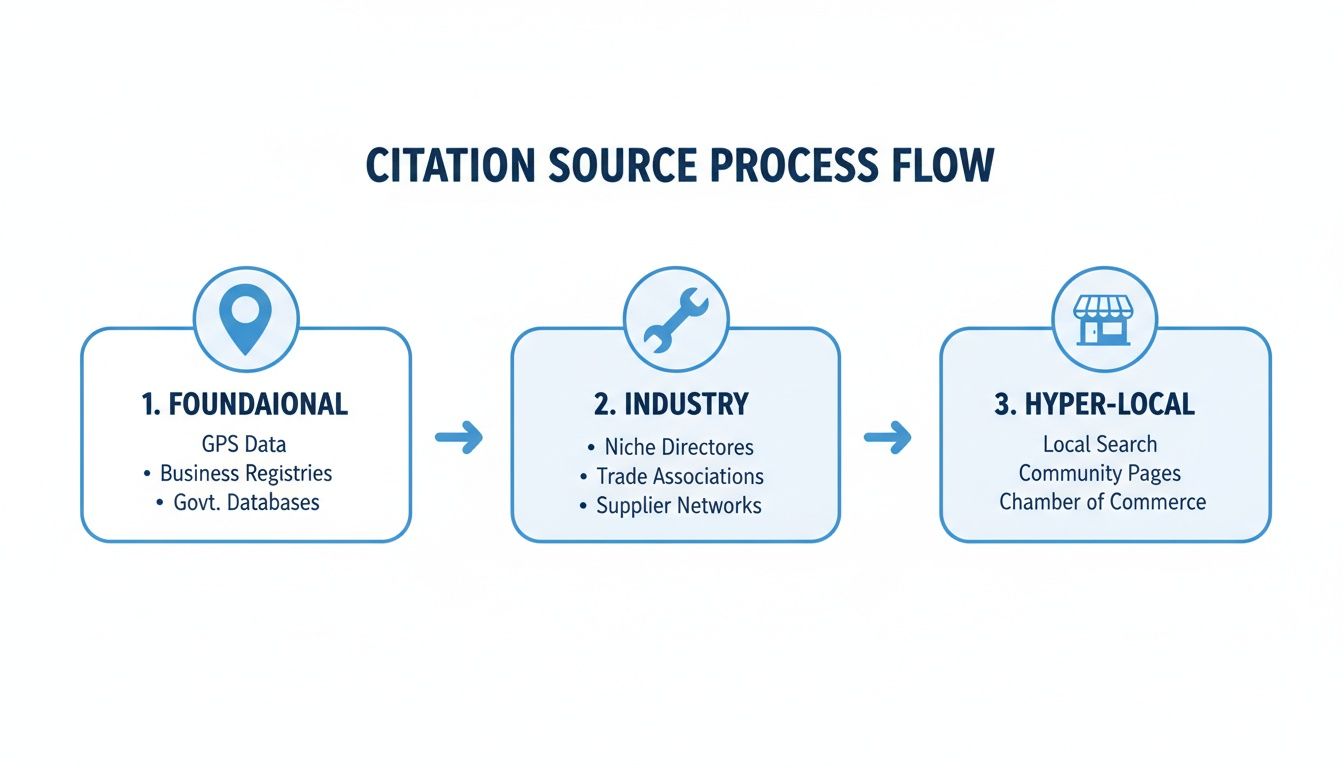
This layered strategy ensures you're building a strong foundation of trust with search engines before you start layering on niche and hyper-local signals.
Creating a Simple Tracking System
You can't manage what you don't measure. As you start submitting your business information, you absolutely need a way to track your progress. It doesn't have to be complicated; a basic spreadsheet is perfect. This simple step will save you from duplicating work and give you a clear, at-a-glance view of your growing digital footprint.
Just set up a few columns:
- Directory Name: The name of the website (e.g., Yelp, Angi).
- Submission Date: When you sent in your info.
- Status: A simple dropdown with options like "Submitted," "Live," "Pending Review," or "Rejected."
- Live URL: The direct link to your published profile.
- Username/Login: The credentials you used.
- Notes: Any important details, like verification steps needed or if you had to call them.
This spreadsheet becomes your command center. It keeps you organized and provides a vital record of every citation you’ve built, which is invaluable for future audits and cleanup.
Local citations are the trust signals that search engines like Google crave. They directly impact how businesses appear in the coveted Google Maps top three. Research shows that having consistent profiles across 50+ directories can lead to a 25-35% uplift in local map visibility—a game-changer when citation signals are a major ranking factor.
Measuring What Truly Matters
Tracking submissions is important, but tracking results is what actually grows your business. The entire point of this exercise is to generate more leads and revenue. This isn't just a box-ticking SEO task; it's a core business growth activity designed to get you in front of customers with money in hand.
The key performance indicators (KPIs) you need to obsess over are the ones tied directly to your bottom line. We're talking about tangible outcomes that prove your time and money are delivering a real return.
Here are the metrics to watch:
- Google Maps Ranking Improvements: Are you climbing higher in the top three map locations for money-making terms like "roofer near me"?
- Increase in Phone Calls: Can you measure a lift in calls coming from your Google Business Profile and other directory listings? This is the goal.
- Growth in Local Organic Traffic: Is your website getting more visitors from people searching within your specific service areas?
- Rise in Website Form Submissions: Are more potential customers reaching out through your site's contact forms?
At Transactional Marketing, this is our bread and butter. Our entire system is designed to laser-focus on these outcomes, turning consistent citation work into hundreds, sometimes thousands, of additional phone calls for our clients each year.
To get a better handle on monitoring your success, you can check out our guide on essential local SEO reporting tools. This is how you draw a straight line from your citation campaign to tangible business growth.
A Few Common Questions About Citation Building
As you get into the nitty-gritty of citation building, you're bound to have questions. It's a detailed process, and it’s easy to get sidetracked by the specifics. To help, I’ve put together some straightforward answers to the questions and roadblocks I see business owners run into most often.
How Long Does It Take for New Citations to Help My Rankings?
This is the big one, and for good reason—you want to know when you'll see a return on your effort. The impact isn't like flipping a switch, but it's significant and builds on itself over time. When you submit to those foundational directories like Google Business Profile, you can start seeing positive signals in just a few weeks.
But for a full-blown campaign across 50+ quality directories, you should expect to see noticeable ranking improvements for those money-making transactional search terms in about 3 to 6 months.
At Transactional Marketing, we've found a way to compress that timeline. Our proven system doesn't just build citations; it combines that work with aggressive on-page and off-page SEO. That synergy is how we consistently get clients showing up on page one, often within a tight 30 to 60-day window.
Should I Build Citations Myself or Hire Someone?
Deciding between DIY and using a service really boils down to time versus control. Building them yourself gives you total control over every single detail, but it's a massive time sink. A paid service brings speed and scale, but you have to be careful—vet them thoroughly to avoid getting listed on junk directories that can actually hurt your rankings.
For most business owners I talk to, a hybrid approach works best.
- Handle the top 10-15 profiles yourself. I'm talking about Google, Yelp, and the most important industry-specific sites where every detail has to be perfect.
- Then, bring in a trusted partner like Transactional Marketing to scale your efforts across dozens of other valuable directories. This way, you get consistency without burning through all your time.
What If My Business Moved or Got a New Phone Number?
This is an all-hands-on-deck situation. Outdated information is a major red flag for search engines and can absolutely tank your ability to rank for crucial transactional searches like "roofer near me."
You need to run a full citation audit to hunt down every last mention of your old info. Get your Google Business Profile updated first, then methodically go through every other directory and fix your listings. This "citation cleanup" isn't just a good idea; it's non-negotiable for local SEO. Consistency is everything.
Do Mentions in Blogs or News Articles Count?
They sure do. We call these 'unstructured citations,' and they send a powerful local signal to Google and AI models. When a local news site, a community blog, or an industry publication mentions your business name along with your city or phone number, Google pays attention.
These unstructured mentions are gold because they reinforce your business's ties to a specific area. They build your authority and relevance for local searches, essentially acting as a vote of confidence that helps you own your service area and gets more customers calling—the exact customers with money in hand who are ready to spend it.
Ready to turn your online presence into a lead-generating machine? The team at Transactional Marketing uses a proven system to dominate local search for high-value transactional terms, making your phone ring with customers ready to buy. Learn more about our contract-free SEO services and see how our technology can get your business in the Google Maps top three, resulting in hundreds more calls every month.