


Stop Leaving Money on the Table: It's Time to Cross-Sell.
The biggest missed opportunity for most local service businesses isn't finding new customers. It's selling more to the customers you already earned. In eCommerce, cross-selling can contribute 10% to 30% of total revenue, and upsell or cross-sell programs can lift average order value by 10% to 40%, according to OpenSend's roundup of upsell and cross-sell statistics. Service businesses don't run exactly like online stores, but the business lesson is the same. Existing trust is easier to monetize than cold traffic.
That matters even more in local search. If you only rank for one transactional term like “plumber near me,” you're competing for a single moment. If you also rank for “water heater repair,” “drain cleaning,” “whole home repipe,” and “sump pump installation,” you build a wider net around the same buyer and more reasons for that buyer to stay with you.
At Transactional Marketing, the target is always the same. We go after money-in-hand searches. Terms like “dentist near me,” “AC repair near me,” and “roof repair near me” are where local revenue starts. But local domination doesn't stop with the first booked job. The best cross selling strategies make sure your business shows up for the next need, the related need, and the preventive need.
AI optimization changes how this works today. Google, Maps, and AI-driven search systems pull from structured service pages, local signals, reviews, internal links, and business clarity. If your cross-sell services aren't visible, they won't be recommended. Here are 10 ways to fix that.
1. Service Bundling and Package Upselling
Bundling works when the customer already sees the services as part of one outcome. A dental office can package cleaning, whitening, and fluoride into a cosmetic maintenance offer. An HVAC company can bundle seasonal tune-ups with priority scheduling. An electrician can package panel inspection, outlet upgrades, and LED conversion as a home safety service.
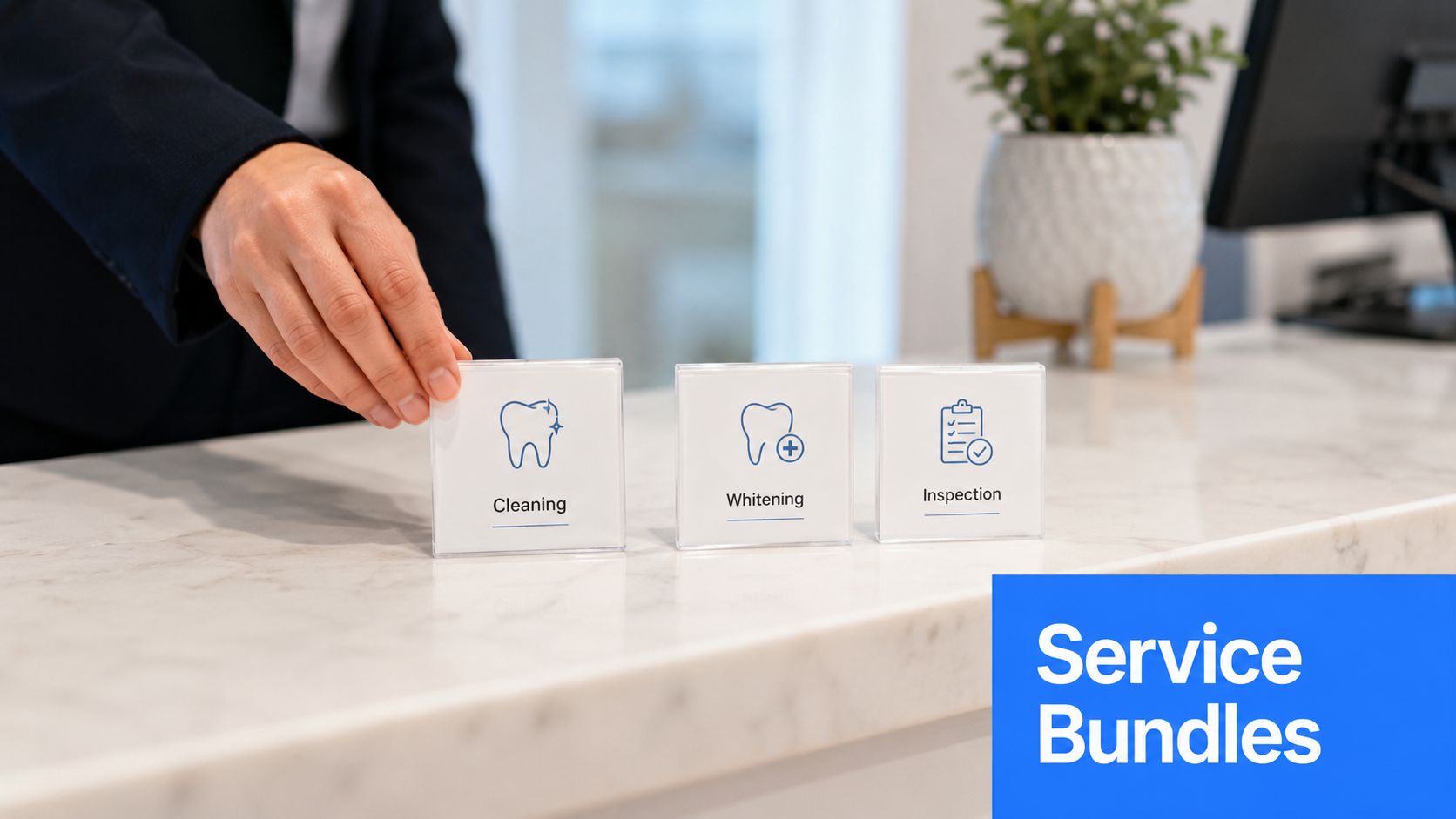
The mistake most owners make is bundling based on what they want to sell, not what the customer wants solved. A “bundle” that feels like extra line items won't convert. A bundle framed as a simpler decision usually will.
Build bundles around search intent
A bundle should also exist as a search asset, not just a sales script. If you offer a furnace tune-up plus maintenance plan, create a page built around the exact terms people search when they're ready to buy. That means pages and map signals tied to phrases like “HVAC maintenance package near me,” “annual AC service plan,” or “heating maintenance contract.”
For HVAC contractors, a strong support asset is this HVAC maintenance contract template. It helps turn a one-time service into a recurring relationship.
- Lead with the outcome: Name the package after the result, such as “Home Comfort Plan” or “Complete Smile Package.”
- Keep the bundle tight: Two or three services usually feel focused. Too many choices create hesitation.
- Make it visible in local SEO: Put bundled services in service pages, Google Business Profile posts, FAQs, and booking paths.
Practical rule: If a technician needs three minutes to explain the bundle, the bundle is too complicated.
AI optimization matters here because AI search systems need a clean association between related services. If your site clearly connects “cleaning,” “whitening,” and “fluoride treatment” on dedicated local pages, you improve the chance of being surfaced for adjacent transactional searches, not just the original one.
2. Geographic Cross-Selling Across Service Areas
A lot of service companies think cross-selling only means adding services. It can also mean extending demand into nearby cities where the same customer profile exists. If an HVAC company already serves homeowners in one suburb, there's often a practical path into the next suburb through existing customer trust, review signals, and location-specific pages.
This is especially useful for businesses that already know one territory converts well. A roofing company that performs emergency storm repair in one ZIP cluster can promote inspections and gutter services in neighboring areas with similar housing stock and weather patterns.
Local pages have to do real work
The weak version of this strategy is cloning one city page twenty times and swapping out the city name. That won't hold up in search or in AI summaries. Each page needs local proof, local service language, and clear service-area relevance.
A better framework is to build separate landing pages for each city and service pair. Then connect them with map optimization, city-specific reviews, and internal links. Transactional Marketing breaks this process down well in its guide to multi-location local SEO.
- Match city to service demand: Promote the services that fit that area's housing, climate, or property profile.
- Use customer geography as a signal: Past bookings often reveal where adjacent demand already exists.
- Keep Maps aligned with site content: Your service pages, Google Business Profile categories, and review language should reinforce one another.
Cross-selling across geography also supports transactional search expansion. If you rank for “electrician near me” in one city but never build out “panel upgrade in [city]” or “EV charger installation in [city],” you leave high-intent searches on the table. AI optimization rewards businesses that present complete local service coverage clearly enough for machines to understand.
3. Complementary Service Recommendations at Point of Service
The strongest cross-sell often happens when the technician is standing in the problem. A pest control tech sees rodent entry points during a standard treatment. A plumber notices an aging water heater during a drain call. A dental hygienist sees staining and talks through whitening while the patient is already thinking about oral care.
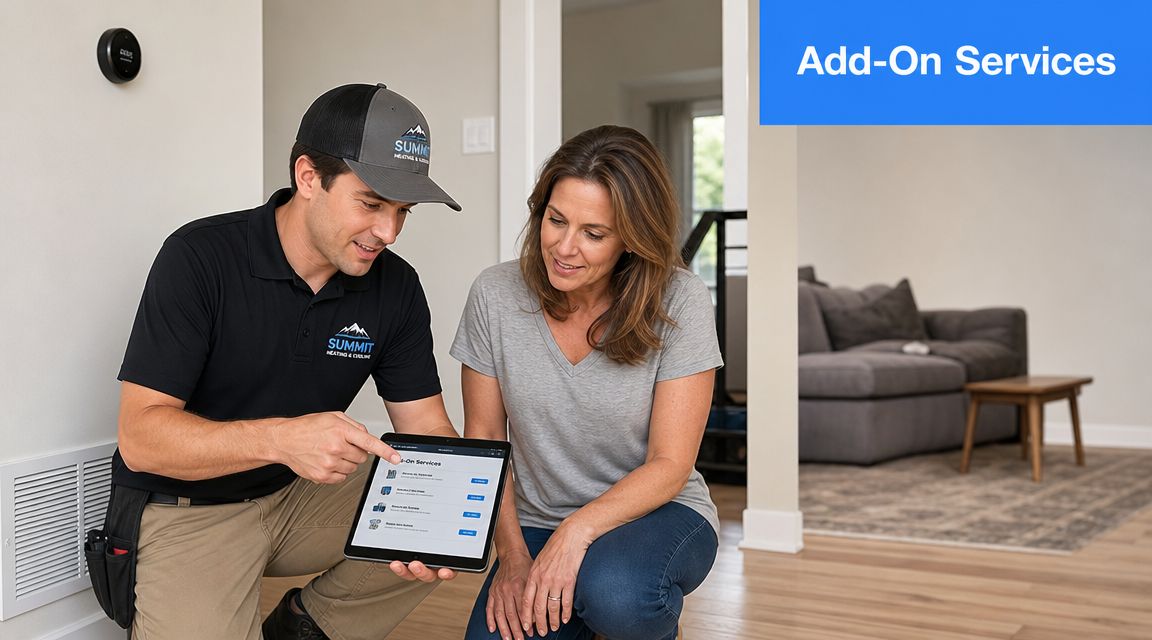
That kind of recommendation works because it's contextual. It doesn't feel like a script. It feels like professional advice.
Timing beats pressure
Mainstream guidance on cross-selling often says to choose one relevant add-on, avoid pushiness, and match the message to the customer journey. It also points out an important gap. The best moment is usually a narrow customer trigger, not a broad sales push, as discussed in Thrive Themes' write-up on cross-selling strategy and customer timing.
That lines up with what works in the field. The technician should recommend the next service when the issue is visible, urgent, or freshly understood.
“Helpful beats persuasive. If the customer feels relieved by the recommendation, you're in the right zone.”
A few point-of-service examples:
- Pest control: “We treated the active issue, but these gaps near the garage door are why it keeps returning.”
- Electrical: “The repair solved today's outage, but the panel age is what concerns me.”
- Dental: “Your cleaning went well. If whitening is already on your mind, this is a good time to talk about it.”
AI optimization helps after the visit. If the recommendation is logged in your CRM and linked to the exact service page, your follow-up emails, remarketing, and service-page content all stay consistent. That consistency improves both conversion and how AI systems interpret the relationship between your core and complementary services.
4. Strategic Referral Partnerships Within Industry Networks
Some of the best cross selling strategies don't happen inside your company at all. They happen through trusted partners. A plumber can refer a customer to a water treatment specialist. A roofer can connect homeowners with gutter protection or restoration services. A dental office can coordinate with a specialist on TMJ-related care.
The key is relevance. Referral partnerships fail when the businesses don't share customer timing, quality standards, or communication speed. They work when both companies solve adjacent problems for the same buyer at the same stage.
Track the relationship like a channel
Too many referral arrangements are casual. One owner says, “Send me what you get.” Then nobody tracks anything, and the partnership fades. If you want referral partnerships to produce local revenue, treat them like a channel with scripts, landing pages, and attribution.
Transactional Marketing's article on how to get referrals is a useful starting point for building that process.
- Pick non-competing complements: HVAC and insulation. Roofing and gutters. Plumbing and water quality.
- Create shared messaging: The customer should hear the same promise from both brands.
- Use dedicated tracking: Separate phone numbers, forms, or booking tags keep the partnership accountable.
I've seen this work best when the handoff is framed around the customer's next step, not around the partner. “You'll probably want this checked next” works better than “I know a guy.”
There's also a search benefit. Referral partners often create co-citation value through mentions, local links, and branded searches. While that isn't a substitute for ranking your own site, it strengthens local entity signals. That matters in Google Maps and in AI-driven local discovery, where business relationships and service context increasingly shape visibility.
5. Seasonal and Preventive Service Cross-Selling
Seasonality makes cross-selling easier because the buyer already feels the need. HVAC companies can move from summer repair into maintenance plans. Roofers can move from storm response into inspection and drainage services. Dentists can pair routine visits with whitening promos around events and holidays.

This works well because prevention is easier to sell when the risk is obvious. A homeowner who just lost AC in peak heat doesn't need a lecture on maintenance. They already understand the pain.
Own the pre-season search window
Most local businesses wait too long. They promote the preventive service when the season has already hit. Search visibility doesn't work that fast. If you want to win “furnace tune-up near me” or “spring AC maintenance,” your pages, internal links, and Google Business Profile posts should already be live and indexed.
A practical seasonal plan usually includes:
- Dedicated seasonal pages: Build pages for terms like “fall furnace maintenance” and “spring AC tune-up.”
- Lifecycle follow-up: Customers who booked one seasonal service should hear about the opposite-season service later.
- Map support: Use updates, posts, and review prompts that mention the seasonal service directly.
The external angle is partnership timing too. If you're building a campaign with a complementary vendor, there are useful ideas in this article on how to scale SaaS with partnerships, especially around structured co-promotion. The principle carries over well to local services.
Seasonal cross-selling also plays well with AI optimization because AI systems often surface concise, intent-matched answers to time-sensitive searches. Businesses with clear pages for preventive services, local seasonality, and service outcomes are easier for those systems to retrieve and recommend.
6. Account-Based Cross-Selling to High-Value Customers
Not every customer deserves the same cross-sell effort. A homeowner who booked a one-off outlet repair is different from a property manager with six buildings. A dental patient coming in once a year is different from a cosmetic patient already investing across multiple treatments.
Account-based thinking helps in this context. Instead of treating every customer as a generic lead, you identify the customers most likely to buy adjacent services and build a more deliberate plan around them.
Use metrics that reflect depth, not just volume
Cross-selling has become more measurable because teams now track KPIs like cross-sell revenue, cross-sell conversion rate, product penetration rate, and time to cross-sell, as outlined in GTM Club's overview of cross-sell metrics and KPIs. For service businesses, the practical translation is simple. Track who adopts a second or third service and how quickly that happens after the first job.
That data tells you who belongs in a high-touch segment.
- Commercial property managers: Good fit for maintenance, emergency response, and inspection packages.
- Multi-location operators: Good fit for standardized service bundles across sites.
- High-trust retail clients: Good fit for memberships, cosmetic add-ons, and recurring plans.
Field note: The easiest customer to cross-sell is usually the one who already trusts your scheduling, communication, and follow-through.
AI optimization supports this strategy when your CRM, website, and local pages all reflect service depth. If your top accounts repeatedly buy combinations like “AC repair + maintenance plan” or “cleaning + whitening,” those patterns should influence the pages, FAQs, and internal links that target future transactional searches. Good account strategy should shape visible search strategy.
7. Digital Upselling Through Website Optimization and CTAs
Your website should cross-sell before a human ever picks up the phone. If someone lands on a drain cleaning page, they should also see water heater service, sewer camera inspections, or maintenance plan options where those offers make sense. If a patient is booking a dental cleaning, the next screen can surface whitening or exam-related add-ons.
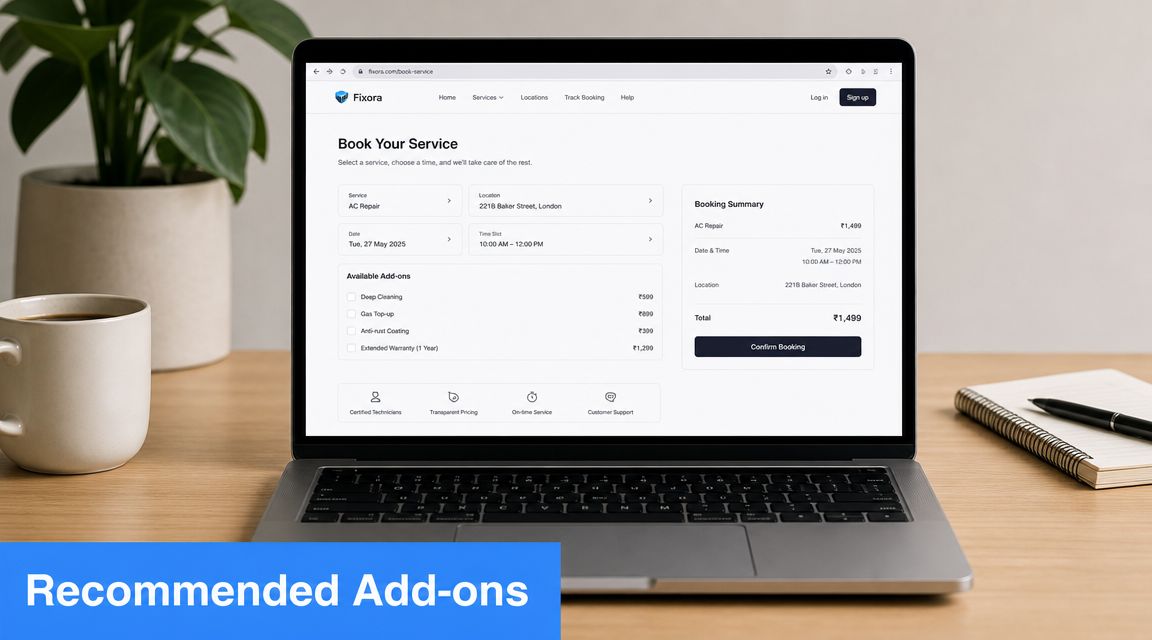
What doesn't work is random “you may also like” clutter. Website cross-sells need to feel like the next logical service, not a banner stuffed into the booking flow.
Simpler logic often wins
A lot of advice on personalization pushes businesses toward heavy analytics and complex recommendation systems. That can help at scale, but local service businesses often get better results from a smaller set of high-confidence pairings and lifecycle triggers, which is a tension discussed in Squarespace's article on cross-selling strategies.
That's the right lens for most local operators. You don't need an overbuilt recommendation engine to suggest “air duct cleaning” from an HVAC service page or “gutter repair” from a roofing inspection page.
A strong digital setup usually includes:
- Service-page cross-links: Put related services where the customer naturally evaluates next steps.
- Booking-path prompts: Surface one relevant add-on during the form or scheduler flow.
- Post-booking nudges: Send a confirmation email that includes one complementary service, not five.
AI optimization and SEO overlap directly. Clear service relationships on your site help search engines and AI systems understand your business coverage. They also help buyers self-select into higher-value jobs. If the site makes the second service obvious, your staff doesn't have to rescue missed revenue later.
8. Email and Marketing Automation Sequences for Complementary Services
Email still works for cross-selling when the trigger is real. A furnace tune-up should lead to an AC maintenance reminder later. A one-time pest treatment should trigger a preventive plan sequence. A cleaning appointment can trigger whitening education or a recall workflow for future care.
What fails is the generic newsletter blast. Broad batch email usually treats every customer the same, even though they entered your business through different services and different problems.
Trigger off behavior, not your calendar
Automated triggered email sequences can produce 152% higher click rates than regular batch campaigns, according to Prospeo's cross-selling strategies playbook. That same source also stresses a point many businesses ignore. Bad CRM records can wreck the whole program before it starts.
If the service history is messy, the automation sends the wrong message at the wrong time. That's how a useful cross-sell turns into annoyance.
- Clean the records first: Customer ID, service history, timestamps, and booked job type should be reliable.
- Tie emails to actual events: Completed service, declined recommendation, lapsed maintenance, or upcoming season.
- Keep the offer narrow: One email, one next step, one booking action.
The stronger operators also feed this data back into content and search. If customers who book drain cleaning often later need hydro jetting, your site should reflect that path. AI optimization gets stronger when your visible content mirrors the actual service journeys already happening in your CRM.
9. Knowledge-Based Content Marketing to Build Awareness of Additional Services
Some services don't need a hard sell. They need better explanation. Homeowners often don't know why water quality affects plumbing life. Patients may not understand how cosmetic and preventive dental care overlap. Property owners may not connect gutter issues with roof damage until there's already a leak.
That's where educational content pulls its weight. It creates awareness before the transactional search happens, and it gives you a natural bridge to complementary services.
Build content around service relationships
Good cross-sell content doesn't ramble. It teaches one problem clearly, then links to the service that solves it. An HVAC company might publish an indoor air quality guide that naturally leads to filtration, duct cleaning, or humidifier installation. A pest control company can explain seasonal pest behavior and lead into preventive treatment pages.
For a strong framework, this guide on what a content marketing strategy is is worth using as the planning base.
A few examples that work well:
- Plumbing: Articles on hard water, scale buildup, and fixture lifespan that connect to water treatment services.
- Roofing: Articles on drainage, flashing, and attic moisture that connect to inspection and gutter services.
- Dental: Articles on stain causes, maintenance habits, and smile planning that connect to whitening or cosmetic consultations.
Cross-sell content also benefits from better measurement. Practitioners often measure cross-sell rate on either a revenue basis or a customer basis, and they also use pair cross-sell rate and time-based cross-sell rate to separate product affinity from timing effects, as explained in Wall Street Prep's breakdown of cross-sell rate. For a local service company, that means tracking which content paths lead people from one service to another over time.
If you want AI systems to mention more than your flagship service, your site needs enough topical depth for those systems to understand your adjacent offerings. Content is how you create that depth.
10. Bundled Marketing and Co-Promotion with Complementary Vendors
A local business can expand reach fast by marketing with a complementary vendor or provider that serves the same buyer. An HVAC contractor and an indoor air quality equipment brand can run a comfort-focused campaign together. A plumbing company and a water treatment provider can create a combined service page. A roofing company and gutter protection vendor can market a prevention package around storm season.
The partnership only works if the offer is coherent. Customers don't care that two brands teamed up. They care whether the combined solution solves one problem better than either offer alone.
Keep the campaign tighter than the partnership
Joint marketing usually gets bloated when each partner insists on pushing every message. The fix is simple. Build one campaign around one use case. For example, “whole-home water quality and plumbing protection” is stronger than trying to promote every plumbing service and every filtration product at once.
A focused co-promotion should include:
- One landing page: Built around the combined buyer problem and local search terms.
- One shared message: The page, ads, and sales language should all promise the same outcome.
- One clean handoff: Make booking and follow-up obvious, especially if two companies are involved.
The AI and local SEO angle matters here too. When both businesses publish aligned content, mention the same use case, and reinforce local relevance, you increase your footprint around that transactional category. That helps on branded and non-branded search, and it gives AI systems more context to connect your business with the broader solution the customer is looking for.
10-Point Cross-Selling Strategy Comparison
| Strategy | Implementation complexity | Resource requirements | Expected outcomes | Ideal use cases | Key advantages |
|---|---|---|---|---|---|
| Service Bundling and Package Upselling | Medium, pricing design and staff training | Moderate, analytics, marketing collateral, sales training | Higher average order value, improved retention, predictable revenue | Repeat-service businesses (dental, HVAC, pest) | Increases lifetime value, simplifies sales, drives recurring revenue |
| Geographic Cross-Selling Across Service Areas | High, multi-location SEO and operational coordination | High, multiple GMB profiles, local landing pages, logistics | Faster geographic expansion, improved local rankings, lower CPA | Multi-location franchises and expanding home-service territories | Leverages existing trust to enter adjacent markets; network effects |
| Complementary Service Recommendations at Point of Service | Medium, training and on-site processes | Low–Moderate, staff training, mobile tools, CRM integration | Immediate upsells, higher conversion at point of service | On-site technician visits and inspections | High-intent personalization, low incremental marketing cost |
| Strategic Referral Partnerships Within Industry Networks | Medium, partner agreements and tracking systems | Low–Moderate, partner management, tracking codes, coordination | Warm referral leads, wider reach, reciprocal customer flows | Complementary non-competing services and local networks | Generates high-quality leads and shared credibility at low acquisition cost |
| Seasonal and Preventive Service Cross-Selling | Medium, requires calendar planning and SEO | Moderate, content, seasonal promotions, capacity planning | Predictable seasonal revenue, recurring maintenance plan adoption | Seasonal-dependent services (HVAC, pest, roofing) | Aligns offers with demand cycles and high-intent search trends |
| Account-Based Cross-Selling to High-Value Customers | High, data, personalization, dedicated management | High, robust CRM, analytics, account managers | High ROI, increased share-of-wallet, measurable outcomes | Commercial clients, multi-property owners, VIP customers | Maximizes ROI through focused, measurable expansion efforts |
| Digital Upselling Through Website Optimization and CTAs | Medium, UX, A/B testing and integration work | Moderate, web development, analytics, content | Scalable online conversions, 24/7 upsell capability | High-traffic booking sites and online service pages | Scalable, data-driven, complements human sales efforts |
| Email and Marketing Automation Sequences for Complementary Services | Medium, sequence design and integrations | Moderate, marketing platform, copywriting, CRM links | Automated nurture, multi-touch conversions, cost-efficient scaling | Post-service follow-ups and lifecycle marketing | Scalable ongoing engagement with clear performance metrics |
| Knowledge-Based Content Marketing to Build Awareness of Additional Services | Medium–High, ongoing content creation and SEO | Moderate, writers, SEO tools, content planning | Long-term organic leads, thought leadership, broader awareness | Services with complex buying journeys or low initial awareness | Builds trust, sustainable organic growth, supports SEO and cross-sells |
| Bundled Marketing and Co-Promotion with Complementary Vendors | High, coordination, co-branding agreements | Moderate–High, shared budgets, co-marketing assets | Expanded reach, shared costs, joint lead generation | Complementary vendors seeking combined campaigns | Doubles audience reach, cost-efficient promotion, enhanced credibility |
Turn Strategy into Transactions with AI-Powered SEO
Cross-selling isn't just a sales tactic. It's a visibility strategy. The first service gets the initial call, but the rest of your service stack is what grows account value, improves retention, and turns one-time buyers into repeat customers. If people only find you for one need, you're still leaving revenue on the table.
That's why the strongest cross selling strategies now sit at the intersection of service design, local SEO, Google Maps visibility, and AI optimization. A technician can make a great recommendation. A front desk team can send a smart follow-up. A referral partner can tee up the next job. None of it scales well if your business doesn't also show up for the next transactional term.
For local service businesses, that means building visibility around the actual phrases buyers use when they're ready to act. “AC repair near me.” “Emergency electrician near me.” “Dentist near me.” “Roof inspection near me.” Transactional Marketing is built around that exact mission. We target money-in-hand searches because those searches produce booked jobs, calls, and patients. Then we widen the footprint so your related services show up too.
Many marketing companies fall short. They talk broadly about traffic, branding, and awareness. That's not enough. You need pages that target local service intent, Google Business Profile optimization that strengthens map visibility, internal linking that connects complementary services, and content that helps AI systems understand what your business offers in each city you serve.
Hyper-local SEO is a major part of making cross-selling work. If you serve three cities, your add-on services should be visible in all three cities where it makes sense. If you want to sell maintenance plans, whitening, panel upgrades, rodent exclusion, or gutter protection, those services need dedicated local relevance. That means city pages, service pages, maps signals, and review language all working together.
AI optimization adds another layer. Search is changing. Buyers still use Google, but they're also getting recommendations from AI-driven interfaces that summarize businesses, compare options, and surface likely solutions. If your website is vague, thin, or incomplete, those systems won't connect the dots for you. If your site clearly maps services, locations, and customer problems, you give both search engines and AI engines something usable.
Transactional Marketing helps local businesses do exactly that. We focus on transactional terms, Google Maps placement, service-area expansion, and AI-ready content that turns searches into revenue. If you're tired of winning the first job but missing the second and third, it's time to build a system that captures the full customer relationship.
If you want Transactional LLC to help your business rank for transactional search terms like “roofer near me,” “dentist near me,” or “AC repair near me,” while also building the local SEO and AI optimization framework that makes cross-selling work, now's the time to talk. Transactional LLC helps service businesses dominate Google Search and Maps, expand into related service terms, and turn more local searches into booked jobs without locking you into a long-term contract.