


Think of Dental SEO as your practice's digital handshake. It’s the art and science of making sure your practice shows up first when local patients search for a dentist online. When someone types in a high-value, transactional search term like "emergency dentist near me," SEO is what puts your name at the top of their list. A critical part of modern digital strategy also involves AI optimization, ensuring your practice is discoverable by new AI-driven search engines and Large Language Models (LLMs) that are changing how patients find care.
Why Transactional SEO Is Your Best Patient Magnet
Picture this: someone just chipped a tooth. They're in pain, they're worried, and they immediately grab their phone to search for an "emergency dentist" or "cracked tooth repair." This isn't just a casual search; it's a transactional search term. The person searching has a serious need and money in hand, ready to spend it.
This is exactly where Transactional Marketing comes in. Our entire philosophy is built around capturing these high-intent moments, turning your website into your most effective patient-generating machine. We don't waste time on broad, informational keywords. We laser-focus on the specific transactional terms that signal an immediate need, ensuring the people finding your site are serious, high-quality patients ready to book. This article is dedicated solely to dental SEO—we believe in a focused approach, creating a separate, tailored strategy for each industry.
The Modern Patient Journey Starts Online
Long gone are the days of relying solely on a good reputation and word-of-mouth referrals. Today, the path to your chair almost always starts with a search engine. When a person needs a dentist, their first move is to pull out their phone.

The data backs this up completely. A staggering 71% of people looking for a dentist start with an online search before they even think about making a call. What's even more powerful is that 86% of those searchers actually contact a dentist after finding them online. This creates a direct, measurable line from search engine visibility to a filled appointment book.
Turning Searches into Scheduled Appointments
Our proven system is designed to get your practice front and center on page one of Google, often within 30 to 60 days. We do this by targeting those crucial, money-making transactional search terms and optimizing your entire online footprint right where it matters most—in your local community.
At Transactional Marketing, our goal is simple: get your practice to show up for the transactional searches that lead directly to phone calls and booked appointments. We connect you with patients who have money in hand and an urgent need for your services.
This isn't your typical, slow-burn marketing approach. We use a focused, battle-tested methodology to ensure you dominate the search results that actually convert. Our deep expertise across various dental practice marketing strategies allows us to build a comprehensive plan that delivers real, tangible results, filling your schedule with high-value patients month after month.
Dominating Local Search with Google Maps Optimization
When someone gets a toothache, they don’t pull out the phone book. They grab their phone and type in a transactional search term like a “dentist near me.” In that exact moment, the most valuable piece of digital real estate for your practice isn’t just the first page of Google—it’s the “Map Pack.” This is the box that appears at the top of the search results, showing the top three local dental practices, and it’s where most patients ready to spend money make their decision.
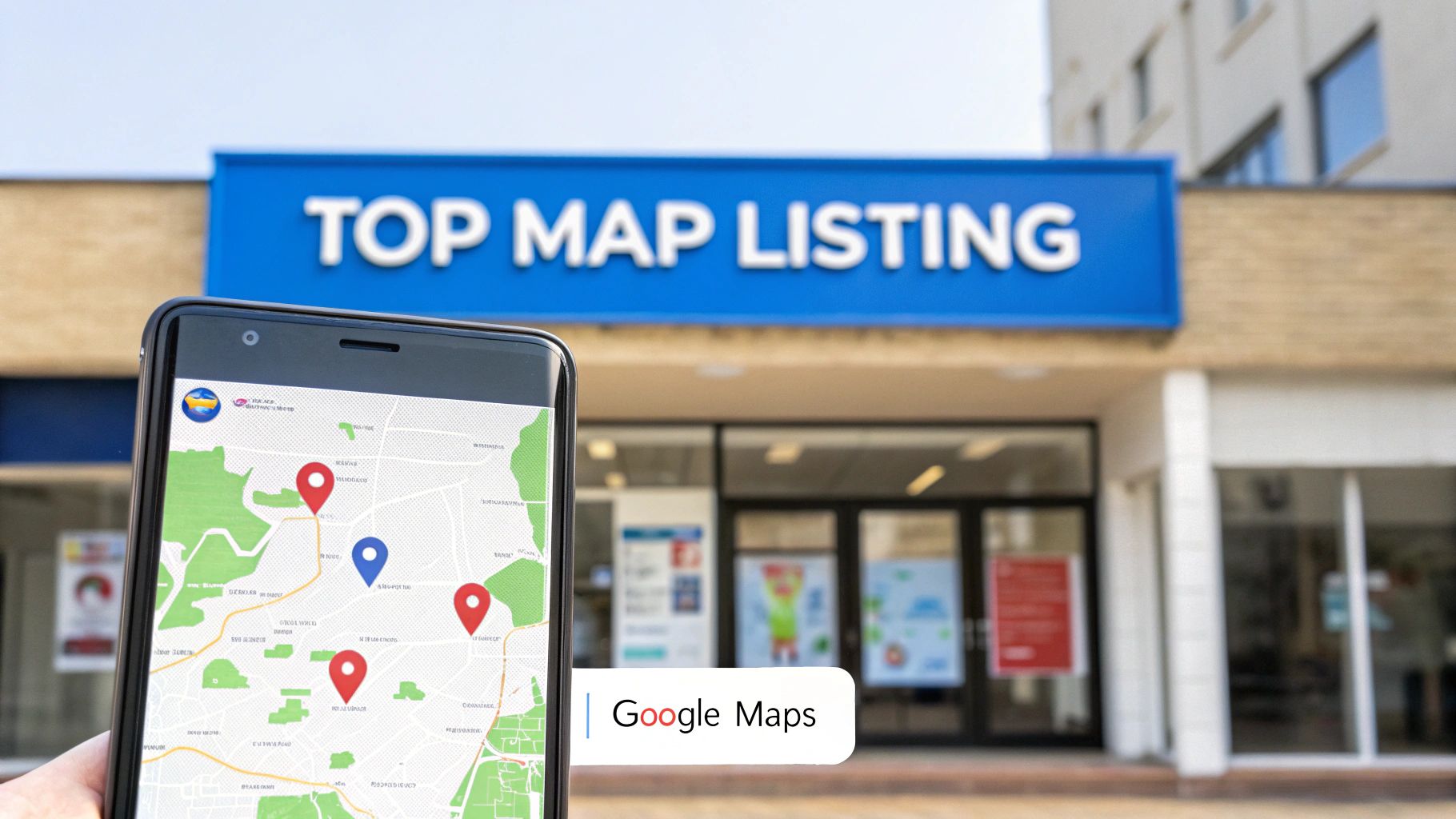
For any local dental practice, winning at SEO really means winning the Map Pack. Securing one of those top three spots is the single most effective way to intercept these high-intent, transactional searches and drive hundreds of more phone calls every month. At Transactional Marketing, we have the technology to make sure your map locations show up in this elite group, turning a simple listing into a powerful patient acquisition machine that generates thousands of more calls every year.
The Three Pillars of Google Maps Ranking
Google's algorithm for map rankings is complex, but it really comes down to three core factors that decide who shows up for transactional searches like “cosmetic dentistry in [Your City].”
- Relevance: This is all about how well your business profile matches what the patient is looking for. It means choosing the right service categories (like "Cosmetic Dentist" or "Orthodontist") and writing detailed service descriptions filled with the exact transactional terms patients use.
- Proximity: This one’s straightforward—it’s how close your practice is to the person searching. While you can't move your office, you can send strong signals to Google about your service area through targeted content and local optimizations.
- Authority: This is a measure of how prominent and trusted your practice is in the community. You build authority with a steady stream of positive patient reviews, consistent business information across the web (known as citations), and links from other local websites.
Think of it like a local election. Relevance is your campaign platform, proximity is your voting district, and authority is your public endorsement. You need all three to win.
A top-three position in the Google Map Pack isn't just about getting seen; it's about driving action. It directly translates into more phone calls, more requests for driving directions, and ultimately, more patients in your chairs.
Your Google Business Profile Is Your Digital Front Door
Your Google Business Profile (GBP) is the engine that powers your Map Pack ranking. An incomplete or neglected profile is like having a "Closed" sign on your front door, while a fully optimized one is a welcoming invitation for new patients. It's often the very first impression a potential patient has of your practice, making its accuracy and appeal absolutely essential.
We turn your GBP from a basic listing into a dynamic tool for patient conversion. This involves a meticulous setup process and ongoing management, because there are a lot of nuances in how to rank higher on Google Maps. It’s a multi-faceted approach that goes way beyond just filling out the basic info.
Regularly engaging with potential patients is key. You can use tools like a GMB Post Generator to easily share practice updates, promotions, and helpful dental tips right on your profile.
To give you an idea of what a winning profile looks like, here’s a quick overview of the key elements we focus on.
Key Elements of a Winning Google Business Profile for Dentists
| Element | Optimization Tactic | Why It Matters for Patient Trust |
|---|---|---|
| Business Information | Ensure Name, Address, Phone (NAP) are 100% consistent everywhere online. | Inconsistent information looks unprofessional and makes patients question if you're even open. |
| Service Categories | Select a precise primary category (e.g., "Orthodontist") and relevant secondary ones. | This tells both Google and patients exactly what you do, matching you to the right searches. |
| Business Description | Craft a keyword-rich description that highlights what makes your practice unique. | A compelling story builds an immediate connection and helps patients feel they've found the right place. |
| Photos & Videos | Upload high-quality, recent photos of your team, office interior, and technology. | Patients want to see where they're going and who will be treating them. It makes you feel more human. |
| Reviews & Q&A | Actively request new reviews and respond professionally to all feedback—good and bad. | Answering questions and reviews shows you care about the patient experience, building immense trust. |
| Services List | Detail every single service you offer with descriptions and, if possible, pricing. | Patients are looking for specific solutions. A detailed list confirms you can solve their problem. |
| Google Posts | Regularly share updates, special offers, and health tips using the Posts feature. | Active profiles look more current and engaged, signaling to patients that your practice is thriving. |
By methodically optimizing every one of these components, we ensure your profile sends the strongest possible signals to Google, establishing your practice as the go-to authority in your local area and driving thousands more phone calls every year.
Your Blueprint for a High-Ranking Dental Website
Getting your practice to the top of Google Maps is a huge win, but it’s only half the battle. What happens when a potential patient clicks from your map listing to your website? You need a powerful, persuasive online home that converts their initial interest into a booked appointment. This is where your on-page SEO blueprint comes in, turning your site from a simple digital brochure into a patient-generating machine.

Think of your website’s structure as a roadmap for both Google and your future patients. A disorganized, confusing site is a dead end for everyone. We build websites with a clear, logical structure designed from the ground up to rank for the transactional keywords that actually grow your practice. If you're looking to get a solid grasp of the fundamentals, exploring some practical search engine optimization tips can lay a strong foundation.
The key is that every high-value service you offer gets its own dedicated page. A patient searching for the transactional term “dental implants” expects to land on a page that speaks directly to that specific need, not a generic “services” list. Creating these focused pages is how we laser-target the exact terms people use when they're ready to book. That's why we're called Transactional Marketing—we get you to show up for the exact terms that lead to business.
Structuring Your Site for Transactional Searches
A winning dental website is built around a core strategy of service pages and location pages. This structure is absolutely essential for capturing patients who are actively searching for care in your specific area.
-
Dedicated Service Pages: Every major procedure you offer—from “Invisalign” and “teeth whitening” to “root canals”—needs its own home on your site. This allows us to optimize each page for the specific, high-intent transactional keywords that patients are typing into Google right now.
-
Location-Specific Pages: If your practice serves multiple neighborhoods or towns, creating pages like “dentist in [Your City]” or “emergency dentist in [Your Neighborhood]” is non-negotiable. This strategy sends powerful local signals to Google, making you the obvious choice for patients in their immediate vicinity.
By creating this clear hierarchy, we ensure that no matter what transactional search a patient uses, they land on a page that directly addresses their problem. This immediately builds trust and dramatically increases the chances they’ll pick up the phone.
Building Topical Authority to Become the Go-To Expert
At the end of the day, Google’s job is to provide searchers with the most authoritative answers. For a dental practice, that means proving you have deep expertise in your field. This is also critical for the new wave of AI optimization, as Large Language Models (LLMs) are trained to find and synthesize information from the most credible sources. We build what’s known as topical authority to position you as that source.
Imagine your website as a library dedicated to oral health. Your main service pages are the foundational textbooks on big topics like cosmetic dentistry or orthodontics. But to truly establish yourself as an expert, you need to surround those core pages with supporting content that answers every possible related question a patient might have.
Building topical authority isn't just about having a few pages; it's about creating a comprehensive resource that proves to Google, new AI search engines, and patients that you are the definitive expert for dental care in your community.
We accomplish this through smart content creation, often in the form of blog posts that answer common patient questions. For example, a core service page for "Dental Implants" would be supported by articles like:
- How Much Do Dental Implants Cost in [Your City]?
- Are Dental Implants Painful?
- Dental Implants vs. Bridges: Which is Better?
This one-two punch does two critical things. First, it captures a massive range of long-tail keywords that signal high patient intent. Second, it proves to search engines that your practice has a deep, comprehensive knowledge of the subject. This is exactly how we get our clients showing up on page one of Google within 30 to 60 days, turning their website into a consistent source of high-quality patient traffic.
Earning Trust with Patient Reviews and Local Endorsements
When it comes to dental SEO, trust is everything. A technically sound website gets you in the game, but your reputation across the web is what truly convinces Google—and new patients—that you’re the right choice. This is where we move beyond your own website and focus on building authority through patient reviews and earning "votes of confidence" from other respected local sources.
Think about how you'd find a great local restaurant. You wouldn't just look at their website, right? You’d check their Google reviews, see if they’ve been featured on a local food blog, and maybe ask a friend for a recommendation. That's exactly what patients do when searching for a dentist, and Google’s algorithm is smart enough to replicate that real-world trust-building process.
The Unmistakable Power of Patient Reviews
Patient reviews are arguably the single most powerful signal in local SEO. A consistent flow of recent, positive feedback doesn't just make your Google Business Profile look impressive; it directly influences how high you rank in the Google Maps results for transactional searches.
Each five-star review is a direct signal to Google that your practice delivers an exceptional patient experience, making you a much safer and more reliable result to show people searching for care.
Imagine a potential patient, up late with a toothache, scrolling through their options. Seeing a long list of glowing, recent reviews can be the one thing that compels them to call your practice over another. It's the digital version of a powerful word-of-mouth referral.
But it’s not just about getting reviews; it’s about what you do with them. Responding professionally to all feedback, both positive and negative, demonstrates that you're an engaged, caring practice owner. This kind of active reputation management is a cornerstone of building a trusted online presence.
Getting Local "Votes of Confidence"
Beyond reviews, the next piece of the puzzle is building local links. Don't let the term intimidate you; the concept is simple. When another reputable local website links to your practice’s site, it's essentially giving you a public endorsement.
Google sees these links as proof that your practice is a legitimate, respected, and active member of the local community. The more of these high-quality local links you get, the more authority your website builds, which directly helps you rank for those all-important transactional search terms like "cosmetic dentist near me."
This has nothing to do with spammy old-school tactics. It’s about real community engagement. Here are a few practical ways to earn these valuable local signals:
- Sponsor a local Little League team. Their website will almost always link back to their sponsors' websites as a thank you.
- Team up with other local health professionals. A nearby orthodontist or oral surgeon might link to you as their go-to general dentistry partner.
- Host a community event or charity drive. Getting involved in a local health fair can earn you mentions and links from local news sites and community group pages.
Every one of these actions strengthens your local relevance and your website’s authority. By pairing a proactive review strategy with genuine community involvement, you build a powerful web of trust signals that cements your practice as a local leader, driving both your rankings and your new patient phone calls.
Getting Your Website's Technical Engine Firing on All Cylinders
Think of your dental website like a high-performance car. The content and design are the shiny paint job and comfortable seats that impress patients. But technical SEO? That’s the powerful, meticulously tuned engine under the hood. It’s completely invisible to your visitors, but it's what determines whether your site flies past the competition or sputters to a halt on the starting line.
This behind-the-scenes work is often what separates a practice that struggles to get found from one that consistently tops Google's rankings. In the cutthroat world of local search, even the most beautiful website will fail if its technical foundation is shaky. A slow, clunky, or insecure site actively undermines every other marketing dollar you spend.
The Technical Non-Negotiables
Three core technical pillars are absolutely non-negotiable. They directly impact a visitor's experience and signal to Google that your site is trustworthy and professional. A failure in any one of these areas can send a potential patient clicking away in seconds, straight to your competitor.
-
Website Speed: Every single second counts. If your site drags its feet loading, especially on a phone, potential patients are gone. They'll hit the back button without a second thought. A fast site feels professional and shows you respect their time.
-
Mobile-Friendliness: Let's face it, almost every transactional search like "emergency dentist near me" happens on a smartphone. Your website must provide a seamless, easy-to-use experience on a small screen. It has to be intuitive. That’s why we build powerful mobile-optimized sites designed to turn those mobile searchers into actual patients.
-
Site Security (HTTPS): That little padlock icon in the browser's address bar is a massive trust signal. It tells visitors their connection is secure, protecting their data and assuring them (and Google) that your practice is legitimate and professional.
Helping Google Understand You With Schema Markup
Beyond the basics, we have a powerful tool called structured data, or Schema Markup. Imagine it as creating a set of clear, concise labels for Google that spell out exactly what each piece of information on your site means. Instead of forcing Google to guess, you're spoon-feeding it the answers.
You can explicitly tell it: "This is our practice's physical address," "These are our exact business hours," and "This is a detailed list of our dental services."
Think of Schema Markup as a direct translation of your website into a language search engines and AI models understand perfectly. This makes it incredibly easy for Google to pull your information into high-visibility search features like knowledge panels and map packs.
This level of technical precision is what helps thriving practices dominate the search results. The top-ranking dental sites are always built to be mobile-first, enhanced with schema, and rock-solid from a performance standpoint. This is critical for capturing what we call long-tail keywords—the highly specific searches that make up an astonishing 92% of all queries.
When your technical engine is perfectly tuned, you create a fast, secure, and clear path for every potential patient searching for the exact services you offer.
Measuring Your SEO Success and Taking Action
A real dental SEO strategy isn't about guesswork or feeling good about website visits. It's about tracking tangible results that put more patients in your chairs. Forget the vanity metrics. The only numbers that matter are the ones that grow your practice.
This means we have to focus on the right Key Performance Indicators (KPIs) that prove the work is actually working. We cut through the noise to zero in on what drives new business: showing up for the transactional search terms that signal a patient needs you right now.
We measure our success by your rankings for these high-value keywords, your visibility in the Google Map Pack, and—most importantly—the direct increase in new patient phone calls and appointment bookings.
Your Actionable 90-Day Roadmap to Local Dominance
Getting to the top of Google doesn't happen by accident. It's the result of a deliberate and tested process. While our proven system often starts delivering results within 30 to 60 days, the first three months are absolutely critical for building a foundation that lasts.
Here’s a clear roadmap of what to expect as we get started.
Month 1 (Days 1-30): Foundation and Technical Blueprint
The first month is all about deep analysis and getting your technical house in order. We run a comprehensive audit of your website and entire online footprint to find quick wins and expose any underlying weaknesses. Think of this as tuning up your website’s engine for peak performance.
- Kickoff & Goal Alignment: We start by pinpointing your most profitable services and ideal patient demographics. This ensures our strategy is perfectly aligned with your actual business goals from day one.
- Transactional Keyword Research: Our team hunts down the exact "money" keywords that patients in your city are typing into Google, like "emergency dentist [Your City]" or "dental implants near me." These are the transactional terms we get our customers to show up for.
- Technical & On-Page SEO Audit: We get our hands dirty, diving into your site's code, page speed, and overall structure to fix anything that could be holding you back in the search results.
- Google Business Profile Optimization: We meticulously comb through every single section of your GBP, optimizing it to grab as much real estate as possible in the all-important Google Maps results.
The image below shows the key technical pillars we prioritize to make sure your website is fast, secure, and works flawlessly on mobile devices.
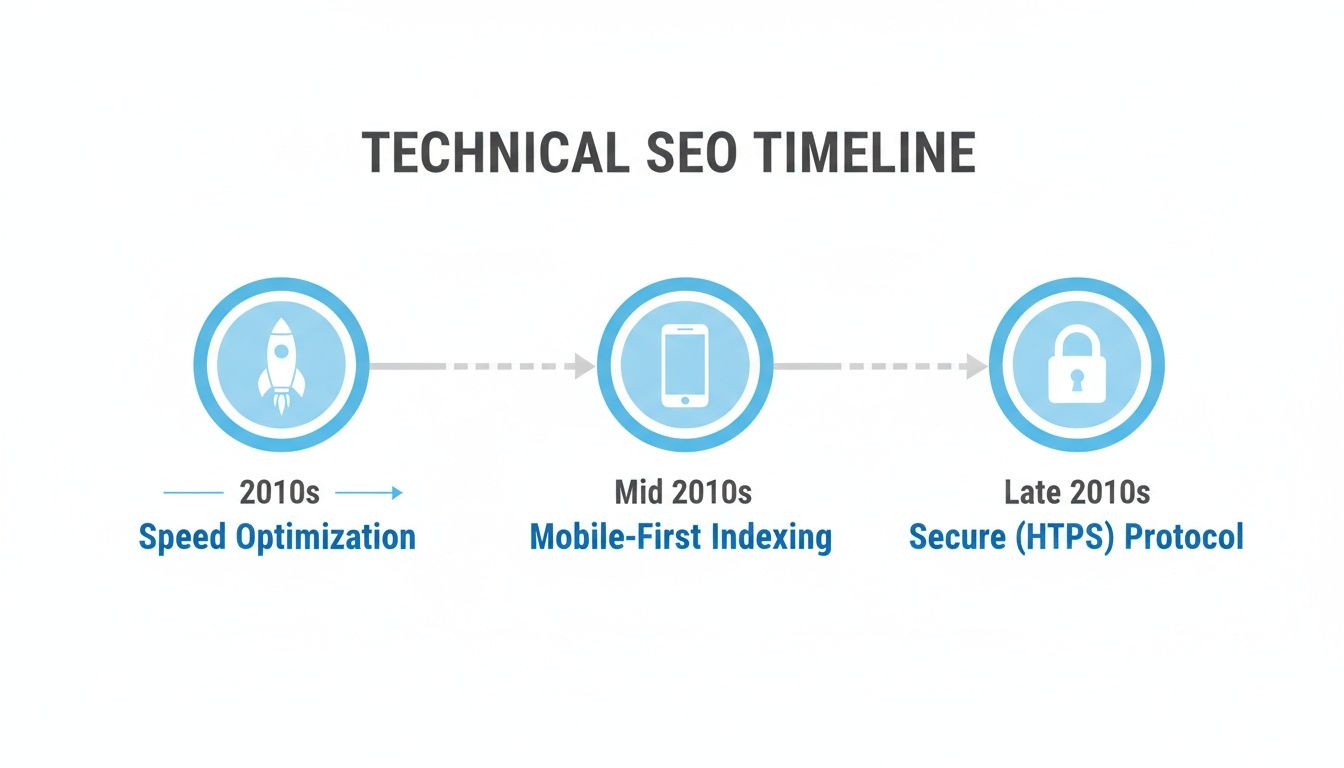
A fast, mobile-friendly, and secure website isn't just a nice-to-have; it's the non-negotiable bedrock of any successful dental SEO campaign.
Month 2 (Days 31-60): Content Authority and Local Signals
With the technical foundation solidly in place, we pivot to building your authority. This means creating the high-value, locally-focused content that both Google and potential new patients are actively looking for.
- Service & Location Page Rollout: We begin publishing highly optimized pages for each of your core services and the specific neighborhoods or towns you serve.
- Initial Content Creation: Our writers develop the first batch of authoritative blog posts, answering common patient questions and targeting valuable long-tail keywords.
- Citation Building & Cleanup: We make sure your practice's name, address, and phone number (NAP) are perfectly consistent across all major online directories, which sends strong trust signals to Google.
Month 3 (Days 61-90): Acceleration and Reporting
This is where the real momentum starts to build and the results become undeniable. We analyze the early performance data to double down on what’s working and fine-tune our approach for maximum impact.
The goal of month three is to transform those initial ranking improvements into a consistent, predictable stream of new patient inquiries. We focus on strategies that directly drive more phone calls and contact form submissions.
We'll also walk you through a suite of powerful local SEO reporting tools that give you a transparent, behind-the-scenes look at your campaign's progress. You will see firsthand how our work is translating into higher rankings, better map visibility, and a measurable lift in patient leads that sets the stage for long-term growth.
Your Dental SEO Questions, Answered
If you're thinking about putting real effort into your practice's online presence, you've probably got some questions. Let's tackle the most common ones we hear from practice owners just like you.
How Long Until I Actually See Results from SEO?
Every market has its own quirks, but our approach is built for speed. Here at Transactional Marketing, we have a repeatable, proven system that consistently gets our clients ranking on the first page of Google for money-making, transactional search terms in just 30 to 60 days.
Think of it this way: the first few months are all about laying a rock-solid foundation. You don't get a six-pack after one trip to the gym, but after three to six months of consistent work, the changes are impossible to ignore. That’s when you’ll see a real, compounding impact on your rankings, website traffic, and, most importantly, the number of new patient calls you get.
What Should a Dental Practice Expect to Budget for SEO?
The cost can certainly vary, but it's crucial to see SEO as an investment, not just another line item expense. The better question to ask is, "What's the return on that investment going to be?" A sharp SEO campaign targeting transactional keywords like "dental implants near me" doesn't just drive clicks—it brings in high-value patients ready to start treatment.
To figure out your potential ROI, just think about the lifetime value of a single new patient. When one patient can be worth thousands of dollars to your practice over the years, a strategy that consistently brings in even a handful of new patients every month delivers an incredible return. Your budget should really be a reflection of your growth goals and how competitive your local area is.
What’s the Real Difference Between SEO and Paid Ads?
SEO and paid advertising (like Google Ads) are two powerful tools for getting in front of new patients, but they work in fundamentally different ways.
- Paid Ads (PPC): This is essentially renting your visibility. You pay Google for a top spot, and the second you stop paying, your ad vanishes. It's fantastic for getting a quick burst of new leads right now.
- Dental SEO: This is more like owning your visibility. You're building a valuable, long-term asset for your practice that generates a steady stream of organic traffic without you having to pay for every single click. In the long run, SEO almost always delivers a higher ROI because the results you build are yours to keep.
The smartest marketing plans often use a mix of both. But SEO is the bedrock of sustainable, long-term growth. It builds the kind of trust and authority with both Google and potential patients that paid ads just can't replicate, keeping your practice visible for years to come.
Ready to stop guessing and start getting patients from Google? At Transactional Marketing, we build dental SEO campaigns that focus on what matters—attracting patients with money in hand, ready to book an appointment. See how our proven system can fill your schedule by visiting https://transactional.net.