


You're probably in one of two spots right now.
You run a service business, and your phone isn't ringing enough. Maybe you own an HVAC company, a roofing business, a dental practice, or a pest control operation. You know how to sell your service once a lead comes in. What you don't have time for is figuring out Google Business Profile categories, location pages, review strategy, AI search visibility, and why some competitor keeps showing up for queries like “roofer near me.”
Or you're looking at a digital marketing franchise because it sounds clean. Proven system. Training. Brand. Templates. Someone hands you the playbook, and you go sell marketing.
That sounds good on paper. The question is simpler. Will it get you in front of people searching transactional terms with money in hand?
Transactional Marketing exists around that exact idea. A transactional search term is the search that matters most. “Air conditioning repair near me.” “Dentist near me.” “Emergency plumber near me.” “Roofer near me.” Those searches come from people ready to book, call, schedule, or buy. That's the traffic local businesses should care about.
AI optimization now matters too. Search isn't just ten blue links anymore. Large language models, AI summaries, entity understanding, local citations, review language, and structured service content all affect how businesses get surfaced. If your digital strategy isn't built for both classic SEO and AI-driven discovery, you're already behind.
The Search for More Customers and the Franchise Promise
A local business owner usually doesn't wake up wanting a marketing system. They wake up wanting more booked jobs, more scheduled consultations, and fewer dead spots on the calendar.
A mechanic, roofer, or dentist hits the same wall. Referrals aren't enough. Word of mouth fluctuates. Paid ads get expensive fast when the account isn't managed well. SEO agencies talk about impressions and engagement when what you need is calls from people who need service now.
That's why the digital marketing franchise model gets attention. It promises structure. You buy into a brand, get training, get a process, and start offering SEO, PPC, websites, and social media under a recognized banner. For someone who wants a business in a box, that pitch is effective.
Why the model looks attractive
The market demand is real. The global digital marketing franchise market is projected to reach USD 15.7 billion by 2033, growing at a 10.3% CAGR, according to DataHorizzon Research on digital marketing franchise growth. Local businesses clearly want help with SEO, social media, and PPC.
That demand makes people assume the model itself is the answer.
It isn't. Demand for marketing services doesn't automatically mean a franchise is the best way to deliver them, especially for local service businesses that win on hyperlocal intent and fast-moving search behavior.
Practical rule: If a marketing model can't clearly explain how it gets a business to rank for “near me” and city-plus-service searches, it's solving the wrong problem.
What actually matters to a service business
If you're a home service company or local clinic, the target isn't “more visibility” in a vague sense. The target is transactional visibility. You need to appear when someone is searching with buying intent right now.
That means showing up for exact searches like “air conditioning repair near me,” “emergency electrician near me,” or “dentist near me.” It also means showing up in the map pack, because a huge portion of local buyers never go past those top map results. If you want a deeper look at the local infrastructure behind that, this guide on local SEO for franchise businesses is worth reading.
A lot of franchise pitches skip that distinction. They sell marketing as a bundle. Serious operators focus on the search terms that produce revenue.
What Exactly Is a Digital Marketing Franchise
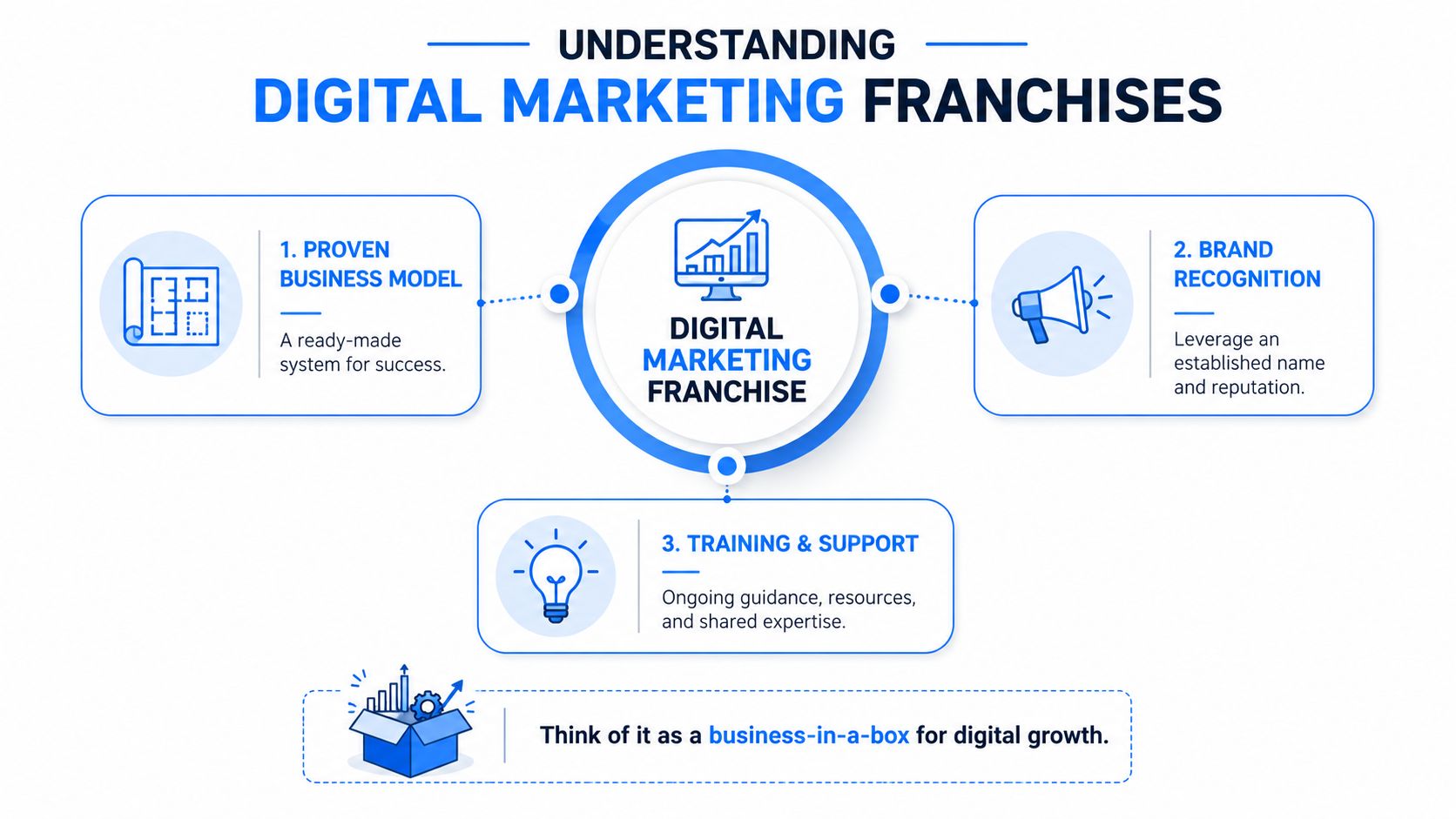
A digital marketing franchise works a lot like a fast-food franchise. The parent company builds the brand, the offer, the sales materials, the operating system, and the training. The local owner buys into that system and follows it.
You're not inventing the business from scratch. You're leasing a proven framework and agreeing to run it their way.
The basic structure
Three pieces define the model.
- Franchisor: The parent company. They own the brand, set the systems, and decide how services are packaged and delivered.
- Franchisee: The local operator. You buy the right to use the brand and sell within the approved system.
- Franchise agreement: The contract that controls what you can do, how you operate, what you pay, and what rules you follow.
Most systems also include royalty fees, mandatory software, approved vendors, prescribed offers, and sales scripts. In plain English, you get support, but you also give up freedom.
What you're really buying
People think they're buying marketing expertise. Usually, they're buying four things instead.
Brand recognition
An established name can make prospecting easier. If the parent brand has credibility, you don't start from zero every time you pitch.
Sales process
Most franchises hand you a ready-made pitch deck, service menu, onboarding flow, and fulfillment process. That helps operators who are good at selling but weak on operations.
Training and support
You'll often get onboarding, coaching, templates, and internal documentation. For many first-time owners, that's the biggest draw.
The appeal isn't mystery. It's reduced decision-making.
Constraints
This is the part franchise sales reps don't emphasize enough. You may be locked into specific service packages, pricing logic, software platforms, and delivery methods. If your market needs something different, tough.
That matters more in SEO than in many other fields because local visibility isn't one-size-fits-all. A roofer, dentist, chiropractor, and pest control company don't need the same content strategy, page structure, review prompts, or Google Business Profile setup. That's one reason broad “marketing for everyone” systems often produce bland results.
If you want the non-franchise version of what an SEO provider should do, read what SEO companies do. It's a useful filter before you buy into any packaged model.
The Franchise Playbook Operations Services and Costs
Once you get past the glossy pitch, the digital marketing franchise becomes an operations question.
What are they delivering? How fast can they launch campaigns? What happens for a local service business that needs map rankings, city pages, and AI-optimized service content instead of generic social posts?
What many franchises sell
Most digital marketing franchise systems package familiar services:
- Templated websites that are easy to deploy but often weak on local differentiation
- Basic SEO packages with title tags, service pages, and directory submissions
- Social media posting that keeps feeds active but rarely drives booked jobs
- PPC management using broad account structures that may not reflect service-area buying patterns
- Reporting dashboards that look polished but sometimes emphasize vanity metrics over revenue signals
That doesn't make the model useless. It makes it uneven. Some systems are competent. Some are selling repetition dressed up as expertise.
What a competent system should include
There are a few essential elements if the goal is real local search performance.
A strong multi-location setup needs dynamic location pages with unique NAP data, hours, and local descriptions. It also needs LocalBusiness schema and a logical URL structure so Google can properly interpret each service area. That local SEO architecture is outlined in this franchise digital marketing guidance on dynamic NAP integration and location page structure.
A second benchmark is speed and reporting. A benchmark for competence in this space is a documented 30-day launch playbook that allows a new franchisee to deploy local marketing campaigns within one month, supported by a centralized reporting dashboard to track location-specific KPIs like lead conversion rates and CPA, according to BizIQ's breakdown of franchise digital marketing operations.
If a system can't launch quickly and can't report by location, it's not built for serious local execution.
A dashboard is only useful if it shows what happened by city, by service, and by lead source.
Cost reality and comparison discipline
A franchise adds a layer of cost before you've booked a single customer. There's the buy-in, the ongoing royalty structure, the required software stack, and whatever limitations come with territorial rules. The exact numbers vary, but the pattern is the same. You pay for the system whether or not the system fits your market.
That's why smart buyers compare franchise models with other route-based or territory-based business structures before signing anything. If you want an example of how investors think through fixed capital requirements in another operational model, this breakdown of required capital for FedEx routes gives useful context. Different industry, same discipline. Know what you're committing to before you chase the brand name.
Here's the hard part many buyers miss. In local marketing, the actual cost isn't just the franchise fee. It's the opportunity cost of running a generic system in a market that rewards specificity.
If you're evaluating any marketing model, you need to understand how to calculate cost per acquisition. That number exposes whether the playbook is producing customers or just activity.
Weighing Your Options Pros and Cons of Franchising
There are legitimate reasons people buy a digital marketing franchise. There are also strong reasons local service operators should be skeptical.
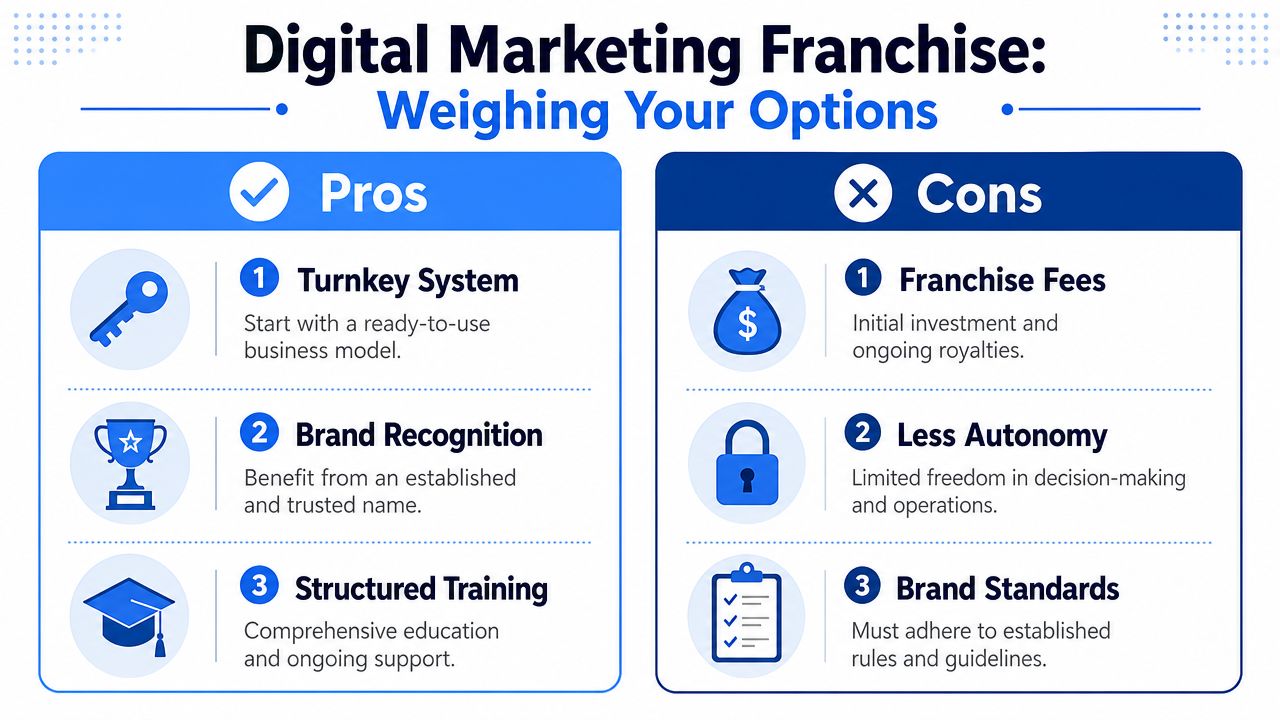
The real advantages
The upside is straightforward.
- You get a starting point. That matters if you've never sold marketing services before.
- You get training. Many operators need structure more than freedom in the beginning.
- You get a recognized offer. That can shorten the trust-building process in sales conversations.
For some buyers, that's enough. They don't want to build systems. They want to inherit them.
Here's a broader perspective on franchise operations and marketing systems:
Where the model breaks for local service SEO
The biggest weakness is rigidity.
Local search doesn't reward sameness. A dental office needs a different content architecture than a roofer. A pest control company needs different service modifiers, seasonality pages, review prompts, and map relevance signals than a chiropractor. AI optimization makes that gap even wider because large language models surface businesses based on tightly matched service context, local entity clarity, and topical coverage.
That's why the old “everyone uses the same assets” approach fails.
Top-performing franchise networks use a hub-and-spoke model that allows for local tailoring, while rigid mandatory digital marketing mandates often backfire, especially in service industries where hyperlocal context drives SEO and engagement, according to this analysis of local digital adoption in franchise networks.
The closer the search is to a buying decision, the less tolerance there is for generic marketing.
The trust problem
Another issue is proof.
Franchisees often hear about traffic, rankings, content production, and campaign activity. What they want is simple. Did this produce calls, appointments, and revenue in my territory? That's where many systems get exposed. If the model can't connect local campaign actions to local business outcomes, confidence drops fast.
For service businesses, that gets expensive. You can't build your year around vague reports while a competitor grabs “dentist near me” or “roof repair near me” in your city.
A franchise can make sense if you need training wheels. It's a weaker fit if your market requires aggressive local adaptation, transactional keyword targeting, and Google Maps execution that changes by service area.
Smarter Alternatives for Local Service Businesses
If you run a local service business, you don't need a prettier marketing story. You need a model that gets your business found when buyers are ready to act.
That's why the best alternative to a digital marketing franchise often isn't another franchise. It's a more flexible operating model built around local intent, AI visibility, and map pack performance.
Three practical paths
Build your own agency or internal team
This gives you control. It also gives you all the mistakes.
You need to hire writers, SEO operators, Google Ads managers, web support, and reporting talent. You need processes for service pages, city pages, review workflows, schema, content QA, and AI search formatting. Most local businesses don't want to become marketing operations companies.
Use white-label fulfillment
This looks efficient until quality drifts.
White-label providers can help with production, but many don't own strategy. They'll deliver pages, reports, or citations. They won't necessarily build a plan around “air conditioning repair near me” in one city and “emergency AC service” in the next. That gap matters.
Work with a specialized SEO partner
This is the strongest route for many service businesses because it stays focused on outcomes. Not generic digital presence. Not vanity traffic. Transactional search visibility.
For local service companies, Google Maps optimization deserves its own lane. It is not the same thing as writing blog content or tweaking title tags.
Google Maps rankings are primarily controlled by Relevance, Proximity, and Prominence, which account for over 60% of a business's position. Optimizing the Google Business Profile primary category and review velocity is more critical than general website content for map visibility, according to this Google Business Profile ranking analysis.
That's a major reason generic franchise systems underperform. They often treat maps as a side task inside a broader package. For service businesses, maps are often the front door.
If you want more calls from “near me” searches, treat Google Maps as a primary revenue channel, not a profile you set up once and ignore.
Marketing Model Comparison for Service Businesses
| Attribute | Digital Marketing Franchise | DIY / In-House Agency | Specialized SEO Partner (e.g., Transactional) |
|---|---|---|---|
| Speed to execution | Depends on franchise systems and approvals | Slow at first while hiring and building process | Usually faster because the playbook already exists |
| Flexibility by industry | Often limited by standard packages | High, but only if your team knows local SEO deeply | High when the partner builds by vertical and service |
| Google Maps focus | Often bundled into a general offer | Varies by internal expertise | Usually treated as a dedicated growth channel |
| AI optimization readiness | Uneven across franchise networks | Hard to build internally without specialists | Stronger when content and entity structure are purpose-built |
| Control over strategy | Restricted by franchise rules | Full control | Shared control with room for local priorities |
| Best fit | New entrepreneurs who want a packaged model | Businesses willing to build from scratch | Service companies that want calls, leads, and appointments from search |
The practical choice comes down to this. If your business lives on local demand, pick the model that's obsessed with local demand. That means city pages, review flow, service-specific content, Google Business Profile categories, map visibility, and AI-ready content structures.
If you're evaluating providers, this guide on how to choose a digital marketing agency gives you a clean way to sort specialists from generalists.
Your Due Diligence Checklist and Next Steps
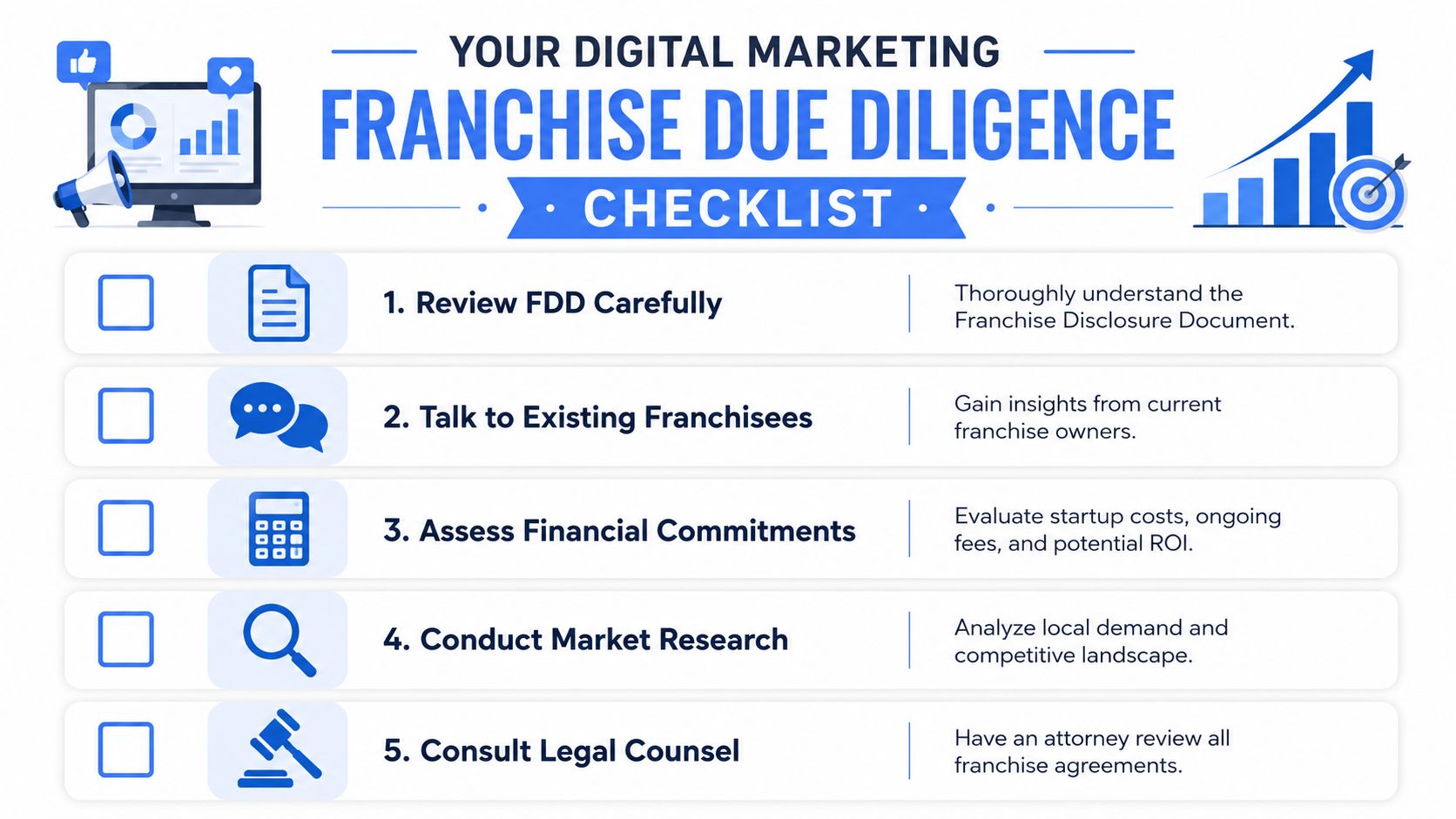
If you're still considering a digital marketing franchise, ask better questions before you sign anything.
The marketing side of franchising matters more than ever. Franchise digital marketing is now the primary engine for growth, with 78% of brands increasing their digital budgets in 2024 and digital channels absorbing over 60% of total marketing spend for franchise systems, according to these franchise marketing statistics. That means weak execution is no longer a side issue. It's the core issue.
Questions that expose the truth
Don't ask whether they “do SEO.” Ask sharper questions.
- Show transactional proof. Ask which exact local intent terms they target for service businesses, such as “dentist near me” or “air conditioning repair near me.”
- Ask for the Maps process. Make them explain how they handle categories, services, reviews, relevance, and local prominence.
- Check industry separation. If they use the same content strategy across roofing, dental, plumbing, med spa, and pest control, that's a warning sign.
- Ask how they handle AI optimization. They should be able to explain how content, entities, service pages, FAQs, reviews, and local business data influence LLM-driven discovery.
- Demand local reporting. If they can't show results by city, service, and search intent, the reporting won't help you make decisions.
What your next move should be
Stop shopping for a marketing system like you're buying office furniture.
Start with the result. You want your business to show up when a buyer searches a transactional term. You want visibility in Google Maps. You want city-specific service pages that can rank. You want AI-friendly content that helps your brand get discovered as search keeps changing. And you want reporting tied to leads, calls, booked jobs, and patient appointments.
That's the standard.
If a franchise can do that, fine. If it can't, the logo and training materials don't matter.
If you want a partner focused on transactional search terms, Google Maps visibility, AI optimization, and local SEO built for service businesses, talk to Transactional LLC. They help companies rank for the searches that bring in buyers ready to book, from “roofer near me” to “dentist near me,” with a contract-free model built around results instead of long commitments.