


You're probably here because the ads look busy, the leads feel random, and you can't tell whether the person running your account understands your market or just knows how to spend your budget. That's the problem with hiring for google ads management near me, a lot of buyers are shopping for proximity when they should be shopping for someone who can separate profitable local searches from junk clicks and set up campaigns that fit a real service area.
If you run a roofing, HVAC, dental, or pest control business, Google Ads can absolutely work, but only when the account is built around transactional search terms, tight location controls, and conversion tracking that tells the truth. Google says its ad products can reach customers across Search, YouTube, and the broader Google ecosystem, and independent estimates place Google's share of the PPC market at 69.04% in 2025 (Google Ads overview). That scale is exactly why local campaign quality matters so much.
Why Local Google Ads Expertise Matters More Than You Think
A Denver roofer can burn through a week of spend by hiring an agency that knows how to launch ads but does not know how to wall off the wrong neighborhoods, exclude dead service areas, or set up conversion tracking that proves the calls are worth buying. The account will still show activity. The phone will stay quiet, and the owner will be left guessing where the budget went.
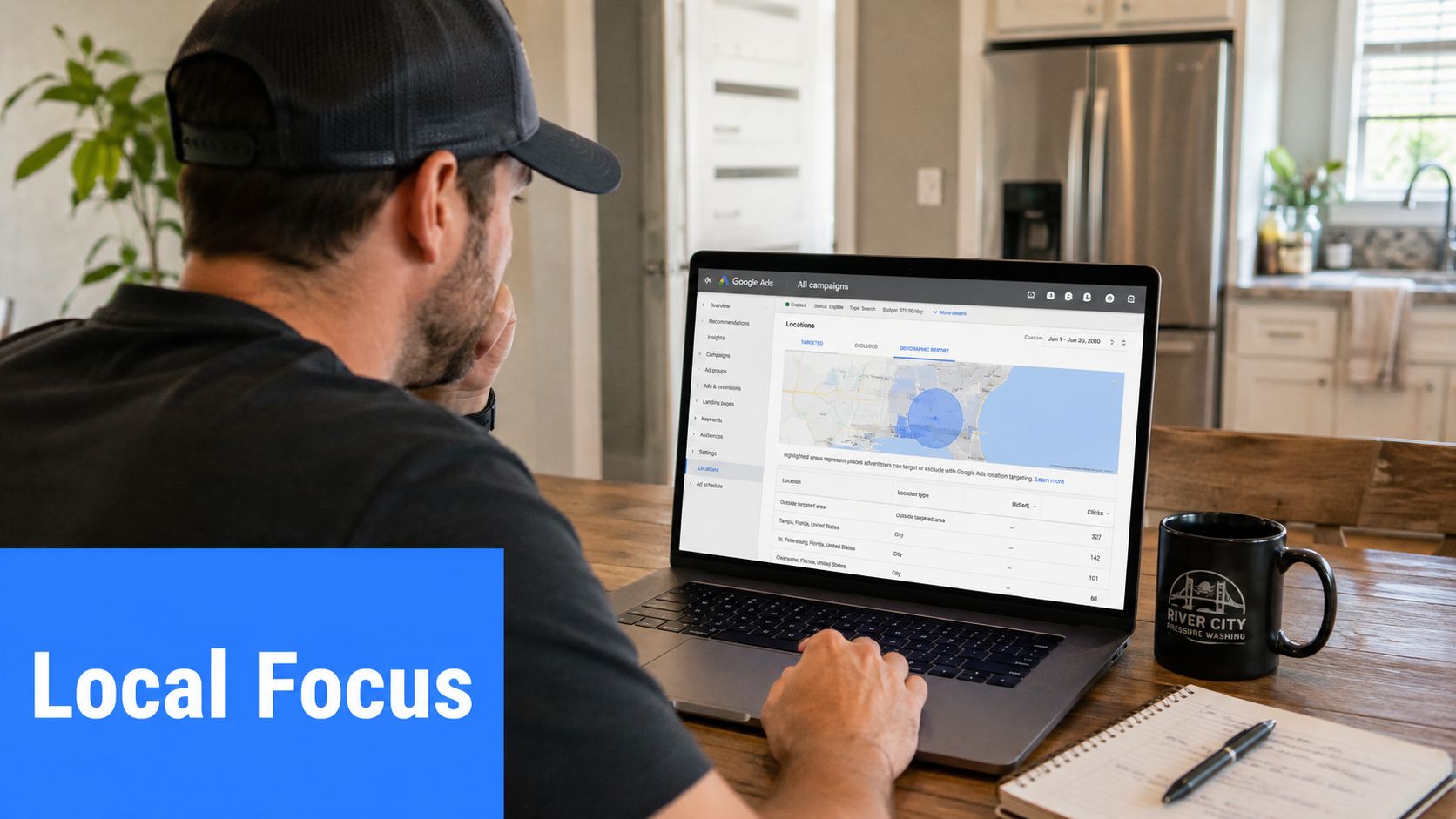
The difference with a strong local manager is not that they know Google Ads exists. It is that they know how to build a service-area campaign around geo-exclusions, location assets, and tracking that separates booked jobs from junk form fills. A query like “roofer near me”, “dentist near me”, or “AC repair near me” is a buying signal, but only if the account is set up to catch intent inside the right footprint and report the right outcome, which is the part many agencies gloss over in favor of vanity clicks (Google Ads overview).
Proximity is not the win, local judgment is
A nearby agency can still be wrong for your business, but someone who works local accounts usually understands how neighborhoods, ZIP codes, and service boundaries change demand. Google Ads reports are built around search terms, keyword matches, location settings, and conversion columns, so the manager you hire needs to know which queries point to immediate action and which ones are just tire-kickers.
That judgment matters more than a polished pitch. If an agency cannot explain how it would structure a service-area campaign, set the right exclusions, and make the conversion data believable, it is not ready to manage your spend. For a concrete example of how a specialist should frame local PPC work, the Polaris Marketing Solutions expertise page is worth reading. For a broader benchmark on what a competent local PPC specialist roster should look like, compare how clearly they talk about coverage, tracking, and lead quality.
Practical rule: If the manager cannot tell you where your profitable area starts and stops, they do not understand local search well enough to protect your budget.
Local Google Ads is not a commodity. The right manager knows how to turn a search term into a booked call, and how to keep your ads from paying for traffic that never had a chance to become a customer.
How to Find and Vet Google Ads Managers in Your Area
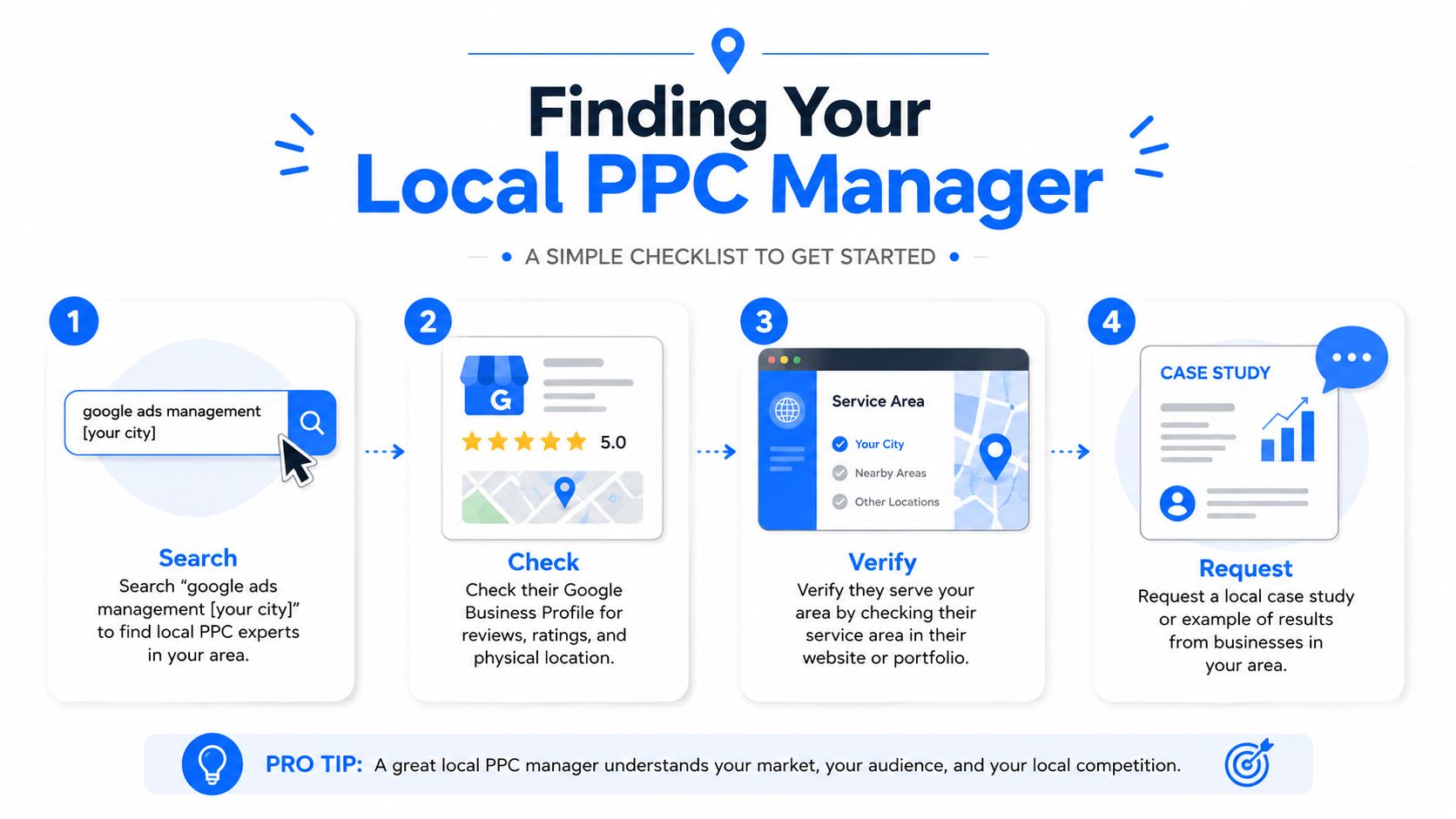
Start with your own search behavior. Search Google Ads management [your city], then open the Google Business Profiles that appear, because a manager's visibility in their own market is a useful signal, not a guarantee, of whether they understand local search at all.
What to inspect first
Look at the profile like a buyer, not a tourist. Reviews matter, but so do service categories, response patterns, and whether the agency's own presence matches the kind of work you need. If they can't keep their own local profile clean, current, and visible, they're not a strong bet for yours.
Then check how they talk about service areas in their portfolio. For home-service and clinic businesses, the question isn't whether they can run ads, it's whether they understand how to align location targeting with real coverage boundaries so budget doesn't leak outside the profitable zone (Google location targeting help). A good shortlist usually comes from seeing who can speak precisely about city-level, ZIP-level, or radius-level campaign planning.
For a practical comparison point, a list like the Google Ads agency list for Albuquerque from UFO Performance Marketing can help you see how agencies present themselves in a local market. Use it as a reference, not as a final answer.
The outreach email should be short and blunt
Ask for three things right away, a local case study, a sample reporting dashboard, and an explanation of how they separate search terms by service area. If they send back vague claims about “full-funnel growth” or “AI-powered visibility” without showing you how they handle neighborhoods, ZIPs, or exclusions, move on.
Ask them what they would exclude before they tell you what they would target.
For a second look at how to evaluate agencies in general, the internal guide at https://transactional.net/pay-per-click-experts/ is useful because it puts competence and fit ahead of polished sales language. That's the right mindset when you're screening for google ads management near me.
Freelancers, boutique shops, and larger firms
A freelancer can be fine for a simple account with one service line. A boutique agency usually makes more sense when you need tighter geo-management and regular optimization. Larger firms often bring process, but process alone doesn't save waste if the account structure is lazy.
The best fit is the one that can prove it understands your geography, your lead type, and your sales cycle. Everything else is noise.
Technical Questions That Reveal Real Local PPC Competence
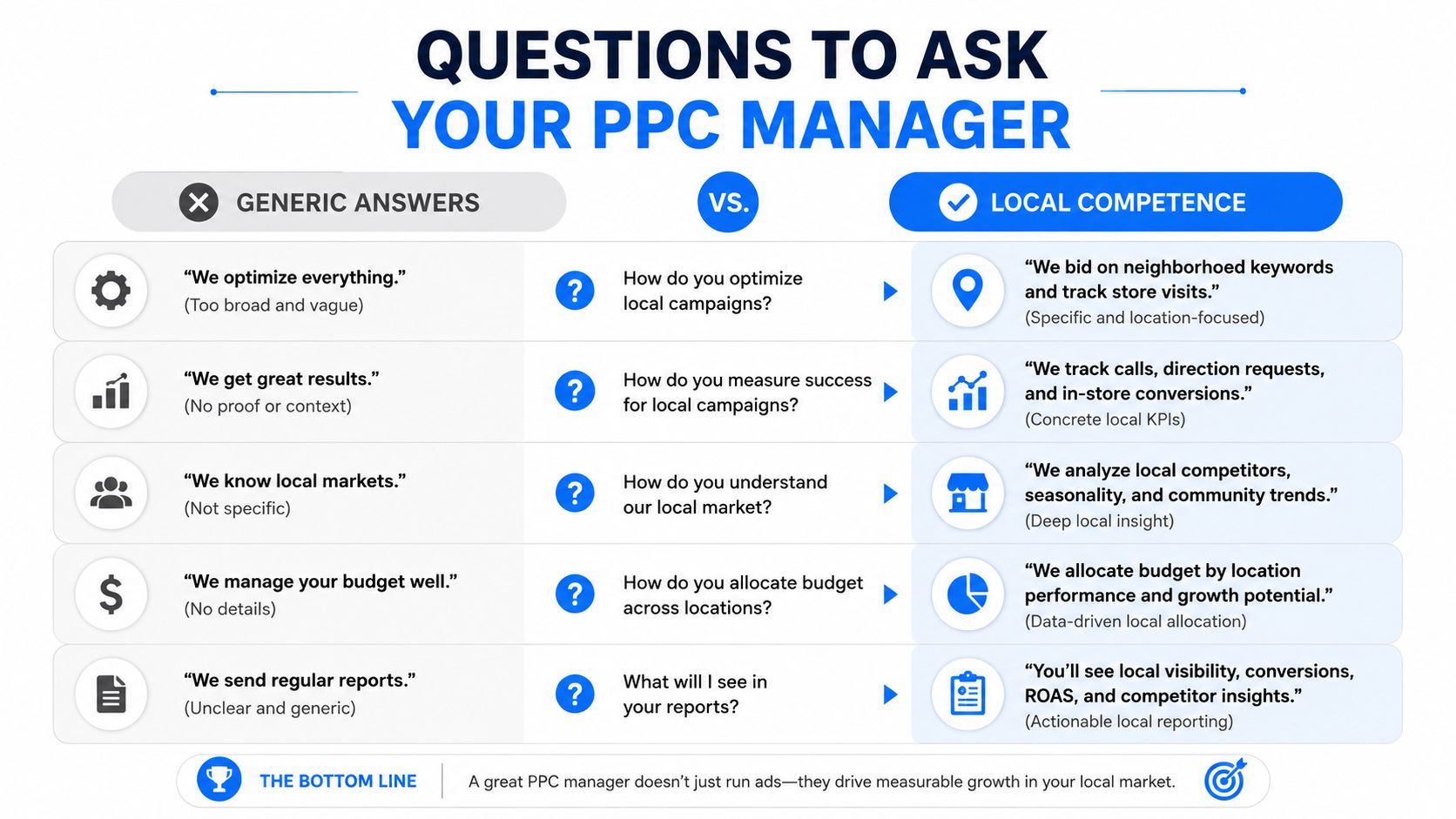
A weak local PPC manager talks in slogans. A capable one explains how the account is built, what gets excluded, and how leads are tracked from the start.
Start with targeting, not promises
Ask whether they use service-area targeting, radius targeting, or city and ZIP targeting, and ask which locations they exclude. Google lets advertisers target by city, ZIP code, radius, or location assets, and it also lets them narrow delivery to users who are physically in the area, which matters for businesses that do not serve every nearby town the same way. The setup guidance in Google location targeting help spells out those controls.
If they cannot explain exclusions, they are not ready to manage local spend. Bad geography burns budget fast, especially when ads keep showing in places that never turn into jobs or calls. The search terms report is the other basic check, because it shows the actual queries that triggered the ads and gives you the cleanup list that a real manager should work from (Google search terms report help).
Search campaigns and Local Services Ads are not the same thing
Agency owners blur these all the time because it makes the pitch sound broader. Google's Local Services Ads process centers on screening, verification, budgets, broader job types, reviews, and photos, while standard Google Ads still require separate location controls and campaign setup (Local Services Ads help).
That difference changes the kind of lead you get. Local Services Ads can fit faster phone-call demand, while Search campaigns give you tighter keyword control and clearer intent signals. If a manager treats the two systems as interchangeable, they are selling convenience, not judgment.
Ask about match types and negatives
Phrase and exact match should be the default for high-intent searches. Search terms should be reviewed every week. Negative keywords should be part of the plan from day one, not something they “get to later.”
A good manager should also know how to keep ad groups focused. One small-business service recommendation says ad groups should contain no more than 15 to 20 keywords that share a single theme, and a starting budget of at least $1,000 per month is more realistic than trying to starve a local account (Pronto Marketing Google Ads services).
Operational truth: A clean search terms report tells you more about competence than a polished case study ever will.
If you want a practical setup reference, use a clear Google Ads campaign setup guide and compare it against the vendor's process. A manager who cannot explain setup clearly usually cannot manage optimization clearly either.
For a related creative angle on turning attention into action, the guide on convert with AI video creatives shows how format affects response once the audience is already interested. The same idea applies here, because a weak account structure wastes intent even when the ad itself is strong.
Pricing Benchmarks and Budget Expectations for Local Campaigns
The cheapest proposal usually turns into the most expensive one after wasted clicks, weak tracking, and sloppy setup. Local Google Ads management should be judged on structure, reporting, and real labor, not on the lowest number a salesperson can say without flinching.
| Metric | Benchmark Value | What It Means for You |
|---|---|---|
| Management fee model | 7% to 12% of monthly ad spend | A common structure for ongoing management when the account has enough spend to justify hands-on work (OuterBox Google Ads management) |
| Starting ad budget | At least $1,000 per month | A practical floor for small-business management work (Pronto Marketing Google Ads services) |
| Local management support | 1-to-1 call or chat within the first 30 days | Early setup should get direct attention while tracking and account structure are being built (Google Ads Expert support) |
| Lead-gen stability threshold | 30 conversions per month | A practical point where Target CPA becomes more statistically stable (Improvado campaign guide) |
Compare the pricing models
Percentage-of-spend pricing fits active local accounts because the workload usually rises as the account gets more complex. Flat fees are easy to compare, but they become a bad fit if the agency spends less time than your campaign needs. Performance-based pricing sounds attractive on a sales call, then the cost often shows up in setup fees, reporting gaps, or fuzzy definitions of success.
Ask what is inside the fee. If landing pages, call tracking, conversion setup, geo-exclusions, or reporting are billed separately, the quote looks lower on paper and higher in practice.
For a simple cost reference, use local paid-search cost expectations before you compare agencies. That helps you judge whether a proposal is realistic or just thinly packaged.
Budget should match your lead economics
A local service business cannot judge Google Ads by clicks alone. The key question is whether the campaign produces leads that fit your close rate and job value. If the budget is too small to generate enough conversion data, the manager is guessing, and guessing with service-area campaigns usually means paying for the wrong ZIP codes, the wrong radius, or the wrong calls.
Google's support for new advertisers is front-loaded for a reason, because the first month is where setup, tracking, and structure set the tone. If the agency is not talking about conversion tracking, location assets, and geo-exclusions from the start, they are not pricing a real local PPC program.
Red Flags and Warning Signs in Agency Proposals
A weak proposal sounds confident and stays vague. That combination should make you nervous, not impressed.
Watch for fake certainty
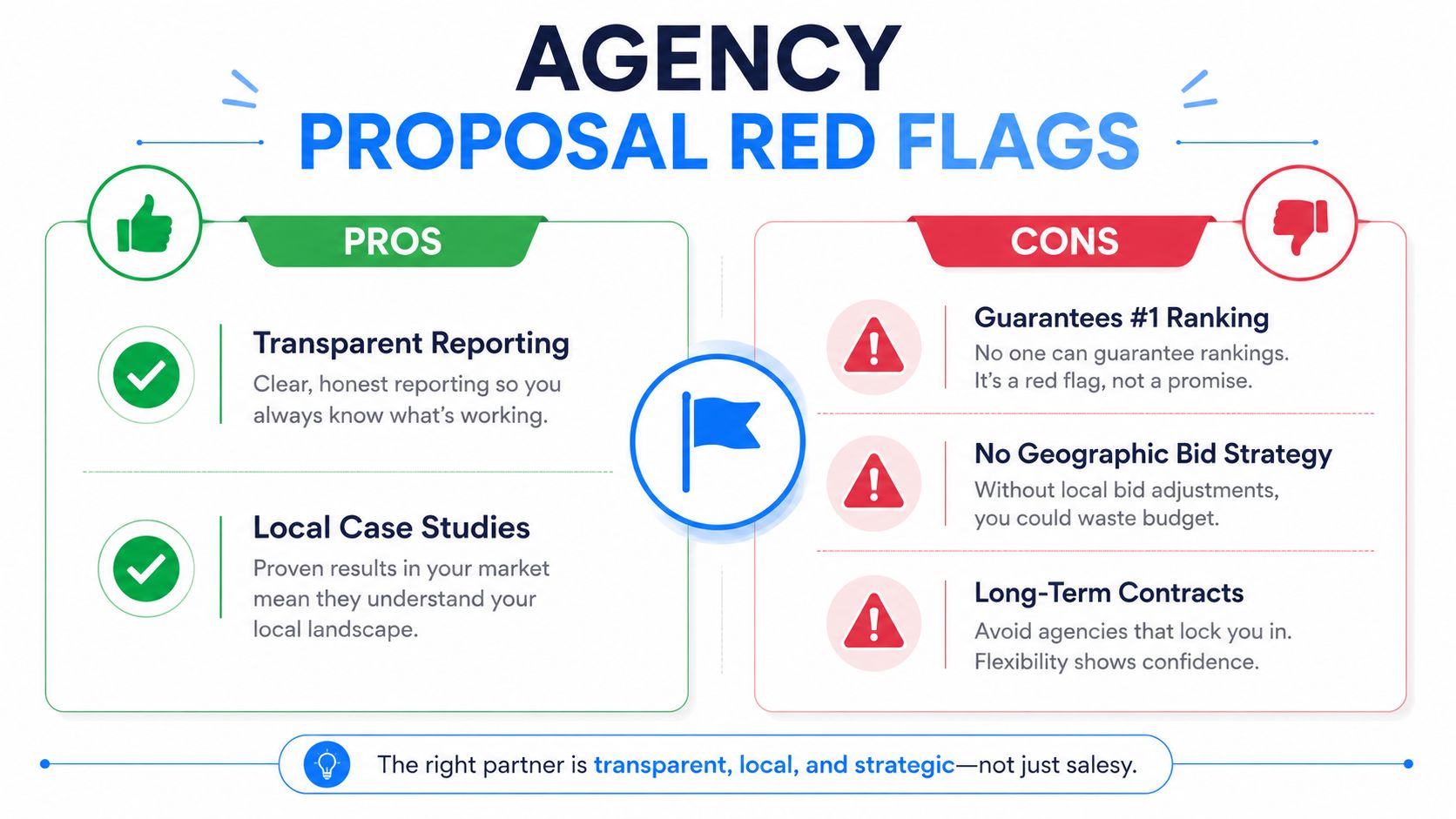
If an agency promises top rankings without explaining location strategy, they are selling a headline, not a system. If they blur Search campaigns and Local Services Ads into one bucket, they do not understand the differences that affect lead type and sales cycle.
A proposal that says “we target your area” without naming exclusions, radius logic, or location assets is too loose for local service businesses. The agencies worth hiring can explain exactly how they will structure a service-area campaign, where they will cut wasted geography, and how they will keep ads away from places you never want to service.
Be suspicious of missing process details
If they cannot explain their negative keyword routine, do not hire them. If they cannot say how often they review search terms, do not hire them. If they cannot describe how they keep conversion tracking aligned with CRM data, do not hire them.
Good local PPC work depends on the boring parts being handled well. That means clean conversion setup, clear location signals, and reporting that shows whether calls, form fills, or booked jobs are coming from the right searches. If the proposal never mentions geo-exclusions or location assets, it is not built for service-area campaigns, it is built to sound complete.
Contracts should fit the risk
Long commitments can make sense in some accounts, but they should not be the default when the agency has not proven competence yet. A proposal should say what happens in the first month, how reporting works, and what specific metrics get reviewed. It should also spell out who owns the ad account, who sets up tracking, and what happens if the launch needs to be corrected after the first review.
For a broader filter on partner selection, use the agency selection checklist for service businesses. It helps you pressure-test any team that seems more interested in locking you in than in showing you how they will improve your local presence.
Making Your Decision and Getting Campaigns Live
A manager can sound polished and still miss the basics that matter to a service business. I want to hear a plain explanation of your service area, your lead type, and how the tracking is wired before anything goes live. If they keep hiding behind jargon, keep shopping.
The launch conversation should begin with account access, conversion verification, and a real campaign structure review. For local service campaigns, the first question is whether they can separate the territory you serve from the places you do not, then tie that structure to calls, forms, and booked jobs. A vendor who cannot explain geo-exclusions, location assets, and conversion tracking in simple language is not ready to manage spend.
The first 30 days should have a written checklist. I want to see search terms reviewed early, tracking tested on both mobile and desktop, and call or form leads checked against the CRM so you know which searches are producing real work. If those steps are missing, the account is not being launched, it is being guessed at.
Your last question should be blunt. “How will you make sure we show up for the exact searches that turn into calls and booked jobs?” If the answer stays focused on transactional search terms, service-area control, clean conversion tracking, and reporting you can use, you are close to the right hire.
Transactional LLC helps service businesses get found for the exact search terms that signal buying intent, especially local phrases like roofer near me, dentist near me, and other transactional queries. If you want a team that pairs Google Maps optimization, AI-driven content, and focused local SEO with paid campaigns, visit Transactional LLC and see how they build visibility around the searches your customers are already making.