


SEO usually takes 3 to 6 months to show measurable results, and 6 to 12 months is where strong ROI usually shows up. But if you run a local service business and you target transactional terms with a tight local SEO strategy, page-one movement can often show up within 30 to 60 days on the right terms.
That’s the part most articles miss. They give you the slow, broad answer, then leave you thinking SEO is just a waiting game. It isn’t. Bad SEO is a waiting game. Smart local SEO is a prioritization game.
If you’re a roofer, plumber, HVAC company, dentist, chiropractor, med spa, or pest control business, you do not need to start by chasing giant vanity keywords. You need to show up when someone searches “roofer near me,” “emergency plumber [city],” “AC repair near me,” or “dentist near me.” Those are transactional searches. The buyer already wants the service. They’re not researching for fun. They’re trying to hire somebody.
That’s why the answer to how long does seo take to show results depends less on “SEO” in the abstract and more on what you’re targeting, how local your market is, how strong your Google Business Profile is, and whether your strategy is built to drive calls instead of impressing people with traffic charts.
The Real Answer to How Long SEO Takes
Most agencies hide behind the same answer. They say SEO takes a long time, tell you to be patient, and hope you stop asking hard questions.
The honest version is simpler. General SEO usually takes 3 to 6 months to produce measurable gains in traffic, impressions, and rankings for lower-competition terms, according to Lasso Up’s roundup of authoritative SEO timeline research. That’s the normal timeline. It’s real. It also isn’t the whole story.
For local service businesses, the better question isn’t “how long does all SEO take?” It’s “how fast can I start showing up for the searches that turn into jobs?” That’s where strategy matters.
If you target broad terms too early, you wait longer. If you target transactional local terms first, fix the core pages, tighten internal linking, and push hard on Google Maps, you can create visible movement fast. Not for every keyword, and not for every market, but often for the terms that bring in phone calls.
Practical rule: If your SEO plan doesn’t start with service-plus-city and near-me intent, it’s probably built for reports, not revenue.
A lot of business owners also confuse “full SEO maturity” with “initial lead generation.” Those are not the same milestone. A complete campaign takes longer because authority, links, topical depth, and trust build over time. But the first wins should not take forever if the campaign is structured correctly.
Here’s the no-nonsense version:
- Broad SEO growth: Slower, cumulative, longer path
- Transactional local SEO: Faster path to lead intent
- Google Maps visibility: Often the quickest route to calls
- Authority building: Necessary for staying power, not always for first traction
If you want the full breakdown of what an SEO partner should be doing during that time, read what SEO companies do. Most business owners have never been shown the difference between busywork and ranking work.
Understanding the Four Engines of SEO Speed
SEO speed comes from four systems working in the right order. Get that order wrong and you add months. Get it right and a home service business can start gaining traction on lead-driving local terms in 30 to 90 days.
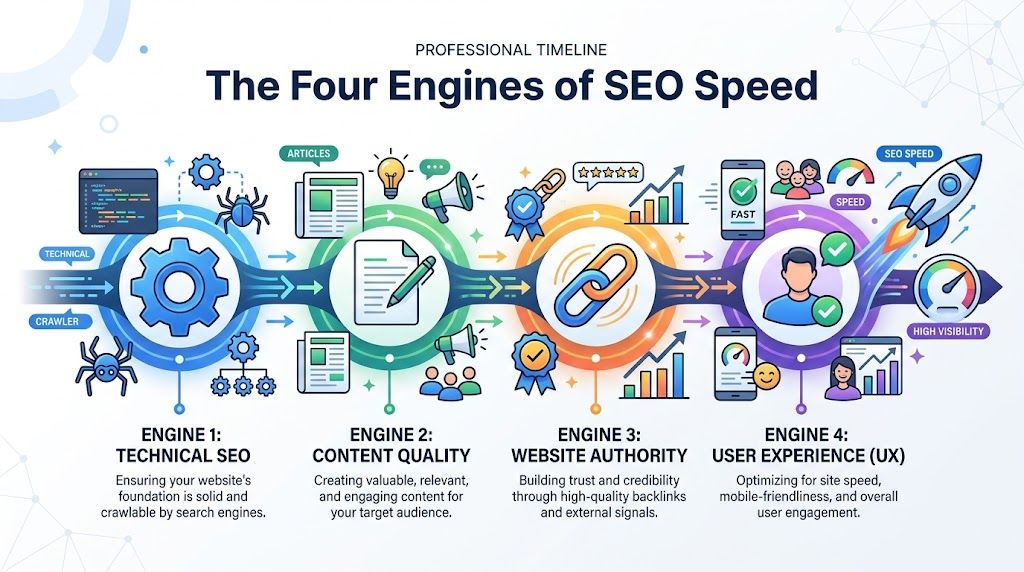
1. Technical SEO removes drag
Technical SEO sets the ceiling for every other result. If Google struggles to crawl your service pages, sees duplicate location intent, or lands on weak page structure, rankings slow down before the campaign has a chance to work.
The first wins often come from fixing the obvious blockers:
- Indexing cleanup: important pages get crawled and processed
- On-page targeting fixes: titles, headings, and copy match real search intent
- Internal linking: priority pages get more support from the rest of the site
- Location page structure: city and service pages stop cannibalizing each other
A lot of slow SEO is not a patience problem. It is an implementation problem.
2. Google Maps creates the fastest path to leads
For plumbers, roofers, dentists, and other local service companies, Google Business Profile is often the fastest engine in the system. It sits closer to buyer intent than a broad blog strategy because the searcher usually wants to call, book, or request help now.
That speed depends on setup quality. Primary category, secondary categories, service list, review velocity, linked landing pages, business info consistency, and proximity signals all affect map visibility. If you want to understand what influences those rankings, review these local search ranking factors for Google Business Profile and local organic results.
This is the part many agencies underplay. They spend too much time publishing generic content and not enough time tightening the local assets that produce calls.
The fastest SEO results usually come from narrowing the target to high-intent local searches and pairing strong landing pages with a properly built Google Business Profile.
3. Content expands reach after the core pages are right
Content should support revenue first. For a local business, that means service pages and city pages come before a library of educational articles.
Use content in this order:
| Content type | Job |
|---|---|
| Service pages | Rank for direct buyer searches |
| City pages | Match location-specific intent |
| FAQ and objection-handling content | Improve conversion and support service pages |
| Topical support content | Build relevance around core services |
User experience matters here too. A page that ranks but fails to convert still slows ROI. Clear layout, fast load times, mobile usability, and strong calls to action all influence whether traffic turns into leads. User Experience Optimisation plays a direct role in that outcome.
AI search systems also reward clarity. Businesses that describe services plainly, structure pages well, and keep local relevance tight are easier for search engines to trust and surface.
4. Authority builds staying power
Authority takes longer than technical fixes or Maps work, but it compounds. Quality links, brand mentions, review signals, branded searches, and real local reputation make rankings harder to dislodge.
Broad-market SEO and local transactional SEO diverge. You do not need massive authority to start ranking for focused service-plus-city terms in many markets. You do need authority to hold those rankings, expand into tougher terms, and make future pages rank faster.
Here is the correct sequence:
- Technical SEO removes blockers.
- Google Maps optimization creates early local visibility.
- Content supports commercial intent and expands coverage.
- Authority building strengthens long-term market position.
Start with authority campaigns before fixing the first three, and you choose the slow lane.
Factors That Control Your SEO Results Timeline
SEO speed is not mainly about budget. It is about focus.
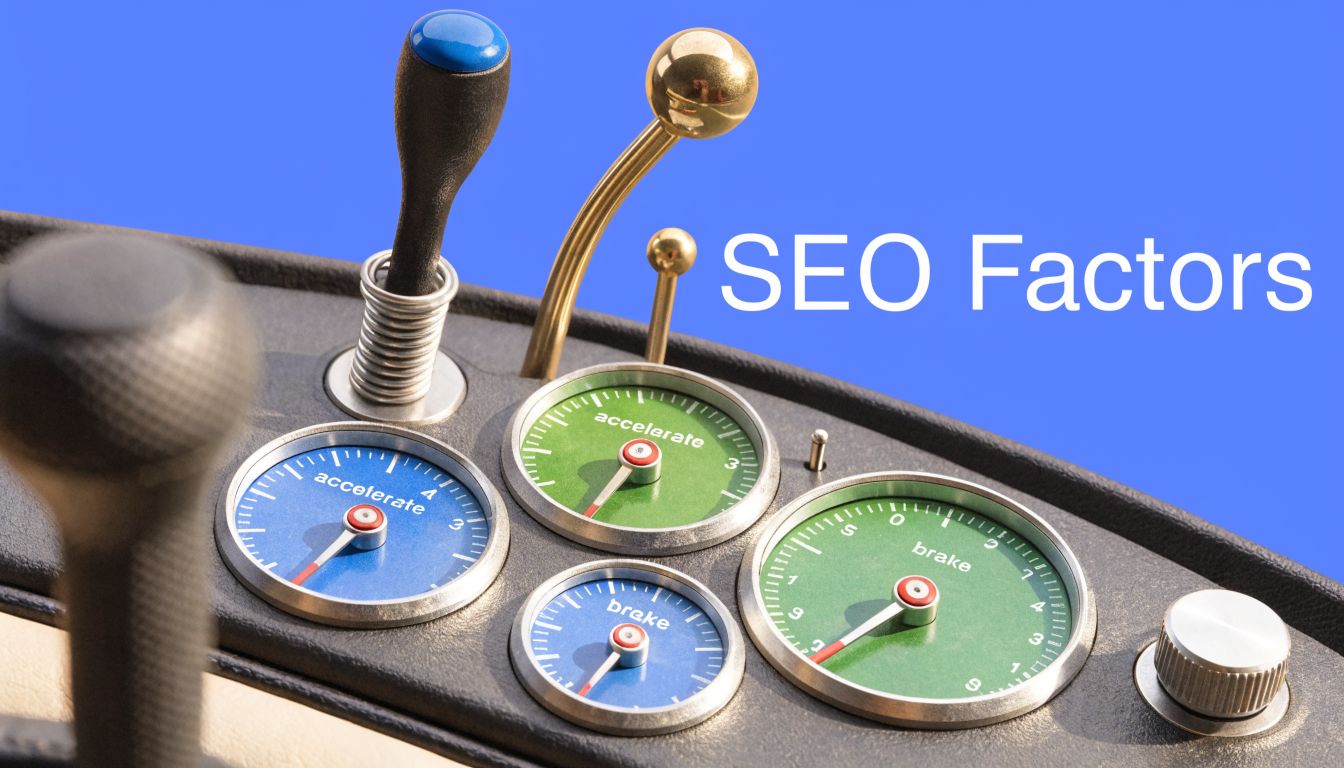
Two companies can invest the same amount and get completely different results because one targets buyer-ready local searches and the other spreads effort across broad terms, weak pages, and vanity content. For home service businesses, the fastest path usually comes from tight local intent. Service plus city. Emergency service terms. High-conversion Google Maps visibility. That is how you compress the timeline into 30 to 90 days for lead-driving keywords instead of waiting on a slow, broad campaign.
What speeds things up
The first lever is keyword selection. Broad research terms take longer because they attract more competition and weaker buying intent. Transactional local searches move faster because the searcher already knows what they need and wants a provider nearby.
Start with terms like these:
- Service plus city terms: “roof repair Plano”
- Urgent intent terms: “24 hour plumber Tampa”
- Near-me variants: “dentist near me”
- Map-led searches: local service queries with clear call intent
Aged domains usually move faster too. If the site already has indexed service pages, branded search activity, reviews, and some local trust, Google has enough context to rank pages with less hesitation. A brand-new site has to earn that context first.
Google Business Profile quality has a direct effect on speed. A complete profile, correct categories, recent reviews, matching service pages, and clear service areas can produce faster visibility than site content alone. Local SEO often wins first in Maps, then expands into stronger organic positions.
User behavior also changes the timeline. If visitors tap back because the page is slow, confusing, or hard to use on mobile, rankings and lead volume both stall. Good design is not cosmetic. It helps traffic convert and supports stronger search performance. This overview of User Experience Optimisation explains that connection well.
What slows everything down
New domains are slower. So are unfocused campaigns.
If a business targets an entire state before it can rank in its best service cities, it adds months to the process. The same goes for publishing informational blog posts while core service pages are thin, duplicate, or missing.
Competition matters, but business owners often misunderstand it. The issue is not just how many competitors exist. The issue is how well entrenched they are in the map pack and organic results. If established local companies already have strong reviews, tightly matched landing pages, and years of local signals, you need better execution, not more random content.
Technical and structural mistakes create the biggest delays:
| Brake | Why it hurts |
|---|---|
| Weak site structure | Google cannot tell which service pages matter most |
| Duplicate location pages | Relevance gets split across similar pages |
| Thin service pages | The page does not match buying intent well |
| Poor mobile performance | Visitors leave before calling or booking |
| Mismatched GBP landing pages | The profile and page send conflicting local signals |
One more problem deserves a direct callout. Businesses often choose volume over precision. They build pages for every nearby town, even when those pages say almost the same thing. That rarely speeds anything up. It usually dilutes relevance and creates cleanup work later.
What actually changes the timeline
The businesses that get results faster make one smart trade. They go narrower before they go bigger.
They pick the few services that produce the best jobs. They match those services to the cities that generate the most revenue. They tighten the Google Business Profile, improve the landing pages tied to those terms, and make it easy for a visitor to call.
That approach shortens the path to leads because it aligns with how local buyers search and how Google evaluates proximity, relevance, and prominence. If you want the clearest breakdown of those signals, review these local search ranking factors.
Your SEO timeline gets shorter when your targeting gets tighter.
SEO Timelines for Plumbers Roofers and Dentists
Theory is useful. Real buying behavior is better. Let’s talk about what this looks like when the business depends on inbound calls.
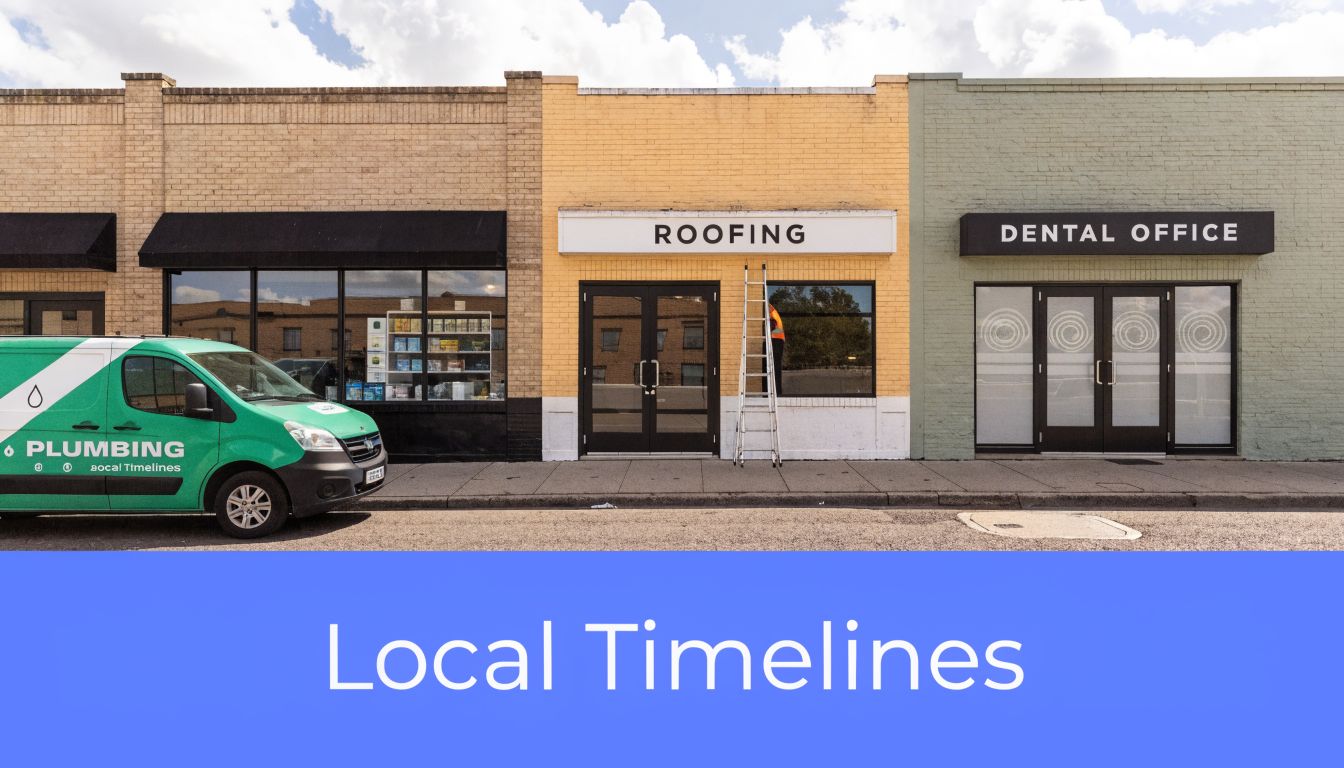
Plumbers win fastest on urgency
A plumbing company has one huge advantage. A lot of its best searches are urgent.
When someone searches “burst pipe repair,” “emergency plumber,” or “water heater repair near me,” the buyer is close to action. They are not looking for entertainment. That means the path to results is often shorter if the campaign focuses on emergency services, city-specific landing pages, map relevance, and click-to-call usability.
A plumber usually gets the fastest traction by tightening these assets first:
- Core emergency pages: Fast, direct, location-matched
- Google Business Profile categories and services: Aligned with actual search behavior
- Service area mapping: Focused on revenue cities, not every city nearby
- Review strategy: Built around urgent job types and named services
That’s also why niche examples from adjacent service models can be useful. This page on local SEO for mobile detailing businesses shows the same principle in a different local service setup. Narrow geography plus buyer intent beats generic visibility.
If plumbing is your lane, this guide on local SEO for plumber businesses is the more direct blueprint.
Roofers need storm intent and service specificity
Roofing SEO moves differently because demand can be seasonal, storm-driven, and insurance-related.
A roofer doesn’t just need a “roofing company” page. They need separate local assets for the searches people use when there’s real money on the table. Think hail damage repair, leak repair, emergency tarping, insurance claim support, and city-based repair terms.
A realistic local roofing progression looks like this:
| Phase | What usually matters most |
|---|---|
| Early movement | Google Maps relevance, service page cleanup, city targeting |
| Mid-stage traction | Rankings for repair-specific and damage-specific terms |
| Long-term growth | Authority around replacement, insurance, and wider service area coverage |
The roofers who wait longest are usually the ones chasing broad vanity phrases instead of damage-specific buyer terms.
Dentists live or die by maps and intent matching
Dental practices often underestimate how local and immediate patient behavior really is.
Searches like “emergency dentist near me,” “same day dentist,” “tooth pain dentist [city],” and “dental implants [location]” aren’t casual research terms. They signal urgency or a high-value treatment path. That’s why dental SEO rewards precision.
For dentists, the smart opening move is usually:
- Fix the treatment pages first
- Align GBP with the highest-value services
- Strengthen local proof signals
- Support those pages with trust-building educational content
Here’s a useful visual explainer before we go further:
HVAC sits in the middle and rewards structure
HVAC campaigns usually split between urgent and planned demand. “AC repair near me” behaves differently from “furnace maintenance” or “ductless mini split installation.”
That mix is why HVAC SEO gets strong results when the site is tightly segmented by:
- Emergency services
- Seasonal repair terms
- Installation and replacement pages
- Neighborhood or city modifiers
- Map pack targeting for high-intent service searches
The companies that get early wins don’t build one generic HVAC page and hope. They build a page structure that mirrors how people buy. Repair terms first. Location intent second. Support content third. Broader authority after that.
That same pattern works across local service categories. The business may change. The buying intent doesn’t.
How to Measure Real SEO Success and ROI
SEO is working when search turns into calls, form fills, booked jobs, and revenue. Everything else is a supporting metric.
That matters even more for local service businesses chasing fast wins. If your first 30 to 90 days are aimed at high-intent terms, your reporting should focus on whether visibility is improving for the searches that produce leads. A rise in generic traffic does not pay for a truck roll, a crew, or a front desk.

Track leading indicators early
In the early stage, you are checking whether Google is accepting your positioning. Rankings and leads rarely jump on day one. First, your service pages get indexed correctly. Then your visibility improves for the right queries. Then clicks and calls follow.
Watch these first:
- Google Search Console impressions for service-plus-city terms
- Keyword movement on your core money pages
- Google Maps grid improvement in real service areas
- Indexation for new or rebuilt location and service pages
- Clicks from local transactional searches
These are not vanity metrics if they are tied to buying intent. They show whether your campaign is pointed at the right terms and whether your local page structure is doing its job.
Judge ROI with lagging indicators
Revenue is the scorecard. Track it once the early visibility gains start producing demand.
Search Engine Land’s SEO timeline guide notes that stronger ROI often shows up later, once rankings stabilize and lead flow becomes more consistent. That is true for broad SEO campaigns. Local service businesses can often see qualified lead movement earlier when they target narrow, transactional terms first. The mistake is expecting full revenue lift before the visibility layer is in place.
The lagging indicators that matter are simple:
| Metric | Why it matters |
|---|---|
| Qualified phone calls | Shows direct purchase intent |
| Contact form submissions | Captures buyers who are ready to talk |
| Booked appointments or jobs | Connects SEO to operations |
| Revenue from organic leads | Proves actual return |
| Map pack visibility for money terms | Shows whether local lead flow is likely to continue |
If call volume is flat, the campaign is not healthy enough yet. High impressions do not change that.
Use a dashboard that connects search to revenue
A useful report ties rankings, Maps visibility, and conversions together in one view. Otherwise, you get a pile of numbers with no business meaning.
My preferred stack is straightforward. Use Google Search Console for query data, GA4 for organic conversions, call tracking for phone leads, a rank tracker for service-city terms, and a map grid tool for GBP coverage. If you want an outside reference, Cometly has a practical guide on how to measure SEO performance.
Your dashboard should show:
- Keyword trends by city and by service
- Map visibility across the areas you serve
- Queries generating impressions and clicks
- Calls, forms, booked jobs, and revenue from organic and map traffic
Transactional LLC offers dashboards built around those measurements, including keyword timelines, map heat maps, Search Console query tracking, and biweekly reporting. That setup is useful because it keeps the focus on local buyer intent instead of broad traffic charts.
If you want a stricter way to judge whether SEO is producing real business impact, compare your reporting against this marketing effectiveness framework. It helps you separate lead generation from dashboard theater.
Your Roadmap to Fast SEO Wins and Lasting Results
You do not need a complicated plan. You need the right sequence.
The mistake most businesses make is trying to build local dominance and authority at the same time without first locking down the easiest transactional wins. That spreads effort too thin and stretches the timeline.
First 90 days focus on the transactional sprint
The first phase should be aggressive and narrow. The goal is simple. Get your business in front of buyers who are already searching to hire.
Start here:
Rebuild your Google Business Profile around money services
Your categories, services, linked landing pages, photos, review prompts, and service areas should all reinforce the exact services you want to rank for.Fix the pages that should already be making you money
Your homepage, main service pages, and priority city pages should be rewritten for transactional intent. If someone lands on the page, they should know what you do, where you do it, and how to contact you immediately.Track service-plus-city keywords, not generic vanity terms
“Plumber near me” and “drain cleaning [city]” matter. “Best plumbing tips” doesn’t, unless it supports trust or conversion.Tighten internal links and local relevance signals
Most local sites waste authority because they don’t connect service pages, location pages, and supporting content properly.
Short timelines come from focus. The businesses that move fastest usually target the fewest pages first.
This phase is where page-one movement on specific local terms can start to show up, especially if the website already has some age and the GBP is under-optimized rather than broken.
Months four through twelve build local dominance
Once the core transactional terms are moving, then you expand.
Most of the compounding value gets built. Not in one giant burst, but by stacking more local relevance, more service depth, and more authority around the pages that already started working.
That usually means:
- Expanding content silos around services, problems, and locations
- Publishing AI-structured supporting content that reinforces topical depth
- Building local citations, mentions, and authority links
- Adding more city pages carefully, without duplication
- Refining pages based on Search Console and conversion behavior
Here’s the split that works best for most local service businesses:
| Timeline | Primary objective |
|---|---|
| First 90 days | Win fast on transactional local terms |
| Months 4 to 6 | Expand coverage and improve conversions |
| Months 6 to 12 | Strengthen authority and stable lead flow |
| Beyond that | Scale into additional services and service areas |
What not to do
A bad roadmap is easy to recognize.
- Don’t start with dozens of weak blog posts
- Don’t target statewide keywords if you sell locally
- Don’t send map traffic to generic pages
- Don’t judge SEO by traffic alone
- Don’t ignore mobile conversion paths
A local SEO campaign should feel like triage first, expansion second. Get found for the searches with money behind them. Then build the rest of the machine.
Common Questions About SEO Timelines
Why does a brand-new website take longer
Because Google has less to trust.
A new domain has no ranking history, no established backlink profile, no branded search behavior, and no track record on local intent. That doesn’t mean it can’t rank. It means Google usually needs more time to evaluate it. Established sites can often move faster because they already have some baseline trust and crawling frequency.
For a new business, that makes local focus even more important. You’re better off trying to win specific service-city terms than broad category terms.
Can paid ads speed up SEO
Not directly.
Google Ads does not increase organic rankings. But PPC can help the business while SEO ramps up. It also gives you useful keyword and conversion data. If “emergency AC repair” converts well in paid search, that’s a strong signal to prioritize that term in SEO, Maps, and landing page work.
The smart play is often to use paid ads as a bridge while organic visibility builds.
What is AI optimization and does it help SEO move faster
AI optimization helps when it improves structure, scale, and relevance. It hurts when it creates thin junk.
Used correctly, AI can support keyword clustering, service-content planning, internal link mapping, FAQ generation, schema support, and content production workflows. That shortens execution time. It does not remove the need for real expertise, clean local intent matching, or human review.
AI also matters because people increasingly discover businesses through AI-assisted search experiences and answer engines. If your site clearly explains who you serve, where you serve, what problems you solve, and how your services connect, you improve your odds of showing up in both traditional search and AI-driven discovery.
Can you guarantee a number one ranking
No honest SEO should guarantee a specific rank.
Google controls rankings. Competitors move. Search layouts change. Map results shift. Anybody promising guaranteed number-one rankings is selling fantasy.
What you can demand is a clear process, tight keyword targeting, visible work, transparent reporting, and a strategy built around transactional searches instead of vague awareness metrics.
Is 30 to 60 days realistic or just sales talk
It’s realistic for movement on the right local terms when the campaign is focused correctly. It is not realistic as a blanket promise for every keyword in every market.
That distinction matters. A local service business can absolutely see page-one movement or stronger map visibility early if the target terms are transactional, geographically tight, and supported by strong on-page and GBP work. But long-term dominance still takes time, especially in competitive markets.
What should I expect first if SEO is working
Expect visibility signals before revenue signals.
That usually means:
- Improved impressions for service terms
- More map visibility across your service area
- Better rankings on core local pages
- More clicks to high-intent pages
- Then more calls and form fills
If an SEO provider can’t show that progression, they probably don’t have control of the campaign.
If you want a local SEO strategy built around transactional searches instead of vague traffic goals, talk to Transactional LLC. They focus on service-area visibility, Google Maps optimization, AI-supported content silos, and transparent reporting tied to the searches that turn into calls, jobs, and patients.