


A service business owner sees this every day without realizing what happened. A prospect searches for a high-intent query on a phone, gets an instant answer at the top of Google, and books with the company that owned the answer first.
That top box isn't just an SEO trophy. For local businesses, it can shape who gets the call, who gets the quote request, and who gets remembered when the customer is ready to buy. Most advice on how to get featured snippets stays stuck on broad informational queries. That misses a significant opportunity for plumbers, dentists, HVAC companies, roofers, pest control operators, and med spas.
The useful question isn't just how to get featured snippets. It's how to win them for searches that sit close to revenue, then connect that visibility to Google Maps, service pages, and booking paths.
Why Snippets Matter for Transactional Searches
A homeowner searches for emergency AC help on a hot afternoon. Before the first standard organic result, Google may show a direct answer pulled from a competitor's page. If that answer covers response time, common causes, or what the customer should do next, your competitor just earned trust before the searcher even started scrolling.
That is why featured snippets matter in local SEO. They give a business position zero visibility on searches where urgency and trust affect who gets the call.
Snippets are scarce, which makes them valuable
Featured snippets don't appear everywhere. In a large GetStat study of 999,868 SERPs, snippets appeared on 9.28% of results pages, and 82% of featured snippets were paragraph snippets, according to GetStat's featured snippet research.
That matters for two reasons. First, you are not optimizing for a universal SERP feature. You're competing for a limited one. Second, the most common win condition is still the short paragraph answer, not some exotic schema trick.
Practical rule: If a service page can't answer a real customer question in plain English near the top of the page, it probably won't win a paragraph snippet.
Transactional snippets aren't the same as textbook snippets
Most snippet advice targets terms like "what is root canal therapy" or "how does central air work." Those can help. But local service businesses make money on questions closer to a decision:
- Cost-driven searches like "how much does drain cleaning cost"
- Urgency searches like "what to do before an emergency electrician arrives"
- Comparison searches like "dental implant vs bridge"
- Local intent searches tied to service needs and booking behavior
These searches often sit one step before a call. The searcher isn't casually browsing. They're trying to reduce risk, understand price, or choose between options fast.
Why this matters more than generic traffic
A snippet can satisfy curiosity. It can also pre-frame the sale. If your page answers "how long does a furnace repair take" clearly and credibly, you're not just chasing visibility. You're lowering friction.
That's the difference between vanity SEO and transactional SEO. Generic traffic looks good in a report. Transactional visibility creates better odds that the next click becomes a lead.
For local businesses, snippets work best when they support the buying path. The snippet introduces the answer. The landing page builds trust. The map result confirms proximity. The call button closes the gap.
Finding Your Golden Snippet Opportunities
The best snippet targets usually aren't hidden in some expensive tool. They already exist in your search data. If your site ranks on page one for the right question, you don't need a brand-new content campaign first. You need sharper formatting and better intent alignment.
Start with page-one queries, not brainstorming
Google tends to pull featured snippets from pages that already rank on the first page. That changes the workflow. Instead of guessing what to write, pull your existing query data from Google Search Console and look for searches where you're already visible.
Focus on queries that sound like buying research, not school-report research.
A few examples:
- "how much does AC repair cost"
- "how long does a tooth extraction take"
- "roof repair or roof replacement"
- "what size water heater do I need"
- "is same day pest control possible"
These aren't all bottom-of-funnel in the strictest sense. But they often happen right before a customer chooses who to contact.
What to filter for in Search Console
Open your performance report and review queries by page. You're looking for a mix of current visibility and commercial intent.
Use this shortlist:
Question phrases with implied purchase intent
"How much," "how long," "which is better," "does insurance cover," and "same day" often lead to service decisions.Queries attached to money or urgency
Pricing, timelines, emergency response, financing, recovery steps, and service comparisons are stronger than broad definitions.Pages that already fit the query
If Google shows your general service page for a cost question, you may only need a better FAQ block instead of a new article.Queries that support a call, map action, or form fill
That's the main filter. Some snippet wins bring researchers. Others bring buyers.
Many SEO guides skip that distinction. As noted in Boostability's guide to featured snippets, service businesses need to separate snippet opportunities that attract research traffic from those that influence calls, map actions, or appointment requests.
If a query doesn't help a customer choose, book, compare, or act, it may still be useful. It just shouldn't lead your snippet roadmap.
Build a transactional query list
Once you've pulled candidates, group them by intent bucket instead of keyword volume alone.
| Intent bucket | Example query style | Best page type |
|---|---|---|
| Cost | how much does service cost | service page FAQ or pricing explainer |
| Speed | how long does service take | service page FAQ |
| Emergency | what to do before technician arrives | emergency service page |
| Comparison | option A vs option B | comparison page |
| Qualification | do I need repair or replacement | service decision guide |
A disciplined keyword workflow proves beneficial. A practical reference is this article on keyword research best practices for local SEO, especially if you're sorting search terms by business value instead of raw traffic.
Check the live SERP before you optimize
Don't trust tools alone. Search the query manually. Look at three things:
- What snippet format appears now
- Whether local pack results crowd the page
- Whether the current answer is weak, outdated, vague, or overly informational
A weak snippet is an opening. A strong snippet with poor conversion support is also an opening. You may not beat it by writing more. You often beat it by answering faster and tying the answer to a service decision.
Structuring Content to Answer Questions Directly
Formatting wins snippets more often than word count battles do. Google needs to understand what question your page answers and where the answer starts. If your page rambles through brand messaging, long intros, and generic SEO filler, you're making extraction harder than it needs to be.

Match the format to the query
A lot of businesses force every answer into a paragraph. That leaves wins on the table. List and table snippets exist because some searches are better answered in structured formats. Industry guidance cited by Niumatrix on featured snippet structure notes that list-format snippets account for about 19.1% of all featured snippets.
Use the format the query naturally asks for:
- Paragraphs for direct answers such as cost, timing, definitions, and simple yes-or-no questions
- Numbered lists for process queries like emergency steps or appointment prep
- Bulleted lists for benefits, symptoms, warning signs, or qualification criteria
- Tables for service comparisons, material options, treatment differences, or package distinctions
What good snippet formatting looks like
For a plumbing page targeting a timing query, don't bury the answer inside a long services overview. Write it cleanly.
Example paragraph block
<h2>How long does a water heater replacement take?</h2>
<p>A standard water heater replacement usually takes a few hours once the technician is on site, but timing depends on the unit type, code upgrades, access, and whether any plumbing or venting changes are needed.</p>
For an emergency service query, use steps.
Example ordered list
<h2>What should you do during a plumbing emergency?</h2>
<ol>
  <li>Shut off the main water supply if you can reach it safely.</li>
  <li>Turn off power near affected areas if water is close to outlets.</li>
  <li>Move valuables and towels to limit damage.</li>
  <li>Take photos if insurance documentation may be needed.</li>
  <li>Call an emergency plumber.</li>
</ol>
For a comparison query, use a table.
Example table block
<h2>Dental implant vs bridge</h2>
<table>
  <tr>
    <th>Option</th>
    <th>Best for</th>
    <th>Main consideration</th>
  </tr>
  <tr>
    <td>Dental implant</td>
    <td>Long-term single-tooth replacement</td>
    <td>Requires healing time and adequate bone support</td>
  </tr>
  <tr>
    <td>Dental bridge</td>
    <td>Faster replacement in some cases</td>
    <td>May involve adjacent teeth</td>
  </tr>
</table>
FAQ blocks work when they're real, not decorative
Most FAQ sections are weak because they exist for SEO, not for customers. They repeat obvious questions, hide the answers in accordion tabs, or answer in one vague sentence. That's not enough.
A stronger FAQ section does three things:
- Uses the exact customer question in the heading
- Answers it immediately
- Supports the answer with brief context below
If you're building out FAQ content from scratch, this guide to building successful FAQ pages is useful because it focuses on making answers usable, not just indexable. It pairs well with a tighter local content workflow like this approach to SEO content planning for service businesses.
Good snippet content sounds like a technician, treatment coordinator, or office manager answering the question clearly on the phone.
The On-Page Blueprint for Winning Snippets
There is a repeatable structure behind most snippet wins. It isn't glamorous, but it works. Put the exact question in a heading, answer it in the next paragraph, then support that answer with format-specific detail Google can parse cleanly.

The core layout that keeps winning
The strongest pattern for paragraph snippets is straightforward. Put the target question in an H2 or H3 and answer it immediately. Multiple SEO analyses summarized by Sure Oak's featured snippet guide converge on a 40 to 60 word answer range as the most common benchmark for paragraph snippets.
That range matters because it forces clarity. Local service pages lose snippet opportunities when they start with scene-setting copy like "At our family-owned company, we understand…" Google doesn't need your origin story to answer "how much does termite treatment cost."
A cleaner page section looks like this:
- H2 with the exact question
- Immediate answer paragraph
- Optional list, table, or short supporting paragraph
- Conversion path below the answer
Schema helps, but it doesn't rescue weak copy
A lot of site owners treat schema as the magic switch. It isn't. Schema helps search engines understand the page, but it can't fix an answer that's vague, bloated, or disconnected from the query.
Use schema to reinforce content that is already organized well:
- FAQPage schema for legitimate question-and-answer sections
- LocalBusiness schema to reinforce business identity and local relevance
- Service-level clarity in page copy so the page itself makes sense without structured data
If your site has crawl issues, duplicate templates, or thin location pages, fix that first. A clean technical foundation makes snippet optimization easier, and this checklist of technical SEO issues that hurt local visibility is a practical place to start.
Build answers that satisfy both search engines and humans
Good snippet sections don't stop at extraction. They also move the customer forward. That means the short answer should reduce uncertainty, while the next page element should help the visitor act.
A simple local service page sequence often works best:
| Page element | Job |
|---|---|
| Question heading | Signals exact intent match |
| Short answer paragraph | Gives snippet-ready response |
| Supporting detail | Adds trust and specificity |
| Proof element | Reinforces credibility |
| CTA block | Moves visitor to call or book |
This principle shows up outside local SEO too. Even in adjacent content disciplines, structure drives discoverability. A good example is this article on creating search-driven content for podcasters, which makes the same broader point. Search-first structure beats clever writing when you need visibility.
The page that wins the snippet is often not the page with the most content. It's the page with the least confusion.
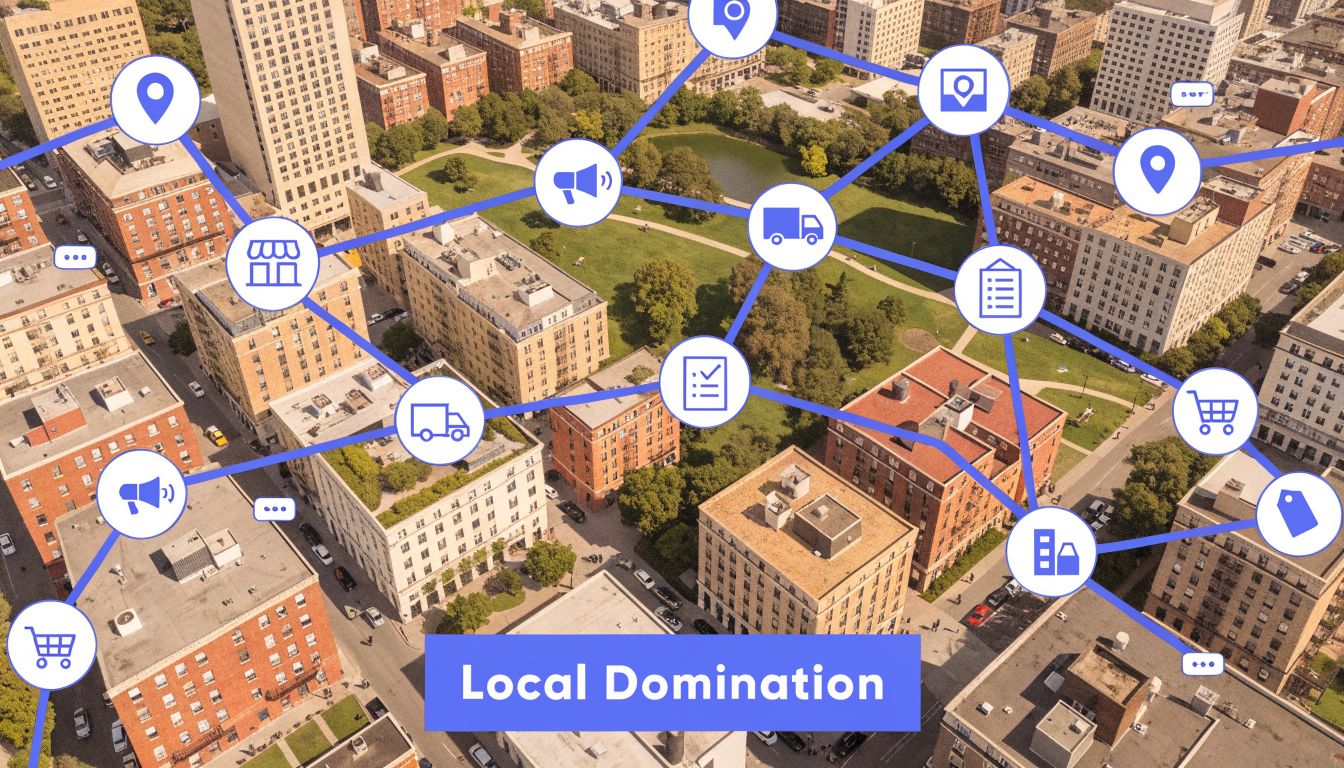
Advanced Tactics for Local Service Domination
Featured snippets matter on their own, but they get stronger when they support a larger local search system. A snippet can introduce your brand. Your Google Business Profile can validate location and relevance. Your service page can turn that attention into a call.
That connection is where many campaigns fall apart. Businesses treat snippets, maps, and AI visibility like separate channels. Google doesn't.
Use snippets to support local pack visibility
A searcher may first encounter your business through an answer box, then look for signals that you're nearby, credible, and available. That's where your Google Business Profile, reviews, categories, service areas, and local landing pages take over.
For example, a dentist might win a snippet for an implant cost query. The user then searches the practice name, checks reviews, and opens the map result. A roofer may win a snippet for storm damage steps, then convert the lead through the local pack when the homeowner wants immediate help.
The handoff matters. If your site answers the question but your local presence is weak, you create awareness without capture. Stronger map visibility closes that gap. This guide on how to optimize a Google Business Profile for local leads fits directly into that workflow.
Write for AI citation, not just snippet extraction
Search is changing. The target isn't only the classic featured snippet anymore. The target is becoming the trusted source behind multiple answer surfaces.
As explained in AIOSEO's article on featured snippets and AI Overviews, the goal is evolving from winning a single box to becoming the source of the answer across SERP features, including AI Overviews. Those are related but different ranking surfaces.
That shift changes how you write:
- Keep facts consistent across service pages and FAQ blocks
- State answers directly before adding persuasive copy
- Use simple language that survives excerpting
- Avoid contradictions between location pages, GBP details, and main service pages
Build entity clarity across your whole presence
Google needs confidence that your business provides the service, in the place you claim, with enough supporting evidence to trust your answer. That confidence doesn't come from one paragraph alone.
It comes from alignment across:
- Service pages with clear scope and intent-based FAQs
- Location pages that reflect real service area relevance
- Google Business Profile content that matches the site
- Review themes that reinforce the same services and problems solved
- Consistent business details across the web
This is why transactional SEO works best when each asset supports the same buyer journey. The snippet earns attention. The map result proves local relevance. The page removes doubt. The phone call happens after those pieces line up.
Monitoring Testing and Protecting Your Snippets
Snippet wins are temporary unless you defend them. Competitors revise pages, Google changes the format, and search intent can drift. If you aren't watching your snippet pages, you'll often discover the loss after leads have already softened.
Watch ownership at the query level
Start in Google Search Console. Track the pages tied to your target questions and monitor changes in impressions, clicks, and average position. If a query suddenly gets more visibility but fewer clicks, the SERP may have changed. If clicks rise after a content revision, your formatting likely improved alignment.
Pair Search Console with manual checks for your highest-value searches. For broader visibility tracking, a resource like how to monitor SERP features for traffic impact is useful because it keeps the focus on what appears on the page, not just rank position.
Test structure, not just wording
Many businesses rewrite snippet sections too aggressively. They swap out the answer, change the heading, edit the CTA, and then have no idea what caused the gain or loss. Test one meaningful variable at a time.
Strong variables to test include:
- Paragraph versus list format when the intent supports both
- Shorter versus slightly fuller direct answers
- Question phrasing in the H2 or H3
- Table insertion for comparison queries
- FAQ placement higher or lower on the page
Don't test five things at once. If you do, you won't know whether format, heading language, or page placement changed the outcome.
Know when a lost snippet is worth winning back
Not every snippet deserves a rescue mission. Prioritize the ones tied to transactional behavior. If you lose a broad educational snippet that rarely assisted leads, that may not be urgent. If you lose a cost, emergency, or comparison snippet tied to your service line, move fast.
A practical recovery process looks like this:
- Check the live SERP and note the current format.
- Review the page that replaced you and identify what it answers better.
- Tighten your answer block without bloating the page.
- Improve surrounding support content such as lists, FAQs, or comparisons.
- Recheck internal links and technical health so Google can reprocess the page cleanly.
Protecting snippets isn't glamorous work. But for local service companies, it's often the difference between visibility that converts and visibility that fades.
If you want help turning high-intent search terms into booked jobs, Transactional LLC builds local SEO, Google Maps, and AI-focused content systems for service businesses that want to rank for the searches that effectively bring in customers.