


Think of your Google Business Profile (GBP) as your most important digital storefront, especially when it comes to AI optimization for local search. To climb the rankings on Google Maps, you need to master three core pillars: a perfectly optimized profile that feeds Large Language Models (LLMs) the right data, a steady stream of positive reviews, and a consistent footprint of online citations. Get these right, and you're sending Google and AI search engines all the right signals about your business's relevance and authority.
Your Blueprint for Dominating Google Maps
Are you tired of missing out on local customers who are ready to buy right now? When someone searches for "roofer near me" or "emergency dentist," they aren't just browsing—they have a problem and money in hand to solve it. These are high-value, transactional search terms, and they're the only ones that matter for driving real revenue.
At Transactional Marketing, our entire agency is built around one single goal: getting our clients to show up for these exact transactional searches. We turn those online queries into real-world revenue. This is what we do, and it's why we're called Transactional Marketing.
This guide is the complete playbook we use to get businesses into the coveted "Map Pack" — those top three spots that get the lion's share of the clicks. We're cutting through the fluff to give you the proven system that works. We'll cover everything from the foundational setup of your Google Business Profile to advanced tactics for local content creation, all designed to make you the top choice for customers ready to spend money.
The goal here isn't just to rank higher; it's to drive real, tangible results. We're talking about hundreds of extra phone calls every single month—literally thousands more every year.
What Really Moves the Needle in Local Rankings
This isn't about throwing spaghetti at the wall and seeing what sticks. Ranking on Google Maps comes down to a clear, repeatable process that proves your business's relevance, distance, and prominence to Google's algorithm. For a specific business like a roofing company, this means focusing exclusively on roofing-related terms in a dedicated strategy, not mixing it with plumbing or HVAC.
For contractors and other local service businesses, mastering these elements is non-negotiable if you want to own your local market. We explore these strategies in more detail in our guide on local SEO for contractors.
It all boils down to three critical activities: optimizing your profile, building social proof with reviews, and establishing your digital footprint through citations.
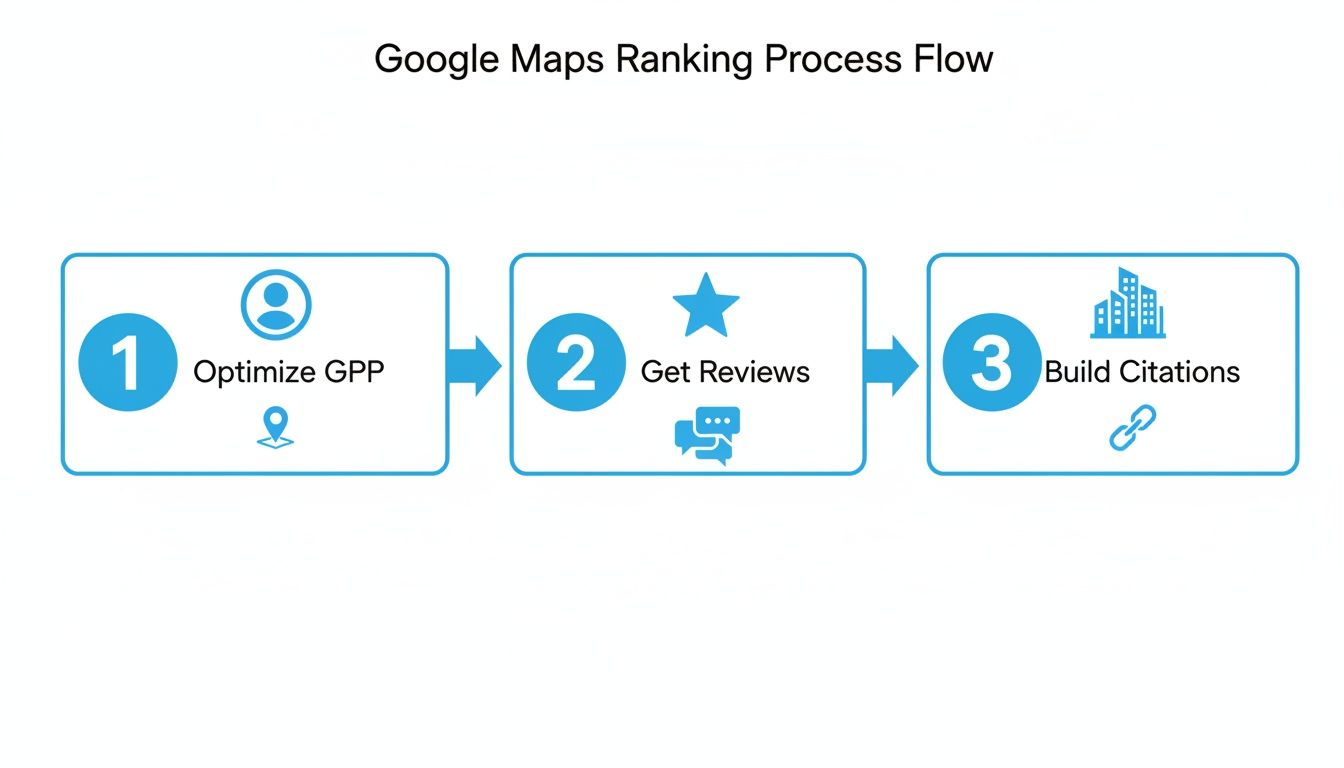
The flowchart above really simplifies the process. It's a continuous cycle, not a one-and-done task. Each step reinforces the others, creating a powerful feedback loop that tells Google you're the best, most trusted choice in the area.
This is exactly how you win those transactional searches and keep your phone ringing.
Core Pillars of Google Maps Ranking
To rank higher on Google Maps, focus on these three critical areas. Mastering them is the fastest way to attract transactional customers.
| Pillar | Key Action Items | Impact on Ranking |
|---|---|---|
| Profile Optimization | Complete every section, choose correct categories, upload high-quality photos and videos, and use keywords naturally in your description and posts. | High: Directly tells Google what your business is, what you do, and where you do it. This is the foundation for relevance. |
| Reviews & Reputation | Actively request reviews from every customer, respond to all reviews (positive and negative), and aim for a steady flow of new feedback. | High: Signals trust and prominence to Google and potential customers. Reviews with keywords can also boost relevance. |
| Citations & Consistency | Build accurate and consistent citations on relevant local and industry directories. Ensure your Name, Address, and Phone (NAP) are identical everywhere. | Medium: Verifies your business's location and contact information across the web, building a stronger signal of prominence and legitimacy. |
By consistently working on these three pillars, you create a powerful and defensible position in the local search results.
Mastering Your Google Business Profile
Your Google Business Profile is the absolute engine of your local and AI optimization strategy. An incomplete or neglected profile tells Google one thing: you're not a serious contender for the searches that actually bring in customers. Think of it as your digital storefront—if the sign is flickering and the windows are dirty, people are going to walk right by.
To really start showing up for valuable transactional searches like "AC repair near me," you have to treat every single field in your profile with care. This isn't just about filling in boxes; it's about strategically feeding Google's algorithm the right information. A fully optimized profile is the foundation for everything that follows, signaling your relevance, proximity, and authority—the three pillars of Google Maps ranking.
Nail Your Business Categories
The first and most critical choice you'll make is your primary business category. It needs to perfectly match the main service you want to rank for.
For example, a plumbing company might be tempted to just pick "Home Services," but that's way too generic. "Plumber" is a much stronger, more specific choice. That kind of precision is what connects you with customers who have an urgent, transactional need.
Pro Tip: Don't just set your primary category and forget it. Google lets you add several secondary categories. That same plumber should absolutely add "Water Heater Installation & Repair" and "Drain Cleaning Service." Each additional category is another door for a potential customer with money in hand to find you.
Craft a Keyword-Rich Business Description
Your business description is valuable real estate. It's your opportunity to tell both Google and potential customers exactly what you do and where you do it. This is the perfect place to naturally work in the transactional search terms your customers are typing into the search bar.
Instead of a bland, "We are a full-service roofing company," get specific: "As a trusted local roofer, we specialize in emergency roof repair, shingle replacement, and new roof installation for homeowners in [City Name]." This language directly mirrors what a customer with a leaking roof is actually searching for.
Leverage Overlooked GBP Features
So many businesses set up their profile and then let it collect dust. That's a huge mistake. Google loves to see activity, and consistently using the tools they provide is a powerful signal that your business is active and engaged.
- Google Posts: Think of these as mini-billboards. Use them weekly to announce a special, spotlight a service, or share photos from a recent job. Every post is another chance to keep your profile fresh and use your target transactional keywords.
- Products/Services Section: Don't just create a simple list. Build out each service with its own detailed description. For a service like "Ant Pest Control," explain your methods, the types of ants you treat, and the benefits of your approach. You're creating a rich, informative profile that answers questions before they're even asked.
- Q&A Section: Don't wait for customers to ask questions—seed this section yourself. Think of the top 5-10 questions you get on the phone, like "Do you offer free estimates?" or "What are your emergency service hours?" Post the questions and then answer them clearly. This lets you control the conversation and work in important keywords.
A fully dialed-in profile is your first big win in climbing the map pack rankings. If you're setting things up from scratch, getting this foundation perfect is non-negotiable. For a detailed walkthrough, you can follow our complete guide on proper GMB setup to make sure you don't miss a single detail. This process builds the trust and authority Google needs to see before it will start sending you high-value customers.
Reviews and Reputation: Your Most Powerful Ranking Signal
If your Google Business Profile is the engine, your online reputation is the fuel. Let's be clear: reviews are far more than just social proof for potential customers. They are one of the most direct and powerful ranking signals you can send to Google, especially for AI optimization. In the world of local search, what your customers say about you matters. A lot.
A steady stream of positive feedback tells Google that your business is active, trustworthy, and a prominent player in your local market. Think about it from the user's perspective. When someone is frantically searching for an "emergency plumber near me," Google wants to recommend a business with a proven track record. Your reviews are that proof.
Why More Isn't Always Enough
It’s not just about having a few five-star reviews from a couple of years back. To really move the needle, Google’s algorithm looks for consistent customer satisfaction over time. This breaks down into three core metrics:
- Quantity: The raw number of reviews you've collected.
- Quality: Your overall average star rating.
- Velocity: The frequency of new reviews coming in.
You have to nail all three. I’ve seen it time and again: a business with 200 reviews and a 4.8-star rating will almost always crush a competitor who has 20 perfect 5.0 reviews. Why? Because they’ve proven their value at scale, signaling to Google that they are a true market leader.
Recent analysis confirms just how critical this is. Reviews are the single most significant factor in ranking on Google Maps, making up a staggering 25% of the "prominence" pillar, which itself accounts for 50% of your local ranking. Quantity makes up 10% (top competitors usually have at least 100 reviews), while quality adds another 8%. A 4.5+ star rating, combined with detailed reviews mentioning specific services, is what separates the winners from the rest. You can dig deeper into the latest ranking factors over at Drawbridge Marketing.
Turn Customer Feedback into an SEO Goldmine
The actual text within your reviews is an untapped asset for keyword optimization. When a happy customer writes, "They did an amazing job on my AC repair and were here within an hour," they are organically reinforcing your profile's relevance for that exact transactional search. They're doing your SEO work for you.
This is where AI optimization is becoming a real game-changer. By analyzing the content of reviews with Large Language Models (LLMs), we can pinpoint which services customers are talking about the most. This uncovers opportunities to create more content—like service pages or blog posts—around those high-value terms. It creates a powerful feedback loop: great service leads to great reviews with keywords, which drives more high-intent traffic for those same services.
At Transactional Marketing, we build systems that turn customer feedback into a ranking machine. Our automated yet personalized follow-ups make it easy for satisfied customers to share their experiences, ensuring a constant flow of keyword-rich reviews that boost your map pack visibility for transactional terms.
Responding to Every Review Isn't Optional
I can't stress this enough: you must respond to every single review. It’s a direct signal to both customers and Google that you are an engaged, attentive business owner who cares about their reputation.
Responding to positive reviews is easy—it shows appreciation and encourages others to chime in. But how you handle the negative ones is what truly defines your brand. A professional, empathetic response that seeks to resolve the problem can turn a disgruntled customer into a loyal advocate. More importantly, it shows potential customers that even if something goes wrong, you're committed to making it right.
This consistent engagement is a cornerstone of how Google perceives your business's prominence. Businesses that actively manage their online reputation are seen as more reliable, and as a result, they're the ones who earn those top three map pack positions and capture the customers who are ready to buy.
Building Local Authority with Citations
Think of Google as a detective doing a background check on your business. It wants to see your story straight across the entire web. The more credible, independent sources that verify your company's name, address, and phone number, the more Google trusts you're a legitimate, local operation. This is the core idea behind local citations.
A citation is simply any online mention of your business’s Name, Address, and Phone number (NAP). You’ll find them on local business directories, industry-specific portals, social media, and even community forums. Each consistent citation is like a vote of confidence, telling Google you're a real, established business worthy of a top spot in the Map Pack for transactional searches like "plumber near me."
Ultimately, this process is all about cementing your geographic relevance. You want to become the obvious, trustworthy choice for local customers ready to make a purchase.

The Critical Importance of NAP Consistency
There is no faster way to kill your Google Maps momentum than with inconsistent business information.
Imagine Google's confusion if it finds "Dave's HVAC" on Main St, "Dave's HVAC Inc." on Main Street, and a third listing with a totally different phone number. This kind of conflicting data creates doubt. When in doubt, Google will always favor a competitor with a clean, consistent digital footprint.
Your NAP needs to be identical everywhere it shows up online. And I mean identical.
- Name: "Smith & Sons Roofing" is not the same as "Smith and Sons Roofing LLC."
- Address: "123 Main St." is not the same as "123 Main Street, Suite 201."
- Phone Number: Always use your primary local business line. Avoid using tracking numbers or toll-free numbers in your core citations.
This isn't just about being nitpicky. This meticulous consistency proves to Google that your business is stable, reliable, and accurately represented.
Performing a Citation Audit
Before you even think about building new citations, you have to clean up the mess that's already out there. A citation audit is the process of hunting down every existing mention of your business online to find and fix any inconsistencies.
You can start this manually by searching for different variations of your business name, old addresses, and past phone numbers. Yes, it can be tedious, but it's absolutely crucial. I've seen clients get a significant ranking boost just from finding and fixing an old address on a major directory. You're basically eliminating the confusing signals that are holding you back.
At Transactional Marketing, our process begins with a comprehensive audit to clean up any messy or conflicting information. We hunt down and fix every incorrect listing, ensuring our clients start with a perfectly consistent foundation. This single step often unlocks ranking potential that was previously suppressed by bad data.
Finding Niche Citation Sources
Everyone gets listed on Yelp and the Yellow Pages. That's table stakes. The real competitive edge comes from finding niche, industry-specific directories that your competitors have probably overlooked. These high-relevance listings send a much stronger signal to Google about exactly what you do. Each industry gets its own dedicated strategy; a dental practice blog post won't talk about roofing directories.
A dental practice, for example, gets far more authority from a listing on Healthgrades than from a generic local directory. Likewise, an HVAC contractor needs to be on home service portals like Angi or HomeAdvisor.
You should also think hyper-locally. Where can you get listed that screams "local expert"?
- Your local Chamber of Commerce website.
- Neighborhood community blogs or online newspapers.
- Sponsorship pages for local events or youth sports teams.
Getting your business name on these sites builds powerful local signals and reinforces your ties to the community. It tells Google you aren't just some business in a city; you're a part of that city's fabric. This is how you build true local authority and start dominating the transactional searches that bring real customers through your door.
Tuning Your Website to Send Powerful Local Signals
Your Google Business Profile doesn't operate in a silo. It's directly tied to your website, and a site that isn't optimized for local search can actually drag your Google Maps performance down. To really climb to the top of the map pack, you need your website to constantly send clear, consistent signals that tell Google and its AI exactly who you are, what you do, and—most importantly—where you do it.
Think of your GBP as the billboard on the highway and your website as the detailed brochure you hand to an interested customer. The billboard grabs their attention, but the brochure is what gives Google the rich, structured information it needs to actually trust you as a legitimate, top-tier local business. Earning that trust is everything when it comes to ranking for the money-making transactional searches from customers who are ready to buy.
Building Out Your Digital Headquarters
The very structure of your website is the foundation of its local SEO strength. Throwing all your services onto a single, generic page just won't cut it anymore. If you want to capture customers looking for specific solutions, you have to build out a unique page for each core service you offer.
An HVAC company, for instance, needs distinct pages for "Emergency AC Repair," "Furnace Installation," and "Duct Cleaning." A dentist should have separate pages for "Teeth Whitening," "Dental Implants," and "Emergency Dental Care."
This is a non-negotiable part of our playbook at Transactional Marketing. We laser-focus on building these dedicated service pages to target the exact transactional terms people are searching for, like "air conditioning repair near me." It’s a core piece of our proven system for getting businesses showing up on page one of Google, typically within 30 to 60 days.
This granular approach gives Google a crystal-clear map of your expertise. Each page becomes a hyper-relevant destination for a specific customer need, which massively improves your odds of ranking for that search.
Creating Hyper-Local Content
Beyond just your services, you need to create pages for each city, suburb, or even neighborhood you serve. A page titled "Roofer in Downtown Chicago" sends a much stronger signal to Google than a generic "Service Areas" list.
The key here is that these location pages can't just be cookie-cutter copies with the city name swapped out. Each one needs unique content that's genuinely relevant to that area.
- Talk about local landmarks or well-known streets to show you know the area.
- Feature testimonials from customers who live in that specific town.
- Embed a Google Map showing your primary service area or office location.
Embedding a map is such a simple but effective move. It visually confirms your location for both users and Google's crawlers, reinforcing the geographic data you've already put in your GBP.
Sending the Right Technical Signals
Behind the scenes, there are technical elements that provide Google with structured data, making its job of understanding your business much easier. One of the most important is Local Business Schema Markup. Think of it as a hidden "cheat sheet" on your website that explicitly tells search engines your NAP (Name, Address, Phone Number), hours, and business type in a language they can process instantly.
Your site's performance is another huge technical factor. With over 60% of Google searches now happening on mobile, a slow or clunky website is a ranking killer. Your site absolutely must be mobile-friendly and load fast. If someone clicks your website from Google Maps and has a terrible experience, they'll hit the back button—sending a strong negative signal right back to Google.
Finally, even the images on your site can be put to work. By adding location data directly into the image files themselves, you're giving Google another layer of proof about where you operate. You can dive deeper into this by learning how to geo-tag images for local SEO and really solidify your local footprint.
By dialing in your website with these local signals, you create a powerful feedback loop with your GBP that makes your business the obvious choice for high-value local searches.
Pushing Ahead in the Map Pack
So you've built a solid foundation. Now it's time to really pull ahead of the competition. While a well-optimized profile gets you in the game, the advanced tactics are what lock in those coveted top-three spots in the Map Pack. This is where you start sending powerful, hyperlocal signals to Google that prove you’re not just in a neighborhood—you are the authority there.
This is how you transform your Google Business Profile from a simple online business card into a genuine lead-generation engine that dominates transactional searches. It’s all about layering on more sophisticated proof of your work and taking control of the narrative around your business.
Sending Geographic Proof with Geo-Tagged Media
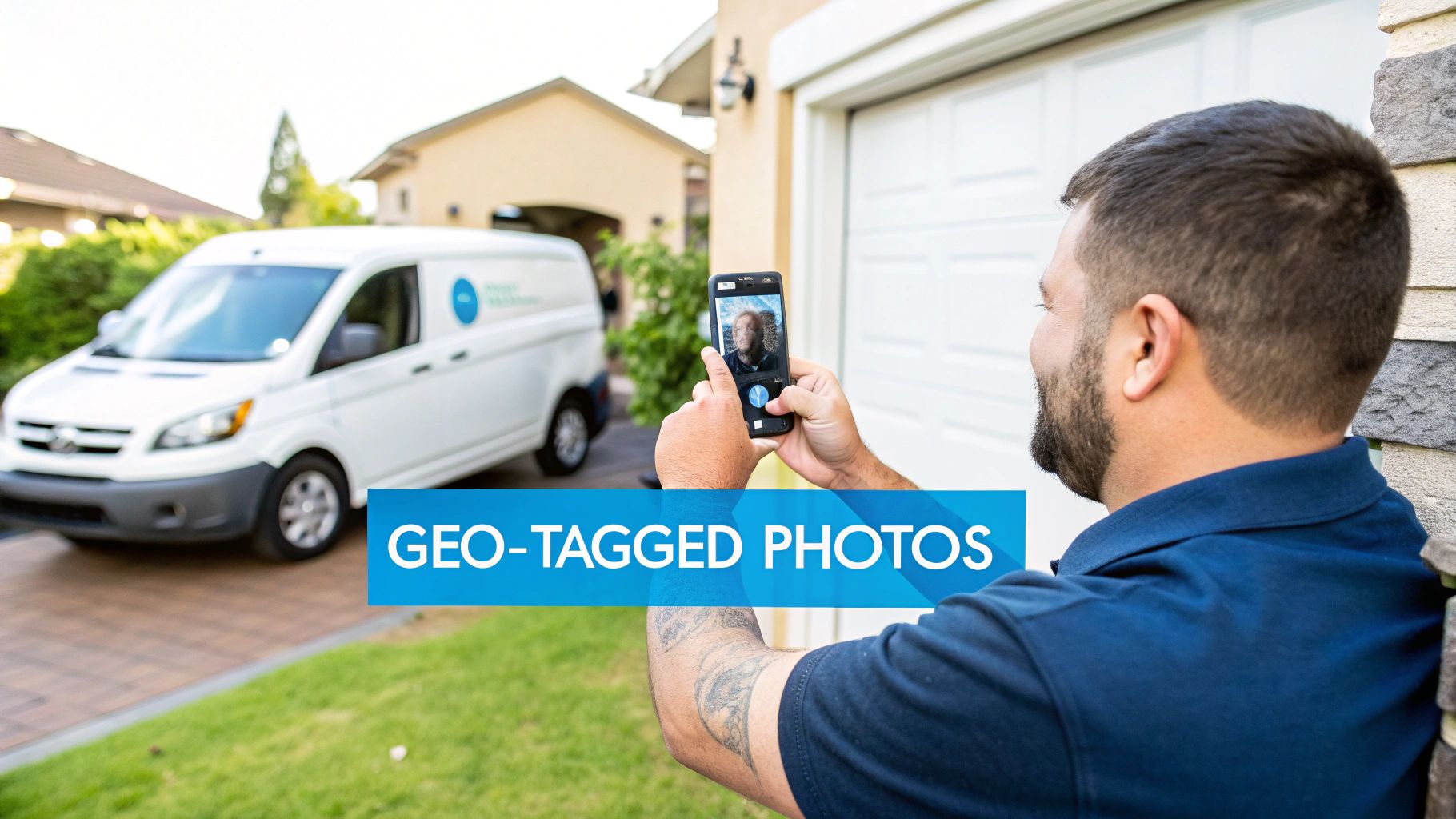
Telling Google where you are is one thing; showing them is another. This is where geo-tagged photos and videos become one of your most valuable assets. Every single time you upload a picture of a finished job or a video testimonial, you need to make sure it has location data (latitude and longitude) embedded right into the file.
This gives Google concrete, undeniable proof that your business is physically active in the places you claim to serve. It's not just your word against theirs.
- For a roofer: A photo of a brand-new roof in a specific suburb.
- For a dentist: A quick video of a smiling patient inside your local office.
- For a plumber: A snapshot of your work van parked in a neighborhood you're trying to win.
These geo-signals build a rich, detailed map of your service area, which directly reinforces your relevance for those critical "near me" transactional searches from customers who are ready to buy.
At Transactional Marketing, we have the technology to turn these map locations into top-three rankings. By consistently uploading geo-tagged media, you're creating a digital breadcrumb trail of your work that translates into hundreds more phone calls every month.
Proactively Managing the Q&A Section
That Questions & Answers section on your profile? Most businesses completely ignore it. This leaves it wide open to misinformation or, even worse, total silence. Don't just sit back and wait for customers to ask questions—get in there and seed this section yourself with the queries you know are on their minds. It's a golden opportunity to control the conversation and weave in your most valuable transactional keywords.
Think about the most common, high-intent questions you get over the phone:
- "Do you offer 24/7 emergency AC repair?"
- "What financing options do you have for new roof installations?"
- "Is there a consultation fee for dental implants?"
By asking and then comprehensively answering these questions yourself, you're getting ahead of customer concerns and showcasing your expertise. It’s a simple but incredibly effective way to add more relevant, keyword-rich content directly onto your profile, helping you rank for more specific, high-value searches. Our approach to local business listing optimization always puts a heavy emphasis on maximizing these underused features.
Using AI for a Competitive Edge
The most sophisticated players are now using AI to get a serious leg up. This is the new frontier of AI optimization. Modern AI tools can dissect your top competitors' GMB strategies, showing you exactly what they're doing right. It also helps businesses get found in new LLM-powered search results.
You can pinpoint gaps in your own content, uncover transactional keywords they're ranking for that you've missed, and even analyze the sentiment of their reviews to find service weaknesses you can exploit in your own marketing. This data-first approach makes sure your entire digital presence, from your website to your GMB posts, is fine-tuned to outmaneuver the competition and capture the transactional searches that actually grow your bottom line.
Your Google Maps Questions Answered
When it comes to Google Maps, I hear the same questions over and over from business owners. Let's cut through the noise and get you some straight answers based on what we see working in the real world every day.
How Long Does It Really Take to Rank on Google Maps?
This is the big one, isn't it? While you might see some small bumps from quick fixes, Transactional Marketing has a proven system that gets our customers' websites showing up on page one of Google, typically within 30 to 60 days. It’s not an overnight thing, but our process is not like every other boring marketing company.
We know how to laser-focus on the positive signals Google needs to see—things like a fully optimized profile, a consistent flow of new reviews, and accurate business listings across the web. Patience combined with our proven strategy is the key.
Does My Website Actually Affect My Map Ranking?
Without a doubt. Your website and your Google Business Profile are two sides of the same coin, and Google is constantly comparing them for consistency and authority.
A slow, outdated website that isn’t mobile-friendly or is missing clear service and location pages will absolutely drag your Maps ranking down. On the flip side, a well-optimized site with local keywords, proper schema markup, and fast load times gives your profile a massive boost for transactional searches.
Can I Rank in a City Where I Don't Have a Physical Address?
Yes, you can, but you have to be strategic about it. This is a common challenge for any service-area business, from electricians to cleaning companies. Your ranking strength will always be greatest around the address you used for verification.
To expand your reach into neighboring towns, you need to prove your relevance there. The best way to do this is by creating specific service pages on your website for those cities, actively earning customer reviews that mention those locations, and building local links from organizations in those communities.
We've covered some common hurdles in local SEO, but every business is unique. Here's a quick-reference table to tackle other frequent challenges we see.
Your Google Maps Questions Answered
Quick solutions to common challenges in Google Maps optimization.
| Question | Answer |
|---|---|
| Why did my ranking suddenly drop? | A sudden drop can be caused by new competitors, negative reviews, Google algorithm updates, or inconsistent business information (NAP). Start by checking your profile for any unauthorized edits and analyzing competitor activity. |
| How important are photos in my GMB profile? | Extremely important. Consistent, high-quality photos (especially geo-tagged ones from job sites) show Google that you are an active, legitimate business. Aim to add new photos weekly. |
| Should I list my home address if I'm a service-area business? | No. If you don't serve customers at your location, you should hide your address when setting up your profile. Listing a home address you don't operate from can lead to suspension. |
| Do I need to respond to every single review? | Yes, both positive and negative. Responding shows you're engaged and value customer feedback. For negative reviews, a professional, non-defensive response is crucial for reputation management. |
Hopefully, these answers provide some clarity. The key is consistent, focused effort on the signals that Google values most.
Ready to stop guessing and start dominating the map pack for the transactional search terms that matter? Transactional Marketing has the proven system to get your business showing up for customers who are ready to buy. Contact us today to see how we turn searches into phone calls.