


Most window and door contractors don't have a traffic problem. They have a speed, intent, and visibility problem. In one 2026 industry analysis, the average lead response time for window and door installation was about 47 hours, while 78% of homeowners hired the first contractor to respond, 78% of leads weren't answered within the first hour, and 44% of contractor leads never received any follow-up (window and door marketing stats). That's a brutal gap between demand and execution.
The contractors who win local search usually aren't chasing every query. They focus on transactional searches like “window replacement near me” and “door installation contractor near me,” where the homeowner is ready to call, compare, and book. Research queries still matter, but they support the sale. The lead engine starts with buyer-intent search terms, then connects Google Maps visibility, service-area pages, conversion-focused landing pages, reviews, citations, and AI-supported SEO into one operating system.
That's also why firms like Transactional LLC stand out as a useful example in this space. Their model is built around transactional terms, Google Maps optimization, industry-specific content, and measurable local visibility instead of generic marketing activity. If you're serious about booked jobs, connect your rankings to calls, forms, and multi-touch lead generation analytics, not just impressions.
1. AI-Powered Transactional Search Term Targeting for Window and Door Contractors
A lot of SEO work fails because it targets the wrong searches. “How to clean vinyl windows” can bring visits. It rarely brings replacement jobs. “Window replacement near me” and “front door installation [city]” are different. Those are the searches that justify real budget and real page development.

Large language models are useful here because they help sort search intent at scale. Instead of dumping every keyword into one list, use AI to separate replacement, installation, repair, parts, DIY, warranty, and price-shopping queries. For lead generation for window and door contractors, that distinction matters because recent guidance in the category points to qualification and routing as a bigger bottleneck than raw click volume, especially when teams need to separate high-intent replacement jobs from repair, parts, and low-value inquiries (window and door lead generation guide).
What to build first
Start narrow. Pick a small group of service-city combinations and build around exact buyer language. A Phoenix contractor, for example, shouldn't begin with a broad “windows” page. It's more practical to launch pages for “replacement windows Phoenix,” “vinyl window replacement Phoenix,” and “patio door installation Phoenix,” then watch which terms generate qualified calls.
A good supporting process looks like this:
- Map intent by service line: Separate window replacement, entry door installation, patio doors, impact windows, and energy-efficient upgrades into distinct clusters.
- Filter out weak leads early: Exclude terms tied to parts, screen repair, broken glass-only requests, and generic DIY education unless you have a reason to monetize them.
- Close the loop with CRM data: Compare ranked keywords against actual estimate requests and booked jobs, not just traffic.
- Use exact-match internal structure: A page targeting one service in one city usually converts better than a catch-all services page.
For teams building this systematically, high-intent keyword targeting is the right framework.
Practical rule: If the query sounds like something a homeowner would search right before calling, it belongs in the core campaign. If it sounds like homework, put it in a support layer.
2. Google Maps AI Optimization and Top-3 Local Pack Domination
For window and door contractors, the local pack often decides who gets the call. A homeowner searching "window replacement near me" or "patio door installer" is usually comparing three things in seconds: proximity, review quality, and whether the listing looks like a real operating company instead of a placeholder profile.
That makes Google Maps a lead-quality channel, not just a visibility play.
The contractors that show up consistently tend to do four things well. They match their profile to real service demand, reinforce that profile with the right location pages, collect reviews that mention actual jobs, and keep citations clean enough that Google sees one stable business identity across the web. If one of those breaks, rankings often soften even when the website itself is decent.
AI helps with speed and pattern detection. It can scan competing Google Business Profiles, review text, categories, service lists, and city-page language to spot what is missing from your own setup. That is useful for a multi-location contractor or a company offering several lines like replacement windows, entry doors, impact products, and patio doors, because profile drift happens fast.
A practical way to audit Maps performance is to work backward from the searches that should produce estimates:
- Search your priority terms by city and by "near me" variation.
- Compare the top profiles for primary category, secondary categories, review themes, photos, and linked landing pages.
- Check whether your website page answers the intent behind the listing click.
- Flag weak trust signals, especially thin reviews, outdated photos, and mismatched business data.
This is also where AI-supported SEO fits naturally. Use it to classify review sentiment, summarize competitor positioning, and identify missing service-location combinations. Do not use it to mass-generate fake updates or generic review replies. Those shortcuts usually create thin signals, and thin signals do not hold local rankings for long.
For teams that want a more detailed process for improving local pack visibility, this guide on how to rank higher on Google Maps lays out the core mechanics.
One trade-off matters here. Contractors often try to rank a broad profile across every nearby city, even when the website has little proof for those areas. That can increase impressions, but it often lowers lead quality. A tighter footprint with stronger city-page support, better job photos, and reviews tied to real installations usually produces better calls than a wide but weak service-area setup.
The goal is simple. Make the Maps listing, the landing page, the reviews, and the citation profile tell the same story about what you install, where you install it, and why a homeowner should contact you now.
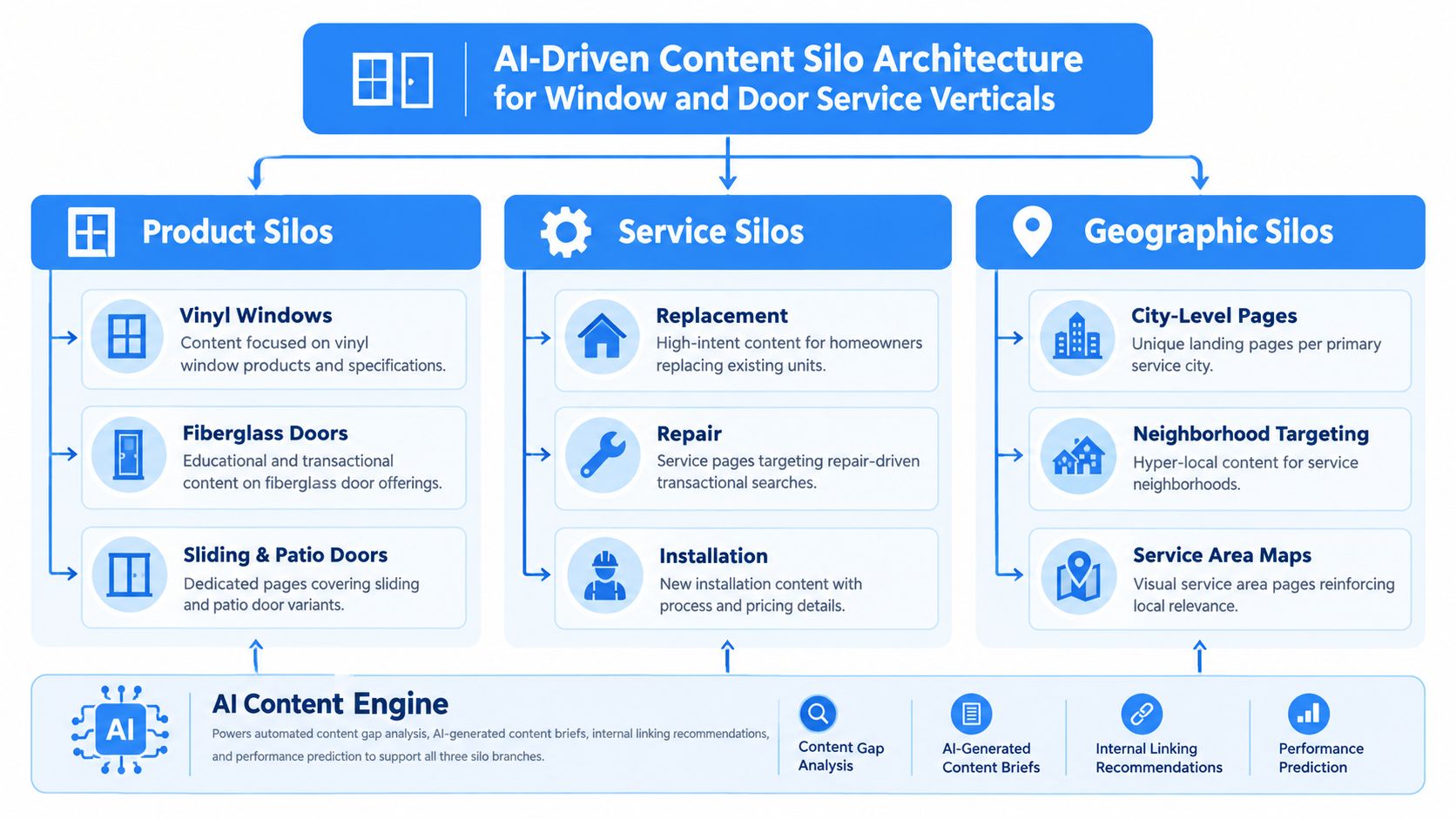
3. AI-Driven Content Silo Architecture for Window and Door Service Verticals
Content structure decides whether a high-intent search reaches an estimate page or gets stranded on a generic services overview. For window and door contractors, that usually shows up in searches like "impact window replacement Miami," "front door installation near me," or "sliding patio door contractor Boca Raton." If the site folds those intents into one broad page, rankings blur, click-through rates slip, and lead quality usually drops with them.
The practical fix is to build around buying intent first, then support that intent with tightly related pages.
Start with the pages that can produce revenue now. Window replacement, entry door replacement, patio door installation, impact windows, and city-specific service pages usually belong in that group. Each page needs its own scope, its own proof, and its own conversion path. A homeowner searching for hurricane-rated windows is much closer to booking than someone casually reading about energy savings, so those two searches should not land on the same page.
Support content still matters, but it has a job. It should remove objections, clarify options, and strengthen the main service pages instead of competing with them. Good examples include financing terms, permit expectations, frame material comparisons, warranty explanations, and installation timelines.
A clean silo for a coastal Florida contractor might work like this:
- Money pages: window replacement Miami, impact windows Miami, patio door installation Miami, entry door replacement Miami
- Product and solution pages: vinyl windows, aluminum windows, hurricane-rated windows, sliding glass doors, French doors
- Decision pages: financing options, rebate eligibility, warranty coverage, expected install timeline, code and permit questions
- Location support pages: city pages only for areas with real crews, completed jobs, reviews, and photos to support the claim
That last point matters more than many contractors expect.
Expanding every service into every nearby city can increase indexable pages, but it also creates thin location content fast. Thin city pages rarely help for long, and they often attract weak leads from areas the company cannot serve profitably. A smaller footprint with better local proof usually performs better than a wide map of copied pages.
AI helps at the planning and maintenance stage. Use it to group search terms by intent, spot cannibalization between similar pages, outline supporting articles, and identify missing combinations such as product plus city or service plus financing concern. Do not rely on it to mass-produce dozens of near-duplicate location pages. Search engines and buyers are both good at spotting that pattern.
Message framing also changes by market. Guidance from window and door contractor marketing insights points to separate rebate pages, payback pages tied to local utility costs, and category-specific pages such as storm windows or patio doors. That matches what many contractors see in practice. In storm-prone areas, impact protection often drives the search. In high energy-cost markets, rebate and efficiency language can bring in stronger estimate requests.
The goal is a direct path from query to page to call. Each silo should answer one commercial intent clearly, support Google's understanding of the service, and give the homeowner enough confidence to request an estimate without hunting through the rest of the site.
4. LLM-Enhanced Review Generation and Sentiment Analysis for Window and Door Contractors
Reviews influence two points in the lead path at once. They affect whether a contractor appears credible in Google Maps, and they affect whether a homeowner who lands on that listing or page decides to call.
For window and door companies, the review job is specific. The strongest reviews mention the product installed, the crew experience, timing, cleanup, and the result. “Love our new windows” helps. “Installed triple-pane replacement windows in Arlington, finished in one day, crew kept the jobsite clean, house is quieter” helps more because it reinforces local relevance and buyer trust in the same sentence. That language also gives AI systems and search platforms more context about what the business does.
Analysts covering AI local search have found that review volume correlates with AI mentions across industries, and they recommend monitoring visibility beyond Google Maps to include tools such as ChatGPT, Perplexity, Gemini, and Google AI Overviews (AI local search signals analysis). For contractors, that makes review collection an operating discipline, not a side task for the office manager.
The practical workflow is simple, but it needs structure.
Ask at the right moment. Send the first request right after final walkthrough, while the homeowner is still looking at the finished door or window package. If the job had a punch-list issue, hold the review request and route that customer into service recovery first. That trade-off matters. A slightly lower request volume is better than pushing frustrated customers toward a public complaint.
LLMs help on the execution side:
- Create review request copy for different jobs, such as full-home replacement windows, entry door installs, patio door replacements, or storm-rated upgrades.
- Rewrite staff responses so they sound human, mention the actual work completed, and avoid the generic tone that makes review profiles look managed.
- Group review themes by sales value, such as energy savings, curb appeal, outside noise reduction, financing relief, or installer professionalism.
- Flag negative patterns early, especially scheduling delays, missed callbacks, measurement errors, or cleanup complaints.
That last point is where sentiment analysis earns its keep. A contractor may assume price is the main objection, then find that weak communication is what shows up repeatedly in reviews and estimate follow-up notes. Fixing that issue often improves close rates faster than rewriting website copy.
A good review system also feeds the rest of the SEO program. Review language can be reused carefully on service pages, FAQ sections, and estimate pages to match the way homeowners describe problems before they search. For teams that want a tighter process, these review request templates can reduce admin time. It also helps to track local business reputation so the company can spot shifts in sentiment before they start affecting lead quality.
5. AI-Powered Competitor Transactional Keyword Analysis and Market Positioning
Competitor analysis should answer one commercial question. Which high-intent searches can your company win faster than the firms already showing up in organic results and Google Maps?
For window and door contractors, that usually means comparing terms that sound similar but convert differently. “Impact windows Miami” signals a product and code-driven need. “Window replacement Miami” is broader and often brings in mixed intent, including early research. A contractor that treats those as one keyword usually builds one generic page, then wonders why traffic does not turn into estimates.
A practical workflow looks like this:
- Export the top-ranking pages for a few money terms in your market, such as “impact windows Miami,” “hurricane windows Miami,” and “window replacement Miami.”
- Feed the title tags, H1s, GBP categories, and review snippets into an AI prompt: “Compare these competitors by product specificity, city modifiers, financing language, and installation intent. Flag missing terms and pages that target broad replacement intent but ignore impact-specific demand.”
- Have the model group the gaps by revenue potential, not by SEO neatness. A missing “Coral Gables impact window replacement” page matters more if your crews already quote jobs there and competitors only mention Miami at the homepage level.
That process often surfaces gaps that a manual scan misses. One common pattern is a competitor ranking with a title tag focused on “window replacement Miami” while never building a dedicated page for “impact windows Miami.” Another is a strong main-city page paired with weak suburb coverage, even though nearby searches can convert well because competition is thinner.
The useful output is not a giant spreadsheet. It is a short priority map.
Page gaps with buying intent
A rival may have one “doors” page, but no focused pages for sliding patio door replacement, front entry door installation, or hurricane-rated exterior doors. Those are separate searches with separate objections, price expectations, and close rates.
Geographic gaps tied to crew coverage
Many contractors rank in the primary city and leave money on the table in the suburbs they already serve. If installers are active in Plano, Frisco, or Coral Springs, but competitors only optimize for the main metro, that is a workable opening.
Message gaps that affect lead quality
Some pages still lean on vague claims about craftsmanship. In many markets, homeowners are searching with sharper purchase criteria: impact resistance, energy efficiency, financing, noise reduction, HOA compliance, or faster install timelines.
AI helps sort those patterns quickly, but the positioning call still needs contractor judgment. Chasing every uncovered keyword creates thin pages and weak sales follow-up. The better move is to pick the terms closest to booked work, then build focused pages that match the search, the city, and the offer. That is how competitor research supports the full transactional path instead of turning into a reporting exercise.
6. AI-Optimized Local Citation and Business Directory Authority Building
Bad citation data wastes local demand.
A homeowner searches your brand after seeing you in Google Maps, clicks a directory profile, finds an old phone number, and the lead either dies or goes to a competitor. The ranking impact matters, but the revenue loss is more immediate. For window and door contractors, citation work supports the middle of the transactional path. Searcher finds the business, checks trust signals, confirms service area, then decides whether to call.
Citation authority is less about volume than control. Google needs a consistent business identity across the web. Prospects need the same thing. If your company has changed domains, used call tracking inconsistently, moved offices, or built separate profiles for overlapping service areas, AI can speed up the cleanup by finding mismatches, duplicate listings, and outdated references that a manual check often misses.
Three citation situations usually deserve attention first.
Core identity conflicts
Start with the listings that shape branded search behavior and map trust. Google Business Profile, Apple Business Connect, Bing Places, Yelp, Facebook, and the major data aggregators should mirror the website on business name, primary phone, address format, hours, and URL. Small differences are common. Repeated differences create uncertainty.
Service-area confusion
Window and door contractors often serve multiple suburbs from one office. Directory profiles that imply a physical location in every city can create compliance issues, while weak service-area signals can limit visibility outside the main city. The practical fix is consistency. One real headquarters, clear service-area descriptions, and directory copy that aligns with the locations you dispatch crews to.
Legacy clutter
Old tracking numbers, duplicate profiles, and stale microsites cause more problems than obscure-directory gaps. They split trust, send users to dead pages, and make review history harder to consolidate. AI helps surface that clutter fast, but the removal and suppression work still needs careful review.
A clean process usually looks more like operations than marketing:
- audit the top-tier listings and compare them against the live website
- suppress or merge duplicates before building new profiles
- standardize service descriptions so they reflect priority services such as window replacement, patio door installation, entry door replacement, or impact-rated products
- review citations after any rebrand, phone change, URL migration, or GBP edit
- track which directories drive calls, referral clicks, and branded searches
For teams building that into a repeatable process, this guide to citation building for local SEO covers the operational side well.
There is also a channel-quality angle. Paid directories and third-party lead sources can fill the calendar, but they often bring weaker intent, more price shopping, or shared-lead competition. Clean citations support the searches you want more of: branded queries, map views, and high-intent local service searches where the prospect is already narrowing options. They do not replace pages, reviews, or Google Maps work. They make those assets easier for Google and homeowners to trust.
7. AI-Driven Conversion-Optimized Landing Pages and Transactional Query Response
The click is expensive. Wasting it on a generic page is one of the fastest ways for a window or door contractor to lose high-intent demand.
Transactional SEO only pays off when the page matches the search. A homeowner searching "patio door replacement [city]" should land on a page built for patio door replacement in that market, with clear service scope, proof, and a direct next step. If the page forces them to decode your navigation, compare service types, or guess whether you handle replacements, lead quality drops and close rates usually follow.

I usually judge these pages on one question: does the page answer the query fast enough to keep a ready-to-buy homeowner from going back to search results? In this category, that means the headline, service area, offer, trust signals, and contact path need to appear early. AI helps produce and test those variants at scale, but it does not replace clear positioning.
A focused landing page for this trade usually needs five things working together:
- Exact query match: Use the service and location in the headline and opening copy, such as "Entry Door Replacement in Mesa" or "Vinyl Window Installation in Naperville."
- Early qualification: State whether you handle replacement, full installation, retrofit, impact products, or repair, and name the cities or ZIPs you serve.
- Low-friction response path: Put the phone number, short form, and estimate CTA above the fold. Mobile users should not need to pinch, scroll, or hunt.
- Proof near decision points: Reviews, product brands, financing availability, warranty language, before-and-after photos, and license or certification details should sit close to the CTA.
- Clear next step: Explain what happens after submission, whether that is a call, a scheduling text, or an in-home estimate request.
The AI layer matters most before and after the page goes live. Before launch, use it to map search variants into page types. "Window replacement cost," "best replacement windows," and "window installer near me" do not deserve the same page, even if they sit in the same service line. After launch, use AI to review call transcripts, form submissions, and on-page behavior so the page reflects actual objections, not guessed ones.
That workflow also supports LLM visibility in a practical way. Pages with clean service definitions, geographic specificity, transparent process details, and consistent proof are easier for AI search systems to summarize accurately. Contractors do not need "AI content" for its own sake. They need pages that answer transactional questions cleanly enough for both Google and AI-assisted search interfaces to trust the result.
There is a real trade-off here. Building one strong page per service-intent-location cluster takes more effort than sending all paid and organic traffic to a broad city page. But broad pages tend to attract mixed intent, weaker form fills, and more price shoppers. Focused pages usually produce fewer wasted calls because the homeowner self-qualifies before the lead hits the CRM.
Response handling still decides whether that work turns into revenue. A good landing page should feed call routing, scheduling, and follow-up workflows immediately. If the page is aligned to the search but the lead sits untouched, the contractor paid for relevance and lost the sale in operations.
7-Point Lead-Gen Strategy Comparison for Window & Door Contractors
| Solution | Implementation Complexity | Resource Requirements | Expected Outcomes | Ideal Use Cases | Key Advantages |
|---|---|---|---|---|---|
| AI-Powered Transactional Search Term Targeting for Window and Door Contractors | High, requires LLM integration and continuous training | Moderate–High: search data, AI tooling, CRM and conversion tracking | Fast qualified leads; measurable ROI within 30–60 days | Multi-location contractors seeking immediate purchase-intent leads | Prioritizes high-intent keywords, faster ROI, scalable by city |
| Google Maps AI Optimization and Top-3 Local Pack Domination | Moderate, GBP automation, citation and review workflows | Moderate: GBP access, review management, citation tools, photo assets | Significant uplift in calls and leads; top‑3 map visibility in ~45–75 days | Businesses prioritizing Google Maps dominance and "near me" queries | Greatly increases local visibility and call volume; cost‑effective vs ads |
| AI-Driven Content Silo Architecture for Window and Door Service Verticals | High, requires SEO expertise, architecture planning and governance | High: large content volume (50–100+ articles), editorial resources, AI content tools | Long-term organic growth; 3–5× traffic vs flat sites (60–180 days to mature) | Brands investing in sustainable SEO and topical authority across services/locations | Builds topical authority, improves crawl/indexing and SERP CTRs |
| LLM-Enhanced Review Generation and Sentiment Analysis for Window and Door Contractors | Moderate, LLM workflows for requests, sentiment models and moderation | Moderate: CRM integration, SMS/email systems, review platform access, compliance oversight | Increased review volume/ratings (+30–50%) and improved trust signals within ~90 days | Businesses needing more authentic reviews and competitive sentiment insights | Automates review generation/responses and reveals service messaging gaps |
| AI-Powered Competitor Transactional Keyword Analysis and Market Positioning | Low–Moderate, analysis-focused with tool integrations | Low–Moderate: competitive SEO tools, backlink scanners, analyst review | Rapid identification of keyword opportunities (7–14 days); potential lead lift 40–60% | Teams seeking quick wins and data-driven keyword strategies | Reveals underserved keywords and backlink opportunities for fast wins |
| AI-Optimized Local Citation and Business Directory Authority Building | Low, largely automated submissions and monitoring | Low–Moderate: citation platforms, NAP verification, occasional manual checks | Improved citation consistency and local visibility; ranking impact in 60–90 days | New or multi-location businesses needing consistent local presence | Fast execution, low cost, builds foundational local authority for Maps |
| AI-Driven Conversion-Optimized Landing Pages and Transactional Query Response | Moderate, landing page generation plus A/B testing and tracking | Moderate: CMS, CRO/A-B testing tools, analytics, design and copy edits | Higher conversion rates (+30–50%); faster qualified lead generation (21–90 days) | Paid campaigns and organic traffic conversion for high-intent queries | Increases conversions, reduces CPL, scalable per keyword/geography |
Build a Measurable Transactional Lead Engine
The strongest lead generation for window and door contractors follows a sequence. Start with transactional keyword research and competitor gap analysis so you know which searches are worth building around. Then lock down your Google Business Profile, clean up citation accuracy, and build service-area pages that mirror the exact jobs and cities you want to sell. After that, publish focused landing pages, add review request workflows, and use AI to refine what's already producing calls.
This approach works because it respects how homeowners buy. They search with local intent. They compare businesses fast. They trust visible reviews, clear service pages, and an easy path to contact. Then they hire the company that looks relevant, local, credible, and responsive. Transactional search terms are where the money is. That's why Transactional Marketing is such a useful framing for this kind of campaign. It's built around showing up for searches that signal someone is ready to spend, not just browse.
Track the right things by city and by service line. Watch keyword rankings, Google Maps positions, Search Console queries, phone calls, form fills, qualified leads, booked jobs, and cost per lead. Tie those numbers back to pages, search terms, and service areas so you can see what's creating revenue. If you're improving traffic but not booked estimates, the problem usually sits in lead quality, page intent match, or response handling.
AI and LLM optimization fit into that measurement system. AI search visibility is now tracked separately from traditional SEO by measuring whether a brand or location is mentioned or cited in AI responses, which means sourceability and entity clarity matter alongside classic rankings (local AI visibility tracking). For window and door contractors, that turns clean business data, strong reviews, structured service pages, and trustworthy citations into more than SEO assets. They become discoverability assets across search and AI systems.
Timelines and ROI will vary by market, competition, implementation quality, and how well you track conversions. If you want an outside partner, Transactional LLC fits this measurement-first model because its dashboarding, Google Maps work, AI-driven content engine, paid campaigns, and contract-free approach all align with the way local contractor lead generation should be managed. And once those assets are in place, layer in conversion rate optimization for growth so your local traffic turns into booked jobs instead of abandoned forms.
Transactional LLC helps service businesses build this exact type of local acquisition system with transactional keyword targeting, Google Maps optimization, AI-driven content, and conversion-focused local pages. If you want a partner that tracks rankings, visibility, and lead flow by city and service, visit Transactional LLC.