

For contractors, local SEO isn't just marketing—it's about being the first business a homeowner finds when they're in a pinch. It’s the art and science of making sure your business pops up for high-value, transactional searches like 'roofer near me' or 'plumber in Austin'. These are the searches that connect you directly with customers who have a problem now and are ready to hire.
Why Transactional Search Is Your Lifeline
Let's be real. As a contractor, you don't need a flood of random website visitors. You need your phone to ring with actual jobs. This is the entire philosophy behind our name, Transactional Marketing. We focus exclusively on getting your business in front of people typing in the exact phrases they use when they have money in hand and are ready to spend it.
Think about it from your customer's perspective. When a pipe bursts in their basement, they aren't Googling "the history of copper piping." They’re frantically searching for "emergency plumber near me." That’s a transactional search. It signals a motivated customer, wallet in hand, looking for the first credible, trustworthy contractor they can find. Winning these transactional moments is what keeps your schedule full.
The Pillars of Local Dominance
A rock-solid local SEO strategy is built on a few core components that all have to work together. If you drop the ball on any one of them, you're essentially invisible to your best potential customers.
- Google Business Profile (GBP): Think of this as your digital storefront. It’s the first impression you make on Google, especially in the Google Maps results. A fully dialed-in profile is non-negotiable if you want a shot at the coveted "Map Pack," which we have the technology to help you dominate.
- Website Authority: Your website is your home base. It must be fast, mobile-friendly, and built out with specific pages for every single service you offer and every city you serve. This structure proves to Google that you're a serious authority in those local markets.
- AI Optimization & Reviews: Trust is the currency of the trades. Earning a steady stream of positive reviews and ensuring your business information is structured for new AI search tools (like LLMs) are massive trust signals for both search engines and people.
This visual gives you a clear picture of how these pieces fit together.
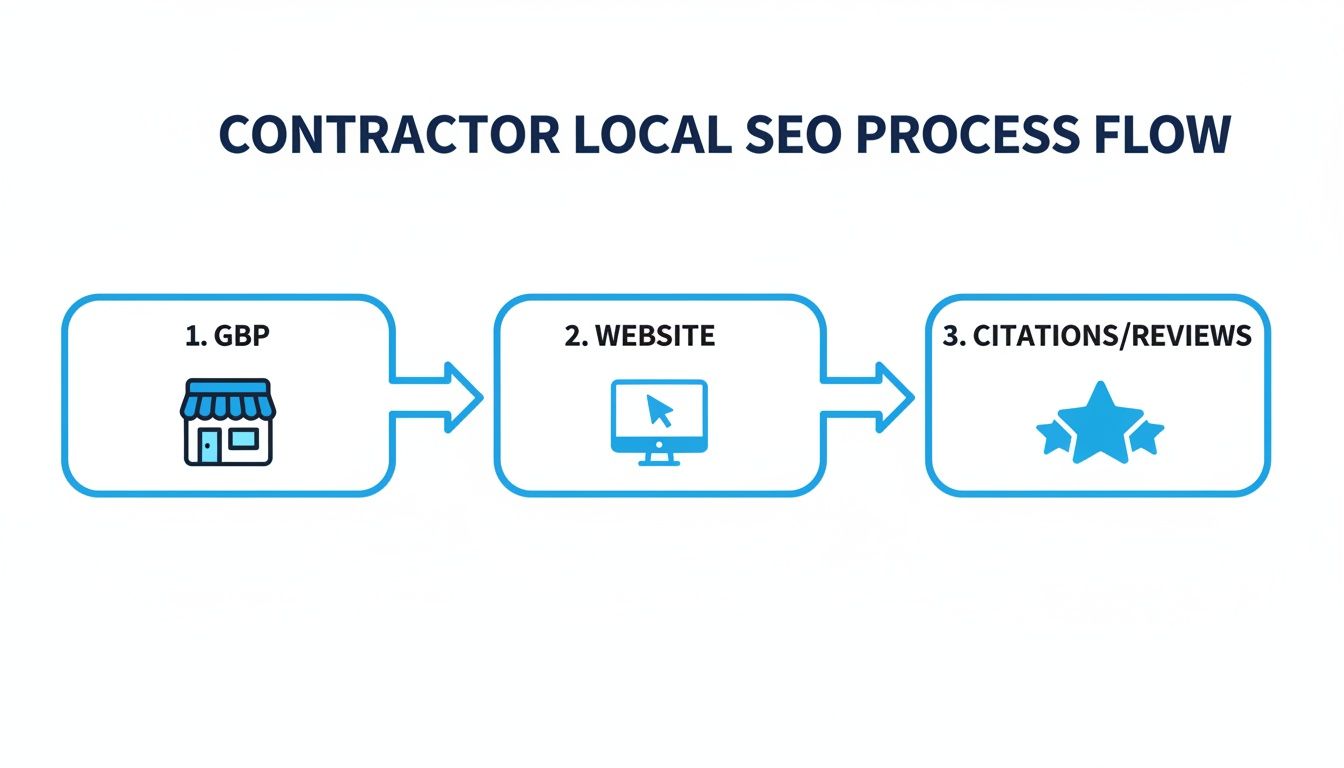
As you can see, a powerful Google Business Profile, a well-optimized website, and a stellar online reputation all feed into each other. Together, they create a lead-generation engine that consistently brings in local customers.
To help break this down, here are the essential pillars of a successful strategy.
Core Components Of A Transactional Local SEO Strategy
| Component | Primary Goal | Key Action |
|---|---|---|
| Google Business Profile | Dominate the Google Map Pack | Fully optimize every section; actively post updates and gather Q&As. |
| On-Page & AI Optimization | Establish your website as a local authority for both search engines and LLMs | Build dedicated service and location pages; ensure the site is mobile-friendly. |
| Citations & Reviews | Build trust and credibility with Google & customers | Create consistent listings on key directories; implement a review acquisition plan. |
| Local Link Building | Signal local relevance and importance | Secure links from other local businesses, suppliers, and community sites. |
Each of these components plays a crucial role in convincing Google that you are the best answer for a local search.
From Search to Service Call
Ultimately, the entire point of local SEO is to shorten the distance between a customer’s problem and your phone number. It goes beyond just keywords. It’s about understanding the whole local search environment—from how Google Maps ranks the top three results to how new AI Overviews are starting to answer questions directly. This AI optimization is the new frontier for getting found online.
At Transactional Marketing, our proven system is built from the ground up to get our clients' websites ranking on page one of Google, typically within 30 to 60 days. We don't just build websites; we build predictable lead-generation machines that turn transactional searches into hundreds of more calls every single month.
By mastering your Google Business Profile, building out strategic location pages, and cultivating a five-star reputation, you create an undeniable online presence. This ensures that when a local customer needs help, your business is the most visible—and most trusted—option they see.
Fine-Tuning Your Google Business Profile for Maximum Impact
Think of your Google Business Profile (GBP) as the single most powerful tool in your local SEO toolbox. It's not just another online listing; it’s your digital storefront, your billboard on Google Maps, and usually the first handshake with a potential customer. For contractors, a perfectly tuned GBP is the direct line to homeowners making transactional searches like 'emergency HVAC repair near me' or 'siding contractor in Dallas'.
When a potential customer sees your business pop up in the coveted Google Maps 3-Pack, it’s a massive signal of trust and relevance. Our entire system is built around getting our clients into that prime digital real estate, because we know from experience it means the phone starts ringing. These aren't just lukewarm leads; they're immediate job opportunities from people who need a pro, right now.
Nail Your Categories for Transactional Intent
The first real step in turning your GBP from a static listing into a lead-generating machine is picking the right categories. This is a classic stumbling block where a lot of contractors go wrong by being too generic. Google relies heavily on categories to figure out exactly what you do and match you to the right searches.
Your primary category needs to be the most specific, accurate description of your core service. For instance, don't just put "Contractor." Get specific. You’re a "Roofing Contractor," "Plumbing Contractor," or "Electrical Contractor." That precision is non-negotiable.
Once that's locked in, you need to add secondary categories for every other service you provide.
- If you're a roofer: You might also add "Gutter Cleaning Service," "Siding Contractor," and "Storm Damage Restoration."
- If you're an electrician: Think about adding "Electric Vehicle Charging Station Installer" or "Landscape Lighting Designer."
This level of detail is what gets you found for the full spectrum of services you offer, not just the most obvious ones.
Write a Business Description That Actually Sells
Your business description is valuable real estate. It's your chance to tell both Google and potential customers who you are, what you do, and—most importantly—where you do it. This isn't the place for vague corporate jargon. You want to pack it with the exact local and service-based keywords your customers are typing into the search bar.
A weak description sounds like this: "We are a full-service contracting company dedicated to customer satisfaction." It’s generic and unhelpful.
A powerful, optimized description reads like this: "As a licensed roofing contractor in Austin, TX, we specialize in emergency roof repair, shingle replacement, and storm damage restoration for homeowners throughout Travis County. Call us for a free estimate on your next roofing project."
See the difference? The second example is laser-focused on transactional terms and a specific service area. It leaves zero doubt in Google’s mind what searches this business should show up for. Getting this part right is a core reason we can get our clients ranking on page one within 30 to 60 days.
By filling out every single field in your profile, you're telling Google that you’re an active, authoritative local business. Incomplete profiles get buried, while the complete ones rise to the top and grab the attention of customers ready to make a decision.
Use Google Posts and Photos to Build Local Authority
Google loves to see fresh activity. One of the best ways to show your business is active and genuinely serves a local area is by regularly using Google Posts and uploading geo-tagged photos. The search world is becoming more local by the day; it's projected that in 2025, 46% of all Google searches will have local intent. On top of that, businesses with complete Google Business Profiles get 7 times more clicks than those with bare-bones listings. These numbers make it clear how critical these optimization steps are.
Geo-tagged photos are simply images with location data embedded in them. When you upload pictures of a new roof you just finished in a specific neighborhood, you're sending a powerful signal to Google that you do work in that exact spot.
Make it a habit to use Google Posts every week to:
- Showcase a recent project with some great before-and-after photos.
- Run a special offer, like "10% off gutter installation this month."
- Share a 5-star review you just received from a happy client in a specific town.
These simple actions do more than just keep your profile from getting stale; they create more opportunities to weave in those crucial transactional keywords and location names. While mastering these advanced tactics is a key part of our proven system, it's important to get the basics right first. For a refresher, you can check out our guide on the initial GMB setup process, which covers all the essentials you need before diving this deep.
Your Website: The Engine That Drives Local Leads
Think of your Google Business Profile as the sign on your truck—it gets you noticed. But your website? That's your showroom and your sales floor rolled into one. A killer GBP gets you the click, but it's your website that has to convince a homeowner to pick up the phone. For contractors, this is where the real money is made, turning high-intent, transactional searches into paying jobs.
A generic website just doesn't cut it anymore. It gets lost in the crowd. The secret to dominating your local market is to build a website that mirrors your actual service area. You need dedicated pages that speak directly to a customer's specific problem in their specific town.
A Site Structure Built to Win Jobs
I've seen it a hundred times: contractors cram all their services and every town they serve onto one or two pages. That's a huge mistake. If you want to win a search like 'HVAC repair Houston' or 'emergency roof repair Dallas,' you have to give Google a page that is laser-focused on that exact search.
This is where a "silo" structure comes into play. It's simple but incredibly effective:
- Service Pages: Don't just make a "Plumbing" page. That's way too broad. You need to break it down into every single service you offer. Think "Trenchless Sewer Replacement," "Water Heater Installation," and "Emergency Leak Repair." Each page becomes a magnet for someone searching for that specific solution.
- Location Pages: If you work in more than one town or even distinct neighborhoods, each one needs its own page. A "Plumber in Austin" page should feel different from a "Plumber in Round Rock" page. It should have local reviews, photos from local jobs, and content that speaks to that community.
This structure is the foundation of our entire system. It allows us to focus our SEO efforts with surgical precision, which is how we get contractors showing up on page one, often within 30 to 60 days.
On-Page SEO That Actually Converts
With the right pages in place, the next step is optimizing each one. You need to send clear signals to both search engines and potential customers that you are the expert they're looking for. This means weaving your local keywords into the most important on-page elements.
Here's a look at where these critical on-page SEO elements actually appear.
The image above points out the title tag, meta description, and H1 heading. These are your first impression in the search results, and they have to be compelling.
- Title Tags: This is the big blue link people click on in Google. Keep it tight and lead with your keyword. For example: "Emergency Roof Repair Dallas | [Your Company Name]".
- Meta Descriptions: This short paragraph under the title doesn't directly help you rank, but it's your sales pitch. A good one gets you the click over your competitor. It needs to be a powerful call to action that includes your keyword.
- Headers (H1, H2, etc.): Headers organize your page content for readers and for Google. Your main H1 heading is non-negotiable—it must feature your primary keyword, like "Expert Trenchless Sewer Replacement in Houston."
Nailing these details tells Google you're highly relevant for those money-making transactional searches.
The Trust Signals You Can't Afford to Skip
Getting a visitor to your site is one thing; getting them to trust you enough to call is another. Your website needs to scream "legitimate, local, and reputable" from the moment it loads. Every page, especially your service and location pages, should be packed with these trust signals.
Your website isn't a digital brochure. It's a tool built to make your phone ring. Every single element should be designed to remove friction and make it incredibly easy for a customer to decide you're the right choice. We build sites that turn clicks into hundreds of more calls every month.
Embedding a Google Map of your service area or office is a simple but powerful visual cue. It instantly confirms you're a local pro and reinforces the information on your Google Business Profile.
Sprinkle in customer testimonials and reviews, especially ones that mention the specific service or city of the page they're on. There’s nothing more powerful than a homeowner in Dallas seeing a glowing review from their neighbor. That kind of social proof is pure gold.
Finally, the absolute must-have: your Name, Address, and Phone number (NAP). This information has to be on every single page of your site, usually in the footer. It must be 100% consistent with your Google Business Profile and every other directory listing online. It's a foundational signal for Google and shows customers you're a stable, professional operation ready for their call.
In the contracting world, your reputation is everything. On the job site, quality work speaks for itself. But online, your reputation is what gets new customers to even consider calling you. This is where two of the most important pieces of local SEO come into play: citations and reviews.
Think of them as powerful trust signals. They tell both Google and potential clients that you're a legitimate, reliable professional in their area.
At Transactional Marketing, we've seen this time and again. When a homeowner searches for something like 'electrician near me,' they aren't just looking for a number—they're looking for the most trustworthy option, fast. A solid profile with consistent business listings and a bunch of great reviews is often the one thing that turns a search into a service call.
What Are Local Citations and Why Do They Matter?
A local citation is simply any online mention of your business's Name, Address, and Phone number (NAP). It's like leaving a digital breadcrumb trail all over the web for Google to follow.
You'll find these citations on all sorts of sites:
- Big Directories: Think Yelp, Angi, and the Better Business Bureau.
- Trade-Specific Sites: Platforms like Houzz, HomeAdvisor, or your industry association’s website.
- Hyperlocal Hubs: Your local Chamber of Commerce or community business directories.
Every time Google finds your business listed with the exact same NAP, it gets a little more confident that you're a real, established local company. But inconsistencies—a different suite number on one site, an old phone number on another—create confusion and can absolutely torpedo your rankings in Google Maps.
The goal is absolute consistency. Think of it this way: if you can't keep your own business information straight online, how can a customer trust you to get the details right on their project? A clean citation profile is non-negotiable for local search dominance.
Making sure your NAP is identical across the web is a foundational task. For a deeper look at this, we have more resources on the importance of maintaining NAP consistency for local contractors.
A Proactive System for Generating 5-Star Reviews
While citations build foundational trust with search engines, reviews are what build trust with actual people. They are, without a doubt, the single most powerful form of social proof for any contractor. A steady stream of positive, recent reviews has a direct impact on your ability to rank in the Google Maps 3-Pack and win those high-value searches.
The data doesn't lie: a massive 83% of consumers check Google reviews before they even think about contacting a local business. Yet it’s amazing how few contractors have a real system for getting them. Just waiting and hoping for reviews isn't a strategy. You need a proactive process.
Here’s a simple, proven system you can start using today:
- Find the "Golden Moment": The absolute best time to ask for a review is right after the job is done and the customer is standing there admiring your work. Their satisfaction is at its peak.
- Make It Ridiculously Easy: Don't just mumble, "Hey, leave us a review sometime." Send them a direct link to your Google Business Profile review page via text or email. The fewer clicks it takes, the more likely they are to do it.
- Respond to Every Single Review: Thank customers for their positive feedback, and be specific ("Thanks for the kind words on the new roof we installed in Austin!"). For the rare negative review, respond professionally and offer to take the conversation offline to fix it. This shows everyone else that you stand behind your work.
This isn't about being pushy. It’s about making it simple for your happy customers to share their great experience. At Transactional Marketing, we help contractors put these systems in place to create a consistent flow of reviews that fuels their Google Maps ranking and brings in hundreds more calls from customers who are ready to hire.
Measuring The Results That Actually Matter
If you can't measure it, you can't manage it. This old saying is especially true for local SEO. I’ve seen too many contractors get distracted by what I call "vanity metrics"—things like impressions or clicks. They look good on a report, but they don't put money in your pocket.
Let's cut through the noise. The only numbers that truly matter are the ones tied directly to your bottom line. We're talking about the actions a homeowner takes right before they’re ready to hire you for a job.

Tracking Transactional KPIs
Forget about the fluff. Your local search success hinges on tracking a handful of critical metrics that prove your marketing is actually working. These are the direct results of ranking for those high-intent, transactional search terms we talked about earlier.
These are the KPIs you should be obsessed with:
- Inbound Phone Calls: The gold standard. A ringing phone means a potential customer needs you, right now.
- Quote Request Form Submissions: Anyone who takes the time to fill out your form is a serious, qualified lead.
- Clicks for Driving Directions: A powerful signal from your Google Business Profile. It shows someone is planning to visit your office or showroom.
These actions are the entire point of doing local SEO. A good strategy is reverse-engineered to drive these specific outcomes, which is how you can consistently generate hundreds of new calls every month.
The difference between a good marketing strategy and a great one is measurement. When you focus only on the data that leads to profitable jobs, you eliminate the guesswork and ensure every dollar you invest delivers a real return.
Proving The Tangible ROI
So, what kind of return can you realistically expect? The numbers are pretty clear. Studies have shown that Local SEO yields a stellar 250% ROI for contractors, which means you get back about $2.50 for every $1 you put in.
This kind of return often beats paid search, and the best part is that it compounds over time without needing a constantly growing budget. That's a game-changer for tradespeople. As we head into 2025, with 46% of small businesses naming SEO as their number one source for leads, it's obvious where the smart money is going.
This is where a proven system makes all the difference. The right approach can get contractors onto the first page of Google for their most valuable keywords in as little as 30 to 60 days. The key is transparent reporting that draws a straight line from the work being done to the calls and quote requests filling up your schedule.
By tracking the right metrics, you stop hoping for leads and start building a predictable, growing pipeline of profitable work. If you're interested in seeing how we track and present these results, you can learn more about our comprehensive analytics and reporting. We don't just promise results; we show you the data that proves it.
Frequently Asked Questions
How Long Does It Take For Local SEO To Work For A Contractor?
While a lot of agencies will give you a vague "six to twelve months" answer, we've found that's far too slow. Our approach at Transactional Marketing is built for speed. By hammering your Google Business Profile optimization and targeting high-value transactional keywords like "air conditioning repair near me" from day one, we consistently see our contractor clients hit page one within 30 to 60 days.
You'll often see an immediate jump in Google Maps rankings, which brings that first wave of calls. From there, the broader organic rankings for all your service and city pages will build and strengthen over the next three to six months. The entire strategy is designed to get your phone ringing quickly, not make you wait around for results.
What Is More Important: Google Maps Or Organic Website Rankings?
For a contractor, that's like asking if you need a hammer or a drill. You need both, and they work together. They're two sides of the same coin, both aimed at customers ready to make a hiring decision.
Think of the Google Maps 3-pack as the prime real estate for those "I need help now" searches, like 'emergency plumber near me'. It’s the first place a homeowner with a burst pipe is going to look, and it drives those urgent, high-quality phone calls. At Transactional Marketing, we have the technology to get you into the top three map positions, translating to thousands of more phone calls a year.
At the same time, strong organic rankings for your website build long-term trust and authority. They capture the customer who's planning a bigger project and doing more research. A winning local SEO for contractors strategy makes you impossible to miss on both fronts, which is exactly how we build our campaigns.
A potential customer should see your business in the Map Pack, then see your website again in the organic results. That kind of visibility makes you the obvious, most credible choice in their area. Total domination is what turns a search into a scheduled job.
Can I Do Local SEO Myself, Or Do I Need An Agency?
Absolutely, you can handle the basics. Claiming your Google Business Profile and making sure your name, address, and phone number are correct is a great start. But let's be realistic—the local search world for contractors is a dogfight. It’s incredibly competitive, and with AI changing the search results, the rules are constantly shifting. This AI optimization is the new way businesses will be found, and understanding how LLMs pull information is now critical.
If you just want to exist online, DIY is fine. If you want to dominate your market and generate a flood of leads that actually grows your business, you need a specialist. An agency like Transactional Marketing brings the focused expertise, the right tools, and a battle-tested system designed to get contractors ranking for the transactional search terms that lead to paying jobs. We worry about the SEO and AI complexities so you can focus on running projects and closing deals.
At Transactional Marketing, our entire system is engineered for one purpose: to make your phone ring with profitable jobs. We get contractors like you to own the local search results for the transactional terms that matter most. It's time to stop guessing and start growing with a partner who gets it.
Discover how we can get you on page one by visiting us at https://transactional.net