


Most advice about local SEO for doctors is pointed at the wrong target. It tells practices to publish more educational content, answer broad health questions, and wait for authority to compound. That can help at the margin, but it doesn't solve the main revenue problem for most clinics. A practice grows when it captures patients searching with intent to call, book, or get directions now.
That's the lane Transactional Marketing cares about. A search like “doctor near me,” “dentist near me,” or “urgent care near me” isn't casual research. It's a transactional search. The patient is already in market. For local medical practices, the shortest path to growth in 2026 is usually not a bigger blog library. It's stronger visibility in Google Maps, the local pack, and the exact city-level searches that turn into appointments.
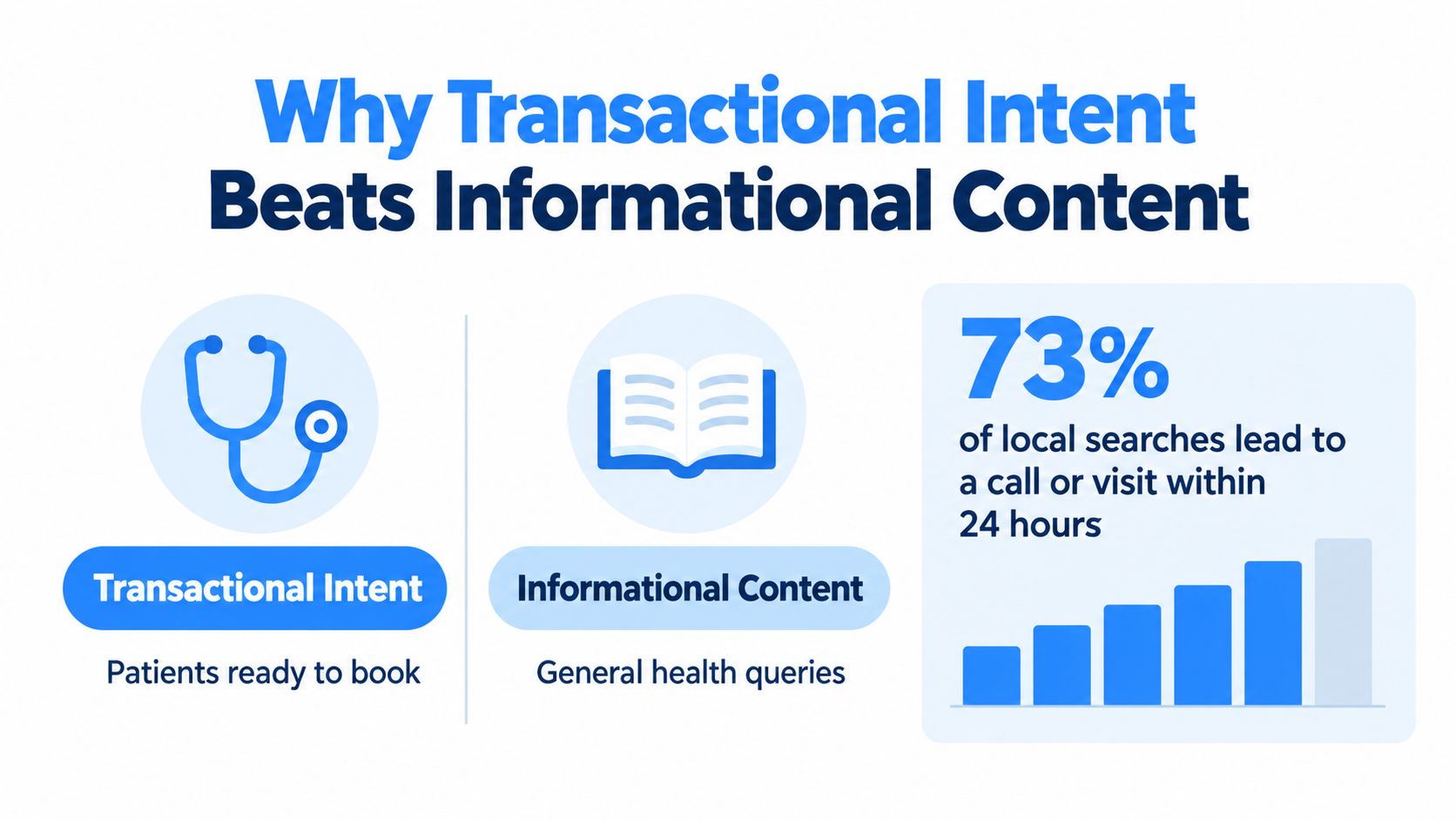
Why Transactional Intent Beats Informational Content
The biggest mistake I see in local SEO for doctors is treating medical marketing like a publishing contest. Practices are told to chase top-of-funnel traffic with symptom articles and general health posts, even when their actual revenue depends on local appointment demand.
That advice misses how local medical searches behave. Local search has long been tied to immediate action. 46% of Google searches have local intent, 88% of patients who search for a local healthcare provider visit or call within 24 hours, 76% of people searching for a doctor near me book within the same week, and 92% of local medical searches result in an offline action according to medical SEO search behavior data. For a practice owner, that's the point. You're not trying to win abstract awareness. You're trying to intercept demand that is already close to conversion.
AI Overviews pulled back from local provider queries
The “content-first” crowd usually assumes AI search will reward whoever publishes the most information. That's too simplistic for doctor marketing.
BrightEdge reported that local/provider intent queries like “dermatologist near me” and “best family doctor near me” had AI Overviews in December 2023, then 0% by December 2025, which shifts visibility back toward Maps and the local pack for these searches, as shown in BrightEdge's provider query analysis. If a patient is searching for a nearby provider, Google often doesn't want to summarize a medical topic. It wants to route that user to local options.
Practical rule: If the search includes a city, neighborhood, or “near me,” assume the map result matters more than your latest blog post.
That's why local SEO for doctors should start with a list of high-intent terms, not a content calendar. Terms tied to specialty plus place, treatment plus place, and “near me” modifiers usually sit much closer to booked revenue than broad educational topics. A practice that wants stronger patient flow should map those queries first and build around them. A good place to sharpen that targeting is high-intent keyword strategy for local businesses.
What informational content still does well
Informational pages still have a role. They can support credibility, answer pre-visit questions, and help AI systems understand your entity. But they shouldn't lead the strategy for most independent practices unless the clinic already owns its map visibility.
A simple comparison helps:
| Search type | Typical patient mindset | Better priority |
|---|---|---|
| “what causes eczema flare ups” | researching | supporting content |
| “dermatologist near me” | ready to choose | maps and GBP |
| “pediatrician in north dallas” | comparing local options | maps plus location page |
| “tooth pain what to do” | problem awareness | educational support |
| “emergency dentist near me” | immediate action | top transactional target |
The common thread is intent. Transactional Marketing is built around that idea because transactional terms are where practices get paid. For doctors, local visibility wins when it aligns with how patients buy care, not just how marketers like to measure traffic.
Optimizing Google Business Profile for Map Dominance
If your Google Business Profile is weak, your website usually can't compensate for it on transactional local searches. That's why local SEO for doctors should begin with profile precision, not homepage tweaks.
Start with the visual checklist before you touch your categories or service copy.
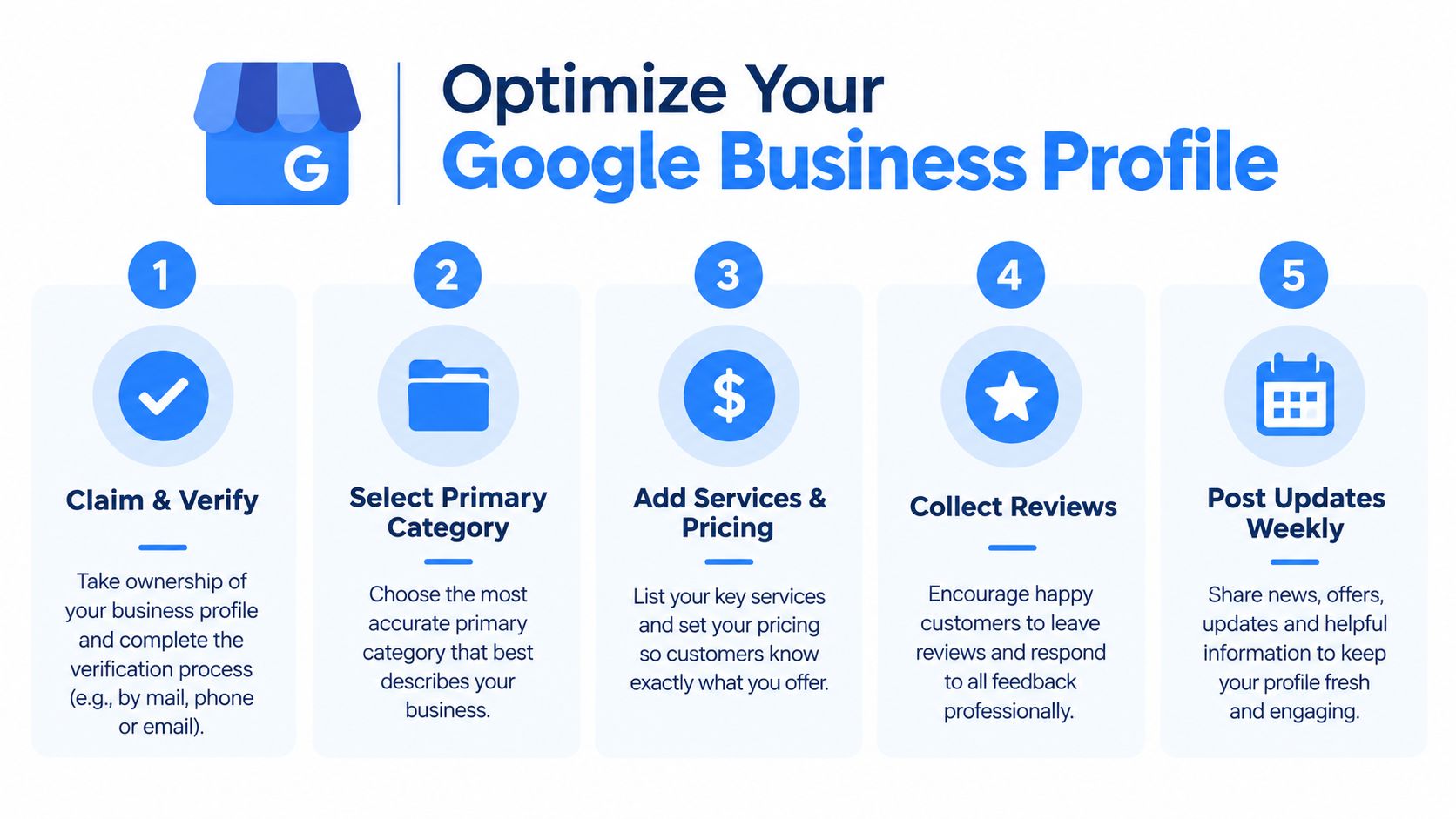
Google's own local systems revolve around relevance, distance, and prominence, and industry summaries in 2026 also place Google Business Profile signals at about 32% of local pack weighting, with the primary category, keywords in the business title, and proximity among the strongest individual inputs according to this local pack ranking breakdown. That tells you where to focus. You need the profile to match the searcher's intent as tightly as possible.
Category selection is not a minor detail
For medical practices, the primary category does heavy lifting. “Doctor” is often too broad when the actual service demand is for “Dermatologist,” “Pediatric Dentist,” “Orthodontist,” or another specific specialty. Generic categorization weakens relevance, especially in crowded metros where many providers share similar geography.
A practical workflow looks like this:
- Audit the top map competitors for your target query in each city.
- Match the primary category to the service line you want to rank for first.
- Use secondary categories carefully to support adjacent services without muddying the main signal.
- Align profile services and business description with the same language patients use.
One 2026 healthcare guide says local pack visibility is driven primarily by proximity (36.1%), review count (19.4%), and review keyword relevance (13.1%), and recommends benchmarking the top three target queries in each city before optimizing category specificity, review acquisition, and on-profile content, as outlined in this medical SEO guide.
The profile that ranks is usually the one that makes Google's job easiest. Clear specialty, clear location, clear trust signals.
Completeness affects both ranking and conversion
A complete profile does more than improve relevance. It also gives patients fewer reasons to hesitate. In healthcare, hesitation kills calls.
Fill out the basics thoroughly:
- Business identity: Use practice name consistently across Google, your website, and healthcare directories.
- Hours and availability: Keep office hours current. If you offer urgent visits, same-day appointments, or telehealth, reflect that clearly where allowed.
- Services: List actual service lines, not vague umbrella terms.
- Photos: Show the office exterior, reception area, treatment rooms, and provider headshots.
- Posts and updates: Publish updates weekly when possible, especially around seasonal services, new providers, or scheduling availability.
Later in the process, many teams benefit from a more detailed Google Business Profile optimization framework, especially when multiple specialties or locations are involved.
Place a training reference or team walkthrough inside the process so staff can maintain the profile consistently:
What doesn't work anymore
The old approach was to “set and forget” the listing. That fails in competitive healthcare markets.
Avoid these common missteps:
- Underdeveloped profiles: A claimed listing with thin content rarely competes well.
- Website-only SEO: Many practices invest in service pages while leaving the map listing generic.
- Loose service alignment: If your profile says one thing and your landing pages say another, Google gets mixed signals.
- Measurement by rank alone: If you don't connect profile actions to booked appointments, you won't know which changes matter.
For doctors, map dominance is not a side task. It is often the main acquisition channel for local, ready-to-book demand.
Structuring Multi-Provider and Location Entities
Multi-provider practices usually create local SEO problems in one of two ways. They either collapse everything into one entity and limit visibility for individual doctors, or they create too many profiles and split authority, reviews, and relevance.
The right structure depends on how patients encounter the practice in the world. If the clinic has one front desk, one shared brand, and one main booking path, the location entity should usually remain the anchor. If individual providers are public-facing, patient-selectable, and searched by name or specialty, separate provider entities may make sense.
When separate profiles help
The guidance here is mixed. Some 2026 guidance says a multi-provider practice can have one profile for the location plus one profile for each public-facing provider, while other healthcare GBP guides emphasize one verified profile per physical practice and careful category and service setup, as discussed in this clinic GBP analysis.
That tension is real. It's also why this decision shouldn't be delegated to a generic agency checklist.
Separate provider profiles tend to make more sense when:
- Patients book by doctor name: The physician has individual demand and patients ask for that person specifically.
- Specialties differ materially: A group with distinct clinical tracks may need cleaner entity separation.
- Provider reputation is an asset: Individual reviews, citations, and branded searches support discovery.
- Public bios and schedules exist: The provider functions as a visible entity, not just an internal staff member.
When fragmentation causes damage
Too many profiles at one address can create confusion fast. Reviews scatter. Categories overlap. Staff updates become inconsistent. Duplicate or near-duplicate pages weaken the whole cluster.
A cleaner way to think about it is entity hierarchy:
| Scenario | Better structure |
|---|---|
| Single-location family practice | one location profile |
| Group clinic with well-known named physicians | one location profile plus provider profiles where justified |
| Multi-location specialty group | one profile per location, plus provider entities only when publicly distinct |
| Shared suite or rotating clinicians | stay conservative and verify only what clearly qualifies |
A useful companion concept is geo consistency across all mention points. If you're cleaning up how locations and clinicians appear online, this overview of MyMentions geo visibility is worth reviewing because it frames how place-based entity signals can drift across the web.
If you can't explain to a patient why two separate profiles exist, Google may struggle with the same question.
A workable decision framework
Audit your structure with three filters:
Search behavior
Are people searching for the clinic brand, the doctor name, or the specialty plus city?Operational reality
Does each provider have independent hours, scheduling, and patient demand?Signal dilution risk
Will another profile increase visibility, or just split reviews and citation consistency?
Practices with multiple offices should also pair entity decisions with clear multi-location local SEO architecture. That includes location pages, provider pages, and internal linking that mirrors the actual business structure. In local SEO for doctors, entity clarity is often the difference between stable map growth and ongoing ranking confusion.
Building Review Velocity and Reputation Signals
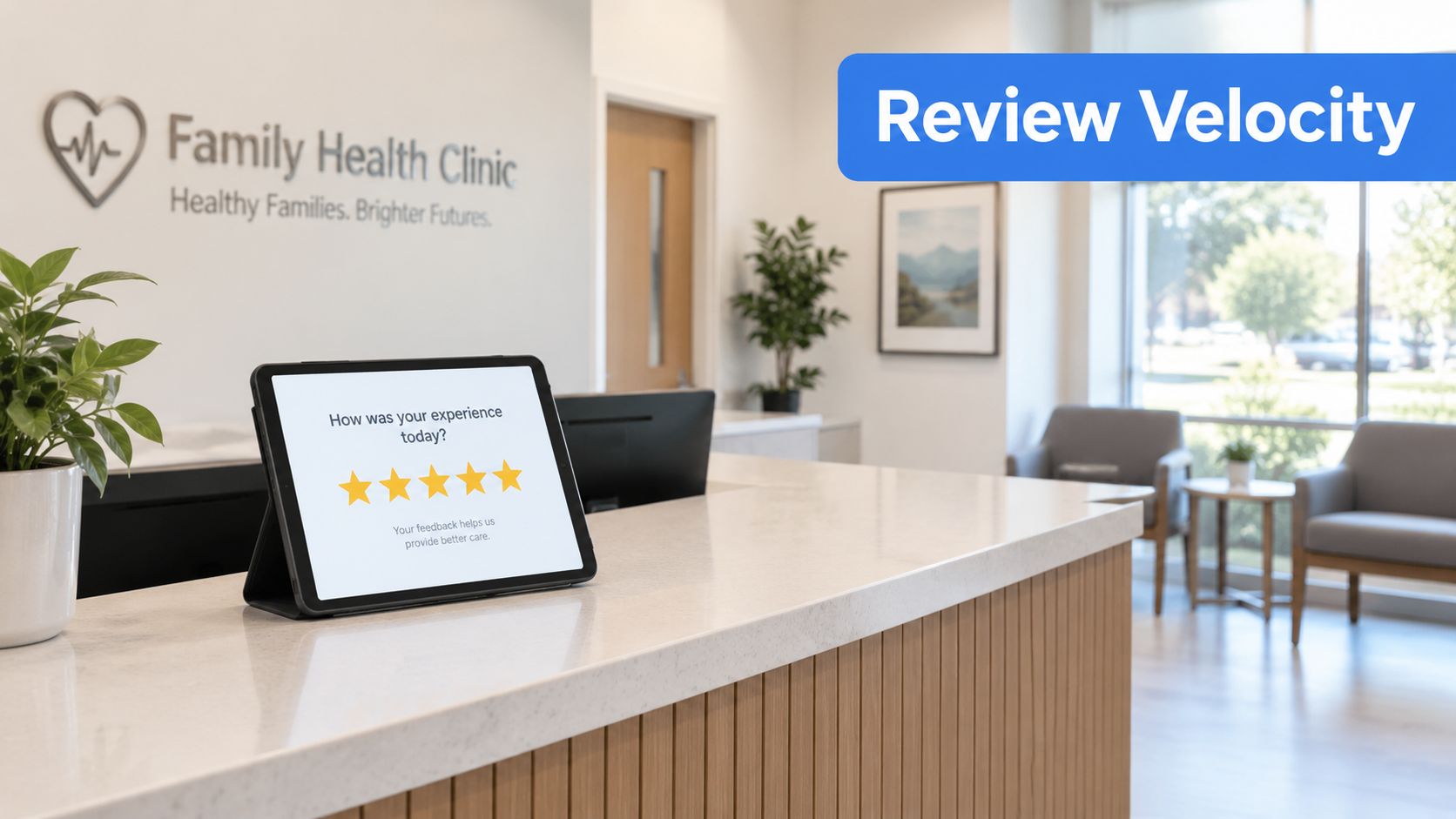
Doctors often fixate on star ratings alone. Patients care about trust, of course, but Google also looks at the pattern behind the reviews. A profile with steady, recent, relevant feedback usually sends a stronger signal than one with a large but aging review base.
That's why review velocity matters. A regular stream of legitimate patient feedback indicates that the practice is active, chosen, and still earning confidence now.
What Google appears to reward
Review signals remain one of the dominant local ranking categories, with roughly 20% of local pack weight tied to reviews and related signals such as quantity, rating, recency, and velocity, based on 2026 local review signal summaries. For medical practices, that's not just a ranking issue. It's also a conversion issue because patients compare trust cues before they call.
The practical implication is simple. Don't run one review campaign per year and expect lasting map strength. Build a repeatable workflow.
A better review system for clinics
Most practices already have moments when patient satisfaction is highest. Use those moments.
- After a successful visit: Front desk staff can send the review request after checkout or after a follow-up message.
- By provider or service line: If a specialist is a major draw, route patients to the correct profile and page path.
- With simple instructions: Friction kills completion. The request should be short, direct, and easy to open on mobile.
- With compliant responses: Reply professionally without exposing protected health information.
Some teams use tooling to manage customer reviews efficiently because consistency usually breaks down when requests and responses depend on memory alone.
Ask when satisfaction is fresh, not weeks later when recall fades and response rates drop.
What to ask for and what to avoid
You can't script patients, and you shouldn't. But you can make it easier for them to describe the visit clearly. Specificity helps both future patients and local relevance.
A stronger ask sounds like this in practice:
| Weak prompt | Better prompt |
|---|---|
| “Please leave us a review” | “If your visit went well, would you mind sharing feedback about the service you received?” |
| “Rate us on Google” | “If you found the staff, scheduling, or treatment helpful, your feedback would help other patients.” |
The goal isn't keyword stuffing. It's natural language that reflects actual experience.
Avoid common mistakes:
- Review gating: Don't filter who gets asked based on expected sentiment.
- Incentives: Don't trade gifts or discounts for reviews.
- Bulk bursts: A sudden push with no continuity can look unnatural and won't sustain momentum.
- Silence on negative feedback: Patients notice whether the practice responds calmly and professionally.
If review acquisition is inconsistent, it usually helps to document the follow-up sequence and tie it to a structured Google review generation process. In local SEO for doctors, reviews aren't decoration. They are ongoing ranking fuel and one of the clearest pre-appointment trust signals you control.
Aligning Local Authority with AI Search Visibility
AI optimization for doctors isn't a separate discipline from local SEO. It's the next layer of the same work. Large language models don't invent trusted local brands from scratch. They usually surface entities that already appear coherent, prominent, and well represented across the web.
That matters because more patient discovery is happening inside answer-style interfaces. If your practice has scattered citations, incomplete provider information, and weak local authority, AI systems have less confidence in mentioning you.
Entity strength carries into AI systems
A useful way to think about AI visibility is brand stature. One study reports that each step down the stature ladder costs roughly 30 percentage points of unbranded visibility in AI answers, according to research on visibility in LLM-driven search. For local medical practices, that means authority isn't only about classic rankings anymore. It's also about whether your clinic is strong enough as an entity to appear in answer-based discovery.
Many practices split their efforts unnecessarily. They treat local SEO, citations, reviews, and AI optimization as different projects. They aren't.
The overlap is bigger than most clinics think
When you strengthen local authority, you also improve the signals AI systems can absorb:
- Consistent practice identity: Matching name, address, phone, provider names, and specialties across the web reduces ambiguity.
- Complete profile data: Google Business Profile content, service descriptions, hours, and categories help define the entity.
- Provider-specific expertise pages: Clear doctor bios and specialty pages give AI systems structured context.
- Reputation evidence: Reviews, mentions, and branded references reinforce legitimacy.
A useful side effect is that AI optimization becomes more durable when it starts from transactional local infrastructure. If a clinic only publishes generalized health content without a clean entity footprint, it may still struggle to appear in AI-assisted provider discovery.
What clinics should actually do
A practical AI-ready local stack for doctors includes the following:
- Standardize all core business details across your site, GBP, and key directories.
- Keep provider and location pages distinct so AI systems can map people to places and specialties.
- Write service pages in direct language that states what the clinic does, where it does it, and who provides it.
- Preserve trust consistency through accurate hours, updated staff rosters, and current contact data.
Transactional Marketing focuses heavily on this overlap because transactional search terms and AI discovery both depend on entity clarity. In other words, local SEO for doctors now has two outputs. Better map visibility today, and stronger mention-worthiness in AI search environments that increasingly mediate patient choice.
Measuring Patient Acquisition and Map Performance
If your reporting ends at impressions, rank screenshots, or website sessions, you don't know whether local SEO for doctors is working. You only know that something was visible.
The measurement standard should be stricter. A local SEO campaign has to show whether map visibility turned into calls, direction requests, form submissions, and booked appointments. Anything short of that is incomplete.
The metrics that matter
The business case is clear. Healthcare local SEO benchmarks show that local search accounts for 29.4% of all healthcare leads, healthcare converts at 3.2% from local search traffic, and position 1 in the local pack can capture an estimated 25% to 35% CTR, according to healthcare local search benchmark data. That's why small movement in the map pack can have outsized commercial impact.
Track performance in layers:
| Layer | What to track | Why it matters |
|---|---|---|
| Visibility | map rankings for core transactional terms | shows whether the practice is entering the buying path |
| Engagement | calls, direction requests, website clicks from GBP | shows whether searchers act on the profile |
| Conversion | appointment requests and booked patients by source | shows real acquisition value |
| Revenue quality | new patient type, service line, payer mix if relevant | shows whether leads are commercially useful |
Use a fixed review window
One of the easiest ways to misread local performance is to overreact to daily ranking shifts. Local results vary by proximity, device, and search context. Looking at one screenshot tells you almost nothing.
A better routine uses a fixed review cycle:
- Choose core transactional keywords: Focus on the terms that reflect direct appointment intent.
- Track by city or service area: Medical demand is local. Ranking in one part of a metro does not equal ranking everywhere.
- Review over a meaningful window: The earlier medical SEO guidance cited a 60-day comparison window for local pack movement. That's a better operating pace than weekly panic.
- Compare rankings to booked outcomes: If rankings improved but appointments didn't, your profile or landing page may be leaking conversions.
Rankings are diagnostics. Booked appointments are the result.
Some practices also need stronger attribution because calls, forms, and front-desk scheduling often live in different systems. If that's your bottleneck, this explanation of Cometly local business attribution is useful because it addresses how local businesses connect channel activity to actual lead sources.
A reporting framework owners can use
A monthly dashboard for a clinic should answer five questions:
- Which transactional keywords moved into stronger map positions?
- Which GBP actions increased or declined?
- How many new patient inquiries came from local organic and map channels?
- Which services generated those inquiries?
- Did visibility gains happen in the exact cities or ZIP clusters that matter most?
The wrong KPI is “we published more content this month.” The right KPI is “more in-market patients found the practice and booked.”
That's where Transactional Marketing's model makes sense for this category. The point isn't broad SEO theater. The point is to target searches like “dentist near me” or city-level specialty terms, improve map placement, and measure whether those searches produce phone calls and appointments. A dashboard that combines keyword timelines, heat-map style local ranking views, Search Console query trends, and lead-source tracking is far more useful than a traffic-only report because it ties SEO work back to patient acquisition.
Transactional LLC helps local businesses and medical practices target transactional search terms, improve Google Maps visibility, and build AI-ready search presence around the exact services and cities that drive revenue. If you want a strategy centered on map rankings, Google Business Profile optimization, and measurable patient acquisition instead of vanity traffic, visit Transactional LLC.