

Local SEO is all about showing up when a customer in your service area is desperately looking for what you do. Think plumbing, HVAC, or roofing—when someone needs these services, they usually need them now. The goal is to make sure your business is the first one they see in local search results and AI-powered answer engines, especially in that all-important Google Map Pack.
Why Transactional Searches Are a Goldmine for Home Services
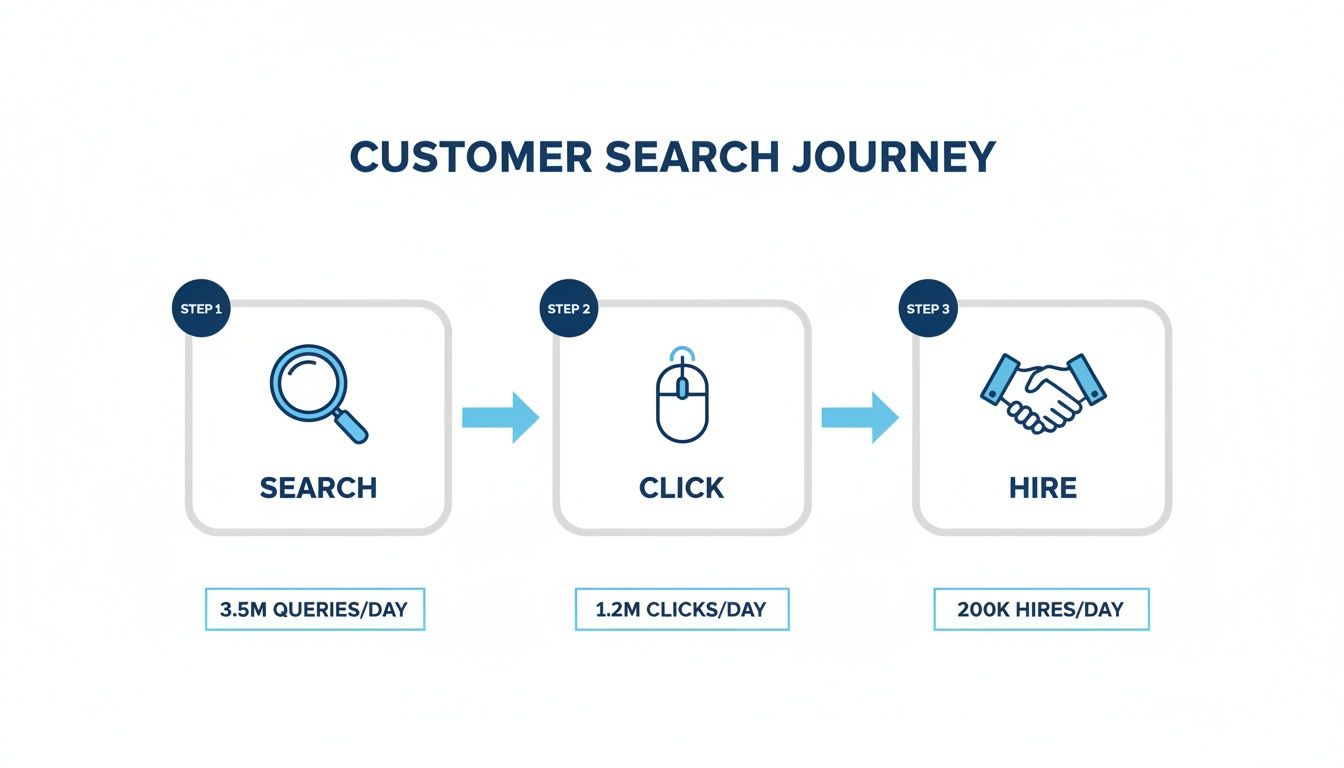
Picture this: a homeowner's AC gives out in the middle of a July heatwave. Or worse, a pipe bursts and is flooding their basement. They're not casually browsing Google for "how an HVAC system works." They're frantically typing "emergency AC repair near me" or "plumber in [their city]" into their phone.
These aren't just searches; they're distress signals from someone with a real problem, credit card in hand, ready to hire whoever can solve it fastest.
This is the incredible power of a transactional search term. It signals immediate, high-value intent. Here at Transactional Marketing, our entire philosophy is built around capturing these exact moments. We are called Transactional Marketing because we get our clients to show up for the transactional search terms that matter. We focus your marketing like a laser beam, connecting your home service company with local homeowners right when they’re ready to buy.
The Critical Difference in Search Intent
Getting a handle on search intent—specifically, the difference between informational and transactional searches—is the first real step toward a marketing strategy that actually makes you money. Someone searching for "how to fix a leaky faucet" is in research mode. The person searching for "emergency plumber Anytown USA" is in hiring mode. A smart local SEO strategy goes all-in on the second one.
Focusing on these high-intent queries is the most direct path to turning your marketing budget into booked jobs and a real return on your investment. It's about being the best and most obvious answer when a local customer has a problem that can't wait. We get customers like you to show up for these exact transactional search terms.
To make this crystal clear, let's compare the two types of searches a potential customer for a plumbing business might make.
Transactional vs. Informational Keywords for a Plumber
| Search Type | Keyword Example | User Intent | Business Value |
|---|---|---|---|
| Transactional | "emergency plumber near me" | Needs immediate help; ready to hire | High – Leads to a booked job |
| Informational | "how to snake a drain" | DIY research; trying to learn | Low – Not looking to hire (yet) |
| Transactional | "water heater installation cost" | Comparing providers; close to buying | High – Serious buyer in decision phase |
| Informational | "what causes low water pressure" | Troubleshooting; problem diagnosis | Low – May eventually hire, but not now |
As you can see, transactional keywords are where the money is. They represent customers who have already decided they need a professional and are actively looking for one.
The Power of Local Proximity
Did you know that a staggering 46% of all Google searches have local intent? That alone makes local SEO a non-negotiable for any home service business.
Even better, research shows that 76% of people who find a local business on their phone visit within 24 hours. And 28% of those searches result in a purchase. That's not just a lead; that's a job booked today.
This data proves that showing up in local searches and on Google Maps isn't just about looking good—it’s the engine that drives your growth. Transactional Marketing has a proven system designed to get your business website showing up on page one of Google for these exact money-making searches, typically within just 30 to 60 days. To dive deeper into this, check out our guide on how to rank higher on Google Maps.
At Transactional Marketing, we don't just build websites; we build customer acquisition systems. We make sure that when a homeowner in your area has a problem, your business is the immediate, obvious solution. That’s the power of targeting transactional search.
Mastering Google Business Profile to Dominate the Map Pack
For any home service company, the Google Map Pack is the most valuable piece of digital real estate on the planet. When a homeowner has an emergency—a busted furnace in winter or a leaky roof during a storm—this is the very first place they look. It’s the modern-day yellow pages, but infinitely more powerful. This is the core of Google Maps optimization.
Think of your Google Business Profile (GBP) as your company's digital storefront. A neglected profile is like a dusty, closed-up shop that customers walk right past. But a fully optimized one? That's a bright, welcoming beacon that pulls in high-intent customers who are ready to book a job right now. This isn't just about having your phone number listed; it's about turning your GBP into a customer-generating machine.
The goal is simple: lock down one of those top three spots in the Map Pack for high-value search terms like "HVAC repair near me." This is where the magic happens. Landing in the top three isn't a vanity metric—Transactional Marketing has the technology to get you there, which translates directly into hundreds of more phone calls every single month and literally thousands more every year.
Your GBP Optimization Playbook
Optimizing your Google Business Profile is a game of details. Every single field needs to be filled out completely and strategically to signal maximum relevance to Google and emerging AI search tools. An incomplete profile whispers to Google that you might not be a serious player, but a perfected one shouts that you're the authority in your local market.
It all starts with the fundamentals, an area where so many businesses stumble. Your Name, Address, and Phone Number (NAP) must be perfectly consistent everywhere it appears online. This consistency builds a foundation of trust with search engines and LLMs, proving you're a legitimate, established local business. Even a tiny variation can create confusion and hurt your rankings.
From there, it's about diving into the details that convince searchers to become callers:
-
Primary & Secondary Categories: Getting your categories right is critical. Your primary category should be your main service (e.g., "Plumber"). Then, use the secondary categories to cover all your other specializations, like "Water Heater Installation & Repair" or "Drain Cleaning Service." This level of detail is crucial for AI optimization.
-
Compelling Business Description: This is your 750-character elevator pitch. We craft keyword-rich descriptions that sell your unique value, highlight your service areas, and showcase your commitment to customer satisfaction.
-
Services & Products: Don't be shy—list every single service you offer. This is how you start ranking for those specific, long-tail transactional terms like "tankless water heater installation in [your city]," catching customers who know exactly what they need.
-
High-Quality Photos & Videos: Show off your team, your branded trucks, and photos of jobs well done. Real visuals build immediate trust and give potential customers a peek at the professional service they can expect.
For a deep dive that ensures you don't miss a single step, check out our complete Google My Business optimization checklist. It's the perfect resource for building a dominant profile from the ground up.
Keep Your Profile Active and Engaging
A "set it and forget it" approach simply doesn't work with GBP. Google rewards businesses that are active and engaged on the platform.
Regularly using features like Google Posts to share special offers, seasonal maintenance tips, or recent project photos keeps your profile fresh and shows Google you’re an active business. Answering customer questions in the Q&A section and responding promptly to every single review—good or bad—is non-negotiable. This engagement shows potential customers you're attentive and professional, which is often the final nudge they need to pick up the phone.
Building a Hyper-Local Website Content Strategy
A generic "Services" page on your website is like putting up a single, vague billboard for an entire state—it’s too broad, and it ends up speaking to no one. To really win at local and AI-powered search, your website needs to talk directly to customers in every single neighborhood and city you cover. This article, for instance, focuses solely on home service companies, not a mix of industries.
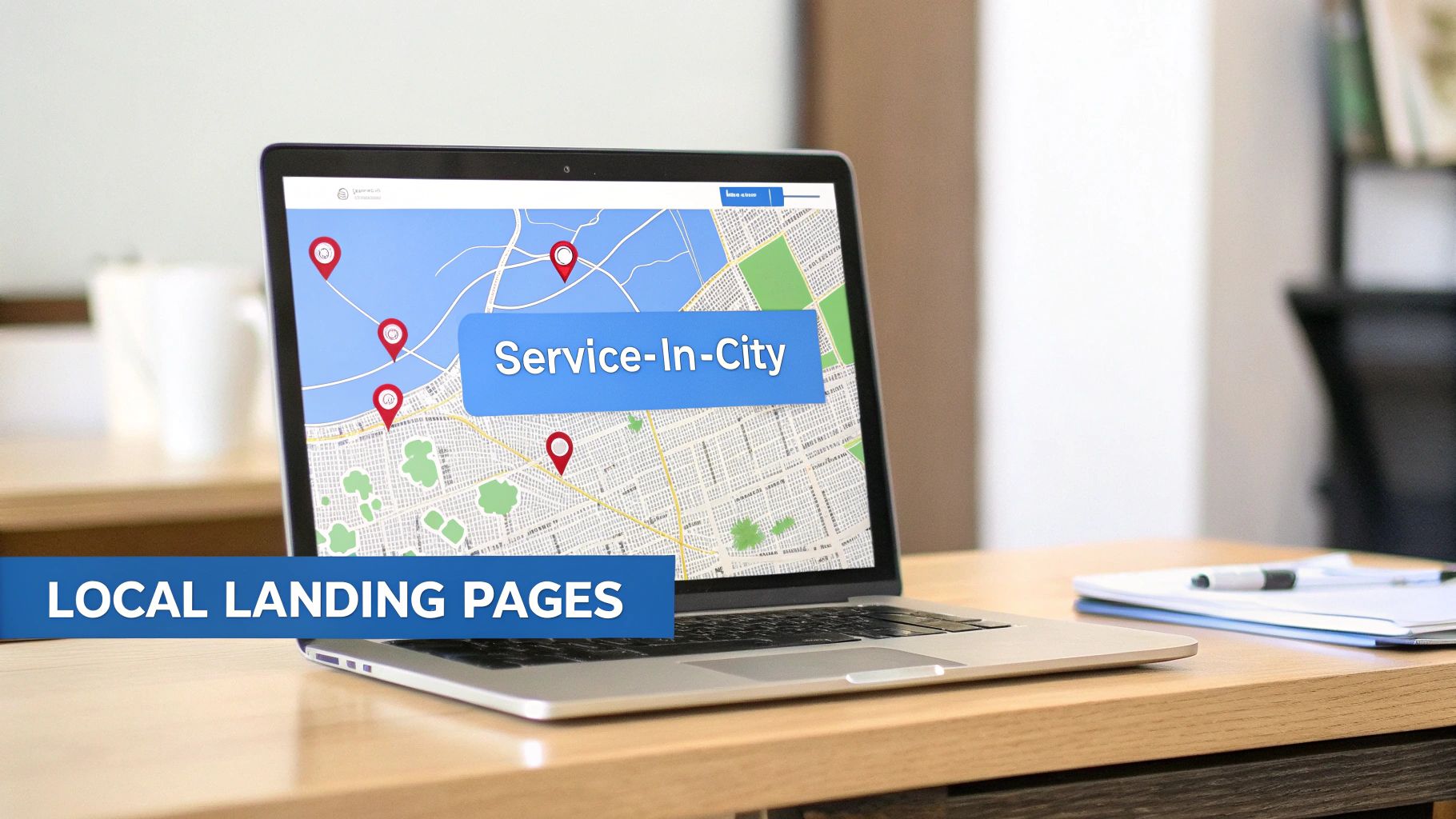
This is where a hyper-local content strategy becomes your secret weapon. It’s all about creating dedicated 'service-in-city' landing pages. Think of them as mini-websites for each location you serve, like "HVAC Repair in Pasadena" or "Emergency Electrical Services in Glendale." These pages act like powerful magnets for customers searching for your specific trade in their immediate area.
At Transactional Marketing, this is a core piece of our playbook. We don’t just tweak your homepage; we build out a digital footprint that covers your entire service area, one city at a time. This is how we make sure that when a customer searches for a transactional term like "roofer near me" in their suburb, your hyper-local page is the most relevant result Google can possibly serve up.
Why Hyper-Local Pages Win
When a homeowner needs urgent help, their search is immediate and local. In fact, over 78% of local mobile searches for home services result in a purchase within 24 hours. That number is incredible. It shows just how ready-to-buy these searchers are, and it’s why targeting them on a local level is so crucial.
This is exactly why a strategy built on hyper-local pages works so well. Each page is carefully designed to send strong local signals to Google for that specific service and location pairing.
A dedicated page for "Plumbing in Burbank" will always, always outperform a generic "Our Services" page for a customer searching in Burbank. It's a clear, undeniable signal of relevance that Google's algorithm is built to reward.
Anatomy of a High-Converting Local Landing Page
Now, this isn’t about just copying a page and swapping out the city name. That's a recipe for failure. Each page has to be a unique, valuable resource that proves you belong in that community.
So, what goes into a great 'service-in-city' page? Here’s what we build into every single one:
- Localized Titles and Headings: The page title and main H1 heading must include both the service and the city (e.g., "Expert AC Repair in Pasadena"). It’s the first thing Google sees.
- Unique, Localized Content: The writing should speak to the unique needs of that area. Reference local landmarks, neighborhood names, or common problems specific to that city (e.g., "We know Pasadena summers can be brutal on an older AC unit…").
- Area-Specific Testimonials: Got a great review from a customer in that city? Feature it prominently. This social proof builds instant trust with their neighbors.
- Embedded Local Map: A Google Map showing your service area or highlighting the specific city provides a powerful visual cue that reinforces your local presence.
This level of detail is fundamental. Our process is not like every other boring marketing company. We laser-focus on creating these digital assets for your business, ensuring you become the obvious and most trusted choice for customers in every corner of your service area.
This neighborhood-by-neighborhood approach is a cornerstone of effective local SEO for home service companies. By building out these targeted assets, you're not just ranking for keywords; you're building a digital fortress around your service territory. For a deeper look into this strategy, explore our comprehensive guide on local SEO for contractors. You’ll quickly see how this transforms your website from a simple online brochure into a powerful engine for generating high-quality jobs.
Turning Customer Reviews Into Your Biggest Asset
In the home service business, trust is everything. It's the currency that gets you invited into a customer's home to fix a leaky pipe or a broken AC unit. Today, that trust is built online, and online reviews are the new word-of-mouth.
Think of it this way: a high star rating is a giant green light for potential customers, signaling that you're a safe, reliable bet. A low rating? That's a stop sign that sends them straight to your competition. Reviews are a huge factor not just for Google's algorithm, but for the real people making the hiring decisions.

Why Google Cares So Much About Your Reputation
Google’s job is to give searchers the best, most trustworthy answers. When someone frantically searches for a transactional term like "emergency plumber near me," Google doesn't want to recommend a company with a history of unhappy customers. Your reviews are direct evidence of your quality.
The algorithm is looking at a few specific things:
- Review Quantity: The sheer number of reviews you've collected. A roofer with 250 reviews looks a lot more established and credible than one with just 12.
- Review Quality: This is your average star rating. A consistent 4.8-star rating is a powerful signal that you do great work, and it's practically a requirement for getting into the top of the Map Pack.
- Review Velocity: How often you’re getting new reviews. A steady trickle of recent feedback tells Google your business is active, busy, and consistently keeping customers happy right now.
Building a Five-Star Review Engine
Great reviews don't just happen by accident. You need a system. The absolute best time to ask is right after you've finished the job and your customer is thrilled with the result. That's when their satisfaction is at its peak.
A proactive review strategy isn't optional—it's essential. You can't leave your online reputation to chance. You have to actively guide happy customers to share their experience on your Google Business Profile.
This doesn't have to be complicated. Simple, automated tools can make it a seamless part of your process. A quick follow-up text message or email with a direct link to your Google review page removes all the friction. The customer just has to tap and type. This is how you build the volume and velocity that Google’s algorithm loves.
The Art of Responding to Every Single Review
Getting reviews is only half the battle; responding to them is just as critical. When you thank someone for a positive review, it shows you appreciate their business and reinforces that great experience.
But how you handle the inevitable negative review is where you can truly shine. A calm, professional, and helpful response to a complaint shows potential customers that you stand by your work, take accountability, and are committed to making things right. That builds more trust than a perfect record ever could.
At the end of the day, a stellar reputation is the foundation of local SEO for home service companies. Studies have found that 75% of businesses agree local SEO brings in more qualified leads than any other marketing channel. And with 87% of customers admitting they flat-out skip businesses with low ratings, managing your reputation is non-negotiable. You can learn even more about SEO for home service businesses on 1seo.com.
Your Website: The Bedrock of Local Dominance
Think of your Google Business Profile as the flashy billboard on the highway. It gets people's attention. But your website? That's the actual storefront they pull over to visit. It’s the central hub of your entire local SEO and AI optimization effort, providing the depth, detail, and authority that seals the deal for both Google and your potential customers.
Without a solid, well-optimized website, even a perfect GBP will eventually hit a glass ceiling. It just won't have the foundation it needs to consistently own the top spots in the Map Pack.
This is where on-page and technical SEO come into play. These aren't just fancy buzzwords; they're the nuts-and-bolts adjustments that make your site fast, easy for Google to understand, and persuasive for a real person who needs your help now. The goal is to create a frictionless path from a frantic "air conditioning repair near me" search to that person calling you to book a job. A great site amplifies every signal your GBP sends out, creating a powerful one-two punch for local visibility.
At Transactional Marketing, our entire system is built on making your website and GBP work in perfect harmony. We sweat the technical details that get you ranked for the money-making search terms—the ones that bring in customers ready to hire you on the spot.
Speak Google’s Language with Schema Markup
Imagine handing Google and AI a cheat sheet for your home service business—one that instantly clarifies who you are, what you do, and where you do it. That's exactly what LocalBusiness schema markup does. It's a snippet of code on your website that spoon-feeds search engines and Large Language Models (LLMs) your most critical information in a perfectly structured format they love.
Instead of making them guess, schema spells everything out:
- Your Services: Not just "plumbing," but "emergency drain cleaning," "water heater installation," and "sewer line repair."
- Your Hours: Including that all-important 24/7 availability for emergencies.
- Your Service Area: A precise list of the specific cities, towns, and even neighborhoods you cover.
- Your Ratings: It helps pull your star ratings right into the search results, building immediate trust.
This structured data is a cornerstone of AI optimization. When someone in your service area has a crisis and searches for a solution, schema helps ensure that search engines and AI assistants see you as a relevant, qualified, and available expert.
Nail Your Mobile and Speed Experience
Let's be real: home service emergencies don't happen when someone is sitting comfortably at their desktop. They're happening on a smartphone, often while the customer is standing in a puddle of water. Your website absolutely must load fast and look great on a phone.
A slow, clunky mobile site is the digital equivalent of a busy signal—it sends high-intent customers straight to your competitors.
Google has used mobile-first indexing for years now. This means it primarily looks at your site's mobile version to decide how to rank you. A bad mobile experience doesn't just annoy users; it actively harms your search visibility.
We make sure every site is built for the "on-the-go" customer, with big, easy-to-tap "click-to-call" buttons and simple navigation. Focusing on this user experience is non-negotiable for turning search traffic into booked jobs. For a deeper dive, there are fantastic resources on mastering local SEO strategies that can help you fine-tune your approach.
An Actionable On-Page SEO Checklist
To bring it all home, every single one of your core service pages—especially those hyper-local city pages—needs to be dialed in. This on-page optimization is how you make sure the words on your site perfectly match the transactional terms your customers are typing into Google.
Here’s a quick-hit checklist for a perfectly tuned local service page:
| Element | Optimization Tactic | Example |
|---|---|---|
| Title Tag | Service in City | Brand Name |
Expert Drain Cleaning in Silver Lake | ABC Plumbing |
| Meta Description | Write a compelling mini-ad with a call-to-action. |
Need fast drain cleaning in Silver Lake? ABC Plumbing offers 24/7 emergency service. Call now for a free estimate! |
| H1 Header | Use your main keyword and location. |
Same-Day Drain Cleaning Services in Silver Lake |
| Page Content | Weave in keyword variations and local flavor naturally. |
Talk about common drain issues found in older Silver Lake homes, showing true local expertise. |
By methodically optimizing every element, you create pages that are a perfect match for what local customers are looking for. This synergy between a technically sound website and a dominant GBP is how we consistently get our clients showing up on page one, often within just 30 to 60 days.
8. How to Track Local SEO Success and Measure ROI
Marketing is only effective if it makes the phone ring. For any home service business, the only metrics that really move the needle are the ones that pad your bottom line: more calls, more booked jobs, and a real, tangible return on your investment (ROI). It's easy to get distracted by things like website traffic, but what good are visitors if they don't turn into customers?
This is where a sharp focus on results comes in. We pinpoint the exact transactional "money" keywords that drive actual business—think searches like "AC repair near me"—and show you precisely how those rankings translate into measurable growth. It's all about proving the value of your local SEO strategy, month after month.
Key Performance Indicators for Home Services
To know if your SEO is working, you have to track the right things. Paying attention to these specific data points gives you a crystal-clear picture of your performance and helps uncover new opportunities.
These are the core metrics we live by to ensure your strategy is consistently generating high-value leads:
- Keyword Rankings by City: It’s not enough to rank for "roofer." You need to know you rank for "roofer in Dallas." We track your position for critical, high-intent search terms in every single neighborhood you serve.
- Google Maps Visibility: Our Google Maps optimization includes advanced heat map technology to create a visual report card of your rankings across your entire service area. This lets us see exactly where you're dominant and where we need to push harder.
- Inbound Phone Calls: For most home service pros, this is the most direct measure of success. We track every single call that comes from your Google Business Profile and website so you know what's working.
- Website Form Submissions: Not everyone picks up the phone. Tracking how many customers request quotes or book appointments through your site gives us another vital piece of the conversion puzzle.
Measuring True Return on Investment
Calculating your ROI is the ultimate gut check for any marketing campaign. It answers the one question that matters most: "Is this making me money?" If you want to dive deeper, there are some simple strategies to measure marketing ROI that can help you connect the dots.
The goal is to connect every marketing dollar to a specific outcome. When you can see that an investment in ranking for "emergency plumber near me" led directly to a profitable water heater installation, the value of local SEO becomes undeniable.
This data-first approach allows us to constantly refine your campaign. By analyzing which keywords and locations generate the most profitable jobs, we can double down on what works and make sure every dollar of your marketing budget is deployed for maximum impact.
Curious about your potential returns? Use our free ROI calculator to get a quick estimate.
Frequently Asked Questions
When it comes to local SEO for home service businesses, it’s easy to get lost in the details. At its core, though, it's all about one thing: being the most relevant and trustworthy choice for a homeowner with an urgent problem. Here are some of the questions we get asked most often.
How Long Until My Phone Starts Ringing?
Every local market is different, but you shouldn't have to wait half a year to see if your marketing is working. Our whole approach is built for speed. Transactional Marketing has a proven system that gets clients their website showing up on page one of Google for their most important money-making keywords, typically within 30 to 60 days. We even give you a live dashboard to watch the progress unfold yourself.
Is My Google Business Profile More Important Than My Website?
Think of them as a one-two punch. Your Google Business Profile is the first handshake—it gets you in front of eyeballs in the Map Pack and often generates that first, critical phone call.
But your website is what seals the deal. It's where you build real trust, show off your five-star work, and give customers the confidence they need to book a job. A top-tier local SEO and AI optimization strategy needs both to be firing on all cylinders.
Can I Just Do This Myself?
You can certainly handle the basics, like updating your hours on your Google Business Profile, and that's a great start. But truly dominating your local service area is a full-time job. It's a constant cycle of finding the right transactional keywords, creating hyper-local content, managing online listings, and having the technical know-how to stay ahead of Google's updates and your competitors.
Working with a specialized agency like Transactional Marketing gives you access to proven systems and technology designed to generate hundreds of more calls. It lets you focus on what you do best: running your business and serving your customers.
Why Do You Focus So Much on "Transactional" Keywords?
We're obsessed with transactional keywords because they connect you with people who are ready to open their wallets right now. That's why we're called Transactional Marketing.
When someone searches for "emergency plumber near me" or "AC repair service," they aren't just browsing. They have an immediate problem and are looking for a fast solution. By getting you to rank for these high-intent terms, we make sure your marketing dollars go directly toward generating immediate leads and the highest possible ROI. It's the straightest line from a Google search to a paying customer.
Ready to stop guessing and start dominating your local market? Transactional Marketing has the proven system to get your home service company in front of customers who are ready to hire you today. We focus on the transactional search terms that drive real revenue and deliver measurable results within 30-60 days.