

For any HVAC company, local SEO isn't just another item on a marketing checklist—it's your direct line to customers with an urgent, high-value problem that needs solving right now. A powerful local strategy makes sure you're the first business they find when a homeowner is desperately searching "emergency AC repair near me" during a brutal heatwave.
Why Transactional SEO Is Critical for HVAC Growth
When a furnace gives out in the middle of a blizzard or an air conditioner dies on a 95-degree afternoon, people don't have the luxury of browsing. They have an immediate problem and are ready to pay the first qualified company that can fix it. This is a transactional search, and it’s the exact moment your business absolutely must show up. At Transactional Marketing, our entire system is built around putting our clients directly in the path of these high-intent customers.
We laser-focus on getting your HVAC company to own the search results for the specific phrases that lead directly to booked jobs. We aren't chasing vague brand awareness; we're after tangible results that grow your bottom line. The goal is simple: make your phone ring with calls from people searching for terms like:
- "Furnace repair [your city]"
- "Air conditioning installation near me"
- "24-hour HVAC service"
This is the core of our philosophy and why we're called Transactional Marketing—we connect you with customers at the precise moment they are ready to transact.
The Power of Local Visibility
The real battle for these valuable leads is fought and won in the Google Local 3-Pack and at the top of Google Maps.
Picture this: a homeowner’s AC unit sputters and dies on the hottest day of the year. Their first move is to search 'AC repair near me'—a term that gets over 60,500 monthly searches during peak season alone. Now consider that 97% of people discover local companies online, and a staggering 75% never scroll past the first page of results. Your ranking isn't just a vanity metric; it's everything.
If your business isn't a fixture in that Local 3-Pack, you're essentially invisible to customers who are ready to book a service call immediately. This is why Google Maps optimization is so important. Transactional Marketing has the technology to get these map locations showing up in the top three in their service areas, translating into hundreds of more phone calls every month.
Our proven system is designed to get your business website showing up on page one of Google for these critical transactional terms, often in just 30 to 60 days. This isn't guesswork. It's a technology-driven process that transforms your Google Business Profile into a lead-generation machine. This approach is fundamental to success for all trades, as we outline in our guide to local SEO for home service companies. It’s about being seen when and where it matters most.
Here's a look at the foundational elements we focus on to capture those ready-to-buy local customers.
Pillars of a Transactional HVAC SEO Strategy
| Strategy Component | Primary Goal | Key Metric for Success |
|---|---|---|
| Google Business Profile (GBP) Optimization | Dominate the Google Local 3-Pack and Maps for high-intent, transactional keywords. | Number of phone calls, direction requests, and website clicks from GBP. |
| Hyper-Local Keyword Targeting | Rank for service and city-specific terms in your entire service area. | Top 3 rankings for terms like "AC repair [City Name]". |
| Service & Location Page Buildout | Create dedicated, authoritative pages for every service and location. | Organic traffic and conversions for individual service pages. |
| Review & Reputation Management | Build social proof and trust to increase conversion rates. | Average star rating (goal: 4.8+) and total number of reviews. |
| Local Link Building & Citations | Establish local authority and relevance with Google. | Number of high-quality, locally relevant backlinks and citation consistency. |
| Technical SEO & Schema Markup | Help search engines and AI understand your services and service area explicitly. | Clicks and impressions for rich results in Google Search Console. |
By mastering these pillars, your HVAC business moves from being just another option to being the obvious choice for homeowners in need.
Mastering Your Google Business Profile for Maximum Visibility
Your Google Business Profile (GBP) is the absolute cornerstone of local SEO for any HVAC company. It's not just another online listing; it's your digital storefront, and it's almost always the very first thing a potential customer sees when they make a transactional search.
Picture this: a homeowner's furnace dies in the middle of a cold snap. They grab their phone and frantically search "emergency furnace repair near me." Your GBP is the beacon that turns that urgent, high-value search into a profitable job for you. Getting this right isn't optional; dominating Google Maps and the Local 3-Pack is how you win, and it all begins with a perfectly tuned-up profile.
This whole process is designed to turn your passive listing into an active, lead-generating machine. It’s a direct line from search to rank to conversion.
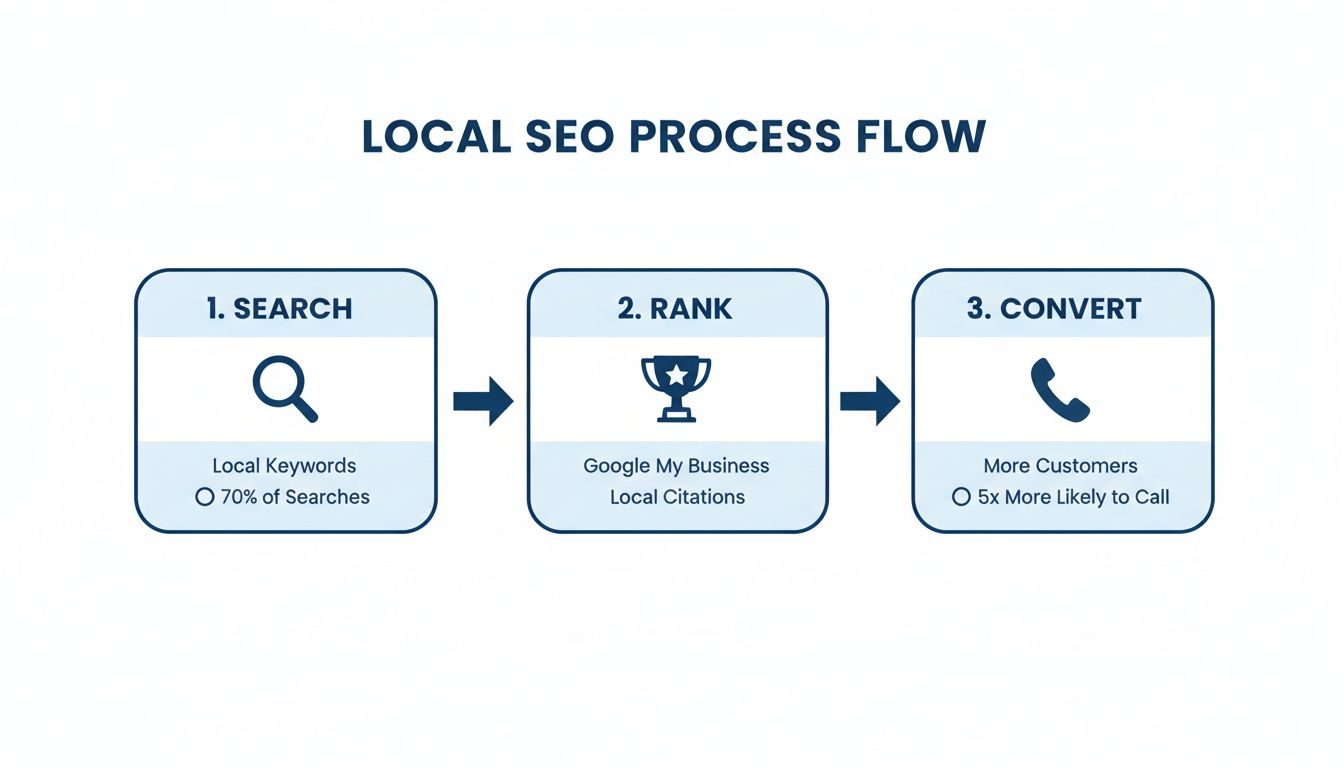
This visual really gets to the heart of what we do: making sure your HVAC business isn't just found, but is the first and only choice for customers who are ready to pull out their wallets.
Selecting the Right Categories
Getting your categories right is a critical first step, and it's shocking how many businesses mess this up. Your primary category needs to be the single most accurate description of what you do. For most HVAC businesses, this will be "HVAC contractor" or maybe "Air conditioning contractor." This single choice has a massive impact on the transactional searches you show up for.
But don't stop there. The real magic happens in your secondary categories. This is your chance to snag all those specific, high-intent searches. You have to think like a customer with an urgent problem. They aren't searching for "HVAC services"; they're searching for a solution.
Add categories like:
- Heating contractor
- Furnace repair service
- Air conditioning repair service
- Air duct cleaning service
By adding these, you're telling Google the full story of what you can do. This makes you eligible to appear for a much wider, more valuable set of search terms. Nailing this is a foundational piece of the system we use to get clients ranked in as little as 30 to 60 days.
Crafting a Compelling Business Description
Your business description is prime real estate. Don't waste it with generic fluff. This space is your chance to weave in your most important transactional keywords and clearly state why a customer should call you and not the competition.
A powerful business description isn't just a list of services; it's a direct answer to a customer's immediate problem. You need to frame what you do as a solution—think fast emergency repairs, reliable installations, and honest pricing. That’s how you connect with someone who’s ready to make a decision right now.
For instance, instead of the bland "We are a full-service HVAC company," try something that actually sells:
"Your trusted HVAC contractor in [City] for 24/7 emergency AC and furnace repair. We specialize in fast air conditioning installation and expert heating services to keep your home comfortable year-round. Call us now for reliable, upfront service."
See the difference? It speaks directly to the needs of someone in the middle of a stressful, purchase-driven search.
Using Media to Build Local Relevance
Photos and videos are so much more than just window dressing for your profile. They are powerful signals to Google that prove your local activity and expertise. In fact, Google’s own data shows that businesses with photos get 42% more requests for directions and 35% more clicks through to their websites.
To really make an impact, you need to be strategic. Upload high-quality, geotagged photos of:
- Your branded service vans parked in the different neighborhoods you serve.
- Your technicians on the job (always get customer permission, of course).
- Before-and-after shots of completed furnace or AC unit installations.
- Your team at your shop or office.
Geotagging these images with location data is a subtle but incredibly effective tactic. It reinforces your service area footprint in Google's eyes, strengthening your map rankings in the specific zones you want to own. For a complete walkthrough of these optimizations, our Google My Business optimization checklist gives you a detailed roadmap.
Activating Your Profile with Posts and Q&A
A "set it and forget it" GBP profile is a massive missed opportunity. Features like Google Posts and the Q&A section are there to turn your static listing into a dynamic, interactive platform.
Get in the habit of using Google Posts weekly. Announce a "$99 Furnace Tune-Up Special," share a quick tip about improving air quality, or highlight your 24/7 emergency services. This consistent activity signals to Google that your business is alive, well, and actively engaged with the community.
The Q&A section is just as important. Don't wait for customers to ask questions—seed it yourself! Proactively ask and answer the most common questions you get on the phone, like "Do you offer financing options?" or "What are your emergency service hours?" This does two things: it provides valuable info upfront and lets you control the narrative while naturally including important keywords. You're removing friction for the customer, making it that much easier for them to decide you're the right call.
Building a Website That Dominates Your Service Area
If your Google Business Profile is the engine driving your local map rankings, then your website is the high-performance chassis holding everything together. A smartly structured website is what allows an HVAC company to break out of its home zip code and start systematically winning jobs across multiple cities, suburbs, and neighborhoods.
This is how you prove to Google—and to potential customers—that you’re the go-to provider for the entire region.
The secret is to move beyond a simple homepage and a generic "services" page. To really capture those high-intent, transactional searches—the "air conditioning repair near me" queries that turn into actual revenue—your website’s architecture needs to be hyperlocal and ruthlessly focused. At Transactional Marketing, this is the core of our philosophy: build a digital footprint that mirrors your physical service area, ensuring you show up right where your customers are searching.
When you get this right, your site transforms from a simple online brochure into a powerful, revenue-generating machine that works around the clock to bring in profitable jobs.
Creating Hyperlocal Service and City Pages
I see this all the time: HVAC companies trying to rank for a dozen different things with a single page. It just doesn't work. A generic "AC Repair" page will never rank effectively in five different cities. Google wants to see specific, relevant signals for each location you serve. The answer? Dedicated hyperlocal pages.
This means you’ll build out a unique page for every combination of service and location you want to target. This is a core tenet of our strategy; we never combine industries or services on one page. Marketing for an HVAC company is completely different from marketing for a dentist, and we treat each service with that same level of focus.
Think of it like this:
- AC Repair in [City A]
- Furnace Installation in [City A]
- AC Repair in [City B]
- Furnace Installation in [City B]
And here's the critical part: each of these pages needs unique, valuable content. Simply swapping out the city name is a recipe for failure. Instead, talk about common HVAC problems specific to the older homes in that area. Mention local landmarks or specific neighborhoods to ground your content in reality. This level of detail shows search engines you’re a true local authority, not just someone casting a wide, generic net.
This strategic expansion is essential for any business with growth ambitions. We dive much deeper into this in our complete guide to multilocation local SEO.
Optimizing On-Page Elements for Transactional Keywords
With your hyperlocal pages built, it's time to tune up every on-page element to grab the attention of customers who are ready to make a call. This is where we make sure the exact transactional phrases people are typing into Google, like "air conditioning repair near me," are front and center.
Here’s what to focus on:
- Title Tags: This is the blue link people see in the search results, and it's your first impression. It has to be compelling and feature the primary keyword. For example:
24/7 AC Repair in [City Name] | Call [Your Company] Now! - Header Tags (H1, H2): Your main H1 heading should leave no doubt what the page is about:
Emergency Air Conditioning Repair in [City Name]. Use subheadings (H2s) to target related long-tail keywords and answer common questions. - Page Content: The copy itself needs to naturally weave in variations of your target keywords. Talk about your process for
air conditioner repair, the benefits of a newfurnace installation, and why homeowners in[City Name]have trusted your technicians for years.
When you meticulously optimize these elements for every single city and service page, you're sending an incredibly strong signal to Google. You aren't just saying you offer "HVAC services"; you're proving you are the best possible solution for "emergency furnace repair in the [specific neighborhood] neighborhood."
Establishing Topical Authority with Dedicated Service Pages
Alongside your location-based pages, your website needs to have strong, authoritative pages for each core service you offer. Think of these as the central hubs for topics like "Air Conditioning," "Heating," "Ductwork," and "Indoor Air Quality."
These "pillar" pages should be comprehensive, covering every facet of that service. For instance, your main "Air Conditioning" page should be the parent page that links out to more specific pages for AC repair, AC installation, AC maintenance, and even ductless mini-splits. This structure, known as a content silo, proves your deep expertise on the subject.
This isn't just a "nice to have" in modern SEO; it's essential for both traditional search and new AI optimization. Google and LLMs want to rank experts. When your site architecture clearly demonstrates you're an authority on all things HVAC, the algorithm rewards you with higher rankings for a whole host of high-intent search terms. It’s a powerful strategy that translates directly into more calls and more booked jobs.
Using Reviews and Citations to Build Local Trust

If your Google Business Profile and website are the engine of your local SEO, then reviews and citations are the fuel. These off-page signals are what build real-world authority and social proof, turning a strong foundation into a dominant force in the map pack.
Think about it from the customer's perspective. When their AC dies on a 95-degree day, they see your business next to two competitors. What makes them call you? More often than not, it's the high star rating and the sheer volume of recent, positive reviews that seal the deal. This is how you win those critical transactional searches.
Systematizing Your Review Generation
Hoping for reviews is not a strategy. The only way to build a powerful review profile is to create a repeatable system that actively requests feedback after every single service call. You have to make it a non-negotiable part of your process.
The goal is to generate a steady, consistent stream of fresh reviews. This constant activity shows Google—and potential customers—that you're a thriving, trustworthy business.
It all starts with your technician in the field. After finishing a job, a simple, personal ask can work wonders: "We're a local company and feedback from customers like you really helps us out. Would you mind sharing your experience online?"
Then, follow up immediately with a direct link:
- Text Message: Send a text with your Google review link within an hour of leaving their home. This is the fastest way to get a response; open rates are through the roof.
- Email: An email follow-up is a good backup, but keep it incredibly simple. One clear call-to-action: leave a review.
Of course, the best reviews come from a great customer experience. This is where tools like HVAC business management software can make a huge impact, ensuring your operations are smooth from the first call to the final invoice.
Responding to Every Piece of Feedback
Generating reviews is only half the battle. You have to respond to all of them—good and bad. This signals to Google that you're an active, engaged business owner. More importantly, it shows potential customers you actually care.
For positive reviews, thank the customer by name and weave in a keyword. Something like, "Thanks, Sarah! We're so glad our team could get your AC repair in Dallas handled so quickly." It’s a subtle but effective way to reinforce your services and service areas.
For negative reviews, the approach is critical. Respond promptly, professionally, and with empathy. Acknowledge their frustration, offer to take the conversation offline to find a solution, and never, ever get into a public argument. How you handle criticism can tell a potential customer more about your company than a dozen five-star reviews.
The Critical Role of Local Citations
Beyond reviews, local citations are another foundational piece of the trust-building puzzle. A citation is simply any online mention of your business's Name, Address, and Phone number (NAP).
Think of it this way: every time Google finds your consistent NAP on a reputable website, it's like another vote of confidence confirming your business is legitimate and located where you say it is.
The absolute key here is NAP consistency. Even a tiny variation, like "St." on one directory and "Street" on another, can create confusion for search engines and weaken your local authority. Your NAP must be identical everywhere.
Start by getting your information locked down on the major data aggregators and directories that matter for home service businesses.
- Core Directories: Yelp, Bing Places, Apple Maps.
- Industry-Specific Sites: Angi, HomeAdvisor, Better Business Bureau (BBB).
These consistent listings create a clean digital footprint that Google’s algorithm loves. It’s a vital piece of the puzzle, especially when you consider that local intent drives 46% of all Google queries. With a staggering 76% of those people calling a business the same day, a clean citation portfolio ensures you’re the one they call.
Winning High-Intent Searches with AI Optimization
Traditional SEO is no longer enough. The way customers find HVAC services is changing fast due to AI optimization, and if you’re not adapting, you’re falling behind. AI optimization focuses on how Large Language Models (LLMs) find and present business information in search results.
We're moving away from a world where people just type "AC repair near me" into Google. They're asking specific, problem-based questions to AI assistants, and these tools are getting incredibly good at giving them direct answers. Your goal is to provide the exact content that makes you the source of truth for these AI-powered searches.
Proving Your Expertise with Content Silos
Let's get practical. A homeowner in your town notices their AC unit is making a weird rattling sound. Their first move isn't to look for a company. It's to figure out what's wrong. They'll search for something like, "why is my AC unit rattling?"
If your website has a detailed blog post that explains the common causes—a loose part, debris in the unit, a failing motor—you’ve just become their trusted advisor. This is the whole idea behind a content silo. It’s a powerful way to organize your site to prove to Google (and customers) that you’re the go-to authority on a topic.
It works like this:
- The Pillar: You have your main service page, like "Air Conditioning Repair in Phoenix." This is the foundation, targeting your most important transactional keyword.
- The Support: Then, you build a cluster of related articles and blog posts that answer every conceivable question about AC repair. Crucially, all these supporting articles link back to that main pillar page.
For an "AC Repair" silo, your supporting content could look like this:
- 5 Signs You Need Emergency AC Repair
- How Much Does an AC Freon Recharge Cost in Phoenix?
- My Air Conditioner Froze Up – What Do I Do?
- Is It Worth Repairing a 15-Year-Old AC Unit?
This structure tells search engines and LLMs you’re not just another company with a generic service page. You’re a comprehensive resource, and that makes you a much more credible and authoritative result to show people. This is exactly the system we use at Transactional Marketing to dominate the search results for our clients' most profitable services.
How AI Search Changes Everything
The explosion in AI-driven search, from Google's SGE to ChatGPT, makes this content-first approach absolutely critical. These tools don't just give you a list of blue links; they synthesize information from the best sources to provide a direct, conversational answer.
Think about a query like, "What are the most common AC problems in older homes in Phoenix and who can fix them?" The AI isn't going to pull from a flimsy service page. It’s going to find the HVAC company that has built a deep well of content covering AC issues, home age, and local climate factors. Your content silo is the raw material that fuels these AI answers.
Building out these deep content reserves isn't just a good idea—it's how you future-proof your marketing. You're creating the source material that the next generation of search engines will rely on to recommend local service providers. This is the new frontier of AI optimization.
Of course, as these strategies start driving more calls, you can't afford to miss a single one. This is where many of our clients start looking into an HVAC Answering Service to make sure every lead, especially those lucrative after-hours emergency calls, gets captured. Generating the lead is only half the battle; you have to be ready to convert it.
Tracking Your Success and Proving ROI
Good marketing isn't about blind faith; it's about results you can see and measure. When you're investing in local SEO for HVAC companies, the only way to truly know it’s working is to track the numbers that lead directly to booked jobs and more revenue. It’s about focusing on what actually makes your business grow.
At Transactional Marketing, we’re all about radical transparency. Our entire system is built to not only deliver results but to prove them with cold, hard data. We don't believe in burying the truth in confusing reports. We show you exactly how our work is making your phone ring.
Visualizing Your Dominance with Rank Heatmaps
One of the best ways to see your progress in real-time is with rank heatmaps. Think of these as a visual report card for your Google Maps rankings, showing you exactly where you stand across every single neighborhood and zip code you service.
It's one thing to know you rank for "AC repair near me." It's another to see precisely which blocks have you in the top three and where you still have room to climb. This hyper-local view lets us dial in your strategy with surgical precision, making sure you’re visible where your best customers are looking.
Uncovering Transactional Queries in Search Console
Google Search Console is like a direct line into your customers' minds. We use it to pinpoint the exact, money-making search terms people are typing in to find you.
When we see queries like "emergency furnace repair in [your city]" or "same-day air conditioner installation" driving a ton of clicks, that's the ultimate validation. It tells us we're capturing customers who have a problem right now and are ready to pay to get it fixed. This is the power of targeting transactional search terms.
This data is pure gold. It shows us which services are hottest in the market, allowing us to focus on the keywords that bring in the most profitable leads. We even wrote a guide on the best local SEO reporting tools that we use to prove value to our partners.
Attributing Jobs with Call Tracking
At the end of the day, what really matters is how many booked jobs came from your SEO campaign. That’s where call tracking comes in. By using unique phone numbers on your Google Business Profile and website, we can trace every single incoming call back to its source. No guesswork involved.
This is what closes the loop. It draws a straight line from our online strategy directly to your bank account. You'll know, without a doubt, how many hundreds of calls our system is driving every month, proving the ROI and justifying every penny of your marketing spend.
Common Questions We Hear About HVAC Local SEO
Let's tackle some of the most frequent questions HVAC owners ask when they're digging into a local SEO strategy. I've heard these hundreds of times, so let's get you some straight answers.
How Long Does This Actually Take?
Everyone wants to know when the phone will start ringing. While our proven process can often deliver results quickly, seeing a nice little bump in the first 30-60 days from aggressively tuning up your Google Business Profile is very common.
Think of it as a 3-6 month journey to start seeing significant, consistent momentum. We're talking about higher rankings, more website visitors, and most importantly, more qualified phone calls. The key is consistency—chipping away at reviews, building out local content, and getting your name listed in the right places. That’s how we build a fortress around those high-value transactional search terms that bring in actual jobs.
Do I Really Need an Office in Every Suburb I Service?
Absolutely not. This is a common misconception that holds a lot of HVAC companies back. You're a Service Area Business (SAB), and Google gets that. Your Google Business Profile is designed specifically for you to list all the towns and zip codes you cover.
So, how do you rank in those other towns? The proven strategy is to build out dedicated "city pages" on your website. The catch is they can't be generic, cookie-cutter pages. Each one needs unique, genuinely helpful content about that specific location. This is your chance to show Google you're the go-to expert for "furnace repair in [City B]" even though your shop is in [City A].
Should I Just Pay for Ads Instead of Doing All This SEO Stuff?
This isn't an either/or situation. Paid ads (especially Google's Local Services Ads) and local SEO for HVAC companies are two sides of the same coin—they work best together. Ads are like a faucet you can turn on for immediate leads, which is fantastic for filling gaps in your schedule.
Local SEO, on the other hand, is like building an asset. It’s a long-term play that generates a steady stream of "free" organic traffic and leads over time. A solid SEO foundation actually makes your ads work better and often cost less. The ultimate goal is to show up everywhere a customer is looking, both in the paid and organic sections. But SEO provides that deep, foundational value that you own forever. The minute you stop paying for ads, they're gone.
Ready to make your phone ring with customers who are actually ready to buy? At Transactional Marketing, we specialize in getting HVAC companies to the top of Google Maps for the search terms that drive real revenue.
Discover how our proven system can transform your local visibility.