


You’re probably in one of two situations right now.
You’re either paying for marketing that feels disconnected from revenue, or you’re getting leads that look fine on a spreadsheet and fall apart when your team picks up the phone. That’s the local service trap. Clicks look busy. Impressions look impressive. Booked jobs and scheduled patients are what matter.
Pay per lead sounds like the fix, and sometimes it is. But most local businesses use it wrong. They buy leads before they’ve built the foundation that makes those leads profitable. Then they blame the channel, the agency, or the market when the underlying issue is weaker positioning, poor qualification, and no control over transactional demand.
My view is simple. Pay per lead works best as an accelerator, not a replacement for local SEO, Google Maps visibility, and strong coverage of transactional search terms like “plumber near me,” “emergency HVAC repair,” or “dentist near me.” If you don’t already show up where high-intent buyers search, you’re building growth on rented ground.
Why Your Old Marketing Playbook Is Broken
A lot of local businesses still run marketing like it’s 2018. They throw money into PPC, local sponsorships, generic SEO retainers, lead marketplaces, or broad awareness campaigns and hope enough of it sticks.
Then the month ends.
The phones didn’t ring enough. The jobs that came in were low value. The front desk says the leads were price shoppers. The agency points to traffic charts. Nobody wants to talk about return.
You’ve been paying for activity, not outcomes
That old playbook rewards motion. It doesn’t reward booked work.
If you’re a roofer, plumber, pest control company, med spa, chiropractor, or dental practice, the only searches that matter most are transactional search terms. Those are the searches made by people ready to act. “AC repair near me.” “Emergency electrician.” “Tooth extraction dentist near me.” Money-in-hand searches.
That’s where local lead generation becomes practical instead of theoretical.
Why businesses are moving toward pay per lead
This shift isn’t random. The pay-per-lead market is projected to grow from US$1.785 billion in 2024 to US$3.019 billion by 2031, at about a 7.8% CAGR, driven by businesses moving toward performance-based marketing that reduces upfront risk and ties spend to qualified lead delivery, according to this pay-per-lead market projection.
That growth tells you something important. Business owners are tired of paying first and asking questions later.
Practical rule: If your marketing partner gets paid whether or not you get real inquiries, your incentives are misaligned from day one.
Why PPL appeals
Pay per lead forces a cleaner conversation.
You stop asking, “How many clicks did we get?”
You start asking, “How many qualified calls, forms, and appointments came in?”
That’s better. But it’s still incomplete.
A bad pay per lead setup can bury you in junk. A good one can fill your pipeline. The difference usually comes down to whether the provider understands local buyer intent and whether your business already has strong organic visibility in the places buyers choose from.
If your acquisition costs feel bloated, start by reviewing how your channels are performing against customer value. This breakdown on how to reduce customer acquisition cost is the right mindset shift. Lower spend isn’t the goal. Better economics are.
Understanding the Pay Per Lead Model
Think of pay per lead like hiring a fisherman and paying only for fish that meet your size standard. You’re not paying for the boat, the fuel, or the hours on the water. You’re paying for the catch that fits the agreement.
That’s the core idea.
How the model functions
A pay per lead provider attracts interest through channels like Google Ads, local landing pages, SEO pages, Google Business Profile assets, call campaigns, or network sites. Then they pass that inquiry to you if it matches your agreed standards.
A clean workflow usually looks like this:
- The partner generates demand through search, maps, ads, or other local channels.
- They validate the lead against basic criteria such as service type, area served, and usable contact details.
- They deliver the lead by call, form, text, CRM push, or appointment handoff.
- You pay a preset amount only when the inquiry meets the qualification rules.
That’s why the model appeals to owners who are done funding vague campaigns.
Where PPL differs from PPC and retainers
A lot of businesses confuse these models, and that confusion gets expensive fast.
| Model | What you pay for | Main upside | Main downside |
|---|---|---|---|
| Pay per click | Clicks | Fast traffic | You still carry conversion risk |
| Retainer | Agency time and scope | Consistency and strategy | You pay whether leads come in or not |
| Traditional ad buy | Exposure | Broad reach | Weak accountability |
| Pay per lead | Qualified inquiries | Better alignment to outcomes | Quality disputes can wreck the relationship |
With PPC, you’re paying for interest.
With pay per lead, you’re paying for opportunity.
That distinction matters most for transactional searches. A person who types “water heater repair near me” is far more valuable than someone passively scrolling past an ad. Local service businesses win when they capture demand at the moment it becomes urgent.
Why local service companies like this model
Pay per lead can work especially well when your team needs demand now, your close process is solid, and you know exactly which jobs are worth chasing.
It’s also useful when you want tighter control over unit economics. If you know what a good customer is worth, you can decide what a lead is worth.
Don’t buy “marketing.” Buy access to real conversations with people who need your service in your area.
The missing part most providers ignore
Most PPL sellers act like lead delivery is the whole job. It isn’t.
If your website is weak, your Google Business Profile is buried, your reviews are uneven, or your location pages don’t rank for buyer-intent searches, the entire system gets less efficient. You end up relying on purchased demand instead of owning demand.
That’s why local businesses should understand the mechanics behind search visibility before signing any lead deal. If you need a simple primer, this guide on what SEO companies do gives the baseline. The short version is this: good SEO builds the conditions that make every lead channel perform better.
Evaluating PPL for Your Service Business
Some local businesses should lean hard into pay per lead. Others should use it sparingly. A few should avoid it until they fix basic operational problems first.
If your phone goes unanswered, your intake process is sloppy, or your team can’t convert urgent inquiries, more leads won’t save you. They’ll just expose the leak faster.
When PPL is a strong fit
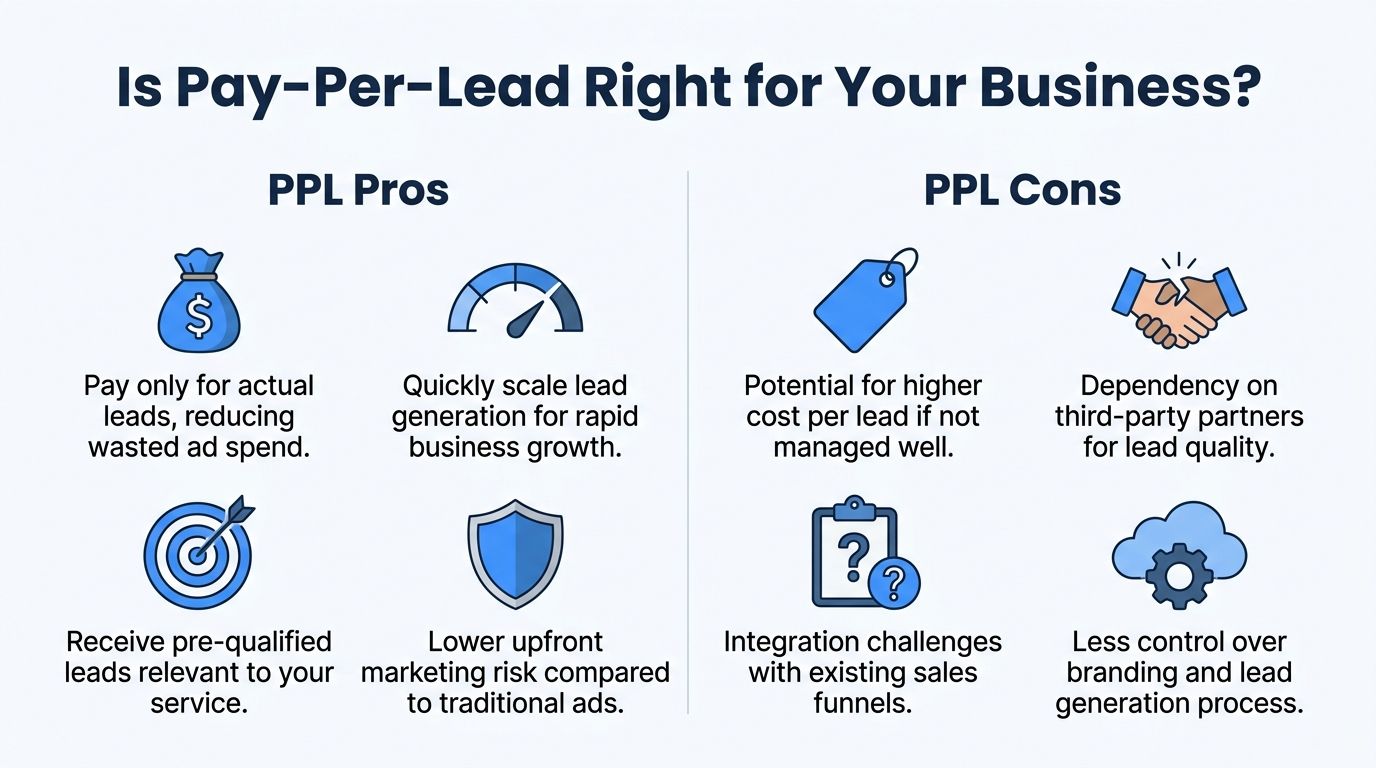
Pay per lead is a good option when your service has clear demand, your margins support acquisition costs, and your staff responds fast.
These businesses usually fit well:
- Urgent home services like plumbing, HVAC, electrical, and roofing, where buyers search with immediate intent.
- Appointment-driven practices like dental, orthodontic, chiropractic, and med spa, where a lead can be screened and booked quickly.
- Local operators entering a new service area who need demand before organic rankings mature.
The upside is straightforward.
- Lower upfront risk: You aren’t funding media blindly.
- Cleaner forecasting: You can model spend against lead flow more directly.
- Faster scaling: If the partner has real demand sources, volume can increase faster than organic alone.
Where businesses get burned
The biggest problem isn’t price. It’s mismatch.
A provider may technically deliver leads, but those leads might be outside your service area, shopping for the cheapest option, missing core contact info, or asking for services you don’t even offer. That’s not lead generation. That’s outsourced chaos.
Other failure points show up quickly:
- Dependency risk: If one provider controls most of your pipeline, they control your growth.
- Brand dilution: The prospect may remember the directory or lead source, not your business.
- Operational drag: Your team wastes time sorting junk from opportunities.
- Volume whiplash: Some weeks feel overloaded. Others go quiet.
A lead source you can’t verify is a liability, not an asset.
A simple decision filter
Use this test before you commit.
| Question | If the answer is yes | If the answer is no |
|---|---|---|
| Do you know your most profitable service types? | PPL can be targeted around real margin | You’ll overpay for low-value work |
| Can your team answer and follow up quickly? | You can turn lead flow into revenue | You’ll waste good opportunities |
| Do you rank for some transactional terms already? | PPL can supplement owned demand | You may become dependent on bought leads |
| Can you define a qualified lead clearly? | Disputes stay manageable | Billing fights will start immediately |
My recommendation
Use pay per lead if your business already has three things:
- Strong intake
- Clear job economics
- A real local search presence
If you don’t have those, fix them first.
The best PPL outcomes happen when the business is already visible for high-intent local searches and uses purchased leads to add capacity, not to replace an absent foundation. That’s especially true in service categories where trust, proximity, and Maps visibility influence who gets the call.
Decoding PPL Pricing and Lead Quality
Most business owners ask the wrong opening question.
They ask, “What do leads cost?”
The better question is, “What does a qualified, closeable opportunity cost in my market, for my service, with my margins?”
That’s the number that matters.
Pricing varies because customer value varies
There is no universal pay per lead rate. There shouldn’t be.
According to this breakdown of pay-per-lead pricing by vertical, legal services average $320 per lead, healthcare averages $285, and home services like HVAC and plumbing typically land in the $50 to $150 range. The same source notes that pricing tracks with customer lifetime value, and a plumber with a $400 average ticket plus repeat business can justify a higher lead cost.
That’s the right lens. If one new customer can turn into repeat revenue, membership revenue, or future treatment plans, paying more for a better lead makes sense.
The contract definition matters more than the invoice
Lead quality doesn’t improve because a provider says it’s “exclusive” or “high intent.” It improves when the contract defines what counts.
Your agreement should spell out what a qualified lead must include.
- Real identity: Name and working contact details.
- Service relevance: The person requested a service you offer.
- Geographic fit: The address or location sits inside your service area.
- Actionable need: The person has a genuine reason to speak with your business now.
- No duplicates: You shouldn’t pay twice for the same inquiry.
And it should also define what does not count.
- Wrong market
- Spam or fake info
- Out-of-scope requests
- No-contact submissions
- Repeat leads already in your database
If “qualified lead” isn’t defined in writing before launch, expect arguments later.
Pay-Per-Lead Pricing Models Compared
| Model | How It Works | Best For | Key Consideration |
|---|---|---|---|
| Flat-rate PPL | You pay the same amount for each approved lead | Simple local service campaigns | Easy to manage, but quality can vary |
| Tiered pricing | Higher-intent or better-screened leads cost more | Businesses with different service values | You need clear rules for each tier |
| Appointment-based | You pay when a lead becomes a scheduled appointment | Dental, med spa, consult-driven offers | Booking quality matters more than raw form fills |
| Revenue-share hybrid | Provider earns based on downstream results or a blended setup | Mature operators with strong tracking | Requires trust and clean attribution |
If you’re sorting through provider models, this guide on how to outsource lead generation is a useful outside reference because it pushes you to look beyond price and think about process, ownership, and accountability.
Track what happens after the lead arrives
A lead isn’t revenue. It’s the start of a sales process.
You need to monitor the full path:
- Contact rate: Did your team reach the lead?
- Appointment-set rate: Did the inquiry turn into a booked slot or estimate?
- Close rate: Did that appointment become real revenue?
- Source quality by service line: Which lead types produce profitable jobs?
Many owners are fooled by this. They see affordable leads and assume the campaign is working. Meanwhile, the close rate is weak and the staff is drowning in bad inquiries.
That’s why you need a real acquisition model tied to business math, not marketing vanity. This explainer on how to calculate cost per acquisition is worth applying before you sign any deal. If you don’t know what acquisition can cost while staying profitable, you can’t judge a lead provider intelligently.
How to Choose a High-Performance PPL Partner
A slick sales deck means nothing in pay per lead.
The key question is whether the provider can generate steady, qualified local demand without cutting corners when pressure hits. A lot of them can’t.
The dirty secret behind many bad PPL relationships
Some lead gen companies create their own instability. They front ad spend, mark up the leads, and hope the math works. Then clients reject a big chunk of inquiries, cash gets tight, and the provider starts pushing weaker leads just to keep revenue moving.
According to this discussion of hidden cash-flow issues in PPL, agencies often face negative cash flow when they cover ad spend upfront and clients reject 50% of leads as unqualified. That tension turns into lead-quality disputes and unstable outcomes for the business owner.
That’s not your problem to solve, but it becomes your problem fast when the provider starts lowering standards.
What to ask before you sign
Don’t ask vague questions like “How do you get leads?” Ask questions that expose the operating model.
- Where do the leads come from? Search ads, SEO assets, Google Maps visibility, call campaigns, local pages, directories, or resold traffic all behave differently.
- How do you verify lead quality? You want a documented screening process, not sales language.
- What happens when a lead is disputed? Get the timeline and the approval process in writing.
- Do you understand my exact service mix? A provider who treats emergency plumbing and cosmetic dental the same way doesn’t understand local intent.
- Can I see source-level reporting? If they can’t show where leads originated, you’re buying a black box.
Watch for these warning signs
Some red flags are obvious. Others hide behind enthusiasm.
- Too much emphasis on volume: Cheap lead counts are often camouflage for low standards.
- No discussion of Google Business Profile or local SEO: That usually means they’re buying demand, not building durable demand.
- No intake strategy: If they don’t ask how your team answers calls or handles missed inquiries, they don’t care about your close rate.
- Weak transparency: If reporting is delayed, vague, or aggregated, expect trouble.
The best PPL partner thinks like an operator. The worst one thinks like a broker.
Why source strategy matters
A partner that knows local SEO and Google Maps can pre-qualify intent better because they understand the searches that convert. A partner that only knows ad arbitrage often chases volume first and fit second.
That’s why I’d rather work with a provider who understands location pages, reviews, service-area relevance, call routing, and local buying behavior than one who just says they have “traffic.”
If you want a good outside comparison point for partner models, especially where performance relationships blur into channel partnerships, reviewing how companies structure affiliate marketing partners can be useful. Not because PPL and affiliate are identical, but because both models depend heavily on partner quality, incentives, and trust.
Achieving Growth with SEO, GMB, and PPL
Here, most pay per lead advice falls apart.
It treats PPL like a standalone growth engine. For local service businesses, that’s backwards. Your best long-term system is owned visibility first, paid acceleration second.
The foundation should be transactional search coverage
When someone searches “roofer near me,” “emergency dentist,” or “pest control near me,” you want your business showing up in the places buyers act on immediately.
That means:
- your website ranks for service-plus-city terms
- your Google Business Profile is strong
- your Maps presence is competitive
- your reviews support conversion
- your service pages answer real buying intent
- your business is easy for search engines and AI systems to understand
Those assets create the baseline. Then pay per lead fills gaps.

Why the hybrid model wins
In competitive markets, relying only on paid lead channels gets expensive. According to Belkins’ CPL benchmark overview, some B2B leads cost over $1,500 in 2026 benchmarks, while qualified home service leads can cost $150 to $300. The same source argues that a strong SEO and GMB base can dramatically lower blended CPL compared with relying only on paid channels.
That’s exactly the point.
When your website and Google Maps presence already generate inbound calls, every purchased lead becomes part of a stronger mix. You’re not desperate for outside volume. You’re selective. That changes your negotiating power and your ROI.
Google Maps is not optional
For local service brands, the map pack often decides who gets called first. If you’re buried there, you’re forcing yourself to buy demand you should have been capturing organically.
A serious local strategy includes review growth, category alignment, service-area clarity, location relevance, and regular optimization of your profile. If you haven’t tightened that up yet, start with this guide on how to optimize Google Business Profile.
AI optimization is now part of local visibility
Search behavior is changing. People still search in Google, but they also ask AI tools direct questions about who to hire nearby. That means your business needs more than rankings. It needs clear, structured, trustworthy local signals that AI systems can interpret and surface.
That includes:
- consistent service descriptions
- well-built location pages
- strong review language
- accurate business data
- content aligned to transactional intent
- clear evidence of expertise in your service area
If you ignore AI discovery, you’ll lose ground even if your old SEO playbook still brings some traffic.
Own the searches you can rank for. Use pay per lead to widen the funnel, not to become the funnel.
Your Action Plan for High-Intent Leads
If you want pay per lead to produce real ROI, keep the strategy simple.
First, audit your visibility for transactional search terms. Search the phrases your buyers use when they’re ready to spend. Check your website rankings, your map presence, your reviews, and how your listings look on mobile. If you don’t show up well for buyer-intent searches, fix that before you scale purchased leads.
Second, define a qualified lead in writing. Not loosely. Precisely. Service type, city, contact standards, duplication rules, and what counts as a valid dispute. Most PPL failures start with vague expectations.
Third, build a blended system. Use local SEO, Google Maps, and AI-optimized content to own your highest-intent searches. Then layer pay per lead on top to add volume, test new geographies, or support high-margin services.
That’s the model I recommend because it protects your margins and gives you more control. You stop renting all your demand. You start owning a meaningful share of it.
If your current lead gen feels unstable, that’s the reset. Better visibility. Better qualification. Better economics.
If you want help building that kind of system, Transactional LLC is the right partner to talk to. They focus on what matters for local service growth: ranking for transactional search terms, strengthening Google Maps visibility, improving Google Business Profile performance, and building AI-ready local content that turns searches into calls, booked jobs, and new patients.