


Some weeks the phone rings nonstop. Other weeks you're staring at a half-empty schedule, wondering why the leads dried up again. That pattern is common in pest control, especially when a company leans on referrals alone, buys shared leads, or runs broad marketing that attracts people who want free advice instead of service.
The fix isn't more traffic. It's better intent.
In pest control lead generation, the best prospect is the one searching with a problem that needs attention now. Terms like "termite treatment near me," "rodent removal [city]," and "bed bug exterminator" aren't casual searches. They are transactional search terms. The person typing them usually wants a quote, a call, or an appointment. That's the lane that matters.
A strong system captures those searches in two places at once. First, your website has to rank for service-and-city combinations that show clear buying intent. Second, your Google Maps presence has to show up where local customers compare providers fast and call even faster. Layer in AI-guided content planning, disciplined follow-up, and clean reporting, and lead flow becomes far more predictable.
The Core Problem With Pest Control Leads
Most pest control companies don't have a lead problem. They have an intent problem.
They spend money on channels that create activity but not booked work. That includes generic social posts, broad keywords, low-quality lead vendors, and blog content built around informational topics that never move a homeowner to pick up the phone. Traffic looks fine. Sales don't.
The market is too competitive for that kind of waste. The global pest control market is projected to reach $29.1 billion by 2026, which means more companies are fighting for the same local searches. At the same time, SEO leads close at 14.6% compared with 1.7% for outbound methods, according to SmartXCRM's pest control lead generation breakdown. That gap says everything. When someone searches for help, they convert far better than someone interrupted by outbound marketing.
Transactional searches are the real asset
Informational queries have a place, but they are not the backbone of pest control lead generation. A search like "why do I have ants in my kitchen" might belong to a future customer. A search like "ant exterminator near me" belongs to a current buyer.
That's why the core strategy has to revolve around terms tied to action:
- Urgent service queries like emergency rodent removal, wasp nest removal, and same-day pest control
- Service-specific searches like termite baiting, bed bug treatment, and flea extermination
- Location-based buyers like pest control in a city, suburb, or neighborhood you serve
- Commercial intent searches from restaurants, property managers, and offices needing recurring service
Practical rule: If the keyword doesn't sound like something a ready-to-book customer would type, it shouldn't be the center of your campaign.
A lot of pest companies still market backwards. They start with channels, then hope those channels somehow produce leads. The better approach is to start with buyer intent, then build content, Google Maps signals, and ad campaigns around it.
A broader pest control marketing plan still matters, but it only works when it points toward high-intent searches. For a wider view of that mix, this guide on proven pest control marketing strategies for 2025 is a useful reference. The difference is that lead generation only becomes efficient when transactional terms sit at the center.
Dominate the Map Pack with Google Business Profile Mastery
A weak Google Business Profile costs pest control companies calls every day.
When homeowners search for a local exterminator, they often don't browse ten websites. They scan the map pack, compare reviews, glance at service labels, and call one of the top visible companies. If your profile is incomplete, vague, or poorly optimized, you lose those opportunities before your website even gets a chance.
Build the profile around services people actually buy
Start with the basics, but don't stop there. Most listings are technically complete and strategically useless.
Your categories, services, and business description should match the way customers search when they need help now. That means listing real service lines, not just broad phrases.
Use your profile to reflect buyer intent such as:
- Core service categories that align with extermination and local pest control
- Specific services like termite treatments, rodent removal, bed bug treatments, mosquito control, crawlspace inspections, and wildlife exclusion if you offer them
- Emergency positioning if your team handles urgent calls outside standard hours
- Commercial and residential relevance when both are part of your operation
Treat every field like a ranking and conversion input
Google gives you fields. Most companies leave money in them.
Fill out every applicable service, service area, business hour, appointment option, and attribute. Add photos from real jobs, branded trucks, technicians in the field, before-and-after exclusion work, and exterior shots that confirm you're a legitimate local company. Use posts to reinforce current services and service areas.
The profile should answer three questions fast:
- What do you do?
- Where do you do it?
- Why should someone call you instead of the next listing?
Here's a practical checklist.
| Component | Action Item | Why It Matters for Transactional Leads |
|---|---|---|
| Business category | Choose the most accurate primary category and relevant secondary categories | Helps Google match your listing to high-intent service searches |
| Services section | Add every offered pest service individually | Expands visibility for specific buyer searches |
| Service areas | List the cities and areas you truly serve | Filters out bad-fit leads and strengthens local relevance |
| Hours | Keep standard and emergency availability accurate | Reduces friction for urgent callers |
| Photos | Upload recent jobsite, team, vehicle, and office photos | Builds trust before the call |
| Posts | Publish regular updates tied to local services and seasonal demand | Keeps the profile active and reinforces relevance |
| Reviews | Request reviews tied to specific services and cities | Improves trust and local ranking signals |
| Q&A | Add and answer common buyer questions | Pre-handles objections and improves conversion |
A map listing shouldn't read like a directory entry. It should read like a local service page compressed into a profile.
Use posts and photos to support local intent
For pest control, random updates don't help much. Localized updates do.
A good Google Post might highlight termite inspections in a specific city, rodent exclusion during colder months, or mosquito treatment before outdoor event season. The point isn't to chase vanity engagement. The point is to reinforce relevance for searches tied to immediate service demand.
Photos work the same way. Upload images that support real-world trust:
- Technicians on site with branded uniforms
- Service vehicles in recognizable local areas
- Inspection findings when appropriate and professional
- Treatment equipment that signals capability
- Office or dispatch presence if customers visit or verify your location
For a more detailed walkthrough, this resource on how to optimize Google Business Profile covers the mechanics behind stronger local visibility.
Map pack wins come from precision, not tricks
The companies that stay visible in Maps usually do the boring work better than everyone else. They keep data clean. They update services. They collect reviews steadily. They publish useful posts. They align the profile with the website instead of treating them like separate assets.
That discipline matters because maps often produce the fastest response from local searchers. If your pest control lead generation strategy ignores Google Business Profile mastery, you're leaving high-intent calls on the table.
Build an Unbeatable Content Silo with AI Planning
Most pest control websites have a few service pages, a generic home page, and a blog full of scattered topics. That's not a content strategy. That's a loose pile of pages.
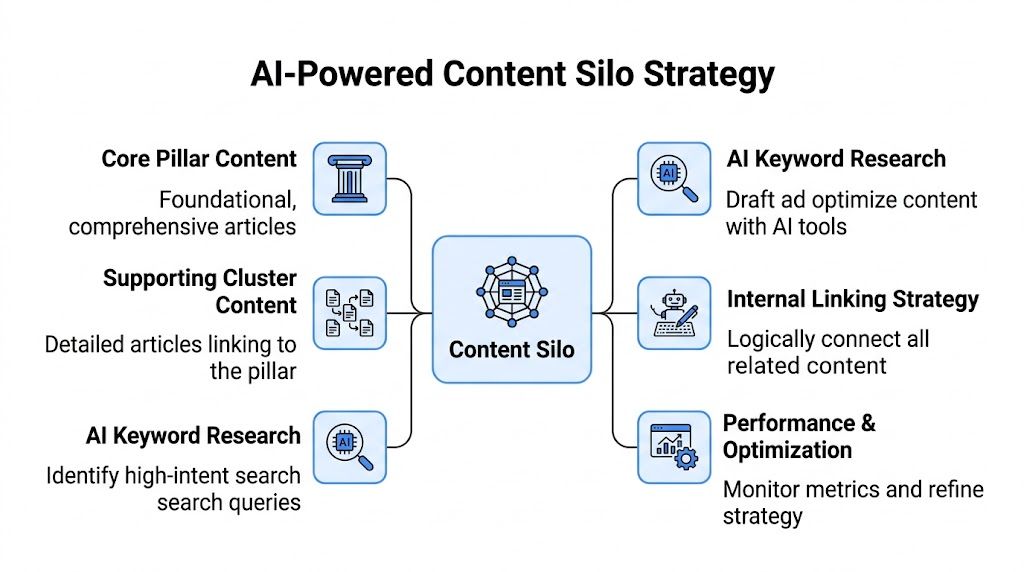
A content silo fixes that by organizing your website around service clusters built for transactional search terms. Instead of one broad rodent page trying to rank for everything, you build a structure where each page has a specific role. One page targets rodent control broadly. Supporting pages target rat extermination in one city, mice removal in another, attic rodent proofing, crawlspace exclusion, and related service-intent searches.
This structure helps search engines understand depth, relevance, and local authority.
What AI planning actually improves
AI doesn't replace strategy. It speeds up the planning layer that many local companies never finish.
A strong AI workflow maps out combinations of:
- Service type such as termite, roach, ant, bed bug, mosquito, rodent
- Location intent including each city and service area
- Problem modifiers like emergency, inspection, removal, treatment, exterminator
- Commercial versus residential use cases
- Related follow-on needs such as exclusion, prevention, and recurring maintenance
That creates a practical page architecture instead of random publishing.
A pest control silo might look like this:
- Pillar page
- Rodent control
- Cluster pages
- Rat exterminator in one target city
- Mice removal in another city
- Attic rodent proofing
- Crawlspace rodent inspection
- Commercial rodent control
The same model works for termites, bed bugs, ants, wildlife, mosquitoes, and recurring pest prevention.
Why this reduces dependence on paid traffic
A key gap in most advice is the absence of a real organic moat. Many pest companies are told to run ads, buy leads, and post occasional blogs. That keeps them dependent on outside platforms.
A better model uses AI-planned content silos and local SEO together. As noted in PestPac's discussion of generating more pest control leads, AI-planned content silos targeting high-intent transactional terms, when amplified through collaborative networks, can accelerate rankings 2-3x faster than solo SEO efforts. That matters because rankings built around local buyer intent can turn organic searches directly into booked jobs.
Your website shouldn't be a brochure. It should be a search capture system built around the exact phrases buyers use when they need service.
Internal linking is where most local sites fail
Even decent pages underperform when they sit isolated.
Each service page should link to related city pages, related problem pages, the main service hub, and conversion pages. If someone lands on "bed bug treatment in [city]," they should be able to move naturally to inspection details, preparation steps, related service areas, and a clear contact path. That linking helps users and reinforces topical relationships for search engines.
A practical content silo usually includes:
- A main service hub for broad relevance
- City-specific pages for local transactional searches
- Supporting educational pages that remove objections and answer common pre-sale questions
- Commercial pages if recurring accounts are important to your business
- Clear internal links that connect the whole cluster
Businesses exploring workflow support for this kind of buildout may also find these AI Lead Generation Tools useful, especially when evaluating how AI can support planning, drafting, and lead capture without turning content into generic sludge.
For local businesses, the challenge isn't publishing more. It's publishing in a sequence that compounds. That's where a structured approach to content marketing for local businesses becomes valuable. Every page should reinforce the next page, the service category, and the local market you want to own.
Launch Paid Ads for Immediate High-Intent Leads
SEO compounds over time. Paid ads can put you in front of ready-to-book searchers much faster.
That doesn't mean throwing money at broad keywords and hoping for calls. In pest control lead generation, paid ads only work well when campaigns are tightly tied to service intent, local geography, and fast conversion paths.
One campaign highlighted by Hook Agency's pest control lead study generated over 290 non-branded leads in two months at a $43 cost per lead, and Local Service Ads helped secure a 58% share of the local search map for primary keywords. Those outcomes didn't come from broad visibility. They came from matching urgent search demand with strong local execution.
Use Google Ads for service-specific urgency
Google Ads works best when you separate campaigns by pest problem and buyer urgency.
Don't put termites, ants, bed bugs, mosquitoes, and rodents in one ad group with one landing page. That setup creates weak ad relevance and mixed intent. Break campaigns apart so ad copy, keywords, and landing pages all match.
A cleaner structure looks like this:
- Termite campaign focused on inspections, treatment, and active infestation searches
- Rodent campaign centered on removal, exclusion, and attic or crawlspace issues
- Bed bug campaign aimed at urgent treatment and inspection needs
- General pest campaign for broad local searches if needed
- Commercial campaign if you target recurring accounts
Negative keywords protect the budget
A lot of ad waste comes from searches that sound relevant but aren't commercial.
You usually don't want to pay for clicks from people looking for DIY remedies, jobs, training, identification guides, or free advice. Build negative keyword lists early and keep refining them as search term data comes in.
Common waste categories include:
- DIY research
- Career searches
- Pest photos and identification
- Free home remedies
- Low-intent educational queries
Field note: If the keyword suggests curiosity instead of urgency, remove it or isolate it. Pest control paid search should stay close to booked-service intent.
LSAs capture buyers who want to call now
Local Service Ads are different from traditional search ads. They are designed for local service providers and often attract people who want to call immediately instead of comparing multiple websites.
For pest control companies, LSAs can work well when your profile is complete, service categories are accurate, service areas are disciplined, and reviews stay active. The lead quality often improves when the profile and intake process are tight because the searcher already sees key trust signals before reaching out.
Send each click to a page built to convert
If your ad says "same-day rodent removal," the landing page should continue that exact promise. It should not dump visitors onto a generic home page with ten services and no obvious next step.
A good paid landing page includes:
- A headline matching the ad
- Clear service area language
- Fast contact options, especially click-to-call
- Trust signals such as reviews, certifications, and technician credibility
- A short form that doesn't slow down urgent leads
If you're trying to plan ad budgets more carefully, this overview of Google paid search cost helps frame the trade-offs behind campaign structure and spend.
Paid ads are not a replacement for SEO. They are the fast-response layer. When both are aligned around transactional search terms, pest control lead generation stops feeling random.
Systematize Your Conversion from Click to Customer
Traffic is only useful when your team can turn it into booked work. A lot of pest control companies lose leads after the hard part is already done. The call comes in, the form gets filled out, and then response time drifts, intake gets sloppy, or no one prioritizes the urgent jobs correctly.
That leak usually has two causes. The website doesn't make action easy, and the follow-up process isn't built for speed.
The landing page should remove friction
A pest control page doesn't need to impress a designer. It needs to help a worried homeowner act quickly.
That means putting the phone number where mobile users can tap it, keeping forms short, and showing enough trust to reduce hesitation. Certifications, reviews, service guarantees, location clarity, and real technician photos all help. So does direct copy that mirrors the problem the customer searched for.
A useful conversion page usually includes:
- A strong call button visible without scrolling on mobile
- A short contact form asking only for the essentials
- Service-specific copy that matches the search term and ad
- Review snippets or proof elements that lower anxiety
- Clear coverage details so people know you serve their area
Score leads by urgency and fit
Not every lead should enter the queue the same way.
In pest control, some prospects need immediate attention because the problem is urgent, the service area fits perfectly, and the job value is strong. Others can wait. A good intake system reflects that reality.
According to Gushwork's review of pest control lead scoring, advanced lead scoring prioritizes three core signals: location, pest urgency, and form-derived data. The same source notes that following up within 5 to 15 minutes can double conversion rates. That makes speed a competitive advantage, not just a customer service preference.
What the triage process should look like
Your form and call intake should collect enough information to route leads intelligently.
A practical triage model:
- Highest priority
- Termites, rodents, active infestations, in-service-area, ready for inspection or treatment
- Mid priority
- General pest issues, recurring service questions, non-urgent residential work
- Lower priority
- Out-of-area requests, vague information, low-fit inquiries
If the lead says "rats in attic tonight" and lives inside your target service area, that lead should not sit in a general inbox.
Automation offers help. A CRM or workflow tool can push urgent leads to the right person fast, trigger confirmation texts, and log follow-up so nothing gets lost. Teams evaluating operational support may want to review approaches to AI business process automation, especially for routing, alerts, and repetitive intake tasks.
Speed has to be operational, not motivational
Telling staff to respond faster rarely fixes anything. Systems do.
Use a process that includes:
- Instant confirmation when a form is submitted
- Clear owner assignment for new leads
- Priority flags based on pest type and location
- Rapid callback standards during business hours
- After-hours response rules so urgent leads don't go cold overnight
Fast pest control lead generation isn't just about generating demand. It's about making sure your company acts like the urgent solution the searcher was looking for.
Build a Perpetual Lead Flywheel with Reviews and Referrals
A good lead generation system shouldn't reset to zero every month. It should compound.
That's what reviews and referrals do when handled systematically. They turn completed jobs into fresh local trust signals, stronger map visibility, and more inbound leads from people who already trust the company before the first call.
Reviews strengthen both ranking and conversion
For pest control, reviews do more than make the business look credible. They help future buyers decide whether your company feels safe, responsive, and professional enough to invite into their home or business.
The quality of the lead matters here. FieldRoutes notes in its pest control lead generation guide that SEO-generated leads close at 14.6%, and strong operators often maintain customer retention rates of 70-90%. That connection matters. A high-intent lead who finds you through a transactional search is more likely to become a long-term customer when the service experience matches the search promise.
Ask at the right moment, not eventually
The best time to request a review is right after the customer expresses satisfaction. Not a month later. Not when someone on the office team remembers.
A simple process works best:
- Send the request fast after service completion
- Use a direct link to the review profile
- Mention the service performed so the customer has context
- Train technicians to tee up the request before the message goes out
Shorter, cleaner requests usually win. The customer doesn't need a speech. They need a link and a reason.
The flywheel starts when a finished job produces a review, that review helps win the next searcher, and that new customer becomes the next review request.
Referrals need structure too
A lot of companies say referrals are important but never build a process around them.
Referrals work better when you identify who is most likely to recommend you. That often includes repeat customers, property managers, real estate contacts, and homeowners who had a good emergency-service experience. Give them a simple way to refer. Make sure your office staff asks naturally. Follow up with appreciation when they do.
A basic referral system can include:
- A short ask in post-service communication
- A mention during renewal or follow-up calls
- A lightweight incentive if it fits your business model
- Tracking so referral sources are visible
The key is consistency. Reviews and referrals shouldn't feel optional or random. They are part of pest control lead generation because they improve local trust, map performance, and repeat business at the same time.
Track Your ROI with a Transparent Results Dashboard
Most pest control companies don't need more marketing reports. They need reports that answer one question clearly. Is this turning into calls, jobs, and growth?
A transparent dashboard should make that obvious. If the reporting is full of vague charts and inflated language, it's probably hiding weak accountability.
Track rankings by service and city
Broad ranking reports aren't enough.
You need to know whether the business is gaining visibility for the exact transactional search terms that matter in the exact service areas you want to own. That means tracking keyword timelines by service and city, not just generic domain visibility.
Useful ranking views include:
- Service plus city terms such as termite treatment in a target city
- Near me intent proxies reflected through local visibility
- Map pack movement across the service area
- Page-level performance for silo pages and landing pages
Heat maps are especially helpful because they show where map visibility is strong and where it falls off. For a pest control business, that matters more than bragging about a few rankings in areas you don't want to service.
Tie every channel to lead actions
A ranking increase is useful only if it produces calls, forms, and booked work.
Your dashboard should show operational outcomes tied to marketing assets:
| KPI | What to look for | Why it matters |
|---|---|---|
| Keyword timelines | Movement for transactional service terms in target cities | Shows whether visibility is improving where buyers search |
| Map heat maps | Coverage strength across the service area | Reveals local gaps and competitive pressure |
| Google Business interactions | Calls, directions, website visits | Indicates local buyer engagement |
| Form submissions | Service page and landing page conversions | Shows which pages attract action |
| Phone calls | Volume and quality by source | Connects marketing to real lead flow |
| Search Console query data | Actual terms generating impressions and clicks | Helps expand or refine content silos |
| Landing page behavior | Which pages hold attention and produce contact | Highlights conversion issues fast |
Good reporting changes decisions
When reporting is clear, you can act on it.
If one city cluster starts gaining traction, you can expand that silo. If maps visibility is weak in a high-value suburb, you can tighten local signals there. If one service page gets traffic but doesn't convert, you can fix the offer, layout, or contact flow.
Operator mindset: Don't ask whether marketing is "working." Ask which service, city, and asset is producing the next booked job, and which one is wasting attention.
The best dashboard isn't built for presentations. It's built for decision-making. It should show what happened, where it happened, and what action to take next. In pest control lead generation, that's how you move from guessing to scaling.
If you want a contract-free partner that focuses on transactional search terms, Google Maps visibility, AI-driven content silos, and transparent reporting, Transactional LLC is built for that job. They help local service businesses show up where buyers are ready to spend, track rankings by city and service, and turn search visibility into calls and booked work.