

In the competitive pest control industry, visibility is everything. When a homeowner discovers a termite swarm or a restaurant faces a rodent issue, they don't browse; they search for an immediate solution. Their search is transactional, meaning they have a problem and are ready to pay to solve it now. This is a transactional search term, and it’s precisely where your business needs to appear: at the top of Google, right when a potential customer searches for "pest control near me."
Traditional marketing is no longer enough to capture this high-intent audience. To win, you need a modern playbook of pest control marketing strategies focused on dominating local, transactional search terms and optimizing for AI-driven search. At Transactional Marketing, we specialize in getting our clients to show up for the exact transactional search terms that mean a customer has money in hand, ready to spend. Our proven system can elevate your website to page one of Google, often within 30 to 60 days, by laser-focusing on the precise terms paying customers use, like "bed bug exterminator near me."
This guide provides a comprehensive blueprint of ten powerful, actionable strategies. We will move beyond generic advice and provide specific steps for mastering Google Maps optimization, structuring your content for AI and LLM visibility, and leveraging your digital presence to capture local demand. Forget casting a wide, ineffective net; these strategies are designed to get your phone ringing and your schedule full by placing you directly in front of customers ready to hire your services. Each tactic is engineered to deliver measurable results, ensuring your marketing budget translates directly into more customers and revenue.
1. Google Business Profile (GMB) Optimization & Local SEO
Your Google Business Profile (GMB) is the cornerstone of your local pest control marketing strategies, acting as your digital storefront for high-intent customers. When a homeowner searches for "ant exterminator near me" or "emergency rodent removal," they are making a transactional query. They have a pressing need and are ready to hire a solution. A fully optimized GMB ensures your business appears prominently in the Google Maps "Map Pack"—the top three local results—capturing these critical leads before your competitors do. Transactional Marketing has the technology to get businesses into this top three, translating into hundreds of more phone calls every month.
Why It's Foundational for Pest Control
An unoptimized GMB profile is invisible to potential customers. A complete, active, and well-managed profile, however, builds trust and authority with both Google's algorithm and local searchers. It directly translates into more phone calls, website clicks, and booked appointments. For example, national brands like Orkin leverage their GMB profiles by location, using professional photos and seasonal pest alerts to dominate local markets. This strategy is just as crucial for independent operators aiming to secure top placement for valuable, transactional search terms.
Actionable Implementation Steps
To turn your GMB into a lead-generation powerhouse, focus on these key areas:
- Complete Every Section: Fill out all available fields with precision. This includes your business name, address, phone number (NAP), hours, and a detailed description infused with keywords like "residential pest control" and "commercial extermination."
- Specify Your Services: Don't just list "pest control." Add individual services for every pest you handle, such as "Termite Treatment," "Bed Bug Extermination," "Rodent Control," and "Mosquito Abatement." This helps you rank for specific, transactional searches.
- Maintain an Active Profile: Google rewards activity. Post updates 2-4 times per week showcasing "before and after" treatment photos, educational content about seasonal pests, or limited-time service promotions.
- Aggressively Manage Reviews: Social proof is paramount. Respond to every review, good or bad, within 24 hours. Beyond optimizing your profile, consistently learning how to get more Google reviews for your business is crucial for boosting local search rankings and customer trust.
Key Insight: GMB is not a "set it and forget it" tool. It is a dynamic platform that requires consistent management to secure and maintain top rankings for the transactional search terms that drive revenue. For a step-by-step guide, explore this comprehensive Google Business Profile optimization checklist from Transactional.net.
2. Hyperlocal Content Marketing & Silo Strategy
Hyperlocal content marketing moves beyond general blog posts, focusing on creating highly specific, location-based content that answers high-intent customer questions for each city you serve. This approach uses a content silo strategy, where you build clusters of pages around core pest topics. This structure signals expertise to Google and optimizes your site for AI and LLMs, helping you dominate transactional search terms like "termite treatment cost in Scottsdale" or "emergency bed bug exterminator in Tempe," attracting customers who are ready to book a service immediately.
Why It's Foundational for Pest Control
Simply having a generic "Services" page is no longer enough to compete. A hyperlocal content strategy positions your company as the definitive local authority on specific pest problems. When a homeowner searches for a solution to their immediate pest issue, they use city-specific, problem-specific terms. By creating dedicated content that answers these queries, you capture traffic that is much more likely to convert into a phone call. This is a core component of effective pest control marketing strategies designed for lead generation, and exactly what we do at Transactional Marketing to get you to show up for the terms that matter.
Actionable Implementation Steps
To build a content engine that drives qualified local leads, implement this siloed, hyperlocal approach:
- Create Service-in-City Landing Pages: Develop a unique, detailed page for each core service in every city you target (e.g., "Rodent Control in Phoenix," "Scorpion Sealing in Mesa"). These pages should feature local testimonials, city-specific pest information, and clear calls-to-action.
- Build Content Silos (Topic Clusters): For each major pest (termites, rodents, scorpions), create a main "pillar" page. Link this pillar to several specific "cluster" pages that answer transactional questions, such as "How much does termite treatment cost in [City]?" or "Signs of a rodent infestation in Arizona homes."
- Target High-Intent, Transactional Keywords: Focus your content on keywords that signal a user is ready to buy. These often include terms like "emergency," "cost," "quote," "near me," and "exterminator." Answering these queries directly puts you in front of customers with money in hand.
- Optimize for AI and LLMs: Structure your content to answer common questions clearly and concisely, often using H3 headings for the question and a direct paragraph for the answer. This improves your chances of being featured in AI-powered search results and capturing the "position zero" featured snippet in Google, boosting visibility and authority.
Key Insight: A hyperlocal silo strategy is about creating a comprehensive, locally-focused resource that answers every potential question a customer might have. This technical SEO architecture establishes your authority with search engines and transforms your website into a powerful tool for capturing transactional search traffic.
3. Review Generation & Reputation Management
Your online reputation is your digital handshake, and for pest control companies, it’s a critical factor in converting high-intent searchers into paying customers. When a homeowner finds multiple options for a transactional search term like "bed bug exterminator in Dallas," your star rating and the quality of your reviews are often the final deciding factor. A systematic approach to review generation and reputation management builds the social proof necessary to earn trust and close the deal before a prospect ever picks up the phone.

Why It's Foundational for Pest Control
Trust is non-negotiable when a customer is inviting a technician into their home. A strong review profile on platforms like Google, Yelp, and Angi acts as a powerful trust signal that directly impacts your visibility in the Google Maps pack and your website's conversion rate. National brands like Terminix understand this, systematically requesting feedback to maintain high ratings that dominate local markets. For independent operators, a proactive reputation management strategy is one of the most effective pest control marketing strategies to compete and win against larger competitors for those all-important transactional searches.
Actionable Implementation Steps
To transform customer feedback into a consistent lead source, implement these focused tactics:
- Systematize the Ask: Don't leave reviews to chance. Send a review request via SMS or email within 24 hours of service completion, when the positive experience is still fresh. Make it easy with a direct link to your Google review page.
- Respond to Every Review: Engage with all feedback within 24-48 hours. Thank positive reviewers and address negative reviews with empathy and a public offer to resolve the issue offline. This shows prospective customers you are committed to service quality.
- Leverage Positive Reviews: Feature your best 5-star testimonials directly on your homepage, service pages, and even in your GMB posts. This social proof reinforces your expertise and builds immediate credibility.
- Monitor Review Velocity & Sentiment: Keep a close eye on the frequency and tone of incoming reviews. A sudden drop in star ratings or an increase in complaints can be an early warning sign of operational issues that need immediate attention.
Key Insight: A passive approach to reviews means leaving your brand's reputation in the hands of the few highly motivated (and often unhappy) customers. Proactive reputation management is an essential marketing function that protects your brand, builds trust, and directly fuels lead generation. To dive deeper, explore these proven strategies for review generation and reputation management.
4. Paid Search Advertising (Google Ads & Local Services Ads)
While SEO and GMB optimization build long-term authority, paid search advertising is your direct-access lane to customers actively searching for immediate solutions. This strategy uses platforms like Google Ads and Google Local Services Ads (LSAs) to place your business at the very top of search results for high-value transactional queries. When someone urgently searches "emergency bed bug treatment" or "rodent removal same day," a paid ad ensures your company is the first solution they see, capturing customers ready to spend money now.
Why It's Foundational for Pest Control
Paid search advertising delivers speed and precision that organic efforts cannot match in the short term. It allows you to bypass the months-long process of ranking organically and capture high-intent leads from day one. Google Local Services Ads are particularly powerful, providing a "Google Guaranteed" badge that builds instant trust and operates on a pay-per-lead model, often delivering a higher ROI. For instance, a local company can use LSAs to appear above even national brands, securing guaranteed leads from homeowners specifically in their service area.
Actionable Implementation Steps
To leverage paid search for immediate lead flow, concentrate on these two platforms:
- Prioritize Google Local Services Ads (LSAs): If you meet the criteria (background checks, licensing, insurance), LSAs should be your first step. They are built for transactional searches and charge per qualified lead, not per click. Focus on maintaining a high review score to stay competitive.
- Target Urgency with Google Ads: Create search campaigns focused on emergency keywords like "termite damage repair now" and "urgent scorpion removal." Your ad copy must reflect this urgency, offering "Same-Day Service" or "24/7 Emergency Response."
- Implement Smart Bidding and Targeting: Use location-based bid adjustments to increase bids by 20-30% in affluent or high-infestation zip codes. Utilize call and location extensions in every ad to make it seamless for a distressed homeowner to contact you directly from the search results.
- Track Revenue, Not Just Clicks: A click for a $2,500 termite bond is far more valuable than a click for a $150 general inspection. Set up conversion tracking that measures actual appointment values to accurately calculate ROI and optimize your ad spend toward the most profitable services.
Key Insight: Paid search is an indispensable tool among pest control marketing strategies for capturing immediate demand. Start with the high-trust, high-ROI format of LSAs, then supplement with highly targeted Google Ads campaigns focused on emergency transactional keywords to dominate the top of the search results.
5. Service Area Mapping & Multi-Location Expansion
Expanding your service footprint doesn't always require opening a new physical office. Service area mapping is one of the most effective pest control marketing strategies for dominating surrounding neighborhoods, cities, and suburbs. This method involves creating unique, optimized web pages for each location you serve, making your business visible to customers using transactional search terms like "bed bug exterminator in Scottsdale" even if your office is in Phoenix. It systematically captures high-intent leads across a broad geographic territory.
Why It's Foundational for Pest Control
Your ideal customers are not searching for "pest control"; they are searching for "pest control in [their specific neighborhood or city]." If you only focus on the city your office is in, you are invisible to thousands of potential clients in adjacent areas. By creating dedicated service area pages, you build local relevance for each target market, signaling to Google that you are the authoritative provider for those specific communities. This is how we get our customers to show up for the exact transactional terms in their local cities, right where their customers are searching.
Actionable Implementation Steps
To deploy a successful service area expansion strategy, concentrate on these critical actions:
- Create Unique Location Pages: Build a dedicated landing page on your website for each city or major neighborhood you service. Do not duplicate content. Each page should feature unique text, local testimonials, and photos relevant to that specific area.
- Optimize On-Page SEO: Infuse each page with location-specific keywords. The page title, headings, and body content should clearly state the service and location, such as "Reliable Rodent Control in Chandler, AZ."
- Build Local Citations: For each target area, build citations in local directories and on community websites. This reinforces your geographic relevance with Google's algorithm for that specific service area.
- Optimize for AI-Driven Local Search: Structure these pages with clear schemas and FAQs to directly answer queries that LLMs might pull from, such as "Which company handles scorpion sealing in Mesa?" This prepares you for the future of search.
Key Insight: A multi-location SEO strategy transforms your website from a single digital storefront into a network of localized presences. It systematically puts your brand in front of customers making transactional searches across your entire service radius. To dive deeper, explore these proven techniques for implementing multi-location local SEO and watch your lead volume grow.
6. Customer Referral & Word-of-Mouth Marketing Programs
A formalized referral program transforms your happiest customers into a proactive sales force. Instead of relying on passive word-of-mouth, this strategy creates a structured system that actively encourages and rewards existing clients for bringing you new business. For a high-trust service like pest control, where recommendations carry immense weight, a referral program is one of the most cost-effective and powerful pest control marketing strategies for acquiring high-converting, transactional leads.
Why It's Foundational for Pest Control
A lead generated from a trusted referral is pre-qualified and enters the sales process with a high degree of confidence in your company's ability to solve their problem. This dramatically lowers customer acquisition costs compared to paid advertising and shortens the sales cycle. For example, a company offering a $50 service credit for a successful referral is investing directly in a proven lead source, often yielding a higher ROI than a comparable spend on pay-per-click ads. It’s a direct line to new customers who are ready to make a hiring decision.
Actionable Implementation Steps
To launch a referral program that generates consistent, high-quality leads, focus on structure and simplicity:
- Make Referring Effortless: The process must be seamless. Include a unique referral link or QR code on every invoice and in your email signature. Use a simple landing page that clearly explains the reward and allows customers to submit a referral in under 60 seconds.
- Offer Compelling, Tiered Incentives: Motivate repeat referrals by increasing the reward. For instance, offer a $50 credit for the first referral, $75 for the second, and a free quarterly service for the third. This gamifies the process and identifies your most loyal brand advocates.
- Systematize Your Communication: Don't let your program be an afterthought. Regularly promote it in post-service follow-up emails, on printed materials left behind by technicians, and during customer service calls. Consistent reminders are key to participation.
- Reward Both Parties: A powerful tactic is to offer an incentive to both the referrer and the new customer. For example, the referring client gets a $75 credit, and their friend receives $75 off their initial service. This dual-sided offer significantly boosts conversion rates.
Key Insight: A structured referral program moves word-of-mouth from a passive hope to an active, measurable marketing channel. By making it easy to participate and offering valuable incentives, you create a sustainable pipeline of high-trust, transactional leads that are primed to convert.
7. Social Media & Video Marketing
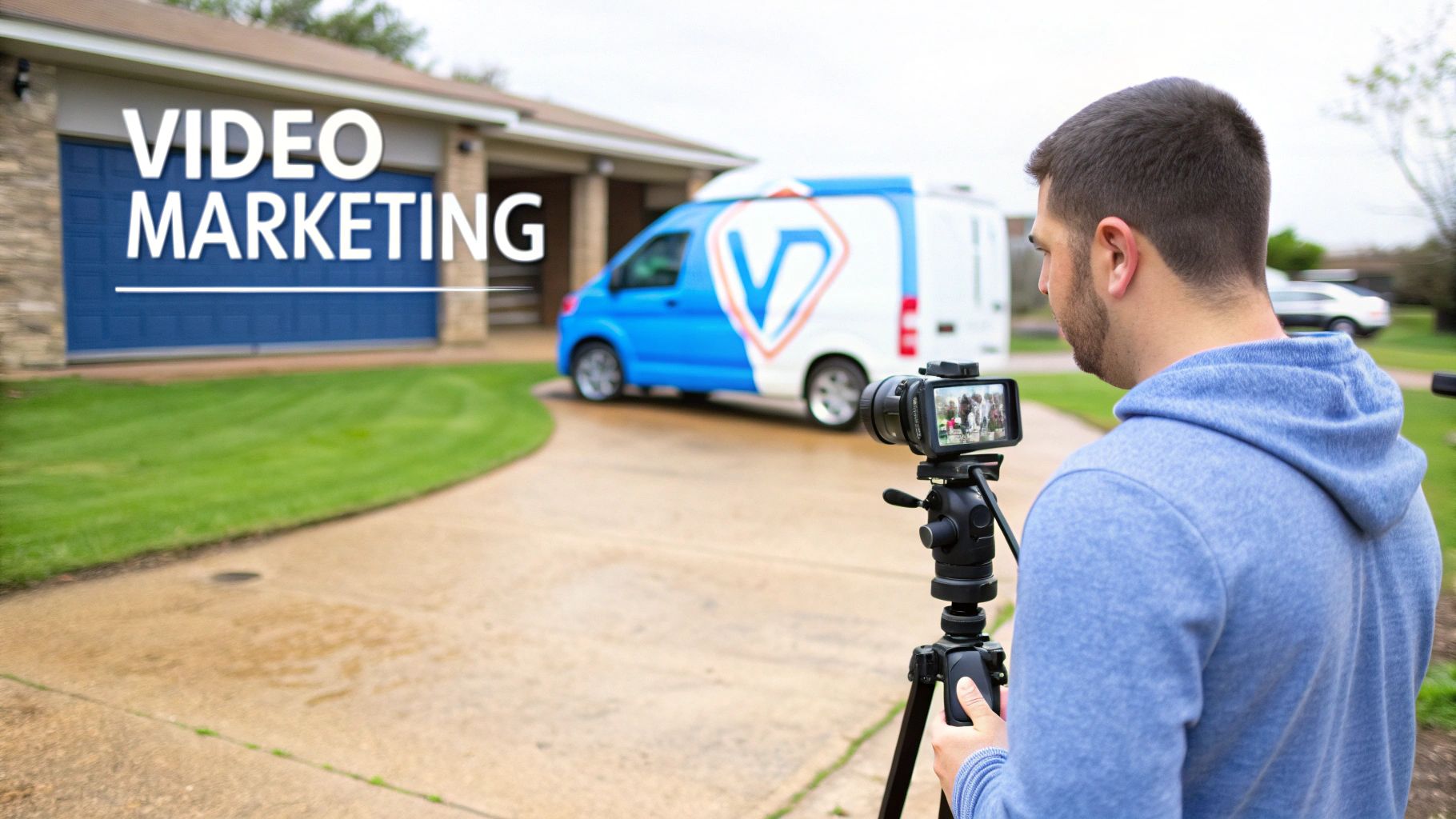
Social media and video marketing are powerful tools for building brand trust and visually demonstrating your effectiveness. This strategy leverages platforms like Facebook, Instagram, YouTube, and TikTok to engage with local homeowners, share educational content, and provide compelling visual proof of your services. By combining short-form videos (like before-and-after treatments) with longer educational guides optimized for search, you can capture attention, build authority, and drive high-quality, transactional leads.
Why It's Foundational for Pest Control
Pest control can be an abstract service until a homeowner sees the results. Video marketing makes your work tangible, showcasing the transformation from an infested area to a pest-free zone. National brands like Orkin use their extensive YouTube channels to educate millions, solidifying their authority. For local businesses, this approach builds immense trust; a homeowner is far more likely to call a company whose work they have seen and who has provided helpful advice on preventing the very problem they are now facing.
Actionable Implementation Steps
To effectively integrate social media and video into your pest control marketing strategies, focus on creating valuable and engaging content:
- Create Compelling Before-and-After Videos: Film short, 30-60 second clips showing the results of your termite, rodent, or bed bug treatments. These videos are perfect for Instagram Reels, TikTok, and Facebook, providing powerful and shareable social proof.
- Publish Educational Guides on YouTube: Develop longer (5-10 minute) videos explaining how to identify termite damage or prepare a home for bed bug treatment. Optimize titles and descriptions with transactional keywords like "termite extermination cost [Your City]" to attract search traffic.
- Leverage Customer Testimonials: A video testimonial is significantly more impactful than a written review. Feature satisfied clients on your homepage, service pages, and in paid ad campaigns to dramatically increase conversion rates.
- Maintain Consistent Social Activity: Post 3-5 times per week across your chosen platforms, mixing educational content, promotional offers, and community engagement. Actively respond to all comments and messages to build a loyal local following.
Key Insight: Video content directly supports transactional SEO by increasing time-on-page when embedded on your website, a key ranking signal for Google. It also serves as visual proof that you are the best local expert to handle urgent, high-intent searches like "emergency bed bug removal."
8. Email Marketing & Customer Retention Campaigns
While lead generation is crucial, retaining existing customers is far more cost-effective. Email marketing serves as your primary tool for nurturing these valuable relationships, transforming one-time service calls into a recurring revenue stream. By staying in touch with past clients, you can remind them of seasonal pest threats and position your company as the go-to solution when those needs arise, maximizing customer lifetime value and creating more transactional opportunities from your existing customer base.
Why It's Foundational for Pest Control
Pest control is a cyclical business, driven by predictable seasonal patterns. A customer who hired you for rodent removal in the fall is a prime candidate for termite prevention in the spring or mosquito abatement in the summer. An effective email marketing strategy automates this outreach, ensuring you connect with the right customer at the exact moment they need your next service. This proactive communication builds loyalty and prevents them from searching for a competitor when a new pest problem emerges.
Actionable Implementation Steps
To build an email program that drives repeat business, focus on segmentation and timely automation:
- Segment Your Customer List: Group your contacts by the services they've purchased, such as "Termite Treatment," "Rodent Control," or "General Pest Plan." This allows you to send highly relevant offers and reminders.
- Create Seasonal Campaigns: Develop automated email sequences that trigger 30-45 days before peak pest seasons. For example, send a "Termite Season Is Coming" alert in late winter with an early-bird inspection special.
- Craft Compelling Subject Lines: Use urgency and clear value propositions. Subject lines like "Fall Is Here: Don't Let Rodents Move In" or "Protect Your Summer: Schedule Mosquito Treatment Now" grab attention and prompt action.
- Automate Nurturing and Retention: Set up a welcome series for new customers to build rapport. Also, create "win-back" campaigns for clients who haven't booked in over a year and automated requests for reviews and referrals post-service. For more advanced tactics, explore how to use email marketing automation to increase sales with ActiveCampaign.
Key Insight: The true power of email marketing lies in its ability to automate customer retention. By segmenting your audience and aligning your campaigns with seasonal pest cycles, you create a predictable, low-cost revenue stream that complements your lead generation efforts for new transactional customers.
9. Website Development & Conversion Rate Optimization (CRO)
Your website is your digital headquarters, and its primary job is to convert visitors into paying customers. Simply having a website isn't enough; it must be engineered to guide potential clients from a transactional search, like "emergency bed bug treatment," to taking immediate action. This is where Website Development and Conversion Rate Optimization (CRO) become essential components of your pest control marketing strategies, ensuring your online presence is a high-performance asset built to generate calls and revenue.

Why It's Foundational for Pest Control
A poorly designed or slow-loading website creates friction, causing high-intent prospects to abandon your site for a competitor's. A strategically built website, optimized for conversions, instills trust, answers critical questions quickly, and makes it incredibly easy for a stressed homeowner to request a quote or call for service. At Transactional Marketing, our proven system gets our customers' websites showing up on page one of Google, often within 30-60 days, precisely because we focus on both visibility and conversion.
Actionable Implementation Steps
To transform your website into a conversion machine that dominates transactional searches, implement the following:
- Prioritize Mobile-First Design: With over 60% of pest control searches happening on mobile, your site must be flawless on smartphones. This means large, easy-to-tap buttons, simple navigation, and click-to-call functionality.
- Place Prominent Calls-to-Action (CTAs): Your primary CTAs, such as "Get a Free Quote Today" or "Schedule Your Inspection," must be visible "above the fold" without any scrolling. Use contrasting colors to make them stand out.
- Build Trust with Social Proof: Immediately build credibility by featuring customer testimonials, Google review widgets, and certifications from organizations like the National Pest Management Association (NPMA).
- Optimize for Speed and Performance: Every second counts. A slow website will be penalized by Google and abandoned by users. Optimize images, use efficient code, and invest in quality hosting to ensure near-instant load times. To ensure your website effectively turns visitors into customers, implement proven conversion rate optimization best practices for quick wins.
Key Insight: Your website's success is not measured by traffic alone, but by its ability to convert that traffic into revenue-generating phone calls and form submissions. For a deeper dive into creating a site that converts, see how Transactional.net approaches strategic website development for local service businesses.
10. Strategic Partnerships & Local Network Collaboration
Strategic partnerships are a powerful, often underutilized, component of a comprehensive pest control marketing strategy. This approach involves collaborating with complementary, non-competing local businesses like plumbers, roofers, HVAC companies, and real estate agents. By establishing a formal referral network, you tap into their existing customer base, gaining warm leads from a trusted source and significantly lowering your customer acquisition cost for high-intent, transactional opportunities.
Why It's Foundational for Pest Control
Your ideal customer is already doing business with other home service professionals. A roofer who discovers a rodent infestation in an attic or a home inspector who identifies termite damage during a pre-sale inspection can become your most valuable lead source. These referrals come with built-in credibility, positioning your company as the go-to solution for a pressing problem. For instance, a partnership with a property management company can create a steady, recurring stream of business for tenant-reported pest issues, a revenue channel your competitors have to fight for with expensive ads.
Actionable Implementation Steps
To build a robust and profitable local network, focus on creating mutually beneficial relationships:
- Identify Complementary Partners: Make a list of businesses that serve the same homeowner clientele but don't compete with you. Think HVAC technicians, plumbers, home inspectors, real estate agents, and property managers.
- Formalize the Agreement: Create a simple partnership agreement that outlines the referral process, commission structure, and mutual expectations. Clarity prevents misunderstandings and ensures both parties are motivated.
- Develop Co-Marketing Materials: Equip your partners to sell for you. Provide them with co-branded brochures, digital flyers, or business cards that they can easily pass to customers who have an immediate pest control need.
- Establish a Tracking System: Use a simple spreadsheet or a CRM to track referrals from each partner. This allows you to measure the ROI of each relationship, identify your top-performing partners, and ensure commissions are paid accurately and on time.
Key Insight: Strategic partnerships transform your marketing from a solitary effort into a community-based lead generation engine. By building a network of trusted local allies, you create a sustainable pipeline of high-quality, transactional leads that are more likely to convert than cold traffic.
10-Point Comparison of Pest Control Marketing Strategies
| Strategy | Implementation complexity | Resource requirements | Expected outcomes | Ideal use cases | Key advantages |
|---|---|---|---|---|---|
| Google Business Profile (GMB) Optimization & Local SEO | Low–Medium: initial setup + ongoing maintenance | Time for posts, photos, review management; minimal budget | Faster local visibility, more calls and map traffic | Single-location or multi-location local services | Free, high ROI, builds trust via reviews |
| Hyperlocal Content Marketing & Silo Strategy | High: planning, content scale, technical SEO | Content creators or AI tools, SEO specialist, months of work | Sustainable high-intent organic traffic and topical authority | Businesses targeting many service cities / long-term growth | Captures long-tail local queries; AI optimization |
| Review Generation & Reputation Management | Medium: process + automation and response workflows | SMS/email automation, monitoring tools, staff to respond | Improved trust, higher local rankings, better conversion | Companies with existing customer base seeking credibility | Primary local trust signal; low cost per impact |
| Paid Search Advertising (Google Ads & LSAs) | Medium–High: campaign setup, continuous optimization | Ad budget, PPC expertise, optimized landing pages | Immediate qualified leads; measurable ROI | Need rapid lead flow or during peak seasons | Fast results, precise targeting, budget control |
| Service Area Mapping & Multi-Location Expansion | High: many location pages and GMB profiles to manage | Content production, multi-GMB management tools, tracking | Broader coverage and more local leads across territories | Regional businesses and franchises expanding reach | Dominate multiple "near me" searches without new offices |
| Customer Referral & Word-of-Mouth Programs | Medium: program design, tracking and fulfillment | CRM integration, reward budget, referral tracking system | High-converting leads; lower customer acquisition cost | Businesses with satisfied, repeat customers | Highest conversion rates; cost-effective acquisition |
| Social Media & Video Marketing | Medium–High: production and consistent posting | Video production, social manager, paid promotion budget | Increased brand awareness, engagement, and trust signals | Brands needing visual proof and community engagement | Shareable content, strong trust via before/after videos |
| Email Marketing & Customer Retention Campaigns | Low–Medium: segmentation and automation setup | Email platform, content creation, list growth efforts | Higher repeat bookings and increased lifetime value | Companies with customer lists wanting repeat business | Very high ROI; automatable and measurable |
| Website Development & Conversion Rate Optimization (CRO) | Medium–High: design, technical SEO, A/B testing | Developers, designers, CRO tools, hosting | Higher conversion rates and improved SEO performance | Businesses relying on web leads and bookings | Owned asset that multiplies traffic value; long-term gains |
| Strategic Partnerships & Local Network Collaboration | Medium: partnership building and coordination | Time for outreach, formal agreements, co-marketing materials | New referral channels, shared costs, expanded reach | Companies serving property managers, inspectors, complementary trades | Access to new customers, credibility via partner trust |
Turn Clicks Into Customers with a Transactional-Focused Strategy
The journey through these comprehensive pest control marketing strategies reveals a singular, powerful truth: success in this industry isn't about casting the widest net, but about being in the right place at the precise moment a customer needs you. This is the essence of a transactional-focused approach. When a homeowner discovers a termite swarm or a restaurant manager spots a cockroach, they aren’t browsing; they are buying. Your marketing must be engineered to capture that exact moment of high intent with a transactional search term.
We've explored a powerful arsenal of tactics, from dominating the Google Maps pack with a perfectly optimized Google Business Profile to building unshakeable local authority through hyperlocal content. We’ve covered the trust-building power of a stellar reputation, the immediate impact of targeted Google Ads, and the long-term value of customer referral programs. Each strategy is a vital component, but their true power is unlocked when they work in concert, creating an integrated system that consistently delivers high-value, transactional leads.
Synthesizing Your Strategy for Maximum Impact
Think of these strategies not as a checklist to be completed, but as a framework for building a lead-generation machine. Your hyperlocal content (like a blog post on "termite swarm season in [Your City]") directly supports your Local SEO and AI Optimization efforts, helping you rank for critical transactional keywords. Those rankings, in turn, drive traffic to a website optimized for conversion, while your sterling reviews provide the social proof needed to turn a visitor into a caller.
The most crucial takeaway is the shift in mindset from brand awareness to transaction readiness. Every marketing dollar and every minute of effort should be aimed at intercepting customers with money in hand.
Key Insight: The difference between a struggling pest control company and a market leader often comes down to one thing: a relentless focus on capturing transactional search terms. They don't just want to be known; they want to be chosen when the need is urgent.
This is where the future of search, including AI optimization, becomes critical. As Large Language Models (LLMs) and conversational AI increasingly answer user queries directly, having content that is structured, authoritative, and optimized for these platforms will be paramount. Your marketing must provide clear, direct answers to transactional questions like, "Who is the best emergency rodent removal service near me?"
Your Actionable Path Forward
To translate this knowledge into tangible results, start with a focused audit. Where is your biggest opportunity?
- Audit Your GMB: Is every section filled out? Are you using posts weekly? Do you have a consistent flow of new, positive reviews? This is your digital storefront and your fastest path to capturing "near me" searches.
- Analyze Your Keywords: Are you targeting informational keywords like "what do termites eat," or are you laser-focused on transactional search terms like "termite inspection cost [Your City]"? Shift your content and ad spend to the latter.
- Map Your Customer Journey: From the initial Google search to the final invoice, how seamless is the process? A high-converting website and a simple scheduling system are non-negotiable elements in a modern pest control marketing strategy.
By implementing these sophisticated pest control marketing strategies, you move beyond simply competing. You begin to dominate the local search landscape, ensuring that when a potential customer has a pest problem, your business is the immediate, obvious, and trusted solution. You become the answer they are actively searching for, turning their urgent need into your next scheduled appointment.
Ready to stop guessing and start implementing a proven system that targets high-intent, transactional customers? At Transactional LLC, we specialize in deploying advanced SEO and Google Maps optimization to get our clients on page one, fast. We focus exclusively on the money-in-hand search terms that drive immediate calls and revenue for your pest control business. That's why we're called Transactional Marketing—we get you to show up for the exact transactional terms that matter.
Visit Transactional LLC to see how our laser-focused approach can transform your lead flow.