


Your reputation is your rank for transactional searches. A homeowner with a burst pipe searches “plumber near me” on a phone, sees the Google Maps top three, and picks the company that looks safest to call right now. In that moment, your star rating, review count, response quality, business info, and overall trust signals matter more than whatever branding message you paid an agency to write.
That's why reputation management tips matter far beyond public relations. This work directly affects whether high-intent buyers call you or move to the next listing. Reputation.com reports that more than 90% of customers consult reviews before making a purchase, and 47% post reviews themselves, which makes visible customer feedback a core part of the buying journey, not a side task handled when someone has spare time (Reputation.com reputation management guide).
For local service companies, this is even more direct. A bad Google review, a missing listing detail, or an unanswered complaint can cost you the click before your website even gets a chance. At Transactional Marketing, the focus is simple. Show up for transactional searches like “roofer near me,” “dentist near me,” and “ac repair near me,” then give searchers enough trust to call immediately.
These reputation management tips are built for that exact outcome. More calls. More booked jobs. More local buyers choosing you over the company sitting one spot below.
1. Manage Customer Reviews Generate Monitor and Respond Promptly
Most businesses treat reviews like an afterthought. That's a mistake. Reviews influence whether a buyer trusts you enough to call, and ReviewTrackers reports that 53% of consumers expect brands to respond to reviews, while 63% say a business has never responded to their review (ReviewTrackers reputation management statistics).
That gap is your opportunity. If your competitors ignore reviews, you can beat them by acting like a business that's awake.
Set up a review pipeline
Don't wait for happy customers to remember you later. Ask right after the job is done, right after the patient visit ends, or right after the customer says, “Thanks, that looks great.”
Use your CRM, job management software, or scheduling tool to trigger:
- A direct SMS request: Send the review ask while the experience is still fresh.
- A simple review link: Don't make people search for your business manually.
- A backup email request: Catch customers who ignore texts but check email later.
For a plumber, that means the tech closes the invoice and the system sends the review request. For a dental office, the front desk marks the appointment complete and the patient gets the request before leaving the parking lot.
Practical rule: Ask for the review when satisfaction is highest, not three weeks later when the customer barely remembers your name.
Respond like a real operator
Response speed matters, but response quality matters more. A short, thoughtful reply beats a lazy “Thanks for your feedback” pasted onto every review.
Handle reviews this way:
- Positive reviews: Thank the customer by name and mention the service.
- Negative reviews: Acknowledge the issue, apologize if appropriate, and give a real path to resolution offline.
- Questionable reviews: Document them, report policy violations if needed, and still post a calm public response.
A local HVAC company that replies well to a complaint about scheduling shows every future buyer that it solves problems. That's not defensive PR. That's conversion support.
If you need a system for collecting more first-party and platform reviews, use a review generation process that fits local service businesses.
2. Build Consistent Citations Across Local Directories
If your business name, address, and phone number don't match across the web, Google gets mixed signals and customers get confused. Both problems hurt calls.
Citations still matter because they help confirm that your business is real, active, and located where you say it is. That matters when someone searches “electrician near me” or “emergency dentist near me” and Google has to decide which listings deserve visibility.
Fix the basics before chasing advanced tactics
Start with your core listings:
- Google Business Profile: Make sure the primary details match your website exactly.
- Apple Maps and Bing Places: These often get ignored, but they feed discovery on other devices and platforms.
- Yelp and major directories: Claim them, correct them, and stop duplicate versions from floating around.
- Industry directories: Home services, dental, and medical directories can reinforce local trust signals.
A roofing company with one phone number on Google, another on Yelp, and an old address on Apple Maps looks unreliable. A buyer may never call. Google may also hesitate to rank that business strongly in the map pack.
Audit citations on a schedule
Don't do one cleanup and forget it. Businesses change call tracking numbers, move offices, add suite numbers, or update branding. Those changes create listing drift fast.
Use a spreadsheet, BrightLocal, or Semrush Local to review your citations on a recurring basis. Check for duplicates, old addresses, spelling variations, and category issues.
Your citation profile should read like one business, not four slightly different versions of the same company.
If you want a repeatable process, follow a citation building approach for local SEO. This is one of the fastest ways to support Google Maps visibility for transactional terms in your service area.
3. Create Industry-Specific Content That Targets High-Intent Search Terms
Generic content doesn't win transactional searches. A page titled “Our Services” won't beat a page built around “emergency water heater repair in [city]” when someone needs help now.
Your content needs to match what buyers type when they're ready to spend. That means service pages, supporting articles, location pages, and FAQs built around specific problems and specific service areas.
Build pages for the searches that bring money
A few examples:
- A pest control company should publish pages around termite treatment, rodent control, and same-day exterminator services by city.
- A dentist should build pages for emergency dental care, dental implants, root canals, and same-day appointments by location.
- An HVAC contractor should create content for furnace repair, AC replacement, heat pump noise, and after-hours service.
Transactional Marketing's approach is important. You don't want traffic for broad curiosity terms that never turn into calls. You want searches like “roofer near me,” “ac repair near me,” and “dentist near me.” Those are transactional terms. Those searchers are close to hiring.
Write for search engines and AI summaries
AI-driven search is changing how buyers get answers. Some users won't click ten blue links. They'll trust the summary they see first. That means your content has to be clear enough for humans and structured enough for machines.
Industry guidance notes that reputation firms are now optimizing AI search source material and authoritative structured content so AI systems can cite accurate business information, while still emphasizing local visibility and crisis messaging (AI-era reputation management guidance from Percepture).
Use this standard:
- Lead with the answer: Put the core service answer near the top.
- Use clear headings: Make each section easy to parse.
- Keep local details consistent: Match cities served, business details, and service descriptions everywhere.
- Add strong calls to action: “Call now” and “Book appointment” should be visible without scrolling forever.
If your site isn't publishing industry-specific content around high-intent terms, you're leaving money on the table.
4. Optimize Your Google Business Profile for Maximum Local Visibility
Your Google Business Profile does more selling than most business websites. For many transactional searches, it's the first thing a buyer sees, compares, and clicks.
That profile has to be complete, accurate, and active. If it looks neglected, buyers assume the business is neglected too.
Here's the image every local business owner should have in mind when thinking about map pack visibility:
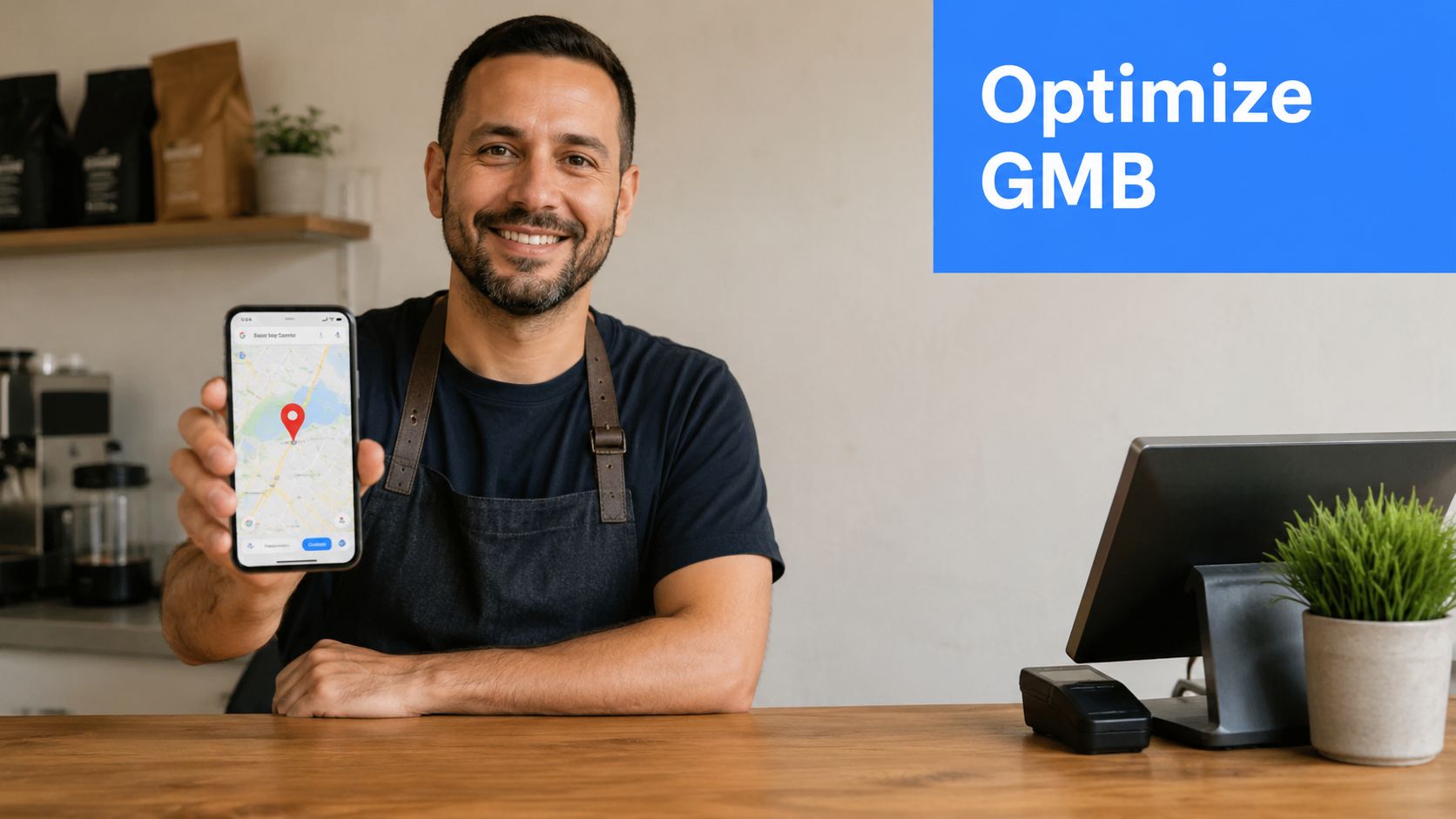
Fill out every field that helps a buyer choose you
At minimum, lock down:
- Primary and secondary categories: Pick the services you provide.
- Hours and holiday hours: Don't create friction with outdated availability.
- Services and service areas: Make it clear where you work and what you do.
- Photos: Real staff, trucks, equipment, offices, and completed work outperform empty branding.
- Questions and answers: Seed common questions and answer them before prospects ask.
A plumbing company should show drain cleaning, water heater repair, and emergency plumbing services clearly. A med spa should show actual treatment rooms, staff, and branded service descriptions. A dental practice should show the office, team, and the services that drive patient decisions.
Keep the profile active
An updated profile signals that the business is alive. Post updates, offers, seasonal reminders, and service highlights. Watch incoming questions. Respond to reviews. Check for unauthorized edits.
Your map listing often gets judged before the website. Buyers see stars, photos, review language, and business details simultaneously, making this a critical conversion moment.
For a tactical walkthrough, use this Google Business Profile optimization checklist. It aligns directly with winning local searches that turn into calls.
5. Monitor Online Mentions and Brand Sentiment Across Platforms
Reviews are only part of your reputation. People also talk about businesses in Facebook groups, neighborhood forums, Reddit threads, community pages, and comment sections. If you ignore those places, you'll miss problems that shape buying decisions before they ever become formal reviews.
Sprout Social recommends tracking measurable reputation KPIs such as sentiment analysis, review volume and ratings, response time, share of voice, brand mentions, and customer satisfaction scores, which is the right mindset for local operators who want reputation work tied to real business outcomes, not vague brand chatter.
Watch the places where local decisions get made
A few examples matter a lot:
- Neighborhood Facebook groups: “Who do you recommend for sewer line replacement?”
- Local Reddit threads: “Has anyone used this dentist?”
- Community forums: “Which pest control company shows up on time?”
- Unlinked mentions: Someone names your business without tagging you or linking your site.
A single comment about no-shows, hidden pricing, or poor follow-up can spread faster than most owners realize. The problem isn't always the comment itself. It's that the business never sees it and never addresses the issue that caused it.
Use tools, but assign a human owner
Google Alerts can catch some mentions. Sprout Social, Hootsuite, and Mention can go deeper. But software alone won't protect your reputation. Someone on your team has to review alerts, spot patterns, and decide what needs a response.
If customers keep complaining about the same issue in different places, treat that as an operations problem, not a marketing problem.
A pest control company that sees repeated comments about retreatment timing should fix customer communication. A dental practice that keeps getting wait-time complaints in local groups should tighten scheduling. Better operations create better sentiment. Better sentiment supports better rankings and more calls.
6. Build a Strong Social Media Presence with Location-Specific Content
Social media won't replace Google Maps for transactional intent, but it absolutely supports trust. Buyers often find you in search, then check your Facebook or Instagram to make sure you look real, current, and competent.
An inactive profile with old posts and no engagement weakens confidence. An active local profile strengthens it.

Post the kind of proof local buyers care about
Forget fluffy brand content. Post what helps a nearby customer trust you:
- Before and after job photos: Show the actual work.
- Team content: Put faces behind the business.
- Short educational posts: Explain common issues in plain language.
- Customer wins: Share testimonials and solved problems.
- Location-based updates: Mention cities, neighborhoods, and service routes.
A roofer can post storm damage inspections from specific towns. A chiropractor can post short clips on common back pain triggers. A med spa can show treatment room professionalism and post-care education.
Use social media to support search credibility
People cross-check businesses. They'll read your Google reviews, scan your website, then check social pages to see if you're active and trustworthy. That's why good social media acts like reputation reinforcement.
If your company needs help understanding why this matters for visibility and trust, this guide on social media for women-led businesses makes the broader case for maintaining a real brand presence online.
You don't need to go viral. You need to look active, local, and reliable. That helps transactional searchers feel comfortable calling now.
7. Implement a Robust Review Defense and Crisis Management Plan
Bad reviews happen. False claims happen. Misunderstandings happen. What hurts businesses most isn't that criticism appears. It's that nobody has a plan when it does.
You need a written process before the next problem lands.
Build response templates before emotions get involved
Set up basic templates for:
- Service complaints: Acknowledge the experience, apologize where appropriate, and offer direct contact.
- Factually wrong claims: Respond calmly with verifiable facts and invite offline resolution.
- Spam or abuse: Document it, report it through the platform, and avoid public arguments.
- Serious allegations: Escalate internally and preserve records immediately.
A plumbing company accused of overcharging should respond with professionalism, not defensiveness. A dental office dealing with a complaint about discomfort should acknowledge the concern and offer follow-up care communication. The public is reading these replies. Future buyers judge your temperament as much as the original review.
Don't chase perfection
Many businesses obsess over getting only positive reviews. That's the wrong goal. Several industry sources stress that strong reputation management is about addressing issues transparently, responding to criticism, and learning from detractors, not hiding negative feedback. Neil Patel's guide also points to monitoring resolution metrics and whether reviews change after a response, which is often more useful than staring at star count alone (Neil Patel reputation management guide).
A believable profile with thoughtful responses often outperforms a suspiciously perfect profile with no sign of real customer interaction.
Train one person or a small team to own this process. They should know when to respond, when to escalate, when to request removal, and when to move the issue offline fast.
8. Develop Strategic Business Partnerships and Local Network Relationships
Local reputation doesn't come only from reviews. It also comes from who refers you, who mentions you, and who is willing to attach their name to yours.
That's why strategic partnerships help local visibility. If trustworthy local businesses recommend you consistently, those mentions influence both search behavior and conversion behavior.
Build referral relationships that strengthen credibility
Start with complementary businesses that serve the same customer base:
- HVAC companies and plumbers
- Roofers and gutter companies
- Dentists and orthodontists
- Chiropractors and physical therapists
- Pest control companies and property managers
A property manager who repeatedly sends pest control leads is doing more than feeding work. They're transferring trust. The same goes for a general dentist referring cosmetic cases or an electrical contractor referring HVAC upgrades.
Make the partnership operational
Don't keep it casual and vague. Set up:
- A referral process: Decide how leads get sent.
- A quality expectation: Protect both brands.
- Co-marketing opportunities: Feature each other in social posts, blogs, and local guides.
- Local community involvement: Sponsor events, support chambers, and show up where customers already gather.
For service businesses, this kind of network creates a reputation moat. Searchers may discover you on Google, then hear your name again from a realtor, contractor, office manager, or neighboring business owner. That repetition builds confidence.
A related business lesson applies here too. Weak systems behind the scenes can erode trust fast, especially in healthcare settings, which is why this piece on avoiding lost revenue from billing problems is a good reminder that reputation and operations always connect.
9. Track and Report Reputation Metrics with Transparent Analytics
If you can't measure reputation work, you can't improve it. Worse, you can't prove which actions drive more calls and booked jobs.
Reputation management has moved beyond PR and into operational measurement. Mordor Intelligence projects the online reputation management market at USD 7.75 billion in 2026, growing to USD 14.01 billion by 2031 at a 12.59% CAGR, with cloud deployment holding 72.45% market share in 2025 and expanding at an 18.14% CAGR, which shows how strongly the category is shifting toward always-on monitoring and centralized dashboards (Mordor Intelligence online reputation management market report).
Track the metrics that tie to revenue
For local service businesses, the right dashboard should include:
- Review volume and trend direction
- Average rating by location or service line
- Review response time
- Google Maps visibility for target terms
- Calls and form leads from local traffic
- Branded search growth and mention trends
If you run multiple locations, segment the data. One office may have a response problem while another has a listing consistency problem. One service line may have strong reviews but weak map visibility. You won't see that if everything gets lumped together.
Tie the dashboard to transactional search terms
This matters most. Don't settle for vanity metrics. Tie reputation work to searches that produce revenue. If your rankings improve for “emergency plumber near me” but calls don't rise, something else is broken. If your reviews improve and map actions rise, you're moving in the right direction.
Use a reporting system that shows what's happening by city, keyword set, and map visibility. In this context, a local SEO reporting dashboard becomes useful, especially if your business depends on showing up for buyers ready to hire now.
10. Invest in Professional Website Development and User Experience Optimization
A strong reputation gets the click. Your website has to finish the job.
If a buyer lands on a slow, outdated, confusing site, your reviews can't save the conversion. The website has to confirm the trust your reputation already created.
Here's what that trust should look like in practice:
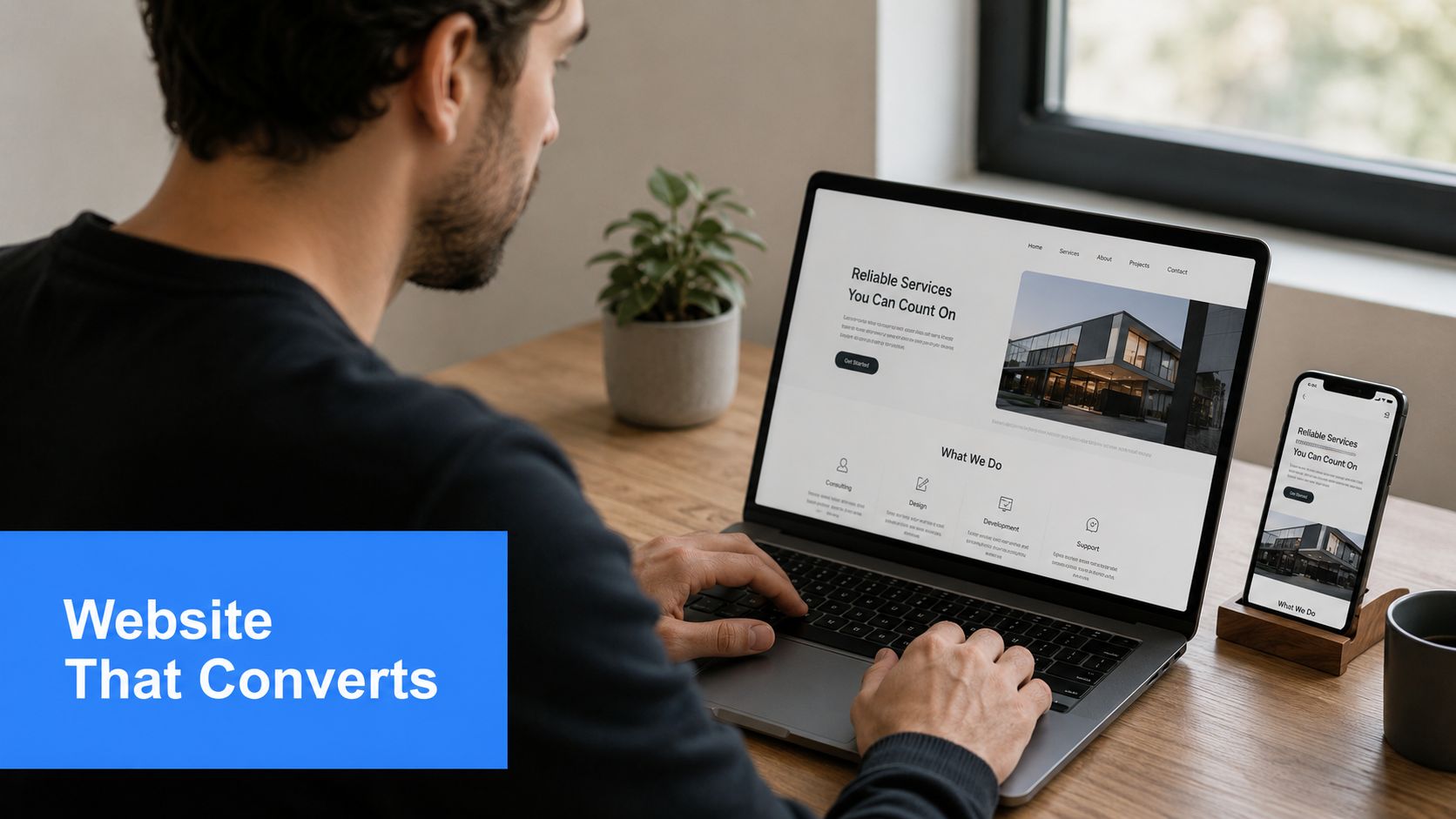
Build for mobile first and buyer intent
Most local service searches happen on phones. That means your site should make the next step obvious:
- Click-to-call buttons: Always visible on mobile.
- Fast service pages: No clutter, no hunting.
- Location relevance: Show where you work.
- Trust signals: Reviews, testimonials, licenses, warranties, and photos.
- Short paths to contact: Forms and booking options should be easy to find.
An emergency plumbing customer doesn't want a fancy homepage intro. They want to know you handle burst pipes, serve their area, answer the phone, and can come today.
Support AI optimization with clear structure
Website UX now overlaps with AI optimization. If your service pages are thin, vague, or inconsistent with your listings, AI systems may pull weak or outdated information. If your pages are clear, authoritative, and structured well, they're easier to cite and easier to trust.
One strong practical benchmark from an independent statistics roundup is that 72% of consumers say positive reviews increase trust and lead to sales, and businesses with 4+ star ratings see an average 64% revenue increase plus an 18% revenue lift from review volume alone (Gitnux reputation management statistics roundup). But those trust gains still need a site that converts.
Your website should make one thing easy for a transactional searcher. Call now. Book now. Request service now. Anything less wastes the reputation you worked to build.
10-Point Reputation Management Comparison
| Strategy | Implementation complexity | Resource requirements | Expected outcomes | Ideal use cases | Key advantages |
|---|---|---|---|---|---|
| Manage Customer Reviews: Generate, Monitor, and Respond Promptly | Medium, automation + policy-driven responses | Moderate, review tools, CRM triggers, staff time | Higher review volume & ratings; improved local rankings and trust | Service businesses with frequent completed jobs (plumbing, HVAC, dental, pest) | Rapid social proof growth; boosts Maps visibility and conversions |
| Build Consistent Citations Across Local Directories | Low–Medium, audits and submissions | Low–Moderate, citation tools, manual upkeep | Improved local search visibility and legitimacy signals | SMBs with inconsistent listings or multi-location footprint | Cost-effective SEO signal; multiple discovery paths |
| Create Industry-Specific Content Targeting High-Intent Terms | High, research, silo structure, optimization | High, writers, SEO, topic research, ongoing publishing | Increased qualified organic traffic and higher conversion rates over time | Businesses targeting transactional local queries | Builds topical authority and reduces paid acquisition reliance |
| Optimize Your Google Business Profile for Maximum Local Visibility | Low–Medium, initial setup + ongoing updates | Low, photos, profile management, occasional posts | Strong Maps prominence, more calls and direct engagement | All local service businesses, especially service-area listings | Free, high-impact channel under business control |
| Monitor Online Mentions and Brand Sentiment Across Platforms | Medium, tool setup and analysis workflows | Moderate, monitoring tools, analyst time | Early detection of issues; actionable customer and competitive insights | Multi-location or reputation-sensitive businesses | Proactive issue management and market intelligence |
| Build a Strong Social Media Presence with Location-Specific Content | Medium, content calendar and community management | Moderate, content creators, scheduling, engagement time | Improved local brand recognition, engagement, referral traffic | Businesses seeking local engagement and testimonial generation | Additional discovery path and visible social proof |
| Implement a Robust Review Defense and Crisis Management Plan | Medium–High, documented protocols and training | Moderate, templates, training, escalation/legal resources | Controlled responses to reputation threats; reduced damage | Businesses at risk of disputes or coordinated attacks | Prevents unprofessional reactions; standardizes crisis handling |
| Develop Strategic Business Partnerships and Local Network Relationships | Medium, partner identification and agreements | Low–Moderate, outreach time, co-marketing resources | Sustainable referral streams and expanded local reach | Complementary service providers and community-focused SMBs | Long-term referrals, shared marketing, network effects |
| Track and Report Reputation Metrics with Transparent Analytics | Medium, KPI definition and dashboarding | Moderate, analytics tools, reporting cadence, analyst time | Demonstrable ROI, data-driven prioritization, early warnings | Agencies and businesses that require accountability | Transparent performance tracking and actionable insights |
| Invest in Professional Website Development and UX Optimization | High, design, development, optimization | High, designers, developers, hosting, maintenance | Higher conversion rates, reinforced credibility, SEO support | Businesses converting reputation-driven traffic (all service verticals) | Converts visits to leads; central hub for reputation and bookings |
Turn Your Reputation into Revenue
Reputation management isn't a passive defense layer. It's one of the strongest offensive strategies you have for winning local transactional searches and turning those searchers into immediate customers.
That matters because local buyers don't browse the way they used to. They search with urgency. They compare fast. They judge your business before they ever land on your site. If your Google Business Profile looks weak, your reviews look stale, your responses are missing, your citations are inconsistent, or your website feels outdated, they move on. Usually to a competitor that looks safer to call.
That's why these reputation management tips need to be treated like revenue tactics, not cleanup tasks. Review generation builds social proof. Review responses show accountability. Citation consistency supports local trust signals. Google Business Profile optimization improves visibility in the map pack. Industry-specific content helps you rank for the exact terms buyers use when they're ready to spend. Social activity reinforces legitimacy. Monitoring mentions catches small fires before they spread. A crisis plan protects the brand when something goes wrong. Partnerships expand local authority. Reporting ties the whole system back to actual calls and booked work. A strong website closes the loop and converts the traffic your reputation earns.
For local businesses, this is how you win searches like “roofer near me,” “plumber near me,” “dentist near me,” and “ac repair near me.” Those are the searches that matter. Those are transactional searches. The person typing them usually has a problem, money in hand, and a short list of businesses they'll trust enough to contact right away.
Transactional Marketing is built around dominating those moments. The goal isn't generic traffic. The goal is visibility for high-intent search terms, strength in Google Maps, and a reputation system that makes buyers choose your business when the decision is happening now. That's how more rankings turn into more calls, and more calls turn into more booked jobs, patients, and revenue.
If your business is tired of showing up weakly in local search, or not showing up at all when buyers are ready to act, fix the reputation layer first and tie it directly to local SEO and AI optimization. Done right, that system starts compounding. Better reviews support better trust. Better trust supports better click behavior. Better engagement supports better local visibility. Better visibility puts you in front of more buyers who are ready to hire.
That's the work that grows a service business.
Transactional businesses win when they show up at the exact moment a buyer is ready to act. Transactional LLC helps service companies do exactly that with local SEO, Google Maps optimization, AI-focused content, web development, and transparent reporting built around high-intent search terms that turn into real calls and booked jobs.