


You bought into a franchise because the model worked. The brand had recognition, the systems looked polished, and corporate promised marketing support. Then the local reality hit. People in your city search for the service you sell every day, but your location doesn't show up where it matters.
That's the gap most franchisees live in. The brand wins awareness. The local operator loses the customer.
If you want real growth, stop judging marketing by whether corporate has a nice website or a clean brand guide. Judge it by whether your location appears when someone searches a service plus a city or service plus “near me.” That's the moment the buyer is ready to act. That's the entire game.
The Franchisee's Dilemma Winning the Brand but Losing the Customer
A franchisee can do almost everything right and still get buried online. The storefront is open. The team answers the phone. Reviews are decent. The national site looks professional. But when someone nearby searches for the exact service, competitors with weaker brands steal the click.
That happens because local intent beats brand prestige in a service search. A person searching “dentist near me” or “air conditioning repair near me” isn't doing casual research. They're looking for a provider now, in their area, with money in hand. If your location isn't visible in that moment, corporate branding doesn't save you.
There's a scale problem too. In the United States alone, there are more than 800,000 active franchises, and 46% of all Google searches are for local information, which means franchisees without a specialized local SEO strategy can disappear in a crowded market, according to Thrive's franchise SEO analysis.
What local invisibility actually looks like
One franchise owner I've advised had the classic complaint. Corporate said the website was “optimized.” Brand search looked fine. But the location page was thin, generic, and impossible to find unless you already knew the brand name.
That setup fails the actual buyer journey:
- The buyer searches by need: They type the service, not the franchise name.
- Google responds by geography: It favors nearby, relevant, well-structured local entities.
- Your local page loses: It has no unique local authority, no strong service targeting, and no reason to outrank local competitors.
Practical rule: If your local page reads like a copied corporate brochure, it won't win transactional searches.
That's why serious franchisees need a different playbook than corporate marketing teams. You need location-level search visibility, not just brand consistency. A strong multi-location local SEO strategy gives each franchise unit a chance to compete where revenue is won.
Why Corporate SEO Fails at the Local Level
Corporate SEO usually chases broad visibility. That sounds smart until you look at how customers buy local services. National pages, broad keywords, and brand messaging don't do much for a person looking for a provider in one city, one neighborhood, or one urgent moment.
That mismatch creates predictable failure. Corporate wants one message, one site structure, and one content standard. Local search demands relevance by city, service, and intent. Those are not the same thing.

The brand site usually flattens local relevance
Most franchise websites treat local pages as placeholders. Same copy. Same service descriptions. Maybe a city name swapped into a headline. That approach creates weak signals and duplicate content problems.
Franchise SEO requires a different architecture. The minimum viable structure is a unique page for every product or service plus a dedicated page for each location. On top of that, franchise businesses need strong technical foundations. WP Speed Fix's franchise SEO guidance points out that NAP consistency outweighs citation building, and inconsistent name, address, and phone data can wreck local performance. The same source also stresses that AI search crawlers and LLMs are sensitive to site structure and technical issues, which makes Core Web Vitals and clean technical SEO more important than many franchise systems admit.
Corporate priorities and local priorities conflict
Here's what corporate often values, compared with what actually drives local leads:
| Corporate focus | What the franchisee needs |
|---|---|
| Brand consistency | City and service relevance |
| Shared content blocks | Unique local service pages |
| Centralized control | Fast local updates |
| National authority | Google Maps visibility and local conversions |
That tension is why many franchisees feel like they're running a local business with a website built for a boardroom.
A polished national site can still be a weak local sales tool if each location has no independent search footprint.
The technical misses are usually obvious
A weak franchise setup usually has some combination of these problems:
- Buried locations: The location pages are hard to reach and don't sit close enough to the homepage.
- Thin pages: They read like business cards, not landing pages built to rank.
- Confused signals: Canonicals, title tags, and location targeting are sloppy.
- No local performance tracking: Nobody knows which cities or services produce leads.
Corporate SEO isn't “bad.” It's just aimed at the wrong target. Franchisees need local market capture. That takes a separate discipline.
The Transactional Marketing System Winning High-Intent Searches
Most SEO campaigns waste time on keywords that look busy in reports and do nothing for revenue. Franchisees don't need more impressions from curious searchers. They need visibility for the searches that turn into calls, form submissions, booked jobs, and scheduled appointments.
That's where transactional search terms come in.

What transactional actually means
A transactional query is a search from someone ready to hire. “Roofer near me.” “Emergency dental service.” “Air conditioning repair near me.” “Plumber in Scottsdale.” These aren't casual searches. These are buyer searches.
That's the philosophy behind Transactional Marketing. The name says what matters. Go after the terms tied to purchase intent, not fluff. If someone is searching for a local service provider by need and location, that's where the budget should go.
The cleanest way to sort signal from noise is to filter for purchase intent. Rankdots' guidance on transactional keywords recommends using a strict filter for keywords with at least 40% transactional probability to cut informational clutter and surface bottom-of-the-funnel opportunities tied to closed deals.
Here's the split that matters:
- Informational term: “how does an air conditioner work”
- Transactional term: “air conditioning repair near me”
- Weak local term: “best HVAC system types”
- Strong local term: “AC repair in Mesa”
Why this model produces faster movement
A focused local SEO campaign can move quickly because it doesn't try to rank for everything. It targets service + city and service + near me patterns that line up with actual buying behavior. That's also why AI optimization matters now.
LLMs and AI-driven search systems don't just look for keyword repetition. They evaluate structured entities, technical clarity, location relationships, and whether a business is clearly the answer for a local commercial need. Franchisees who still treat SEO like blogging for broad awareness are behind.
A focused high-intent keyword strategy helps you map terms by service line, urgency, and city so your pages line up with the searches that matter.
Stop asking whether a keyword gets traffic. Ask whether the searcher is likely to buy.
The point isn't to become visible for random education queries. The point is to become the obvious option when a buyer is ready to spend. That's why laser-focused local campaigns often outperform bloated “full funnel” SEO retainers.
A quick walkthrough of this style of targeting helps:
Essential Services for Local Franchise Dominance
Franchise SEO works when the system is built around local intent, local entities, and local conversion paths. Strip away the agency language and the foundation is simple. You need strong Maps visibility, pages that match local searches, content that sounds native to the market, and technical consistency that search engines can trust.
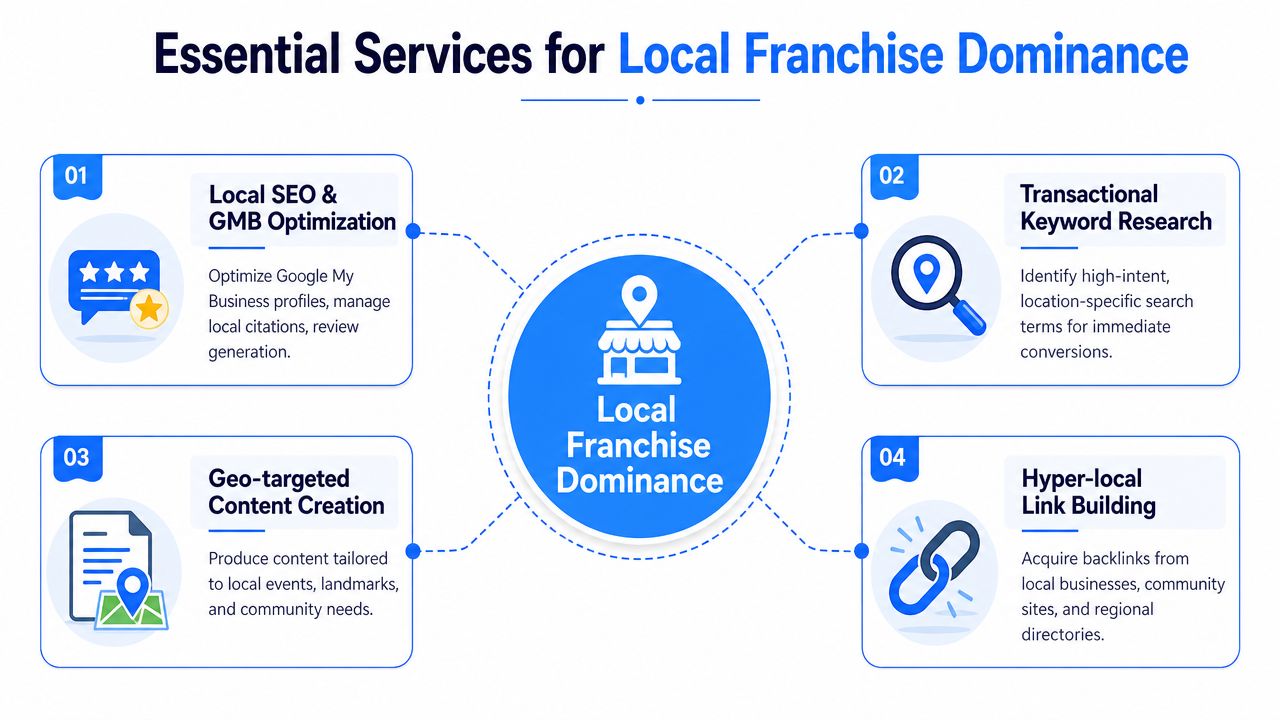
Google Maps and GBP optimization
If your franchise isn't competitive in Google Maps, you're missing the fastest path to local calls. A lot of service businesses win or lose the lead before the user even clicks through to a website.
One detail gets overlooked all the time. For urgent searches, category selection matters more than franchisees think. Transactional.net's local SEO guidance for franchises explains that to rank for searches like “emergency dental service,” businesses need all relevant secondary GMB categories, because those categories drive visibility for specific service terms beyond the primary generic category.
That's the practical version of Google Maps optimization. Not vague profile management. Precision.
- Primary and secondary categories: Match the actual service demand in the market.
- Service-area alignment: Don't let the profile drift away from the cities you need to win.
- Review intent: Gather reviews that reinforce service relevance, not just generic praise.
Multi-location site architecture
A franchise site can't be a stack of cloned location pages. It needs architecture that supports local ranking.
Arc 4's franchise SEO framework at their strategy resource recommends a three-tier content strategy: national brand content, regional or state relevance, and hyper-local city or neighborhood content for each location. The same source also notes that pages should contain 600 to 1,200 words of unique copy, use canonical logic to prevent duplication, include XML sitemaps, and track micro KPIs such as GBP calls, direction requests, and local keyword rankings by location.
That's the difference between a real franchise SEO system and a set of brochure pages.
Hyper-local AI-optimized content
AI optimization isn't optional anymore. If your pages don't clearly connect services, locations, entities, and intent, LLM-driven search experiences won't surface you consistently.
The content itself has to sound local. Not fake-local. Actual landmarks, service-area distinctions, neighborhood language, and service-specific context. Corporate boilerplate can't do that.
A good planning model outside SEO is Everglow Prosperity's 7 steps for sustainable business growth. It's useful because franchisees need growth systems, not isolated tactics. Local SEO works the same way. The page, the GBP, the service map, and the call tracking all need to line up.
Technical SEO and tracking
Technical sloppiness kills local performance. If location pages are hard to crawl, disconnected internally, or impossible to measure, the campaign stalls.
Outpace SEO notes in its franchise SEO article that franchise locations should be discoverable within three clicks from the homepage, and dynamic XML sitemaps should prioritize new or updated location pages for faster indexing.
Use this checklist:
- NAP consistency: Keep name, address, and phone identical everywhere.
- Location indexing: Make sure every key page is easy for crawlers to reach.
- Call tracking and analytics: If you can't tie rankings to inquiries, you can't manage the campaign.
- City-level keyword mapping: Each location needs its own target set.
One practical option is local SEO services for franchises, which combines location page strategy, Google Maps work, citation management, and reporting around service-city rankings.
Solving Unique Franchise SEO Challenges and Politics
A lot of franchise SEO advice ignores the hardest part. The technical work isn't always the main barrier. Internal politics are.
The common situation looks like this. The franchisee sees weak local visibility, wants to fix it, and has budget ready. Corporate controls the site, sets the message, and doesn't want local variation. The result is paralysis. Everyone agrees local leads matter, and nobody changes the system that's blocking them.
The budget argument that actually works
You usually won't win this fight by arguing for “better marketing.” That language is too vague. You win by tying local SEO to service-line demand, call volume, and booked revenue.
The gap is real. Mayfly's franchise SEO resource points out that there's a lack of practical frameworks for franchisees to negotiate SEO budgets with corporate, even though local search dominates buyer behavior. It also notes that many guides ignore the franchisee's real-world problem of justifying local spend when corporate forces a single-brand website, especially in home service and dental franchises.
Build your case like an operator, not a marketer:
- Show lost demand: List the service terms people search when they're ready to buy.
- Show the current failure: Document where your location doesn't appear in Maps or organic results.
- Show the structural cause: Thin local pages, weak categories, or no local content autonomy.
- Show the decision path: What changes corporate must approve, and what the franchisee can manage locally.
Where franchisees should push for autonomy
You don't need total control of the brand site to improve local performance. You need authority over the pieces that affect local intent.
Push for room to control:
| Area | Why it matters |
|---|---|
| Location page copy | It must reflect the city and services, not national boilerplate |
| GBP management | Local categories, updates, and service details affect visibility |
| Review operations | Review flow is local, not corporate |
| Call tracking and analytics | The franchisee needs proof of lead quality and source |
If corporate won't give you autonomy, ask for measurable accountability. If they control the assets, they should also report local outcomes by location and service line.
That conversation changes everything. It moves the discussion away from opinions and into operational responsibility.
Choosing Your SEO Partner and Measuring What Matters
Most franchisees choose SEO vendors the wrong way. They compare proposals by monthly fee, skim a list of deliverables, and get sold on vague promises like “authority building” or “visibility growth.” That's how you end up paying for activity instead of outcomes.
The better question is simple. Can this partner help your location win more high-intent searches and prove it with lead-focused reporting?
What a serious franchise SEO partner should show you
Start with economics. Backlinko's SEO services statistics puts average SEO ROI at 22:1, or roughly $22 for every $1 invested. For franchisees, that makes SEO one of the few channels worth judging as a revenue engine instead of a branding expense.
That doesn't mean every provider deserves your money. It means the right one should operate with brutal clarity.
Ask for these specifics:
- City-level ranking visibility: Not generic keyword reports. You need location-specific terms.
- Google Maps tracking: Especially for the service areas that generate revenue.
- Call and lead attribution: If they can't connect search gains to inquiries, walk away.
- Local page strategy: Ask how they handle unique service and location pages.
- AI optimization approach: They should understand entity structure, crawlability, and how LLM-facing search surfaces local businesses.
Ignore vanity metrics
A franchisee doesn't deposit impressions in the bank. Traffic by itself is noisy. Average position without city context is half-useful at best.
What matters is this short list:
- Phone calls from local search
- Qualified form leads
- Booked appointments or jobs
- Visibility for transactional service terms in target cities
- Google Maps presence where buyers are searching
If you want a practical framework for review, use a location-level dashboard and tie it to how to measure marketing effectiveness. That keeps the conversation grounded in business outcomes.
A broader market view can also help when comparing vendors. This overview of a franchise marketing agency is useful because it shows how franchise-specific marketing differs from standard local agency work. The lesson is straightforward. Multi-location systems need multi-location reporting.
A good SEO partner won't hide behind “brand lift.” They'll show which cities, which terms, and which assets generated leads.
Conclusion Your Path to Transactional Growth
If you're a franchisee, the old playbook isn't enough. Brand awareness helps. It doesn't close the gap when local buyers search by service and geography, then hire the business they can see immediately.
That's why SEO services for franchisees have to be built around transactional intent. Not broad awareness. Not padded reports. Not generic content from a corporate library. You need local pages built for real cities, Google Maps optimization tied to service demand, and technical structure that gives search engines and AI systems a clear answer about who you serve and where.
The fastest path to better results is narrow focus. Pick the service terms tied to buying intent. Build pages that match those searches. Clean up location data. Strengthen GBP categories. Track calls, leads, and booked business by city. Then keep pushing into the next set of transactional terms.
The franchisees who win don't wait for perfect corporate alignment. They document the gap, push for local relevance, and insist on measuring revenue outcomes. That's how local SEO stops being a marketing expense and starts acting like a growth system.
The next 60 days should have one purpose. Make your location easier to find when a ready-to-buy customer searches for exactly what you offer in exactly the place you serve.
If you want a no-BS plan to capture more local buyers, Transactional LLC helps service-area businesses focus on transactional searches, Google Maps visibility, AI-oriented content structure, and city-level lead tracking so your franchise location can compete where customers are ready to book.