


You're probably already doing solid work in the field. Your technicians know their trade. Your office can usually keep up. Customers often leave happy.
But your online reputation still feels inconsistent.
One week you get a string of strong reviews. The next week someone complains that nobody called back, the appointment window was vague, or the invoice felt confusing. Then you search your own core terms, like “plumber near me,” “dentist near me,” “AC repair near me,” or “pest control near me,” and a competitor with a cleaner review profile and tighter Google Business presence shows up above you.
That isn't just a marketing problem. It's a service quality improvement problem.
For local businesses, quality is no longer something customers judge only after the job is done. They judge it before they call, while they compare reviews, map listings, response behavior, and business details. If you want to win more transactional searches, the kind where the searcher is ready to book, your operations and your local visibility have to reinforce each other.
Why Better Service is Your Best SEO Strategy
A lot of owners still treat service quality and SEO like two separate departments. That's a mistake.
If your team answers slowly, misses callbacks, creates scheduling friction, or produces uneven customer experiences, those failures eventually show up in the places that influence local rankings most. Reviews get weaker. Responses get delayed. Customers bounce to the next listing. Your Google Business Profile starts looking less trustworthy than the business down the street.
Quality is a ranking input in practice
The shift in modern quality management is simple. It's not enough to measure performance. You have to use data to improve it. The CDC describes performance management and quality improvement as actively using data and benchmarks to improve performance over time, which turns service quality from a vague goal into a measurable discipline for local businesses according to the CDC.
That matters for SEO because search visibility for local service companies is heavily tied to consistency and trust. Search engines and AI-driven discovery systems don't reward businesses for saying they care about customers. They reward the businesses that leave a trail of proof.
That proof usually looks like this:
- Fast response behavior that prevents lead drop-off
- Consistent delivery that reduces negative reviews
- Clear communication that lowers complaints
- Reliable follow-up that generates more positive customer feedback
- Accurate business signals across maps, reviews, and web content
Practical rule: If your service breaks down in the real world, your local SEO eventually reflects it.
Short-term tricks fade, operating discipline compounds
A lot of SEO vendors still chase shortcuts. They obsess over metadata while ignoring the customer experience that fuels review sentiment, branded searches, and map engagement.
That approach doesn't hold up on transactional terms.
When someone searches “electrician near me” or “emergency dentist near me,” they're not looking for clever optimization alone. They're looking for the business that appears dependable right now. Better service quality improvement creates that signal repeatedly, across reviews, response speed, and customer language. Those are the same signals AI systems increasingly use when summarizing local options.
If you want more phone calls and booked jobs, start by tightening the business behind the listing.
Auditing Your Current Service From Call to Completion
Most owners don't need a consultant to find the first layer of service problems. They need an honest walkthrough of what happens from first contact to final payment.
Start with your full customer journey. Don't describe the process the way you want it to work. Write down the way it works on a real Tuesday when phones are ringing, technicians are late, and somebody on the team is covering two roles.
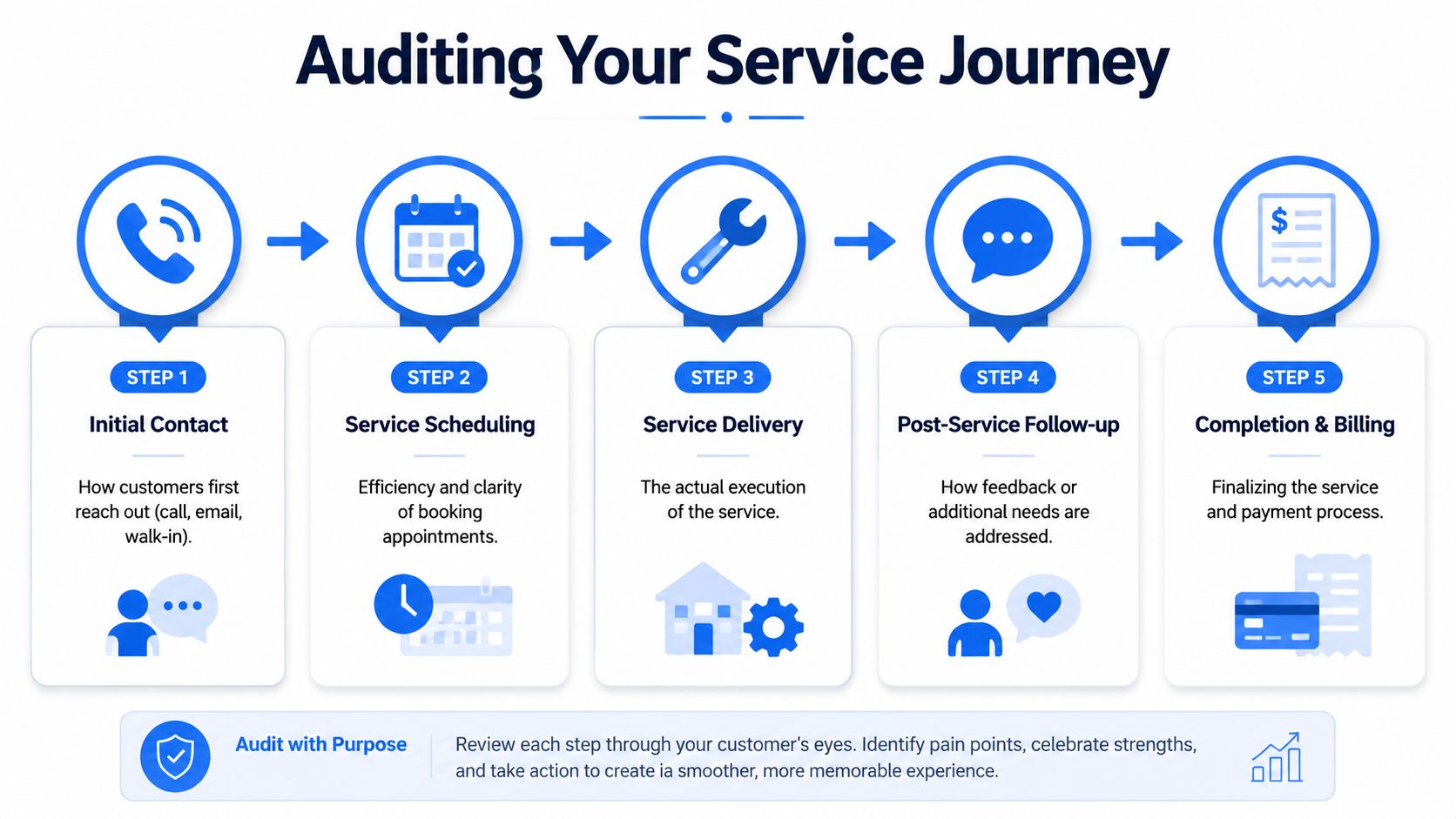
Map the journey in five real-world stages
Use these checkpoints:
Initial contact
Call your own business. Fill out your own website form. Message your Google Business Profile. See what a prospect experiences in the first few minutes.Scheduling
Look at how long it takes to confirm an appointment, explain availability, and give a customer confidence that the booking is real.Service delivery
Review whether the technician or provider arrives prepared, communicates clearly, and closes the job without confusion.Post-service follow-up
Check whether customers receive any follow-up, review request, or service summary.Completion and billing
Inspect the invoice, payment flow, and final handoff. During this phase, much goodwill is often lost.
A simple audit often reveals that the biggest problems aren't technical skill. They're gaps between steps.
For teams working on QA habits, outside frameworks for elevating your customer support quality can help you build a more disciplined review process for calls, tickets, and handoffs.
Use low-tech checks before buying software
You can learn a lot with basic observation.
- Secret shop your phones: Have someone call with a common service request and note hold time, tone, accuracy, and whether they'd want to book.
- Review call recordings: Listen for missed details, rushed explanations, and weak booking language.
- Time web lead response: Measure how long a website inquiry sits before someone replies.
- Check dispatch friction: Look for vague arrival windows, double-booking, or no-show confusion.
- Read reviews by failure type: Separate complaints about pricing from complaints about communication, scheduling, and responsiveness.
Later, if you want to tie operational fixes back to lead generation, this guide on measuring marketing effectiveness helps connect service improvements to actual business outcomes.
Here's a simple test. If a customer contacts you at the most stressful moment in their day, like a burst pipe or a same-week dental issue, does your process reduce their stress or add to it?
Customers rarely describe your workflow the way you do. They describe what felt slow, confusing, or unreliable.
A short visual walkthrough can also sharpen what your team misses during daily operations:
Defining the Metrics That Drive Local Leads
You can't improve what you refuse to define. “Better service” is too fuzzy to manage, and it's definitely too fuzzy to connect to local SEO.
What you need are a few metrics that expose whether customers are getting a reliable experience at the moments that influence reviews, referrals, and conversions.
Benchmark the work, not the story
Modern quality improvement depends on benchmarking and standardization. CMS notes that quality improvement works by standardizing processes to reduce variation and by benchmarking measures so organizations can identify where performance varies and where improvement opportunities are largest based on CMS guidance.
That matters for local service companies because variation is what kills trust. If one customer gets a callback in minutes and another waits until the next day, your team doesn't have a service brand. It has a service lottery.
Essential Service Quality KPIs for Local Businesses
| KPI | What It Measures | Why It Matters for SEO |
|---|---|---|
| First response time | How quickly your team replies to calls, forms, or messages | Faster response improves the first impression and helps convert high-intent searchers before they choose a competitor |
| Booking completion rate | How often inquiries turn into scheduled jobs or appointments | Reveals friction in phone handling, scheduling, or offer clarity that can waste local search demand |
| Time-to-resolution | How long it takes to fully solve the customer's issue | Delays create frustration, reduce satisfaction, and increase the chance of weaker reviews |
| Review generation rate | How consistently happy customers are asked to leave feedback | Strong review flow improves the digital trust signals people see before they call |
| Review sentiment by topic | What customers repeatedly praise or criticize | Shows whether your reputation is being shaped by speed, communication, professionalism, or billing issues |
| Repeat purchase or rebooking trend | Whether customers come back | Returning customers usually indicate dependable service and can strengthen branded search behavior over time |
| Support-ticket or complaint trend | Where service is breaking down repeatedly | Helps identify patterns that damage both operations and reputation if left unresolved |
Pick metrics that connect to customer reality
A common mistake is choosing one vanity metric and staring at it. A better setup tracks what happened operationally, what the customer experienced, and what happened publicly after the job.
The NCBI overview of quality-improvement methods recommends measuring more than one dimension at once, including process change, adoption, and experience, rather than relying on a weak proxy metric in the NCBI quality improvement overview.
For a local business, that usually means pairing metrics like:
- Lead response time with booking rate
- On-time arrival performance with review sentiment
- Follow-up completion with review generation
- Complaint categories with repeat business patterns
If you're building dashboards for this, these local SEO reporting tools are useful because they help you see performance through both ranking data and operational outcomes.
Don't overcomplicate the first version. A short scorecard reviewed every week beats a beautiful dashboard nobody uses.
Building Bulletproof Systems and SOPs
Once you know where service breaks, the next move isn't another speech to the team about trying harder. It's building systems that make good service easier to repeat.

Fix the system before blaming the staff
Research on perceived service gaps found that the largest gap came from appointment availability and access issues, while empathy showed the smallest gap. In plain terms, customers often feel quality problems more from scheduling friction than from bedside manner in this research on service quality gaps.
That's a useful correction for local businesses. If your calendar is chaotic, your routing is sloppy, or your office can't give clear appointment windows, more customer-service coaching won't solve the root problem.
Build SOPs around the moments that create reviews
You don't need a giant operations manual. You need a handful of short, enforced SOPs for high-impact moments.
Phone answer SOP
Write a basic script that covers greeting, problem identification, urgency, service area confirmation, and next step. Keep it conversational, but make sure every caller gets the same key information.
A weak phone process creates preventable losses before a tech ever leaves the shop.
Scheduling SOP
Document who owns the booking, how availability is presented, what confirmation message goes out, and what happens if the schedule changes. If your team uses scheduling software, map exactly when texts, emails, or calls are triggered.
If you're evaluating telecom and intake infrastructure, resources that help you find call centre software solutions can be useful when you need cleaner routing, queue handling, and call management.
Technician closeout SOP
Create a departure checklist. It should include job recap, customer questions answered, work area check, payment confirmation, and review request trigger.
A good SOP removes guesswork. A bad SOP is just a memo no one follows.
Keep procedures short enough to survive reality
Long SOPs usually die in the field. Better systems look like this:
- One page for the office: how to answer, book, confirm, and escalate
- One page for dispatch: how to route, update ETAs, and handle delays
- One page for the field team: what must happen before leaving the site
- One template for follow-up: thank-you text, review ask, and unresolved issue path
The best service quality improvement work is boring in the right way. It standardizes the obvious moments where trust is either built or damaged.
Creating a Feedback Loop That Fuels Improvement
Strong SOPs help, but static systems eventually drift. Markets change. Staff changes. Customer expectations change. That's why service quality improvement has to run as a loop, not a one-time cleanup project.
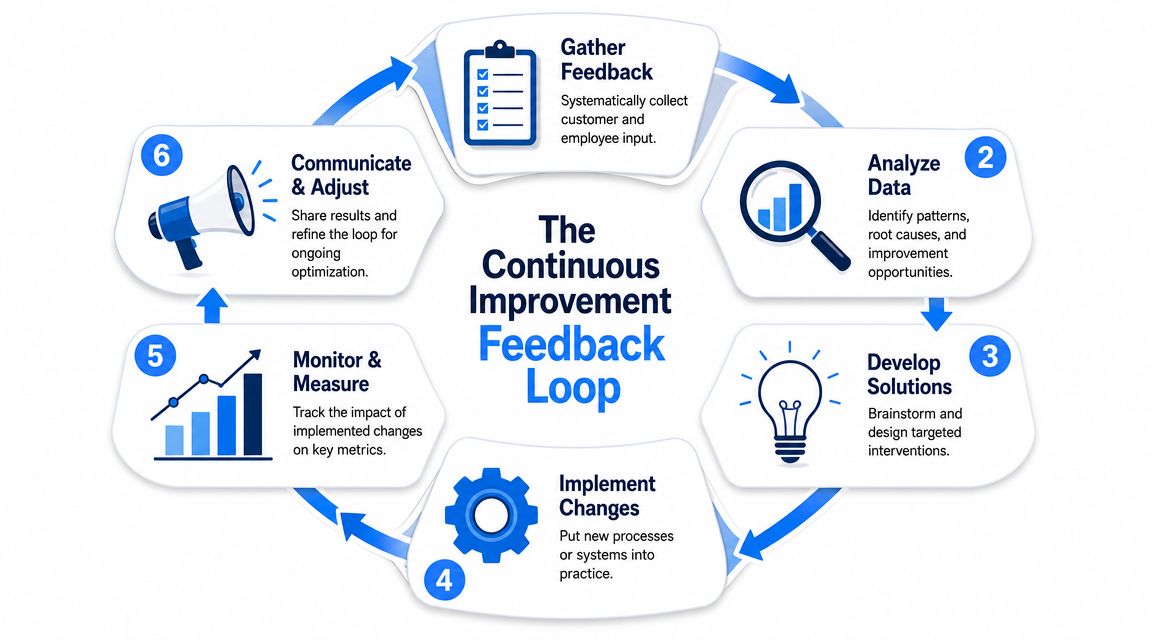
Use a short review cycle
A rigorous quality-improvement process usually uses a short-cycle model like PDSA, Plan-Do-Study-Act. In a scoping review of CQI interventions, implementation periods ranged from 2 months to 1 year and 5 months, some projects used bi-weekly or monthly data reviews, and outcomes included an 18% increase in overall service performance and a 29.3% improvement in antenatal care quality in one intervention reported in this scoping review.
The local business takeaway is practical. Improvement sticks when you review it on a schedule and adjust in small cycles.
Run a simple four-part loop
Use this structure every month:
Collect
Ask for feedback after every completed job through SMS, email, or front-desk follow-up. Pull in reviews, complaints, and internal team notes.Categorize
Tag comments into buckets like scheduling, communication, arrival timing, billing, cleanliness, or outcome quality.Act
Pick one issue that shows up repeatedly. Update the SOP, script, or scheduling rule tied to that issue.Repeat
Recheck the same metric and same complaint category during the next review cycle.
Many businesses fail at this exact stage. They collect feedback, skim it, and move on. That's not a loop. That's a suggestion box.
Turn comments into operational changes
If three reviews mention poor arrival updates, don't tell the team to “communicate better.” Write a rule that dispatch sends an ETA update when a job is delayed. If customers say the invoice was confusing, rewrite the invoice explanation template.
For reputation growth specifically, a structured system for getting more reviews works best when it's tied to moments where the customer has already confirmed satisfaction.
The review request should come after the service win, not at a random point in the workflow.
Monthly is enough for many small businesses. Some teams benefit from a bi-weekly review if lead volume is high or service errors are compounding. The key is consistency. A recurring review habit prevents minor friction from turning into a reputation pattern.
Turning Great Service into Transactional Search Dominance
Here, everything connects.
Service quality improvement isn't just an operations project. It's a visibility strategy for the searches that matter most, the ones with buying intent. When someone searches “roof repair near me,” “med spa near me,” “chiropractor near me,” or “HVAC repair near me,” they're making a fast trust decision.
They look at reviews. They look at map placement. They look at how active and credible the business appears.
Digital perception starts before the phone rings
Perceived service quality now forms before the service encounter. The gap-model discussion in OpenStax notes that consumers increasingly rely on reviews and Google Business Profile-style signals when evaluating local services, which means improving first digital impressions through response speed and review generation can shape quality perception before the business even speaks to the customer as discussed in OpenStax.
That's why operational improvements produce SEO gains that many owners don't expect.
- Better response handling creates stronger first impressions
- Better scheduling creates fewer complaints
- Better follow-up creates more review opportunities
- Better consistency creates steadier sentiment in public feedback
Those quality signals help you compete for transactional search terms, the searches where the person has money in hand and is ready to book now.
Why this matters for AI optimization too
AI search systems and large language model discovery tools don't browse your business the way you do. They synthesize signals. They look for consistency across business details, reviews, customer sentiment, and evidence of reliability.
If your public reputation says your team is hard to reach, inconsistent, or difficult to book, that gets folded into how your business is represented.
If your public reputation says you respond quickly, complete jobs professionally, and communicate clearly, that becomes an advantage in both classic local SEO and AI optimization.
For map visibility, this matters even more. If you want stronger placement where buyers click first, study the mechanics of ranking higher on Google Maps and connect them directly to your service process, not just your profile settings.
The businesses that win local search over time usually do one thing better than everyone else. They make the online promise match the actual physical experience. That's what drives more calls, more bookings, and stronger performance on the exact “near me” terms that turn into revenue.
If you want help connecting operational service quality improvement to more visibility for high-intent local searches, Transactional LLC focuses on exactly that. The team helps service businesses show up for transactional terms like “roofer near me,” “dentist near me,” and “AC repair near me,” with a strong emphasis on Google Maps optimization, local SEO, and AI-driven content that supports real lead generation.