


A homeowner's AC dies at 6:30 p.m. They grab their phone and search “air conditioning repair near me.” A parent notices their kid has a tooth issue and searches “dentist open now.” A property manager sees water damage and searches “emergency plumber.”
Those aren't casual searches. Those are transactional searches. The person searching is ready to call, book, or buy.
If your business doesn't show up in Google Maps, the Local Pack, or your branded panel, you're missing the easiest revenue on the internet. That's why understanding what is gmb in seo matters. It's not trivia. It's how local service businesses get found when people need help now.
At Transactional Marketing, that's the whole game. We target the exact terms that signal buying intent, the same kind of terms explained in this guide to transactional search queries. If someone searches “roofer near me” or “dentist near me,” you don't need more brand awareness. You need visibility where Google is deciding who gets the call.
Your Gateway to High-Intent Customers
Most business owners think SEO means blog posts, backlinks, and waiting months for rankings to move. That's incomplete. For a local service business, Google Business Profile, which many people still call GMB, is often the first place a real buyer sees you.
That matters because buyers don't always click websites first. They look at the map results, scan reviews, check hours, hit call, and move on. If you're visible there, you get the lead. If you're not, your competitor does.
Why transactional intent changes the game
A search like “best roofing materials” is informational. A search like “roof repair near me” is money-in-hand intent. Local SEO should be built around the second type.
When someone searches with urgency, they usually want four things fast:
- Proof you're real: Reviews, photos, and a complete profile
- Proof you're relevant: Clear services and categories that match the search
- Proof you're available: Hours, phone number, and service area
- Proof you can solve the problem: A strong first impression in Maps and Search
Practical rule: If your profile doesn't answer “Should I call this business right now?” within seconds, it's underperforming.
GMB is the conversion point
Your Google Business Profile isn't just a citation. It's the front desk, dispatcher, and sales assistant for local search. It's where Google decides whether to place you in front of high-intent users, and it's where those users decide whether to contact you.
That's why service businesses can't treat it like a one-time setup task. If you want more calls from local buyers, your profile has to be managed like a revenue asset.
What Exactly Is Google Business Profile
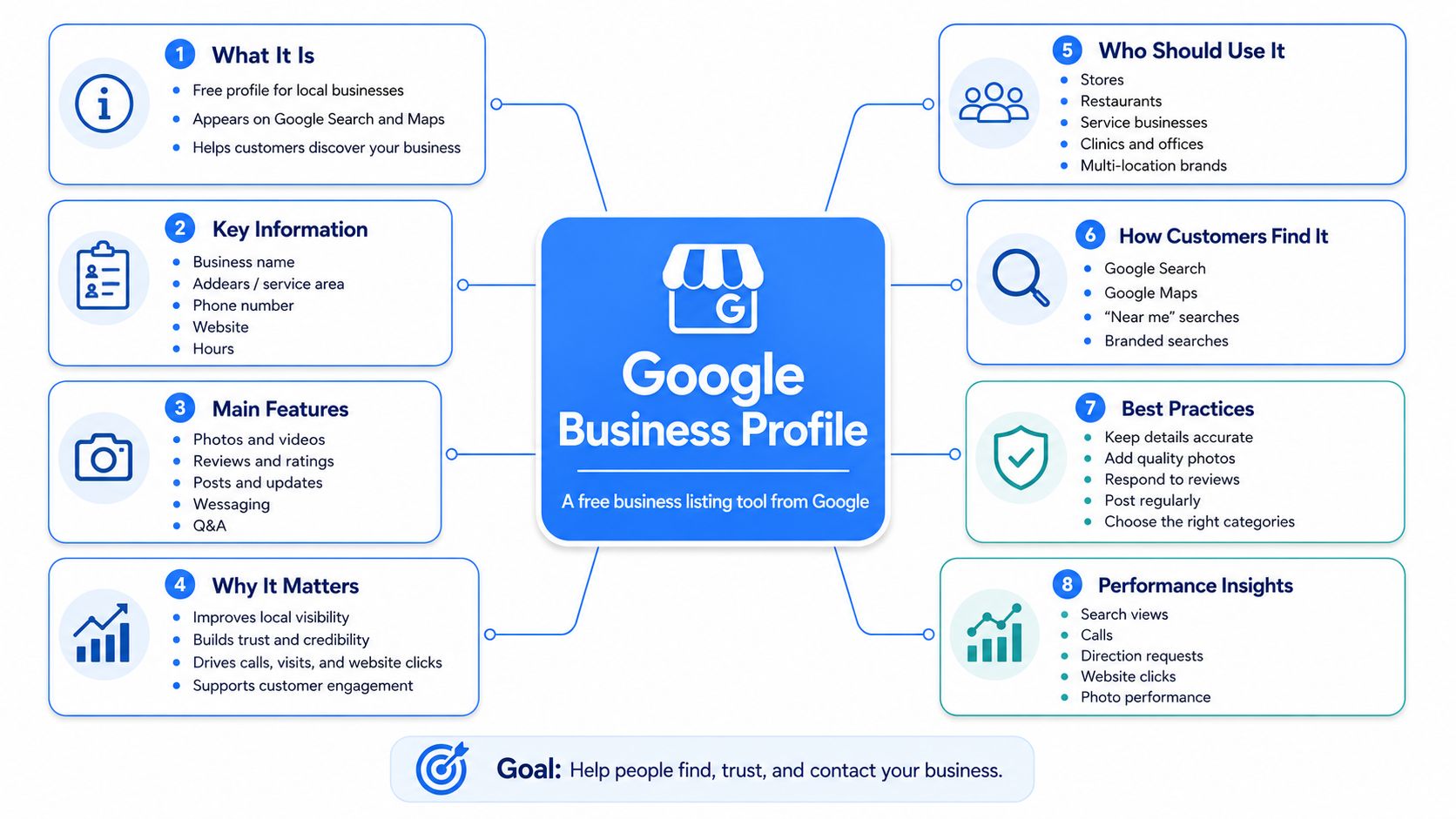
GMB stands for Google My Business, the former name of what Google now calls Google Business Profile. The name changed, but the role didn't. It's still the control center for how your business appears across Google's local surfaces.
In plain English, it's your business listing on Google Search and Google Maps. But calling it “just a listing” misses the point. It's the data source Google uses to decide how to display your company when someone searches for local services.
Where it shows up
A well-built profile can influence whether you appear in places like:
- Google Maps results: Where many service searches end
- The Local Pack: The map-based result block near the top of local searches
- Knowledge-style panels: The branded profile area with business details
- Open-now and near-me searches: Fast-decision queries with strong intent
Published guidance on local SEO describes Google Business Profile as the gateway to Google Maps, the Local 3-Pack, knowledge panels, and open-now searches. One industry review also estimated that it contributes to 19.2% of local search ranking factors in this analysis of Google My Business statistics.
That's why smart local operators treat it as a core search asset, not a side task.
What the profile actually controls
Your profile tells Google and searchers the basics that drive action:
| Profile element | Why it matters |
|---|---|
| Business category | Helps Google match you to service-related searches |
| Phone number | Drives immediate calls from mobile users |
| Service area | Clarifies where you operate |
| Hours | Affects open-now decisions |
| Reviews | Influence trust and click behavior |
| Photos | Help people judge credibility fast |
| Services and updates | Reinforce relevance and intent matching |
A plumber, dentist, HVAC company, pest control operator, or med spa doesn't need local visibility in theory. They need to show up when someone is ready to book. Your Google Business Profile is the foundation for that outcome.
Your website explains your business. Your Google Business Profile gets the first call.
Why Your Service Business Cannot Ignore GMB
If you run a service business, ignoring your Google Business Profile is a revenue leak. You might still get referrals, repeat clients, and some organic traffic. But you'll lose the fastest-moving local leads to businesses that take Maps seriously.
That's because Google Business Profile visibility is not the same thing as broad organic SEO. Many business owners lump them together, and that mistake costs them calls.
Local buyers don't search like researchers
A homeowner with a burst pipe doesn't compare twelve websites. They search, scan, and call. A patient looking for a local dentist often chooses from the businesses Google puts in front of them first.
That means your profile has one job. Convert urgency into contact.
Google's local documentation emphasizes that local results are driven primarily by relevance, distance, and prominence, and that a complete, verified profile helps Google understand and display the business correctly. That distinction between local profile visibility and general SEO is covered clearly in this explanation of Google Business Profile and local ranking signals.
Why this hits service-area businesses especially hard
If you don't rely on walk-in traffic, your profile still matters. In many cases, it matters more. Service-area businesses need Google to understand what they do, where they work, and why they're a credible option for nearby searchers.
That applies directly to:
- HVAC companies: Emergency and seasonal demand creates high-intent searches
- Roofers: Storm damage and leaks create immediate buying behavior
- Dentists and chiropractors: Patients compare proximity, trust signals, and availability
- Pest control companies: Searchers want a quick solution, not a long research process
A weak profile doesn't just lower visibility. It hands ready-to-buy customers to the next business in the map results.
The real business outcome
An optimized profile can drive the actions that matter most:
- Phone calls
- Direction requests
- Website clicks
- Appointment and booking actions
If your business depends on local demand, Google Business Profile is not optional. It's one of the main ways buyers decide who gets contacted today.
Key GMB Ranking Factors That Drive Visibility
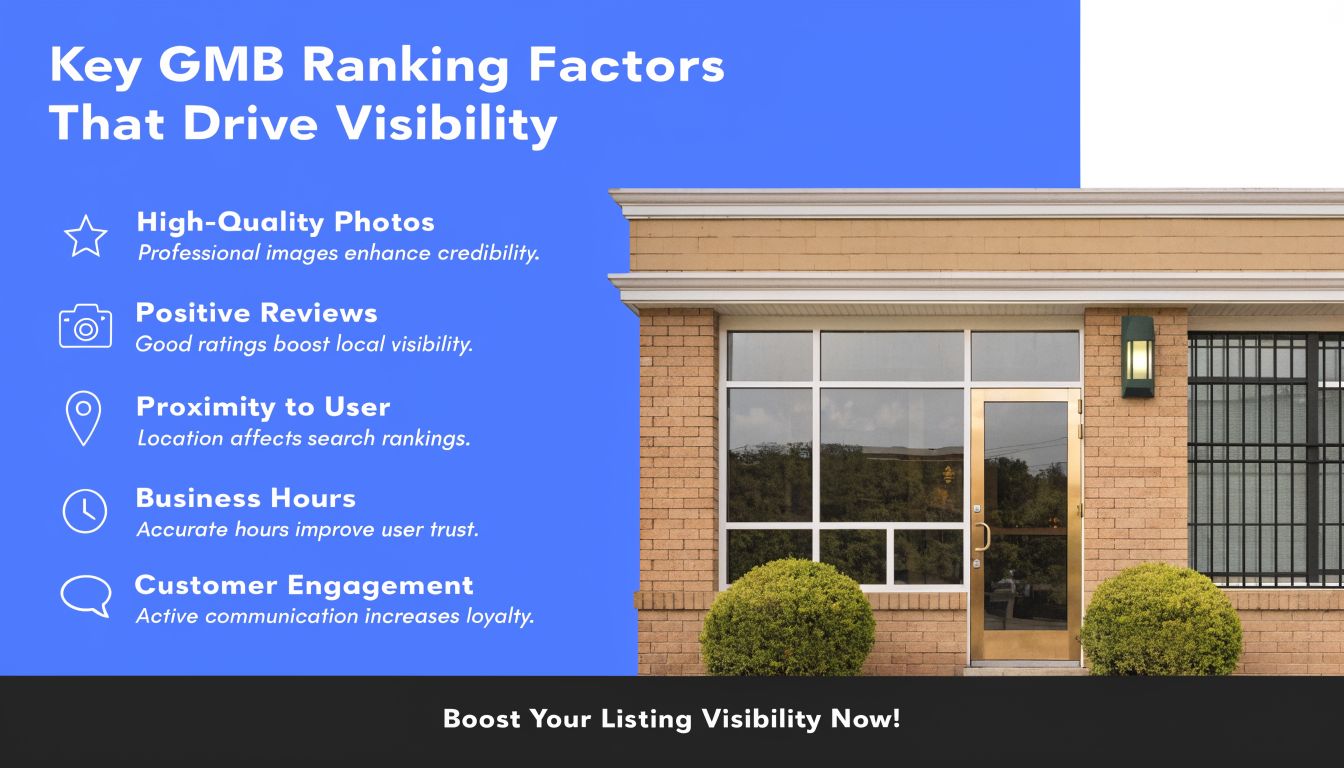
Google has made the basic local ranking framework pretty clear. Local visibility comes down primarily to relevance, distance, and prominence. If you want better map placement, stop chasing gimmicks and work these three levers correctly.
Relevance
Relevance is how closely your profile matches what someone searched for. If a user searches “water heater repair,” Google looks for businesses whose categories, services, business details, and supporting signals align with that need.
Many companies sabotage themselves by choosing a vague category, barely describing their services, and expecting Google to figure it out.
Do this instead:
- Pick the right primary category: Don't guess
- Add accurate secondary categories: Cover legitimate adjacent services
- List real services clearly: Match buyer language without stuffing keywords
Distance
Distance is Google's attempt to measure how close your business is to the searcher or the location named in the search. You can't fake proximity, and you shouldn't try.
What you can do is make sure your profile settings reflect reality. Service areas, address setup, and location structure need to be clean. Multi-location businesses need separate, accurate profiles, not one catch-all listing.
Prominence
Prominence is your business's local authority and credibility. Google looks at your overall presence, not just what you typed into the profile.
That includes signals like:
- Review quality and recency
- Business completeness
- Brand mentions and local citations
- Website support for the location and service
A practical breakdown of these factors appears in this guide to Google Maps ranking factors.
Relevance gets you considered. Distance gets you into the local conversation. Prominence helps you win it.
What this means for rankings
If you're asking what is gmb in seo from a ranking perspective, here's the answer. It's one of the most direct ways to influence local search performance. A 2025 industry analysis estimated that Google Business Profile contributes to 19.2% of local search ranking factors, as noted earlier in the cited industry review.
That's a big enough share that sloppy optimization isn't a minor issue. It's a competitive disadvantage.
Actionable GMB Optimization Tips for Transactional Searches
Most advice on Google Business Profile is too generic to help you rank for buyer-ready terms. “Fill out your profile” isn't a strategy. You need a profile that tells Google exactly what you do, where you do it, and why a local searcher should contact you now.
Start with the fields that shape intent matching
These are the first items I'd fix for any service business:
Primary category
This choice matters more than most owners realize. If you're an HVAC contractor but your profile leans too broadly, you'll blunt your relevance for urgent repair searches.Secondary categories
Use them to support real services, not to turn your profile into a keyword dump. If you offer drain cleaning and water heater work, reflect that accurately.Services menu
Add real service lines people search for. Use plain language. “AC repair,” “tooth extraction,” and “termite treatment” are more useful than vague marketing phrases.
Clean up trust signals next
A local buyer makes snap judgments. Your profile has to reduce hesitation immediately.
- Business name: Use your real-world name only. No stuffing city names or service keywords.
- Phone and hours: Keep them current. Wrong hours kill leads fast.
- Photos: Add fresh photos of trucks, staff, jobs, exterior signage, equipment, and completed work.
- Business description: Explain what you do, who you serve, and where you operate.
If you want a practical walkthrough, this guide on how to optimize Google Business Profile covers the basics many owners skip.
Use profile features most companies ignore
Google gives you tools inside the profile that too many businesses leave untouched.
| Feature | Smart use |
|---|---|
| Posts | Highlight seasonal services, offers, and urgent service availability |
| Q&A | Pre-answer common objections and service questions |
| Messaging | Reduce friction for mobile searchers |
| Booking or appointment links | Shorten the path from search to action |
| Photos and videos | Reinforce legitimacy and service quality |
Field-tested advice: Don't post fluff. Use updates to answer real buying questions like availability, service types, financing, and response areas.
Reviews need a system, not wishful thinking
Every service business says reviews matter. Few build an actual process.
Do this consistently:
- Ask after successful jobs: Train your team to request reviews at the right moment
- Mention the service naturally: A customer talking about AC repair or cleaning helps relevance
- Respond to every review: Positive and negative
- Watch patterns: Repeated complaints usually point to an operations issue, not just a profile issue
Add visual proof that supports local conversion
Photos are useful. Immersive visuals can be even better for certain businesses with offices, showrooms, or customer-facing locations. If you want to make your location easier to assess online, this tutorial on how to create 360 views without specialized cameras is a practical resource.
For teams that don't want to manage every profile task manually, one option is Transactional LLC, which handles Google Maps and Google Business Profile work as part of a local SEO system focused on high-intent local searches.
The point isn't to use every feature. The point is to remove doubt, strengthen relevance, and make calling you the easy decision.
Common GMB Mistakes That Cost You Customers
Most Google Business Profile failures aren't dramatic. They're boring mistakes repeated for months while competitors absorb the calls.
The set-it-and-forget-it trap
Business owners claim the profile is “done” because it exists. That's like saying your website is finished because the homepage loads.
A stale profile sends bad signals to both Google and searchers. Old hours, outdated photos, weak service details, and no recent activity make your business look neglected.
The mistakes I see most often
- Wrong category selection: You dilute relevance and rank for less valuable searches
- Service area confusion: Google can't clearly connect your business to the right local intent
- Keyword stuffing in the business name: Short-term thinking that can lead to profile problems
- Ignoring reviews: You lose trust and leave objections unanswered
- Incomplete service data: Buyers don't know whether you solve their exact problem
Some owners also hide behind a decent website and assume that will carry the Maps listing. It won't.
If your profile creates confusion, buyers don't investigate further. They move to the next option.
Visibility problems usually have a cause
If your listing isn't appearing where you expect, don't guess. Audit it. The issue is often category alignment, incomplete verification, weak prominence signals, or poor local relevance.
This troubleshooting guide on why a business may not be showing up on Google Maps is a useful starting point if your profile feels invisible.
The businesses that win local search don't avoid mistakes by luck. They manage the profile like it affects revenue, because it does.
Your Next Steps to Dominate Local Search
If you've been asking what is gmb in seo, the simple answer is this. It's the system Google uses to decide whether your local business gets seen and contacted when someone is ready to buy.
That makes your next move pretty obvious. Either you optimize the profile properly, or you keep donating leads to competitors who did.
Option one is do it yourself
If you're disciplined, you can clean up the profile, tighten categories, improve service data, build a review process, and keep the listing active. For multi-location brands, also think carefully about local landing pages and discoverability tools. If you're planning location expansion, this complete guide on store locators is worth reviewing because it helps clarify how users and search engines interact with local location data.
DIY works if you maintain the profile and support it with real local SEO work.
Option two is use a specialist
Some businesses don't have time to manage Maps ranking, review workflows, service pages, local content, and profile updates at the level required to win competitive markets. In that case, hand it to a team that focuses on transactional search visibility.
That's especially true if your money terms are obvious and valuable:
- roofer near me
- dentist near me
- air conditioning repair near me
- pest control near me
- emergency plumber
Those searches aren't abstract traffic. They're purchase intent.
The local businesses that dominate don't chase random visibility. They focus on the exact searches that produce booked jobs and new patients.
If you want more calls, more map visibility, and stronger placement for local money terms, treat your Google Business Profile like the sales channel it is. Build it. Optimize it. Maintain it. Then support it with the rest of your local SEO system.
If you want help turning Google Maps and high-intent local searches into real calls, Transactional LLC can help you build a tighter local SEO system around your Google Business Profile, service pages, and transactional search targets so your business shows up where buyers are already looking.