


Most service business websites have the same problem. They collect a long list of keywords like “roofer near me,” “roof leak repair,” “emergency roofing company,” and “roof estimate,” then treat every phrase like it needs its own page. That creates thin pages, mixed signals, and weak rankings.
The better move is organization.
Keyword clustering is how you turn a messy keyword list into a focused local SEO strategy built around transactional searches. That matters because service businesses don't need random traffic. They need calls from people searching with intent to hire now. If someone types “dentist near me” or “AC repair in Dallas,” that search has commercial value. Your site structure should reflect that.
When business owners ask what is keyword clustering, the simple answer is this. It's the process of grouping related search terms so one strong page can target a whole set of closely connected queries. Done right, that helps your website rank better, supports your Google Business Profile, and gives Google a clearer understanding of which services you offer in which cities.
Stop Chasing Keywords Start Organizing Them
A homeowner searches “roofer near me” after spotting a leak. Then they try “emergency roof repair,” “roof tarping,” and “roof estimate.” If your site treats each phrase like a separate SEO target, you end up with a pile of weak pages competing against each other instead of one strong page built to win the call.
That is the core problem with keyword chasing. It bloats your site, confuses Google, and weakens your ability to rank in both local results and Google Maps.
The better way to handle local search demand
Keyword clustering gives you a cleaner system for local SEO. You stop asking how to rank for every variation and start deciding which phrases belong together because they signal the same job, the same intent, and the same chance of turning into revenue.
For a service business, that means organizing around transactions, not wording. A roofing company should group terms tied to urgent repair intent. A dentist should group phrases tied to immediate booking intent. An HVAC company should group phrases tied to same-day service intent. The page structure should match how people hire.
That approach also supports Google Business Profile visibility. Your website sends clearer service and location signals, which helps Google connect your business to high-intent local searches instead of treating your site like a scattered set of loosely related pages.
Use this framework:
- Start with the service action: Group keywords that point to the same job, such as “roof leak repair,” “emergency roof repair,” and “fix leaking roof.”
- Add local modifiers after the intent is clear: Fold in city names, neighborhoods, and “near me” variations once you know they belong to the same service cluster.
- Assign one conversion goal per page: Every cluster should support a page built to get a phone call, a form fill, or a booked appointment.
One strategic detail gets ignored too often. Branding and domain choices can reinforce relevance or make your company look thin and forgettable. If you're weighing service-focused domains or local microsites, NameSnag on keyword domains is a useful read.
If your keyword list is still a mess, start by tightening the inputs with these keyword research best practices.
Practical rule: Build pages around buyer intent and service areas, not every keyword variation you can export.
Keyword Clustering Explained A Simple Analogy
Think of your website like a toolbox in the back of a service truck. If every tool is thrown in randomly, your crew wastes time searching for what they need. The tools are all there, but the setup is sloppy.
That's what an unclustered website looks like to Google.
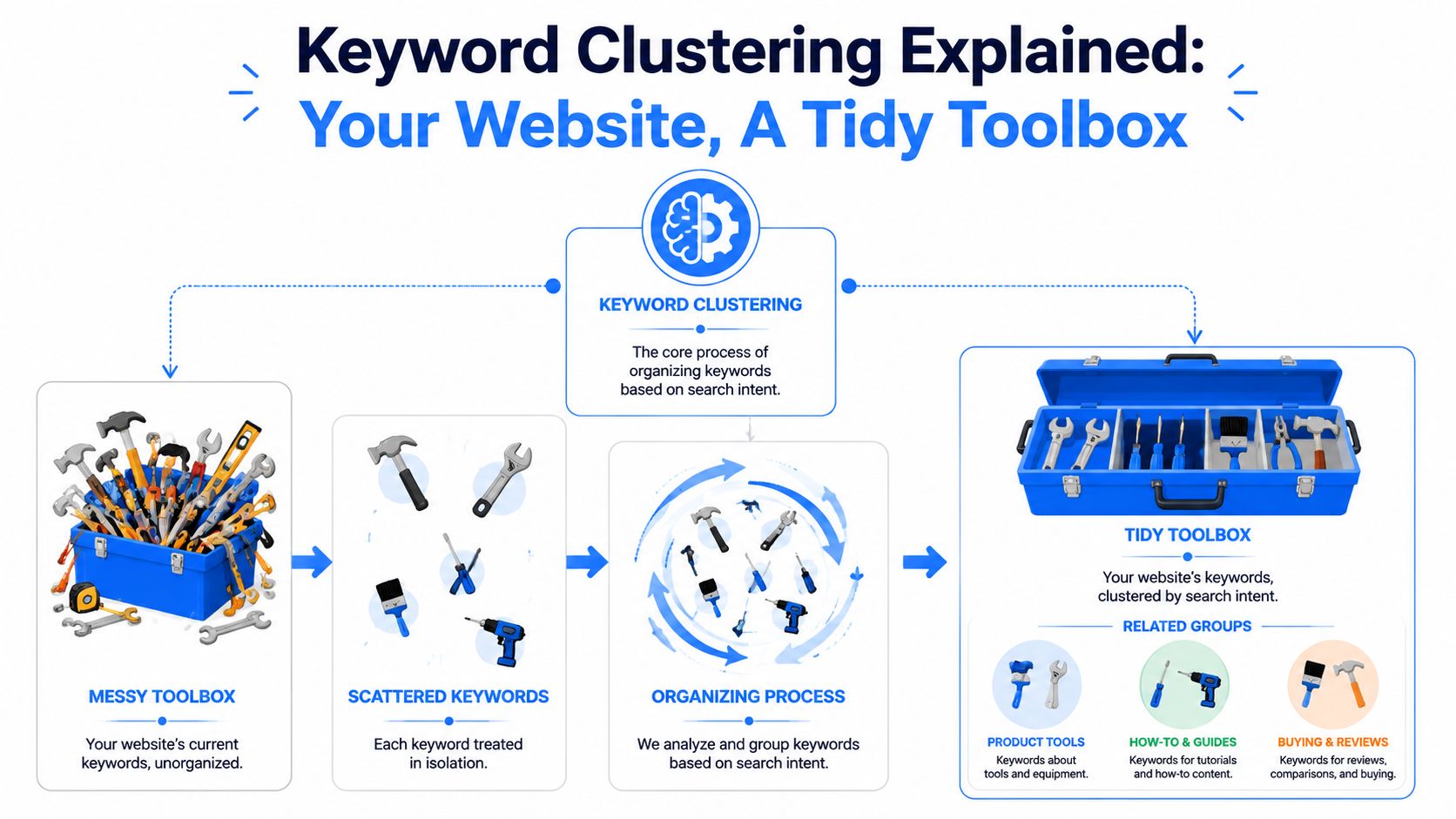
Your keywords are the tools
One keyword might be “AC repair near me.” Another might be “air conditioner not cooling.” Another might be “fix central air.” Those phrases don't look identical, but they can reflect the same underlying need. The customer wants cooling restored fast.
That's why keyword clustering is not just grouping synonyms. It's a technical SEO method for mapping keywords to pages by search intent and SERP overlap, so one page can rank for a set of semantically similar queries instead of forcing separate URLs for each term, as explained in Ahrefs' guide to keyword clustering.
Why intent matters more than wording
A lot of people cluster by surface similarity. That's a mistake.
“AC repair” and “AC installation” both contain “AC,” but they don't represent the same job, the same budget, or the same stage of the buying process. One searcher wants a repair visit. The other is shopping for replacement. Those should not live on the same page.
Good clustering asks a sharper question: does Google treat these searches like the same problem?
If the answer is yes, one page can usually do the work. If the answer is no, split them.
Here's a simple way to understand it:
- Same problem: “Emergency plumber near me” and “24 hour plumber” likely belong together.
- Different problem: “Water heater repair” and “water heater installation” usually need different pages.
- Different journey stage: “Best dentist for implants” and “what are dental implants” may need different content types even though they're related.
Google cares less about exact wording than most business owners think. It cares more about whether your page matches the reason behind the search.
If you want a cleaner foundation for this idea, read what search queries really are. It helps separate the words people type from the intent behind those words.
Why Clustering Is a Game Changer for Local Service Businesses
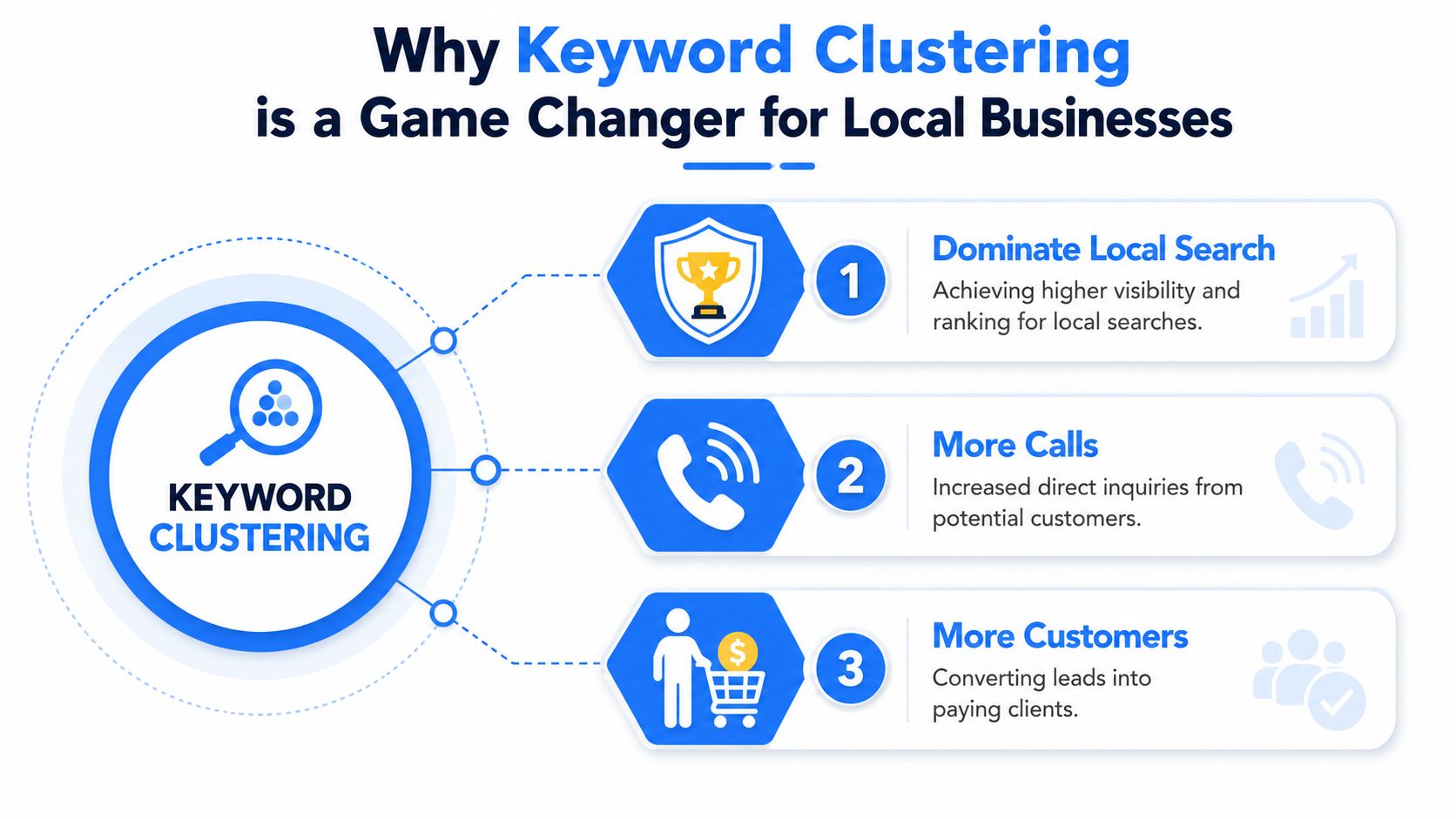
Someone in your service area searches “roofer near me” after a storm. Another person searches “roof leak repair.” A third types “emergency roof repair [city].” If your site treats those as unrelated opportunities, you split your authority, dilute relevance, and lose calls to a competitor with a cleaner structure.
That is why clustering matters in local SEO. It helps you organize pages around real service demand instead of random keyword variations.
It helps you capture more transactional searches
A good local service page should rank for a group of closely related, high-intent searches. One page for one exact keyword is a weak strategy.
For a roofer, one strong page can often cover searches like “roof repair near me,” “roof leak repair,” “emergency roof repair,” and “local roof repair company” if Google treats them as the same service need. That gives you a better shot at showing up across the searches that produce calls.
The business benefit is simple. You stop creating thin pages for every wording variation, and you stop missing demand because your main page is too narrow. You build pages that match how people search when they are ready to hire.
That also makes SEO content planning for service pages much easier. You can map services, locations, and intent groups into a site structure that supports rankings and conversions.
It strengthens your Google Maps relevance
Google Business Profile rankings do not come from your profile alone. Your website helps confirm what you do, where you do it, and which searches you deserve to appear for.
Clustered service pages send clearer relevance signals. If your electrician site has focused pages for “emergency electrician,” “electrical panel upgrade,” and “EV charger installation,” Google gets a more precise picture of your business. That supports your visibility in both local organic results and the map pack.
Local businesses usually go wrong by publishing vague pages called “Services” or “What We Do,” then expect to rank in Maps for specific, high-value searches. Google needs stronger evidence than that.
If you want more map pack visibility for terms like “dentist near me” or “24 hour plumber,” your site structure has to reinforce those services clearly.
A useful overview of local SEO and page structure is this video:
It turns weak pages into stronger assets
A lot of service sites have the same structural problem. They either publish too many near-duplicate pages or cram every service into a few generic pages.
Clustering fixes that by giving each page a defined job.
- One page, one intent group: Build each page around a specific service need and the transactional searches tied to it.
- Less internal competition: Consolidate overlapping terms instead of forcing multiple pages to fight each other.
- Stronger conversion paths: Send visitors to pages that match the job they want done now.
- Better support for location expansion: Once service clusters are clear, adding city pages becomes more controlled and less messy.
The result is a site that is easier for Google to understand and easier for prospects to act on. For a local service business, that is the point. More qualified traffic, more map visibility, and more phone calls from people ready to book.
How Keyword Clustering Works The Main Approaches
There are several ways to cluster keywords. Only one of them should guide decisions on important local service pages.
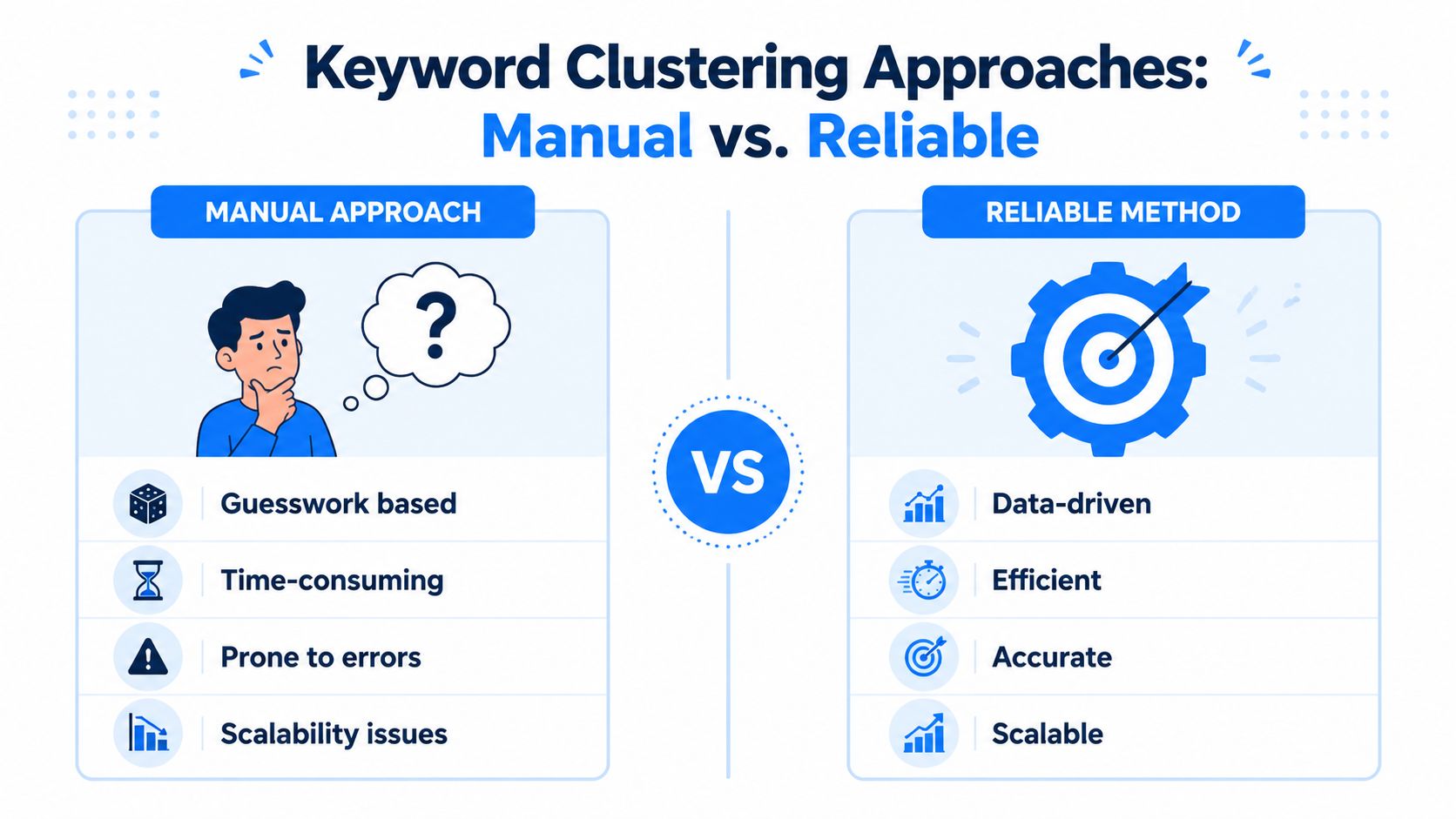
Manual grouping is fast and often wrong
The old method is simple. You look at a list, spot similar words, and put them in the same bucket. That's easy to do with terms like “plumber near me,” “local plumber,” and “plumbing company near me.”
Sometimes it works. Often it doesn't.
Manual grouping breaks down when similar words mask different intent. “Tooth extraction cost” and “emergency dentist near me” may overlap in topic but not necessarily in what the searcher wants at that moment. One may be price research. The other may be urgent booking intent.
SERP overlap is the reliable method
The stronger method uses Google's own results as the decision-maker.
A widely cited algorithmic description of clustering says to take keywords one by one, query the search engine, compare the top 10 ranking listings, and cluster terms when overlap is high enough to indicate shared intent. That same overview also notes more advanced research using BERT-generated word vectors and k-means clustering, as described in Wikipedia's keyword clustering summary.
For practical local SEO, the key takeaway is simpler than the terminology. Check whether Google ranks many of the same pages for both terms.
SE Ranking describes one concrete rule used in clustering systems. Keywords can be grouped when 3 or more of the same pages overlap in Google's top results. That's useful because it turns clustering from opinion into a repeatable process.
If Google shows many of the same pages for two searches, it's telling you those searches belong together.
Where AI fits in
AI tools can speed up clustering, especially for larger keyword sets across services and cities. They're useful for preprocessing, identifying semantic relationships, and sorting patterns at scale.
But for local service SEO, AI should support judgment, not replace it.
Your best pages target commercial intent in a specific market. That means a person still needs to review whether the cluster makes business sense. A machine can suggest that “roof inspection” and “roof estimate” are related. A strategist still has to decide whether those terms should share a page based on the live results and the conversion goal.
For a stronger content plan after clustering, use a structured SEO content planning process.
A Practical Workflow for Clustering Transactional Keywords
Most business owners don't need theory. They need a workflow they can understand and apply. Clustering transactional keywords is straightforward when you keep the focus on services that lead to booked jobs or scheduled appointments.
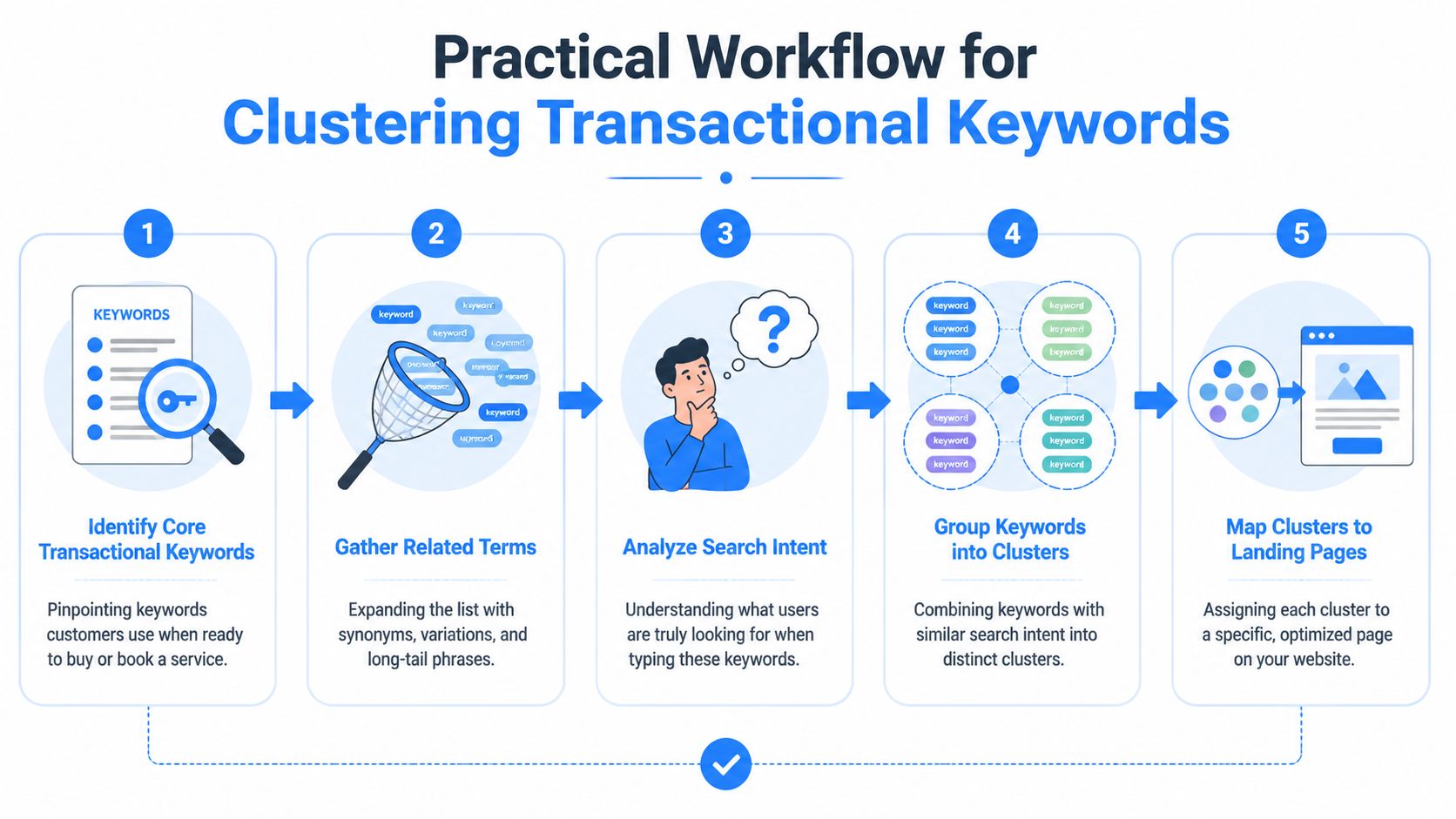
Start with your core money services
Begin with the services that drive revenue. Don't start with broad blog topics. Start with the searches tied to real commercial action.
For a plumbing company, that might mean drain cleaning, water heater installation, sewer line repair, and emergency plumbing. For a dental office, it might mean emergency dentistry, dental implants, Invisalign, and teeth cleaning.
Then add the natural transactional modifiers people use:
- Local intent modifiers: near me, in city name, local
- Buying modifiers: estimate, cost, quote, same day
- Urgency modifiers: emergency, 24 hour, fast
This creates your raw keyword pool.
Validate with live Google results
This is the step often overlooked, and it's the one that matters most.
Semrush points out an issue that gets overlooked in mainstream guides: you need to validate clusters with live SERPs rather than rely only on tool-generated groupings, because the main challenge is deciding when two terms should stay together or split apart. That matters because one page can become too broad, while separate pages can become too thin, as explained in Semrush's discussion of keyword clustering.
Here's the practical workflow:
- Search the first keyword in Google.
- Search the second keyword in Google.
- Compare the ranking pages.
- If the results are very similar, keep them in one cluster.
- If the results shift meaningfully, split them into separate pages.
For example, if “emergency roofer” and “roof leak repair” return many of the same local pages, they likely belong together. If “new roof installation” returns a different set of pages focused on replacement and financing, that deserves its own cluster.
Don't trust the spreadsheet over the search results. Google has already shown you how it interprets the query.
Map clusters to pages and local assets
Once the groups are clear, assign each cluster to a page with a single conversion goal. Don't pile multiple clusters onto one generic service page.
A clean local structure often looks like this:
| Cluster | Best page type | Conversion focus |
|---|---|---|
| Emergency plumbing cluster | Dedicated service page | Call now |
| Water heater installation cluster | Dedicated service page | Quote request |
| Dental implant cluster | Procedure page | Consultation booking |
| AC repair in city cluster | Local service page | Appointment request |
Then support that structure with matching page titles, service descriptions, FAQs, internal links, and alignment with your Google Business Profile categories and services.
If you're publishing the actual page after clustering, this guide on how to write SEO content will help keep the page focused on rankings and conversions.
Keyword Cluster Examples for Service Industries
Clustering gets easier when you see what it looks like in practice. The pattern is simple. One target page should own one core service intent, then absorb closely related keyword variations that Google treats as the same need.
Sample Keyword Clusters for Local Service Businesses
| Service Vertical | Parent Topic / Target Page | Keywords in the Cluster |
|---|---|---|
| Roofing | Roof Repair Page | roof repair near me, roof leak repair, emergency roofer, leaking roof repair, local roof repair company |
| Roofing | Roof Replacement Page | roof replacement, new roof installation, replace roof, roofing contractor for new roof, roof estimate |
| HVAC | AC Repair Page | AC repair near me, air conditioner repair, air conditioner not cooling, fix central air, emergency AC repair |
| HVAC | AC Installation Page | AC installation, new air conditioner installation, central air replacement, install AC unit, AC replacement estimate |
| Dental | Emergency Dentist Page | emergency dentist near me, urgent dental care, same day dentist, tooth pain dentist, emergency dental appointment |
| Dental | Dental Implants Page | dental implants, tooth implant dentist, missing tooth replacement, implant consultation, dental implant specialist |
| Plumbing | Drain Cleaning Page | drain cleaning near me, clogged drain service, clear blocked drain, drain unclogging, emergency drain cleaning |
| Pest Control | Ant Control Page | ant exterminator near me, ant pest control, get rid of ants service, local ant treatment, ant removal company |
What these examples show
The wording changes, but the customer goal stays consistent inside each cluster. That's the point.
A roofer shouldn't create one page for “roof leak repair” and another for “emergency roofer” if Google treats both as the same service need. But that same roofer absolutely should separate repair from replacement if the searcher intent changes.
This also shows why local SEO and Maps optimization benefit from clustering. When each service page lines up with one real intent group, the site becomes easier for Google to interpret and easier for searchers to trust.
Common Pitfalls and Best Practices for Lasting Results
The biggest mistake is grouping by similar words instead of similar intent. That's how businesses end up with pages that are too broad, too vague, or aimed at the wrong customer.
Another common error is overbuilding. Owners publish dozens of near-duplicate city and service pages without checking whether the searches deserve separate URLs. That usually creates cannibalization instead of growth.
What to avoid
- Mixed-intent pages: Don't combine repair, replacement, and maintenance on one page if they lead to different SERPs and different buyers.
- Tool-only decisions: Clustering software is helpful, but it shouldn't overrule live Google results.
- Generic service pages: A page titled “Our Services” won't rank for strong local transactional searches.
What works better
Some sources distinguish keyword clustering from topic clustering, with topic clustering focusing on related themes and internal-link structures. The useful takeaway is that the best modern approach is often a hybrid that emphasizes semantic meaning and user journey over pure keyword matching, as discussed in Page Optimizer Pro's comparison of keyword clustering and semantic clustering.
That's the right way to think about lasting results for local businesses.
- Trust the SERPs: Google's current results are the best test of whether terms belong together.
- Build pages around services people buy: Focus on transactional intent first.
- Support your Maps presence: Make sure your site structure reinforces the services and locations you want your Google Business Profile to rank for.
Keyword clustering isn't an academic SEO exercise. It's one of the clearest ways to build pages that rank for “roofer near me,” “dentist near me,” or “AC repair near me” without wasting time on thin content and scattered targeting.
If you want help turning scattered keywords into a site structure that drives more local calls, Transactional LLC helps service businesses build conversion-focused SEO, stronger Google Maps visibility, and AI-driven content plans aimed at transactional searches that turn into booked jobs and patient appointments.