

If you're tearing your hair out asking, "Why isn't my business showing up on Google Maps?" the answer is often hiding in plain sight. More often than not, the problem boils down to the absolute basics of your Google Business Profile (GBP): it's either unverified, incomplete, or completely unclaimed.
This one simple misstep can make you totally invisible to the very customers you want to attract—the ones punching "plumber near me" into their phones with money in hand, ready to make a call. These are the transactional search terms we at Transactional Marketing live for, and getting you to show up for them is our entire mission.
Your First Step to Getting on the Map
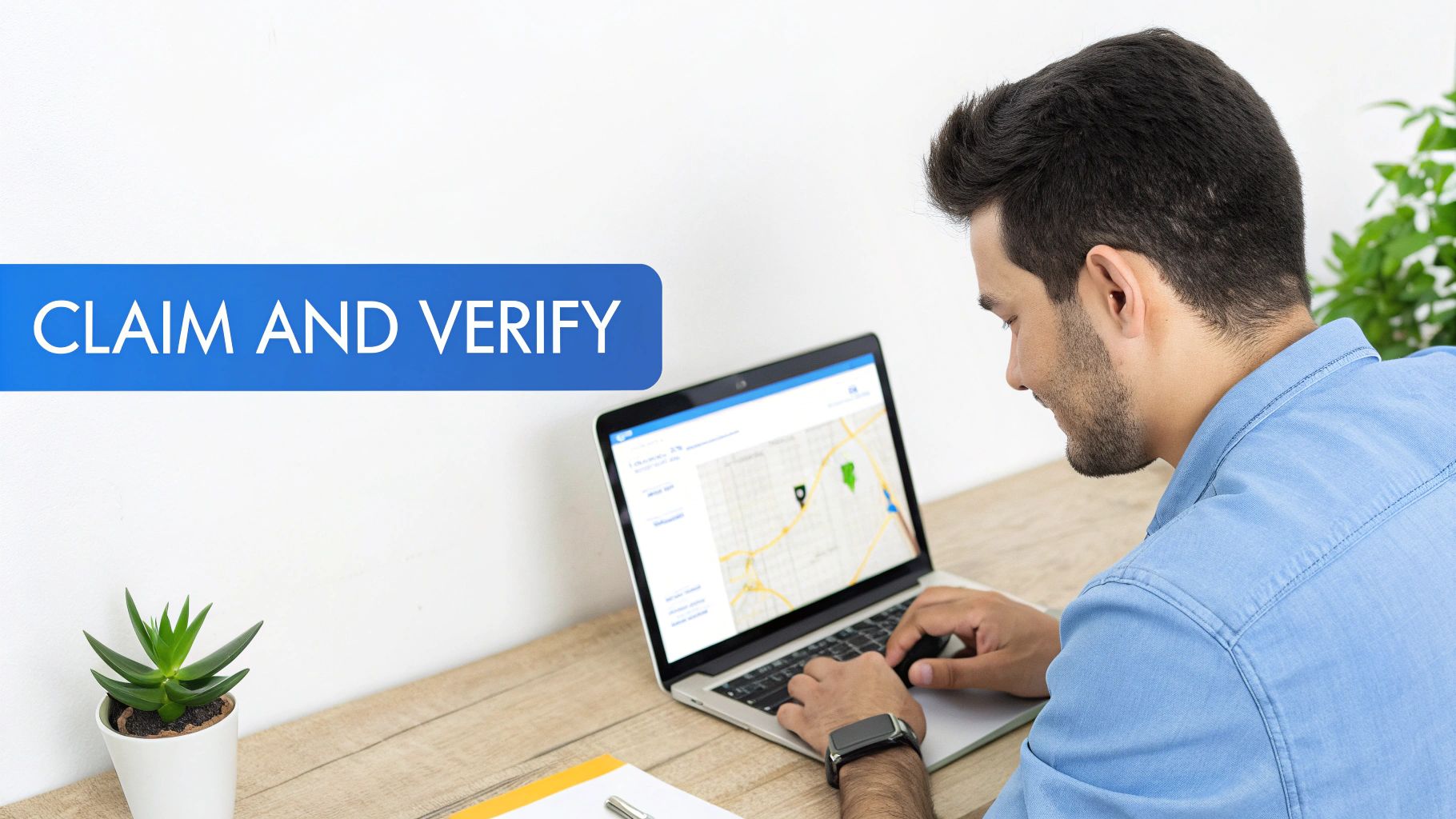
Picture this: a homeowner is staring at a flooded basement. Their first move is to search for "emergency plumbing services." That's what we call a transactional search term, and for any local service business, it's pure gold. But if your Google Business Profile hasn't been properly claimed and verified, you're not even in the running. It’s like trying to compete in a race you never officially entered.
Too many business owners fall into the trap of thinking Google just knows they exist and will figure out the rest. That’s a dangerous assumption. An unclaimed profile is like an empty storefront with no sign on the door; both potential customers and Google’s algorithm will just walk right on by. Getting you found for these money-in-hand searches is exactly what Transactional Marketing does.
To help you get started, here's a quick rundown of the most common issues we see that keep businesses off the map and the immediate steps you can take to fix them.
GBP Visibility Checklist: Common Issues and Quick Fixes
This table breaks down the frequent culprits behind a missing Google Maps listing and what you need to do right now to get back in the game.
| Common Issue | Impact on Visibility | Immediate Action |
|---|---|---|
| Unclaimed Profile | Severe: Google won't show a listing it can't confirm is actively managed. You are completely invisible. | Find your business on Maps, click "Own this business?", and follow the prompts to start the verification process. |
| Pending Verification | Severe: Your profile is in a holding pattern. It won't be public until Google confirms your legitimacy. | Check your mail for a postcard with a PIN, or look for email/phone verification options. Complete the final step. |
| Incomplete Profile | High: Missing hours, services, or a description makes your profile seem less reliable to Google's algorithm. | Log in and fill out every single section. Aim for 100% completion, paying close attention to services, categories, and business hours. |
Getting these three foundational elements right is non-negotiable. It's the price of admission for showing up in local search results, especially for the high-value transactional search terms that drive your business.
The Make-or-Break Role of Verification and Completion
Verification is simply Google's way of confirming you are who you say you are, where you say you are. Until you complete this step, your profile is stuck in limbo and won't be shown to the public. It's the first and most critical gate you have to pass through.
Once you’re verified, the next mission is getting that profile to 100% completion. This isn't just a friendly suggestion; it's a direct signal you're sending to Google's ranking algorithm and the new AI-powered LLMs. An incomplete profile screams that you're less established than a competitor whose listing is packed with helpful information. Every empty field is a missed opportunity to build trust with Google and rank higher for critical transactional search terms.
The data doesn't lie: complete and verified Google Business Profiles are 80% more likely to appear in search results than incomplete ones. This hammers home a simple truth—the more high-quality information you feed Google, the more it will reward you with visibility.
The gap between the top-ranked businesses and everyone else is stark. We consistently see that businesses appearing in the top three map positions have profiles that are around 75% complete, while those buried on page two or three often dip below 40%. It's a crystal-clear indicator that Google's algorithm rewards thoroughness.
Taking Action to Claim Your Digital Real Estate
Claiming and verifying your profile puts you in the driver's seat. You gain full control over your business name, address, phone number, hours, and—most importantly—your customer reviews and photos.
A well-managed profile is the cornerstone of any strategy to land in the coveted Google Maps "3-pack," which is where the vast majority of clicks and calls happen for transactional search terms. If your profile is sitting there unclaimed or half-finished, you're essentially handing customers over to your competitors.
Getting this right is the first step in transforming your Google Maps presence from a frustrating mystery into a powerful lead-generation machine. Our team at Transactional Marketing has the technology to turn these map locations into lead magnets, and we can help you build that solid foundation with our comprehensive GMB setup services.
Optimizing Your Profile for Transactional Searches
Getting your Google Business Profile claimed and verified is just the starting line. Too many business owners stop right there and then wonder why the phone isn't ringing. The problem? Their profile isn't optimized for the searches that actually make money—the ones that signal a customer is ready to buy right now.
At Transactional Marketing, our entire focus is on getting clients to show up for these transactional search terms. We're talking about the money-in-hand queries like "emergency roof repair near me" or "same-day crown dentist." Someone typing that into Google has an urgent problem and a wallet ready to solve it. If your profile is just optimized for a broad term like "roofer," you're completely invisible to these high-value customers.
A verified profile alone won't cut it. You have to strategically build out your profile to speak directly to both Google's algorithm, its AI-powered LLMs, and the customers making those urgent searches.
Going Beyond Basic Categories
One of the biggest mistakes business owners make is picking a primary category and calling it a day. Your primary category is definitely important, but the real ranking power comes from the specific details you add next. Your profile isn't a static business card; it’s a living, breathing sales tool that needs to be fed with the right information to dominate transactional searches.
Instead of just "Dental Clinic," you need to be listing the specific, high-value services that people are actually searching for when they have a problem.
- Broad Term: HVAC Contractor vs. Transactional Term: "24-hour AC repair"
- Broad Term: Dentist vs. Transactional Term: "emergency tooth extraction"
- Broad Term: Plumber vs. Transactional Term: "leaky pipe fix near me"
This is exactly the kind of granularity Google's AI-driven search engine and LLMs are looking for. They want to perfectly match a user's specific problem with the most relevant, detailed solution. By explicitly listing these services, you're essentially raising your hand and telling Google, "I am the perfect solution for this person's urgent need." This is how we get our customers to show up for the exact terms that drive business.
Crafting a Description That Converts
Your business description is another powerful, often underutilized, tool. This isn't the place for fluffy marketing speak. It’s prime real estate for loading your profile with local signals and the keywords that prove your relevance for transactional search terms. Get specific about the neighborhoods you serve and the exact problems you solve.
For example, a roofer in Dallas shouldn't just say, "We offer quality roofing services." A much more effective description is packed with intent-driven language.
Example Description: "Your trusted Dallas roofer specializing in emergency storm damage repair and fast leak fixes for homes in the Lakewood and Highland Park areas. We provide same-day inspections for hail damage and guarantee quick turnarounds on all residential roof repairs. Call us for immediate help with your roofing emergency."
See the difference? This version is loaded with terms that directly match what a panicked homeowner would be searching for. It signals expertise and tells Google that this business is a top contender for high-intent, transactional searches in those specific local areas.
The Power of Detailed Content and Visuals
If you're still asking, "why is my business not showing up on google maps," the answer often lies in what your profile is missing. A sparse profile with little information sends a weak signal to Google and its AI. To compete for top spots, rich, detailed content is absolutely essential for proving you're the right choice for a transactional search term.
The data backs this up. Businesses ranking in the top three map positions average 250 or more images, while those further down the page often have fewer than 200. On top of that, 75% of top-ranking businesses have complete, detailed descriptions. Industry experts consistently point to the primary category as the single most crucial local ranking factor, but the content you build around it is what pushes you to the top.
This proves that a visually rich, fully detailed profile isn't just a "nice-to-have." It’s a core requirement for playing in the big leagues. Every service you add, every photo you upload, and every attribute you select strengthens your case for why Google should show your business to a customer with an urgent need.
To make sure you're covering all your bases, our Google My Business optimization checklist walks you through every critical step. By meticulously optimizing each section, you can turn your GBP from a simple listing into a powerful machine that consistently generates high-value phone calls from transactional searches.
Mastering the Core Ranking Signals
Okay, so your Google Business Profile is live and optimized. That’s step one. But just showing up on the map isn't the goal—you need to land in the top three results, that all-important "map pack," for the transactional search terms that actually make you money.
To get there, you have to understand how Google’s local algorithm thinks. It boils down to three core signals it uses to rank every single business: Proximity, Relevance, and Authority.
Think of these as the language Google and its AI systems speak. At Transactional Marketing, we are fluent in this language. It’s how we consistently get clients to the top for high-value searches like "air conditioning repair near me"—the exact terms that signal someone is ready to buy now.
Proximity Is More Than Just Distance
At first glance, proximity seems simple: it’s how close the searcher is to your business location. And while that's a huge piece of the puzzle, it's not the whole story, especially if you're a service-area business.
Google is smart. Its AI knows the "best" result isn't always the one that's physically closest.
The real game is about proving your service area strength. If you're a plumber based in Scottsdale but you do a ton of work in Mesa, you need to send clear signals that prove you're a legitimate player there. We do this by:
- Uploading geo-tag images from job sites in those target neighborhoods.
- Encouraging customer reviews that specifically mention the towns or communities you served.
- Creating location-specific content on your website detailing the projects you’ve completed in those areas.
Building these signals expands your digital footprint. It tells Google, "Hey, I'm not just stuck at this one address; I actively serve this entire region." This is how you start showing up in transactional searches even when the customer isn't right around the corner.
Building Unshakeable Authority
Authority is essentially Google's trust score for your business. It’s a measure of your prominence and credibility in the real world. A business with high authority is seen as a market leader, and without it, you'll almost always lose to a competitor, even if you’re closer to the searcher.
Authority isn't built overnight. It's the result of consistent effort across several key areas:
- A steady stream of positive reviews: The volume, frequency, and quality of your reviews are massive trust signals. Google rewards businesses that consistently earn positive feedback.
- A strong, well-optimized website: Your website is your digital headquarters. It has to be fast, mobile-friendly, and properly linked from your Google Business Profile.
- Consistent business citations: Your name, address, and phone number (NAP) need to be identical across dozens of directories like Yelp, Angi, and other industry-specific sites. Even small inconsistencies can chip away at Google’s trust in your business.
At Transactional Marketing, we see authority-building as a continuous process, not a one-and-done task. It requires a relentless, systemized approach to generating reviews and building a powerful citation profile. That’s how you convince Google you’re the go-to expert for transactional search terms in your service area.
Connecting Relevance to Transactional Intent
Relevance is all about how well your profile matches what a person is actually searching for. This is where all that initial optimization work pays off. When someone types in "emergency roof repair," Google's algorithm instantly scans profiles to find the one that best matches that specific, urgent need.
You signal your relevance by being meticulous. Fill out every single applicable field in your profile.
Every service you list, every attribute you check (like "24-hour service"), every customer Q&A you answer, and every Google Post you publish creates a richer, more detailed picture of your business. This data feeds the algorithm, proving that you aren't just a generic "roofer," but an expert who handles the exact type of transactional search term the customer just made.
The more precisely you align your profile with these high-intent searches, the more likely Google is to put you in that top-three map pack. This is the core of our strategy at Transactional Marketing.
When Your Listing Suddenly Vanishes
It’s a gut-wrenching moment for any business owner. One day, the phone is ringing and your business is right there on the map; the next, you're gone. When your profile disappears, it instantly cuts off the lifeblood of customers making high-value transactional searches. Even a perfectly tuned Google Business Profile can fall victim to technical hiccups that render it invisible overnight.
Most of the time, a sudden disappearance boils down to two main culprits: a profile suspension or a hidden duplicate listing. Both are serious problems that confuse Google and cost you customers, but they are completely fixable if you know what to do.
Tackling a Profile Suspension
Think of a suspension as Google putting your listing in a penalty box. This typically happens when the algorithm flags a violation of its quality guidelines. The real challenge is that the violation is often something small, and Google rarely points a finger at the exact problem.
A suspended profile is effectively pulled from the map, meaning you won't show up for critical transactional search terms like "roofer near me" or "emergency dentist."
Here are the most common reasons we see for a suspension:
- Keyword Stuffing: You've crammed extra keywords into your business name (e.g., "Dallas Roofing Pros – Shingles, Repair, Leaks").
- Address Issues: You're using a P.O. box, a virtual office, or an address where you don't actually meet with customers face-to-face.
- Conflicting Info: Your name, address, or phone number on GBP doesn't match what's on your website or other key business directories.
- Major Profile Changes: Sometimes, simply changing your business address or primary category can trigger an automatic review and suspension.
If you get hit with a suspension, your first move is to carefully read Google’s guidelines and comb through your profile for anything that might be out of line. Once you find and fix the likely issue, you need to file an official reinstatement request through your GBP dashboard. Be ready to provide proof, like a business license or utility bill, to show you're a legitimate operation.
The Sneaky Problem of Duplicate Listings
Duplicate listings are a silent killer for local rankings. They can appear for all sorts of reasons—a former employee made one, an old marketing agency set one up, or Google's own system scraped old data and created one. No matter how they happen, having more than one profile for a single business location is a huge red flag for Google.
This duplication splits your ranking power. All your hard-earned reviews, photos, and authority signals get diluted across multiple profiles, weakening each one. It creates confusion for Google’s algorithm and its AI, which can’t decide which listing is the "real" one to show. So, often, it just shows neither, costing you valuable transactional searches.
The core ranking signals Google relies on are Proximity, Relevance, and Authority. Duplicate listings directly sabotage your Authority by scattering your reviews and engagement signals, making it impossible to build a strong presence.
To hunt down duplicates, search on Google Maps for your business name, any old names you've used, address variations, and old phone numbers. If you find one, you'll need to claim it and then contact Google Support to merge the profiles. This is a critical step to consolidate all your ranking signals into a single, authoritative listing.
This flowchart breaks down the three pillars of Google ranking that technical issues like duplicates can completely undermine.
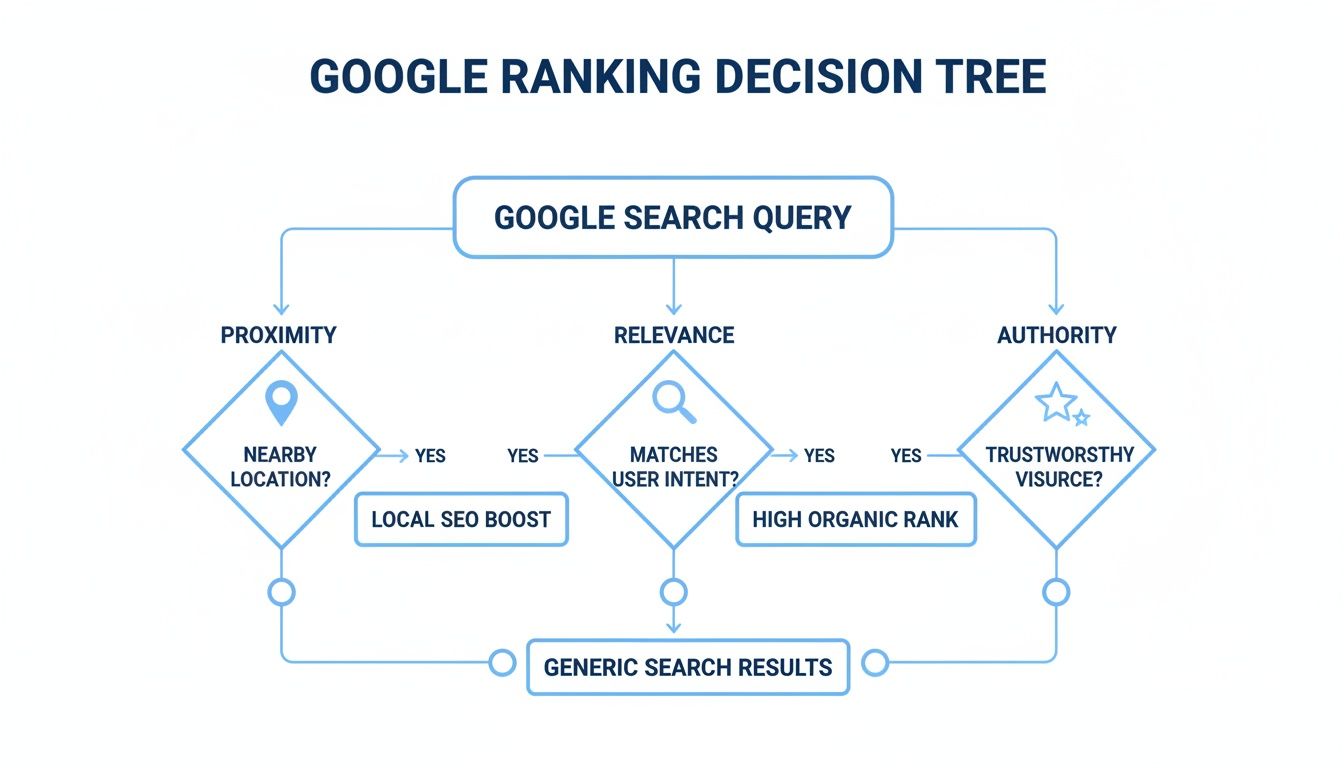
As you can see, your visibility drops off a cliff without strong signals for proximity, relevance, and authority. Keeping your profile clean of technical issues is just as important as any other optimization. It ensures you never lose your spot for the transactional searches that drive real business.
From Invisible to In-Demand in 60 Days
So, you’ve seen what can go wrong and pull your business off the map. Now, let's talk about how to fix it and get you seen—fast. While many marketing agencies preach patience and slow, organic growth, we built Transactional Marketing on a different philosophy. Our entire system is designed for one outcome: getting you visible for the transactional search terms that bring in revenue right now.
We've thrown out the old, slow-moving playbook. Instead, we use a laser-focused process to get your business onto page one of Google, often in just 30 to 60 days. Forget about waiting half a year or more to see a return. Our system is engineered from the ground up to get your phone ringing quickly.
Our Laser-Focused Methodology
How do we pull this off? It’s not just about patching up the weak spots in your profile. It's about aggressively building up every single ranking signal that Google's algorithm rewards. We’ve learned that to dominate searches like "air conditioning repair near me," you need more than just a complete profile—you need to give Google overwhelming evidence that you're the most relevant, authoritative choice in your area.
Our proven system is engineered to build that proof at an accelerated pace. It’s a multi-pronged attack:
- Strategic On-Page SEO: We meticulously optimize your website, ensuring every page directly supports your Google Business Profile. We target the specific cities you serve and the exact transactional search terms your customers are typing into the search bar.
- High-Velocity Local Citations: We build a powerful, consistent footprint for your business across the web's most important directories. This creates a chorus of signals that all point back to you, screaming "authority" to Google.
- Aggressive Review Generation: A constant stream of fresh, positive reviews is non-negotiable. We'll set up a system to help you consistently get authentic feedback, building trust with both customers and search engines.
This isn’t about just going through a checklist. It's about creating an unstoppable momentum that Google's algorithm can't help but notice. We know exactly where to apply pressure to get you showing up for the specific transactional searches that have dollars attached. That’s why we’re called Transactional Marketing.
Turning Maps into Your Primary Lead Source
The goal here is simple: to transform your Google Maps listing from a nice-to-have into your single most powerful lead generation tool. When your business lands in the top three of the map pack, the impact on your bottom line is immediate and significant. Transactional Marketing has the technology to make this happen. This prime digital real estate can drive hundreds of extra phone calls every single month—and literally thousands more over the course of a year.
Our guarantee is straightforward: we get you found for the 'near me' searches that lead directly to sales. We have the technology and the proven system to turn your map location into a customer acquisition machine.
Picture a customer in your service area searching for "dentist near me" or "roofer near me." These are the moments that matter. Our entire process is designed to make sure that when a motivated customer is ready to buy, your business is the first one they see. This is how we take you from being invisible on Google Maps to becoming the go-to provider in your market, and we do it faster than anyone else.
Your Questions About Google Maps Visibility, Answered
We’ve walked through a lot of the nuts and bolts of diagnosing and fixing your Google Maps listing. But when your business isn’t showing up, it's natural to have a few more specific questions. Let's tackle some of the most common ones we hear from business owners who are tired of being invisible.
Everything we do at Transactional Marketing is built on one simple, powerful idea: getting your business found for the transactional search terms that make the phone ring. The answers below are all about that—not just showing up, but actually winning the map pack.
How Long Does It Take to Show Up on Google Maps After Fixing These Issues?
This is always the first question, and the honest answer is: it depends on what was broken. If the issue was something simple, like finishing the verification process, you could pop up on the map within a few days. But just being on the map isn't the goal.
The real money is in ranking in the top three for transactional search terms like "emergency plumber near me." Getting there isn't a one-and-done fix; it's a sustained, strategic push.
At Transactional Marketing, our entire proven system is engineered for speed. While some local SEO campaigns can drag on for six months before you see a real return, our clients consistently see major ranking improvements—and start appearing on page one for their target searches—within just 30 to 60 days. We focus on amplifying the right signals to get you results, fast.
Why Did My Business Disappear When It Was There Before?
Seeing your listing vanish overnight is a gut-punch. It shuts off the flow of inbound calls immediately. When this happens, it's usually due to one of a handful of reasons, and you have to figure out which one it is before you can fix it.
Here are the most common culprits we see:
- A 'Soft' Suspension: Google's algorithm may have flagged a small guideline violation, pulling your listing down while it gets reviewed.
- A Competitor Report: It’s a tough world out there. A competitor can report your listing for a supposed violation, which can trigger an automated review and takedown.
- Major Profile Changes: If you make big edits to your business name, address, or main category, Google can temporarily de-list you while it re-verifies the new information.
- An Algorithm Update: Google is always tweaking its local search algorithm. Sometimes, an update can cause temporary ranking shuffles that knock you out of view.
Your first move should always be to check your Google Business Profile dashboard for any alerts or notifications from Google. If nothing's there, you'll need a professional audit to dig in and find the root cause—something our team at Transactional Marketing does every day to get businesses back online and taking calls again.
How Much Do Customer Reviews Impact My Map Ranking?
Reviews are a massive ranking factor. They're one of the most direct ways to signal your Authority to Google and its AI systems. And it goes way beyond just your star rating.
The algorithm is looking at the whole picture: the total number of reviews you have, the velocity (how often new ones come in), and the quality of those reviews. What’s more, the actual text in the reviews often contains crucial keywords that reinforce your relevance for those high-value transactional searches—think phrases like "they provided fast emergency service for our leaky pipe." A strong star rating also boosts your click-through rate, which sends yet another positive signal to Google. This is exactly why a proactive review strategy is a cornerstone of the proven system we build for every single client.
Ready to stop being invisible and start dominating the map for the searches that matter? The team at Transactional Marketing has the technology and proven system to get your business showing up in the top three for transactional search terms, driving hundreds of more calls every month. Learn more about our laser-focused approach and see how we can get you results in 30 to 60 days.