


When potential patients in your area are in pain and searching online for a solution, your practice needs to be the first one they see. That's the core of local SEO for chiropractors: a focused strategy to make your clinic impossible to miss for the transactional search terms that matter.
It's all about optimizing your Google Business Profile, your website, and your overall digital footprint to show up when people search for things like "chiropractor near me" or "back pain relief in [Your City]". The ultimate prize? A top spot in the coveted Google Maps 3-pack and a prominent position on the first page of search results—right where customers with money in hand are looking.
Your Blueprint For Attracting High-Intent Patients

Let's be clear: your next patient isn't just casually browsing the web. They are actively seeking relief from pain, and they're ready to book an appointment now. This is where so many marketing plans go wrong—they cast a wide net, hoping for visibility, instead of zeroing in on high-intent patients at their exact moment of need.
Our entire philosophy at Transactional Marketing is built on winning these critical moments. There's a reason for our name: we are laser-focused on transactional search terms. These are the phrases people use when they're past the research phase and ready to act. They have money in their hand, and they are ready to spend it.
Think about queries like:
- "Sciatica treatment near me"
- "Emergency chiropractor [your city]"
- "Walk-in chiropractor open now"
Someone typing this into Google isn't just curious. They're looking for an immediate solution. Our proven system is engineered from the ground up to make sure your practice is the one they find and call, right where your customers are.
Moving Beyond Generic SEO
The old playbook of just writing blog posts and hoping they rank is dead. An effective, modern strategy demands an integrated approach that ties together your website, your Google Maps presence, and even the latest advancements in AI optimization. The rise of Large Language Models (LLMs) is fundamentally changing how people discover local businesses, and our strategies are built to take full advantage of this shift, ensuring your business is found in the search results of tomorrow.
The objective here is to build a reliable, predictable patient acquisition engine that works around the clock. This isn't just about "ranking on Google." It's about dominating the specific search results that directly impact your practice's growth. Transactional Marketing has the technology to get your clinic into the top three positions on Google Maps for your core service areas—a placement that translates into hundreds of more phone calls every month and literally thousands more every year.
This guide cuts through the theory and gives you a practical, step-by-step playbook. We'll show you exactly how to transform your online presence into a patient magnet, attracting people who aren't just looking, but are ready to book.
What to Expect From This Guide
This is not another fluffy, one-size-fits-all marketing article. Every section is a deep dive into a specific, actionable strategy designed exclusively for chiropractic practices. We don't combine SEO services with a whole bunch of different industries. What works for a roofer is completely different from what a chiropractor needs to succeed. To truly build a blueprint for attracting high-intent patients, it's also crucial to understand broader strategies, including how to increase patient volume by combining digital marketing with an exceptional in-clinic experience.
Our process is not like every other boring marketing company. We get our clients' websites showing up on page one of Google—typically within 30 to 60 days—for the exact transactional keywords that drive real, measurable growth. Get ready to learn how to capture the patients in your community who are actively searching for the care you provide.
Optimizing Your Google Business Profile for Local Dominance
Let's be clear: your Google Business Profile (GBP) isn't just another online listing. It is the single most powerful tool for attracting local patients, and our Google Maps optimization services are designed to maximize its potential.
Think about it. When someone in pain searches for a transactional search term like "chiropractor for sciatica near me," their eyes jump directly to the Google Business Maps 3-pack. That's prime digital real estate, and Transactional Marketing has the technology to turn these map locations and make sure they show up in the top three.
At Transactional Marketing, we've seen time and again that a well-managed GBP is the primary engine for patient acquisition. It’s where your clinic’s name, address, phone number, and reputation all come together to make that critical first impression. Getting this right isn’t just important—it’s everything for driving hundreds of more phone calls every month.
Choosing Your Categories Strategically
This is one of the first things you do, and it’s where a lot of practices go wrong. Your category selection is how you tell Google exactly what business you're in. You have to be precise.
Primary Category: This one is simple. It must be "Chiropractor." Don't get creative. This designation tells Google your core function, and it’s the most important one.
Secondary Categories: This is where you can add more flavor. Think about what else you offer. If you have a focus on "Pain Management Clinic," "Wellness Center," or "Sports Medicine Clinic," add them here. These additional categories help you show up for a wider net of related transactional searches.
Choosing the wrong primary category or getting too broad can seriously dilute your relevance, making it that much harder to rank for the searches that actually bring patients through your door.
Crafting a Patient-Focused Business Description
Your business description is a golden opportunity to weave in keywords naturally while speaking directly to the needs of a potential patient. Skip the dry list of credentials and instead, focus on the problems you solve.
Frame your services around the conditions people are actively searching for. Talk about how you provide relief for "back pain," "neck pain," "migraines," and "auto accident injuries." Weaving in your city or neighborhood name reinforces your local authority and connects you with searchers nearby. This description is your sales pitch to people who are ready to book an appointment—those searching with transactional intent.
Your GBP is far more than a digital business card. It's a dynamic platform where you prove your relevance, build trust, and convert searchers into scheduled appointments. Consistent, active management is what separates the top-ranking practices from the rest.
Leveraging All Available GBP Features
A complete profile is a trusted profile. It’s that simple. Google rewards practices that use every feature available, and our technology is built to ensure every single element is optimized to push your clinic into that coveted top three on the map.
- Services: Don't be shy. List every single treatment you offer, from "spinal adjustments" to "therapeutic massage." Each service can have its own description, which gives you another shot at using relevant keywords.
- Photos: High-quality, authentic photos build immediate trust. Post pictures of your office interior, your treatment rooms, your equipment, and your smiling staff. Geotagging these images with your clinic's coordinates sends another powerful local signal to Google.
- Google Posts: Use this feature like a mini-blog. Share clinic updates, quick health tips, and special offers. Posting consistently tells Google your business is active and engaged with its community.
- Q&A Section: Get ahead of the game by populating this section yourself. Ask and answer the most common patient questions. This lets you control the narrative and address patient concerns before they even have to ask.
GBP Optimization Checklist For Chiropractors
To help you get started, here’s a quick-glance checklist of the most critical optimization points for your practice's Google Business Profile.
| Optimization Area | Action Item | Impact on Ranking |
|---|---|---|
| Core Information | Ensure NAP (Name, Address, Phone) is 100% consistent everywhere. | High |
| Categories | Set Primary Category to "Chiropractor"; add relevant secondary categories. | High |
| Business Description | Write a patient-focused description with local and service keywords. | Medium |
| Services | List all specific treatments offered with detailed descriptions. | Medium |
| Photos & Videos | Regularly upload high-quality, geotagged images of your clinic and team. | Medium |
| Google Posts | Post weekly updates, offers, or health tips to show activity. | Medium |
| Reviews | Actively request reviews and respond to every single one (good and bad). | High |
| Q&A Section | Pre-populate with common questions and authoritative answers. | Low-Medium |
Completing this checklist is a huge step toward building a profile that Google—and potential patients—will trust.
The importance of this single asset cannot be overstated. Research shows that Google Business Profile signals alone account for about 32% of Local Pack rankings for chiropractors, blowing other factors out of the water.
Responding to every review, both good and bad, is another one of those non-negotiable signals. It shows you value patient feedback and are an active, reputable provider. At Transactional Marketing, our entire proven system is designed to turn your GBP into a machine that generates hundreds of more phone calls every month by securing that top-three placement on Google Maps.
If you're looking for a deeper dive, check out our complete guide on how to optimize a Google Business Profile for maximum impact.
Building a Website That Converts Searches Into Appointments

Our process gets your practice showing up on page one of Google, but that's only half the battle. If a potential patient clicks over to your site and gets lost trying to book an appointment, that top ranking doesn't mean much. The real goal is turning that hard-earned visibility into actual patients in your office, and that all comes down to a website built with purpose.
This is where search engine needs and human needs have to meet. You want to create a clear, simple path from the moment someone types a transactional search term like "sciatica treatment near me" into Google to the moment they hit your "Book Now" button.
Getting this right involves a deep understanding of conversion rate optimization. Every single piece of your website, from how fast it loads to how the content is organized, must gently push visitors toward one single action: scheduling their first visit.
Architecting for Transactional Intent
Here’s a mistake I see all the time on chiropractic websites: a single, generic "Services" page that lumps everything together. Think about it from the patient's perspective. Someone suffering from debilitating migraines has to wade through info on sports injuries and pediatric care just to find what they need. It’s a frustrating experience that causes them to leave.
A much better approach is to build dedicated, hyper-focused pages for each specific condition you treat. This isn't just a smart move for your visitors; it's a massive signal to Google.
- Condition-Specific Pages: Your site needs separate, in-depth pages for sciatica, neck pain, auto accident injuries, migraines—every core service you offer.
- Location-Specific Pages: If you draw patients from multiple neighborhoods or nearby towns, create pages for each one. This helps you show up for searches like "chiropractor in [Neighborhood Name]".
This structure lets you target the exact transactional terms real patients are using, just like "air conditioning repair near me" is the exact term we get our HVAC clients to show up for. When someone searches for an "auto accident chiropractor," they land on a page that speaks directly to their problem, which instantly tells them they’re in the right place.
The Power of Siloed Content
When you organize these pages into logical "silos," or clusters, you start building real topical authority. For instance, your main "Back Pain Treatment" page can act as a hub, linking out to more specific pages on lower back pain, herniated discs, and upper back pain.
This interlinking tells Google that you aren't just a generalist—you're a comprehensive expert on back pain. As a result, Google is far more likely to rank your entire cluster of pages for a whole range of related transactional searches. We laser-focus and target these specific search terms to get your business to show up right where your customers are.
A well-structured website doesn't just answer a user's question; it anticipates their needs and makes the next step—booking an appointment—effortless and obvious. This is the key to converting traffic into tangible growth for your practice.
Essential Technical Foundations for Conversion
Even the most brilliant content strategy will fall flat if the technical side of your site is a mess. Today's patients are searching on their phones and they have zero patience for a clunky experience. For a high-converting chiropractic website, these three technical elements are completely non-negotiable.
- Mobile-First Design: The vast majority of local searches happen on a smartphone. Your website has to look great and work perfectly on a small screen. That means buttons are easy to tap, forms are simple to complete, and your phone number is always "click-to-call." For a deeper dive, read our guide on how mobile-optimized sites boost local traffic for transactional searches.
- Blazing-Fast Load Speeds: You have about three seconds. If your site takes longer than that to load, potential patients will hit the back button before they even see your logo. Slow speeds are a notorious conversion killer and a major red flag for Google's ranking algorithm.
- Local Business Schema Markup: This is a bit of code that acts like a digital business card for search engines. It clearly tells them your practice's name, address, phone number, and services. It’s critical for showing up in feature-rich search results and proving your local relevance.
When you nail this combination of smart site architecture and a rock-solid technical foundation, your website stops being a simple online brochure. It becomes your most effective patient-acquisition machine.
Using AI to Build Real Local Authority with Your Content
Content is what fuels your entire local SEO machine, but the old playbook of writing generic wellness blogs just doesn't cut it anymore. To be seen as the go-to authority, you must be strategic. That means building powerful content "silos" that speak directly to what high-intent patients are searching for. This is where AI optimization comes in, leveraging how Large Language Models (LLMs) find businesses to ensure you're visible in the new era of search.
At Transactional Marketing, we use a sophisticated, AI-driven content engine to build out these strategic clusters. Now, this isn't about letting a robot churn out bland articles. It's about using AI optimization to map out and structure content around core topics—think "neck pain relief" or "spinal health"—that firmly plant your flag as the definitive local expert.
Building Smart Content Silos
Put yourself in a potential patient's shoes. They're searching for "chiropractor for sciatica in my city." They aren't looking for a vague article on back pain; they need specific, trustworthy information that addresses their exact problem. Our proven system is built entirely around this principle.
We start by creating a central "pillar" page for a broad topic like "Sciatica Treatment." Then, we build a cluster of supporting articles around it, each one answering a very specific question.
- Pillar Page: A comprehensive resource on "Sciatica Relief in [Your City]."
- Cluster Content: Highly specific articles like "What to Expect During Your First Sciatica Adjustment," "Exercises to Ease Sciatic Nerve Pain," or "Can a Chiropractor Help After a Sciatica Flare-Up?"
This structure creates a tightly-knit web of authoritative content. It sends a powerful signal to Google and LLMs that you aren't just touching on a topic—you're a comprehensive resource. This helps you rank for a whole spectrum of related transactional search terms, not just a single keyword.
Meeting Patients Wherever They Are
This siloed approach is fantastic because it lets you connect with potential patients at every stage of their journey. Someone just starting their research might land on one of your informational articles. Meanwhile, another person who is ready to book an appointment will find your main service page.
By capturing traffic from both informational and transactional searches, you create a steady pipeline of new patients. You become the trusted voice they turn to for answers, which makes your practice the only logical choice when they’re finally ready to schedule a visit. The latest breakthroughs in AI search engine optimization are making this kind of targeted content strategy absolutely essential for local visibility.
The goal here is simple: own the conversation around chiropractic care in your service area. When someone has a question about a condition you treat, your content should be the first thing they find.
Earning Authority with Local Link Building
Amazing content is the foundation, but to truly dominate the local search results, you have to prove your credibility to Google. This is where local link building comes into play. Think of backlinks—links from other websites pointing to yours—as votes of confidence. When a reputable local organization links to your site, it tells Google you're a trusted and important part of the community.
But here's the catch: not all links are created equal. A bunch of random links from spammy directories won't do you any good. We focus on earning high-quality, relevant backlinks that actually move the needle.
Effective Local Link Building Tactics That Work:
- Community Sponsorships: Sponsoring a local youth sports team, a 5K charity run, or a community wellness fair almost always gets you a valuable backlink from the organization's website. It's a win-win.
- Partnering with Complementary Businesses: Get to know the local gyms, physical therapists, and yoga studios. Cross-promoting services can lead to natural, high-value backlinks and, even better, direct referrals.
- Local Media Outreach: Position yourself as the expert source for local news outlets or health bloggers writing about wellness. A quick quote in an article often comes with a link right back to your practice's website.
By combining an AI-powered content strategy with a targeted local link-building campaign, we do more than just get your website to rank. We build its authority from the ground up, turning it into a powerful asset that consistently attracts high-value patients who are ready to book.
Dominating Google Maps and Managing Your Reputation
For a chiropractor, getting into the Google Business Maps 3-pack is everything. It's the first thing a potential patient sees when they're in pain and searching with transactional search terms like "chiropractor for back pain near me." Landing one of those top spots can be the deciding factor between a quiet waiting room and a schedule packed with new patient appointments.
This isn't just a guessing game. Transactional Marketing has the technology to turn these map locations and make sure they show up in the top three. The result? It means hundreds of extra phone calls every single month, and literally thousands more every year.
The Critical Role of Local Citations
A huge piece of the Google Maps puzzle comes down to something called a local citation. In simple terms, a citation is just any online mention of your practice's Name, Address, and Phone Number (what we call NAP). This includes online directories like Yelp and Healthgrades, as well as countless other local business listings.
Think of each consistent citation as a small vote of confidence in Google's eyes. It confirms that your clinic is a real, legitimate business at a specific location. The catch? Inconsistency is a ranking killer. Even a tiny difference—like listing "St." in one place and "Street" in another—muddies the waters and weakens your authority. We meticulously ensure your NAP is 100% identical everywhere, building an unshakable foundation for your map rankings.
Patient reviews aren't just for show—they're one of the most powerful ranking factors for Google Maps. Real people read them to make real decisions, making your online reputation your most effective conversion tool.
Building a Proactive Review Strategy
While citations help you build trust with Google, reviews are how you build trust with actual people. A steady flow of recent, positive reviews sends an incredibly strong signal to both search engines and potential patients that your practice is active, reputable, and delivers fantastic care.
You can't just sit back and hope for good feedback. We help you put a simple, ethical system in place to actively encourage your happy patients to share their stories. This usually involves a well-timed, automated follow-up that makes it incredibly easy for them to leave a review right when they're feeling the best about their experience.
Responding to Every Single Review
Getting reviews is only half the battle; how you respond is just as important. Answering every single one, good or bad, shows that you're engaged and that you genuinely care about your patients' feedback.
- For positive reviews: Always reply with a prompt and personal thank you. A simple, "Thanks so much, [Patient Name]! We're thrilled we could help you on your path to recovery," goes a long way.
- For negative reviews: This is your chance to shine. Address their concerns calmly and professionally. Acknowledge the issue, show empathy, and offer to take the conversation offline to resolve it. This level of transparency can often turn a negative into a positive.
Managing your online presence is a core component of any effective local SEO for chiropractors strategy. Today, your reviews are your reputation. A stellar review profile not only pushes you higher in the map rankings but, more importantly, it gives a searching patient the confidence they need to pick up the phone and book an appointment with you. If you want a deeper dive, you can read our detailed guide on how to rank higher on Google Maps.
The bottom line is this: in most major cities, a staggering 70-80% of chiropractic searches happen on mobile devices and include 'near me' intent. If you're not actively managing your Google Business Profile and fighting for a top spot on the map, you're missing out on the most valuable, ready-to-book traffic there is.
Measuring Success and Setting a Realistic Timeline
You can't improve what you don't measure. Guesswork has no place in a solid local SEO strategy; everything should be backed by clear, hard data that shows you what’s working and what isn’t. We focus on tracking the metrics that actually translate into more patients for your practice.
Forget vanity metrics. Here’s what truly matters:
- Google Maps Rankings: It’s not enough to rank well at your office address. We use heat mapping tools to visualize your visibility across your entire service area, pinpointing exactly where patients see you for crucial keywords.
- High-Intent Organic Traffic: Are more people finding your website through Google? We track the growth in visitors who land on your site from searches that show they're ready to book an appointment.
- GBP-Driven Phone Calls: This is a big one. We monitor the number of direct phone calls your practice receives straight from your Google Business Profile listing. It's a direct line from search to new patient.
- Transactional Keyword Rankings: We track your position for the money-making terms—the phrases people use when they need help now, like "sciatica treatment in [Your City]."
This kind of focused tracking shows the real-world impact on your bottom line.
What to Expect and When
So, how long does this all take? It’s a marathon, not a sprint, but you’ll see wins along the way. While our proven process often gets our clients' websites showing up on page one of Google within 30 to 60 days, building true dominance is a journey.
This timeline gives you a good idea of how a campaign unfolds.
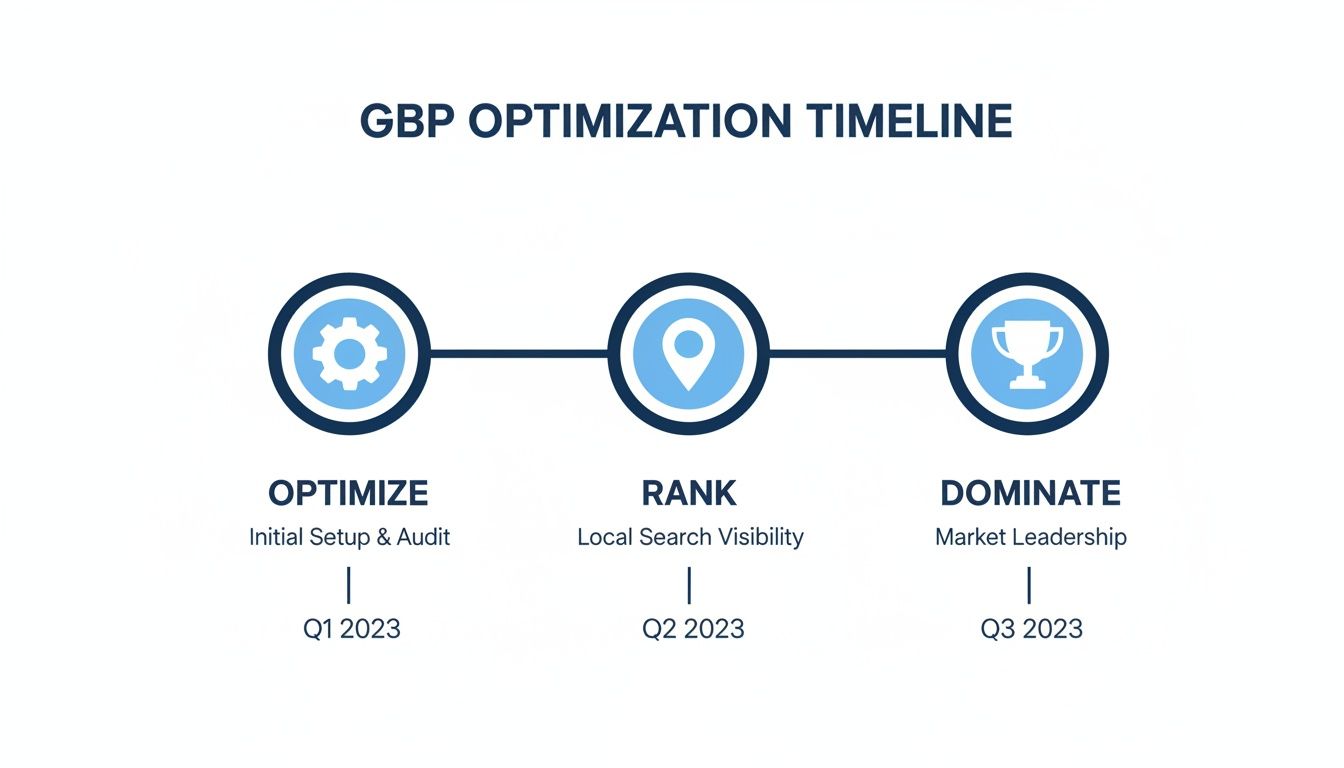
The initial optimization phase lays the groundwork, which then allows us to build ranking momentum, and finally, achieve the kind of long-term authority that drives a steady stream of new patients.
The timeline for a chiropractic practice isn't a mystery; it follows a predictable pattern when the right steps are taken. You can typically expect quick wins from GBP optimizations in the first 4-8 weeks. A more comprehensive local SEO push starts showing significant results within 3-6 months, with major goals like top-three Local Pack rankings often achieved in the 6-12 month timeframe.
For a deeper dive into these timelines, check out these chiropractic marketing insights on whitehat-seo.co.uk.
This strategic, phased approach ensures we're building a powerful and sustainable asset for your practice—one that becomes a reliable engine for acquiring new patients for years to come.
Common Questions We Hear From Chiropractors
Over the years, we've had hundreds of conversations with chiropractors about growing their practices. A few questions always seem to come up when we start talking about local search. Here are the straight-up answers to help you navigate your own local SEO efforts.
What's a Realistic SEO Budget for a Chiropractor?
It’s easy to get hung up on cost, but the real question is about return. A well-executed local SEO plan isn't an expense; it's a patient-acquisition engine. The goal is to generate far more in new patient revenue than you spend each month.
We focus on one thing: performance. We want your practice to show up when a potential patient types in a transactional search term—think "chiropractor for sciatica near me." When we drive those high-intent searches to your practice, the ROI becomes crystal clear in the form of more calls and booked appointments.
Can I Just Do My Own Local SEO?
Of course, you can handle the basics, like updating your Google Business Profile hours or posting a photo. But a serious local SEO strategy that actually moves the needle is a completely different beast. It's a full-time job that demands real expertise.
To truly compete, you need someone who lives and breathes technical SEO, knows how to create content that Google and patients love, builds strategic local links, and constantly analyzes performance data. Partnering with a specialist lets you focus on what you do best—providing amazing patient care—while our proven system handles the heavy lifting of getting your schedule filled.
The biggest mistake we see is treating local SEO as a one-time setup. It's not. The practices that dominate their local market are the ones engaged in a continuous cycle of optimization, content creation, and reputation management. That consistent effort is the secret sauce.
Does Video Really Matter for Local SEO?
Absolutely. Video is a massive trust-builder. Think about it: short, authentic clips of patient success stories, a quick tour of your office, or a simple demonstration of a specific technique can make a huge impact.
When you upload these to your Google Business Profile and website, you're not just adding content. You're giving potential patients a genuine feel for your clinic's environment and your approach before they even consider calling. Google rewards this kind of rich media, helping you stand out in a crowded search result page.
How Long Until I Actually See Results?
This is the big one. You can often see some positive movement from initial Google Business Profile optimizations in as little as 30 to 60 days. That’s the low-hanging fruit.
But getting to the top and staying there for those really competitive, high-value searches like "back pain relief near me" is a marathon, not a sprint. Building your website's authority, publishing expert-level content, and earning Google's trust as the go-to practice in your area is a process. Realistically, it takes a solid 6 to 12 months of consistent work to achieve dominant, lasting rankings.
Ready to stop guessing and start attracting a steady flow of high-intent patients? Transactional Marketing has a proven system to make your chiropractic practice visible for the transactional search terms that actually drive revenue. Let's make your phone ring. Learn more and get started today.