

When we talk about improving your website's conversion rate, we're really talking about turning more of your visitors into actual, paying customers. It's not magic. It comes down to a proven formula built on four critical pillars: having a fast, mobile-first website; establishing instant credibility with trust signals; placing calls-to-action that people can't miss; and, crucially, owning the local search results on Google Maps.
These aren't separate tactics—they're a system. At Transactional Marketing, we integrate traditional SEO, cutting-edge AI Optimization, and Google Maps optimization to turn people with urgent needs into your next scheduled appointment.
Winning the Local Search Game with High Conversion Rates
For any local service business, "conversion rate optimization" isn't just some marketing buzzword. It's the entire game. It's what transforms a frantic "roofer near me" search into a new job on your books. This guide cuts through the generic advice to give you strategies specifically designed to capture customers who have money in hand and are ready to spend it.
Here at Transactional Marketing, we live and breathe this stuff. Our entire approach is built around one thing: getting our clients in front of high-intent, transactional searches.
Think about it. When someone's basement is flooding or their AC gives out in July, they aren't just browsing. They have an urgent problem and money ready to solve it. That's the core of a transactional search term, and it’s precisely where we make sure our clients show up. This is why we are called Transactional Marketing—we get your business found when customers are ready to make a transaction.
Why Transactional Searches Demand a Different Playbook
This isn't e-commerce. A conversion isn't adding a product to a cart. For a local service, a conversion is a phone call, a submitted quote request, or a booked appointment. The customer's mindset is completely different; they're looking for quick answers, reassurance you're the right choice, and an incredibly easy way to connect.
Our system is engineered to deliver exactly that. We consistently get our clients showing up on page one of Google, typically within 30 to 60 days, for the exact transactional search terms that signal someone is ready to buy, like "air conditioning repair near me."
At Transactional Marketing, we don't measure success by website traffic. We measure it by the number of new jobs on your schedule. We laser-focus on the specific, transactional search terms that directly translate into revenue for your business.
This guide is your playbook. We're going to walk through everything from auditing your site to find those hidden "conversion killers" to rolling out quick wins that can start generating leads almost immediately.
The Unfair Advantage of Google Maps Optimization
A massive piece of this puzzle is Google Maps. A huge portion of your best customers will find you through the local "map pack." At Transactional Marketing, we have the technology and proven system to get your business into those top three map spots across your service areas. That kind of dominant visibility isn't just a vanity metric—it translates into hundreds of more phone calls every month and literally thousands of more phone calls every year.
To get you there, we’re going to cover the core areas that will turn your website from an online brochure into a customer-generating machine:
- Auditing and Prioritizing: We'll start by finding the biggest friction points on your website that are actively costing you leads.
- Quick Wins: Next, we'll implement high-impact changes to your CTAs, forms, and trust signals for immediate results.
- Google Maps Dominance: Your Google Business Profile will become a direct line for inbound calls.
- AI Optimization: We'll also touch on how to get your site ready for the next generation of search, including Large Language Models (LLMs) and voice assistants, ensuring you are found in AI-driven search results.
When you truly understand the key local search ranking factors, you can build a foundation that doesn’t just attract clicks—it consistently converts them into profitable work.
To put it simply, here are the essential elements that turn a local searcher into your next customer.
Core Pillars for Converting Transactional Searches
| Conversion Pillar | Why It Matters for 'Near Me' Searches | Expected Business Impact |
|---|---|---|
| Speed & Mobile Experience | The searcher is often on a phone, in a hurry, and has no patience for a slow or clunky site. | Lower bounce rates and a clear signal to Google that your site provides a good user experience. |
| Trust & Credibility | They need to know you're legitimate and reliable right now. Reviews, licenses, and guarantees are non-negotiable. | Higher form submission rates and more phone calls from qualified leads who feel confident in their choice. |
| Clear Calls-to-Action | When a problem is urgent, the solution needs to be obvious. A visible phone number or "Book Now" button is critical. | A direct increase in the number of leads generated from the same amount of website traffic. |
| Google Maps Dominance | Most customers won't look past the first few results on Google or Maps. If you're not there, you don't exist. | A significant and sustained increase in inbound calls and quote requests, often your highest-quality leads. |
Mastering these four areas is the difference between a website that just sits there and one that actively grows your business month after month.
Finding and Fixing Your Website's Conversion Killers
Before we can start boosting your conversion rates, we have to play detective. Right now, your website has hidden problems—I call them conversion killers—that are quietly turning away good, paying customers. The best way to find them is to put yourself in the shoes of a potential client who needs you now.
Picture this: a homeowner's pipe just burst, and they're frantically searching "plumber near me" on their phone. This is a transactional search term, and that customer has money in their hand, ready to spend. They land on your site. The clock is ticking. Can they find your phone number and call you in less than five seconds? If not, you’ve just lost that job to a competitor whose number was front and center.
That’s the exact mindset you need for a proper audit. For a customer with an urgent need, every extra click, every confusing menu, and every second a page takes to load is a dealbreaker. They're not on your site to browse; they're looking for an immediate solution to their problem.
Conducting Your High-Intent User Audit
Think of this as a stress test for how well your site serves someone who is ready to buy. The first rule is to do this on your smartphone, not your computer, because that's where most of your urgent, transactional leads will come from. Be brutally honest as you check these critical areas.
- The Five-Second Phone Number Test: Is your phone number a clickable button at the very top of every single page? If someone has to scroll or search for it, you are absolutely losing calls. It’s that simple.
- Page Load Speed Reality Check: A slow website is poison for conversions. Google's data shows that as page load time goes from one to three seconds, the chance of a mobile user leaving skyrockets by 32%. Does your site feel even a little sluggish?
- Navigation Clarity: Can a brand-new visitor figure out what you do and where you do it, instantly? Vague service descriptions or a messy menu make people work too hard. A confused mind always says no.
- Form Friction: Take a hard look at your contact or quote forms. Are you asking for anything that isn't absolutely essential? Every field you add—especially optional ones like "How did you hear about us?"—is another reason for someone to give up.
Going through this exercise gives you a clear, actionable punch list. You're no longer guessing; you're identifying the specific bottlenecks that are costing you money every single day.
Uncovering Hidden Friction Points
Some of the most damaging conversion killers aren't as obvious as a slow page load, but they are just as destructive. These problems usually boil down to trust and mobile usability—two things that are non-negotiable for local service businesses.
A website that isn't optimized for mobile users is like having a showroom with a locked front door. The majority of your best customers, especially those making a transactional search, will arrive via their smartphone.
For example, does your site look broken or unprofessional on a smaller screen? That immediately shatters any trust you might have built. A seamless mobile experience isn't a bonus feature anymore; it's the foundation for converting local search traffic. You can get a better sense of this by understanding what goes into creating mobile-optimized sites that convert.
Another classic mistake is hiding your trust signals. Is your "Licensed & Insured" badge buried on your 'About' page instead of sitting right next to your phone number? Does your quote form mention that you respect their privacy? These small details have a huge impact on whether a homeowner decides to trust you with their property. By systematically finding and fixing these issues, you clear the path for more leads and more booked jobs.
Tackling Quick Wins for Immediate Lead Growth
Once you’ve hunted down the conversion killers on your website, it’s time to roll up your sleeves and make some high-impact changes. The good news? You don't need a complete site overhaul to see a real difference in your lead flow. Often, the smallest tweaks to your calls-to-action, trust signals, and contact forms can yield the biggest returns.
This is all about removing friction and building instant confidence. Think about your customer. Someone searching for "emergency HVAC repair near me" isn't just browsing—they're making a split-second decision. Your job is to make choosing you the easiest decision they make all day.
From Generic CTAs to Compelling Actions
One of the fastest ways to get more leads is to ditch your generic call-to-action (CTA) buttons. A bland "Contact Us" button is a wasted opportunity. It’s passive and, frankly, a little boring. You need a CTA that speaks directly to a customer's urgent need.
For instance, a simple wording change can be a game-changer:
- Before: "Contact Us"
- After: "Get Your Free Roofing Estimate in Dallas"
See the difference? The second option is specific, offers clear value (a free estimate), and confirms you serve their local area. We zero in on these transactional search terms because they signal a customer is ready to buy, and a hyper-specific CTA reassures them you’re the solution they need right now. This is a core part of the Transactional Marketing strategy.
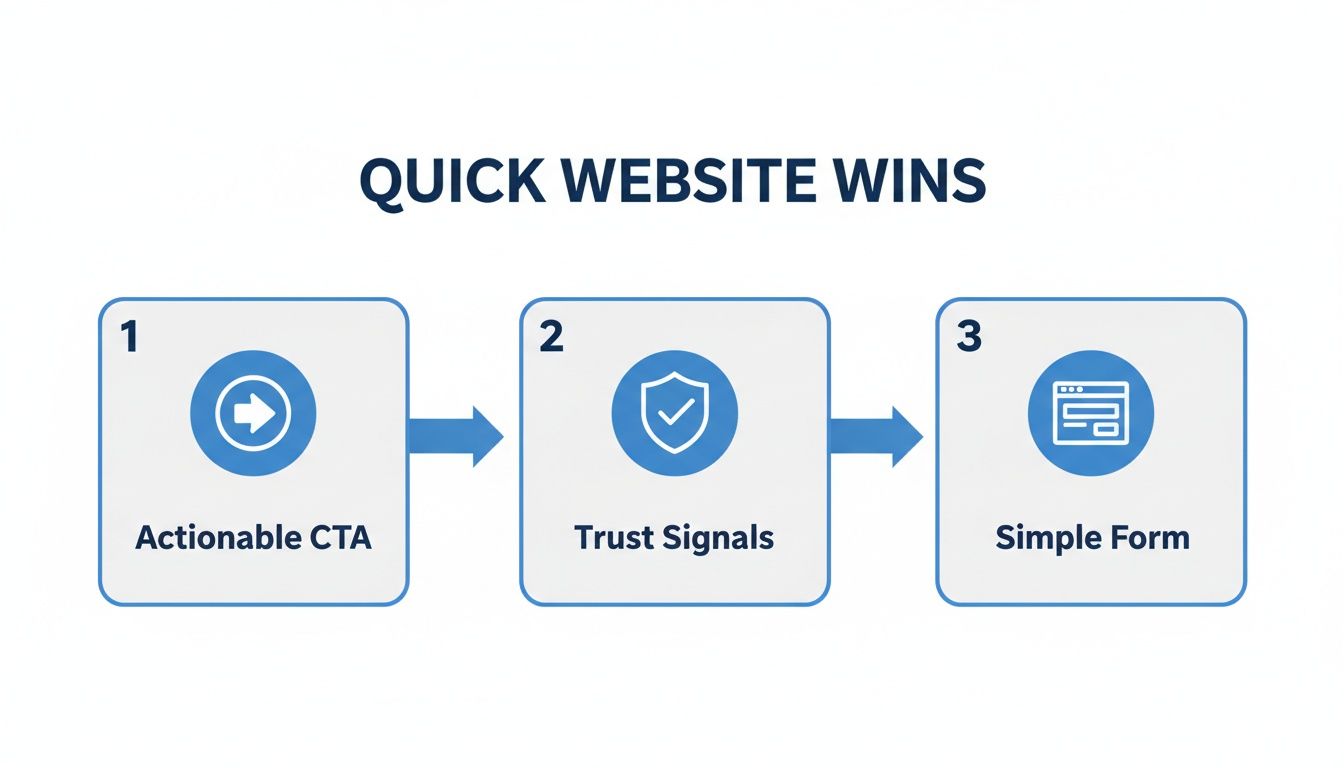
This diagram breaks down the process: create an actionable CTA, show off your credibility, and simplify your forms. It's a straightforward path to getting more leads, fast.
Build Instant Credibility with Trust Signals
When a potential customer lands on your site, the clock is ticking. You have just seconds to earn their trust, which is especially critical when they’re considering inviting a stranger into their home. This is where trust signals come in. Placing them strategically next to your phone number or contact form can dissolve doubt and push people to take action.
These aren't just decorative badges; they're powerful conversion tools.
Pro Tip: Place your most important trust signals—like "Licensed & Insured," your Google star rating, or an "A+ BBB Rating" badge—directly beside your main call-to-action. This simple move can erase any final hesitation a customer has before they pick up the phone.
I've seen massive conversion lifts from this one tactic alone. It reassures the customer that you’re a legitimate, professional operation at the exact moment they’re deciding whether to hire you.
Simplify Your Forms to Capture Every Lead
Finally, it's time to be ruthless with your contact forms. Every extra field you ask someone to fill out is another reason for them to give up and leave. For a customer in a hurry, a long, complicated form is an immediate dead end.
Strip your form down to the bare essentials. For an initial inquiry, all you really need is:
- Name
- Phone Number
- Email Address
- A simple text box for their problem
That's it. You can ask "How did you hear about us?" later. The goal right now is to make it incredibly easy for a customer to request service. Getting this right is how you start outperforming the baseline. The average e-commerce conversion rate hovers between 2% and 3%, but for local services targeting urgent needs, you should be aiming much higher. Simplified forms are a huge part of closing that gap.
If you want to dig deeper, this guide on how to improve website conversion rates offers some great strategies for diagnosing other issues and driving better results.
Dominating Google Maps to Drive Inbound Calls
Sure, your website is important. But for a local service business, the real action happens in the Google Maps pack. When someone searches for "air conditioning repair near me," those top three map listings are more than just suggestions—they're the solution. This is where the conversion happens, often before a potential customer ever lays eyes on your homepage.
Here at Transactional Marketing, our Google Maps optimization service is a cornerstone of what we do. It’s a direct pipeline to customers who are ready to buy, right now. Showing up in the top three of Google Maps translates directly into more phone calls—often hundreds of more phone calls every month and literally thousands of more phone calls every year.
Your Google Business Profile Is Your Second Homepage
You need to start thinking of your Google Business Profile (GBP) as a mini-website built for one thing: immediate action. For anyone making a transactional search, your GBP is the first impression, and every single element has to be geared toward turning that search into a call. This goes way beyond just listing your name and address; it's a strategic play.
We meticulously optimize every section of a GBP to match high-intent keywords. For instance, a roofer’s profile shouldn't just say "roofing." It needs to be packed with specific, transactional terms like "emergency roof leak repair" or "shingle replacement," directly mirroring the phrases their ideal customers are typing into Google.
This level of detail is what gets you found not just for general searches, but for the urgent, specific problems that drive immediate business.
Turning Questions into Conversions
The Q&A feature on your GBP is probably the most underutilized conversion goldmine out there. Most businesses just let it sit, waiting for customers to ask something. We flip that on its head. We use this section to proactively address and dismantle common sales objections before a customer even has a chance to hesitate.
We seed the Q&A section with questions we know customers are already thinking. For a dentist, we might add and answer, "Do you accept new patient emergency appointments?" or "What insurance plans do you take?" This simple step removes friction, builds trust, and makes the decision to pick up the phone that much easier.
By controlling the narrative here, you give people instant answers and guide them straight toward booking an appointment. It's all about anticipating their needs and showing them you're the most prepared, obvious choice. This is a core part of the Transactional Marketing system we use to help clients hit page one of Google within 30 to 60 days.
Using Google Posts for Time-Sensitive Offers
Think of Google Posts as free, targeted ads that live right on your profile. They're perfect for creating a sense of urgency and driving immediate action. We use them to blast out special offers, spotlight a specific service, or push seasonal deals that align with what people are searching for right now.
Here's how we turn Posts into a conversion machine:
- Create Urgency: A post like "15% Off AC Tune-Ups This Week Only" pushes people to call before the deal is gone.
- Highlight Key Services: During a cold snap, we’d feature a post about "Same-Day Water Heater Repair."
- Build Trust: We'll showcase a recent five-star review or a photo of a successfully completed job in a local neighborhood.
Each post sends a fresh signal to Google that your business is active and relevant, which helps boost your visibility. More importantly, it gives a customer with a problem another compelling reason to click your call button instead of your competitor's.
For a deeper dive into the specific tactics involved, you can learn more about how to rank higher on Google Maps and start turning that visibility into real profit. Ultimately, mastering the map pack is non-negotiable if you want to capture leads at their highest point of intent.
Using AI Optimization to Win Future Customers
The way customers find and choose local services is fundamentally changing. We're moving past the era of just typing keywords into Google. The new reality is people are having conversations with smart assistants and getting direct answers from AI-powered search engines. This isn't some far-off future; it's the new frontier of customer acquisition, and it’s how businesses will be found moving forward.
At Transactional Marketing, we focus heavily on AI Optimization. Our goal is to make your business the only recommendation when someone asks their phone, "Who's the best emergency plumber near me?" This is exactly where AI Optimization becomes a game-changer for your conversion rate, as it positions you to be found in search results powered by Large Language Models (LLMs).
Answering Questions Before They're Even Asked
At its core, this new search landscape is all about providing precise, direct answers. The Large Language Models (LLMs) that power tools like ChatGPT and Google's AI Overviews are built to find the single best answer, not just show a list of ten blue links. Our entire AI-driven content strategy is designed to anticipate the exact questions your ideal customers have on their minds.
We create content that establishes your business as the undisputed local authority. It's no longer enough to target a simple keyword like "dentist near me." We go deeper, building out content that directly answers the conversational questions people are actually asking:
- "What's the average cost of a dental implant in Dallas?"
- "Can I get a same-day crown from a local dentist?"
- "How do I find a dentist in my area who is great with kids?"
When you have the best, most comprehensive answers to these questions, you become the go-to source for the LLM. It sees you as the expert and recommends you directly. This is what it means to capture high-intent, transactional search terms in the age of AI.
Setting Realistic Conversion Goals with Real Data
While AI opens up exciting new possibilities, any good strategy has to be grounded in reality. We use real-world data to set practical benchmarks for what success actually looks like. The latest industry data gives us some fantastic context for our service-based clients.
For example, we know that businesses in the healthcare and medical sectors—which are a great proxy for dental practices or med spas—are seeing conversion rates between 2.8% and 4.2%. For a home service company like a pest control operator or an HVAC contractor, this tells us that hitting a 3-4% conversion rate is a fantastic result. It puts them right in line with, or even ahead of, their peers.
This data-driven approach keeps everyone honest. We're not chasing vanity metrics; we're focused on hitting achievable targets that drive real, measurable growth for your business.
Future-Proofing Your Lead Generation
Our proven system is engineered for speed and impact, getting businesses onto page one of Google for their money-making terms, often within 30 to 60 days. We bring that same laser focus to AI optimization. We use AI tools to dig into user behavior on your site, spotting friction points in the customer journey and running A/B tests on everything from button text to form layouts to find what truly converts.
This process creates a powerful, continuous feedback loop. We observe how real users interact with your site, refine the experience to make it smoother, and constantly update your content to better align with conversational search patterns. This ensures you're not just visible today but are building a durable competitive advantage for the future of search.
To get a better handle on this evolving field, I recommend diving into our complete guide on AI Search Engine Optimization. By getting ahead of this curve now, you're building a pipeline of high-intent leads that will keep your business thriving for years to come.
Tracking the Metrics That Actually Matter
It’s easy to get lost in a sea of data. Website traffic and impressions might look good on a report, but they don't pay the bills. For a service business, only a few numbers really move the needle: more phone calls, more form submissions, and ultimately, more jobs on the books.
That’s why we obsess over transparent reporting that draws a straight line from every single optimization we make to those tangible outcomes. You won’t get a fluffy report from us. You'll see exactly how our work targeting transactional search terms is driving real-world actions that grow your bottom line.
Leading Indicators of Revenue Growth
For any local business, two metrics are crystal-clear predictors of future revenue: keyword rankings for transactional terms and your visibility on Google Maps.
Think about it. When we get your business to page one for a search like "air conditioning repair near me," that’s not just a vanity win. It's a direct pipeline to a customer who needs your help right now. Our process is not like every other boring marketing company; we deliver these high-value rankings consistently within 30 to 60 days.
The same goes for your Google Maps presence. Our Google Maps optimization gets you a top-three spot in the local pack, which translates directly into inbound calls from customers who are ready to book an appointment.
The real takeaway here is that conversion optimization isn't a one-and-done project. It's a continuous cycle of testing what works, meticulously measuring the results, and refining your approach to keep the phone ringing.
Connecting Actions to Real-World Conversions
To truly understand what's driving your business and prove the value of your marketing, you have to implement robust call tracking software. This is non-negotiable. It’s the only way to attribute a phone call back to the specific marketing channel—or even the exact keyword—that brought you that lead. Once you connect those dots, you can confidently double down on what’s working and cut the fat.
Recent data shows just how important a well-rounded strategy is. While everyone is focused on mobile, desktop and tablet users still convert at higher rates (2.96-2.98% vs. 2.86% for mobile). This tells us you can't afford to ignore any device.
Interestingly, professional services have some of the highest organic search conversion rates at 2.7%, while paid search across all industries averages 3.2%. The lesson? A smart investment in both a strong organic presence and targeted paid campaigns is the fastest way to get measurable results for a local service company.
Frequently Asked Questions
You're not alone in wanting to get more leads from your website. Over the years, we've heard the same core questions from countless service business owners. Here are the straight-up answers to a few of the most common ones.
What’s a Good Conversion Rate for a Service Business Website?
You’ll often hear a general benchmark of 2-3%, but frankly, that’s a bit low for a local service business pulling in high-intent, transactional traffic. If people are actively searching for "roofer near me" or "dentist near me," you should be aiming for the 3-5% range, or even higher.
That said, we don't get too hung up on the percentage itself. A number on a report is one thing, but a ringing phone is what actually pays the bills. The real measure of success is a tangible increase in qualified calls and booked jobs.
How Quickly Can I See Conversion Rate Improvements?
Faster than you probably think. Some of the simplest changes can make an immediate impact. For instance, making your phone number a prominent, clickable button at the very top of your site can get you more calls literally overnight.
For the bigger, more sustainable wins, our proven system for local SEO and Google Maps optimization usually starts delivering a major lift in rankings and leads within 30 to 60 days. We’ve built our process to get you results that you can see and feel in your business, fast.
Should I Focus on SEO or Website Design for Better Conversions?
It's the classic chicken-or-egg question, but the answer is you need both. They're two sides of the same coin and are completely codependent.
Think about it: our specialized SEO is designed to get a customer making a transactional search like "emergency plumber near me" to your website. That's a golden opportunity. But if your site is clunky, slow to load, or impossible to use on a phone, that high-intent visitor is gone in a flash.
You need powerful SEO to attract the right people, and you need a clean, fast website to make it dead simple for them to hire you. One without the other is just a waste of money.
Ready to stop guessing and start getting more transactional leads from your website? The proven system from Transactional Marketing gets businesses like yours to page one of Google for the search terms that matter. Discover how we can grow your business today.