

When it comes to local SEO, the entire game boils down to one thing: being the answer when a customer needs you right now. It’s about showing up first for the transactional search terms that drive business, like "roofer near me" or "dentist near me". At Transactional Marketing, this is our laser focus, because a person typing those words has money in their hand and is ready to spend it.
This isn't about chasing likes or getting website traffic for the sake of it. This is about turning a search query into a ringing phone and a scheduled job. That's how local SEO directly generates revenue.
Your Blueprint for Capturing Transactional Customers
Let's be blunt: if your service business isn't on the first page of Google for your core services, you're invisible to the customers who matter most. Mastering local SEO is more than just a marketing checklist; it’s a direct pipeline to predictable, sustainable growth.
This guide is your playbook for dominating your service area. We're going to focus relentlessly on the exact transactional search terms customers use when they have a problem and need an immediate solution. This is not a generic guide for every industry; our approach is to target one industry per topic. For example, SEO for a roofing company is a completely different strategy than for a dental business.
We’ll walk through the pillars of modern local SEO—from optimizing your Google Business Profile and mastering Google Maps optimization to laying a foundation that keeps you visible for years to come. The entire focus is on attracting customers who are ready to hire you.
This is the proven system Transactional Marketing uses to get our clients' websites showing up on page one of Google, typically within 30 to 60 days. Our process isn't like every other boring marketing company. We know how to laser-focus and target specific search terms to get businesses to show up in their local cities, right where their customers are.
The Power of Transactional Keywords
You have to understand the difference between someone just browsing and someone ready to buy. It's all in the words they type into Google.
A search for "how to fix a leaky faucet" is purely informational. That person is in DIY mode. But a search for "plumber near me" is a transactional search term—they have a problem they can't solve and are actively looking to pay a professional. This distinction is the bedrock of our strategy at Transactional Marketing.
Consider this: a staggering 46% of all Google searches have local intent. With billions of searches happening every day, that’s a massive pool of potential customers looking for services right in your backyard. Your next customer is online, searching for you at this very moment.
This simple flow chart breaks down how we turn that online visibility into real-world dollars for your business.
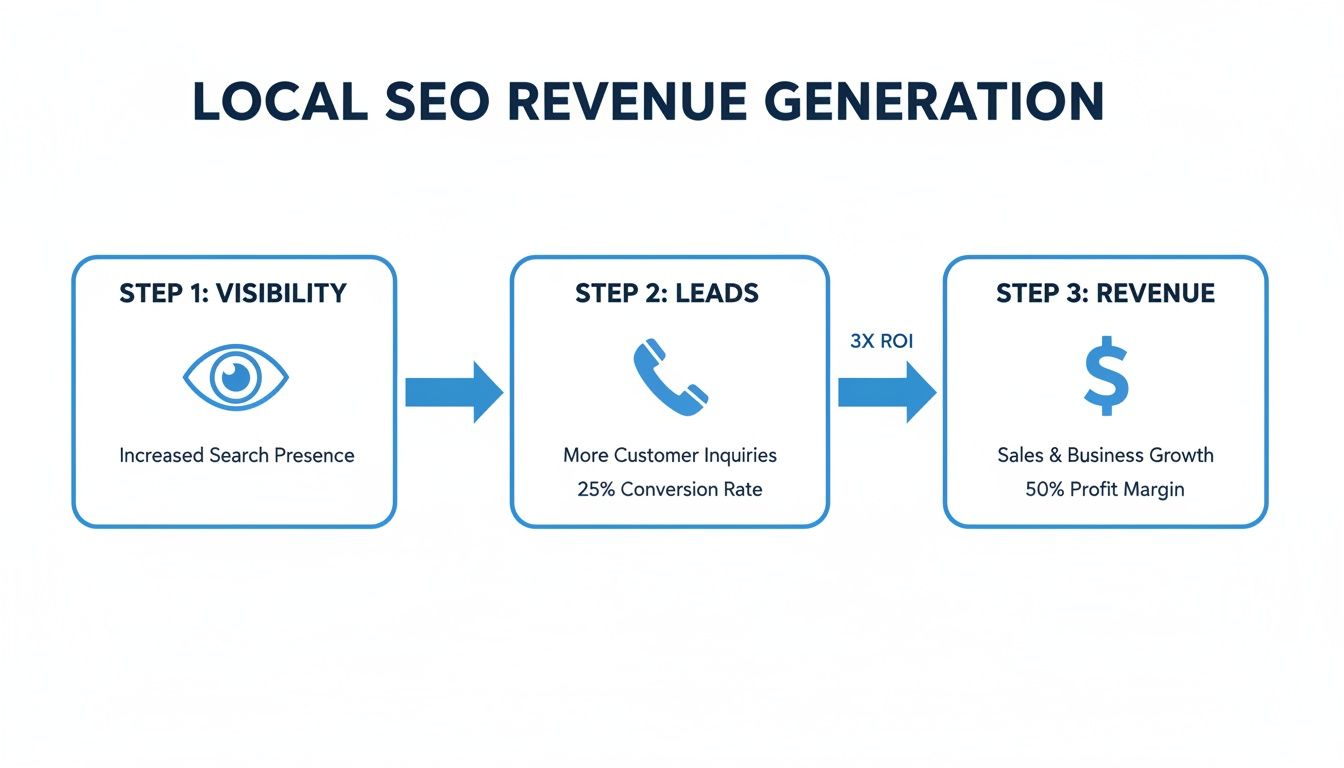
The takeaway here is simple but profound: more visibility leads directly to more leads, which in turn drives revenue. It creates a predictable growth engine. For a deeper dive tailored specifically to service providers, this resource on Local SEO for Contractors is an excellent read.
The Transactional Search Term Advantage
Understanding search intent is critical. While informational content has its place, transactional terms are what pay the bills today. This is why we are called Transactional Marketing—we get our customers to show up for these exact terms. This table clarifies why we focus so heavily on them.
| Search Type | Example Query | User Intent | Business Value |
|---|---|---|---|
| Transactional | "roof replacement houston tx" | Ready to hire a roofer now | High – Leads to immediate calls, estimates, and jobs. |
| Informational | "how much does a new roof cost" | Researching, comparing options | Medium – Captures potential future customers, builds authority. |
| Transactional | "air conditioning repair near me" | Urgent problem, needs immediate help | Very High – Often less price-sensitive, focused on speed and availability. |
| Informational | "signs of a water heater failing" | Trying to diagnose a problem | Low – Not yet looking for a service provider, may attempt a DIY fix. |
By prioritizing keywords where the user is clearly looking to make a purchase, you skip the tire-kickers and connect directly with people who need your services and are ready to pay for them. This focus is the fastest path to a positive ROI from your marketing efforts.
Mastering Your Google Business Profile and Maps Presence
Let’s be honest: your Google Business Profile (GBP) is the single most important marketing tool you have for winning local customers. It's not just a listing; it's the engine that puts your business in front of people who need you right now. For any service business—HVAC, plumbing, dental, you name it—a well-oiled GBP is what gets you into the coveted Google Maps "3-Pack" and makes your phone ring. This is why Google Maps optimization is a core service at Transactional Marketing.
Think about it from your customer's perspective. When someone frantically searches for "emergency AC repair near me," they aren't casually browsing. They have a problem, and they're ready to pay the first credible expert who can solve it. Our entire approach is built around making sure you are that expert. It all starts here.
Transactional Marketing has the technology to optimize these map locations and ensure they show up in the top three in their service areas. This isn't just about filling in the blanks on a profile. It’s about strategically sending all the right signals to Google, proving that your business is the most relevant, authoritative answer to a customer's urgent problem. Get this right, and you’re looking at hundreds of more phone calls every month and literally thousands more every year.
Choosing Your Categories with Surgical Precision
The first place I see businesses stumble is with their service categories. Your primary category is non-negotiable—it carries the most weight and tells Google who you are at a high level. For an HVAC company, that’s going to be "Heating contractor" or "Air conditioning contractor." Simple enough.
But the real magic happens in the secondary categories. This is your chance to get granular and target the specific, profitable services you offer. Don't just pick one or two; use every single relevant category available.
- An HVAC business should be adding "Air conditioning repair service," "Furnace repair service," and even "Duct and vent cleaning service."
- A dentist needs to include things like "Cosmetic dentist," "Dental implants provider," and especially "Emergency dental service."
This level of detail is a massive signal to Google. It helps you show up for those long-tail, hyper-specific searches that almost always come from someone ready to make a purchase.
Crafting a Description That Actually Converts
Think of your business description as prime real estate. This is your spot to tell both Google and your customers exactly what you do and where you do it, all while weaving in those crucial transactional keywords.
A generic "We are a full-service dental practice" just isn't going to cut it. It’s a wasted opportunity. Instead, try something with a bit more punch:
"As the leading emergency dentist in Springfield, we specialize in same-day root canals, crowns, and urgent dental care. Our practice is equipped to handle toothaches and emergency repairs for patients throughout the Springfield and Clark County areas. Call us for immediate appointments."
See the difference? This version is packed with transactional intent ("emergency dentist," "same-day root canals"), service keywords, and clear location signals. It leaves zero doubt about the problems you solve and for whom.
Proactively Answering Questions in the Q&A Section
The Google Q&A section is one of the most overlooked—and powerful—features on a GBP. This is where potential customers go with their final, make-or-break questions. If you aren't the one answering them, someone else might, or worse, the silence could cost you the lead.
Don't wait for questions to roll in. Take control of the narrative by pre-populating this section yourself. Brainstorm the most common questions you already get on the phone and post them from a personal account.
- "Do you offer financing for new AC units?"
- "What are your emergency service hours?"
- "Is a consultation for dental implants free?"
Then, log in as the business and provide clear, helpful answers. This tactic not only addresses customer friction points upfront but also gives you another chance to include your target keywords naturally. It builds trust and helps a potential customer make a decision that much faster.
Leveraging Google Posts for Immediate Action
Google Posts are essentially free mini-billboards that show up right on your profile and in the Maps results. They are perfect for driving immediate action, which is a goldmine for any service business.
Use them to create urgency and highlight offers that get people to pick up the phone.
- HVAC: "Limited Time Offer: $50 Off Any AC Repair This Week! Call Now to Book."
- Dentist: "New Patient Special: $99 Cleaning, Exam & X-Rays. Offer Ends this Month."
- Roofer: "Free Roof Inspection for Storm Damage. Don't Wait for a Leak—Call Us Today."
These posts aren't just for customers; they also show Google that your profile is active and being managed, which is always a positive signal. At the end of the day, your GBP and Google Maps presence are direct lines to revenue. When you stop treating them like static listings and start using them as the dynamic sales tools they are, you'll be perfectly positioned to capture the best customers in your market.
Building Your On-Page and Technical SEO Foundation
Your Google Business Profile might be the star of the show, but it can't perform without a strong supporting cast—and that's your website. Think of your GBP as the flashy billboard on the highway and your website as the actual storefront. If a customer pulls off the highway and finds a rundown shop, they're gone. The two need to work together perfectly.
This connection is what convinces Google you're a legitimate, authoritative expert in your area. When a homeowner is in a pinch and searches for "AC repair near me," Google doesn't just glance at your GBP. It digs into your website to verify you actually offer that service in that location. A shaky on-page or technical foundation will completely undermine all the effort you've poured into your Google profile.
Dedicated Pages for Every Service and Location
The single biggest mistake I see service businesses make is cramming everything onto one generic "Services" page. It’s a classic move, and it’s a recipe for confusing both potential customers and Google's crawlers. To actually rank for the transactional searches that make your phone ring, you need to get specific.
That means creating a dedicated page for each core service you offer and for each primary city you serve. Our strategy always separates industries and services—SEO for a roofing company gets its own content, completely separate from SEO for a dental business.
Let's say you're a roofer based in Phoenix, but you also work in Scottsdale and Mesa. Your site structure should look something like this:
- Service Pages: One page for "Roof Repair," another for "Roof Replacement," and one for "Commercial Roofing."
- Location Pages: A dedicated page for "Phoenix Roofing Services," one for "Scottsdale," and another for "Mesa."
This structure gives you the space to get hyper-focused. Your "Roof Repair" page can be optimized for terms like shingle repair and storm damage leak patching. Meanwhile, your "Phoenix" page can target broader keywords like roofer in Phoenix AZ. This kind of clarity is exactly what Google’s algorithm is designed to reward.
By creating specific, targeted pages, you're essentially drawing Google a map. You're saying, "Hey, I'm the expert for this exact service right here in this specific town." That's the secret to ranking for those high-value, ready-to-buy searches.
Optimizing On-Page Elements for Local Intent
Once you've built out these dedicated pages, it's time to tune up the core on-page elements. These are the direct signals you send to search engines about what each page is about.
- Title Tags: This is your most powerful on-page signal. The formula is beautifully simple: Primary Service + City/Location | Brand Name. A dentist’s page title, for example, should be "Emergency Dental Care in Austin | Smile Bright Dental."
- Meta Descriptions: This doesn't directly influence your ranking, but it absolutely influences whether someone clicks on your result. A good meta description sells the click. It needs to include your keyword, a clear benefit, and a call to action. Something like: "Need fast relief? Our Austin emergency dental clinic offers same-day appointments for toothaches and repairs. Call now for immediate care!"
- Headers (H1, H2): Your main page heading (the H1) should be a close match to your title tag. Then, use subheadings (H2s and H3s) to break up the content and naturally weave in variations of your keywords. Think "Common Dental Emergencies We Treat" or "Your 24/7 Emergency Dentist in Austin."
The Non-Negotiable Technical Elements
What happens behind the scenes is just as important as the content your visitors see. A few key technical pieces have to be in place for local SEO to really work.
First up is LocalBusiness schema markup. This is a snippet of code that gets added to your website, and it spoon-feeds Google your business details—name, address, phone number (NAP), hours, and service type—in a language it perfectly understands. It takes all the guesswork out of the equation for search engines.
Second, your website must have a mobile-first design. I can't stress this enough. The overwhelming majority of "near me" searches happen on a smartphone, often when someone is in a jam. If your site is slow, clunky, or hard to read on a phone, you've lost that customer. Google knows this and will bury your site in the rankings.
Having a responsive site isn't a bonus anymore; it's the cost of entry. To see if your site is up to par, learn more about why mobile-optimized sites are crucial for converting local traffic and generating more leads. A fast, clean mobile experience is your best bet for capturing every single lead, no matter what device they're using.
Building Local Authority with Citations and Reviews
Once your website and Google Business Profile are dialed in, Google starts looking for outside proof. It wants to see that you're a real, trusted authority in your local market, not just a slick website. This proof really boils down to two things: local citations and customer reviews.
Getting these right is how you build a rock-solid online reputation. It directly translates into higher rankings and, more importantly, more calls from qualified customers.
Think about it from your customer's perspective. When they're frantically searching for an "emergency plumber near me," they need to make a quick decision they can trust. Seeing your business listed consistently across the web with a pile of positive feedback removes all doubt. A strong citation and review profile tells both Google and your future customers that you are the safe, reliable choice.

The Critical Importance of NAP Consistency
The bedrock of your entire local presence is something we call NAP consistency. This is your business Name, Address, and Phone number. These three pieces of information must be identical everywhere they appear online, from your own website to Yelp to a niche industry directory.
I mean identical down to the character.
Even tiny variations—like listing "Street" on one site and "St." on another—can create confusion for search engines. That confusion erodes the trust Google has in your business data, which can seriously drag down your local search visibility. The fix? Establish one single source of truth for your NAP info, which should always be the contact page on your website. Every other listing you build must be a perfect mirror of what’s on that page.
Securing High-Authority Local Citations
Local citations are simply online mentions of your NAP information. Every consistent mention acts like a digital breadcrumb confirming your location and legitimacy. But here’s the key: not all citations carry the same weight.
Sure, you need to be on the big directories like Yelp and Foursquare. But the real leverage comes from getting listed on high-authority local and industry-specific sites.
- Local Powerhouses: Think your city’s Chamber of Commerce, local business journals, or even community news websites.
- Industry-Specific Directories: For a dentist, this might be Healthgrades. For a roofer, it could be a directory run by a major shingle manufacturer like GAF or Owens Corning.
These niche citations send a much stronger signal to Google. They prove you're not just a business in a location, but a recognized player within your specific field. We've put together a full playbook for finding these goldmines in our guide to citation building for local SEO.
A consistent and robust citation profile acts as a vote of confidence. The more reputable sites that list your business correctly, the more Google trusts that you are who you say you are and that you serve the area you claim.
A System for Generating Consistent 5-Star Reviews
Reviews are the lifeblood of any local service business. Don't just take my word for it—research shows 95% of consumers use reviews to make decisions, and a staggering 86% consider them essential. For ranking in the Google Maps pack, a steady stream of positive reviews is one of the most powerful signals you can send.
You can't just cross your fingers and hope for good reviews. You need a simple, repeatable system.
- Timing is Everything: The absolute best time to ask for a review is right after a successful job when the customer is happiest. For an HVAC tech, that’s right after the AC kicks back on during a heatwave. For a dentist, it’s after a painless, positive check-up.
- Make It Effortless: Don't make them hunt for it. Send a direct link to your Google review page via text or email. The fewer clicks it takes, the more likely they are to do it.
- Train Your Team: This should be part of your standard operating procedure. A simple, genuine "We'd be so grateful if you could take 30 seconds to share your experience on Google" from your technician can work wonders.
And don't forget to respond to every single review, good or bad. A thoughtful "thank you" to a positive review shows you're engaged. A professional and helpful reply to a negative one shows you take accountability. This active management is a masterclass in building trust.
The Future of Local Search Is AI Optimization
The way people find local businesses is rapidly changing. It's moving beyond just typing "roofer near me" into a search bar. We are entering the era of AI Optimization, where customers ask their devices questions and Large Language Models (LLMs) provide the answers. If your SEO strategy isn't built for this new world, you will become invisible.
This is why AI Optimization is a core part of what we do. It's about structuring your website content so that AI-driven search engines and LLMs don't just see you as an option—they see you as the definitive authority for your service in your city. This is the new frontier for how businesses get found.

Building Authority with Content Silos
So, how do you prove your expertise to an algorithm? One of the most effective strategies is building out content silos. Think of it as organizing your website to scream "we are the experts." Instead of one generic "Services" page, you create a deep hub of knowledge for each specific service you offer.
It’s a pretty straightforward concept in practice:
- Start with a Pillar Page: This is your big, comprehensive guide to a core service. For a roofer, a perfect pillar page would be "Roof Replacement Services in [Your City]." It covers the topic from A to Z.
- Add Supporting Content: Next, you create a cluster of shorter, more specific articles that all link back to that main pillar page. These articles answer the nitty-gritty questions your customers are actually asking right before they decide to hire someone.
This structure sends a crystal-clear signal to both Google and emerging AI models. You’re not just another company that offers a service; you're the go-to resource on every single aspect of it.
Targeting Transactional Questions
Those supporting articles are your secret weapon. This is where you target the high-intent, transactional keywords and questions that drive real business. We're not talking about broad searches; we're talking about the specific problems a customer needs solved right before they pick up the phone.
Let's stick with our roofer. The supporting articles in their silo would tackle real-world queries like:
- "How much does a new shingle roof cost in Austin?"
- "5 signs you need an emergency roof repair right now"
- "What's the best roofing material for hot Texas weather?"
Each piece is a laser-focused tool designed to catch a customer at that make-or-break moment. You're not just hoping to show up for "roofer near me"; you're capturing the person who is one question away from making a buying decision. This is exactly what we focus on at Transactional Marketing—getting you found for the transactional searches that actually turn into jobs.
An AI-driven content plan doesn't guess what customers are searching for. It uses data to pinpoint the exact questions that signal purchase intent, ensuring every piece of content you create is a magnet for qualified leads.
Future-Proofing for AI Answer Engines
The true genius of a content silo shines when you think about how LLMs and AI search work. When someone asks an AI, "What's the most durable roofing material for a hot climate?" the AI isn't just looking for keywords. It’s searching for the most complete, authoritative, and well-structured answer available online.
By building out these deep content silos, you're essentially handing the AI a perfectly organized knowledge base on a silver platter. It can easily digest your expertise and serve it up as the definitive answer. You’re no longer just optimizing for a list of blue links; you're positioning yourself to be the source for AI-generated recommendations. If you want to dive deeper into this, our guide on AI search engine optimization is a great next step.
This approach ensures you stay relevant as search technology continues to evolve. Whether your next customer is using a keyboard or talking to an AI, your business will be right there, positioned as the expert with the solution they need.
Tracking Your Local SEO Wins and Proving the ROI
Let's be honest, marketing can feel like you're throwing money into a black hole if you can't see what's coming out the other side. Forget about fuzzy metrics like "website traffic." We focus on what actually pays the bills: phone calls, contact form fills, and actual booked jobs.
This is the only way to know for sure that your SEO efforts are a smart investment, not just another business expense. You need to be able to draw a straight line from ranking for a specific transactional search term to a new customer calling your front desk. That’s how you prove the strategy is working.
Use Google Search Console to Find Your Money Keywords
Think of Google Search Console (GSC) as a direct peek into your customers' minds. It's a free tool that tells you exactly what people are typing into Google before they click on your website. For tracking your transactional keywords, it's pure gold.
Don't just glance at the overview. You need to get your hands dirty in the "Performance" report. This is where you can filter down and see the exact search terms—the queries—that are bringing people to you.
- Informational Search: "how long does a furnace last" – Sure, it gets traffic, but it's rarely from someone who needs a new furnace today.
- Transactional Search: "emergency HVAC repair near me" – This is the exact term we get our customers to show up for. It’s a search that leads to a ringing phone.
When you see your rankings climb for these transactional keywords in GSC, you know the right kind of customers are finding you.
See Your Local Dominance with Rank Heat Maps
For a service business that covers an entire city or county, a simple list of keyword rankings just doesn't cut it. You don't operate out of a single dot on the map—your service area is your battleground. This is precisely why rank tracking heat maps are a game-changer.
These tools give you a bird's-eye view of your Google Maps rankings across your entire territory. You can literally see, neighborhood by neighborhood, where you're crushing it in the top 3 and where you're invisible.
A heat map takes your ranking data out of a spreadsheet and puts it onto a map of your city. It’s your digital footprint, showing you exactly where to focus your efforts to win over the most valuable customers.
This kind of visual proof is incredibly powerful. As your SEO campaign progresses, you can watch your digital presence spread across town like wildfire, connecting our work directly to your growing reach.
Knowing how to measure marketing ROI is everything, and heat maps give you a tangible way to see that return. In the end, tracking isn't about hoarding data; it's about using that intelligence to make smarter decisions that grow your business.
Your Top Local SEO Questions, Answered
How Long Does Local SEO Take to Work?
This is the big question, isn't it? While every city and service is different, Transactional Marketing has a proven system that gets customers' websites showing up on page one of Google, typically within 30 to 60 days.
It's not about doing everything at once. We achieve these results by laser-focusing on high-value, transactional search terms—the searches people make when they are ready to buy. This is how you get leads and calls coming in quickly, not six months down the line.
What’s the Single Most Important Thing for Local SEO?
Hands down, it's your Google Business Profile (GBP). This one profile is the engine behind your visibility in Google Maps and the all-important "3-Pack."
Think of it as your digital storefront. A dialed-in GBP with the right service categories, a solid description packed with relevant keywords, and a consistent flow of new reviews is the fastest path to getting in front of customers searching for transactional terms like "dentist near me" or "roofer near me."
Can I Just Do Local SEO Myself?
You can absolutely get the ball rolling. Setting up your Google Business Profile and making sure your business name, address, and phone number are correct everywhere is a great start.
But when you're in a competitive market, the basics aren't enough. Winning requires a deeper strategy that weaves together technical website fixes, smart citation building, and a content plan that answers your customers' real questions. It’s about making all the pieces work together to dominate those high-intent, transactional searches.
Local SEO isn't a checklist you complete; it's a competitive race. Your goal isn't just to show up. It's to be more visible and more trusted than every other business fighting for the same customers in your service area.
Why Is Showing Up on Google Maps Such a Big Deal?
Landing in the top three results on Google Maps is the digital equivalent of having a billboard on the busiest highway in town. For local services, this is where the final buying decision is made.
This is why we've obsessed over Google Maps optimization. Transactional Marketing has the technology to turn these map locations into top-three powerhouses in their service areas. This isn't just for vanity—it translates directly into hundreds of more phone calls every month and thousands more every year.
Ready to stop being invisible to your best customers? The team at Transactional Marketing specializes in getting service businesses like yours to show up for the transactional search terms that actually drive revenue. Let's make your phone ring.