

Tired of the feast-or-famine cycle? It's a classic problem for HVAC businesses. You're slammed when it’s scorching hot or freezing cold, but then you're just waiting by the phone when the weather is mild. That rollercoaster cash flow makes it impossible to grow, hire with confidence, or plan for the future.
If you want to stop chasing unpredictable, one-time repair jobs, you need to build a stable, predictable revenue stream. And the best way to do that is with a solid HVAC maintenance contract. This isn't just paperwork; it's the key to turning a single service call into a long-term, profitable customer relationship. More importantly, it's a powerful tool to get your business found for the transactional search terms that drive immediate revenue—the exact terms customers use when they have money in hand and are ready to hire.
Turn One-Off Repairs Into Predictable Revenue
The real solution to inconsistent work is moving your business from being purely reactive to proactive. Instead of just fixing things when they break, you become the trusted partner who keeps them from breaking in the first place.
A professionally crafted HVAC maintenance contract formalizes that partnership. It takes a one-time transaction and turns it into recurring income you can count on. That stability isn't just great for your bank account—it dramatically increases the value of your business because you can prove you have consistent, predictable revenue. The most successful, scalable businesses are built on these kinds of recurring revenue business models.
The Transactional Marketing Advantage
Here at Transactional Marketing, our entire approach is built around connecting you with customers who are ready to spend money right now. These are the people actively searching for transactional terms like "AC repair near me" or "furnace tune-up in [Your City]." This is why our name is Transactional Marketing—we laser-focus on getting our clients to show up when a customer is ready to spend money. A well-defined maintenance plan is an absolute goldmine for attracting these high-intent customers. Every service you list in that agreement—from coil cleaning to refrigerant checks—is a search term someone is typing into Google.
Think about it: by creating dedicated pages on your website for each service in your maintenance plan, you're giving Google and AI language models exactly what they need to find you for those searches. This is how our proven system gets your website showing up on page one of Google, typically within 30 to 60 days. This is how you start to dominate local search results and, most importantly, the Google Maps listings, which translates into hundreds more phone calls every month.
This guide is more than just a template you can download. We’re going to walk you through how to tweak every single section of your contract to maximize your profit and keep customers coming back. You’ll learn how to build trust and create a powerful marketing tool that works for you 24/7.
Ultimately, a strong contract helps you land on the first page of Google, turning those transactional search queries into scheduled appointments and reliable income. For a deeper dive on this, our guide on how to improve website conversion rate can show you how to turn more of those website visitors into paying customers.
Defining Your Scope Of Work to Prevent Disputes
Let’s be honest: the single biggest headache in this business often comes from a simple misunderstanding over what is—and isn’t—included in a maintenance plan. Ambiguity is the enemy. A crystal-clear scope of work in your HVAC maintenance contract isn't just a legal shield; it's your best defense against scope creep, angry phone calls, and the dreaded one-star review.
This goes beyond just covering your bases. It's actually a savvy marketing move and a critical component of AI optimization. At Transactional Marketing, we help our clients dominate high-intent, local search. When you spell out services like "biannual coil cleaning" or "condensate line flush" in your contracts and on your website, you're creating the exact content Google and new AI search tools love. Suddenly, you're the top result when a local business owner searches for a transactional term like "commercial HVAC coil cleaning near me." Your contract becomes a lead-gen tool.
Detailing What’s Included
Your scope of work should read like a detailed checklist, leaving zero room for interpretation. Put yourself in the customer’s shoes. They want to know exactly what their money is getting them.
Think about listing out specific, tangible tasks:
- Two Scheduled Tune-Ups: One for the cooling season, one for heating. Simple, but essential to state.
- Filter Changes: Be specific. Are you including two standard 1-inch pleated filters per year? What about specialized sizes? Spell it out.
- Component Cleaning & Inspection: Don't just say "inspection." List the key actions like cleaning condenser and evaporator coils, tightening all electrical connections, and lubricating moving parts.
- System Diagnostics: Mention thermostat calibration, checking refrigerant levels (note: checking, not adding), and performing carbon monoxide safety tests on furnaces.
This clarity helps shift your business model from chasing one-off repairs to building a stable, predictable revenue stream.
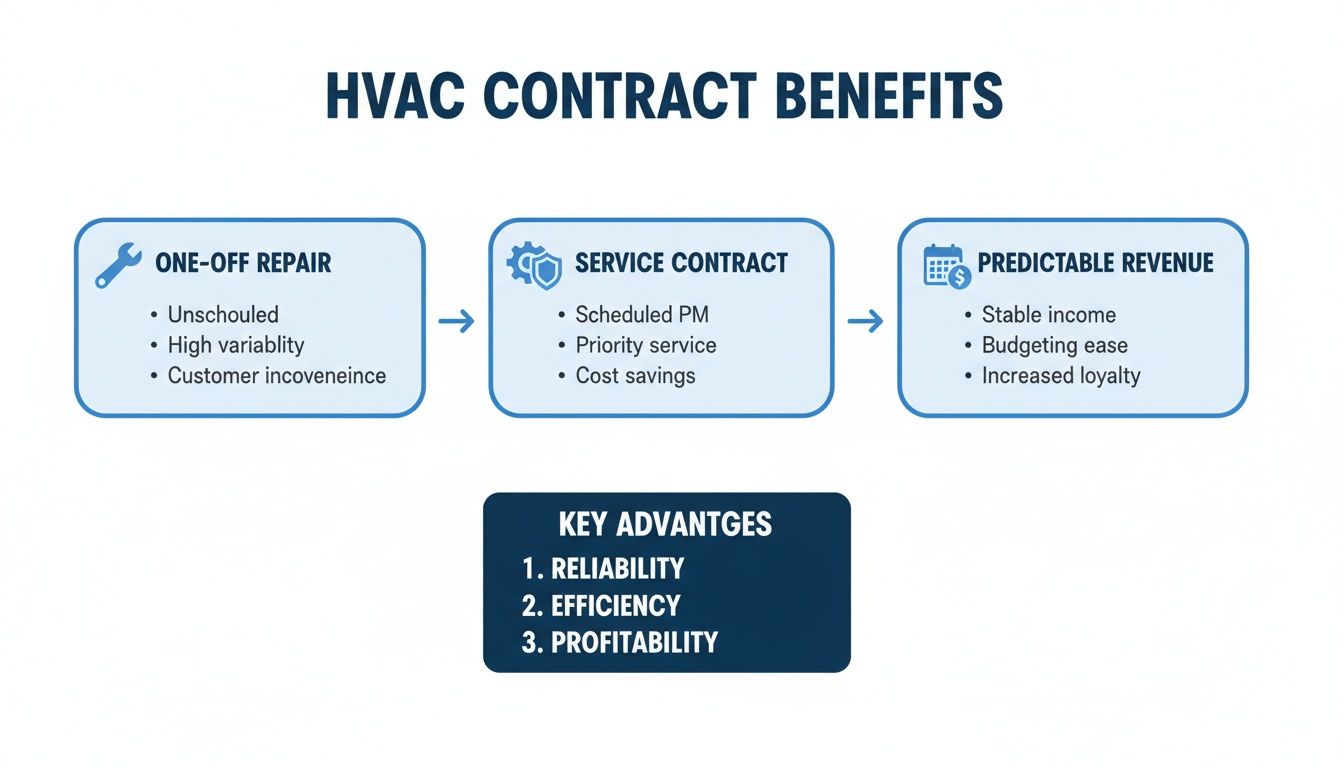
As the flowchart shows, service agreements are the foundation for growth. They turn the chaos of emergency calls into a sustainable income you can count on, month after month.
To give customers a clear choice, it's a great idea to tier your services. Here’s a quick look at how you can structure what’s included in a standard plan versus what you might reserve for a premium offering.
Essential vs. Premium Service Inclusions
| Service Component | Standard Plan (Included) | Premium Plan (Add-On/Included) |
|---|---|---|
| Scheduled Visits | 2 per year (Spring/Fall) | Up to 4 per year (Quarterly) |
| Response Time | Standard 24-48 hour response | Priority/Guaranteed 4-hour response |
| Filter Replacement | Standard 1-inch filters | All filter sizes, including media filters |
| Coil Cleaning | Basic condenser coil rinse | Deep chemical clean (condenser & evaporator) |
| Drain Line Flush | Included | Included + annual drain pan treatment tablets |
| Repair Discounts | 10-15% off parts & labor | 20%+ off parts & labor, no diagnostic fees |
| After-Hours Calls | Standard emergency rates apply | No overtime charges for emergency calls |
Structuring your offerings this way makes the value of your premium plan immediately obvious and helps customers self-select the level of service that best fits their needs and budget.
Defining What’s Not Included
Being upfront about what isn’t covered is just as important. This is where you manage expectations and prevent the classic "I thought that was included!" argument when a major component fails.
A rock-solid "Exclusions" clause is your safety net. It protects your profitability by making sure you get paid fairly for work that goes far beyond a standard tune-up.
For example, your contract should state in plain English that it doesn't cover:
- Catastrophic Failures: Things like a dead compressor, a cracked heat exchanger, or a seized blower motor are repairs, not maintenance.
- Refrigerant: Specify that checking the charge is included, but the refrigerant itself and the labor to add it are billable.
- After-Hours Emergencies: Unless they've bought a premium plan, make it clear that calls outside of business hours come with additional charges.
- Ductwork & Airflow Issues: Clarify that the agreement covers the HVAC equipment, not the building’s duct system, registers, or insulation problems.
By meticulously defining both what you do and don't do, you build a foundation of trust. This transparency is exactly what customers are looking for, and it strengthens your reputation when they find you on platforms like Google Maps—a critical channel we focus on at Transactional Marketing. Our technology helps get our clients into the top three map listings, driving hundreds of qualified, transactional calls to their business every month.
Structuring Pricing and Payments For Profitability
How you price your service agreements is just as critical as the quality of the work you do. Let's be honest, getting the pricing right isn't just about covering costs; it's a powerful marketing tool that attracts and keeps the kind of customers you want for the long haul. If you're still stuck on a simple cost-plus model, you're leaving money on the table.

This is where your HVAC maintenance contract template stops being just a piece of paper and starts driving real revenue. Smart pricing models are designed to speak to different types of customers while making your business more profitable.
Flat-Rate vs Monthly Subscriptions
I've seen HVAC businesses succeed with both of the main payment structures, and some offer a mix. The right choice really comes down to who your customers are and what your cash flow needs look like.
- Annual Flat-Rate: The old-school approach. The customer pays one lump sum for the whole year. This is fantastic for your cash flow, as you get the revenue upfront and it makes bookkeeping a lot simpler. Plenty of customers still love the "set it and forget it" convenience.
- Monthly Subscriptions: This is the model that's really taken off. A smaller, recurring monthly payment feels much more manageable for a homeowner's budget, making it an easier "yes." For you, it creates a steady, predictable income stream month after month, which makes forecasting and budgeting a dream.
A common and effective strategy is to offer both. You might frame the annual plan with a small discount—think "pay for 11 months, get the 12th free"—to nudge people toward the upfront payment while still capturing those who prefer the monthly option.
Designing Tiered Maintenance Plans
A one-size-fits-all plan is a recipe for missed opportunities. Your customers have different homes, different budgets, and different ideas about what's worth paying for. By setting up tiered plans—maybe a "Basic," "Pro," and "Elite" package—you can appeal to a much wider audience and give your techs an easy way to upsell.
Think of your pricing page as one of your best salespeople. When you lay out the benefits of each tier, you're guiding the customer to the right choice for their needs. This is how you directly answer someone searching for a transactional term like "affordable HVAC service plans" and turn them into a paying customer.
For instance, your Basic plan could cover the two essential seasonal tune-ups. Step up to the Pro plan, and maybe they get a discount on repairs and priority service. The Elite tier could include perks like no overtime charges and coverage for certain common parts. This structure has something for everyone, from the budget-conscious homeowner to a commercial client who sees downtime as a disaster. You can even model how different offerings impact your bottom line with something like our ROI calculator for marketing spend, which demonstrates how targeted plans improve returns.
This isn't just a small-time play. The global market for HVAC maintenance contracts is already valued at a staggering $52 billion and is expected to nearly double to $106 billion by 2033. For an HVAC business like yours, a solid, standardized HVAC maintenance contract is your ticket to getting a piece of that pie. These agreements create recurring revenue that can boost your annual income by a very real 25-40%.
The Fine Print: Essential Legal Clauses That Protect Your Business
A contract’s real strength lies in its legal protections. While the scope of work and pricing are the engine, these legal clauses are the steel frame holding everything together. They’re what keep your business safe and sound.
This isn't just about sounding official; these are the critical shields that build trust and signal to high-value local customers that you're a true professional.
Think of these clauses as your non-negotiables for managing risk. They draw clear lines, set boundaries, and stop small misunderstandings from spiraling into costly legal battles. Skipping them is like leaving your shop unlocked overnight—it's a risk you just can't afford to take.
Limitation of Liability and Insurance
One of the most important sections you'll include is the limitation of liability clause. This language makes it clear that your company isn't on the hook for unforeseen damages that fall outside the direct scope of your maintenance work.
Here’s a real-world example: say a pre-existing electrical issue in a client's home causes a system to fail right after your tune-up. This clause helps protect you from being blamed for an unrelated problem. It's a lifesaver.
Just as critical is spelling out your insurance requirements. Your contract should state that you carry proper general liability and workers' compensation insurance. This isn't just for your own protection; it gives your clients incredible peace of mind, proving they’ve hired a legitimate, professional outfit.
When putting together your HVAC maintenance contract, it's always a good idea to cross-reference a solid small business contract template guide to make sure your legal language is rock-solid.
Termination and Renewal Conditions
You need clear rules of the road for how the agreement can end or continue. Without them, you're just asking for disputes. Your contract has to specify:
- Notice Period: How much warning is needed to end the contract? Be specific (e.g., 30 days written notice).
- Cancellation Triggers: List the valid reasons for immediate termination, like a client refusing to pay or providing an unsafe work environment.
- Auto-Renewal: This is a game-changer for client retention. Including an automatic renewal clause flips the model to "opt-out," which keeps service—and revenue—flowing unless a client actively decides to cancel.
The HVAC services market is on track to hit $97.9 billion by 2030, and a huge chunk of that is preventive maintenance. Contracts that bundle valuable services like indoor air quality checks can command a premium. For an HVAC company, showcasing these benefits on your Google Business Profile is smart marketing that helps you rank for transactional searches like ‘HVAC contract service’ and turn those searches into paying customers.
The goal here is fairness and clarity. A well-written termination clause protects you from getting stuck in a bad deal while giving the customer a reasonable way out.
These legal protections are the bedrock of a good contract. For a real-life example of transparent business practices, feel free to review our own terms and conditions.
Turn Your Contract Into a Local SEO and AI Optimization Powerhouse
Ever thought of your HVAC maintenance contract as a marketing tool? Most don't, but that's a missed opportunity. This document isn't just about operations; it's a powerful, untapped asset that can transform your online presence and start generating calls instead of just waiting for them. This is the new way businesses are going to be found, through both traditional SEO and AI optimization for Large Language Models (LLMs).
This is where you bridge the gap between your on-paper services and how customers find you online. It’s about turning your expertise into a magnet for high-intent local clients who are ready to book a job.

The first step is to stop thinking about your services as a single generic offering. Instead, create dedicated landing pages on your website for each specific maintenance plan you offer. This strategy is for one industry, HVAC, which is how search optimization should be done—one industry, one service, per page.
These pages need to be laser-focused. They're built to capture customers actively looking to buy, using transactional keywords like "annual HVAC service agreement in [Your City]" or "commercial HVAC maintenance plan."
When you do this, you're directly answering the exact questions potential clients are typing into Google. The search engine sees your page as the most relevant result, which dramatically boosts your chances of landing on page one. Our proven system at Transactional Marketing delivers consistent results for our clients in as little as 30 to 60 days.
Dominate The Google Map Pack
Your website is crucial, but it's only half the battle. To truly win at local search, you have to dominate the Google Map Pack—that all-important top-three listing where most customers make their final decision. This is a critical service we provide.
Transactional Marketing has the technology to optimize your Google Business Profile and get you to show up in the top three in your service areas. This translates into hundreds of more phone calls every month and literally thousands more every year. We use the benefits outlined in your service contract as powerful marketing content. Maximize your Google Business Profile (GBP) by creating posts and updating your services section to spotlight the key perks from your agreement:
- Priority Service: A huge draw for customers facing an unexpected breakdown.
- Repair Discounts: Showcases immediate savings and appeals to homeowners on a budget.
- Extended Equipment Life: This frames your service as a smart, long-term investment, not just a cost.
This approach ensures that when someone searches "HVAC maintenance near me," your business doesn't just show up—it stands out with compelling offers that drive immediate calls. This is how you turn map listings into a reliable source of new business.
For a deeper dive, check out our complete guide on local SEO for HVAC companies to see more of these proven strategies in action.
Turn Your Services Into Search Victories
Think about the tasks listed in your scope of work. A "condenser coil cleaning" or a "furnace safety inspection" isn't just a job for a technician; it's a specific search term a customer is typing into their phone right now.
Every single line item is a keyword waiting to be claimed. This is the core of our strategy: we get your business to show up for the exact transactional terms people use when they have money in hand and are ready to hire someone. When somebody is searching "air conditioning repair near me," that is the exact search term that we will get our customers to show up for.
Your HVAC maintenance contract is the blueprint for your entire local search and AI optimization strategy. It literally lists out exactly what services customers value, giving you the precise keywords you need to build a campaign that captures ready-to-buy leads.
The market for this is huge. The global HVAC maintenance market was valued at $78.50 billion in 2023 and is on track to hit $110.07 billion by 2029. Using a formalized contract doesn't just reduce your risk; it directly improves your visibility on Google Maps for high-value terms like "emergency HVAC repair," turning those searches into booked appointments.
Common Questions Answered
If you're asking questions as you build out your service agreement program, that's a great sign. It means you're being thoughtful about getting it right. Let’s tackle some of the most common questions we hear from HVAC owners.
How Often Should My HVAC Maintenance Contracts Renew?
Stick with annual contracts. They're the industry standard for a good reason—it just makes sense. This timeline lines up perfectly with the ideal biannual service schedule (once for heating, once for cooling) and gives you a full year to build a real relationship with the customer.
Here's a pro tip: make sure your template includes an auto-renewal clause. This is a non-negotiable for us. Simply add a line requiring a 30-day notice for cancellation. This small tweak flips the script from an "opt-in" to an "opt-out" model, which works wonders for client retention and makes your recurring revenue far more predictable.
What Is The Best Way To Pitch A Service Contract To A Customer?
First, stop calling it a "contract." That word sounds intimidating and formal. Instead, frame it as a "Priority Service Membership" or a "Home Comfort Plan." You're not selling a piece of paper; you're selling peace of mind and value.
When you talk to the customer, highlight the immediate benefits:
- Repair Discounts: Everyone loves saving money. This is an easy win.
- Priority Scheduling: The ability to jump to the front of the line during a July heatwave? That’s a powerful selling point.
- Longer Equipment Life: Help them see this as a smart investment in their home, not just another monthly expense.
The perfect time to bring this up is right after you've successfully finished a repair. They're happy, they trust you, and the value of your expertise is fresh in their mind. Have a simple, one-page summary of the benefits ready to go—it makes it easy for them to say "yes" right then and there.
Should I Use A Digital Or Paper Contract Template?
Go digital, without a doubt. Using a digital HVAC maintenance contract template isn't just about convenience; it makes you look more professional and organized. Customers expect this kind of modern efficiency. Platforms with legally binding digital signatures let your techs send, sign, and file agreements right from their tablet in the field.
This also makes managing renewals a breeze. You can automate reminders so you never miss a chance to keep a customer on the books and lock in that recurring income.
Using digital tools is about building a scalable system for your business. It cuts down on administrative headaches and frees you up to focus on what actually brings in new business, like dialing in your local SEO and dominating Google Maps.
Do I Need Different Contracts For Residential And Commercial Clients?
Yes, 100%. Trying to use one contract for both is a common but costly mistake. Commercial HVAC systems are a completely different animal—they're more complex, the equipment is far more expensive, and they operate under different rules and demands.
Your commercial agreement needs to be much more robust. It has to cover things like access during business hours, specific Service Level Agreements (SLAs) for emergency response times, and compliance with local building codes. The scope of work, pricing structure, and legal protections are all fundamentally different. Treat them as two entirely separate offerings to protect your business and properly serve your clients.
Ready to stop chasing one-off jobs and start building predictable, recurring revenue? At Transactional Marketing, we help HVAC companies like yours dominate local search for the transactional terms that matter. Our proven system gets you showing up on page one of Google and in the top three of the map pack, turning high-intent searches into scheduled appointments.
Learn how we can transform your online presence and drive more profitable calls.