

When someone in your town finds a roach in their pantry, they don't have time for research. They need help, now. This is where local SEO for pest control comes in. It's the strategy of making your business the first one they see when they frantically search for "exterminator near me" or "emergency ant removal." It’s all about turning their immediate panic into your next booked job.
This isn't about general brand awareness; it's about being the go-to solution for urgent, local problems. The core of this approach is a perfectly optimized Google Business Profile and laser-focused website content designed to capture high-intent customers who are ready to spend money right when they need you most.
Why Transactional Search Is Everything For Pest Control
Think about your ideal customer. They aren't casually browsing articles about termite life cycles. They've just discovered damage to their home or heard mice scratching in the walls at 2 AM. They have a serious problem, money in hand, and they're ready to pay someone to solve it immediately.
This is a transactional search term—a query like "pest control near me" made with the direct intent to hire a professional. For a pest control business, these are the golden moments where your revenue is generated.
Connecting With Customers in Crisis
Broad, general SEO might get your blog post about "types of common house spiders" traffic from across the country. But local SEO for pest control targets the homeowner in your service area searching "emergency scorpion removal in Phoenix" on their phone. That's the crucial difference between attracting curious researchers and attracting paying customers.
Here at Transactional Marketing, our entire philosophy is built around winning these high-stakes moments. There's a reason for our name—we focus all our energy on making your business appear for the exact transactional search terms that drive immediate calls and real revenue.
The Power of Being in the Google Map Pack
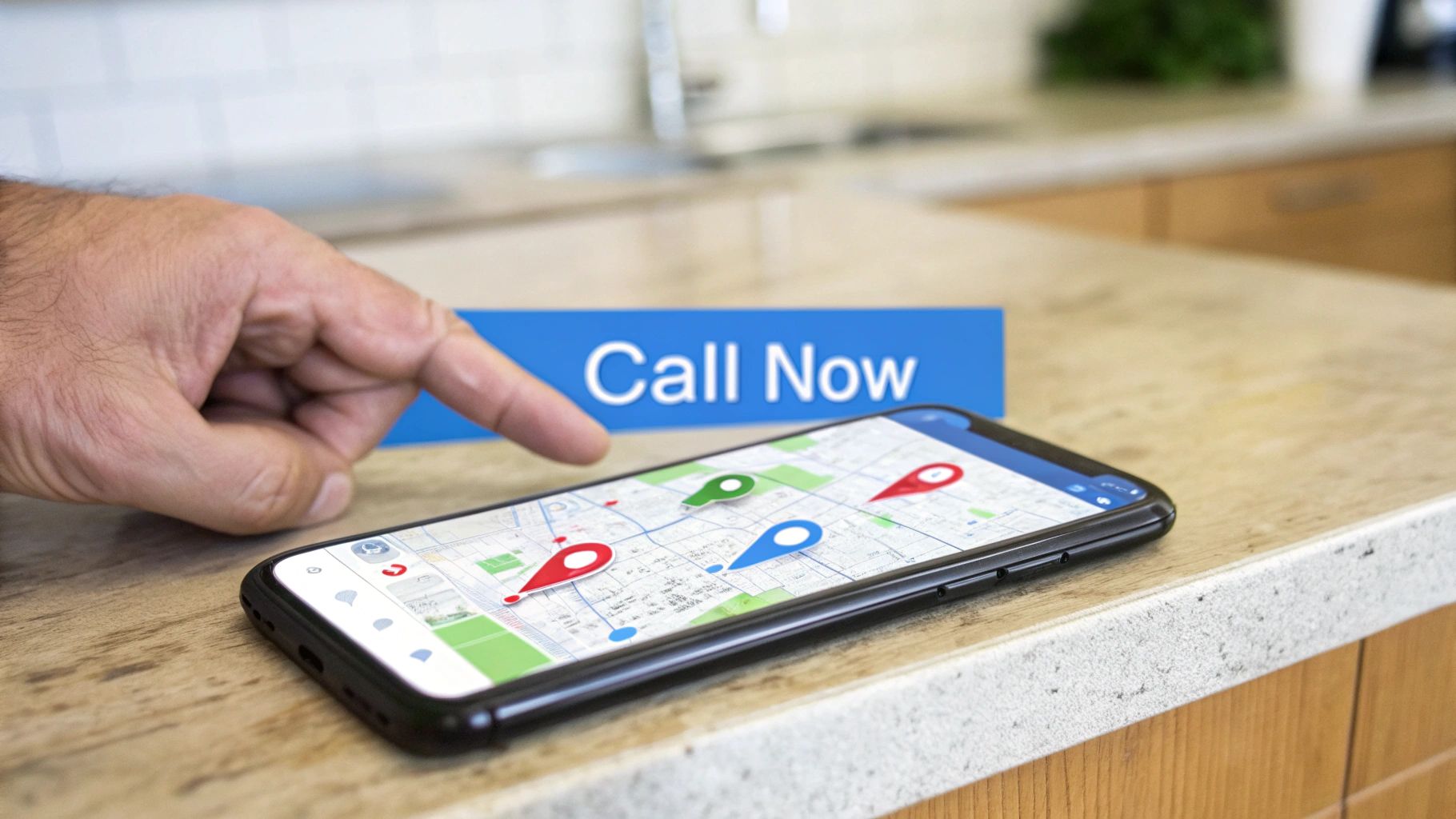
A huge piece of this puzzle is dominating the Google Maps results. When a customer is in a panic over pests, the first thing Google often shows them is the "Map Pack"—the top three local business listings featured prominently with a map. Transactional Marketing has the technology and proven system to get your business into this exclusive group.
Showing up here isn't just a vanity metric. It directly translates into hundreds more phone calls every month and literally thousands more every year, making you the obvious choice for customers in your city.
The real goal isn't just to rank. It's to become the undeniable first call for a customer who needs help right now. This requires a deep strategy that goes beyond just keywords and understands the psychology of a local, urgent search.
Building a Foundation for AI and Voice Search
Getting your local SEO right today is also about preparing for the future. More and more people are using AI assistants and voice search ("Hey Siri, find a good pest control company"). The new way businesses will be found is through AI optimization, which has a lot to do with how Large Language Models (LLMs) find and present information.
By optimizing for transactional local searches now, we are also positioning your business to be the top answer that LLMs and voice assistants will recommend tomorrow. This ensures you're visible not just in traditional search, but also in the AI-powered results that are becoming increasingly common.
For any local service business, a steady stream of high-quality leads is the key to growth. While the pest control industry has its own nuances, many core principles apply across home services, as detailed in this complete guide to getting moving leads. This intense focus ensures you're not just visible but seen as the most relevant and trusted option. To better understand the signals Google values most, you can explore the local search ranking factors that we build our campaigns around.
Optimize Your Google Business Profile To Dominate Local Search
Think of your Google Business Profile (GBP) as your digital storefront. For a pest control company, it's not just another online listing; it's the single most important tool you have for capturing customers who are ready to buy. When a frantic homeowner searches for a transactional search term like "termite inspection near me," their eyes jump straight to the Google Map Pack. You have to be there.
Your GBP is the absolute cornerstone of any serious local SEO for pest control strategy. It's often the first and only place potential customers look to find your phone number, read reviews, and get directions—many will never even click through to your website. A fully fleshed-out profile sends powerful signals to Google, confirming that you're a legitimate, active, and highly relevant business in your local area.
Getting this right is non-negotiable. It’s the very first move in our proven system to get a client's website showing up on page one of Google, typically within 30 to 60 days. The goal is to turn your GBP into a machine that funnels high-intent customers right to your phone.
Selecting Your Core Business Categories
The first step in dialing in your profile is choosing the right categories. It sounds basic, but getting this wrong can make you practically invisible to the people who need you most.
- Primary Category: Your primary choice should almost always be "Pest control service." This is the broad, powerful category that tells Google exactly what you do.
- Secondary Categories: Here's where you get specific. Add everything that applies, like "Termite control service," "Bed bug removal service," and "Rodent control service."
Think of these categories as powerful keywords for Google's local algorithm. They directly influence which transactional searches you show up for.
Crafting A Compelling Business Description
Your business description is prime real estate. It's your chance to tell both Google and potential customers who you are, what you solve, and where you do it. This isn't the place for vague marketing fluff.
You need a concise, keyword-rich summary that highlights your key services and the specific towns you work in. Weave in transactional phrases like "expert rodent removal" or "emergency bee extermination" alongside the names of the main cities you serve. This reinforces your local authority and makes your profile much more relevant for those critical "near me" searches.
A meticulously optimized GBP isn't just an online business card; it's an active lead generation engine. Every single field—from services to photos—is an opportunity to convince both Google and a customer in distress that you are the definitive local expert.
The impact of this focused effort can be massive. We've seen a U.S.-based pest control company that implemented these strategies achieve a 320% increase in local visibility in just three months. By zeroing in on their GBP and high-converting transactional keywords, they grew their profile interactions by 410% and boosted phone calls from organic search by an incredible 95%.
Using Visuals And Posts To Build Trust
Photos and GBP Posts are what bring your profile to life. They build trust in a way that text alone never can. Generic stock photos are a waste of time—customers want to see the real people and equipment they’re inviting into their homes.
- Geotagged Photos: Upload high-quality, geotagged images of your team on the job, your branded trucks, and your equipment in action. This is tangible proof of your local operations.
- GBP Posts: Use this feature like a mini-blog to share seasonal specials ("Summer Ant Control Discount"), offer helpful pest prevention tips, or announce service updates. Fresh posts signal to Google that your business is active and engaged.
Finally, you have to define your precise service areas within your profile. Don't just list the county. Get granular. List every single city, town, and zip code you cover. This is how you ensure your business shows up when someone searches "bed bug exterminator in [Your Target City]," connecting you directly with customers ready to solve their problem.
GBP Optimization Checklist For Pest Control Companies
To help you get started, here's a quick checklist that breaks down the most critical elements of your Google Business Profile and how to handle them for the best results.
| GBP Element | Optimization Tactic | Impact on Local Rank |
|---|---|---|
| Business Name | Ensure it's your exact, real-world business name. No keyword stuffing. | High |
| Primary Category | Set to "Pest control service" for maximum relevance. | High |
| Secondary Categories | Add specific services like "Termite control," "Rodent control," etc. | High |
| Service Area | List every city, town, and zip code you serve. Be specific. | High |
| Business Description | Write a keyword-rich summary of services and service areas. | Medium |
| Services Section | Detail every single pest service you offer with descriptions. | Medium |
| Photos & Videos | Upload high-quality, geotagged photos of your team and vehicles. | Medium |
| Customer Reviews | Actively solicit reviews and respond to every single one (good and bad). | High |
| GBP Posts | Publish weekly posts with updates, offers, or helpful tips. | Medium |
| Q&A Section | Proactively add and answer common customer questions. | Low |
Following this checklist is a surefire way to build a powerful foundation for your local SEO, ensuring you're seen by the right customers at the exact moment they need you.
Build a Website That Converts Clicks Into Calls
Getting your Google Business Profile to the top of the local pack is a huge win, but it’s only half the battle. Think of it as the magnet that pulls in local customers. Now, where do you send them? To turn those valuable clicks into actual, paying jobs, you need a website that’s a finely tuned conversion machine. Your site is the final handshake—it’s where a frantic customer’s urgent problem meets your immediate, professional solution.
Simply having a generic "Services" page just won't cut it anymore. If you want to truly own the local search results, you have to get granular. That means building out dedicated, information-packed pages for every single service you offer and for every city, town, and suburb you cover. This is a cornerstone of the Transactional Marketing system, our proven process that gets a customer's website showing up on page one of Google, typically within 30 to 60 days.

Creating Hyper-Local Service and City Pages
Put yourself in the customer's shoes. A homeowner in a specific suburb is frantically searching for a "termite inspection," or a restaurant manager needs "commercial rodent control" right now. A generic homepage doesn't speak to their immediate need nearly as effectively as a landing page titled "Expert Termite Inspections in Murrieta, CA" or "Commercial Rodent Control for Austin Businesses."
This strategy lets you zero in on the exact transactional search terms that customers with a credit card in hand are using. Each page becomes the perfect, highly relevant answer to a very specific question, right where their customers are.
- Service Pages: Build a unique page for each individual service—think ant control, bed bug removal, termite treatments, and so on. On each page, walk through your process, detail the specific pests you handle, and answer the frequently asked questions you get on the phone for that service.
- City Pages: You also need a dedicated page for every town or even neighborhood you serve. Talk about local landmarks, mention common pest problems specific to that area, and sprinkle in testimonials from clients who live right there.
This approach creates a powerful web of content that screams to Google that you are the authority across your entire service area. It ensures you don't just show up for "pest control near me," but for hundreds of more specific, high-intent searches that your competitors are missing.
On-Page SEO That Drives Action
Once you have this page structure in place, it’s time to optimize every single one to capture what we call transactional intent. This comes down to strategically using keywords and phrases that signal a user is past the research phase and is ready to hire someone.
Every page title, every header, and every sentence should be crafted with this singular goal in mind.
The anatomy of a perfect local service page isn't complicated. It combines a clear, transactional headline with location-specific details and a prominent call-to-action. This simple formula removes friction and guides a stressed-out customer directly to the solution they need—your phone number.
For instance, an H1 heading shouldn't just be "Bed Bug Services." A much more powerful, conversion-focused heading would be something like "Same-Day Bed Bug Exterminator in Murrieta, CA." It immediately hits on the user's problem (bed bugs), their location (Murrieta), and their urgency (same-day). This is how we get our customers to show up for the exact transactional search terms people are using.
The real-world impact of getting this right is massive. Take Cal Oaks Termite & Pest Control in Murrieta, California. After we did a full website rebuild focused on these service- and location-specific pages, they saw a 4x increase in organic traffic in just 90 days. Their total keyword rankings shot up from 50 to 221, and the site now locks down top-3 spots for multiple high-value transactional terms.
Content That Speaks to Local Problems
Your website content has to do more than just list what you do; it needs to connect with the local customer's specific anxieties. If your pest control company is in Arizona, your site had better talk about scorpions. If you're based in the Pacific Northwest, you need to be the expert on carpenter ants and moisture-related pests.
This kind of localized content shows you're a true local expert, and that builds immediate trust. When a potential customer lands on your site and reads about the exact pest problem they're having, described in the context of their own city, it's an instant confirmation that they’ve found the right company for the job. This is exactly how you turn a website visitor into a paying client. This attention to detail is what separates a basic website from a high-performance lead-generation machine.
Generate Reviews And Build Unshakeable Local Trust
In the pest control business, trust is everything. You're not just selling a spray; you're asking a customer to let a stranger into their home to deal with a problem that's often personal and stressful. This is exactly why a rock-solid online reputation isn't just a marketing "nice-to-have." It's the currency that drives your business and a massive factor in local SEO for pest control.
Put yourself in the customer's shoes. They search for a transactional term like "exterminator near me" and see two companies in the Google Map Pack. One has a handful of reviews. The other has fifty glowing, five-star ratings. Who do you think gets the call? It's a no-brainer. Those positive reviews are the most powerful form of social proof you have, and they directly influence who wins those high-intent, ready-to-buy customers.
We've seen it time and again: a proactive review generation strategy is non-negotiable if you want to dominate your local market. You can't just cross your fingers and hope happy customers leave feedback. You need a system that makes it ridiculously easy for them to share their positive experiences.
Turning Happy Customers Into Your Best Salespeople
The absolute best time to ask for a review is the moment you finish the job. The customer's relief and satisfaction are at their peak. Wait even a day, and the odds of them following through drop off a cliff. The most effective way to do this is to build automated requests right into your service workflow.
Here are a few simple but incredibly effective tactics we use:
- Automated SMS Requests: The second your tech marks a job as "complete," an automated text can fire off with a direct link to your Google Business Profile review page. This removes all the friction.
- Email Follow-Ups: A well-timed email can do the same job. You can even add a little value, like a quick pest prevention tip, alongside the review request.
- Leave-Behind Materials: Never underestimate old-school methods. A professionally designed postcard or door hanger with a QR code linking straight to your review page is a great physical reminder.
The goal here is consistency. You want a steady stream of fresh, positive reviews coming in. Google's algorithm loves to see recent and frequent feedback—it's a massive signal that your business is active, relevant, and keeping customers happy. This constant activity is a key ingredient for climbing into that coveted 3-Pack on Google Maps, which translates into hundreds more phone calls every month.
Why You Must Respond To Every Single Review
Getting reviews is only half the battle. The other, equally crucial part, is responding to every single one—the good, the bad, and the neutral. When you respond, you're showing potential customers (and Google) that you're an engaged, attentive business owner who genuinely cares about feedback.
For positive reviews, a simple and personal "Thank you, we really appreciate your business!" is perfect. For the inevitable negative review, the key is a professional, non-defensive response that offers to take the conversation offline to fix the problem. This can turn a public complaint into a powerful demonstration of your commitment to customer service.
Think of your online reviews as a public conversation about your business. By managing them actively, you're not just reacting—you're shaping the narrative and building a reputation that attracts the clients you want.
Building Authority Beyond the 5-Star Rating
While reviews are the star of the show, they're part of a much bigger picture of local trust signals. To really cement your status as the go-to expert in your area, you need a consistent and accurate footprint all across the web. This is where local citations and backlinks come into play.
- Local Citations: Your business name, address, and phone number (NAP) need to be identical everywhere they appear online. We're talking about major directories like Yelp and Angi, plus any local or industry-specific sites. Even small inconsistencies can confuse search engines and drag down your rankings.
- Local Backlinks: Getting links from other respected local businesses is SEO gold. A link from a local real estate agency's blog, a hardware store's "partners" page, or a community news site sends a powerful message to Google that you're a legitimate, trusted part of the local fabric.
When all these elements work in concert, they create an unshakeable foundation of local trust, making your pest control company the obvious and only choice for customers ready to pick up the phone.
Using Local Content and AI to Future-Proof Your Business
A top-ranking Google Business Profile and a solid website will definitely get the phone ringing today. But to truly own the pest control market in your area, you have to think about how customers will find you tomorrow. The way people look for services is changing, and you need to be ready for what's next in search.
This means looking past the obvious transactional search terms like "emergency rodent removal near me." The future of local search is all about becoming the definitive source of information for any and all pest-related questions your community might have. This is where creating hyper-local content, optimized for Artificial Intelligence, becomes your secret weapon. AI optimization is the new way businesses are going to be found.
Answering the Questions Your Customers Are Already Asking
Long before a customer is ready to hire an exterminator, they’re searching for information. They're typing questions into Google like, "When is termite season in Southern California?" or "What are the signs of a cockroach infestation?"
Crafting high-quality blog posts and articles that answer these specific, local questions is an incredibly powerful strategy. It accomplishes two critical things:
- It establishes you as the expert. When you provide genuinely helpful, authoritative answers, you build trust with potential customers before they even think about making a call. You become the go-to pro in their mind.
- It captures "top-of-funnel" searchers. By answering these informational questions, you get on a potential customer's radar at the very beginning of their journey. When their pest problem gets worse, you’ll be the first company they remember.
Think about it: a homeowner in your town reads your detailed article on how to identify termite swarmers in the spring. A month later, they see those exact swarmers near their window. Who are they going to call? You. That's how you build a pipeline of future customers.
Optimizing for the Next Generation of Search
Creating this kind of expert content isn't just about old-school SEO anymore. It's about structuring your information so that AI-driven search engines and voice assistants pick your answer to show users. The technology behind tools like ChatGPT and Google's AI Overviews, known as Large Language Models (LLMs), is completely changing how search results are delivered.
These AI systems are programmed to find the clearest, most authoritative, and best-structured information to provide direct answers. When someone asks their smart speaker, "Hey Google, how do I get rid of ants in my kitchen in Austin?" the AI scours the web for the best local resource that directly answers that exact question.
Your goal is to make your website the primary source of truth for all pest-related issues in your service area. When AI looks for a definitive local answer, your content should be the undeniable choice it presents to the user.
This is the essence of AI optimization. It means creating well-organized content with clear headings, direct answers, and plenty of location-specific details. You're no longer just optimizing for a keyword; you're optimizing to become the chosen answer for the next wave of search. To see how we put this into practice, check out our insights on AI search engine optimization.
This forward-thinking strategy ensures your pest control business does more than just show up on a list of blue links. It positions you to be the direct recommendation from the AI assistants that will increasingly guide people's decisions. By getting ready for this shift now, you're securing your lead flow for years to come.
Track Your SEO Performance And Measure Real ROI
Putting a solid local SEO strategy in place is a great first step, but how do you actually know it's working? The truth is in the data. You can't improve what you don't measure, and for a pest control business, that means looking past fluffy metrics like "impressions" and focusing on what hits your bottom line.
Let's be blunt: the only reason you're doing any of this is to get the phone ringing with paying customers. That’s why we zero in on the data points that lead directly to revenue—things like phone calls from your Google Business Profile, quote requests from your website, and direction requests from people who are ready to book. This is how you prove the real-world value of a sharp, focused SEO strategy.
Identifying Your Key Performance Indicators
To see if you're winning, you need to know the score. Instead of drowning in a sea of analytics, we laser-focus on the numbers that signal a direct handshake with a potential customer. These are the tell-tale signs that your local SEO efforts are paying off.
Here’s where we look:
- Google Business Profile Insights: This is ground zero for local customer interactions. We keep a close eye on phone calls started right from your profile, clicks through to your website, and requests for driving directions. When these numbers climb, it's a direct sign that your visibility in the Google Map Pack is generating real business.
- Google Search Console: This is where we see how you rank for the money-making transactional search terms in every city you cover. Watching your site climb the ranks for a term like “bed bug exterminator in Dallas” is concrete proof the strategy is hitting its mark.
- Google Analytics: This tool tells us what people do once they land on your website. We track how many visitors hit your key service and city pages, and more importantly, how many of them complete a "goal," like filling out your contact form or clicking to call.
This timeline gives you a good look at how a modern SEO strategy grows over time, starting with foundational blog content and moving toward optimization for AI-powered answers and voice search.
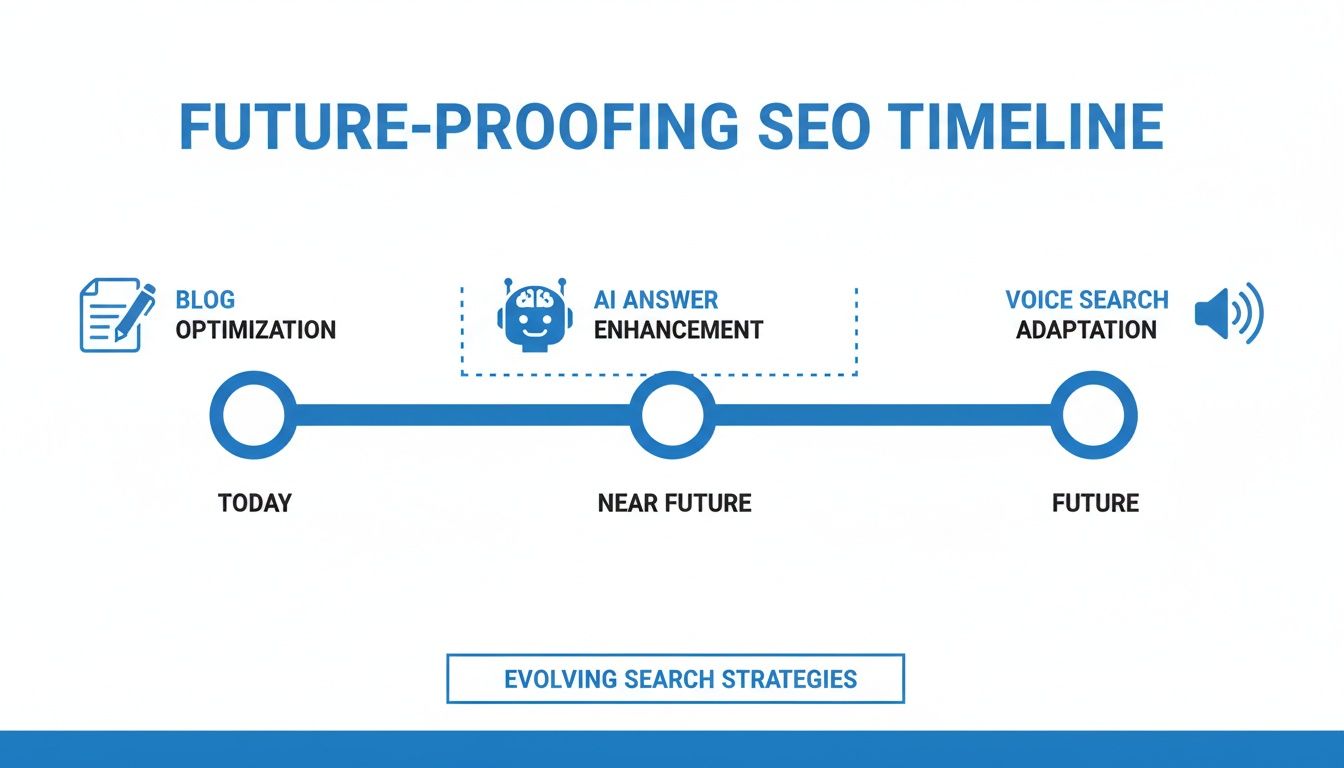
This shows just how important it is to build authoritative local content now so you're ready for whatever search technology comes next.
Calculating Your Return On Investment
At the end of the day, every marketing dollar has to pull its weight. Measuring your Return on Investment (ROI) is how you connect all this SEO activity to actual revenue growth. The formula itself is simple, but the clarity it provides is game-changing.
The concept is straightforward: If you put $1,000 into SEO and it generates $5,000 in new profit, your ROI is 400%. This is the ultimate measure of success. It proves that your marketing isn't just another expense—it's a profitable investment.
To really get a handle on what your SEO is doing for you, you need to learn how to calculate marketing return on investment properly. By figuring out what a lead is worth—based on your average job value and your closing rate—you can turn clicks and calls into a hard dollar amount. This calculation cuts through the noise and shows the direct financial benefit of ranking for those high-intent, transactional search terms.