


For a local service business, whether you're a roofer or a dentist, marketing has one job: to get paying customers. Forget clicks and impressions. Real marketing success is about capturing searches from people who are ready to hire you and turning them into actual business.
This guide shows you exactly how to measure marketing effectiveness by focusing on what truly matters: attracting customers with transactional intent.
Our Modern Playbook for Measuring Local Marketing Impact
I've seen it a hundred times: a marketing agency burns through a client's budget and then hides behind vague metrics like website traffic when the leadership team asks for results. This isn't just frustrating; it’s a liability that puts your entire marketing investment at risk.
At Transactional Marketing, our entire approach is built on delivering tangible proof. For a local service business, success isn't about fuzzy brand awareness. It's about making the phone ring with customers who have their wallets out, searching for "emergency roofer near me" or "dentist open today."
These are what we call transactional search terms, and they're the lifeblood of your business. This is why our company is named Transactional Marketing—we get our customers to show up for these high-intent searches.
This is precisely where most marketing measurement falls flat for local businesses. It gets bogged down in vanity metrics instead of what drives revenue: capturing high-intent local customers at their exact moment of need. Our proven system is designed to draw a straight line from our local SEO and Google Maps optimization efforts to more booked jobs and new patients for you. We don't just report on rankings; we prove the connection to your bottom line.
Focusing on Quality Over Quantity
The game has changed. Measuring marketing is no longer about chasing the highest volume of leads but attracting the right ones. This is especially true in local services, where a single, high-quality customer searching a transactional term like "air conditioning repair near me" is worth a hundred casual website visitors.
The industry is catching on. When gauging marketing effectiveness, lead quality and Marketing Qualified Leads (MQLs) are now the #1 metric for 40% of marketers, even beating out ROI at 31%, according to HubSpot's State of Marketing Report. For a pest control company or a chiropractor, an MQL isn't a random click—it’s a clear buying signal from someone actively looking for your services.
The infographic below shows how we turn search visibility into tangible results, step by step.
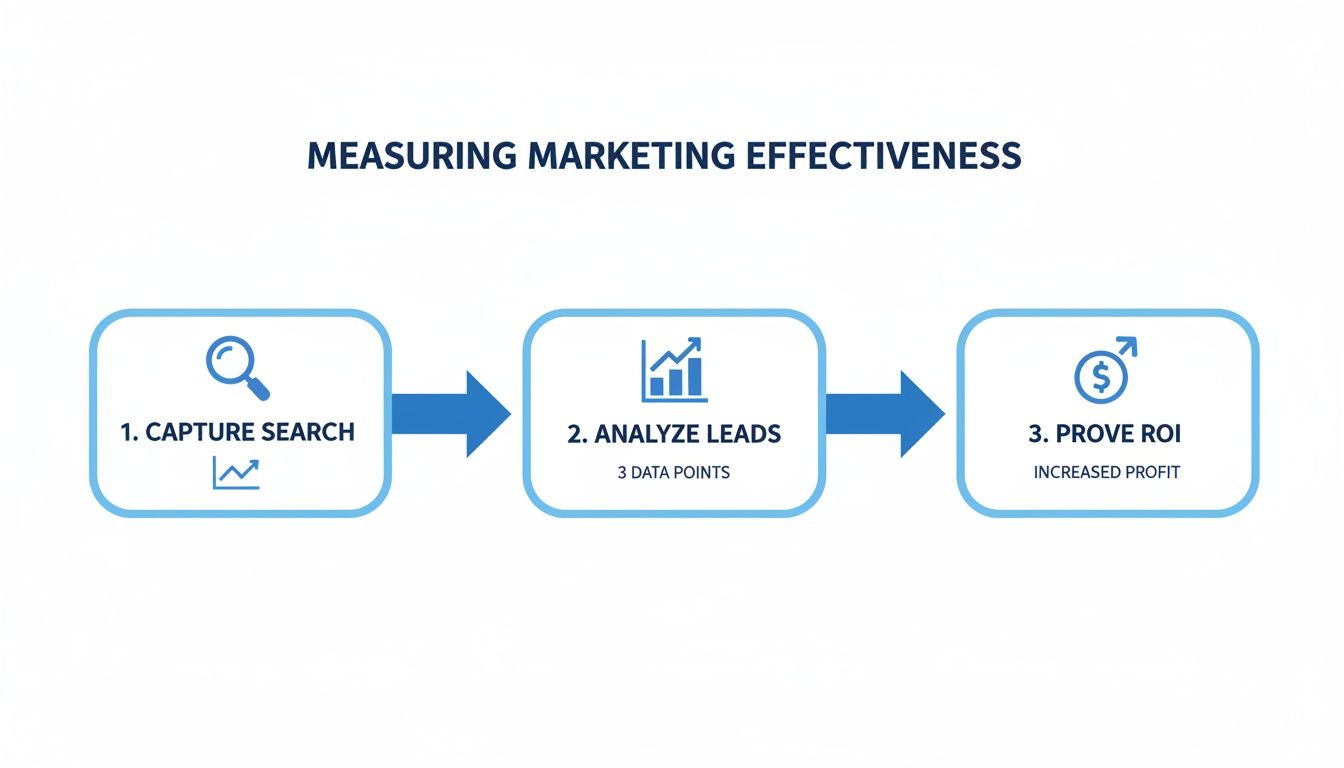
It’s a clear path from capturing a customer's transactional search, to analyzing the lead's quality, and finally, proving a direct return on your investment.
To do this effectively, you need to track the right data points. The table below breaks down the key metrics we focus on to measure what really matters for local businesses.
Key Metrics for Transactional Marketing Effectiveness
| Metric Category | What It Measures | Why It Matters for Local Services |
|---|---|---|
| Search Visibility | Your ranking in Google Maps and local search for transactional keywords. | If customers can't find you when searching terms like "roofer near me," you don't exist. This is the top of the funnel. |
| Lead Generation | The number of phone calls, form fills, and GMB clicks you receive. | This measures how well your online presence converts ready-to-buy searchers into potential customers. |
| Lead Quality | The percentage of leads that are relevant, in your service area, and ready to buy. | Weeds out tire-kickers and focuses on the prospects most likely to become paying customers. |
| Conversion Rate | The percentage of qualified leads that become booked jobs or new patients. | This is the ultimate test of your sales process and the quality of leads your marketing generates. |
| Customer Acquisition Cost (CAC) | The total marketing spend divided by the number of new customers acquired. | Tells you exactly how much it costs to acquire a new customer with money in hand, which is critical for profitability. |
| Return on Investment (ROI) | The revenue generated from marketing efforts minus the cost of those efforts. | The final word on whether your marketing is a worthwhile investment that grows your business. |
Tracking these metrics gives you a complete picture, from initial transactional search to final sale, ensuring every marketing dollar is accounted for.
A Framework Built for Transactional Success
Our playbook is a proven system for generating and measuring results. We accomplish this by concentrating on a few critical areas that many agencies neglect:
- Google Maps Optimization: Dominating the Google Maps 3-pack is non-negotiable. It's the most valuable digital real estate for local businesses, and Transactional Marketing has the technology to turn these map locations and ensure you show up in the top three. This translates into hundreds of more phone calls every month.
- Transactional Keyword Targeting: We find the exact phrases customers use when they're ready to buy—like "dentist near me" or "air conditioning repair near me"—and get you ranked for them. This laser focus ensures your marketing budget attracts buyers, not just browsers.
- AI Optimization: We use AI to anticipate how customers will search for businesses in new AI-driven environments, including those powered by LLMs. This keeps you one step ahead of your competition.
- Rapid Ranking System: Transactional Marketing has a proven system that literally gets our customer's website showing up on page one of Google, typically within 30 to 60 days, for the specific transactional search terms that drive business in your local city.
By weaving these elements together, we create a transparent, high-performance marketing engine. You’ll see exactly how our strategies convert local searches into measurable growth. For a closer look at how we package these results, check out our guide to effective client SEO reporting.
Identifying the KPIs That Actually Drive Revenue

If you're going to measure your marketing, you have to stop drowning in a sea of data. Analytics dashboards can throw hundreds of metrics at you, but for a local service business, only a handful of Key Performance Indicators (KPIs) truly signal success. The rest is just noise, distracting you from what actually moves the needle.
Forget vanity metrics like raw impressions or total website traffic. A plumber in Dallas doesn't pay the bills with page views; they pay them with booked service calls. Here at Transactional Marketing, we cut through the fluff and focus on tangible outcomes that connect directly to your bottom line. That means measuring the specific actions that prove your marketing is attracting ready-to-buy customers using transactional search terms.
Focusing on Transactional Intent Metrics
Your primary KPIs should tell you one thing: are you capturing customers at their moment of need? This requires a mental shift from tracking general online activity to monitoring high-intent conversions. We build our entire measurement strategy around these critical data points.
For instance, a dental practice shouldn’t get bogged down tracking "website traffic." A far more powerful KPI is "new patient appointments booked from a transactional search." This ties the marketing effort directly to revenue. An HVAC company needs to know exactly how many searches for "air conditioning repair near me" led to a scheduled service call.
Key Takeaway: The most effective KPIs for a local service business aren't about activity; they're about transactional outcomes. You need to measure what you can take to the bank—phone calls, form submissions, and booked jobs that come from customers with money in hand, ready to spend.
We build our clients' strategies around a core set of KPIs that prove our system works. These aren't just numbers on a report; they're the vital signs of a healthy, growing service business.
Your Core Revenue-Driving KPIs
To properly measure marketing effectiveness, you have to prioritize these essential metrics above all others.
Rankings for Transactional Keywords: This is your best leading indicator. Where do you show up when a potential customer searches for "roofer in [Your City]"? We track your position for these money-making terms because being visible here is the absolute first step to getting a call. At Transactional Marketing, these are the exact terms we get our customers to show up for.
Google Maps 3-Pack Position: For local businesses, being in the top three on Google Maps for your main services is non-negotiable. This is the most valuable digital real estate you can own. Transactional Marketing has the technology to make sure you show up in the top three in your service areas, which directly translates into hundreds of more phone calls every month and literally thousands of more phone calls every year.
Inbound Phone Calls from Search & GMB: This is the ultimate proof of performance. By using dedicated call tracking, we can pinpoint exactly how many calls come from your organic search rankings and your Google Business Profile. There's no guesswork involved.
Qualified Form Submissions: If your business relies on contact forms for quotes or appointment requests, tracking the number of qualified submissions is crucial. We measure not just the quantity but the quality of these leads to ensure they're coming from genuine, transactional searches.
By obsessively tracking these specific KPIs, we draw a clear and direct line from our marketing activities—like getting your website to page one of Google in 30 to 60 days—to a real increase in your revenue. It's a proven, focused approach designed for one purpose: getting your phone to ring with customers who have money in hand, ready to spend. That’s the core of what we do at Transactional Marketing.
Building Your Essential Measurement Toolkit
You can't prove your marketing is working if you don't have the right way to measure it. The good news is, you don't need a massive, expensive collection of software to get the job done. For most local service businesses, a handful of powerful—and often free—tools can give you all the proof you need.
The real goal here is to stop chasing fragmented data. When your website analytics are in one place, your keyword data is somewhere else, and your call logs are in a totally separate system, you’re left with an incomplete picture. It makes proving ROI next to impossible. A smart, integrated toolkit brings it all together, letting you trace the complete path from a customer’s first transactional search to their final phone call.
The Foundation: Google's Power Trio
For any business that takes local search seriously, Google itself provides the foundational tools you absolutely need. These three platforms are designed to work together, giving you a 360-degree view of how customers are actually finding and engaging with you online.
Google Analytics 4 (GA4): Think of this as the central hub for everything happening on your website. GA4 shows you how people get there, what pages they look at, and—most importantly—what actions they take. You can set up conversion events to track every single form submission, giving you a direct line of sight into how your site generates leads from transactional searches.
Google Search Console (GSC): This is your direct connection to Google's search results. GSC reveals the transactional search terms people use to find you, your average ranking for those terms, and how many people are clicking through to your site. It’s where you validate that your SEO and AI optimization work is actually capturing the high-intent searches you’re aiming for.
Google Business Profile (GMB) Insights: For a local service business, this is the most critical tool of the bunch. GMB Insights shows exactly how customers interact with you on Google Search and Maps. It counts how many people called you using the "call" button, asked for directions, or clicked to your website straight from your profile. This is the ultimate proof that your Google Maps optimization is driving direct, measurable business from customers ready to spend.
By using these three tools in concert, you can finally connect the dots between your keyword rankings (GSC), your visibility on the map (GMB Insights), and the actual leads coming through your website (GA4).
The Non-Negotiable: Call Tracking Software
Let me be blunt: if you're not using call tracking software, you cannot accurately measure your marketing. For service businesses like plumbers, electricians, or roofers, a huge portion of your best leads come from phone calls—especially from urgent, transactional searches like "emergency plumber near me."
Without call tracking, you’re just guessing. You have no real way of knowing if a call came from your GMB listing, an organic search, a paid ad, or even that postcard you sent out last month.
Key Takeaway: Call tracking is the missing link that ties phone call leads back to their specific marketing source. It’s how Transactional Marketing proves to clients that our Google Maps optimization technology is directly responsible for generating hundreds of more phone calls every month.
Modern call tracking platforms work by assigning a unique, trackable phone number to each of your marketing channels. When a potential customer calls the number shown on your Google Business Profile, the software logs it as a GMB-sourced lead. It’s undeniable proof of what’s making your phone ring.
The Unified View: Your Results Dashboard
Having the right tools is one thing, but bringing all that data together into a clear, easy-to-understand format is another challenge entirely. Constantly jumping between GA4, GSC, and your call tracking platform is a huge time-waster and makes it tough to see the big picture. This is where a proper results dashboard becomes essential.
At Transactional Marketing, every client gets a unified dashboard that consolidates all these critical data streams into one place. It’s not just a boring report; it’s a real-time command center for your marketing. It visually connects our activity to your bottom-line results.
Our dashboards are built to show you what matters:
- Keyword Ranking Timelines: Watch how your rankings for critical transactional terms improve over time in your specific service cities.
- Map Ranking Heat Maps: See your GMB visibility across your entire service area on a map, showing exactly where you’re dominating the local search results.
- Lead Source Attribution: Get a crystal-clear breakdown of every call and form fill, showing whether it came from a transactional search, Google Maps, or another channel.
- GMB Performance Data: All your key GMB Insights—clicks-to-call, direction requests, website visits—are pulled in automatically for easy viewing.
This integrated view eliminates all the guesswork. It provides the concrete evidence needed to show how our proven system, which gets businesses ranking on page one in 30 to 60 days, directly translates into more customers with money in hand. To dive deeper into the platforms that can power your own reporting, check out our guide to local SEO reporting tools.
Using AI to Finally See What's Really Working in Your Marketing
When a new customer calls, how do you know which marketing dollar actually brought them to you? For far too long, we’ve been stuck with a broken system called "last-click attribution." It's like giving all the credit for a project's success to the person who sent the final email, completely ignoring all the hard work that came before.
This old way of thinking is particularly damaging for local service businesses. A homeowner might find your roofing company on the Google Maps pack, check your website a day later, and then call you. The old model only credits the last touchpoint, missing how crucial your Maps visibility was.
But here’s the good news. AI optimization, a core service at Transactional Marketing, is finally giving us a clear, honest picture of how marketing efforts work together. It's making it possible to see exactly what’s effective with startling precision, especially as search evolves with Large Language Models (LLMs).
How AI Unlocks the Full Customer Story
AI-powered tools can sift through massive, complicated sets of data that are simply too much for any person to analyze. This is the engine behind Marketing Mix Modeling (MMM), a statistical method that shows how everything—from your local SEO and Google Maps rankings to paid ads—contributes to your bottom line.
And it’s catching on fast. A recent survey from Snap and EMARKETER revealed that a massive 61.4% of marketers are now focused on using MMM to get better, faster insights.
For a local business owner, this is a game-changer. It means AI can look at your data and confirm that while the final phone call came from a direct click, it was your strong, consistent presence on Google Maps for transactional terms that built the trust to close the deal. AI often shows that your Maps visibility is the unsung hero driving those high-value phone calls.
Key Insight: AI attribution gets you past the last click and shows you the entire chain of events that led to a paying customer. This proves the immense value of top-of-funnel work, like earning high visibility on Google Maps, which is crucial for grabbing the attention of customers with strong transactional intent.
Putting It All into Practice
It's one thing to understand the theory, but what does this look like in the real world? AI optimization helps turn the customer journey into a story you can actually measure and act on, ensuring you are found in new AI-powered search results.
Instead of a simple list of leads, you see the narrative behind each one:
- First Contact: A customer searches "plumbers in [city]" and sees your business in the Google Maps 3-pack.
- Second Look: Hours later, they search your company name and spend time on your website’s service pages.
- Final Action: The next day, they hit the "call" button on your GMB profile to book an appointment.
An AI model can assign fair credit to each of these touchpoints, giving you a complete view of what’s driving business. This is absolutely critical for businesses that count on us at Transactional Marketing to get their websites on page one of Google within 30 to 60 days. It proves that those early ranking wins directly fuel the entire sales pipeline. For marketers wanting to integrate this level of data, tools like an AI Search Tracking API can deliver powerful performance insights.
With this deeper understanding, you can put your budget where it will have the most impact. It also sets you up for the next wave of search, where AI optimization will be essential. If you’re ready to get ahead of the curve, you should check out our guide on AI search engine optimization.
Figuring Out Your True ROI to Fuel Real Growth
Let's cut to the chase. Marketing isn't about getting likes or racking up impressions. It’s a straightforward business function: you put money in, and you expect to get more money out. This is where we stop talking about fuzzy metrics and start calculating your real Return on Investment (ROI) and Customer Lifetime Value (LTV).
These are the two numbers that tell you if your marketing is actually working. When you can confidently walk into a meeting and say, "Every dollar we spent on SEO last month brought us ten dollars in profit," you've cracked the code. This clarity is exactly what we aim for at Transactional Marketing—proving how our focus on transactional search terms directly fattens your wallet.
Calculating Your Marketing ROI
Don't let the term "ROI" intimidate you; the math is simpler than you think. For a local service business, it boils down to one question: did the profit from the customers marketing brought in exceed what you spent on that marketing?
First, you'll need to add up all your marketing costs over a set period, like a month. This isn't just your ad budget. Be sure to include agency fees, software subscriptions, and any other odds and ends you paid for to support your marketing.
Then, you look at the revenue from the new customers you acquired through those specific channels. This is why attribution is so important. When you know a customer found you by searching "roofer near me", you can tie their payment directly back to your SEO efforts.
ROI Formula: ((Net Profit from Marketing – Total Marketing Cost) / Total Marketing Cost) x 100
Imagine your dental practice spends $5,000 on marketing in one month. That investment brings in 10 new high-value patients, generating $20,000 in net profit. Your ROI is a massive 300%. This isn't just a nice number; it's concrete proof that targeting high-intent customers with money in hand works.
Looking Beyond the First Sale with Customer Lifetime Value
While ROI shows a snapshot in time, Customer Lifetime Value (LTV) plays the long game. It calculates the total profit you can expect from a single customer over the entire time they do business with you. Understanding this is absolutely critical for making smart budget decisions.
LTV helps you answer the ultimate question: How much can I afford to spend to get a new customer?
A one-time plumbing repair might bring in $400, which is great. But what if that same homeowner calls you for maintenance twice a year for the next five years? Suddenly, that one customer is worth thousands. Their LTV justifies a much higher initial investment.
Here's a simple way to get a baseline LTV:
- Average Sale Value: What does a customer spend on average each time they call you?
- Purchase Frequency: How many times a year does a typical customer use your service?
- Customer Lifespan: On average, how many years do customers stick with you?
LTV = (Average Sale Value) x (Purchase Frequency) x (Customer Lifespan)
Knowing this number gives you the confidence to invest in marketing that delivers long-term value. A strategy that gets you on page one in 30-60 days isn't just about a quick win; it's about acquiring a steady stream of high-LTV customers who will become the bedrock of your business for years to come. For a deeper look at this, our guide on how to reduce customer acquisition cost is a great next step.
Ultimately, your goal is to make every marketing dollar work as hard as possible. Small improvements can have a huge effect on your bottom line. For example, learning how to increase website conversion rate means you get more booked jobs from the same amount of traffic, instantly boosting your ROI.
Frequently Asked Questions

When we talk about measuring marketing, a lot of the same questions come up. It's understandable. You want to know how this all translates into a predictable source of revenue for your local service business. Let’s tackle some of the most common ones I hear from clients.
How Quickly Can I Expect to See Results?
This is the big one, and the answer is often faster than you think. With a focused strategy, leading indicators can change surprisingly quickly. Our system at Transactional Marketing, for example, is a proven process that literally gets clients' websites showing up on page one of Google for their target transactional search terms within 30 to 60 days.
Right away, you'll see a measurable lift in visibility, search impressions, and Google Business Profile activity. The real money-makers—a significant rise in phone calls from customers with money in hand—tend to follow as your Google Maps and organic rankings climb and solidify over the first few months. The trick is to have the right tracking in place from day one to connect those new customer calls directly to the work being done.
What's the One Metric That Matters Most for a Service Business?
If I had to pick just one, it would be your Cost Per Acquired Customer, specifically from a transactional search. Things like website traffic and keyword rankings are important, but they are leading indicators—they don't pay the bills.
You absolutely need to know how many marketing dollars it costs to land a paying customer who searched for something like "plumber in Dallas" or "emergency dentist near me." This single number tells the whole story. It’s the ultimate measure of marketing health because it ties everything back to pure profitability and proves you are attracting customers ready to spend.
Key Insight: When you know what it costs to get a customer from a high-intent, transactional search, you can invest confidently in the channels that actually work. This is the foundation of building a scalable, predictable growth engine for your business.
Why Is There So Much Focus on Google Maps?
Because for any local service business, the Google Maps "3-pack" is the most valuable piece of digital real estate, period. It’s the first place a customer with high transactional intent looks when they need a problem solved now. A person searching "roofer near me" has money in hand, and they are ready to spend it.
Showing up in that top-three section isn't just a vanity metric; it translates directly into hundreds of more phone calls every month. Transactional Marketing has the technology to make sure you show up in the top three in your service areas. Trying to measure your marketing effectiveness while ignoring your Maps performance is a huge mistake.
By tracking your Google Business Profile Insights, especially clicks-to-call, you can measure the massive impact of dominating the map in your service area. This is a core part of how we prove our value and show you a real return.
How Does AI Fit Into Measuring Marketing?
AI optimization is rapidly becoming the new standard for how businesses get found online, especially as conversational search and LLMs take hold. For measuring effectiveness, AI helps in two critical ways.
First, an AI-powered content strategy can analyze huge amounts of data to pinpoint the exact transactional search terms your customers are using in both traditional search and AI-powered engines. It uncovers opportunities your competitors have completely missed, ensuring your content doesn't just rank, but actually converts ready-to-buy customers.
Second, AI tools are brilliant at analyzing performance data at scale. They can spot complex patterns and attribution paths that would take a human analyst weeks to find. This allows for constant, intelligent adjustments to your strategy, making sure your budget is always flowing to the most effective tactics for attracting transactional customers. It's the difference between guessing and knowing.
Ready to stop guessing and start measuring what truly matters? At Transactional Marketing, we build marketing systems that deliver tangible results you can see and measure. Our laser focus on transactional keywords and Google Maps dominance means more customers, more calls, and a clear return on your investment. Contact us today to see how our proven system can work for your business.